Radiation effects and noise evolution in NewAthena WFI flight-production sensors
Pith reviewed 2026-06-30 03:50 UTC · model grok-4.3
The pith
Flight-production DEPFET sensors show increased readout noise and dark current after proton irradiation matching NewAthena mission dose.
A machine-rendered reading of the paper's core claim, the machinery that carries it, and where it could break.
Core claim
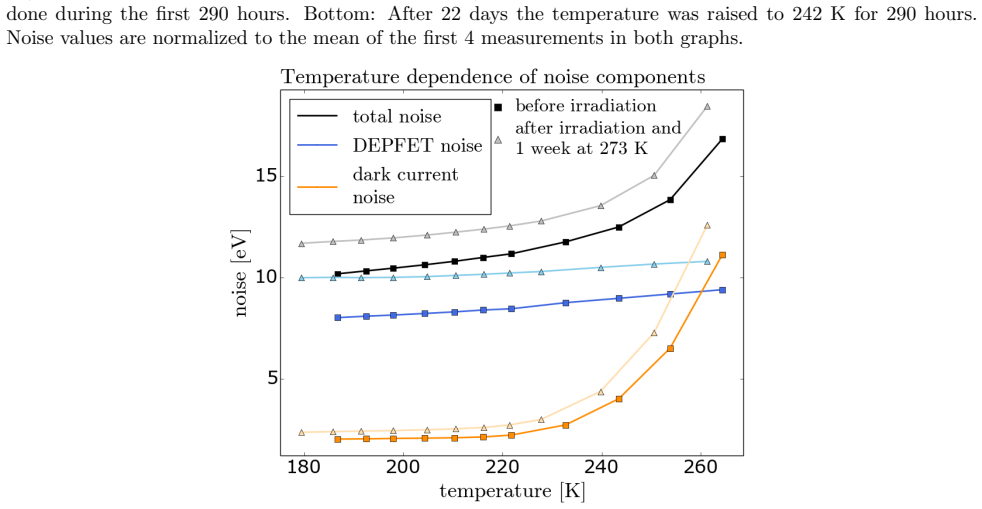
After proton irradiation of a flight-production DEPFET sensor to a total dose equivalent to 2.6 · 10^9 10-MeV-protons/cm² and separate 15 Gy TID exposure, both performed while the device remained fully biased and operated at the nominal 213 K, measurable increases occurred in readout noise, dark current, and threshold voltage; temperature dependence and short-term annealing were also quantified, with direct comparison to prior pre-flight sensor results informing adjustments to operating temperature and projections of end-of-life performance.
What carries the argument
Post-irradiation measurements of readout noise, dark current, and threshold voltage performed on biased and operating flight-production DEPFET modules at controlled temperature.
If this is right
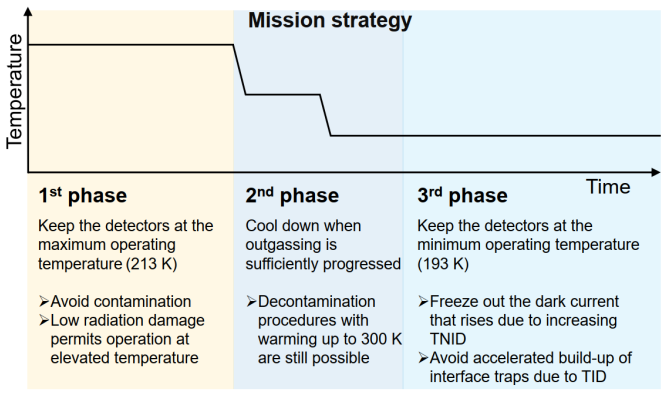
- A lower operating temperature than 213 K may be required to offset the rise in dark current and keep readout noise near the beginning-of-life target.
- End-of-life energy resolution could degrade unless temperature is adjusted to compensate for the observed radiation effects.
- Short-term annealing behavior at low temperature provides data on whether noise recovers between periods of high particle flux.
- Consistency between flight-production and pre-flight sensor responses under irradiation supports use of the same performance margins for the full focal plane.
Where Pith is reading between the lines
- The same irradiation protocol could be repeated on larger sensor arrays to check whether module-level effects scale to the full focal plane.
- If the actual space radiation spectrum produces different damage than the 62.4 MeV protons, mission temperature settings might need further revision.
- These temperature-dependent noise data could help model performance for other DEPFET-based instruments on future X-ray missions.
Load-bearing premise
The 62.4 MeV proton irradiation to a total dose equivalent to 2.6 · 10^9 10-MeV-protons/cm² accurately represents the cumulative total non-ionizing dose the sensors will experience over the NewAthena mission lifetime.
What would settle it
A direct measurement of readout noise and dark current on sensors after the actual NewAthena mission lifetime in orbit that differs substantially from the laboratory proton-irradiation results would show the dose equivalence does not hold.
Figures
read the original abstract
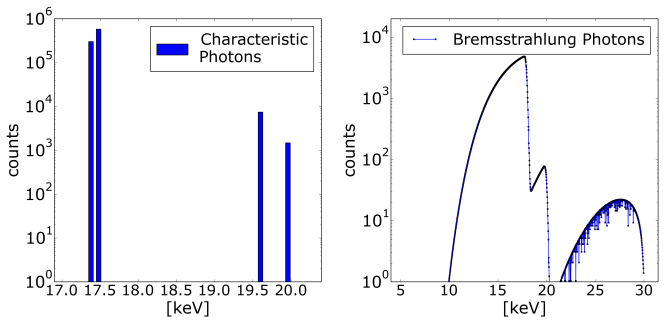
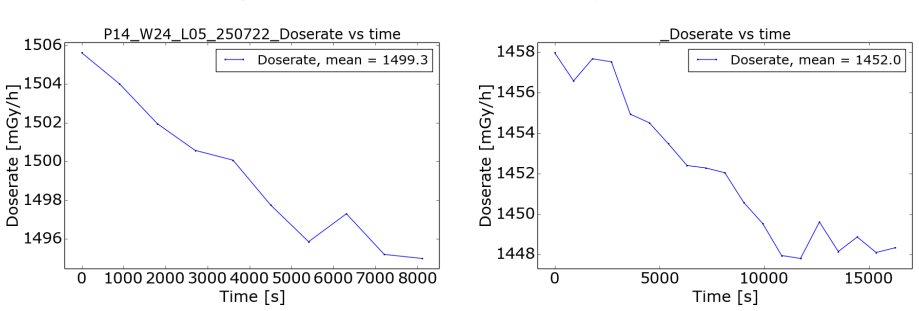
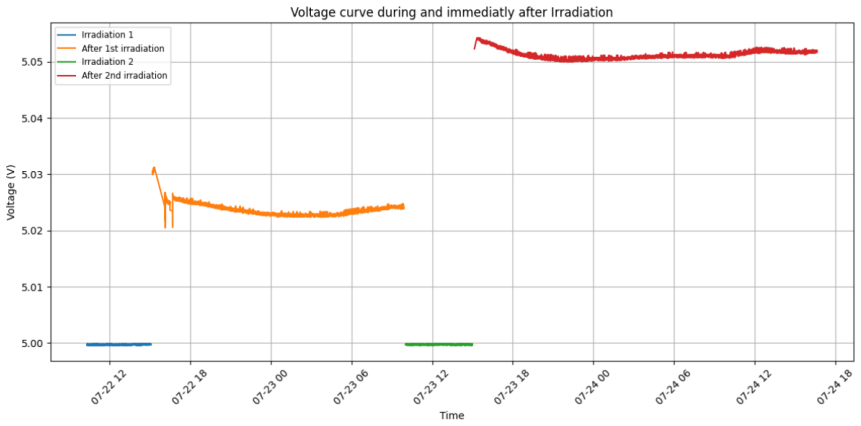
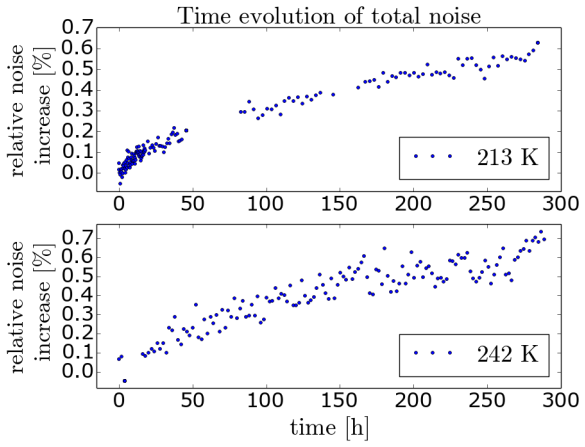
The Wide Field Imager (WFI), one of the two instruments on ESA's next large X-ray observatory NewAthena, is designed for imaging spectroscopy in the 0.2-15 keV range, combining a large field of view with high count-rate capability. Its focal plane is equipped with back-illuminated DEPFET (Depleted p-channel field-effect transistor) sensors that offer high radiation tolerance and provide near Fano-limited energy resolution. Achieving this performance requires an exceptionally low readout noise, with about 3 electrons ENC expected at beginning of life. Consequently, the devices are highly sensitive to radiation-induced changes in noise behavior. In this work, we investigate the impact of both total non-ionizing dose (TNID) and total ionizing dose (TID) on the relevant noise components, including their temperature dependence. A detector module containing a 64x64-pixel sensor from a flight-production wafer was irradiated with 62.4 MeV protons at the MedAustron accelerator facility in Wiener Neustadt to a total dose equivalent to 2.6 $\cdot$ 10$^9$ 10-MeV-protons/cm$^2$. The detector was fully biased and operated throughout the irradiation and subsequent measurements, maintaining the nominal operating temperature of 213 K. To study short-term annealing behavior at low temperature, a second, identical module was exposed to a comparable proton dose within a much shorter timescale by exploiting the available high beam flux. TID effects were investigated separately by irradiating another device with 17.4 keV Mo-K_alpha X-rays to a total dose of 15 Gy. We report the resulting changes in readout noise, dark current, and threshold voltage, and compare them with results from an earlier irradiation campaign using pre-flight sensors. Implications for the instrument's required operating temperature and its expected end-of-life performance are discussed.
Editorial analysis
A structured set of objections, weighed in public.
Referee Report
Summary. The manuscript reports experimental measurements of radiation effects on a flight-production 64x64-pixel DEPFET sensor for the NewAthena WFI. A detector module was irradiated with 62.4 MeV protons to a total dose equivalent to 2.6 · 10^9 10-MeV-protons/cm² while fully biased at 213 K; a second module received a comparable dose on a shorter timescale; and a third device was exposed to 15 Gy TID using 17.4 keV X-rays. Changes in readout noise, dark current, and threshold voltage are quantified and compared to an earlier pre-flight sensor campaign, with discussion of implications for the instrument's required operating temperature and end-of-life performance.
Significance. If the reported changes and their temperature dependence hold, the work supplies directly relevant data on radiation tolerance of flight-grade sensors, supporting refinement of the WFI operating temperature and EOL noise budget for NewAthena. The use of flight-production wafers and in-situ biasing during irradiation adds applicability to actual mission hardware.
major comments (2)
- [Abstract / irradiation description paragraph] Abstract, irradiation description paragraph: The central claim that the 62.4 MeV proton irradiation is 'equivalent to 2.6 · 10^9 10-MeV-protons/cm²' and the subsequent EOL performance implications rest on NIEL scaling, yet the manuscript provides no explicit scaling factor, reference to the NewAthena radiation environment model, or uncertainty estimate on the equivalence; this weakens the mapping from lab deltas to flight predictions.
- [Results / discussion section (implied by abstract)] Comparison to earlier campaign: The discussion of differences versus the pre-flight sensor results inherits the same unquantified NIEL-scaling assumption; without a dedicated section addressing possible differences in sensor processing, beam spectrum, or annealing conditions, the claimed consistency or divergence cannot be evaluated for robustness.
Simulated Author's Rebuttal
We thank the referee for the careful and constructive review. The two major comments identify areas where additional detail on NIEL scaling and comparative analysis will improve clarity and traceability. We address each point below and will incorporate the requested information in the revised manuscript.
read point-by-point responses
-
Referee: [Abstract / irradiation description paragraph] Abstract, irradiation description paragraph: The central claim that the 62.4 MeV proton irradiation is 'equivalent to 2.6 · 10^9 10-MeV-protons/cm²' and the subsequent EOL performance implications rest on NIEL scaling, yet the manuscript provides no explicit scaling factor, reference to the NewAthena radiation environment model, or uncertainty estimate on the equivalence; this weakens the mapping from lab deltas to flight predictions.
Authors: We agree that the equivalence statement would benefit from explicit supporting information. In the revised manuscript we will add the NIEL scaling factor applied (derived from the standard 10 MeV proton equivalent fluence for the NewAthena radiation environment), the reference to the mission radiation model used to define the target fluence, and a brief uncertainty estimate based on beam-energy dependence and model assumptions. These additions will be placed in both the abstract and the irradiation-methods paragraph. revision: yes
-
Referee: [Results / discussion section (implied by abstract)] Comparison to earlier campaign: The discussion of differences versus the pre-flight sensor results inherits the same unquantified NIEL-scaling assumption; without a dedicated section addressing possible differences in sensor processing, beam spectrum, or annealing conditions, the claimed consistency or divergence cannot be evaluated for robustness.
Authors: We accept that a more structured comparison is required. The revised manuscript will contain a new dedicated subsection that explicitly discusses (i) differences in wafer processing between the pre-flight and flight-production sensors, (ii) the proton beam spectra employed in each campaign, and (iii) the annealing timelines and temperatures. This will allow readers to assess the robustness of the reported consistencies or divergences independently of the NIEL scaling details. revision: yes
Circularity Check
No circularity: direct experimental measurements of radiation effects
full rationale
The paper consists of laboratory irradiation of DEPFET sensors with protons and X-rays followed by direct measurements of readout noise, dark current, and threshold voltage shifts. No derivations, first-principles predictions, or fitted parameters are presented that reduce to the inputs by construction. The dose equivalence statement is an experimental design assumption about NIEL scaling, not a self-referential derivation. Comparison to prior campaign data is external benchmarking, not a load-bearing self-citation chain. The work is self-contained against external benchmarks and receives the default non-circularity finding.
Axiom & Free-Parameter Ledger
axioms (1)
- domain assumption 62.4 MeV proton dose can be converted to an equivalent 10-MeV-proton fluence for TNID effects using standard NIEL scaling.
Reference graph
Works this paper leans on
-
[1]
The Wide Field Imager for the NewAthena mission: preliminary design and verification,
Antonelli, V., Pietschner, D., Strecker, R., Mican, B., M¨ oller, J. P., S¨ onmez, A., Saraf, A., Schnetler, H., and Nandra, P., “The Wide Field Imager for the NewAthena mission: preliminary design and verification,” in [Space Telescopes and Instrumentation 2024: Ultraviolet to Gamma Ray], den Herder, J.-W. A., Nikzad, S., and Nakazawa, K., eds.,13093, 13...
2024
-
[2]
The NewAthena mission concept in the context of the next decade of X-ray astronomy,
Cruise, M., Guainazzi, M., Aird, J., Carrera, F. J., Costantini, E., Corrales, L., Dauser, T., Eckert, D., Gastaldello, F., Matsumoto, H., Osten, R., Petrucci, P.-O., Porquet, D., Pratt, G. W., Rea, N., Reiprich, T. H., Simionescu, A., Spiga, D., and Troja, E., “The NewAthena mission concept in the context of the next decade of X-ray astronomy,”Nature Ast...
2024
-
[3]
Electrical characterization of prototype DEPFET detectors for Athena’s Wide Field Imager,
Bonholzer, M., Andritschke, R., Emberger, V., Meidinger, N., M¨ uller-Seidlitz, J., and Treberspurg, W., “Electrical characterization of prototype DEPFET detectors for Athena’s Wide Field Imager,” in [UV, X- Ray, and Gamma-Ray Space Instrumentation for Astronomy XXI], Siegmund, O. H., ed.,11118, 111180F, International Society for Optics and Photonics, SPIE (2019)
2019
-
[4]
Drain current charac- teristics of Athena WFI flight-like DEPFETs,
Bonholzer, M., Andritschke, R., Emberger, V., Hauser, G., and M¨ uller-Seidlitz, J., “Drain current charac- teristics of Athena WFI flight-like DEPFETs,” in [Space Telescopes and Instrumentation 2022: Ultraviolet to Gamma Ray], den Herder, J.-W. A., Nikzad, S., and Nakazawa, K., eds.,12181, 121813V, International Society for Optics and Photonics, SPIE (2022)
2022
-
[5]
Development status of the wide field imager instrument for Athena,
Meidinger, N., Albrecht, S., Beitler, C., Bonholzer, M., Emberger, V., Frank, J., Lederhuber, A., M¨ uller- Seidlitz, J., Nandra, K., Oser, J., Ott, S., Plattner, M., and Strecker, R., “Development status of the wide field imager instrument for Athena,” in [Space Telescopes and Instrumentation 2020: Ultraviolet to Gamma Ray], den Herder, J.-W. A., Nikzad,...
2020
-
[6]
Spectroscopic performance of detectors for Athena’s WFI: measurements and simulation,
M¨ uller-Seidlitz, J., Andritschke, R., Emberger, V., Bonholzer, M., Hauser, G., Lechner, P., Mayr, A., Reiffers, J., Schweingruber, A., and Treberspurg, W., “Spectroscopic performance of detectors for Athena’s WFI: measurements and simulation,” in [Space Telescopes and Instrumentation 2024: Ultraviolet to Gamma Ray], den Herder, J.-W. A., Nikzad, S., and...
2024
-
[7]
Spectral performance budget for ATHENA’s Wide Field Imager,
Mayr, A. et al., “Spectral performance budget for ATHENA’s Wide Field Imager,” in [Space Telescopes and Instrumentation 2024: Ultraviolet to Gamma Ray],13099, International Society for Optics and Photonics, SPIE (2024)
2024
-
[8]
A measurement of the electron–hole pair creation energy and the fano factor in silicon for 5.9kev x-rays and their temperature dependence in the range 80–270k,
Lowe, B. and Sareen, R., “A measurement of the electron–hole pair creation energy and the fano factor in silicon for 5.9kev x-rays and their temperature dependence in the range 80–270k,”Nuclear Instruments and Methods in Physics Research Section A: Accelerators, Spectrometers, Detectors and Associated Equip- ment576(2), 367–370 (2007)
2007
-
[9]
Measurement of the current related damage rate at−50◦C and consequences on macropixel detector operation in space experiments,
Segneri, G., Brown, C., Carpenter, J.-D., Kuhnle, B., Lauf, T., Lechner, P., Lutz, G., Rummel, S., Struder, L., Treis, J., and Whitford, C., “Measurement of the current related damage rate at−50◦C and consequences on macropixel detector operation in space experiments,”IEEE Transactions on Nuclear Science56(6), 3734–3742 (2009)
2009
-
[10]
M., [Physics of semiconductor devices (2nd edition)], Wiley-Interscience,New York, NY (01 1981)
Sze, S. M., [Physics of semiconductor devices (2nd edition)], Wiley-Interscience,New York, NY (01 1981)
1981
-
[11]
Temperature dependence of dark current in a CCD,
Widenhorn, R., Blouke, M. M., Weber, A., Rest, A., and Bodegom, E., “Temperature dependence of dark current in a CCD,” in [Sensors and Camera Systems for Scientific, Industrial, and Digital Photography Applications III], Sampat, N., Canosa, J., Blouke, M. M., Canosa, J., and Sampat, N., eds.,4669, 193 – 201, International Society for Optics and Photonics,...
2002
-
[12]
VERITAS 2.2: a low noise source follower and drain current readout integrated circuit for the wide field imager on the Athena x-ray satellite,
Herrmann, S., Koch, A., Obergassel, S., Treberspurg, W., Bonholzer, M., and Meidinger, N., “VERITAS 2.2: a low noise source follower and drain current readout integrated circuit for the wide field imager on the Athena x-ray satellite,” in [High Energy, Optical, and Infrared Detectors for Astronomy VIII], Holland, A. D. and Beletic, J., eds.,10709, 1070935...
2018
-
[13]
The VERITAS 2.3 readout ASIC for the ATHENA Wide Field Imager,
Schweingruber, A. et al., “The VERITAS 2.3 readout ASIC for the ATHENA Wide Field Imager,” in [Space Telescopes and Instrumentation 2024: Ultraviolet to Gamma Ray],13099, International Society for Optics and Photonics, SPIE (2024)
2024
-
[14]
Readout concepts for DEPFET pixel arrays,
Fischer, P., Neeser, W., Trimpl, M., Ulrici, J., and Wermes, N., “Readout concepts for DEPFET pixel arrays,”Nuclear Instruments and Methods in Physics Research Section A: Accelerators, Spectrometers, Detectors and Associated Equipment512, 318–325 (Oct. 2003)
2003
-
[15]
Commissioning of low particle flux for proton beams at medaustron,
Ulrich-Pur, F., Adler, L., Bergauer, T., Burker, A., De Franco, A., Guidoboni, G., Hirtl, A., Irmler, C., Kaser, S., Nowak, S., Pitters, F., Pivi, M., Prokopovich, D., Schmitzer, C., and Wastl, A., “Commissioning of low particle flux for proton beams at medaustron,”Nuclear Instruments and Methods in Physics Research Section A: Accelerators, Spectrometers,...
2021
-
[16]
Low-temperature proton irradiation with DEPFETs for Athena’s wide field imager,
Emberger, V., Andritschke, R., Azhdarzadeh, P., Hauser, G., Mayr, A., M¨ uller-Seidlitz, J., Rezaei, A., and Treberer-Treberspurg, W., “Low-temperature proton irradiation with DEPFETs for Athena’s wide field imager,” in [Space Telescopes and Instrumentation 2024: Ultraviolet to Gamma Ray], den Herder, J.-W. A., Nikzad, S., and Nakazawa, K., eds.,13093, 13...
2024
-
[17]
Data analysis for character- izing PNCCDs,
Andritschke, R., Hartner, G., Hartmann, R., Meidinger, N., and Struder, L., “Data analysis for character- izing PNCCDs,” in [2008 IEEE Nuclear Science Symposium Conference Record], 2166–2172 (2008)
2008
-
[18]
ROOT based Offline and Online Analysis (ROAn): An analysis framework for X-ray detector data,
Lauf, T. and Andritschke, R., “ROOT based Offline and Online Analysis (ROAn): An analysis framework for X-ray detector data,”Nuclear Instruments and Methods in Physics Research Section A: Accelerators, Spectrometers, Detectors and Associated Equipment762, 142–148 (2014)
2014
-
[19]
Total ionizing dose test with DEPFET sensors for Athena’s WFI,
Emberger, V., Bonholzer, M., M¨ uller-Seidlitz, J., and Andritschke, R., “Total ionizing dose test with DEPFET sensors for Athena’s WFI,” in [Space Telescopes and Instrumentation 2022: Ultraviolet to Gamma Ray], den Herder, J.-W. A., Nikzad, S., and Nakazawa, K., eds.,12181, 1218142, International Society for Optics and Photonics, SPIE (2022)
2022
-
[20]
C.,Experimental analysis of total ionizing dose effects on DEPFET sensors for NewAthena's wide field imager, Master’s thesis, University College Dublin, Dublin, Ireland (2025)
Ostler, L. C.,Experimental analysis of total ionizing dose effects on DEPFET sensors for NewAthena's wide field imager, Master’s thesis, University College Dublin, Dublin, Ireland (2025)
2025
-
[21]
Evaluation of the ATHENA/WFI instrumental background,
von Kienlin, A., Eraerds, T., Bulbul, E., Fioretti, V., Gastaldello, F., Grant, C. E., Hall, D., Holland, A., Keelan, J., Meidinger, N., Molendi, S., Perinati, E., and Rau, A., “Evaluation of the ATHENA/WFI instrumental background,” in [Space Telescopes and Instrumentation 2018: Ultraviolet to Gamma Ray], den Herder, J.-W. A., Nikzad, S., and Nakazawa, K....
2018
-
[22]
Enhanced simulations on the Athena/WFI instrumental background,
Eraerds, T., Antonelli, V., Davis, C., Hall, D., Hetherington, O., Holland, A., Keelan, J., Meidinger, N., Miller, E., Molendi, S., Perinati, E., Pietschner, D., and Rau, A., “Enhanced simulations on the Athena/WFI instrumental background,” in [Space Telescopes and Instrumentation 2020: Ultraviolet to Gamma Ray], den Herder, J.-W. A., Nikzad, S., and Naka...
2020
-
[23]
Enhanced simulations on the Athena/Wide Field Imager instrumental background,
Eraerds, T., Antonelli, V., Davis, C., Hall, D. J., Hetherington, O., Holland, A. D., Hubbard, M., Meidinger, N., Miller, E. D., Molendi, S., Perinati, E., Pietschner, D., and Rau, A., “Enhanced simulations on the Athena/Wide Field Imager instrumental background,”Journal of Astronomical Telescopes, Instruments, and Systems7(3), 034001 (2021)
2021
-
[24]
Basic Mechanisms of TID and DDD Response in MOS and Bipolar Microelectronics,
Oldham, T. R., “Basic Mechanisms of TID and DDD Response in MOS and Bipolar Microelectronics,” (2012)
2012
-
[25]
Noise in solid-state microstructures: A new perspective on individual defects, interface states and low-frequency (1/ƒ) noise,
Kirton, M. and Uren, M., “Noise in solid-state microstructures: A new perspective on individual defects, interface states and low-frequency (1/ƒ) noise,”Advances in Physics38(4), 367–468 (1989)
1989
discussion (0)
Sign in with ORCID, Apple, or X to comment. Anyone can read and Pith papers without signing in.