Baryon Light-Cone Distribution Amplitudes from Lattice QCD: Formalism, Renormalization, Extrapolation, and Matching
Pith reviewed 2026-06-30 03:10 UTC · model grok-4.3
The pith
A complete lattice framework converts equal-time quasi-DAs into physical baryon light-cone distribution amplitudes.
A machine-rendered reading of the paper's core claim, the machinery that carries it, and where it could break.
Core claim
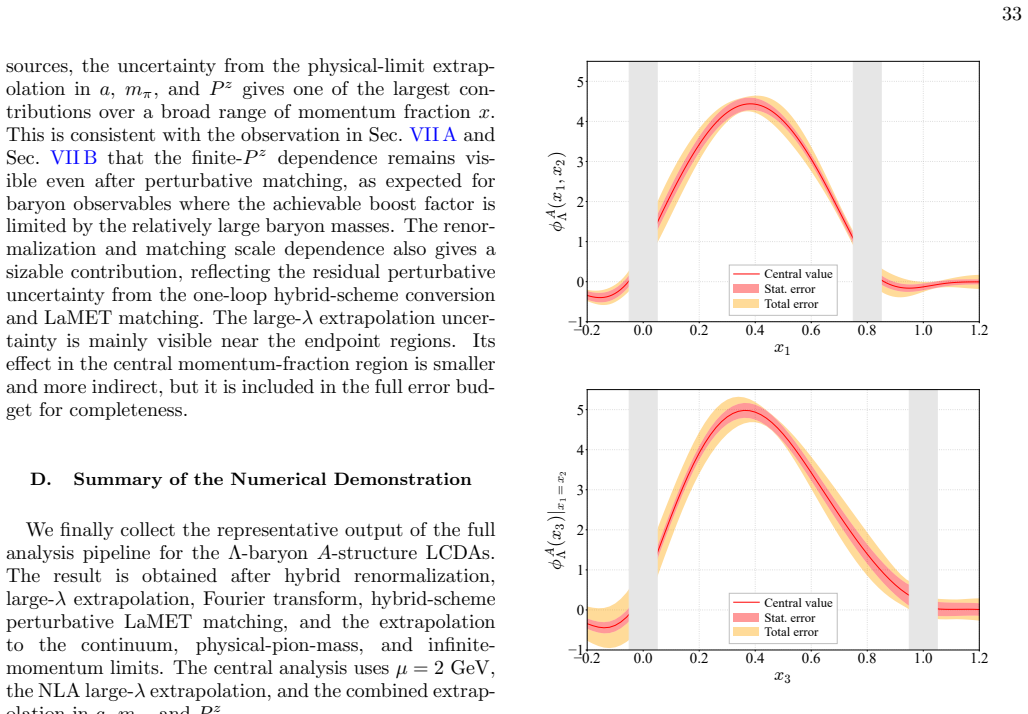
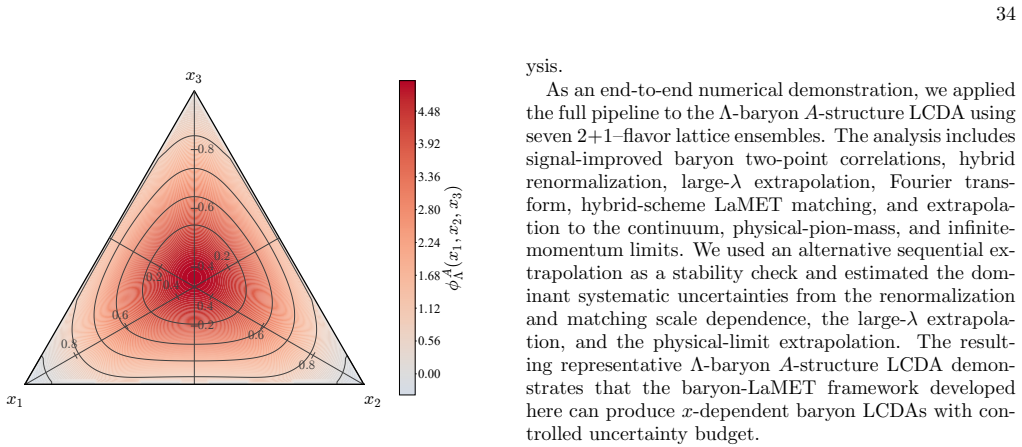
We present a systematic large-momentum effective theory framework for determining baryon leading-twist LCDAs from lattice QCD that covers the complete path from equal-time three-quark quasi-distribution amplitudes to physical baryon LCDAs, including formulation of the V, A, and T quasi-DAs, hybrid renormalization, large-λ extrapolation, and one-loop matching, as demonstrated on the Lambda-baryon A-structure.
What carries the argument
The large-momentum effective theory (LaMET) matching relation in the hybrid renormalization scheme that converts finite-momentum quasi-distribution amplitudes into light-cone distribution amplitudes.
If this is right
- The V, A, and T quasi-DAs can be defined consistently with their spin-flavor and coordinate-space symmetries, including vanishing local limits for antisymmetric amplitudes.
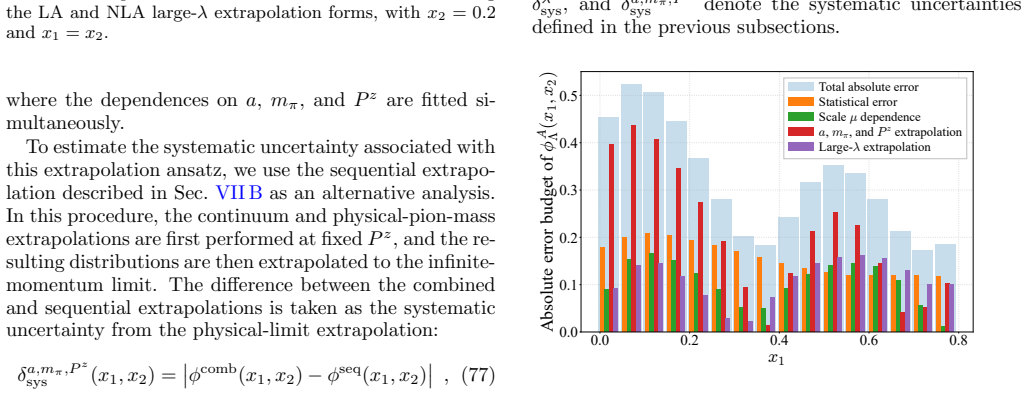
- Systematic uncertainties associated with the infinite-momentum limit, continuum extrapolation, and physical pion mass can be quantified for any baryon LCDA.
- The same pipeline supplies the renormalization and matching tools needed for first-principles x-dependent baryon LCDAs.
- Application to the Lambda baryon supplies a concrete template that can be repeated for the nucleon and other baryons.
Where Pith is reading between the lines
- The hybrid renormalization prescription developed for the (z1,z2) plane may simplify lattice calculations of other multi-parton correlators.
- Once LCDAs for several baryons are available, comparisons with meson LCDAs could test flavor-symmetry relations at the amplitude level.
- The large-distance extrapolation method could be tested on simpler objects such as meson LCDAs where independent results already exist.
Load-bearing premise
The newly developed large-λ extrapolation strategy based on the asymptotic large-distance behavior of Euclidean correlators accurately recovers the physical LCDAs.
What would settle it
A higher-momentum or finer-lattice computation of the same Lambda A-structure amplitude whose extrapolated and matched result differs by more than the quoted uncertainties from the result obtained with the seven ensembles used in the paper.
Figures

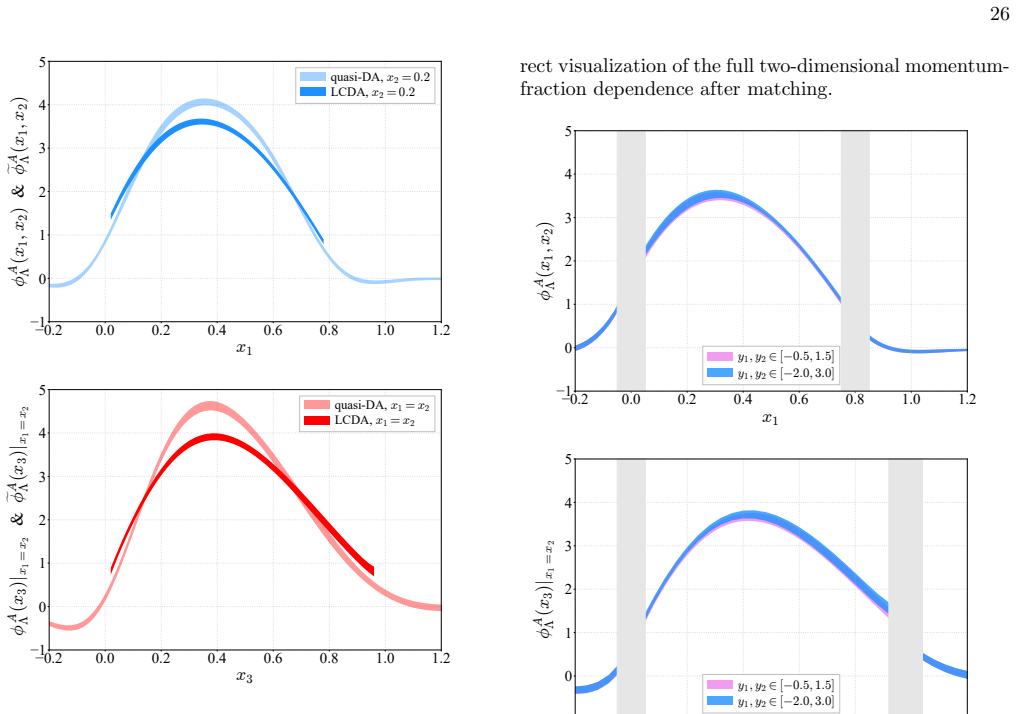
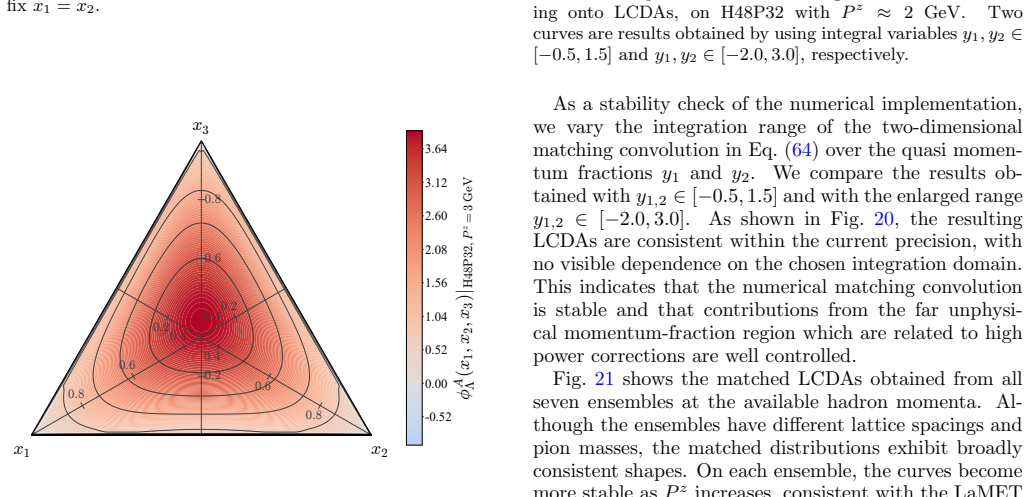
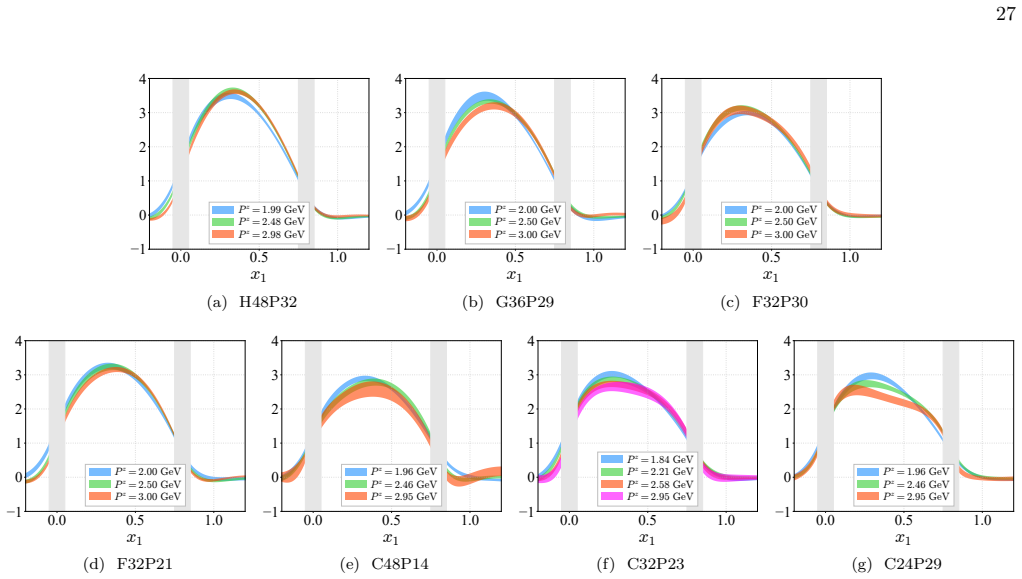
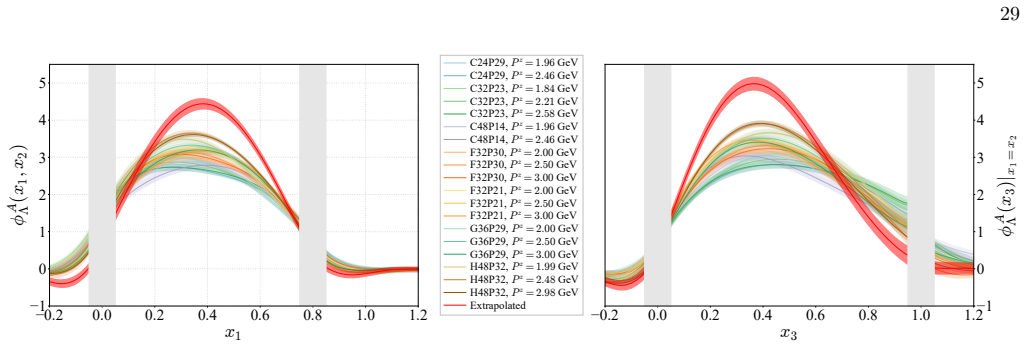

read the original abstract
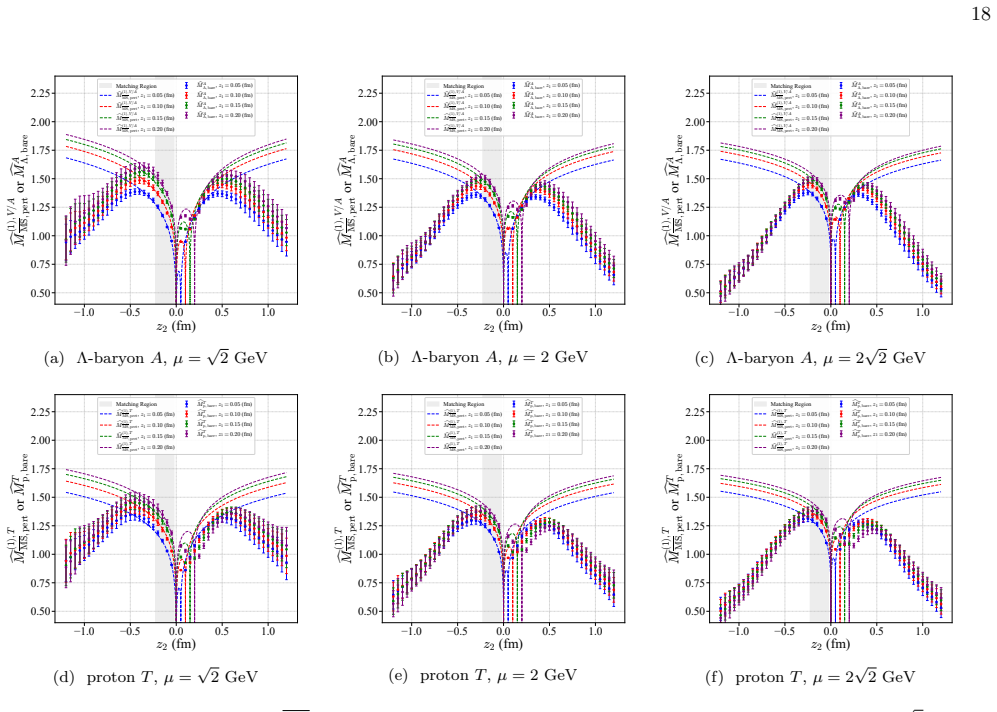
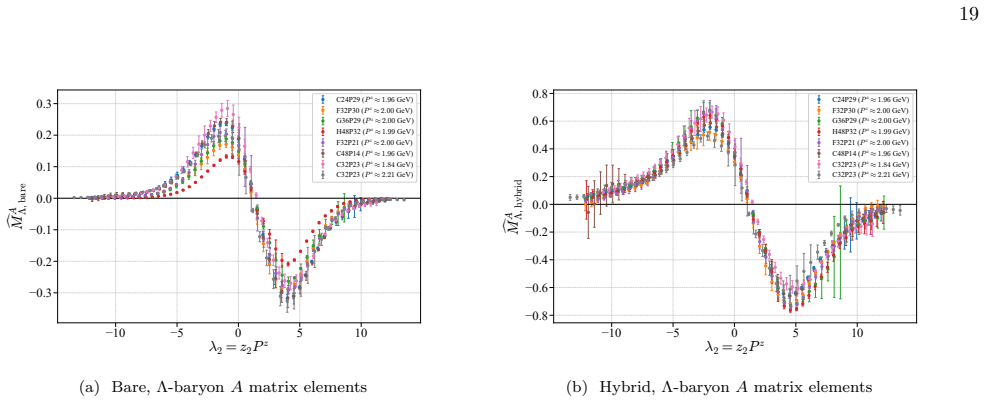
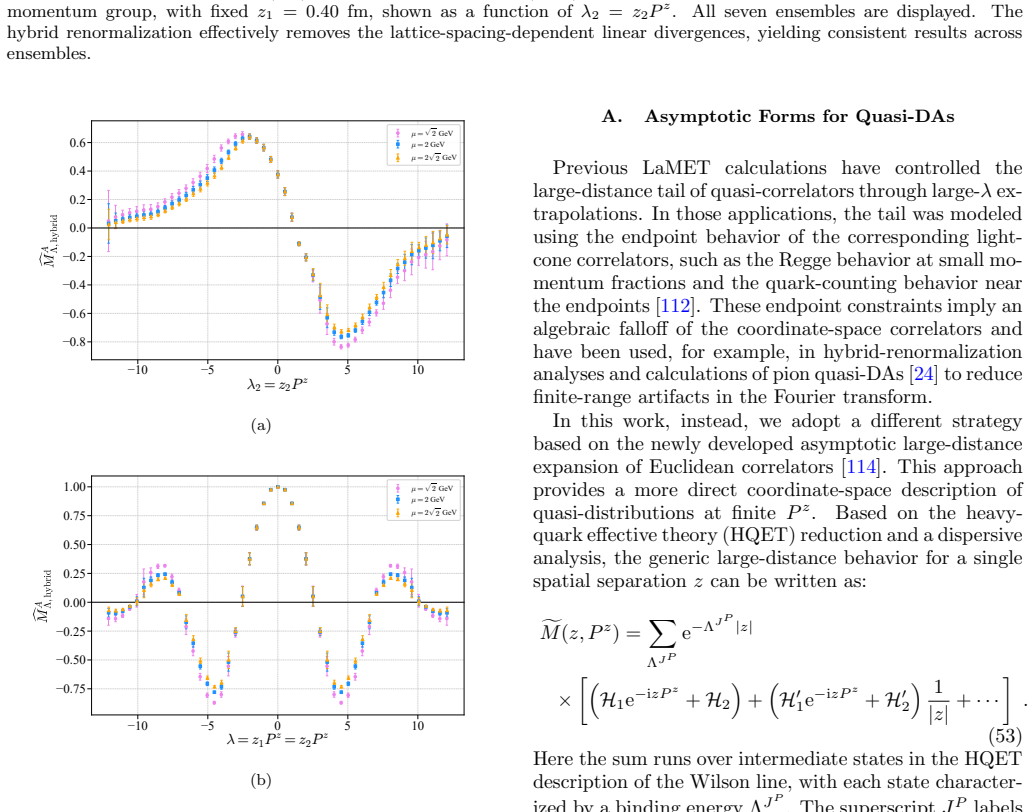
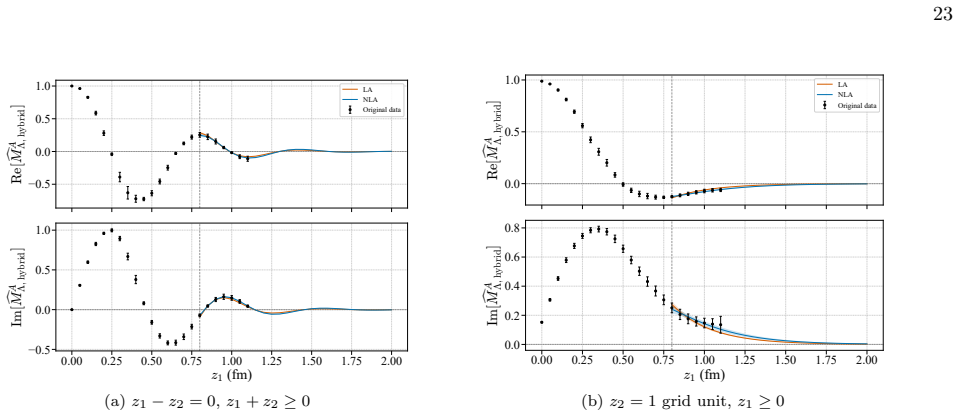
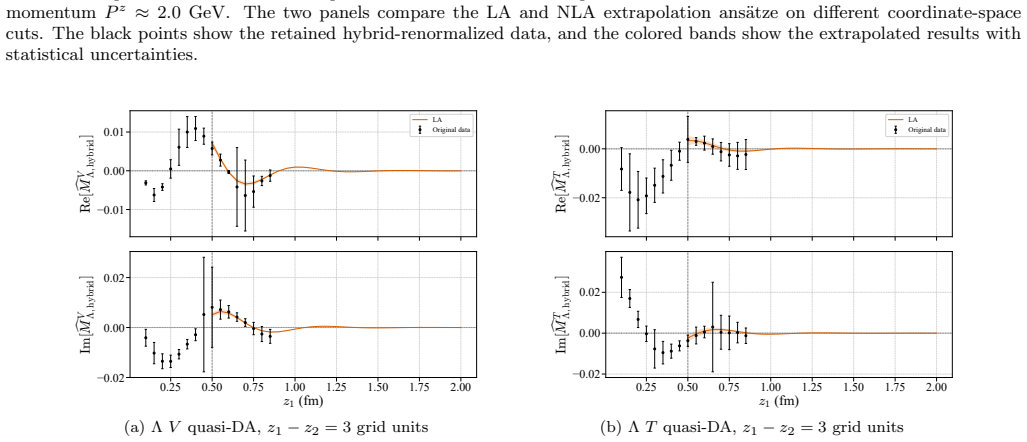
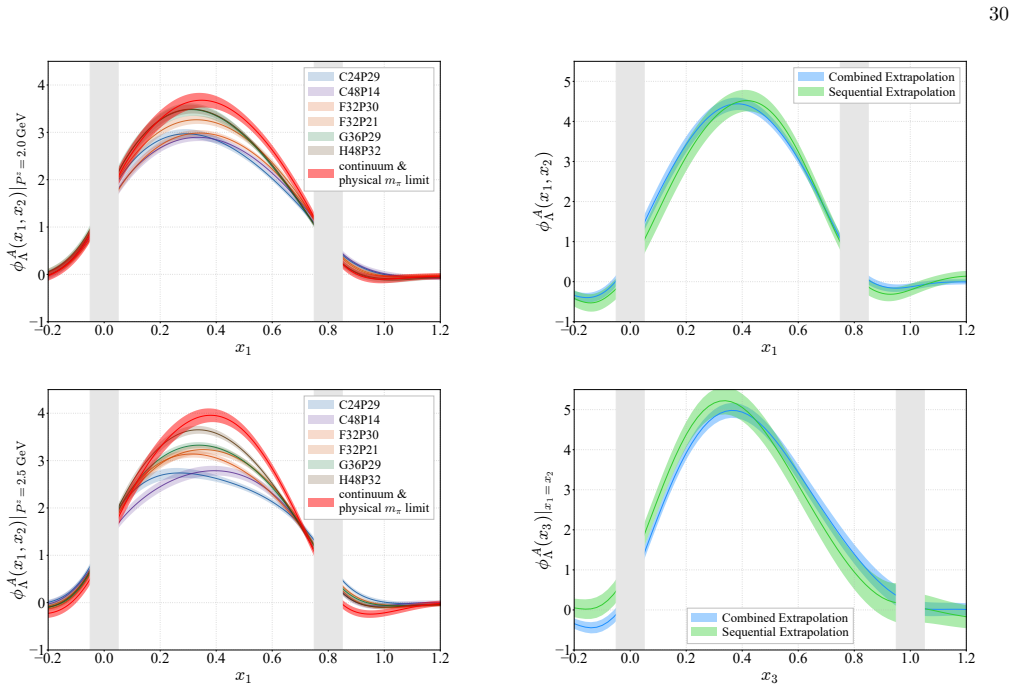
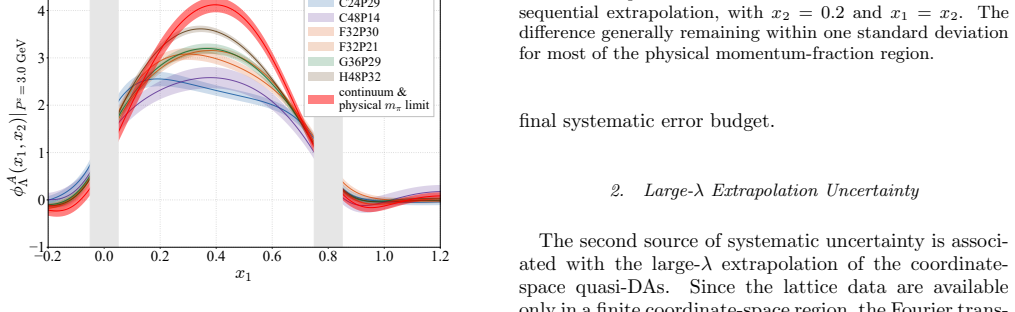
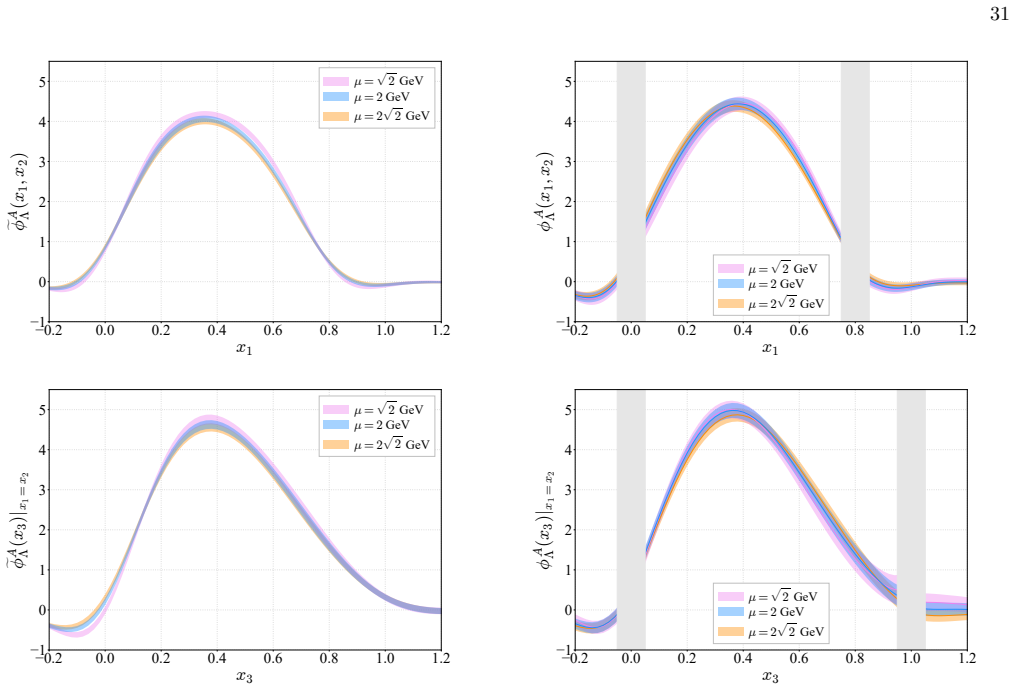
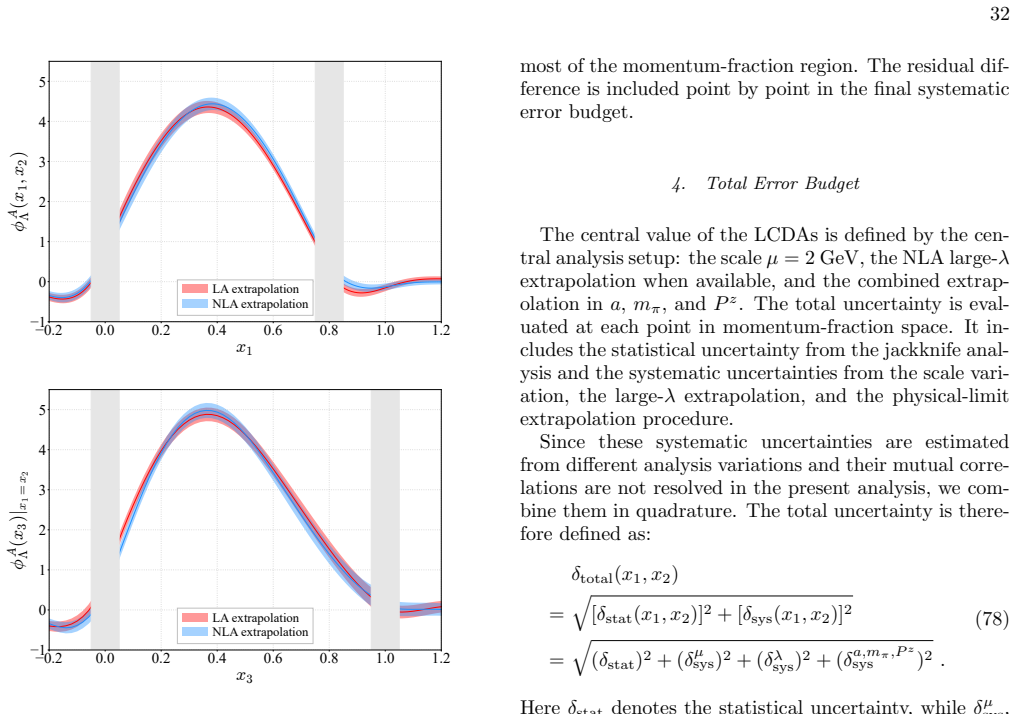
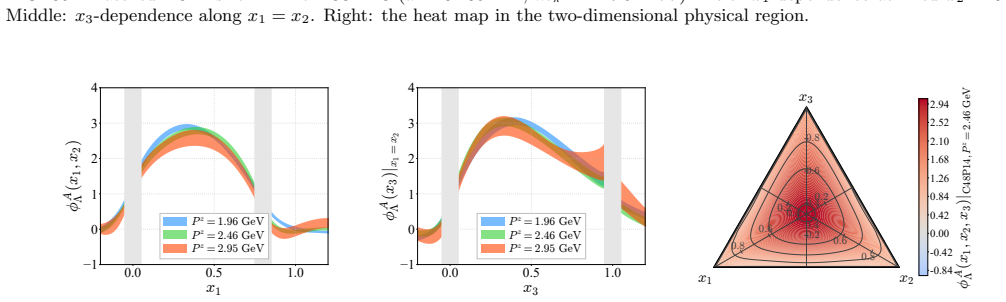
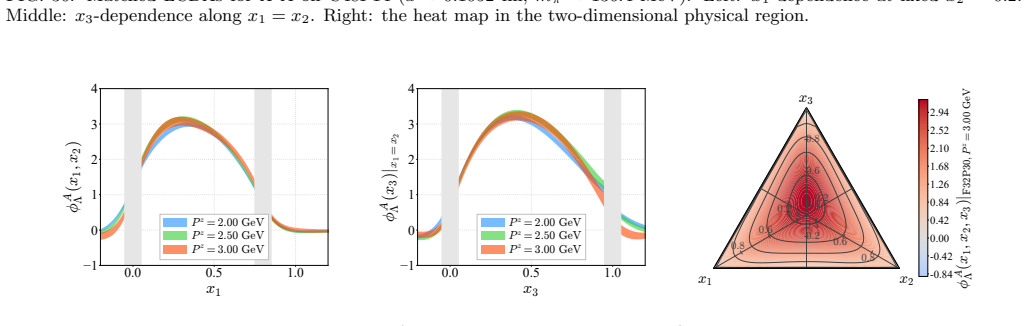
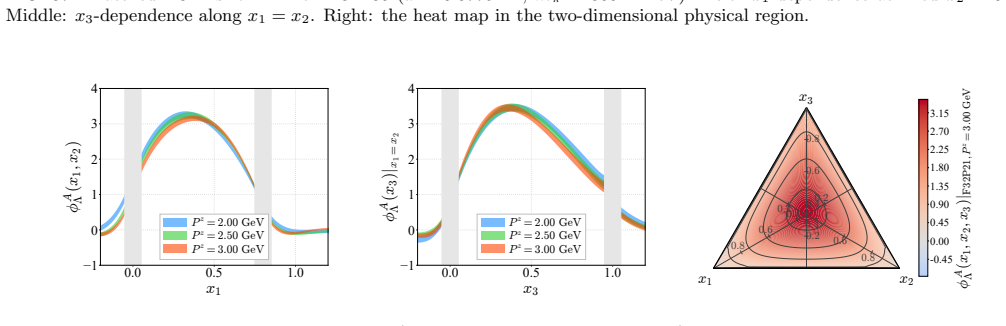
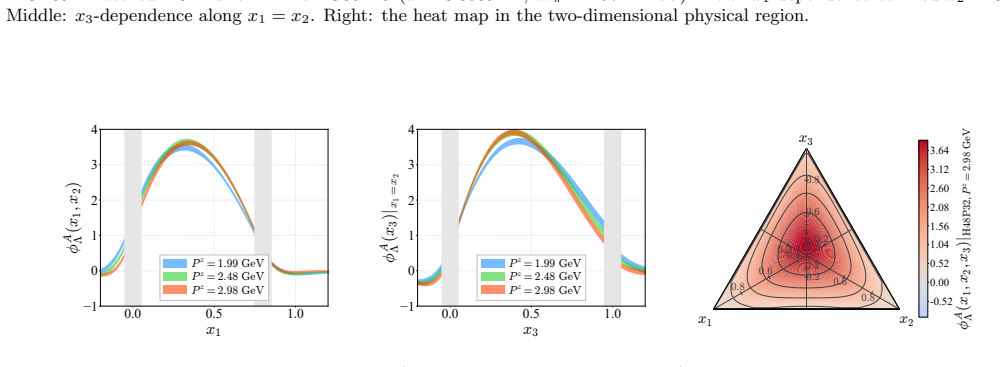
Baryon light-cone distribution amplitudes (LCDAs) are inherently multidimensional objects parametrized by two independent longitudinal momentum fractions, making their first-principles determination substantially more challenging than that of meson LCDAs. We present a systematic large-momentum effective theory (LaMET) framework for determining baryon leading-twist LCDAs from lattice QCD. The framework covers the complete path from equal-time three-quark quasi-distribution amplitudes to physical baryon LCDAs. We formulate the leading-twist $V$, $A$, and $T$ quasi-DAs and analyze their spin-flavor and coordinate-space symmetries, including antisymmetric amplitudes with vanishing local limits. We develop a hybrid renormalization prescription on the $(z_1,z_2)$ plane, introduce a newly developed large-$\lambda$ extrapolation strategy based on the asymptotic large-distance behavior of Euclidean correlators, and derive the corresponding one-loop LaMET matching relation in the hybrid renormalization scheme. As a demonstration, we apply the complete analysis pipeline to the $\Lambda$-baryon $A$-structure quasi-DAs using seven $2+1$--flavor lattice ensembles, and use this amplitude to examine the impact of large-distance extrapolation, perturbative matching, and extrapolation to the continuum, physical-pion-mass, and infinite-momentum limits, together with the associated systematic uncertainties. This work provides the formalism, renormalization, extrapolation, and matching infrastructure for first-principles determinations of $x$-dependent baryon LCDAs.
Editorial analysis
A structured set of objections, weighed in public.
Referee Report
Summary. The manuscript develops a systematic LaMET framework for baryon leading-twist LCDAs, formulating V/A/T quasi-DAs with their symmetries (including antisymmetric cases with vanishing local limits), introducing hybrid renormalization on the (z1,z2) plane, a new large-λ extrapolation from Euclidean correlator asymptotics, and the corresponding one-loop matching in that scheme. It demonstrates the full pipeline on the Λ-baryon A-structure quasi-DAs using seven 2+1-flavor ensembles and quantifies impacts from large-distance extrapolation, perturbative matching, and extrapolations to continuum, physical pion mass, and infinite momentum, along with associated systematics.
Significance. If the central derivations and extrapolation hold, the work supplies the complete infrastructure needed for first-principles x-dependent baryon LCDAs, a longstanding challenge due to their two-dimensional momentum-fraction dependence. Credit is due for the end-to-end pipeline (quasi-DAs through hybrid renormalization and matching), the novel large-λ strategy grounded in Euclidean asymptotics, and the multi-ensemble demonstration that permits explicit assessment of multiple systematic uncertainties.
minor comments (3)
- [Abstract] Abstract: the statement that the framework covers the 'complete path' from quasi-DAs to physical LCDAs would be strengthened by an explicit cross-reference to the section deriving the one-loop matching kernel in the hybrid scheme.
- [Formalism (spin-flavor and coordinate-space symmetries)] The discussion of coordinate-space symmetries for antisymmetric amplitudes notes vanishing local limits; an explicit numerical check or table entry confirming this property on the lattice ensembles would improve clarity.
- [Large-λ extrapolation strategy] The large-λ extrapolation is applied to the Λ A-structure; the manuscript should state the functional form assumed for the asymptotic large-distance behavior and the fitting range in λ explicitly.
Simulated Author's Rebuttal
We thank the referee for their positive summary of our work and for recommending minor revision. No major comments were provided in the report, so we interpret the recommendation as pertaining to minor editorial or presentational adjustments that we will address in the revised version.
Circularity Check
No significant circularity; derivation is self-contained
full rationale
The paper derives the full LaMET pipeline for baryon LCDAs with explicit new elements: definitions of V/A/T quasi-DAs and their symmetries, hybrid renormalization on the (z1,z2) plane, a large-λ extrapolation from Euclidean correlator asymptotics, and the one-loop matching kernel in that scheme. These steps are formulated equation-by-equation without reducing the output LCDAs to input parameters by construction or to self-citations whose validity is presupposed. The Λ-baryon demonstration quantifies extrapolation, matching, and continuum/physical-mass/infinite-momentum systematics on seven ensembles, providing independent content. Self-citations to prior LaMET work are foundational but not load-bearing for the baryon-specific results.
Axiom & Free-Parameter Ledger
axioms (2)
- domain assumption LaMET applies to baryon leading-twist quasi-distribution amplitudes with the stated spin-flavor symmetries
- domain assumption Hybrid renormalization on the (z1,z2) plane removes lattice artifacts without residual scheme dependence after matching
Reference graph
Works this paper leans on
-
[1]
Sym” represents the symmetric behavior under thez 1 ↔z 2 exchange, while “A-Sym
Spinor Contraction of Two-point correlations The source-side interpolators we used in calculation are defined as Eq. (27): Osrc,KE Λ =ϵ ijk 1√ 6 2(ui,T Cγ 5γt dj)s k + (ui,T Cγ 5γt sj)d k + (si,T Cγ 5γt dj)u k , Osrc,KE p =ϵ ijk (ui,T Cγ 5γt dj)u k . (A1) Using ψ=ψ †γt andγ t(Cγ 5γt)†γt =−Cγ 5γt, we have: O src,KE Λ =−ϵ ijk 1√ 6 2 sk (ui Cγ 5γt d j,T ) + ...
-
[2]
II C, we stated that the Λ and proton quasi-DAs possess definite symmetry or antisymmetry under the exchangez 1 ↔z 2
Derivation of Symmetry Properties of Baryon DAs In Sec. II C, we stated that the Λ and proton quasi-DAs possess definite symmetry or antisymmetry under the exchangez 1 ↔z 2. In this subsection, we show that these properties follow directly from the propagator-level structure of the nonlocal two-point correlation functions defined above, together with the ...
-
[3]
Heavy-quark Representation of Wilson Lines Following Ref. [114], the first step in deriving the large-distance behavior of Euclidean correlators is to replace the Wilson lines in the nonlocal baryon operators by the propagators of auxiliary heavy quarks. This trick makes it possible to use a standard spectral decomposition in terms of physical color-singl...
-
[4]
The asymptotic behavior forz→ ∞is obtained by the saddle-point approximation of the phase-space integral
Dispersive Relation To analyze the asymptotic behavior of the nonlocal matrix elements, one inserts two complete sets of intermediate states into the matrix elements: ϵijk ⟨0| ¯Qα′,i′(z1)qi′ α(z1)Q i α′′(0)hk γ(0)Gj β′′(0) ¯Gβ′,j′(z2)gj′ β (z2)|B(P)⟩ = X X1,X2 Z dΓX1(k1) dΓX2(k2)⟨0| ¯Qα′qα(z1)|X1(k1)⟩ ⟨X 1(k1)|Qα′′hγGβ′′(0)|X2(k2)⟩ ⟨X 2(k2)| ¯Gβ′gβ(z2)|B(...
-
[5]
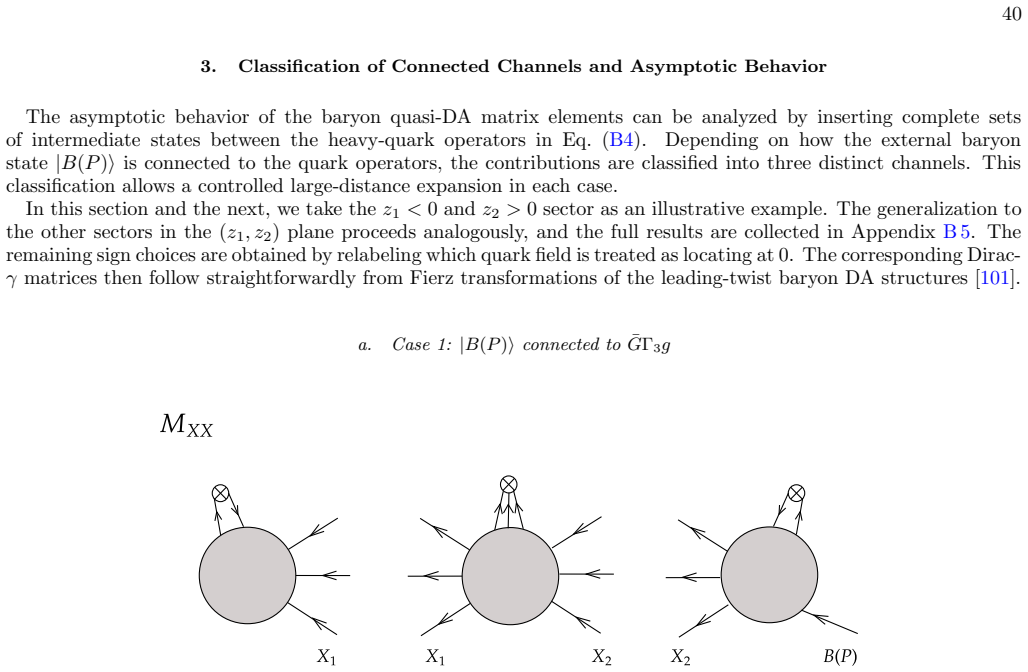
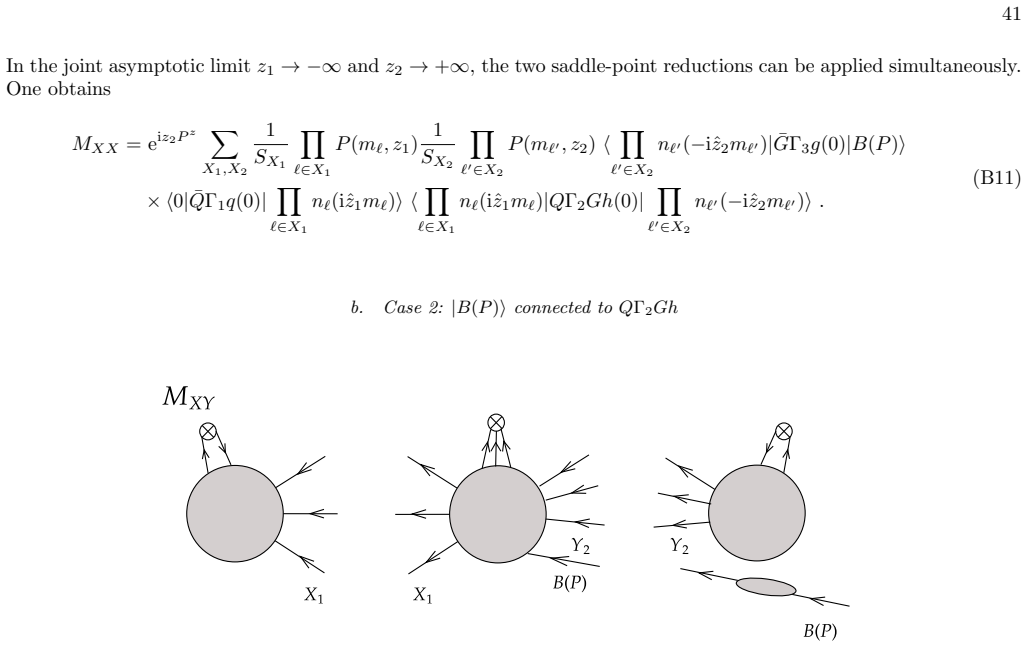
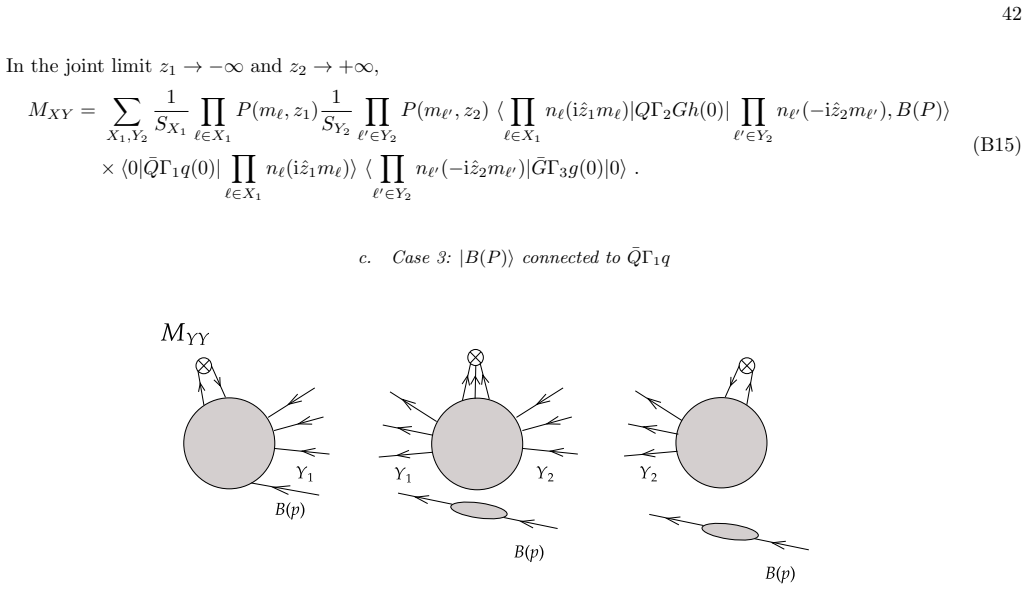
Classification of Connected Channels and Asymptotic Behavior The asymptotic behavior of the baryon quasi-DA matrix elements can be analyzed by inserting complete sets of intermediate states between the heavy-quark operators in Eq. (B4). Depending on how the external baryon state|B(P)⟩is connected to the quark operators, the contributions are classified in...
-
[6]
Here we analyze the general spin structures and binding energies enter the asymptotic forms
General Structure of the Extrapolation In this work, the exponentials in the asymptotic forms of quasi-DAs contain the binding energies selected by the channel quantum numbers. Here we analyze the general spin structures and binding energies enter the asymptotic forms. a. Spin Structures of different amplitudes The spin structure connecting theqandgquarks...
-
[7]
In addition, the intermediate states can also include heavy–light baryons withJ P = 1/2 − andJ P = 1/2+, whose binding energies we denote by Λ 1/2− and Λ1/2+ , respectively
and axial-vector (1 +, e.g.D 1,B 1) mesons, which share the same binding energy Λ 0+ = Λ1+ up toO(Λ QCD/mQ) corrections. In addition, the intermediate states can also include heavy–light baryons withJ P = 1/2 − andJ P = 1/2+, whose binding energies we denote by Λ 1/2− and Λ1/2+ , respectively. For each channel, the specific set of binding energies that ap...
-
[8]
GA,1 + G(1) A,1 |z1| + G(2) A,1 |z2| +· · · # + eiz2P z e−Λ0− |z1|e−Λ1/2− |z2|
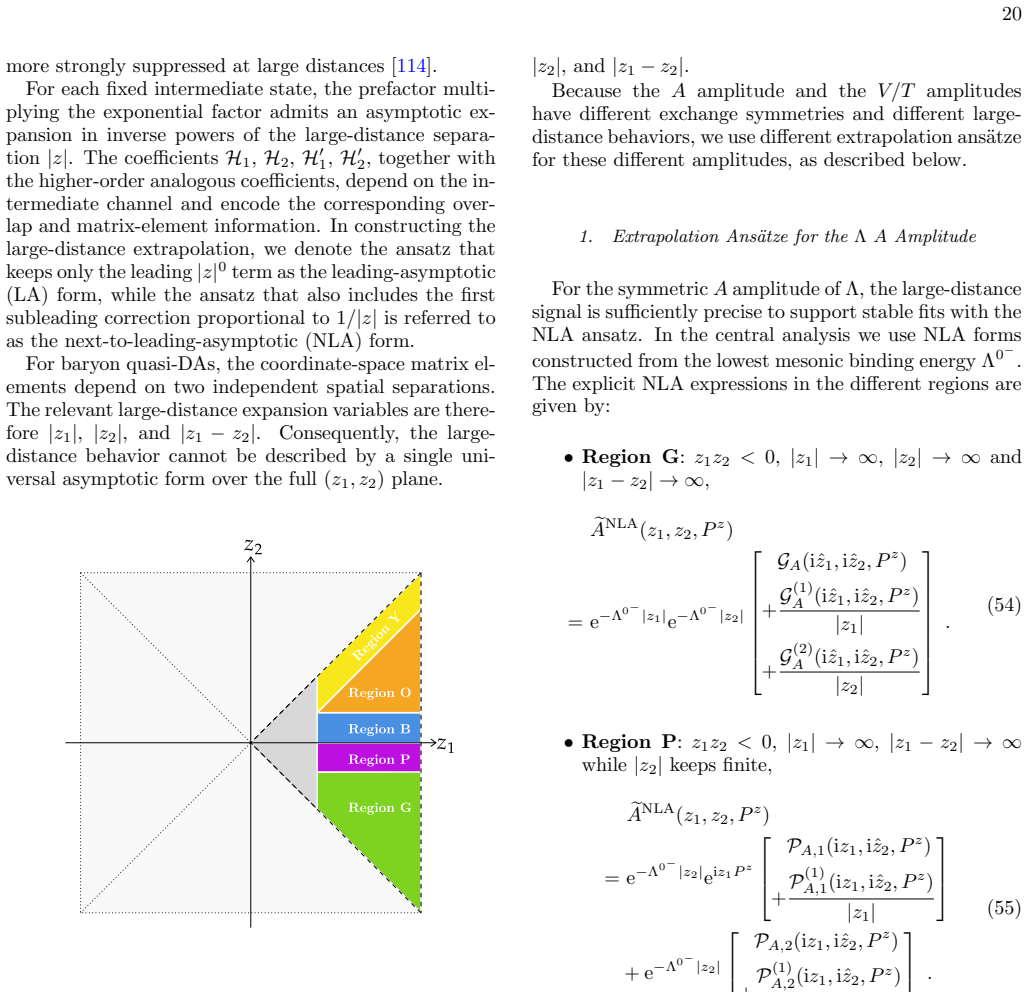
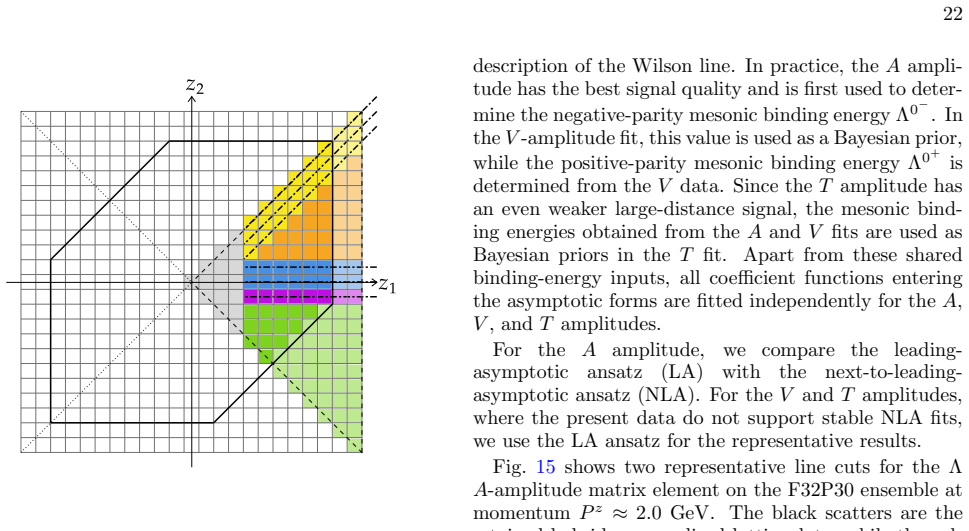
Full Asymptotic Expressions The (z1, z2) plane is divided into several regions according to which coordinate separations become large, as discussed in Sec. V A, following the same convention and region partition shown in Fig. 13. In the derivation above, we used the casez 1z2 <0 as an illustrative example. In the full baryon quasi-DA matrix element, howev...
-
[9]
Expressions of theC n Functions The functionsC n appearing in one-loop matching kernel in the MS scheme Eqs. (67)–(68) are explicitly defined as 48 C2(x1, x2;y 1, y2;P z, µ) = (x1 +y 1)(x3 +y 3) y1y3(y1 −x 1) ln y1 −x 1 −x1 − x3(x1 +y 1 + 2y3) y3(y1 −x 1)(y1 +y 3) ln x3 −x1 x1 <0 (x1 −3y 1 −2y 3)x1 y1(x3 −y 3)(y1 +y 3) − ...
-
[10]
Explicit Forms of the Hybrid Counterterms In hybrid renormalization scheme, to computing the hard kernels and express the complicated hybrid counterterms, it is convenient to define a set of master integrals as follows: I1 {L2, L1}, p ≡ Z L2 L1 dz 2π e−ipz ln(z2) = + i γE + log(−ipL1) + −1 + e ipL1 log(L1) + Γ(0,−ipL1) 2πp − i γE + log(−ipL2) + −1 + e ipL...
-
[11]
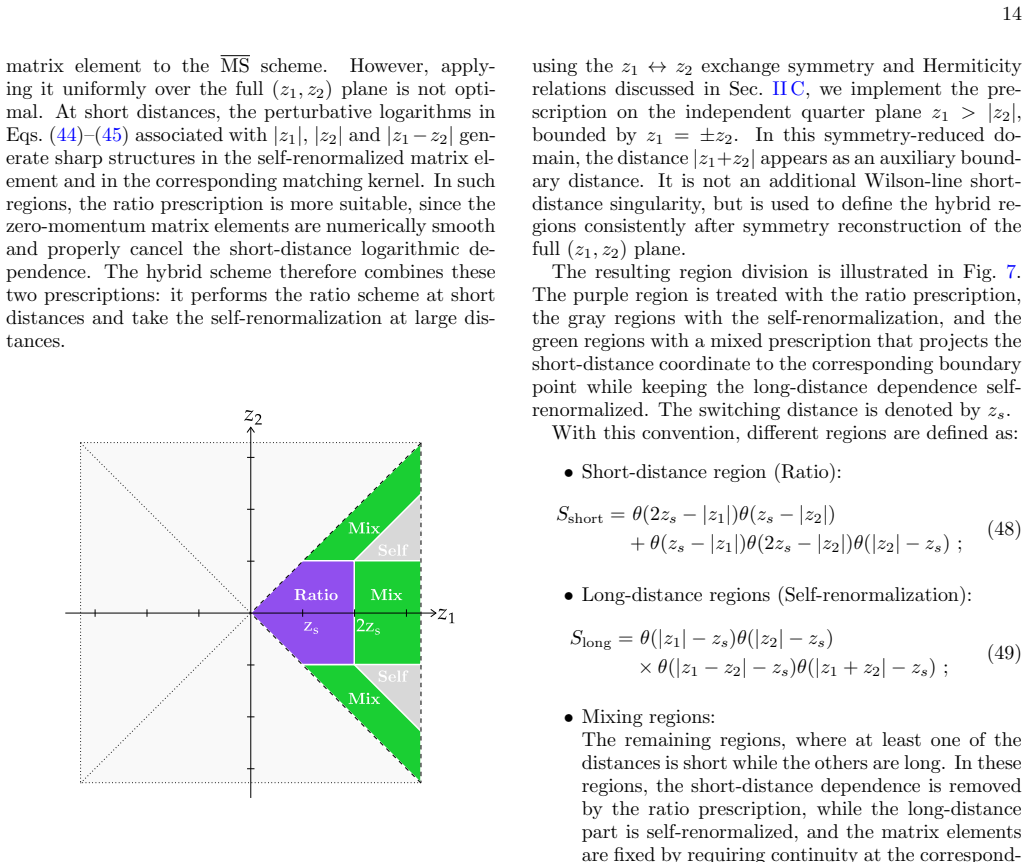
+ 3 4 ln((z1 −z 2)2) # × θ(2zs − |z1|)θ(zs − |z2|) +θ(z s − |z1|)θ(|z2| −z s)θ(2zs − |z2|) =7 8 +I0({2zs,−2z s}, p2)I1({zs,−z s}, p1) + I1({zs,−z s}, p2) I0({2zs,−2z s}, p1)−I0({z s,−z s}, p1) +I0({zs,−z s}, p1)I1({2zs,−2z s}, p2) + I0({zs,−z s}, p2) I1({2zs,−2z s}, p1)−I1({z s,−z s}, p1) + 3 8π(p1 +p 2) + sin((p1 +p 2)...
-
[12]
+ 7 8 ln((2zs)2) + 3 4 ln((z1 −2z ssign[z2])2) # = 1 8 +6e2ip1zsI1({−zs,−3z s}, p1)I0({∞,2z s}, p2) + 6e−2ip1zsI1({3zs, zs}, p1)I0({−2zs,−∞}, p 2) +7 I0({∞,−∞}, p 2)−I0({2z s,−2z s}, p2) log(4z2 s)I0({zs,−z s}, p1) + I1({zs,−z s}, p1) , (C9) I V /A HSII(p1, p2) ≡ Z dz1 2π dz2 2π e−ip1z1−ip2z2 θ(|z1| −2z s)θ(zs − |z2|)× " 7 8 ln((2zs)2) + 7 8 ln(z2
-
[13]
(C13) b.Tcounterterms TheTamplitude has different spin structure fromVandAamplitudes, certain perturbative loop corrections vanish
+ 3 4 ln((sign[z1]2zs −z 2)2) # = 1 8 +6e2ip2zsI1({−zs,−3z s}, p2)I0({∞,2z s}, p1) + 6e−2ip2zsI1({3zs, zs}, p2)I0({−2zs,−∞}, p 1) +7 I0({∞,−∞}, p 1)−I0({2z s,−2z s}, p1) log(4z2 s)I0({zs,−z s}, p2) + I1({zs,−z s}, p2) , (C10) I V /A HSIII(p1, p2) ≡ Z dz1 2π dz2 2π e−ip1z1−ip2z2 θ(|z1| −z s)θ(|z2| −z s)θ(zs − |z1 −z 2|) × " 7 8 ln((zs + (z1 −z 2)θ(...
-
[14]
+ 1 2 ln((z1 −z 2)2) # × θ(2zs − |z1|)θ(zs − |z2|) +θ(z s − |z1|)θ(|z2| −z s)θ(2zs − |z2|) =7 8 +I0({2zs,−2z s}, p2)I1({zs,−z s}, p1) + I1({zs,−z s}, p2) I0({2zs,−2z s}, p1)−I0({z s,−z s}, p1) +I0({zs,−z s}, p1)I1({2zs,−2z s}, p2) + I0({zs,−z s}, p2) I1({2zs,−2z s}, p1)−I1({z s,−z s}, p1) + 1 4π(p1 +p 2) + sin((p1 +p 2)...
-
[15]
+ 7 8 ln((2zs)2) + 1 2 ln((z1 −2z ssign[z2])2) # = 1 8 +4e2ip1zsI1({−zs,−3z s}, p1)I0({∞,2z s}, p2) + 4e−2ip1zsI1({3zs, zs}, p1)I0({−2zs,−∞}, p 2) +7 I0({∞,−∞}, p 2)−I0({2z s,−2z s}, p2) log(4z2 s)I0({zs,−z s}, p1) + I1({zs,−z s}, p1) , (C15) I T HSII(p1, p2) ≡ Z dz1 2π dz2 2π e−ip1z1−ip2z2 θ(|z1| −2z s)θ(zs − |z2|)× " 7 8 ln((2zs)2) + 7 8 ln(z2
-
[16]
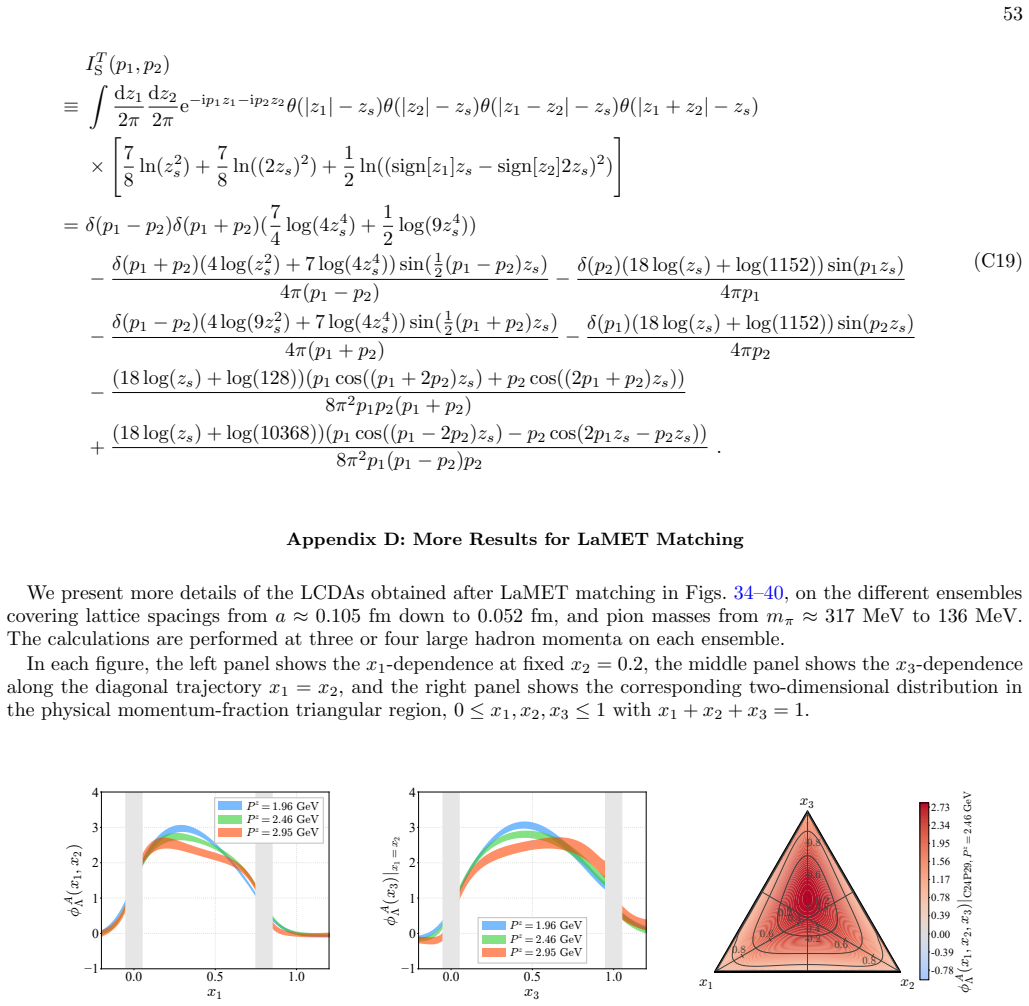
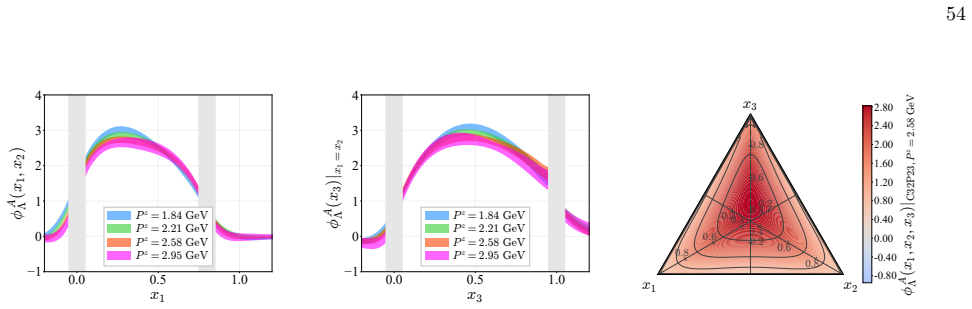
(C19) Appendix D: More Results for LaMET Matching We present more details of the LCDAs obtained after LaMET matching in Figs
+ 1 2 ln((sign[z1]2zs −z 2)2) # = 1 8 +4e2ip2zsI1({−zs,−3z s}, p2)I0({∞,2z s}, p1) + 4e−2ip2zsI1({3zs, zs}, p2)I0({−2zs,−∞}, p 1) +7 I0({∞,−∞}, p 1)−I0({2z s,−2z s}, p1) log(4z2 s)I0({zs,−z s}, p2) + I1({zs,−z s}, p2) , (C16) I T HSIII(p1, p2) ≡ Z dz1 2π dz2 2π e−ip1z1−ip2z2 θ(|z1| −z s)θ(|z2| −z s)θ(zs − |z1 −z 2|) × " 7 8 ln((zs + (z1 −z 2)θ(z1 ...
-
[17]
Orthogonal polynomials up to third moments We use the shorthandx ijk ≡(x i, xj, xk),x i +x j +x k = 1 in following discussions. For a generic leading-twist amplitude, the truncated conformal parameterization up to third moments takes the form: FΛ(x123) = 120x1x2x3 " ηΛ,0 + 3X n=1 nX m=0 ηΛ,nm Pnm(x123) +· · · # ,(E1) where the coefficientsη Λ,nm denote di...
-
[18]
These expressions are obtained by imposing the exchange symmetries of the Λ-baryon leading-twist amplitudes, VΛ(x123) =−V Λ(x213), A Λ(x123) = +AΛ(x213), T Λ(x123) =−T Λ(x213)
Fully expanded LCDAs in the normalization convention of this work We now give the explicitV Λ(x123),A Λ(x123), andT Λ(x123) parameterizations used in our numerical fit. These expressions are obtained by imposing the exchange symmetries of the Λ-baryon leading-twist amplitudes, VΛ(x123) =−V Λ(x213), A Λ(x123) = +AΛ(x213), T Λ(x123) =−T Λ(x213). (E3) The re...
-
[19]
These Φ/Π amplitudes are linear combinations of the same leading-twist LCDAsV,A, andT, rather than independent non-perturbative functions
Convention difference with RQCD moments We now relate the aboveVΛ(x123),A Λ(x123), andT Λ(x123) parameterizations to the Φ/Π amplitudes used in RQCD studies [14–16]. These Φ/Π amplitudes are linear combinations of the same leading-twist LCDAsV,A, andT, rather than independent non-perturbative functions. This identification follows, for example, from the R...
-
[20]
Peter Lepage and Stanley J
G. Peter Lepage and Stanley J. Brodsky. Exclusive Processes in Perturbative Quantum Chromodynamics. Phys. Rev. D, 22:2157, 1980
1980
-
[21]
A. V. Efremov and A. V. Radyushkin. Asymptotical Behavior of Pion Electromagnetic Form-Factor in QCD. Theor. Math. Phys., 42:97–110, 1980
1980
-
[22]
Observation of charge–parity symme- try breaking in baryon decays.Nature, 643(8074):1223– 1228, 2025
Roel Aaij et al. Observation of charge–parity symme- try breaking in baryon decays.Nature, 643(8074):1223– 1228, 2025
2025
-
[23]
Aaij et al
R. Aaij et al. Study of Λb0 and Ξb0 Decays to Λh+h’- and Evidence for CP Violation in Λb0→ΛK+K- Decays. Phys. Rev. Lett., 134(10):101802, 2025
2025
-
[24]
Establishing CP Violation in b-Baryon Decays.Phys
Jia-Jie Han, Ji-Xin Yu, Ya Li, Hsiang-nan Li, Jian-Peng Wang, Zhen-Jun Xiao, and Fu-Sheng Yu. Establishing CP Violation in b-Baryon Decays.Phys. Rev. Lett., 134(22):221801, 2025
2025
-
[25]
CP violation in two-body hadronic Λb decays in the PQCD approach
Jia-Jie Han, Ji-Xin Yu, Ya Li, Hsiang-nan Li, Jian-Peng Wang, Zhen-Jun Xiao, and Fu-Sheng Yu. CP violation in two-body hadronic Λb decays in the PQCD approach. Phys. Rev. D, 112(5):053007, 2025
2025
-
[26]
Braun, and Einan Gardi
Patricia Ball, Vladimir M. Braun, and Einan Gardi. Distribution Amplitudes of the Lambda(b) Baryon in QCD.Phys. Lett. B, 665:197–204, 2008
2008
-
[27]
V. L. Chernyak and I. R. Zhitnitsky. Nucleon Wave Function and Nucleon Form-Factors in QCD.Nucl. Phys. B, 246:52–74, 1984
1984
-
[28]
V. L. Chernyak, A. A. Ogloblin, and I. R. Zhitnitsky. Wave Functions of Octet Baryons.Yad. Fiz., 48:1410– 1422, 1988
1988
-
[29]
I. D. King and Christopher T. Sachrajda. Nucleon Wave Functions and QCD Sum Rules.Nucl. Phys. B, 279:785– 803, 1987
1987
-
[30]
Nathan Isgur and C. H. Llewellyn Smith. The Appli- cability of Perturbative QCD to Exclusive Processes. Nucl. Phys. B, 317:526–572, 1989
1989
-
[31]
S. V. Mikhailov and A. V. Radyushkin. Nonlocal Con- densates and QCD Sum Rules for Pion Wave Function. JETP Lett., 43:712, 1986
1986
-
[32]
V. M. Braun, A. Lenz, and M. Wittmann. Nucleon Form Factors in QCD.Phys. Rev. D, 73:094019, 2006
2006
-
[33]
Bali et al
Gunnar S. Bali et al. Light-cone distribution amplitudes of the baryon octet.JHEP, 02:070, 2016
2016
-
[34]
Bali et al
Gunnar S. Bali et al. Light-cone distribution amplitudes of octet baryons from lattice QCD.Eur. Phys. J. A, 55(7):116, 2019
2019
-
[35]
G. S. Bali, V. M. Braun, S. B¨ urger, M. G¨ ockeler, M. Gruber, F. Kaiser, B. A. Kniehl, O. L. Veretin, and P. Wein. Updated determination of light-cone distribu- tion amplitudes of octet baryons in lattice QCD.Phys. Rev. D, 111(9):094517, 2025
2025
-
[36]
Parton Physics on a Euclidean Lattice
Xiangdong Ji. Parton Physics on a Euclidean Lattice. Phys. Rev. Lett., 110:262002, 2013
2013
-
[37]
Parton Physics from Large-Momentum Effective Field Theory.Sci
Xiangdong Ji. Parton Physics from Large-Momentum Effective Field Theory.Sci. China Phys. Mech. Astron., 57:1407–1412, 2014
2014
-
[38]
Large-momentum effective the- ory.Rev
Xiangdong Ji, Yu-Sheng Liu, Yizhuang Liu, Jian-Hui Zhang, and Yong Zhao. Large-momentum effective the- ory.Rev. Mod. Phys., 93(3):035005, 2021
2021
-
[39]
Pion Distribu- tion Amplitude from Lattice QCD.Phys
Jian-Hui Zhang, Jiunn-Wei Chen, Xiangdong Ji, Luchang Jin, and Huey-Wen Lin. Pion Distribu- tion Amplitude from Lattice QCD.Phys. Rev. D, 95(9):094514, 2017
2017
-
[40]
Pion and kaon distribution amplitudes in the continuum limit.Phys
Rui Zhang, Carson Honkala, Huey-Wen Lin, and Jiunn- Wei Chen. Pion and kaon distribution amplitudes in the continuum limit.Phys. Rev. D, 102(9):094519, 2020
2020
-
[41]
Precision control in lattice calcula- tion of x-dependent pion distribution amplitude.Nucl
Jack Holligan, Xiangdong Ji, Huey-Wen Lin, Yushan Su, and Rui Zhang. Precision control in lattice calcula- tion of x-dependent pion distribution amplitude.Nucl. Phys. B, 993:116282, 2023
2023
-
[42]
Dis- tribution Amplitudes of K* andϕat the Physical Pion Mass from Lattice QCD.Phys
Jun Hua, Min-Huan Chu, Peng Sun, Wei Wang, Ji Xu, Yi-Bo Yang, Jian-Hui Zhang, and Qi-An Zhang. Dis- tribution Amplitudes of K* andϕat the Physical Pion Mass from Lattice QCD.Phys. Rev. Lett., 127(6):062002, 2021
2021
-
[43]
Pion and Kaon Distribution Amplitudes from Lattice QCD.Phys
Jun Hua et al. Pion and Kaon Distribution Amplitudes from Lattice QCD.Phys. Rev. Lett., 129(13):132001, 2022
2022
-
[44]
Lattice QCD calculation of the pion distribution amplitude with domain wall fermions at physical pion mass.JHEP, 07:211, 2024
Ethan Baker, Dennis Bollweg, Peter Boyle, Ian Clo¨ et, Xiang Gao, Swagato Mukherjee, Peter Petreczky, Rui Zhang, and Yong Zhao. Lattice QCD calculation of the pion distribution amplitude with domain wall fermions at physical pion mass.JHEP, 07:211, 2024
2024
-
[45]
Lattice QCD calculation of x-dependent meson distribution amplitudes at physical pion mass with threshold logarithm resummation.Phys
Ian Cloet, Xiang Gao, Swagato Mukherjee, Sergey Syritsyn, Nikhil Karthik, Peter Petreczky, Rui Zhang, and Yong Zhao. Lattice QCD calculation of x-dependent meson distribution amplitudes at physical pion mass with threshold logarithm resummation.Phys. Rev. D, 110(11):114502, 2024
2024
-
[46]
One-loop matching for parton distributions: Non- singlet case.Phys
Xiaonu Xiong, Xiangdong Ji, Jian-Hui Zhang, and Yong Zhao. One-loop matching for parton distributions: Non- singlet case.Phys. Rev. D, 90(1):014051, 2014
2014
-
[47]
Parton Distri- butions from Lattice QCD with Momentum Smearing
Constantia Alexandrou, Krzysztof Cichy, Martha Con- stantinou, Kyriakos Hadjiyiannakou, Karl Jansen, Fer- nanda Steffens, and Christian Wiese. Parton Distri- butions from Lattice QCD with Momentum Smearing. PoS, LATTICE2016:151, 2016
2016
-
[48]
Symmetry properties of nonlocal quark bilinear operators on a Lat- tice.Chin
Jiunn-Wei Chen, Tomomi Ishikawa, Luchang Jin, Huey- Wen Lin, Jian-Hui Zhang, and Yong Zhao. Symmetry properties of nonlocal quark bilinear operators on a Lat- tice.Chin. Phys. C, 43(10):103101, 2019
2019
-
[49]
Kaon Distribution Amplitude from Lattice QCD and the Flavor SU(3) Symmetry
Jian-Hui Zhang, Luchang Jin, Huey-Wen Lin, Andreas Sch¨ afer, Peng Sun, Yi-Bo Yang, Rui Zhang, Yong Zhao, and Jiunn-Wei Chen. Kaon Distribution Amplitude from Lattice QCD and the Flavor SU(3) Symmetry. Nucl. Phys. B, 939:429–446, 2019
2019
-
[50]
Light-cone distri- bution amplitudes of vector meson in a large momentum effective theory.Phys
Ji Xu, Qi-An Zhang, and Shuai Zhao. Light-cone distri- bution amplitudes of vector meson in a large momentum effective theory.Phys. Rev. D, 97(11):114026, 2018
2018
-
[51]
Nucleon Transversity Distribution at the Physical Pion Mass from Lattice QCD
Yu-Sheng Liu, Jiunn-Wei Chen, Luchang Jin, Ruizi Li, Huey-Wen Lin, Yi-Bo Yang, Jian-Hui Zhang, and Yong Zhao. Nucleon Transversity Distribution at the Physical Pion Mass from Lattice QCD. 10 2018
2018
-
[52]
Wei Wang, Yu-Ming Wang, Ji Xu, and Shuai Zhao.B- meson light-cone distribution amplitude from Euclidean quantities.Phys. Rev. D, 102(1):011502, 2020
2020
-
[53]
Machine-learning prediction for quasipar- ton distribution function matrix elements.Phys
Rui Zhang, Zhouyou Fan, Ruizi Li, Huey-Wen Lin, and Boram Yoon. Machine-learning prediction for quasipar- ton distribution function matrix elements.Phys. Rev. D, 101(3):034516, 2020
2020
-
[54]
Next-to- Next-to-Leading Order Calculation of Quasiparton Dis- tribution Functions.Phys
Long-Bin Chen, Wei Wang, and Ruilin Zhu. Next-to- Next-to-Leading Order Calculation of Quasiparton Dis- tribution Functions.Phys. Rev. Lett., 126(7):072002, 61 2021
2021
-
[55]
Lattice-QCD Calculations of TMD Soft Function Through Large-Momentum Effective The- ory.Phys
Qi-An Zhang et al. Lattice-QCD Calculations of TMD Soft Function Through Large-Momentum Effective The- ory.Phys. Rev. Lett., 125(19):192001, 2020
2020
-
[56]
Nucleon Tomography and Generalized Parton Distribution at Physical Pion Mass from Lattice QCD.Phys
Huey-Wen Lin. Nucleon Tomography and Generalized Parton Distribution at Physical Pion Mass from Lattice QCD.Phys. Rev. Lett., 127(18):182001, 2021
2021
-
[57]
Parton distribution functions beyond leading twist from lattice QCD: The hL(x) case.Phys
Shohini Bhattacharya, Krzysztof Cichy, Martha Con- stantinou, Andreas Metz, Aurora Scapellato, and Fer- nanda Steffens. Parton distribution functions beyond leading twist from lattice QCD: The hL(x) case.Phys. Rev. D, 104(11):114510, 2021
2021
-
[58]
Origin and resummation of threshold logarithms in the lattice QCD calculations of PDFs.Phys
Xiang Gao, Kyle Lee, Swagato Mukherjee, Charles Shugert, and Yong Zhao. Origin and resummation of threshold logarithms in the lattice QCD calculations of PDFs.Phys. Rev. D, 103(9):094504, 2021
2021
-
[59]
Lattice QCD Study of Transverse- Momentum Dependent Soft Function.Phys
Yuan Li et al. Lattice QCD Study of Transverse- Momentum Dependent Soft Function.Phys. Rev. Lett., 128(6):062002, 2022
2022
-
[60]
Transverse- momentum-dependent wave functions and soft func- tions at one-loop in large momentum effective theory
Zhi-Fu Deng, Wei Wang, and Jun Zeng. Transverse- momentum-dependent wave functions and soft func- tions at one-loop in large momentum effective theory. JHEP, 09:046, 2022
2022
-
[61]
Hanlon, Nikhil Karthik, Swagato Mukherjee, Peter Petreczky, Philipp Scior, Shuzhe Shi, Sergey Syritsyn, Yong Zhao, and Kai Zhou
Xiang Gao, Andrew D. Hanlon, Nikhil Karthik, Swagato Mukherjee, Peter Petreczky, Philipp Scior, Shuzhe Shi, Sergey Syritsyn, Yong Zhao, and Kai Zhou. Continuum-extrapolated NNLO valence PDF of the pion at the physical point.Phys. Rev. D, 106(11):114510, 2022
2022
-
[62]
Hanlon, Jack Holligan, Nikhil Karthik, Swagato Mukherjee, Peter Petreczky, Sergey Syritsyn, and Yong Zhao
Xiang Gao, Andrew D. Hanlon, Jack Holligan, Nikhil Karthik, Swagato Mukherjee, Peter Petreczky, Sergey Syritsyn, and Yong Zhao. Unpolarized proton PDF at NNLO from lattice QCD with physical quark masses. Phys. Rev. D, 107(7):074509, 2023
2023
-
[63]
Nucleon Transversity Distribution in the Continuum and Physical Mass Limit from Lattice QCD
Fei Yao et al. Nucleon Transversity Distribution in the Continuum and Physical Mass Limit from Lattice QCD. Phys. Rev. Lett., 131(26):261901, 2023
2023
-
[64]
Unpolar- ized transverse momentum dependent parton distribu- tions of the nucleon from lattice QCD.Phys
Jin-Chen He, Min-Huan Chu, Jun Hua, Xiangdong Ji, Andreas Sch¨ afer, Yushan Su, Wei Wang, Yi-Bo Yang, Jian-Hui Zhang, and Qi-An Zhang. Unpolar- ized transverse momentum dependent parton distribu- tions of the nucleon from lattice QCD.Phys. Rev. D, 109(11):114513, 2024
2024
-
[65]
Nonperturbative determina- tion of the Collins-Soper kernel from quasitransverse- momentum-dependent wave functions.Phys
Min-Huan Chu et al. Nonperturbative determina- tion of the Collins-Soper kernel from quasitransverse- momentum-dependent wave functions.Phys. Rev. D, 106(3):034509, 2022
2022
-
[66]
Renormalization of Transverse- Momentum-Dependent Parton Distribution on the Lat- tice.Phys
Kuan Zhang, Xiangdong Ji, Yi-Bo Yang, Fei Yao, and Jian-Hui Zhang. Renormalization of Transverse- Momentum-Dependent Parton Distribution on the Lat- tice.Phys. Rev. Lett., 129(8):082002, 2022
2022
-
[67]
Gluon transverse-momentum-dependent distributions from large-momentum effective theory.JHEP, 02:114, 2023
Ruilin Zhu, Yao Ji, Jian-Hui Zhang, and Shuai Zhao. Gluon transverse-momentum-dependent distributions from large-momentum effective theory.JHEP, 02:114, 2023
2023
-
[68]
Thresh- old resummation for computing large-x parton distribu- tion through large-momentum effective theory.JHEP, 08:037, 2023
Xiangdong Ji, Yizhuang Liu, and Yushan Su. Thresh- old resummation for computing large-x parton distribu- tion through large-momentum effective theory.JHEP, 08:037, 2023
2023
-
[69]
Transverse-momentum-dependent wave functions of the pion from lattice QCD.Phys
Min-Huan Chu et al. Transverse-momentum-dependent wave functions of the pion from lattice QCD.Phys. Rev. D, 109(9):L091503, 2024
2024
-
[70]
Transverse Momentum Distributions from Lattice QCD without Wilson Lines.Phys
Yong Zhao. Transverse Momentum Distributions from Lattice QCD without Wilson Lines.Phys. Rev. Lett., 133(24):241904, 2024
2024
-
[71]
Renormalon cancellation and linear power correction to threshold-like asymp- totics of space-like parton correlators.JHEP, 2024:204, 2024
Yizhuang Liu and Yushan Su. Renormalon cancellation and linear power correction to threshold-like asymp- totics of space-like parton correlators.JHEP, 2024:204, 2024
2024
-
[72]
Shanahan, Michael L
Artur Avkhadiev, Phiala E. Shanahan, Michael L. Wag- man, and Yong Zhao. Determination of the Collins- Soper Kernel from Lattice QCD.Phys. Rev. Lett., 132(23):231901, 2024
2024
-
[73]
To- ward the first gluon parton distribution from the LaMET.J
William Good, Kinza Hasan, and Huey-Wen Lin. To- ward the first gluon parton distribution from the LaMET.J. Phys. G, 52(3):035105, 2025
2025
-
[74]
Power corrections to quasidistribution ampli- tudes of a heavy meson.Phys
Chao Han, Wei Wang, Jia-Lu Zhang, and Jian-Hui Zhang. Power corrections to quasidistribution ampli- tudes of a heavy meson.Phys. Rev. D, 110(9):094038, 2024
2024
-
[75]
Re- alistic method to access heavy meson light-cone distri- bution amplitudes from first-principle.Phys
Xue-Ying Han, Jun Hua, Xiangdong Ji, Cai-Dian L¨ u, Wei Wang, Ji Xu, Qi-An Zhang, and Shuai Zhao. Re- alistic method to access heavy meson light-cone distri- bution amplitudes from first-principle.Phys. Rev. D, 111(11):L111503, 2025
2025
-
[76]
Pion valence quark distribution at physical pion mass of N f = 2 + 1 + 1 lattice QCD.J
Jack Holligan and Huey-Wen Lin. Pion valence quark distribution at physical pion mass of N f = 2 + 1 + 1 lattice QCD.J. Phys. G, 51(6):065101, 2024
2024
-
[77]
Nucleon helicity par- ton distribution function in the continuum limit with self-renormalization.Phys
Jack Holligan and Huey-Wen Lin. Nucleon helicity par- ton distribution function in the continuum limit with self-renormalization.Phys. Lett. B, 854:138731, 2024
2024
-
[78]
Effects of threshold resummation for large-x PDF in large momentum effective theory.JHEP, 03:045, 2025
Xiangdong Ji, Yizhuang Liu, Yushan Su, and Rui Zhang. Effects of threshold resummation for large-x PDF in large momentum effective theory.JHEP, 03:045, 2025
2025
-
[79]
Mass renormalization group of heavy meson light-cone distri- bution amplitude in QCD
Wei Wang, Ji Xu, Qi-An Zhang, and Shuai Zhao. Mass renormalization group of heavy meson light-cone distri- bution amplitude in QCD. 11 2024
2024
-
[80]
Calculation of heavy meson light- cone distribution amplitudes from lattice QCD.Phys
Xue-Ying Han et al. Calculation of heavy meson light- cone distribution amplitudes from lattice QCD.Phys. Rev. D, 111(3):034503, 2025
2025
discussion (0)
Sign in with ORCID, Apple, or X to comment. Anyone can read and Pith papers without signing in.