Practitioners At The Limit: Bereavement, Mockery and Ideology in Response to Crisis
Pith reviewed 2026-07-01 07:02 UTC · model grok-4.3
The pith
Software practitioners are actively unaligning from technocapitalist priorities and adopting countercultural responses.
A machine-rendered reading of the paper's core claim, the machinery that carries it, and where it could break.
Core claim
After decades in which the software industry heroized its technical employees, our current moment finds those employees in crisis across economic, political, professional, technical, and emotional dimensions. Analysis of practitioner interviews and ongoing content analysis of public statements on blogs, microblogs, podcasts and videos shows that much of the workforce of technocapitalism is actively unaligning itself from that system's priorities and seeking new ones, with countercultural responses proliferating including mockery of technocapitalists and technocapitalism, rehabilitation of Luddism, interest in organized labour, and endorsement of alternate systems including anarchism and comm
What carries the argument
Analysis of interviews and public practitioner statements that documents the unalignment from technocapitalist priorities through emerging countercultural expressions.
If this is right
- Whether software practitioners will form an organized enough response to decisively influence the crises remains to be seen.
- Heightened critical attention should be paid to this centrally-located population of technosocial actors in their new and volatile state.
- Their responses may affect not only themselves but the wider world through the products they create.
Where Pith is reading between the lines
- If the trend continues, it could lead to increased unionization efforts or boycotts of certain tech projects in the industry.
- Connections to similar disillusionment in other creative or knowledge-work fields facing automation pressures may emerge.
- Future research could track the growth of these expressions through quantitative analysis of online discourse over time.
Load-bearing premise
The practitioners whose statements were analyzed represent a significant and growing trend in the software industry workforce rather than a vocal minority.
What would settle it
A broad survey of software developers finding that expressions of countercultural responses like mockery of technocapitalism or interest in anarchism are rare and not increasing would falsify the central claim.
Figures
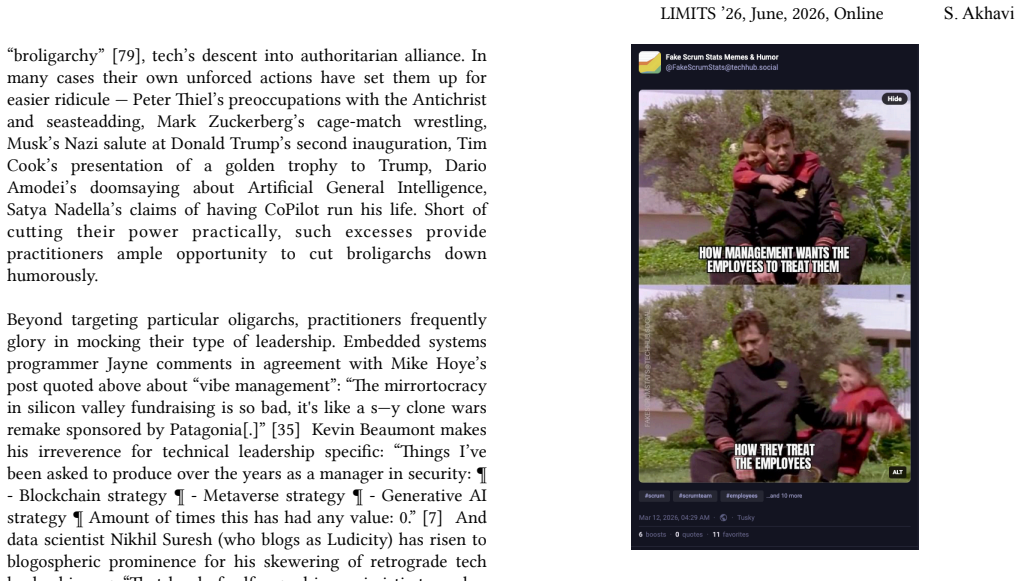
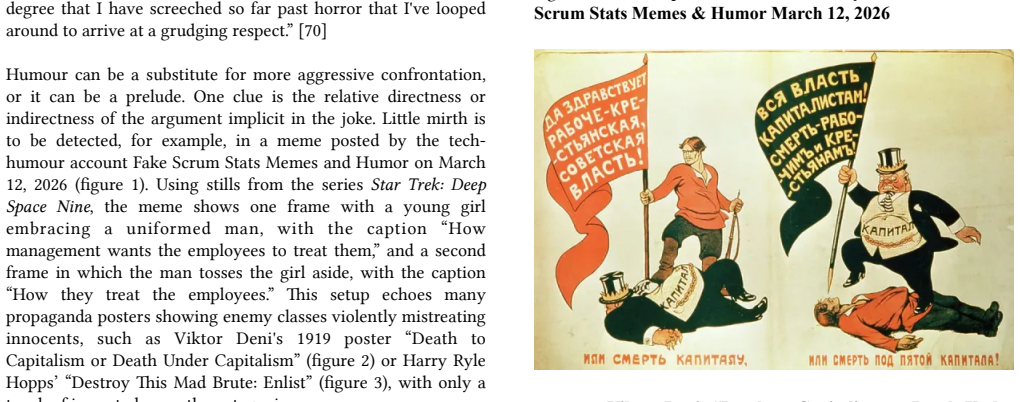
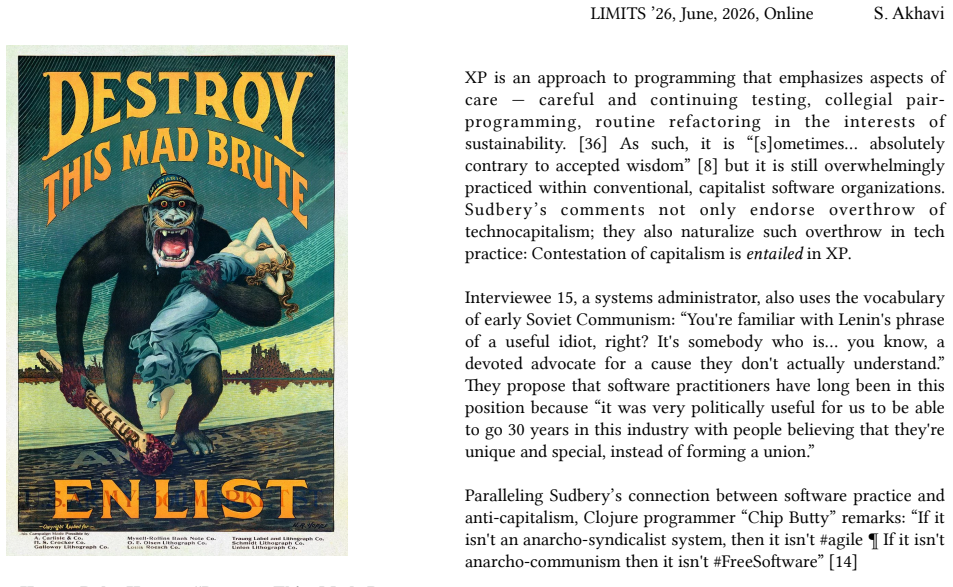
read the original abstract
After decades in which the software industry heroized its technical employees, our current moment finds those employees in crisis. Economically, they are squeezed by a job market that has turned on them since Elon Musk gutted Twitter in 2022. Politically, their craft is continually pressed into the service of an ever tighter alliance between Big Tech and authoritarianism. Professionally, they find themselves less and less able to contribute anything good to anyone within business models that are running out of room to pretend they do anything but extract. Technically, they are confronted with a much-hyped technology, generative AI, that distorts their work while purporting to make them redundant. And emotionally, they are simply not ok - as designer and developer Andrew Sempere puts it, "I think the word I'm looking for is: bereft." This study draws from a series of practitioner interviews undertaken for a current dissertation in STS and from ongoing content analysis of practitioners' public statements on blogs, microblogs, podcasts and videos to argue that much of the workforce of technocapitalism is actively unaligning itself from that system's priorities and seeking new ones. Countercultural responses among practitioners are proliferating, including mockery of technocapitalists and technocapitalism, rehabilitation of Luddism, interest in organized labour, and endorsement of alternate systems including anarchism and communism. Whether software practitioners will form an organized enough response to decisively influence the crises that beset them (and, often through their products, the wider world) remains to be seen. But heightened critical attention should be paid to this centrally-located population of technosocial actors in their new and volatile state.
Editorial analysis
A structured set of objections, weighed in public.
Referee Report
Summary. The paper describes multiple crises confronting software practitioners in technocapitalism (economic squeeze post-2022, alignment with authoritarianism, extractive business models, generative AI disruption, and emotional bereavement) and, drawing on practitioner interviews for an STS dissertation plus content analysis of public statements on blogs, microblogs, podcasts, and videos, claims that much of the workforce is actively unaligning from the system's priorities. It identifies proliferating countercultural responses including mockery of technocapitalists, rehabilitation of Luddism, interest in organized labour, and endorsement of anarchism and communism, while noting that whether these will produce organized influence remains open.
Significance. If the sampled responses prove representative of broader trends, the work would contribute to STS and critical studies of technology by documenting ideological and emotional shifts among a centrally positioned workforce, with potential implications for labor organizing, technology governance, and the societal effects of software systems. The interpretive framing of bereavement and countercultural proliferation offers a lens on practitioner agency that complements quantitative industry surveys.
major comments (2)
- [Abstract] Abstract: The claim that 'much of the workforce of technocapitalism is actively unaligning itself' and that 'countercultural responses among practitioners are proliferating' rests on interviews and content analysis, yet the abstract (and by extension the reported methods) supplies no information on the number of interviews conducted, selection criteria, response rates, sampling frame, or analytical procedures for the content analysis. This absence prevents assessment of whether the observed responses support the generalization beyond the sampled individuals.
- [Abstract] Abstract: Public-statement sources (microblogs, podcasts, videos) are acknowledged as the basis for content analysis, but no steps are described to address selection bias—practitioners who publicly critique technocapitalism are more likely to appear in such corpora—nor is any comparison offered to industry-wide surveys or prevalence metrics that would establish these responses as a significant and growing trend rather than a self-selected minority.
Simulated Author's Rebuttal
We thank the referee for their constructive comments regarding the abstract and the transparency of our empirical basis. We address each point below.
read point-by-point responses
-
Referee: [Abstract] Abstract: The claim that 'much of the workforce of technocapitalism is actively unaligning itself' and that 'countercultural responses among practitioners are proliferating' rests on interviews and content analysis, yet the abstract (and by extension the reported methods) supplies no information on the number of interviews conducted, selection criteria, response rates, sampling frame, or analytical procedures for the content analysis. This absence prevents assessment of whether the observed responses support the generalization beyond the sampled individuals.
Authors: We agree that the abstract does not supply these methodological particulars. The manuscript is a concise interpretive piece drawing on an ongoing STS dissertation; it does not present itself as a statistically representative survey. In revision we will add a short clause to the abstract stating that the claims rest on a qualitative series of practitioner interviews and ongoing content analysis of public statements, and we will explicitly qualify the language to emphasize observed patterns rather than quantified prevalence across the entire workforce. revision: yes
-
Referee: [Abstract] Abstract: Public-statement sources (microblogs, podcasts, videos) are acknowledged as the basis for content analysis, but no steps are described to address selection bias—practitioners who publicly critique technocapitalism are more likely to appear in such corpora—nor is any comparison offered to industry-wide surveys or prevalence metrics that would establish these responses as a significant and growing trend rather than a self-selected minority.
Authors: The referee is correct that public-statement corpora carry inherent selection bias. The paper documents visible countercultural expressions rather than claiming they constitute a majority or statistically significant trend. We will revise the abstract to acknowledge this limitation directly and to frame the contribution as the identification of proliferating responses among practitioners who are already voicing dissent, without asserting industry-wide prevalence. No direct comparison to external surveys appears in the current text because the focus is qualitative; we can note this as a boundary of the present study. revision: yes
Circularity Check
No circularity: interpretive argument from interviews and content analysis
full rationale
The paper advances its central claim—that software practitioners are unaligning from technocapitalism—explicitly as an interpretation of practitioner interviews and public statements on blogs, microblogs, podcasts, and videos. No equations, fitted parameters, predictions, or derivations appear; the text presents the argument as grounded in empirical observations without reducing any step to self-definition, self-citation chains, or renaming of inputs. The absence of mathematical or model-based structure means none of the enumerated circularity patterns (self-definitional, fitted-input-as-prediction, etc.) can be exhibited by quote. The representativeness concern raised by the skeptic is a methodological limitation on generalizability, not a circular reduction of the derivation to its inputs.
Axiom & Free-Parameter Ledger
Reference graph
Works this paper leans on
-
[1]
Sco A d a m s . 1 9 9 5 . Dilbert. Retrieved July 19, 2025 from hps://dilbert- viewer.herokuapp.com/1995-02-05
2025
- [2]
-
[3]
Amazon Employees for Climate Justice. 2025. AI Open Leer. AECJ. Retrieved March 20, 2026 from hps://www.amazonclimatejustice.org/open-leer
2025
-
[4]
Marc Andreessen. 2020. It’s Time to Build. Andreessen Horowitz. Retrieved April 20, 2025 from hps://a16z.com/its-time-to-build/
2020
-
[5]
Marc Andreessen. 2023. e Techno-Optimist Manifesto. Andreessen Horowitz. Retrieved October 25, 2023 from hps://a16z.com/the-techno-optimist- manifesto/
2023
-
[6]
anonymous. 2026. Fesshole 🧻 ( @ f e s s h o l e @ m a s t o d o n . s o c i a l ) . Mastodon. Retrieved March 2, 2026 from hps://mastodon.social/@fesshole/ 116153883462428890
2026
-
[7]
Kevin Beaumont (@GossieDog@cyberplace.social). 2024. ings I’ve been asked to produce over the years as a manager in security: - Blockchain strategy- Metaverse strategy - Generative AI strateg…. Mastodon. Retrieved June 4, 2024 from hps://cyberplace.social/@Gossi eDog/ 112524729500647541 LIMITS ’26, June, 2026, Online S. Akhavi
2024
-
[8]
Kent Beck. 2005. Extreme Programming Explained: Embrace Change. Addison- Wesley, Boston
2005
-
[9]
Martin, Steve Mellor, Ken Schwaber, Jeff Sutherland, and Dave omas
Kent Beck, Mike Beedle, Arie van Bennekum, Alistair Cockburn, Ward Cunningham, Martin Fowler, James Grenning, Jim Highsmith, Andrew Hunt, Ron Jeffries, Jon Kern, Brian Marick, Robert C. Martin, Steve Mellor, Ken Schwaber, Jeff Sutherland, and Dave omas. 2001. Manifesto for Agile Soware Development. Retrieved September 15, 2023 from hp:// agilemanifesto.org/
2001
-
[10]
Ruha Benjamin. 2019. Race Aer Technology: Abolitionist Tools for the New Jim Code (1st edition ed.). Polity, Medford, MA
2019
-
[11]
Greg Bensinger. 2025. Exclusive: Amazon targets as many as 30,000 corporate job cuts, sources say. Reuters. Retrieved March 19, 2026 from hps:// www.reuters.com/business/world-at-work/amazon-targets-many-30000- corporate-job-cuts-sources-say-2025-10-27/
2025
- [12]
- [13]
- [14]
-
[15]
Miguel Afonso Caetano (@remixtures@tldr.neime.org). 2026. "AI models have one undeniable virtue…. Mastodon. Retrieved March 21, 2026 from hps://tldr.ne ime.orghps://tldr.ne ime.org/@remixtures/ 116268159867510833
2026
-
[16]
Danilo Campos. 2024. Sorry, I still want to build technology. Redeem Tomorrow. Retrieved April 14, 2024 from hps://redeem-tomorrow.com/sorry- i-still-want-to-build-technology
2024
-
[17]
Joseph Cox. 2026. Inside ICE’s Tool to Monitor Phones in Entire Neighborhoods. 404 Media. Retrieved January 8, 2026 from hps:// www.404media.co/inside-ices-tool-to-monitor-phones-in-entire- neighborhoods/
2026
-
[18]
Alessandro Delfanti. 2021. e warehouse: workers and robots at Amazon. Pluto Press, London
2021
- [19]
-
[20]
Cory Doctorow. 2023. e ‘Enshiification’ of TikTok. Wired. Retrieved March 27, 2023 from hps://www.wired.com/story/tiktok-platforms-cory-doctorow/
2023
-
[21]
Cory Doctorow. 2023. e proletarianization of tech workers. Medium. Retrieved October 12, 2023 from hps://doctorow.medium.com/the- proletarianization-of-tech-workers-ad0a6b09f7e6
2023
-
[22]
Cory Doctorow. 2024. e moral injury of having your work enshi ified. Medium. Retrieved February 19, 2024 from hps://doctorow.medium.com/the- moral-injury-of-having-your-work-enshiified-2860c586ed44
2024
- [23]
- [24]
-
[25]
Vioria Ellio. 2024. Elon Musk’s Twier Takeover Set Off a R a c e t o t h e Boom. Wired. Retrieved March 19, 2026 from hps://www.wired.com/story/ elon-musk-trust-safety-industry/
2024
-
[26]
Careless, blatantly amateuristic, and lacking any ambition, to put it gently
Wes Fenlon. 2026. Microso uses plagiarized AI slop flowchart to explain how Github works, removes it aer original creator calls it out: “Careless, blatantly amateuristic, and lacking any ambition, to put it gently. ” PC Gamer. Retrieved February 28, 2026 from hps://www.pcgamer.com/soware/ai/microso-uses- plagiarized-ai-slop-flowchart-to-explain-how-git...
2026
-
[27]
Charloe Freitag, Mike Berners-Lee, Kelly Widdicks, Bran Knowles, Gordon S. Blair, and Adrian Friday. 2021. e real climate and transformative impact of ICT: A critique of estimates, trends, and regulations. Paerns 2 , 9 ( 2 0 2 1 ) . hps://doi.org/10.1016/j.paer.2021.100340
- [28]
-
[29]
Grmpyprogrammer (@grmpyprogrammer). 2026. e pinko commie in me… grumpy-learning.com. Retrieved March 14, 2026 from hps://yac.grumpy- learning.com/@grmpyprogrammer/statuses/ 01KKP6FWSA4XDWKJ8GQ0KTE7ST
2026
-
[30]
Jürgen Gueter (tante). 2026. Artisanal care. Smashing Frames. Retrieved March 5, 2026 from hps://tante.cc/2026/03/04/artisanal-care/
2026
- [31]
-
[32]
Connor Hart. 2026. Pinterest to Lay O ff Up to 15% of Workforce in Restructuring. Wall Street Journal. Retrieved March 14, 2026 from hps:// www.wsj.com/business/pinterest-to-lay-o ff-up-to-15-of-workforce-in- restructuring-66a62170
2026
- [33]
-
[34]
IEA. 2025. Energy and AI. Paris. Retrieved March 16, 2026 from hps:// www.iea.org/reports/energy-and-ai
2025
- [35]
-
[36]
Ron Jeffries, Ann Anderson, and Chet Hendrickson. 2001. Extreme Programming Installed. Addison Wesley, Boston
2001
-
[37]
Mike Judge. 2025. Where’s the Shovelware? Why AI Coding Claims Don’t Add Up. Mike Judge. Retrieved December 28, 2025 from hps:// mikelovesrobots.substack.com/p/wheres-the-shovelware-why-ai-coding
2025
-
[38]
Labor Tech Research Network. 2026. Labor Tech Research Network. Retrieved March 8, 2026 from hps://labortechresearchnetwork.org/
2026
- [39]
-
[40]
Steven Levy. 2025. I ought I Knew Silicon Valley. I Was Wrong. Wired. Retrieved February 28, 2026 from hps://www.wired.com/story/silicon-valley- politics-shi/
2025
-
[41]
Ethan Marcoe. 2023. You deserve a tech union ([First edition]. ed.). A Book Apart, New York, New York
2023
-
[42]
Brian Marick. 2009. AR⊗TA: Artisanal Retro-Futurism crossed with Team- Scale Anarcho-Syndicalism. AR⊗TA. Retrieved June 22, 2025 from hp:// arxta.net/explanation.html
2009
-
[43]
Conor McGlynn. 2026. AI and the Myth of the Machine. Compact. Retrieved March 21, 2026 from hps://www.compactmag.com/article/ai-and-the-myth- of-the-machine/
2026
-
[44]
Brian Merchant. 2026. ey just formed the biggest tech worker union in the US. ey plan to rein in AI and curb layoffs. Blood in the Machine. Retrieved May 27, 2026 from hps://www.bloodinthemachine.com/p/they-just-formed- the-biggest-tech
2026
-
[45]
Iris Meredith. 2024. Sam Altman is a dunce. deadSimpleTech. Retrieved April 21, 2025 from hps://deadsimpletech.com/blog/altman_dunce
2024
-
[46]
Gavin Mueller. 2021. Breaking things at work: the Luddites are right about why you hate your job. Verso, London ; New York
2021
-
[47]
Luke Munn. 2019. Alt-right pipeline: Individual journeys to extremism online. First Monday 24, 6 (2019). hps://doi.org/10.5210/fm.v24i6.10108
-
[48]
Naysayers Club. 2026. e Naysayers Club. Retrieved March 9, 2026 from hps://naysayers.club/
2026
-
[49]
Casey Newton. 2023. What we’re learning from the Reddit blackout. Platformer. Retrieved March 21, 2026 from hps://www.platformer.news/what- were-learning-from-the-reddit/
2023
-
[50]
Johnathan Nightingale and Melissa Nightingale. 2025. e poser manifesto. Raw Signal Group. Retrieved April 20, 2025 from hps://www.rawsignal.ca/ newsleer-archive/the-poser-manifesto/
2025
-
[51]
Dare Obasanjo. 2023. e past decade and a half of the tech industry.… Twier. Retrieved September 5, 2023 from hps://twier.com/Carnage4Life/status/ 1635131628573069313
2023
-
[52]
Dare Obasanjo (@carnage4life@mas.to). 2026. I think two things are true…. Mastodon. Retrieved February 27, 2026 from hps://mas.to/@carnage4life/ 116143435828320419
2026
-
[53]
Annie Palmer. 2026. Block shares soar as much as 24% as company slashes workforce by nearly half. CNBC. Retrieved March 14, 2026 from hps:// LIMITS ’26, June, 2026, Online S. Akhavi www.cnbc.com/2026/02/26/block-laying-off-about-4000-employees-nearly- half-of-its-workforce.html
2026
-
[54]
Daniel Pargman and Elina Eriksson. 2023. Exploring Inner Transition: Expanding Computing for Sustainability. In Computing within Limits, June 14,
2023
-
[55]
hps://doi.org/10.21428/bf6269.22dea4ad
LIMITS. hps://doi.org/10.21428/bf6269.22dea4ad
-
[56]
Jay Peters. 2025. Shopify CEO says no new hires without proof AI can’t do the job. e Verge. Retrieved April 10, 2025 from hps://www.theverge.com/news/ 644943/shopify-ceo-memo-ai-hires-job
2025
- [57]
-
[58]
Mihaela Popa-Wya. 2020. Reclamation: Taking Back Control of Words. Grazer philosophische Studien 9 7 , 1 ( 2 0 2 0 ) , 1 5 9 – 1 7 6 . hps://doi.org/ 10.1163/18756735-09701009
-
[59]
Prosocial Tech Website
Prosocial Tech Collab. Prosocial Tech Website. Retrieved March 22, 2026 from hps://prosocialtech.org/
2026
-
[60]
Jamie Powell. 2019. e curious blocking of elonmusk.today. Financial Times. Retrieved July 18, 2025 from hp://alphaville. .com/ 2019/06/26/1561534366000/e-curious-blocking-of-elonmusk-today/
2019
-
[61]
Archibald Pu
“Archibald Pu. ” 1981. Pu’s law and the successful technocrat. Exposition Press, Smithtown, N.Y
1981
-
[62]
rds-level-10.bsky.social. 2026. Bezos can take him for a cruise.… Bluesky. Retrieved March 22, 2026 from hps://bsky.app/pro file/rds- level-10.bsky.social/post/3mhjddhcmhc26
2026
-
[63]
Reuters. 2026. Autodesk cuts 7% of workforce to redirect investments to AI, cloud. Reuters. Retrieved March 14, 2026 from hps://www.reuters.com/ business/world-at-work/autodesk-lay-off-about-7-workforce-2026-01-22/
2026
-
[64]
Janus Rose. 2025. You Can’t Post Your Way Out of Fascism. 404 Media. Retrieved February 23, 2025 from hps://www.404media.co/you-cant-post- your-way-out-of-fascism/
2025
-
[65]
Fergus Ryan, Bethany Allen, Shelly Shih, Stepan Robin, Nathan Arill, Jared Alpert, Astrid Young, and Tilla Hoja. 2025. e party’s AI: How China’s new AI systems are reshaping human rights. Australian Strategic Policy Institute, Barton, Australia. Retrieved March 3, 2026 from hps://aspi.s3.ap- southeast-2.amazonaws.com/wp-content/uploads/2025/11/27122307...
2025
-
[66]
Nick Seaver. 2019. Captivating algorithms: Recommender systems as traps. Journal of Material Culture 24, 4 (2019), 421–436
2019
-
[67]
Andrew Sempere. 2026. Don’t die lil thing. Feral Research. Retrieved February 6, 2026 from hps://feralresearch.org/newsleer/dont-die-lil-thing/
2026
-
[68]
Adam Serwer. 2025. Americans Are Trapped in an Algorithmic Cage. e Atlantic. Retrieved April 6, 2025 from hps://www.theatlantic.com/ideas/ archive/2025/02/trump-administration-voter-perception/681598/
2025
-
[69]
Nick Srnicek. 2017. Platform capitalism. Polity Press, Cambridge, UK
2017
-
[70]
Using AI is no longer optional
Ashley Stewart. 2025. Microso pushes staff to use internal AI tools more, and may consider this in reviews. “Using AI is no longer optional. ” Business Insider. Retrieved June 28, 2025 from hps://www.businessinsider.com/microso- internal-memo-using-ai-no-longer-optional-github-copilot-2025-6
2025
-
[71]
Nikhil Suresh (Lucidity). 2024. Leadership Is A Hell Of A Drug. Ludicity. Retrieved May 16, 2024 from hps://ludic.mataroa.blog/blog/leadership-is-a- hell-of-a-drug/
2024
-
[72]
Every Way Twier Has Goen Worse Since It Became ‘X
Paul Tassi. Every Way Twier Has Goen Worse Since It Became ‘X. ’ Forbes. Retrieved March 18, 2026 from hps://www.forbes.com/sites/paultassi/ 2024/05/29/every-way-twier-has-goen-worse-since-it-became-x/
2026
-
[73]
David Van Dijcke, Florian Gunsilius, and Austin Wright. 2024. Return to Office and the Tenure Distribution. hps://doi.org/10.48550/arXiv.2405.04352
-
[74]
Tom Warren. 2022. Elon Musk demands Twi er employees commit to ‘extremely hardcore’ culture or leave. e Verge. Retrieved May 2, 2024 from hps://www.theverge.com/2022/11/16/23462026/elon-musk-twi er-email- hardcore-or-severance
2022
-
[75]
Molly White. 2023. Effective obfuscation. Citation Needed. Retrieved November 26, 2023 from hps://newsleer.mollywhite.net/p/effective-obfuscation
2023
-
[76]
Eileen Yu. 2024. Australia slams Twier (now X) for 80% cut in trust and safety engineers. ZDNET. Retrieved March 19, 2026 from hps://www.zdnet.com/ article/australia-slams-twier-now-x-for-80-cut-in-trust-and-safety-engineers/
2024
-
[77]
Shoshana Zuboff. 1988. In the age of the smart machine: the future of work and power. Basic Books, New York
1988
-
[78]
2011. Love and Power. All Watched Over by Machines of Loving Grace . Retrieved April 10, 2022 from hps://vimeo.com/24737728
-
[79]
Im Schaen der Netzwelt ( e Cleaners)
2018. Im Schaen der Netzwelt ( e Cleaners). Gebrueder Beetz Filmproduktion, Grifa Filmes, Westdeutscher Rundfunk (WDR)
2018
-
[80]
is is what a digital coup looks like
2025. is is what a digital coup looks like . Retrieved April 19, 2025 from hps://www.ted.com/talks/ carole_cadwalladr_this_is_what_a_digital_coup_looks_like
2025
discussion (0)
Sign in with ORCID, Apple, or X to comment. Anyone can read and Pith papers without signing in.