SHARP -- A spectrograph proposal to fully exploit ELT capabilities and look beyond JWST
Pith reviewed 2026-07-01 01:52 UTC · model grok-4.3
The pith
SHARP proposes a near-infrared spectrograph for the ELT that uses two specialized units to achieve observations sharper and deeper than JWST.
A machine-rendered reading of the paper's core claim, the machinery that carries it, and where it could break.
Core claim
The central claim is that the optical design solutions developed for NEXUS, a multi-object spectrograph optimized for the faintest sources, and VESPER, a multi-object integral field unit for brighter targets, will deliver the angular resolution and sensitivity required to tackle major astrophysics and cosmology questions with the ELT.
What carries the argument
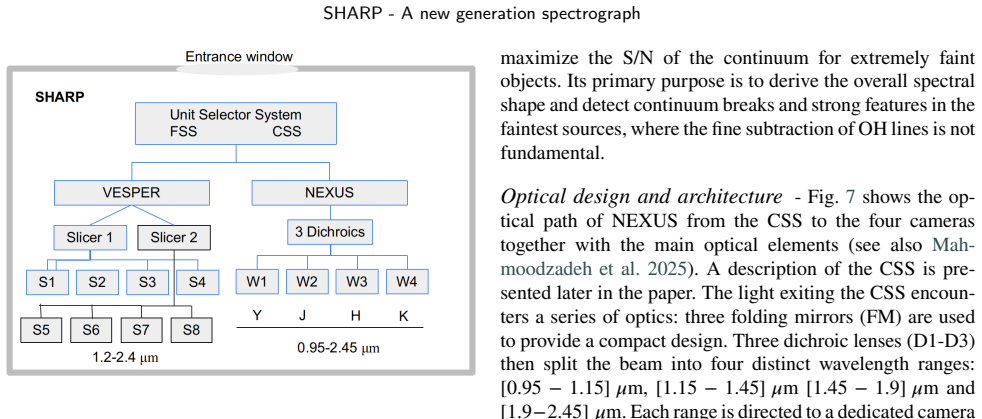
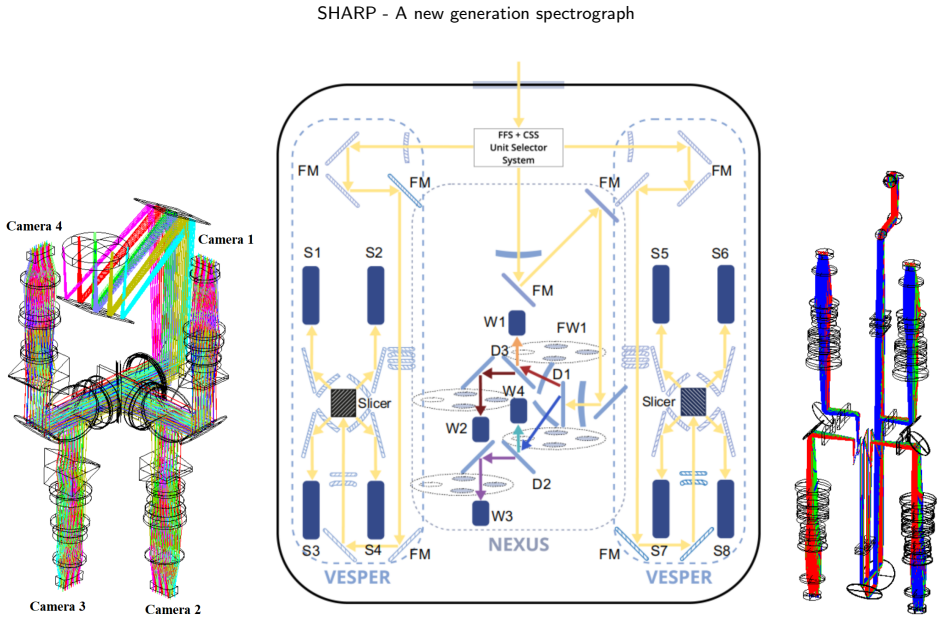
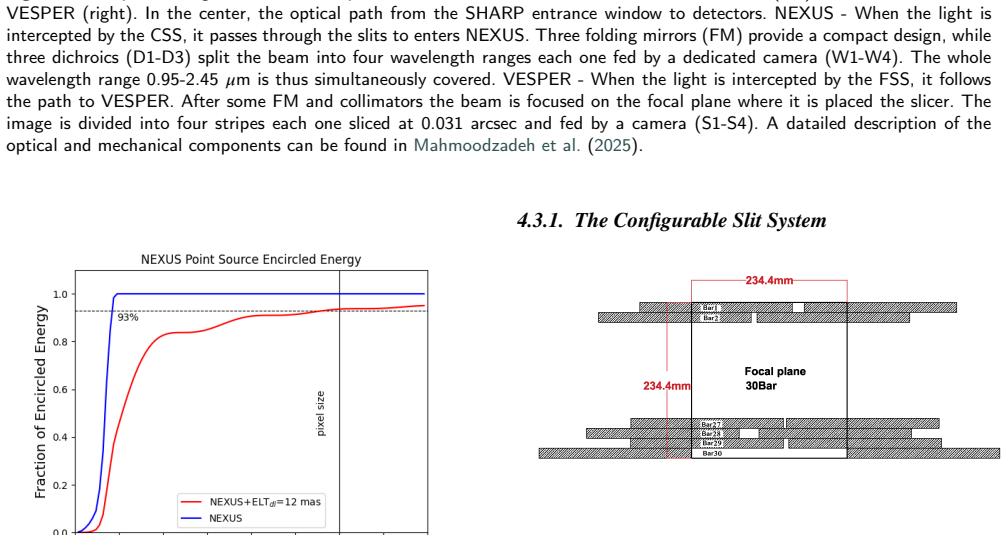
SHARP instrument concept consisting of NEXUS (multi-object spectrograph for faint sources) and VESPER (multi-object integral field unit for brighter sources), both operating in the 0.95-2.45 micron range.
If this is right
- Detection of the faintest high-redshift sources becomes possible across large fields with the multi-object mode.
- Detailed spectroscopy of brighter nearby objects in dust-enshrouded regions is enabled by the integral field unit mode.
- Observations can connect the formation of young stellar objects and planetary systems with the properties of distant galaxies.
- The instrument meets the performance goals set by the ELT's collecting area and resolution capabilities.
Where Pith is reading between the lines
- The dual-unit split could serve as a template for optimizing spectrographs on other extremely large telescopes where source brightness varies widely.
- Specific science cases such as measuring chemical abundances in primordial galaxies could be quantified more precisely once detailed throughput calculations are available.
- Combining the two units might allow efficient survey strategies that alternate between deep MOS pointings and IFU follow-up on the same field.
Load-bearing premise
The optical designs for the two units will actually deliver the angular resolution and sensitivity needed when used with the ELT's adaptive optics system.
What would settle it
An end-to-end performance simulation or laboratory test of the NEXUS or VESPER optics that shows the achieved sensitivity or resolution falls below the threshold required to detect the faintest high-redshift galaxies targeted by the science case.
Figures
read the original abstract
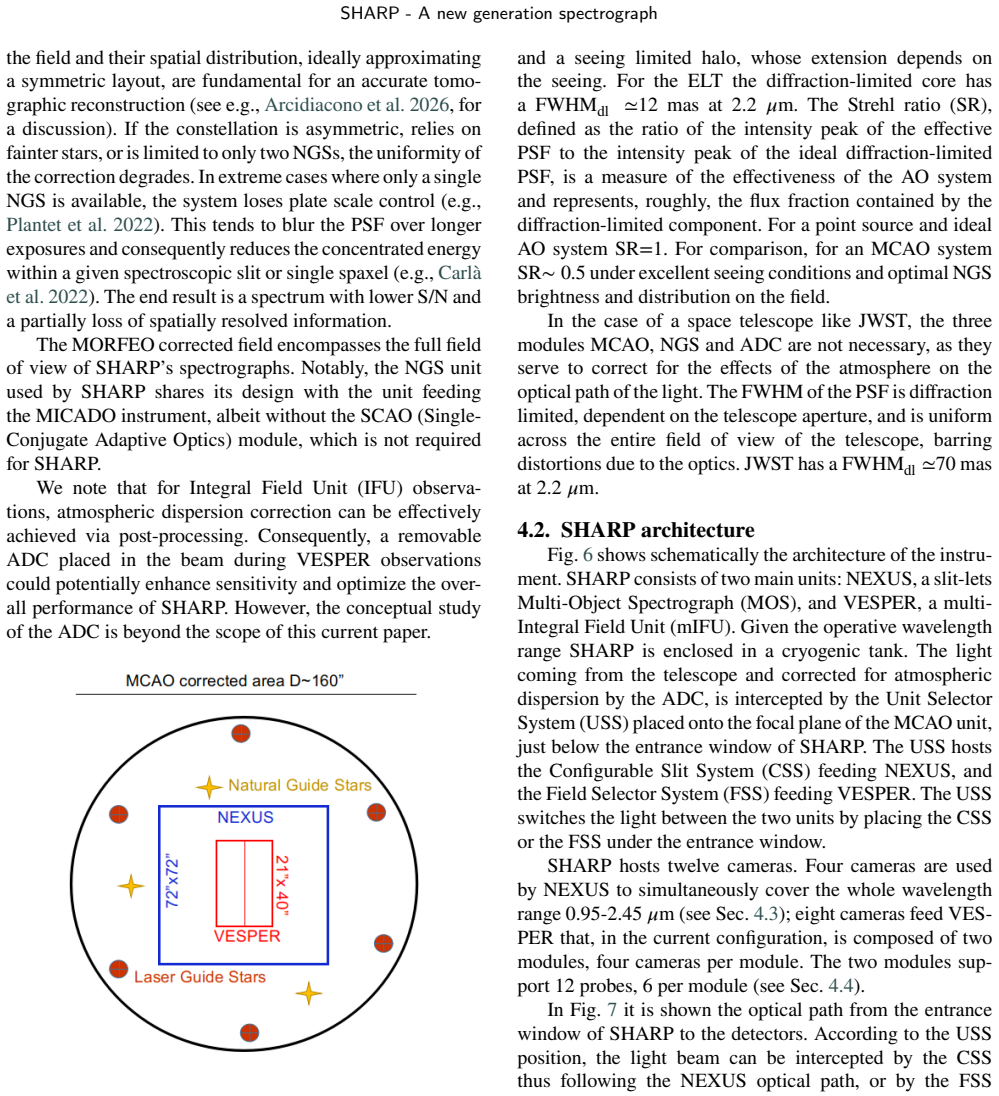
The Extremely Large Telescopes (ELTs), with their large apertures and cutting-edge Multi-Conjugate Adaptive Optics (MCAO) systems, promise to deliver data that is both sharper and deeper than even the James Webb Space Telescope (JWST) across large fields. SHARP is a concept study for a near-IR (0.95-2.45 $\mu$m) spectrograph specifically designed to fully exploit the collecting area and angular resolution capabilities of the upcoming ESO's ELT. The instrument concept is driven by the goal of tackling the most important questions in astrophysics and cosmology, from exploring primordial galaxies to studying the formation of young stellar object and planetary systems in the nearby dust-enshrouded regions, bridging the gap between the local and the distant Universe. This requires versatility to accommodate diverse observational needs. SHARP is composed of two main units: NEXUS, a Multi-Object Spectrograph (MOS) optimized for detecting the faintest sources, and VESPER, a multi-object Integral Field Unit (multi-IFU) designed for brighter ones. This article provides an overview of the scientific design drivers, the solutions developed to meet them, and the resulting optical design that achieves the required performance.
Editorial analysis
A structured set of objections, weighed in public.
Referee Report
Summary. The manuscript presents the SHARP near-IR (0.95-2.45 μm) spectrograph concept for the ELT, driven by science cases spanning primordial galaxies to nearby star and planet formation. It describes a dual-unit architecture: NEXUS (MOS optimized for faintest sources) and VESPER (multi-IFU for brighter sources), with optical design solutions developed to exploit ELT MCAO angular resolution and sensitivity, claiming these achieve the required performance to bridge local and distant universe observations.
Significance. If the designs deliver the stated resolution and sensitivity, SHARP would provide a versatile facility instrument enabling key ELT science beyond JWST reach across large fields. The separation into faint-source MOS and brighter-source multi-IFU units is a pragmatic response to diverse observational needs. However, the manuscript supplies no quantitative performance predictions, error budgets, or verification data, so the significance remains prospective rather than demonstrated.
major comments (2)
- [Abstract and instrument concept paragraph] Abstract, final sentence, and instrument-concept paragraph: the assertion that the optical design 'achieves the required performance' is load-bearing for the central claim yet is unsupported by any error budgets, throughput calculations, Strehl predictions, or sensitivity simulations. The reader's weakest assumption (that NEXUS/VESPER solutions will deliver the needed resolution and sensitivity with the MCAO system) therefore rests on unshown engineering work.
- [Scientific design drivers] Scientific design drivers section (implied by abstract): no quantitative comparison to JWST or existing ELT instruments is given to substantiate how the dual-unit architecture meets the stated goals of detecting faintest sources while handling brighter ones across the 0.95-2.45 μm range.
minor comments (2)
- The manuscript would benefit from explicit tables or figures showing the optical layouts, resolving power, and field coverage for NEXUS and VESPER separately.
- Clarify whether the two units share a common fore-optics path or operate independently, and state the assumed MCAO performance parameters used in the design.
Simulated Author's Rebuttal
We thank the referee for their constructive review of our manuscript on the SHARP spectrograph concept. We address the major comments point by point below, noting where revisions will be made to improve clarity and support for the claims.
read point-by-point responses
-
Referee: [Abstract and instrument concept paragraph] Abstract, final sentence, and instrument-concept paragraph: the assertion that the optical design 'achieves the required performance' is load-bearing for the central claim yet is unsupported by any error budgets, throughput calculations, Strehl predictions, or sensitivity simulations. The reader's weakest assumption (that NEXUS/VESPER solutions will deliver the needed resolution and sensitivity with the MCAO system) therefore rests on unshown engineering work.
Authors: We agree that the current text asserts performance achievement without presenting supporting quantitative analyses such as error budgets or simulations, which is a valid observation for a concept overview paper. The optical designs were developed to meet the stated requirements based on preliminary engineering considerations, but these details are not included in the manuscript. We will revise the wording in the abstract and instrument-concept section to indicate that the designs are intended to achieve the required performance, and we will add a short summary of high-level performance expectations (e.g., resolution and sensitivity targets) to better substantiate the claims. revision: yes
-
Referee: [Scientific design drivers] Scientific design drivers section (implied by abstract): no quantitative comparison to JWST or existing ELT instruments is given to substantiate how the dual-unit architecture meets the stated goals of detecting faintest sources while handling brighter ones across the 0.95-2.45 μm range.
Authors: The manuscript prioritizes the science drivers and the rationale for the dual-unit (NEXUS MOS and VESPER multi-IFU) architecture to address the range of source brightnesses and the ELT MCAO capabilities. However, we acknowledge that explicit quantitative comparisons would strengthen the justification. We will incorporate a concise comparison table or paragraph in the scientific design drivers section, highlighting advantages in sensitivity, field coverage, and wavelength range relative to JWST and instruments such as HARMONI. revision: yes
Circularity Check
No significant circularity; instrument concept paper with no derivations or self-referential claims
full rationale
The paper is a forward-looking instrument concept study describing the SHARP spectrograph design (NEXUS MOS and VESPER multi-IFU units) to meet ELT MCAO goals for specified science cases. No equations, fitted parameters, predictions, or derivation chains are present that could reduce to inputs by construction. No self-citations are invoked as load-bearing uniqueness theorems or ansatzes. The central claims are design choices framed as solutions developed to address requirements, with performance presented as the outcome of the design process rather than an internal tautology. This is self-contained against external benchmarks (ELT capabilities, JWST comparison) with no internal circularity.
Axiom & Free-Parameter Ledger
Reference graph
Works this paper leans on
-
[1]
L., & Norman, M
Abel, T., Bryan, G. L., & Norman, M. L. 2002, Science, 295, 93 Alcalá, J. M., Manara, C. F., Natta, A., et al. 2017, A&A, 600, A20
2002
-
[2]
2025, The Open Journal of Astrophysics, 8, 54
Allen, M., Anania, R., Andersen, M., et al. 2025, The Open Journal of Astrophysics, 8, 54
2025
-
[3]
2025, ApJ, 978, 90 Arcidiacono,C.,Portaluri,E.,Gullieuszik,M.,etal.2026,NewAstronomy, 126, 102559
Antwi-Danso, J., Papovich, C., Esdaile, J., et al. 2025, ApJ, 978, 90 Arcidiacono,C.,Portaluri,E.,Gullieuszik,M.,etal.2026,NewAstronomy, 126, 102559
2025
-
[4]
T., Chan, J
Beifiori, A., Mendel, J. T., Chan, J. C. C., et al. 2017, ApJ, 846, 120
2017
-
[5]
L., et al
Belli, S., Park, M., Davies, R. L., et al. 2024, Nature, 630, 54
2024
-
[6]
2026, ApJ, 997, 189
Bevacqua, D., Marchesini, D., Saracco, P., et al. 2026, ApJ, 997, 189
2026
-
[7]
2024, A&A, 690, A150
Bevacqua, D., Saracco, P., Boecker, A., et al. 2024, A&A, 690, A150
2024
-
[8]
2026, New Astronomy, 126, 102563
Bisogni, S., Vietri, G., Piconcelli, E., et al. 2026, New Astronomy, 126, 102563
2026
-
[9]
2023, Nature Astronomy, 7, 731
Boylan-Kolchin, M. 2023, Nature Astronomy, 7, 731
2023
-
[10]
2008, MNRAS, 383, 93 Bruzual A., G
Boylan-Kolchin, M., Ma, C.-P., & Quataert, E. 2008, MNRAS, 383, 93 Bruzual A., G. 1983, ApJ, 273, 105
2008
-
[11]
2024, in Society of Photo- Optical Instrumentation Engineers (SPIE) Conference Series, Vol
Burgett, W., Bernstein, R., Ashby, D., et al. 2024, in Society of Photo- Optical Instrumentation Engineers (SPIE) Conference Series, Vol. 13094, Ground-based and Airborne Telescopes X, ed. H. K. Marshall, J. Spyromilio, & T. Usuda, 1309417
2024
-
[12]
2013, ApJL, 778, L2 Carlà,G.,Plantet,C.,Busoni,L.,&Agapito,G.2022,MNRAS,516,3837
Cappellari, M. 2013, ApJL, 778, L2 Carlà,G.,Plantet,C.,Busoni,L.,&Agapito,G.2022,MNRAS,516,3837
2013
-
[13]
2019, MNRAS, 485, 382
Carleton, T., Errani, R., Cooper, M., et al. 2019, MNRAS, 485, 382
2019
-
[14]
C., Cullen, F., McLure, R
Carnall, A. C., Cullen, F., McLure, R. J., et al. 2024, MNRAS, 534, 325
2024
-
[15]
2014, ApJ, 792, 95
Choi, J., Conroy, C., Moustakas, J., et al. 2014, ApJ, 792, 95
2014
-
[16]
L., Boylan-Kolchin, M., et al
Chworowsky, K., Finkelstein, S. L., Boylan-Kolchin, M., et al. 2024, AJ, 168, 113
2024
-
[17]
Ciliegi, P., Agapito, G., Aliverti, M., et al. 2021, The Messenger, 182, 13 Ciliegi,P.,Agapito,G.,Aliverti,M.,etal.2024,inSocietyofPhoto-Optical InstrumentationEngineers(SPIE)ConferenceSeries,Vol.13097,Adap- tive Optics Systems IX, ed. K. J. Jackson, D. Schmidt, & E. Vernet, 1309722
2021
-
[18]
2002, A&A, 381, L68
Cimatti, A., Daddi, E., Mignoli, M., et al. 2002, A&A, 381, L68
2002
-
[19]
2022, MNRAS, 513, 2535
Concas, A., Maiolino, R., Curti, M., et al. 2022, MNRAS, 513, 2535
2022
-
[20]
& van Dokkum, P
Conroy, C. & van Dokkum, P. G. 2012, ApJ, 760, 71
2012
-
[21]
Daddi, E., Cimatti, A., Pozzetti, L., et al. 2000, A&A, 361, 535 Davies,R.,Alves,J.,Clénet,Y.,etal.2018,inSocietyofPhoto-OpticalIn- strumentationEngineers(SPIE)ConferenceSeries,Vol.10702,Ground- basedandAirborneInstrumentationforAstronomyVII,ed.C.J.Evans, L. Simard, & H. Takami, 107021S
2000
-
[22]
2021, The Messenger, 182, 17 de Lucia, G
Davies, R., Hörmann, V., Rabien, S., et al. 2021, The Messenger, 182, 17 de Lucia, G. 2013, in Planets, Stars and Stellar Systems. Volume 6: P. Saracco, et al.:Preprint submitted to ElsevierPage 17 of 19 SHARP - A new generation spectrograph ExtragalacticAstronomyandCosmology,ed.T.D.Oswalt&W.C.Keel, Vol. 6, 451 De Lucia, G., Springel, V., White, S. D. M.,...
2021
-
[23]
& Davis, M
Djorgovski, S. & Davis, M. 1987, ApJ, 313, 59
1987
-
[24]
1987, ApJ, 313, 42
Dressler, A., Lynden-Bell, D., Burstein, D., et al. 1987, ApJ, 313, 42
1987
-
[25]
M., Allen, L
Dunham, M. M., Allen, L. E., Evans, II, N. J., et al. 2015, ApJS, 220, 11
2015
-
[26]
J., Dunham, M
Evans, II, N. J., Dunham, M. M., Jørgensen, J. K., et al. 2009, ApJS, 181, 321
2009
-
[27]
Gallazzi, A., Charlot, S., Brinchmann, J., White, S. D. M., & Tremonti, C. A. 2005, MNRAS, 362, 41
2005
-
[28]
P., Mather, J
Gardner, J. P., Mather, J. C., Abbott, R., et al. 2023, PASP, 135, 068001 Gargiulo,A.,Mancini,C.,Ditrani,F.R.,etal.2026,NewAstronomy,127, 102578 Garzón, F., Balcells, M., Gallego, J., et al. 2022, Astronomy and Astro- physics, 667, A107, aDS Bibcode: 2022A&A...667A.107G
2023
-
[29]
& Spyromilio, J
Gilmozzi, R. & Spyromilio, J. 2007, The Messenger, 127, 11
2007
-
[30]
2024, Nature, 628, 277
Glazebrook, K., Nanayakkara, T., Schreiber, C., et al. 2024, Nature, 628, 277
2024
-
[31]
2017, Nature, 544, 71
Glazebrook, K., Schreiber, C., Labbé, I., et al. 2017, Nature, 544, 71
2017
-
[32]
2018, MNRAS, 478, 1795
Hartwig, T., Yoshida, N., Magg, M., et al. 2018, MNRAS, 478, 1795
2018
-
[33]
2004, in Society of Photo- OpticalInstrumentationEngineers(SPIE)ConferenceSeries,Vol.5492, Ground-based Instrumentation for Astronomy, ed
Henault, F., Bacon, R., Dekker, H., et al. 2004, in Society of Photo- OpticalInstrumentationEngineers(SPIE)ConferenceSeries,Vol.5492, Ground-based Instrumentation for Astronomy, ed. A. F. M. Moorwood & M. Iye, 909–920
2004
-
[34]
2004, in Society of Photo- OpticalInstrumentationEngineers(SPIE)ConferenceSeries,Vol.5487,
Henein, S., Spanoudakis, P., Schwab, P., et al. 2004, in Society of Photo- OpticalInstrumentationEngineers(SPIE)ConferenceSeries,Vol.5487,
2004
-
[35]
P., van der Wel, A., Kelson, D
Holden, B. P., van der Wel, A., Kelson, D. D., Franx, M., & Illingworth, G. D. 2010, ApJ, 724, 714
2010
-
[36]
Hopkins, A. M. 2018, PASA, 35, e039 Huertas-Company,M.,Shuntov,M.,Dong,Y.,etal.2025,A&A,704,A94 Jakobsen,P.,Ferruit,P.,AlvesdeOliveira,C.,etal.2022,A&A,661,A80
2018
-
[37]
2006, in Society of Photo-Optical Instrumentation Engineers (SPIE)ConferenceSeries,Vol.6267,Ground-basedandAirborneTele- scopes, ed
Johns, M. 2006, in Society of Photo-Optical Instrumentation Engineers (SPIE)ConferenceSeries,Vol.6267,Ground-basedandAirborneTele- scopes, ed. L. M. Stepp, 626729 Jørgensen, I. & Chiboucas, K. 2013, AJ, 145, 77 Jørgensen, I., Chiboucas, K., Toft, S., et al. 2014, AJ, 148, 117
2006
-
[38]
S., Devriendt, J., & Slyz, A
Katz, H., Kimm, T., Ellis, R. S., Devriendt, J., & Slyz, A. 2023, MNRAS, 524, 351
2023
-
[39]
Kennicutt, Jr., R. C. 1998, ARA&A, 36, 189
1998
-
[40]
Krishnan, J. R. & Abazajian, K. N. 2026, Physical Review D, 113, 083007 La Barbera, F., Ferreras, I., Vazdekis, A., et al. 2013, MNRAS, 433, 3017 La Barbera, F., Vazdekis, A., Ferreras, I., et al. 2019, MNRAS, 489, 4090
2026
-
[41]
M., Mainieri, V., et al
Lamperti, I., Harrison, C. M., Mainieri, V., et al. 2021, A&A, 654, A90
2021
-
[42]
J., D’Eugenio, F., Piotrowska, J
Looser, T. J., D’Eugenio, F., Piotrowska, J. M., et al. 2024, MNRAS, 532, 2832
2024
-
[43]
2025, Journal of Astronomical Telescopes, Instruments, and Systems, 11, 035002
Mahmoodzadeh, H., Saracco, P., Conconi, P., et al. 2025, Journal of Astronomical Telescopes, Instruments, and Systems, 11, 035002
2025
-
[44]
2010, MNRAS, 407, 1003
Maio, U., Ciardi, B., Dolag, K., Tornatore, L., & Khochfar, S. 2010, MNRAS, 407, 1003
2010
-
[45]
F., Frasca, A., Venuti, L., et al
Manara, C. F., Frasca, A., Venuti, L., et al. 2021, A&A, 650, A196
2021
-
[46]
2026, New Astronomy, 127, 102580
Mancini, C., Gargiulo, A., Renzini, A., et al. 2026, New Astronomy, 127, 102580
2026
-
[47]
2023, ApJL, 942, L25
Marchesini, D., Brammer, G., Morishita, T., et al. 2023, ApJL, 942, L25
2023
-
[48]
2024, in Society of Photo- Optical Instrumentation Engineers (SPIE) Conference Series, Vol
Marconi, A., Abreu, M., Adibekyan, V., et al. 2024, in Society of Photo- Optical Instrumentation Engineers (SPIE) Conference Series, Vol. 13096, Ground-based and Airborne Instrumentation for Astronomy X, ed. J. J. Bryant, K. Motohara, & J. R. D. Vernet, 1309613
2024
-
[49]
& Tornambe, A
Matteucci, F. & Tornambe, A. 1987, A&A, 185, 51 McCarthy,P.J.,Carlberg,R.G.,Chen,H.-W.,etal.2001,ApJL,560,L131
1987
-
[50]
M., Alatalo, K., Blitz, L., et al
McDermid, R. M., Alatalo, K., Blitz, L., et al. 2015, MNRAS, 448, 3484
2015
-
[51]
S., Steidel, C
McLean, I. S., Steidel, C. C., Epps, H. W., et al. 2012, in Society of Photo- OpticalInstrumentationEngineers(SPIE)ConferenceSeries,Vol.8446, Ground-basedandAirborneInstrumentationforAstronomyIV,ed.I.S
2012
-
[52]
& Maiolino, R
Nakajima, K. & Maiolino, R. 2022, MNRAS, 513, 5134
2022
-
[53]
M., et al
Nisini, B., Antoniucci, S., Alcalá, J. M., et al. 2018, A&A, 609, A87
2018
-
[54]
P., Naab, T., Johansson, P
Oser, L., Ostriker, J. P., Naab, T., Johansson, P. H., & Burkert, A. 2010, ApJ, 725, 2312
2010
-
[55]
2018, MNRAS, 477, 3954
Parikh, T., Thomas, D., Maraston, C., et al. 2018, MNRAS, 477, 3954
2018
-
[56]
2021, MNRAS, 508, 6176 Pelló, R., Puech, M., Prieto, É., et al
Park, J., Ricotti, M., & Sugimura, K. 2021, MNRAS, 508, 6176 Pelló, R., Puech, M., Prieto, É., et al. 2024, in Society of Photo-Optical In- strumentationEngineers(SPIE)ConferenceSeries,Vol.13096,Ground- based and Airborne Instrumentation for Astronomy X, ed. J. J. Bryant, K. Motohara, & J. R. D. Vernet, 1309615
2021
-
[57]
J., Kovač, K., et al
Peng, Y.-j., Lilly, S. J., Kovač, K., et al. 2010, ApJ, 721, 193 Pérez-González, P. G., D’Eugenio, F., Rodríguez del Pino, B., et al. 2025, Nature Astronomy, 9, 1240
2010
-
[58]
V., Espaillat, C
Pittman, C. V., Espaillat, C. C., Robinson, C. E., et al. 2022, AJ, 164, 201
2022
-
[59]
2022, Journal of Astronomical
Plantet, C., Neichel, B., Agapito, G., et al. 2022, Journal of Astronomical
2022
-
[60]
Polletta, M. d. C., De Lucia, G., Gallazzi, A. R., & Mancini, C. 2026, New Astronomy, 127, 102561 Portegies Zwart, S. F., McMillan, S. L. W., & Gieles, M. 2010, ARA&A, 48, 431 Puskás, D., Tacchella, S., Simmonds, C., et al. 2025, MNRAS, 540, 2146
2026
-
[61]
P., Opitsch, M., Erwin, P., et al
Saglia, R. P., Opitsch, M., Erwin, P., et al. 2016, ApJ, 818, 47
2016
-
[62]
2024, in Society of Photo-Optical Instrumentation Engineers (SPIE) Conference Series, Vol.13096,Ground-basedandAirborneInstrumentationforAstronomy X, ed
Saracco, P., Conconi, P., Arcidiacono, C., et al. 2024, in Society of Photo-Optical Instrumentation Engineers (SPIE) Conference Series, Vol.13096,Ground-basedandAirborneInstrumentationforAstronomy X, ed. J. J. Bryant, K. Motohara, & J. R. D. Vernet, 130965I
2024
-
[63]
2017, A&A, 597, A122 Saracco,P.,LaBarbera,F.,DePropris,R.,etal.2023,MNRAS,520,3027
Saracco, P., Gargiulo, A., Ciocca, F., & Marchesini, D. 2017, A&A, 597, A122 Saracco,P.,LaBarbera,F.,DePropris,R.,etal.2023,MNRAS,520,3027
2017
-
[64]
2003, A&A, 398, 127
Saracco, P., Longhetti, M., Severgnini, P., et al. 2003, A&A, 398, 127
2003
-
[65]
2020, ApJ, 905, 40
Saracco, P., Marchesini, D., La Barbera, F., et al. 2020, ApJ, 905, 40
2020
-
[66]
2003, A&A, 397, 527
Schaerer, D. 2003, A&A, 397, 527
2003
-
[67]
B., Paquereau, L., et al
Shuntov, M., Akins, H. B., Paquereau, L., et al. 2025, A&A, 704, A339
2025
-
[68]
Smith, R. J. 2020, ARA&A, 58, 577
2020
-
[69]
Smith, W. J. 1990, Modern optical engineering. The design of optical systems
1990
-
[70]
2008, in Society of Photo- OpticalInstrumentationEngineers(SPIE)ConferenceSeries,Vol.7018, Advanced Optical and Mechanical Technologies in Telescopes and Instrumentation, ed
Spanoudakis, P., Giriens, L., Henein, S., et al. 2008, in Society of Photo- OpticalInstrumentationEngineers(SPIE)ConferenceSeries,Vol.7018, Advanced Optical and Mechanical Technologies in Telescopes and Instrumentation, ed. E. Atad-Ettedgui & D. Lemke, 70180I Spiniello,C.,Trager,S.,Koopmans,L.V.E.,&Conroy,C.2014,MNRAS, 438, 1483
2008
-
[71]
Springel, V., White, S. D. M., Jenkins, A., et al. 2005, Nature, 435, 629
2005
-
[72]
2020, in Society of Photo- Optical Instrumentation Engineers (SPIE) Conference Series, Vol
Tanaka, I., Ebizuka, N., Motohara, K., et al. 2020, in Society of Photo- Optical Instrumentation Engineers (SPIE) Conference Series, Vol. 11451, Advances in Optical and Mechanical Technologies for Tele- scopes and Instrumentation IV, ed. R. Navarro & R. Geyl, 114515A
2020
-
[73]
2019, ApJL, 885, L34
Tanaka, M., Valentino, F., Toft, S., et al. 2019, ApJL, 885, L34
2019
-
[74]
A., Melotte, D., Neichel, B., et al
Thatte, N. A., Melotte, D., Neichel, B., et al. 2024, in Society of Photo- Optical Instrumentation Engineers (SPIE) Conference Series, Vol. 13096, Ground-based and Airborne Instrumentation for Astronomy X, ed. J. J. Bryant, K. Motohara, & J. R. D. Vernet, 1309614 Thomas,D.,Maraston,C.,Bender,R.,&MendesdeOliveira,C.2005,ApJ, 621, 673
2024
-
[75]
2010, MNRAS, 404, 1775 Thompson,D.,Beckwith,S.V.W.,Fockenbrock,R.,etal.1999,ApJ,523, 100
Thomas, D., Maraston, C., Schawinski, K., Sarzi, M., & Silk, J. 2010, MNRAS, 404, 1775 Thompson,D.,Beckwith,S.V.W.,Fockenbrock,R.,etal.1999,ApJ,523, 100
2010
-
[76]
V., Lim, S., et al
Toloba, E., Sales, L. V., Lim, S., et al. 2023, ApJ, 951, 77 Trussler,J.A.A.,Conselice,C.J.,Adams,N.J.,etal.2023,MNRAS,525, 5328 van der Wel, A., Franx, M., van Dokkum, P. G., et al. 2014, ApJ, 788, 28 van Dishoeck, E. F., Tychoniec, Ł., Rocha, W. R. M., et al. 2025, A&A, 699, A361 van Dokkum, P. G., Abraham, R., Merritt, A., et al. 2015, ApJL, 798, L45 V...
2023
-
[77]
2023, A& A, 678, A173
Vanzella, E., Loiacono, F., Bergamini, P., et al. 2023, A& A, 678, A173
2023
-
[78]
2024, The Messenger, 192, 6
Vernet, E., Cayrel, M., Cirasuolo, M., et al. 2024, The Messenger, 192, 6
2024
-
[79]
2026, New Astronomy, 127, 102577
Vietri, G., Bisogni, S., Piconcelli, E., et al. 2026, New Astronomy, 127, 102577
2026
-
[80]
Winter, A. J. & Haworth, T. J. 2022, European Physical Journal Plus, 137, 1132
2022
discussion (0)
Sign in with ORCID, Apple, or X to comment. Anyone can read and Pith papers without signing in.