Theory and practice of Trotter product formulas for quantum chemistry
Pith reviewed 2026-07-01 02:13 UTC · model grok-4.3
The pith
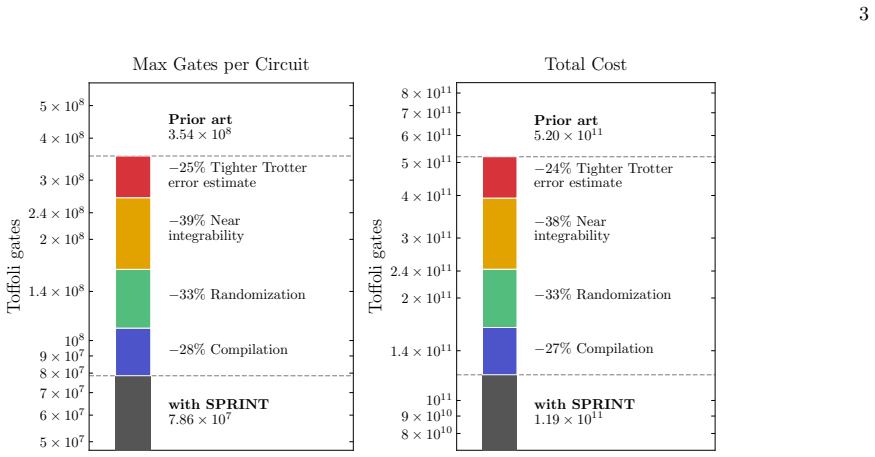
SPRINT Trotter formulas reduce Toffoli gate costs by a factor of 4.5 for quantum chemistry simulations of Li4Mn2O.
A machine-rendered reading of the paper's core claim, the machinery that carries it, and where it could break.
Core claim
The authors establish that Symmetry-Protected Randomized near-Integrable Trotter (SPRINT) formulas, by integrating a generalization of classical near-integrability, randomization, symmetry protection, use of QROM, and other techniques, produce substantial reductions in gate count for Hamiltonian simulation of electronic structure Hamiltonians, as shown by achieving a 4.5-fold lower Toffoli gate cost than the previous state of the art for Li4Mn2O while requiring dramatically fewer qubits than qubitization.
What carries the argument
The SPRINT framework for optimized product formulas, which combines symmetry protection, randomization, near-integrability, and QROM techniques to build efficient Trotter decompositions for chemistry Hamiltonians.
Load-bearing premise
The PennyLane-developed tight Trotter error estimation tool accurately ranks different SPRINT variants without underestimating the full fault-tolerant resource requirements.
What would settle it
A more complete resource analysis including all overheads that shows the Toffoli gate cost reduction is less than 4.5 times or that the qubit advantage disappears.
Figures
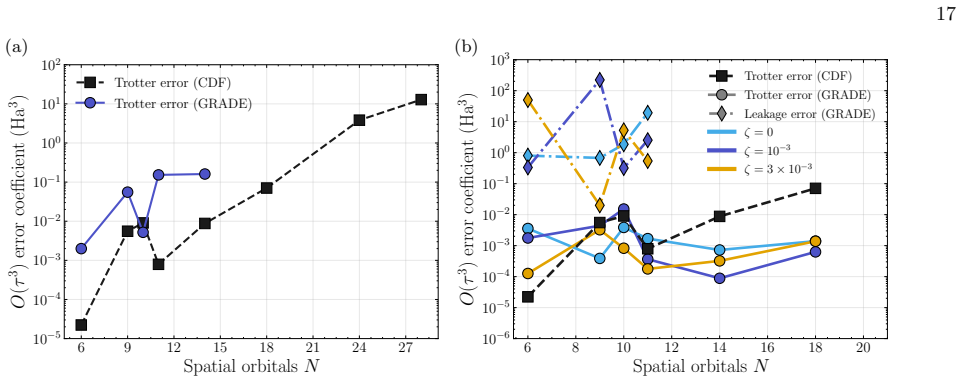
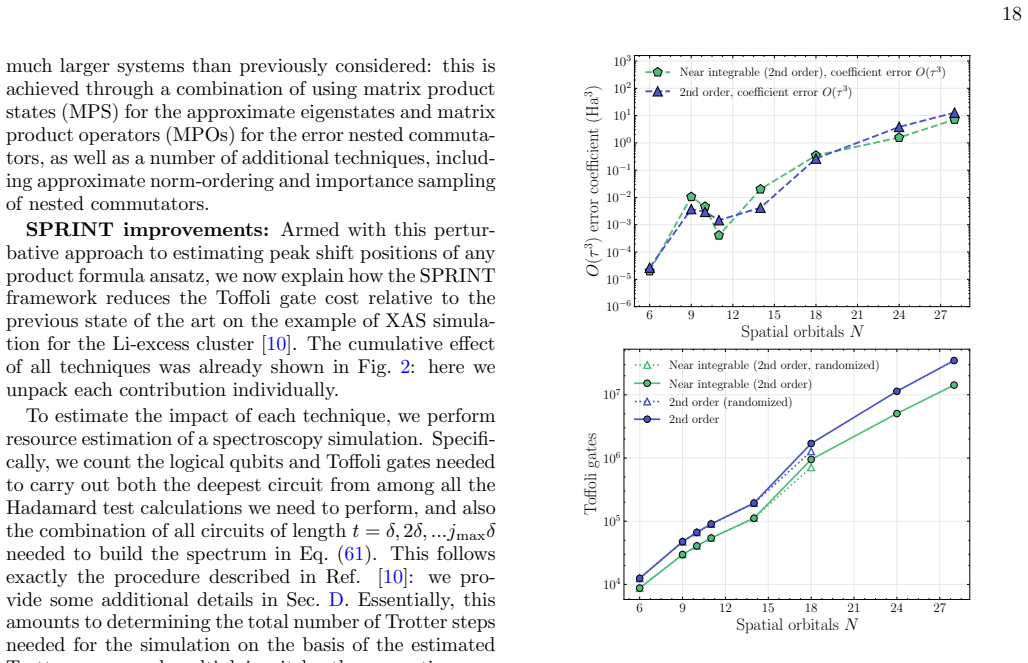
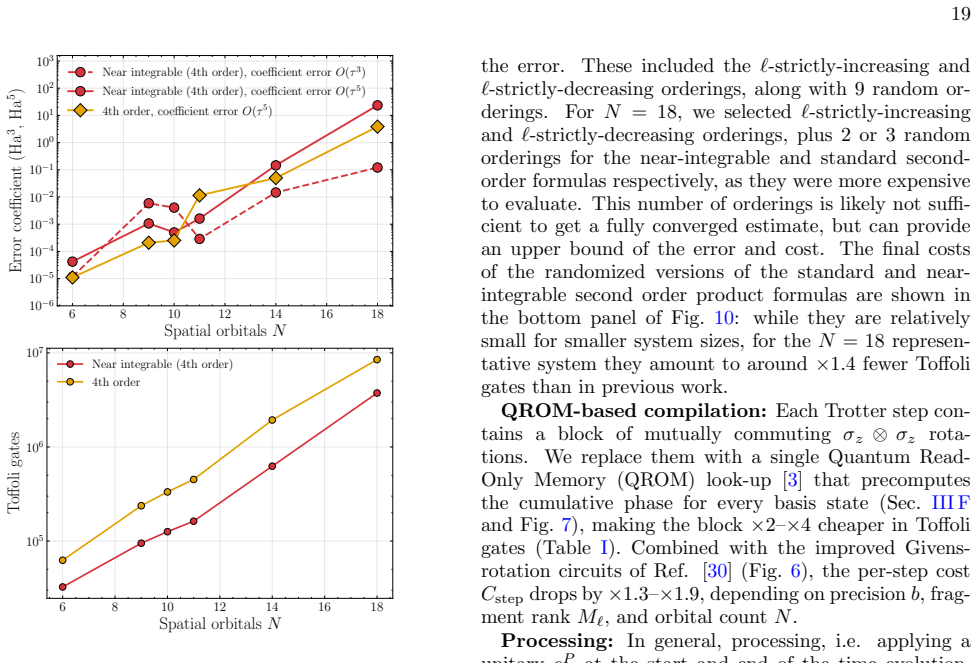
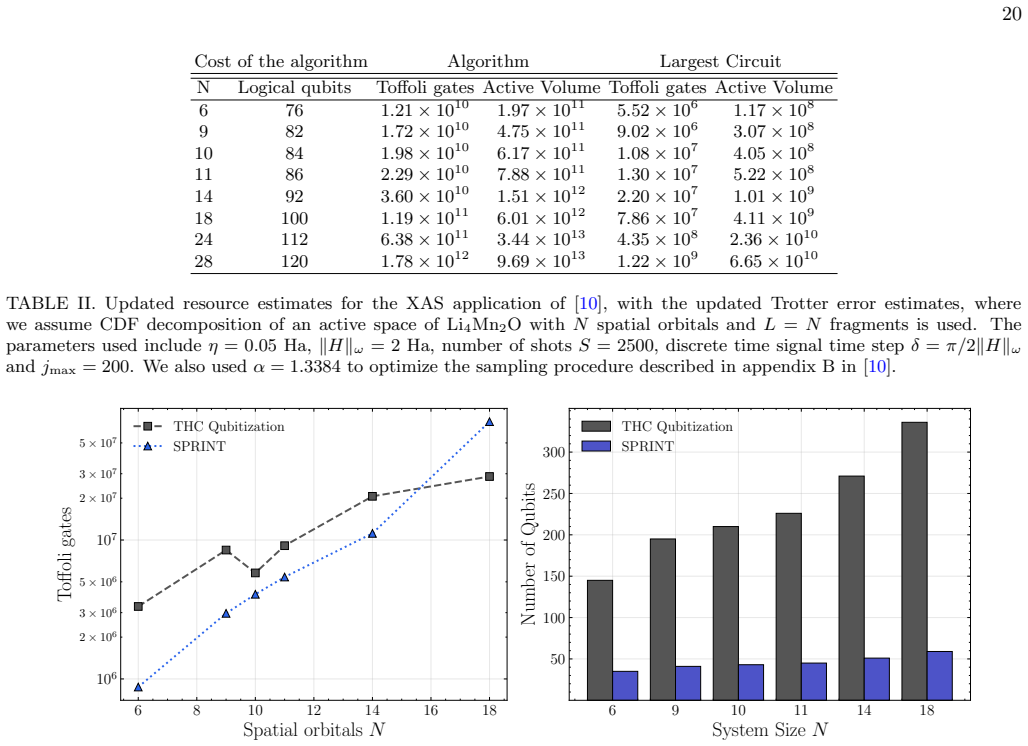
read the original abstract
Trotter product formulas are a fundamental class of methods for Hamiltonian simulation, particularly attractive due to their low qubit requirements. However, they are often overlooked for use with fault-tolerant quantum algorithms, because of their perceived higher gate counts and the difficulty of estimating Trotter error. Here, we introduce Symmetry-Protected Randomized near-Integrable Trotter (SPRINT) formulas, a framework for building optimized product formulas for electronic structure Hamiltonians widely used in quantum chemistry. SPRINT integrates a generalization of classical near-integrability, randomization, symmetry protection, use of QROM, and other techniques into a thoroughly optimized methodology for Hamiltonian simulation. When applied to concrete simulation tasks, we find SPRINT leads to substantial reduction in gate count compared to previous approaches. Alongside SPRINT, we introduce and analyze a Generalized Rank Decomposition (GRADE) of electronic Hamiltonians that generalizes previous factorization methods. We apply these techniques to the task of simulating the X-ray absorption spectrum of Li$_4$Mn$_2$O, a candidate battery cathode material, leveraging recent advances in tight Trotter error estimation to carefully identify the best version of SPRINT for this problem. Using a Trotter error estimation tool developed in the PennyLane software platform, we show that SPRINT reduces the Toffoli gate cost by a factor of $4.5$ relative to the previous state of the art for this problem, with a gate cost only $\times 2.5$ higher than qubitization, while requiring a dramatic $\times 5.5$ fewer logical qubits. These results establish well-designed Trotter product formulas as an attractive Hamiltonian simulation method for industrially relevant problems in chemistry and materials science.
Editorial analysis
A structured set of objections, weighed in public.
Referee Report
Summary. The manuscript introduces Symmetry-Protected Randomized near-Integrable Trotter (SPRINT) formulas, integrating randomization, symmetry protection, near-integrability, and QROM for optimized Trotter product formulas in quantum chemistry. It also presents Generalized Rank Decomposition (GRADE) of electronic Hamiltonians. The central application is to simulating the X-ray absorption spectrum of Li₄Mn₂O, where a PennyLane Trotter error estimation tool is used to select the best SPRINT variant, yielding claims of a 4.5× Toffoli gate cost reduction relative to prior state of the art, only ×2.5 higher than qubitization, and ×5.5 fewer logical qubits.
Significance. If the resource estimates hold under independent verification, the work would establish that well-optimized Trotter formulas can compete with qubitization for fault-tolerant quantum chemistry while offering substantially lower qubit overheads, making simulations of battery materials like Li₄Mn₂O more practical. The SPRINT framework and GRADE decomposition supply new methodological tools whose broader applicability could be tested on other Hamiltonians.
major comments (2)
- [Abstract] Abstract and numerical results for Li₄Mn₂O: the headline factors (4.5× Toffoli reduction, ×2.5 vs qubitization, ×5.5 qubit saving) are obtained by using the PennyLane tool both to rank SPRINT variants and to compute final gate counts; the manuscript supplies neither error bars on these factors nor an explicit check that the chosen randomization schedule parameters were fixed before seeing the output, which is load-bearing for the central performance claim.
- [Results] The resource comparison rests on the assumption that the PennyLane Trotter-error estimator remains tight once QROM, symmetry protection, and full fault-tolerant overheads are included; no cross-validation against an independent error bound or alternative estimator is reported for this Hamiltonian, leaving the ranking of SPRINT variants and the final overhead numbers unverified.
minor comments (1)
- Define all acronyms (SPRINT, GRADE, QROM) at first use and ensure consistent notation for the randomization schedule parameters across sections.
Simulated Author's Rebuttal
We thank the referee for their detailed and constructive report. We respond point-by-point to the major comments below, proposing targeted revisions to improve transparency while preserving the integrity of the reported results.
read point-by-point responses
-
Referee: [Abstract] Abstract and numerical results for Li₄Mn₂O: the headline factors (4.5× Toffoli reduction, ×2.5 vs qubitization, ×5.5 qubit saving) are obtained by using the PennyLane tool both to rank SPRINT variants and to compute final gate counts; the manuscript supplies neither error bars on these factors nor an explicit check that the chosen randomization schedule parameters were fixed before seeing the output, which is load-bearing for the central performance claim.
Authors: We agree that greater transparency is needed regarding parameter selection. The randomization schedule parameters were chosen analytically from the near-integrability and symmetry structure of the Li₄Mn₂O Hamiltonian before any final resource counts were computed; the PennyLane tool was applied only for evaluation and ranking of pre-specified variants. We will revise the manuscript to document this selection process explicitly, including the theoretical criteria used, and to state that parameters were fixed prior to the reported outputs. The estimator produces deterministic gate counts for any fixed parameter set, so statistical error bars do not apply; we will add a clarifying sentence to this effect. These additions will be made without changing the numerical factors themselves. revision: yes
-
Referee: [Results] The resource comparison rests on the assumption that the PennyLane Trotter-error estimator remains tight once QROM, symmetry protection, and full fault-tolerant overheads are included; no cross-validation against an independent error bound or alternative estimator is reported for this Hamiltonian, leaving the ranking of SPRINT variants and the final overhead numbers unverified.
Authors: The PennyLane estimator implements rigorous Trotter error bounds that depend only on the Hamiltonian and the product-formula order; QROM and symmetry protection modify gate implementation but leave the underlying simulation error unchanged. We will add a dedicated paragraph in the revised Results section that recalls these theoretical foundations and explains why the estimator remains applicable after the listed optimizations. While we did not conduct an independent cross-validation for this specific Hamiltonian (owing to the computational cost of alternative bounds), the estimator has been validated on comparable electronic-structure problems in the PennyLane literature. We therefore view the current ranking as reliable but will make the justification explicit as requested. revision: partial
Circularity Check
No significant circularity in derivation chain
full rationale
The paper introduces SPRINT and GRADE as new frameworks integrating randomization, symmetry protection, QROM and related techniques for Trotter formulas. Resource claims for the Li4Mn2O instance are obtained by applying an external PennyLane Trotter-error estimation tool to concrete Hamiltonians in order to rank variants and compute gate counts; these are direct numerical applications against external benchmarks (prior state-of-the-art and qubitization) rather than any prediction or first-principles result that reduces by construction to fitted parameters inside the paper's own equations. No self-definitional steps, fitted-input-called-prediction steps, or load-bearing self-citation chains appear in the derivation. The variant-selection step introduces a potential selection effect but does not equate the reported performance numbers to the inputs by definition.
Axiom & Free-Parameter Ledger
free parameters (1)
- randomization schedule parameters
axioms (1)
- domain assumption Electronic structure Hamiltonians admit a near-integrable decomposition with exploitable symmetries
Reference graph
Works this paper leans on
-
[1]
S. G. Mehendale, L. A. Mart´ ınez-Mart´ ınez, P. D. Ka- math, and A. F. Izmaylov, Estimating trotter approx- imation errors to optimize hamiltonian partitioning for lower eigenvalue errors, Digital Discovery (2025)
2025
-
[2]
G. H. Low, Y. Su, Y. Tong, and M. C. Tran, Complexity of implementing trotter steps, PRX Quantum4, 020323 (2023)
2023
-
[3]
Magic state cultivation: growing T states as cheap as CNOT gates
C. Gidney, N. Shutty, and C. Jones, Magic state culti- vation: growing t states as cheap as cnot gates, arXiv preprint arXiv:2409.17595 (2024)
work page internal anchor Pith review Pith/arXiv arXiv 2024
-
[4]
D. Litinski and N. Nickerson, Active volume: An ar- chitecture for efficient fault-tolerant quantum comput- ers with limited non-local connections, arXiv preprint arXiv:2211.15465 (2022)
-
[5]
N. C. Rubin, D. W. Berry, A. Kononov, F. D. Malone, T. Khattar, A. White, J. Lee, H. Neven, R. Babbush, and A. D. Baczewski, Quantum computation of stopping power for inertial fusion target design, Proceedings of the National Academy of Sciences121, e2317772121 (2024)
2024
-
[6]
R. I. McLachlan and A. Murua, The lie algebra of classi- cal mechanics, arXiv preprint arXiv:1905.07554 (2019)
work page internal anchor Pith review Pith/arXiv arXiv 1905
-
[7]
J. R. McClean, N. C. Rubin, K. J. Sung, I. D. Kivlichan, X. Bonet-Monroig, Y. Cao, C. Dai, E. S. Fried, C. Gid- ney, B. Gimby,et al., Openfermion: the electronic struc- ture package for quantum computers, Quantum Science and Technology5, 034014 (2020)
2020
-
[8]
L¨ owdin, A note on the quantum-mechanical per- turbation theory, The Journal of Chemical Physics19, 1396 (1951)
P.-O. L¨ owdin, A note on the quantum-mechanical per- turbation theory, The Journal of Chemical Physics19, 1396 (1951)
1951
-
[9]
Blanes, F
S. Blanes, F. Casas, and L. Shaw, Generalized extrapo- lation methods based on compositions of a basic 2nd- order scheme, Applied Mathematics and Computation 473, 128663 (2024)
2024
-
[10]
Rendon, J
G. Rendon, J. Watkins, and N. Wiebe, Improved accu- racy for trotter simulations using chebyshev interpola- tion, Quantum8, 1266 (2024)
2024
-
[11]
S. Zhuk, N. F. Robertson, and S. Bravyi, Trotter error bounds and dynamic multi-product formulas for hamil- tonian simulation, Physical Review Research6, 033309 (2024)
2024
- [12]
-
[13]
J. D. Watson and J. Watkins, Exponentially reduced cir- cuit depths using trotter error mitigation, PRX Quantum 6, 030325 (2025)
2025
- [14]
-
[15]
Lin and Y
L. Lin and Y. Tong, Heisenberg-limited ground-state en- ergy estimation for early fault-tolerant quantum comput- ers, PRX Quantum3, 010318 (2022)
2022
- [16]
-
[17]
J. C. Mason and D. C. Handscomb,Chebyshev polyno- mials(Chapman and Hall/CRC, 2002)
2002
-
[18]
Weiße, G
A. Weiße, G. Wellein, A. Alvermann, and H. Fehske, The kernel polynomial method, Reviews of modern physics 78, 275 (2006). 25 Appendix A: Hamiltonian construction for experimental results The starting point for the simulation is a molecular cluster representing the local environment of the absorbing atom. In our case, following Ref. [10], we focus on the ...
2006
-
[19]
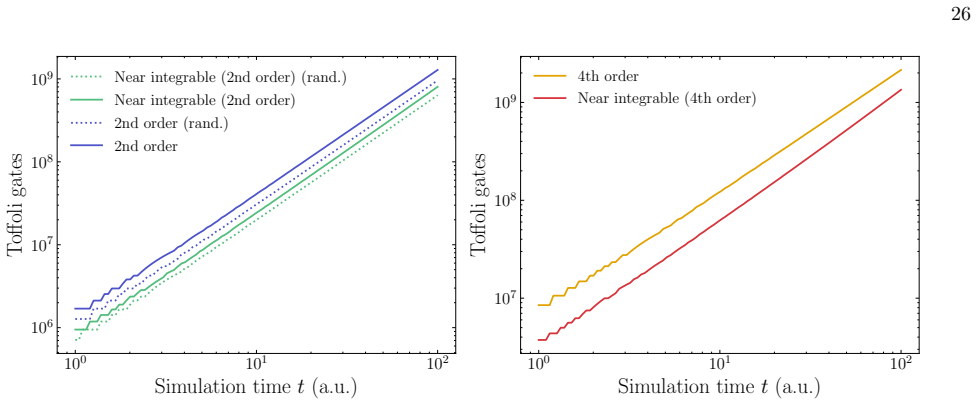
All two-electron integrals (pq|rs) involving at least one core orbital index (here, the O 1sorbital) with mixed 26 100 101 102 Simulation time t (a.u.) 106 107 108 109 Toffoli gates Near integrable (2nd order) (rand.) Near integrable (2nd order) 2nd order (rand.) 2nd order 100 101 102 Simulation time t (a.u.) 107 108 109 Toffoli gates 4th order Near integra...
-
[20]
This ensures that the initial statem ρ |I⟩is placed entirely within the core-excited subspace
Only terms in the dipole operatorm ρ that involve excitationsfromthe core orbital are retained in the initial statem ρ. This ensures that the initial statem ρ |I⟩is placed entirely within the core-excited subspace. Since the modified Hamiltonian preserves this subspace, the subsequent time evolution remains confined to it. With the active space and CVS in...
-
[21]
[30], see Fig
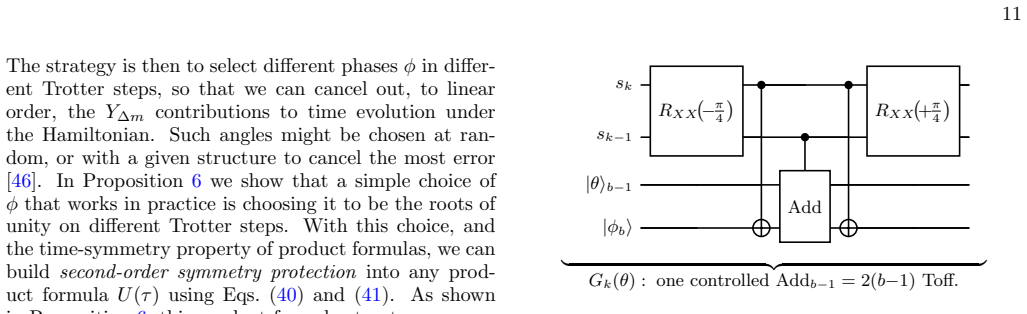
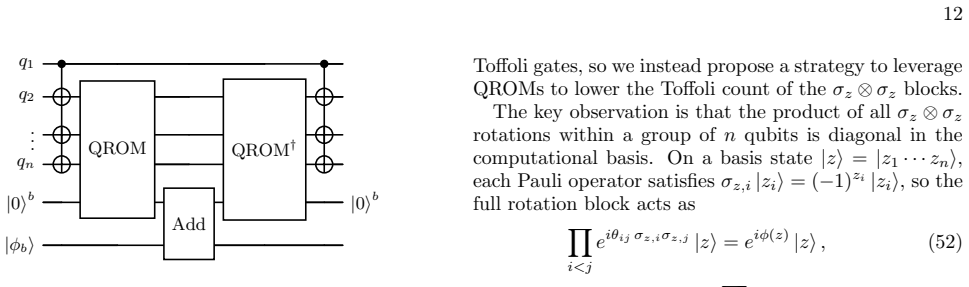
Per-step cost: We count the Toffoli gates in one product formula step, summing the Givens rotation cost (using the fused circuits of Ref. [30], see Fig. 6) and theσ z ⊗σ z rotation cost (using QROM where beneficial, see Table I): these are the values already reported in Fig. 8. As mentioned before, we use CDF throughout this section, given the large leaka...
-
[22]
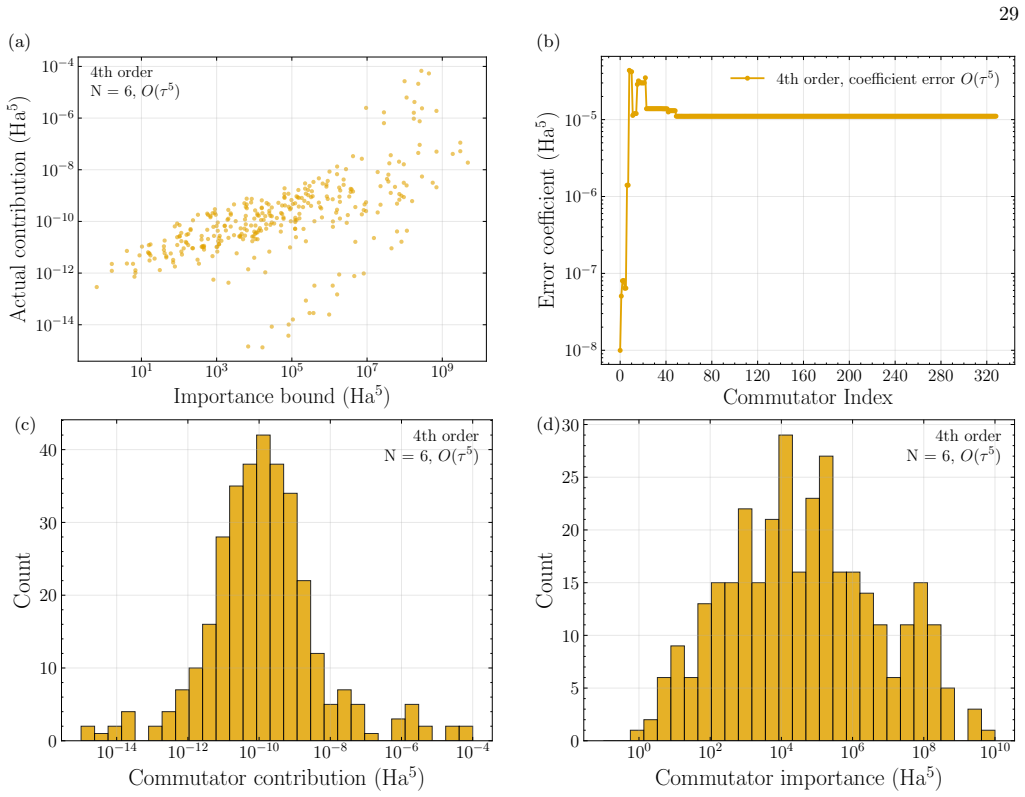
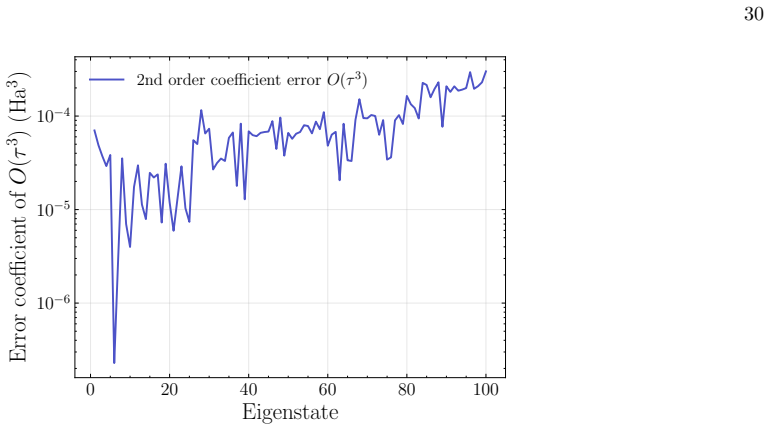
Trotter error: Following the perturbative approach to estimating peak position shift that we just described, we evaluate the expectation value of the leading-order BCH error coefficient for the chosen product formula, as per Eq. (65). The expectation value is computed with respect to approximate eigenstates prepared with DMRG: 29 101 103 105 107 109 Impor...
-
[23]
That is, we choose time stepτsuch that the expected error τ p| ⟨Yp⟩ |is under the target errorϵon average for the evaluated eigenstates
Number of steps: From the error coefficient and the targetϵ(which we take to beϵ= 1 eV throughout), we determine the maximum allowable time stepτ. That is, we choose time stepτsuch that the expected error τ p| ⟨Yp⟩ |is under the target errorϵon average for the evaluated eigenstates. Then, we computer=⌈t j/τ⌉
-
[24]
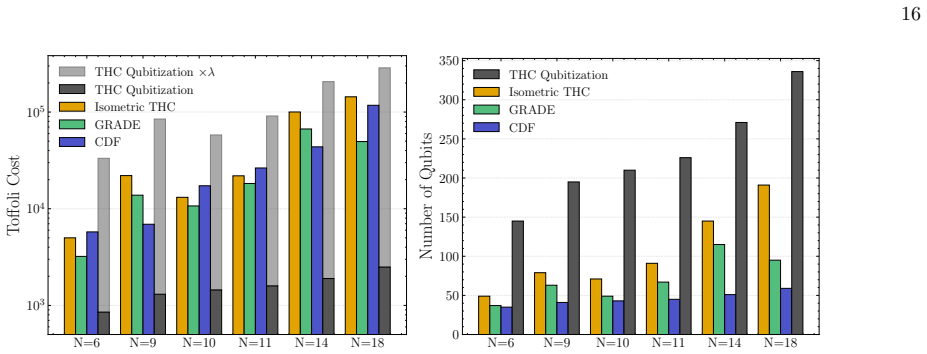
Total cost: We multiply the number of stepsrby the per-step costC step to get the overall resource estimate Ctotal. In the case of the Li-excess cluster XAS calculation, the parameters for the algorithm are as follows [10]: we use the maximum allowed peak position error ofϵ= 1 eV; broadening ofη= 0.05 Ha, discrete time signal time step δ=π/4 andj max = 20...
-
[25]
12 we follow the symmetry-shifted THC block-encoding of Refs
Qubitization resource estimate For the qubitization comparison in Fig. 12 we follow the symmetry-shifted THC block-encoding of Refs. [29, 30], using the same Li 4Mn2O active spaces and Hamiltonians from Sec. V A with THC rankM= 2N. The per-walk-step Toffoli count and logical-qubit count are obtained with the PennyLane estimator [65] at coefficient precisi...
-
[26]
We will denote it byU k(τ)
The Suzuki hierarchy Proposition 1(Suzuki hierarchy).A product formula is said to achieve orderkif the leading order contribution in the effective Hamiltonian isO(τ k). We will denote it byU k(τ). The Suzuki hierarchy provides a systematic way of constructing product formulas of arbitrary even order [41, 42] U2k(τ) =U 2 2k−2(ukτ)U 2k−2((1−4u k)τ)U 2 2k−2(...
-
[27]
Order conditions. Proposition 2(Order conditions for a five-exponential symmetric formula with two fragments).Consider the sym- metric product formula S(τ) =e −ia1τ H0 e−ib1τ H1 e−ia2τ H0 e−ib1τ H1 e−ia1τ H0 ,(E7) whereH=H 0 +H 1, anda 1, a2, b1 ∈Rare free parameters. Then: 1.First-order (consistency) conditions.S(τ)approximatese −iτ H to first order if a...
-
[28]
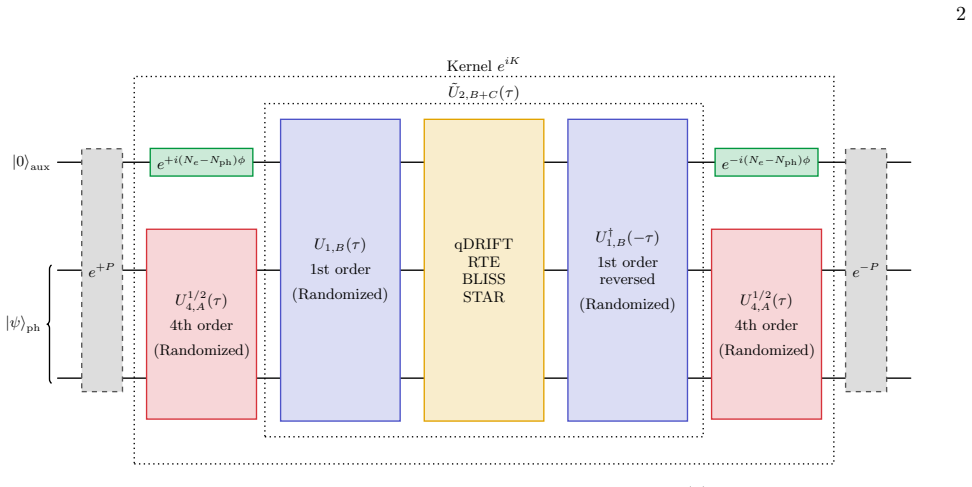
Near-integrability and processing Proposition 3(Error of the near-integrable formula).LetH=H A +αH B withα≪1. Define the near-integrable product formula ˜V4,2(τ) =U 1/2 4,A(τ)U 2,B(τ)U 1/2 4,A(τ),(E28) whereU 4,A(τ)is a fourth-order formula forH A andU 2,B(τ)is a second-order formula forαH B. Then the effective Hamiltonian satisfies ˜V4,2(τ) = exp −iτ H+O...
-
[29]
Derivation of the Hadamard lemma Lemma 1(Hadamard lemma).For any two operatorsXandY, we have eX Y e−X = ∞X j=0 1 j! adj X(Y),(E55) where the nested commutator (adjoint action) is defined recursively as ad0 X(Y) =Y,ad j X(Y) = [X,ad j−1 X (Y)].(E56) Proof.Define the one-parameter family f(t) =e tX Y e −tX .(E57) We proceed in three steps. a. Step 1: Differ...
-
[30]
Define U2(τ, ϕ) =e −iϕQph U2(τ)e +iϕQph ,(E63) whereΠ ph =|0⟩ ⟨0| aux is the binary projector distinguishing the physical from auxiliary subspace, andQ ph = 1−Π ph
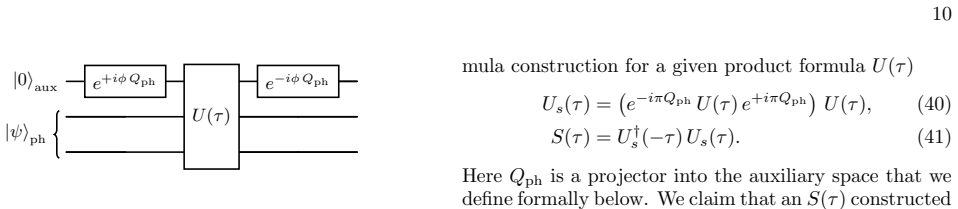
Symmetry protection Proposition 6(Symmetry-protected effective Hamiltonian).LetU 2(τ)be a second-order Trotter step implementing an effective HamiltonianH eff =P ∆m Y∆m, decomposed by the number of electrons excited to or from theNphysical orbitals. Define U2(τ, ϕ) =e −iϕQph U2(τ)e +iϕQph ,(E63) whereΠ ph =|0⟩ ⟨0| aux is the binary projector distinguishin...
-
[31]
A forward cycle UF (τ) = 1Y k=0 U2(τ, πk) (E64) achieves effective Hamiltonian H(1) eff =H+O(τ).(E65)
-
[32]
The symmetric super-cycleU symm =U B(τ)U F (τ), whereU B(τ) =U F (−τ) †, achieves H(2) eff =H+τ 2Y (2) leak| {z } O(τ 2) +τ 2Y (2) Trotter| {z } O(τ 2) +O(τ 3),(E66) which is on par with the intrinsic Trotter error of the second-order formula. We prove the result for the general number operatorN ph with aC-step cycle; the simplified binary operator Π ph w...
-
[33]
Assign to each operator adifferential degree:deg(T) = 2anddeg(V) = 0
Runge-Kutta-Nystr¨ om conditions for kinetic and potential splittings of the Hamiltonian Proposition 7(Vanishing nested commutators for kinetic-potential splittings).LetH=T+Vact onL 2(Rd), where T= Pd j=1 p2 j 2mj +f(q)is the kinetic energy operator andV=V(q)is a smooth, real-valued multiplicative potential. Assign to each operator adifferential degree:de...
-
[34]
This algebraic constraint reduces the number of independent error terms in the Baker–Campbell–Hausdorff expansion of any product formula built frome −iαT ande −iβV
The triple commutator vanishes identically:[V,[V,[V, T]]] = 0. This algebraic constraint reduces the number of independent error terms in the Baker–Campbell–Hausdorff expansion of any product formula built frome −iαT ande −iβV . Proof.We work indspatial dimensions with coordinatesq= (q 1, . . . , qd) and conjugate momentap j =−iℏ∂/∂q j. a. Part 1:[V, T]is...
-
[35]
Here we focus on spectroscopy [10, 19]
Randomized product formulas As we discussed above, the effect of certain forms of randomization will depend on the application. Here we focus on spectroscopy [10, 19]. Our goal in spectroscopy is to evaluate −ηImG ρ(ω) = ητ 2π ∞X j=−∞ e−ητ|j| ˜G(τ j)eijτ ω,(F1) whereηis some dampening factor,τis the time step and ˜Gρ(τ j) = ⟨I|m ρe−iHτ jmρ |I⟩ ∥mρ |I⟩ ∥2 ...
-
[36]
Multiproduct formulas and extrapolation methods We also considered multi-product formulas
Multiproduct formulas a. Multiproduct formulas and extrapolation methods We also considered multi-product formulas. There are two variations. Incoherent multi-product formulas – also known as extrapolation methods –, approximate the time evolution as a linear combination of product formulas, e−itH ≈ X j αjVj(t).(F18) 41 Each product formula in the linear ...
-
[37]
We analyze two primary approaches: deterministic unitary compilation and probabilistic quantum channels, and their distinct effects on the computed spectrum
Rotation Synthesis The implementation of single-qubit rotations introduces a further layer of approximation, the nature of which depends on the synthesis method. We analyze two primary approaches: deterministic unitary compilation and probabilistic quantum channels, and their distinct effects on the computed spectrum. a. Unitary Rotation Synthesis Unitary...
-
[38]
basic algorithm
The symmetry protected effective Hamiltonian We analyze the simulation of a quantum chemistry HamiltonianH=h+Vusing the method proposed in Ref. [6], where the interaction termVis approximated by the projection of a diagonal operator ˜Vacting on an enlarged basis ofMmodes. The total Hamiltonian in the extended space is ˜H=h+ ˜V. The physical subspace corre...
-
[39]
In practice one reconstructs a broadened version with Lorentzian peaks, Aη(ω) = 1 π X k |ck|2 η (ω−E k)2 +η 2 ,(G3) whereη >0 controls the half-width at half-maximum
Setup: the spectroscopy problem Consider a HamiltonianHacting on a Hilbert spaceH s, with eigendecomposition H= X k Ek |Ek⟩⟨Ek|.(G1) The spectral function for a given initial state|ψ⟩=m ρ |I⟩/∥m ρ |I⟩ ∥is A(ω) = X k |ck|2 δ(ω−E k), c k =⟨E k|ψ⟩,(G2) so thatP k |ck|2 = 1. In practice one reconstructs a broadened version with Lorentzian peaks, Aη(ω) = 1 π X...
-
[40]
Afterjapplications the measured time-domain signal is ˜G(τ j) =⟨ψ|U(τ) j|ψ⟩= X k |ck|2 e−iEkτ j.(G4) This is a sum of complex exponentials with frequenciesE kτ
Review: the Fourier route (Trotter product formulas) Trotter product formulas give access toU(τ)≈e −iHτ . Afterjapplications the measured time-domain signal is ˜G(τ j) =⟨ψ|U(τ) j|ψ⟩= X k |ck|2 e−iEkτ j.(G4) This is a sum of complex exponentials with frequenciesE kτ. The broadened spectral function is recovered via a discrete-time Fourier transform (DTFT) ...
-
[41]
The qubitization walk operator Qubitization [2] constructs a unitarywalk operatorWacting on an enlarged spaceH a ⊗ Hs (ancilla⊗system) that block-encodesH/λ: (⟨0|a ⊗I s)W(|0⟩ a ⊗I s) = H λ ,(G6) whereλ= P ℓ |hℓ|is the 1-norm of the Hamiltonian coefficients in a chosen decomposition (e.g. THC). Since∥H/λ∥ ≤ 1, all eigenvalues satisfy|E k/λ| ≤1. We call|0⟩ ...
-
[42]
Measurement protocol.The spectroscopy protocol proceeds as follows:
The qubitization signal is a Chebyshev moment a. Measurement protocol.The spectroscopy protocol proceeds as follows:
-
[43]
Prepare|Ψ 0⟩=|0⟩ a |ψ⟩(the initial state lies entirely in the signal subspace)
-
[44]
Apply the walk operatorntimes:W n |Ψ0⟩
-
[45]
The measured signal is µn ≡ ⟨Ψ 0|W n|Ψ0⟩=⟨0| a⟨ψ|W n |0⟩a|ψ⟩.(G15) We now derive the explicit form ofµ n in five steps
Measure the overlap with the initial state. The measured signal is µn ≡ ⟨Ψ 0|W n|Ψ0⟩=⟨0| a⟨ψ|W n |0⟩a|ψ⟩.(G15) We now derive the explicit form ofµ n in five steps. 49 b. Step 1: Expand in the energy eigenbasis.Write|ψ⟩= P k ck |Ek⟩, so that |Ψ0⟩= X k ck |0⟩a |Ek⟩= X k ck |Gk⟩.(G16) c. Step 2: Decompose each|G k⟩into walk eigenstates.Using Eq. (G14), |Ψ0⟩=...
-
[46]
This is accomplished by thekernel polynomial method(KPM) [84], which we now derive from first principles
Reconstructing the spectrum: the kernel polynomial method Given the moments{µ n}Nmax n=0 obtained from the quantum computer, we wish to reconstruct the spectral function A(ω). This is accomplished by thekernel polynomial method(KPM) [84], which we now derive from first principles. a. Step 1: Chebyshev completeness relation.The Chebyshev polynomials{T n}n≥...
-
[47]
(G26) is not an ad hoc procedure
Equivalence to Fourier analysis in the angular variable The Chebyshev expansion Eq. (G26) is not an ad hoc procedure. It is mathematically equivalent to a standard Fourier cosine series of the walk signal, carried out in the angular variableθ= arccos(ω/λ), followed by a change of variable back to energy. a. Step 1: Define the angular spectral density.The ...
discussion (0)
Sign in with ORCID, Apple, or X to comment. Anyone can read and Pith papers without signing in.