A SHARP Look at Quenching and Bulge-Disk Growth in Massive Galaxies at Cosmic Noon
Pith reviewed 2026-07-01 02:04 UTC · model grok-4.3
The pith
The SHARP-VESPER IFS will enable the first simultaneous bulge-disk decomposition of stellar populations plus spatially resolved ionised gas mapping in massive galaxies at 2.2<z<3.5.
A machine-rendered reading of the paper's core claim, the machinery that carries it, and where it could break.
Core claim
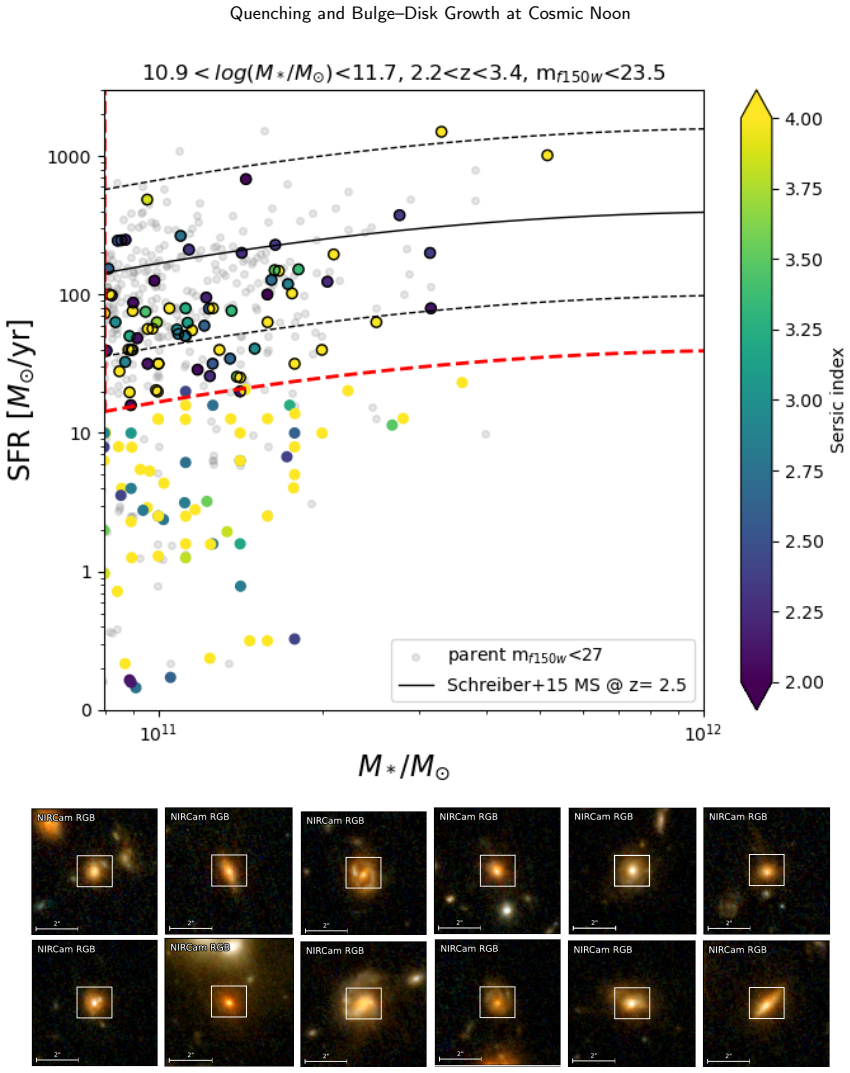
The SHARP-VESPER IFS can, for the first time, combine bulge-disk decomposition of stellar populations with spatially resolved mapping of ionised gas in galaxies above 10^11 solar masses at redshifts 2.2 to 3.5. Typical 15-hour exposures are projected to reach S/N>15-20 on the continuum of inner bulges and outer disks and S/N>5 on [OII], H-beta, [OIII], and H-alpha lines on sub-kpc scales. The resulting data will reconstruct component-specific star-formation histories, ages, metallicities, and alpha-enhancements while tracing star formation, gas kinematics, and feedback-driven outflows, thereby testing whether quenching proceeds inside-out and linking structural transformation to feedback pro
What carries the argument
The SHARP-VESPER Integral-Field Spectrograph, which combines ELT-class sensitivity, 31-mas spatial resolution, broad near-IR wavelength coverage, and 12-IFU multiplexing to perform simultaneous stellar-population and gas analyses.
If this is right
- Independent bulge and disk star-formation histories will reveal the relative timing of bulge assembly and star-formation suppression.
- Spatially resolved gas kinematics and outflow maps will connect feedback processes to the structural transformation.
- Component-specific ages and metallicities will distinguish fast and slow quenching pathways.
- Comparison of inner versus outer regions will test whether quenching proceeds inside-out.
- The programme targets systems on the main sequence shortly before quenching or already in the green valley.
Where Pith is reading between the lines
- These resolved histories could supply direct timing constraints for AGN-feedback models that currently rely on integrated properties.
- Efficient multiplexing would allow statistical samples of rare high-mass systems to be assembled in reasonable observing time.
- The same data set could be cross-matched with lower-redshift integral-field surveys to trace the full evolutionary sequence of bulge growth and quenching.
- If inside-out signatures are confirmed, models of disk instability and merger-driven bulge formation would need to incorporate differential quenching timescales across galaxy components.
Load-bearing premise
The assumption that 15-hour exposures will achieve the stated signal-to-noise ratios on both continuum and nebular lines rests on the instrument attaining its design sensitivity and resolution.
What would settle it
Direct measurement of delivered signal-to-noise ratios on real targets showing values below 15-20 per spectral resolution element on the continuum or below 5 on the nebular lines would falsify the feasibility claim for the planned decomposition and mapping.
Figures
read the original abstract
The physical mechanisms that quench star formation in massive galaxies remain poorly understood. At cosmic noon (1<z<3), when star formation and AGN activity peak, galaxies rapidly evolve from star-forming disks into quiescent, bulge-dominated systems. While quenching correlates with stellar mass and bulge growth, the causal link between bulge assembly, star-formation suppression, and feedback processes remains unclear. Stellar population analysis from spatially resolved spectroscopy of galaxies caught during quenching is crucial to advance on this issue. We show that the SHARP-VESPER Integral-Field Spectrograph (IFS) can efficiently fill this gap by combining ELT-class sensitivity, 31 mas spatial resolution (>3x sharper than JWST) and broad near-IR wavelength coverage with 12-IFU multiplexing. This will enable, for the first time, a simultaneous bulge-disk decomposition of stellar populations and spatially resolved mapping of ionised gas in massive galaxies (log $M_*/M_{\odot}\geq 11$) at 2.2<z<3.5, targeting systems on the main sequence shortly before quenching or already in the green valley. With typical exposure times of 15 hr, we will obtain S/N>15-20 per spectral resolution element, on the inner bulge, and outer disk extracted spectral continuum, and S/N>5 for nebular lines ([OII], H$\beta$, [OIII], H$\alpha$) on sub-kpc scales. These observations will allow us to reconstruct independent bulge and disk star-formation histories, ages, metallicities, and $\alpha$-enhancements, while mapping spatially resolved star formation, gas kinematics, and feedback-driven outflows. By directly comparing the timing of bulge growth and star-formation suppression across galaxy components, this programme will test whether quenching proceeds inside-out, distinguish fast and slow quenching pathways, and link structural transformation to feedback processes in the most massive galaxies at cosmic noon.
Editorial analysis
A structured set of objections, weighed in public.
Referee Report
Summary. The manuscript is an observing proposal for the SHARP-VESPER Integral-Field Spectrograph on the ELT. It claims that 15 hr exposures on massive galaxies (log M*/M⊙ ≥11) at 2.2<z<3.5 will deliver S/N>15-20 per spectral resolution element on bulge and disk continuum and S/N>5 on nebular lines, enabling the first simultaneous bulge-disk decomposition of stellar populations together with spatially resolved ionised-gas mapping to test inside-out quenching, distinguish fast/slow pathways, and link structural change to feedback.
Significance. If the instrument meets its stated design specifications for 31 mas resolution and sensitivity, the program would supply component-resolved star-formation histories, ages, metallicities, and gas kinematics for the transition population at cosmic noon, a capability not currently available and directly relevant to the open question of how bulge growth and star-formation suppression are causally connected.
major comments (1)
- [Abstract] Abstract: the claim that 15 hr exposures will achieve S/N>15-20 on the extracted bulge and disk continuum and S/N>5 on [OII], Hβ, [OIII], Hα is load-bearing for the entire science case yet is presented without any exposure-time calculation, sensitivity model, or reference to instrument performance data; this assumption is explicitly flagged in the proposal but remains unsubstantiated.
minor comments (2)
- The abstract defines cosmic noon as 1<z<3 but targets 2.2<z<3.5; a brief clarification of the adopted range would remove the minor inconsistency.
- The proposal would be strengthened by explicit citation of existing JWST IFS or ground-based studies of quenching at similar redshifts to quantify the unique gain from the proposed resolution and multiplexing.
Simulated Author's Rebuttal
We thank the referee for their constructive review and positive evaluation of the scientific significance. We address the major comment below and will revise the manuscript to incorporate the requested substantiation.
read point-by-point responses
-
Referee: [Abstract] Abstract: the claim that 15 hr exposures will achieve S/N>15-20 on the extracted bulge and disk continuum and S/N>5 on [OII], Hβ, [OIII], Hα is load-bearing for the entire science case yet is presented without any exposure-time calculation, sensitivity model, or reference to instrument performance data; this assumption is explicitly flagged in the proposal but remains unsubstantiated.
Authors: We agree that the S/N performance claims require explicit support. Although the proposal text flags the numbers as assumptions pending detailed modeling, the revised manuscript will add a dedicated methods subsection (or appendix) presenting the exposure-time calculations, the adopted sensitivity model for SHARP-VESPER, references to the instrument's 31 mas resolution and throughput specifications, and the resulting per-component S/N estimates for continuum and nebular lines. This will make the feasibility case fully transparent without altering the core science goals. revision: yes
Circularity Check
No significant circularity
full rationale
The document is an observing proposal for future SHARP-VESPER IFS observations on the ELT. It contains no equations, derivations, parameter fitting, or data analysis. All statements are prospective claims about achievable S/N and science return conditional on instrument performance meeting design specs. No load-bearing step reduces a result to its own inputs by construction, self-citation, or renaming. The feasibility assumption is explicitly flagged as external and is not internally derived.
Axiom & Free-Parameter Ledger
axioms (2)
- domain assumption Stellar population synthesis models can reliably extract ages, metallicities, alpha-enhancements, and star-formation histories from the extracted spectra.
- ad hoc to paper The SHARP-VESPER instrument will deliver the stated 31 mas spatial resolution, sensitivity, and multiplexing as per its design specifications.
Reference graph
Works this paper leans on
-
[1]
doi:10.3847/1538-4357/ad96b6,arXiv:2407.02556. Binney, J., 2004. On the origin of the galaxy luminosity function. MNRAS 347, 1093–1096. doi:10.1111/j.1365-2966.2004.07277.x, arXiv:astro-ph/0308172. Birnboim, Y., Dekel, A., 2003. Virial shocks in galactic haloes? MNRAS 345, 349–364. doi:10.1046/j.1365-8711.2003.06955.x, arXiv:astro-ph/0302161. Bluck, A.F.L...
-
[2]
Monthly Notices of the RoyalAstronomicalSociety534,325–348
The jwst excels survey: too much, too young, too fast? ultra- massive quiescent galaxies at 3 < z < 5. Monthly Notices of the RoyalAstronomicalSociety534,325–348. doi:10.1093/mnras/stae2092, arXiv:2405.02242. Carnall, A.C., McLure, R.J., Dunlop, J.S., Davé, R., 2018. Inferring the star formation histories of massive quiescent galaxies with bagpipes: evide...
-
[3]
Building up JWST-SUSPENSE: inside-out quenching at cosmic noon from age, Fe-, and Mg-abundance gradients. arXiv e-prints , arXiv:2509.12316doi:10.48550/arXiv.2509.12316,arXiv:2509.12316. Cimatti,A.,Daddi,E.,Renzini,A.,2006. Massdownsizingand“top-down” assembly of early-type galaxies. A&A 453, L29–L33. doi:10.1051/ 0004-6361:20065155,arXiv:astro-ph/0605353...
work page internal anchor Pith review Pith/arXiv arXiv doi:10.48550/arxiv.2509.12316 2006
-
[4]
doi:10.1086/521820,arXiv:arXiv:0705.2832. Daddi, E., Dickinson, M., Morrison, G., Chary, R., Cimatti, A., Elbaz, D., Frayer, D., Renzini, A., Pope, A., Alexander, D.M., Bauer, F.E., Gi- avalisco,M.,Huynh,M.,Kurk,J.,Mignoli,M.,2007b. Multiwavelength StudyofMassiveGalaxiesatz ~2.I.StarFormationandGalaxyGrowth. ApJ 670, 156–172. doi:10.1086/521818,arXiv:0705...
work page internal anchor Pith review Pith/arXiv arXiv doi:10.1086/521820 2005
-
[5]
doi:10.1093/mnras/239.3.939. Ditrani, F.R., Longhetti, M., Iovino, A., Fossati, M., Zhou, S., Bardelli, S., Bolzonella, M., Cucciati, O., Finoguenov, A., Pozzetti, L., Salvato, M., Scodeggio, M., Tasca, L., Vergani, D., Zucca, E., 2025. The COSMOS Wall at z∼0.73: Quiescent galaxies and their evolution in different environments. A&A 696, A116. doi:10.1051/...
-
[6]
TheSins/zC-SinfSurveyofz ~2GalaxyKinematics:Evidencefor Powerful Active Galactic Nucleus-Driven Nuclear Outflows in Massive Star-Forming Galaxies. ApJ 787, 38. doi:10.1088/0004-637X/787/1/38, arXiv:1311.2596. Förster Schreiber, N.M., Renzini, A., Mancini, C., Genzel, R., Bouché, N., Cresci, G., Hicks, E.K.S., Lilly, S.J., Peng, Y., Burkert, A., Carollo, C...
work page internal anchor Pith review Pith/arXiv arXiv doi:10.1088/0004-637x/787/1/38
-
[7]
TheSINS/zC-SINFSurveyofz∼2GalaxyKinematics:SINFONI AdaptiveOptics-assistedDataandKiloparsec-scaleEmission-lineProp- erties. ApJS 238, 21. doi:10.3847/1538-4365/aadd49,arXiv:1802.07276. FörsterSchreiber,N.M.,Übler,H.,Davies,R.L.,Genzel,R.,Wisnioski,E., Belli,S.,Shimizu,T.,Lutz,D.,Fossati,M.,Herrera-Camus,R.,Mendel, J.T., Tacconi, L.J., Wilman, D., Beifiori...
work page internal anchor Pith review Pith/arXiv arXiv doi:10.3847/1538-4365/aadd49 2019
-
[8]
The ages and metallicities of galaxies in the local uni- verse. MNRAS 362, 41–58. doi:10.1111/j.1365-2966.2005.09321.x, arXiv:astro-ph/0506539. Gallazzi, A.R., Zibetti, S., van der Wel, A., Nersesian, A., Kaushal, Y., Bezanson, R., D’Eugenio, F., Bell, E.F., Leja, J., Scholz-Diaz, L., Wu, P.F.,Pacifici,C.,Maseda,M.,Mattolini,D.,2025a.LEGA-Cstellarpop- ula...
-
[9]
doi:10.1088/0004-637X/796/1/7,arXiv:1406.0183. Genzel, R., Newman, S., Jones, T., Förster Schreiber, N.M., Shapiro, K., Genel, S., Lilly, S.J., Renzini, A., Tacconi, L.J., Bouché, N., Burkert, A., Cresci, G., Buschkamp, P., Carollo, C.M., Ceverino, D., Davies, R., Dekel, A., Eisenhauer, F., Hicks, E., Kurk, J., Lutz, D., Mancini, C., Naab, T., Peng, Y., S...
work page internal anchor Pith review Pith/arXiv arXiv doi:10.1088/0004-637x/796/1/7 2011
-
[10]
doi:10.1088/0004-637X/788/1/11,arXiv:1402.0866. Lange, R., Moffett, A.J., Driver, S.P., Robotham, A.S.G., Lagos, C.d.P., Kelvin, L.S., Conselice, C., Margalef-Bentabol, B., Alpaslan, M., Baldry, I., Bland-Hawthorn, J., Bremer, M., Brough, S., Cluver, M., Colless, M., Davies, L.J.M., Häußler, B., Holwerda, B.W., Hopkins, A.M., Kafle, P.R., Kennedy, R., Lis...
work page internal anchor Pith review Pith/arXiv arXiv doi:10.1088/0004-637x/788/1/11 2016
-
[11]
doi:10.1038/379613a0,arXiv:astro-ph/9510034. Noeske, K.G., Weiner, B.J., Faber, S.M., Papovich, C., Koo, D.C., Somerville, R.S., Bundy, K., Conselice, C.J., Newman, J.A., Schimi- novich, D., Le Floc’h, E., Coil, A.L., Rieke, G.H., Lotz, J.M., Pri- mack, J.R., Barmby, P., Cooper, M.C., Davis, M., Ellis, R.S., Fazio, G.G., Guhathakurta, P., Huang, J., Kassi...
work page internal anchor Pith review Pith/arXiv arXiv doi:10.1038/379613a0 2007
-
[12]
The connection between galaxy structure and quenching efficiency
doi:10.1093/mnras/stu331,arXiv:1402.3394. Osterbrock,D.E.,1989.Astrophysicsofgaseousnebulaeandactivegalactic nuclei. Park, M., Belli, S., Conroy, C., Johnson, B.D., Davies, R.L., Leja, J., Tacchella,S.,Mendel,J.T.,Benton,C.,Bugiani,L.,Emami,R.,Khoram, A.H., Li, Y., Maheson, G., Mathews, E.P., Naidu, R.P., Nelson, E.J., Terrazas, B.A., Weinberger, R., 2024...
work page internal anchor Pith review Pith/arXiv arXiv doi:10.1093/mnras/stu331 1989
-
[13]
A Highly Consistent Framework for the Evolution of the Star-Forming "Main Sequence" from z~0-6
Acatalogofbulge+diskdecompositionsandupdatedphotometry for1.12milliongalaxiesinsdssdr7. AstrophysicalJournalSupplement Series 196, 11. doi:10.1088/0067-0049/196/1/11. Speagle,J.S.,Steinhardt,C.L.,Capak,P.L.,Silverman,J.D.,2014.AHighly Consistent Framework for the Evolution of the Star-Forming “Main Sequence”fromz˜0-6. ApJS214,15. doi:10.1088/0067-0049/214...
work page internal anchor Pith review Pith/arXiv arXiv doi:10.1088/0067-0049/196/1/11 2014
-
[14]
3D-HST+CANDELS: The Evolution of the Galaxy Size-Mass Distribution since $z=3$
3D-HST+CANDELS: The Evolution of the Galaxy Size-Mass Distribution since z = 3. ApJ 788, 28. doi:10.1088/0004-637X/788/1/28, arXiv:1404.2844. Vulcani, B., Fritz, J., Poggianti, B.M., Bettoni, D., Franchetto, A., Moretti, A., Gullieuszik, M., Jaffé, Y., Biviano, A., Radovich, M., Mingozzi, M., 2020. GASP XXIV. The History of Abruptly Quenched Galax- ies in...
work page internal anchor Pith review Pith/arXiv arXiv doi:10.1088/0004-637x/788/1/28 2020
-
[15]
The KMOS^3D Survey: design, first results, and the evolution of galaxy kinematics from 0.7<z<2.7
TheKMOS3𝐷 Survey:Design,FirstResults,andtheEvolutionof Galaxy Kinematics from 0.7 <= z <= 2.7. ApJ 799, 209. doi:10.1088/ 0004-637X/799/2/209,arXiv:1409.6791. Worthey, G., 1994. Comprehensive Stellar Population Models and the Disentanglement of Age and Metallicity Effects. ApJS 95, 107. doi:10. 1086/192096. Wu, P.F., van der Wel, A., Bezanson, R., Gallazz...
work page internal anchor Pith review Pith/arXiv arXiv doi:10.3847/1538-4357/aae822 1994
discussion (0)
Sign in with ORCID, Apple, or X to comment. Anyone can read and Pith papers without signing in.