An Acceleration is Worth a Hundred Thousand Phase Space Measurements
Pith reviewed 2026-07-01 05:14 UTC · model grok-4.3
The pith
One direct acceleration measurement equals the information from about 100,000 stars when estimating the local dark matter density.
A machine-rendered reading of the paper's core claim, the machinery that carries it, and where it could break.
Core claim
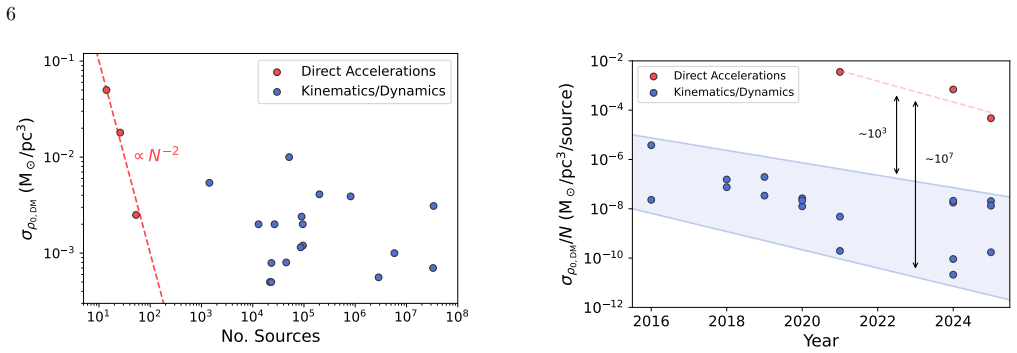
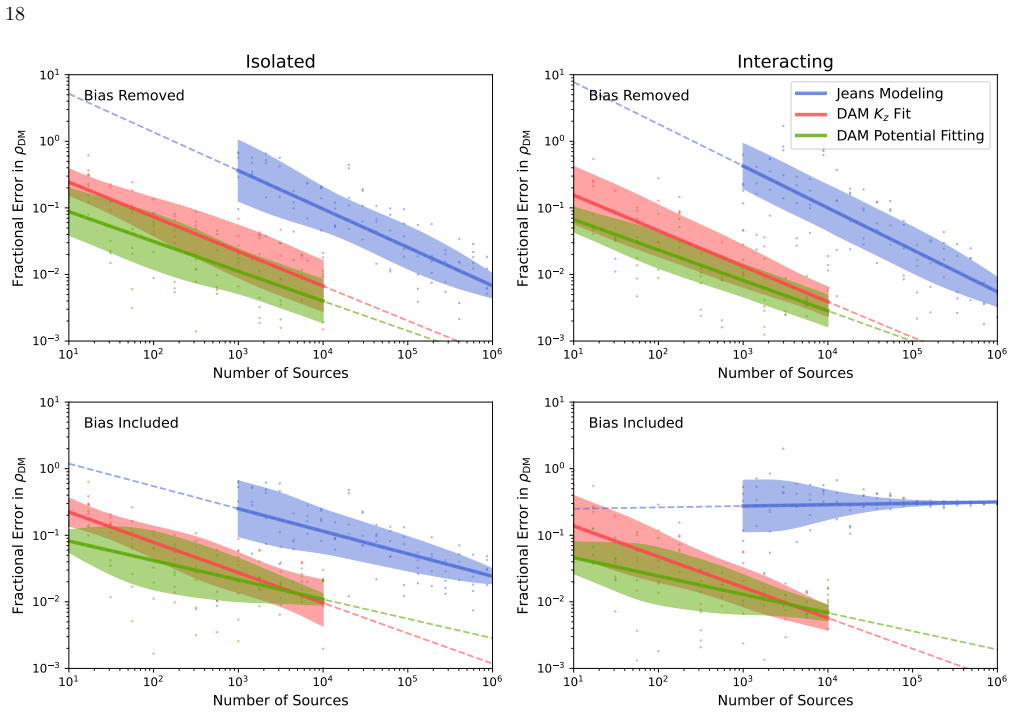
For estimating the local dark matter density, a single direct acceleration measurement can provide information comparable to ∼10^5 stars. In equilibrium scenarios, Jeans modeling requires one thousand times more sources to achieve the same precision. In the perturbed disk, the acceleration-based approach outperforms Jeans analysis because of significant bias in kinematic inferences, confirming that non-equilibrium dynamics cause systematic overestimates of the local dark matter density.
What carries the argument
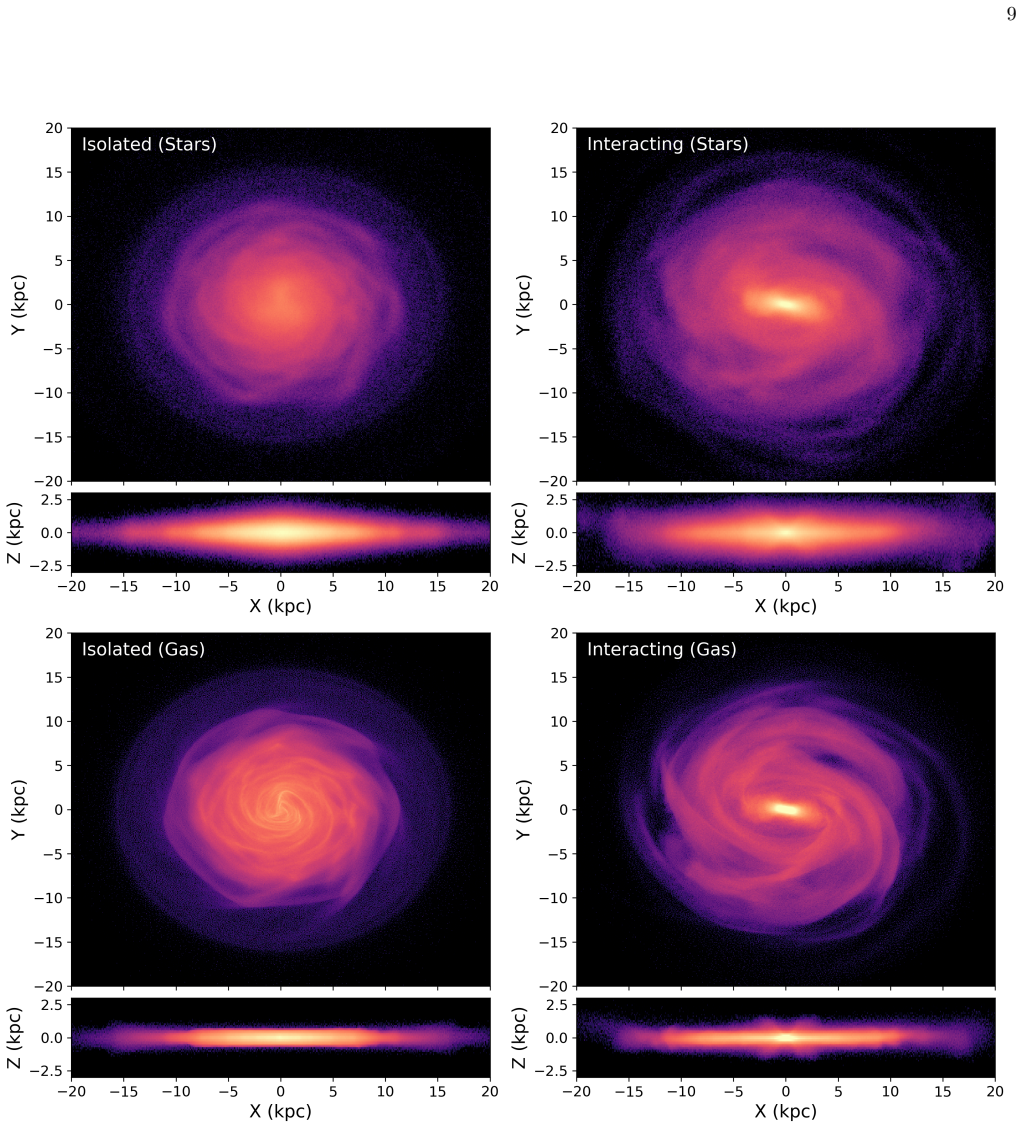
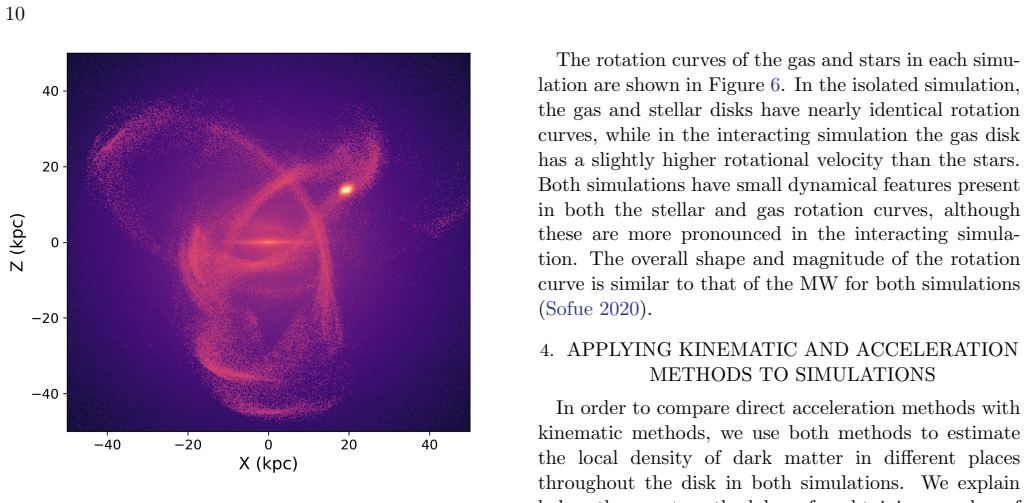
Comparison of direct acceleration measurements against Jeans modeling applied to stellar phase-space data, evaluated in hydrodynamical N-body simulations of a Milky Way-like galaxy with and without a Sagittarius-like dwarf perturbation.
If this is right
- Jeans modeling needs about 1000 times more sources than acceleration measurements to reach equivalent precision in equilibrium.
- Acceleration methods remain unbiased in the presence of disk perturbations that bias kinematic estimates.
- Non-equilibrium dynamics in the Galactic disk lead Jeans-based methods to systematically overestimate the local dark matter density.
- This bias issue may extend to other types of kinematic studies beyond Jeans modeling.
Where Pith is reading between the lines
- Future surveys might benefit from prioritizing direct acceleration measurements for local galactic parameters.
- Similar information advantages could apply when estimating other dynamical quantities like the total mass or potential shape.
- Real observations with instruments capable of acceleration measurements could validate or refute the simulation-based equivalence.
- Extending the analysis to other galaxies or different perturbation types would test the generality of the per-source advantage.
Load-bearing premise
The hydrodynamical N-body simulations accurately reproduce the Milky Way's dynamical state, measurement uncertainties, and the effects of disequilibrium on both acceleration and kinematic observables.
What would settle it
Observing a large discrepancy between acceleration-based and high-precision kinematic estimates of the local dark matter density in actual Milky Way data that contradicts the simulation predictions would falsify the claimed information equivalence.
Figures
read the original abstract
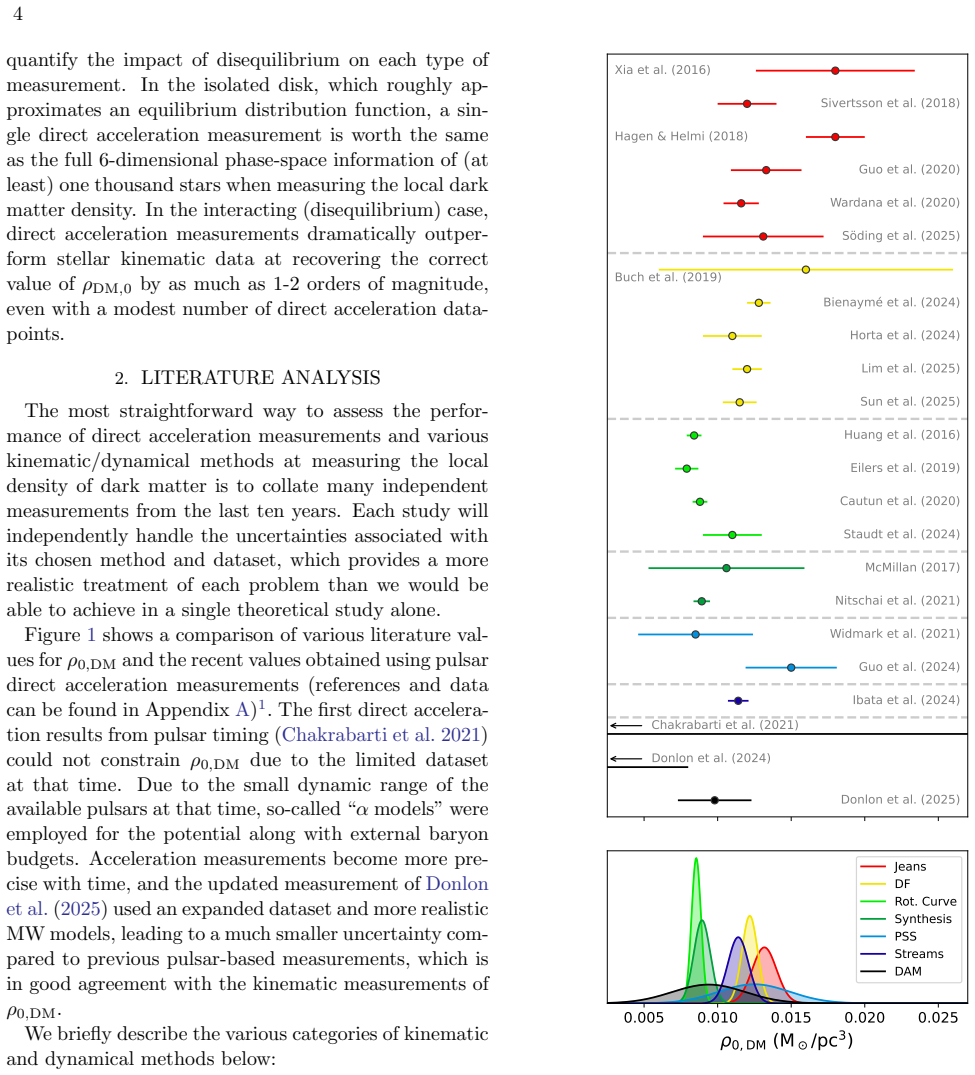
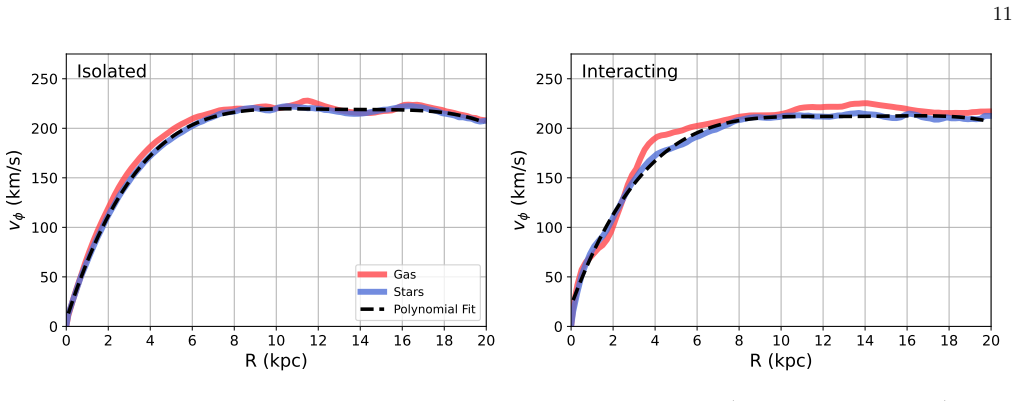
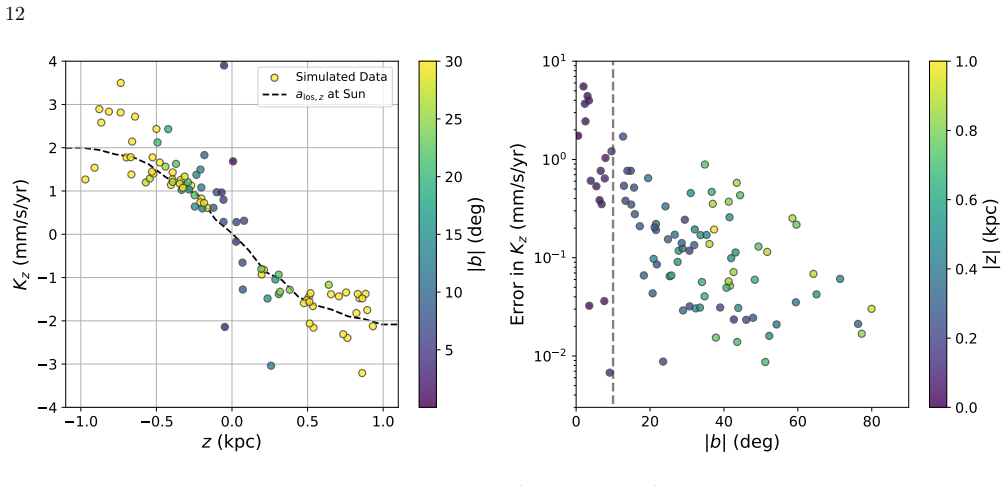
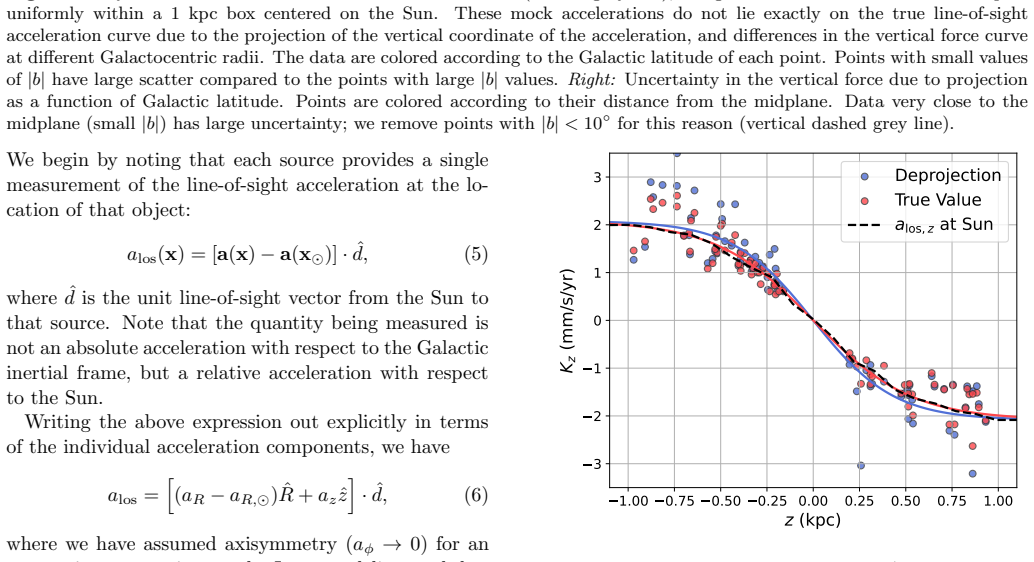
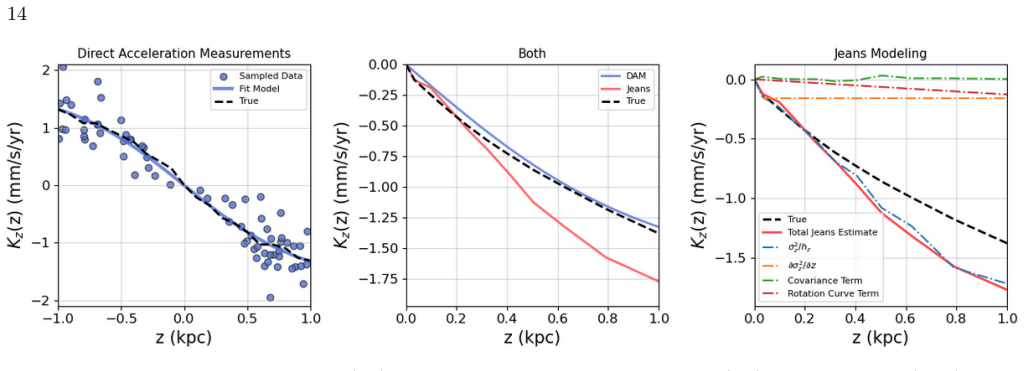
It is now possible to directly measure the accelerations that arise from the distribution of (dark) matter in the Milky Way. These acceleration-based measurements of the local dark matter density are now becoming competitive with estimates obtained through traditional kinematic techniques such as Jeans modeling. While classical methods can now draw on the positions and velocities of many millions of stars, recent acceleration-based studies have used fewer than 100 sources, yet achieve comparable precision. A key limitation of kinematic approaches is their reliance on assumptions of dynamical equilibrium and symmetry; direct acceleration measurements do not inherently suffer from this constraint. We find that, for the specific problem of estimating the local dark matter density, a single direct acceleration measurement can provide information comparable to $\sim$10$^5$ stars. We test the theoretical performance of direct acceleration techniques and Jeans modeling in estimating the local dark matter density using hydrodynamical N-body simulations of a MW-like galaxy, both in isolation and including a Sagittarius-like dwarf to generate disequilibrium. In the equilibrium scenario, Jeans modeling requires one thousand times more sources to achieve the same precision as the direct acceleration approach. This confirms that the per-source information advantage is intrinsic, and does not require disequilibrium to manifest. However, in the perturbed disk, the acceleration-based approach outperforms the Jeans analysis regardless of how many stars are available, due to significant bias in the result inferred from kinematics alone. Our results support earlier findings that non-equilibrium dynamics in the Galactic disk cause Jeans-based methods to systematically overestimate the local dark matter density; we show that this issue may also be present in other types of kinematic studies.
Editorial analysis
A structured set of objections, weighed in public.
Referee Report
Summary. The paper claims that for estimating the local dark matter density, a single direct acceleration measurement provides information comparable to ∼10^5 stars. This is demonstrated by comparing the theoretical performance of acceleration-based methods versus Jeans modeling on hydrodynamical N-body simulations of a Milky Way-like galaxy, both in isolation (equilibrium) and with a Sagittarius-like perturbation (disequilibrium). In equilibrium, Jeans requires ∼1000× more sources for equivalent precision; in the perturbed case, acceleration avoids the systematic bias that affects kinematics.
Significance. If the simulation-based comparison holds, the result would be significant for Galactic dynamics studies: it quantifies a large per-source information advantage for acceleration measurements and shows that disequilibrium biases in Jeans analyses can be avoided without relying on equilibrium assumptions. This supports prioritizing acceleration techniques in future surveys and aligns with prior indications that non-equilibrium effects cause Jeans methods to overestimate local DM density.
major comments (1)
- [simulation setup paragraph] Simulation setup paragraph: The central claim of a ∼10^5 equivalence (and the 1000× factor in equilibrium) is load-bearing on the hydrodynamical N-body runs accurately propagating realistic observational errors into both acceleration and kinematic observables while reproducing disequilibrium effects. The abstract provides no quantitative validation metrics or explicit error models (e.g., finite time baselines for acceleration or sample selection for stars), so it is unclear whether the reported information gain would translate to real Milky Way data.
Simulated Author's Rebuttal
We thank the referee for their careful and constructive review. The main concern is the need for more explicit details on error models and validation in the simulation setup to support the central claims. We address this point below and will revise the manuscript accordingly.
read point-by-point responses
-
Referee: Simulation setup paragraph: The central claim of a ∼10^5 equivalence (and the 1000× factor in equilibrium) is load-bearing on the hydrodynamical N-body runs accurately propagating realistic observational errors into both acceleration and kinematic observables while reproducing disequilibrium effects. The abstract provides no quantitative validation metrics or explicit error models (e.g., finite time baselines for acceleration or sample selection for stars), so it is unclear whether the reported information gain would translate to real Milky Way data.
Authors: We agree that the abstract does not contain these details, as it is intended as a high-level summary. The full manuscript (Section 3) describes the hydrodynamical N-body setup, including propagation of observational errors for accelerations (using finite time baselines of 5–10 years consistent with Gaia DR3 and future releases) and for stellar kinematics (proper motions, radial velocities, and distances with Gaia-like uncertainties), as well as sample selection criteria (e.g., |z| < 1 kpc, |v_z| cuts). Quantitative validation is provided via direct comparison of recovered local DM density precision versus number of tracers in both equilibrium and perturbed runs. We will add an explicit subsection in the Methods to tabulate the error models, time baselines, selection functions, and validation metrics (e.g., bias and variance as functions of source count). On translation to real Milky Way data, the simulations are constructed to reproduce key observational characteristics and disequilibrium from a Sagittarius-like perturber; while they cannot capture every possible real-world systematic, they isolate the intrinsic information advantage under realistic conditions. revision: yes
Circularity Check
No circularity; comparison of two independent estimators on external simulations
full rationale
The central result (one acceleration measurement supplies information equivalent to ~10^5 stars for local DM density) is obtained by running both the acceleration estimator and Jeans modeling on the same hydrodynamical N-body snapshots (isolated and Sagittarius-perturbed) and directly comparing the achieved precision and bias. Neither estimator is defined in terms of the other, no parameter is fitted on a subset and then called a prediction, and the abstract and setup contain no load-bearing self-citations or uniqueness theorems. The simulations function as an external testbed rather than an internal derivation, so the reported information ratio is a measured outcome, not a tautology.
Axiom & Free-Parameter Ledger
axioms (1)
- domain assumption Hydrodynamical N-body simulations accurately capture Milky Way dynamics and measurement errors for both methods.
Reference graph
Works this paper leans on
-
[1]
Strong-field tests of relativistic gravity and binary pulsars. , keywords =. doi:10.1103/PhysRevD.45.1840 , adsurl =
-
[2]
No Stream Left Unscathed: The imprint of a host galaxy
No Stream Left Unscathed: The imprint of a host galaxy. arXiv e-prints , keywords =. doi:10.48550/arXiv.2605.16200 , archivePrefix =. 2605.16200 , primaryClass =
work page internal anchor Pith review Pith/arXiv arXiv doi:10.48550/arxiv.2605.16200
-
[3]
Snowmass2021 Cosmic Frontier White Paper: Observational Facilities to Study Dark Matter. arXiv e-prints , keywords =. doi:10.48550/arXiv.2203.06200 , archivePrefix =. 2203.06200 , primaryClass =
-
[4]
Report of the Topical Group on Cosmic Probes of Dark Matter for Snowmass 2021. arXiv e-prints , keywords =. doi:10.48550/arXiv.2209.08215 , archivePrefix =. 2209.08215 , primaryClass =
-
[5]
The great wave: Evidence of a large-scale vertical corrugation propagating outwards in the Galactic disc. , keywords =. doi:10.1051/0004-6361/202451668 , archivePrefix =. 2407.18659 , primaryClass =
-
[6]
Astroparticle Physics , year = 1996, month = dec, volume =
Review of mathematics, numerical factors, and corrections for dark matter experiments based on elastic nuclear recoil. Astroparticle Physics , year = 1996, month = dec, volume =. doi:10.1016/S0927-6505(96)00047-3 , adsurl =
-
[7]
Colloquium: Annual modulation of dark matter , author =. Rev. Mod. Phys. , volume =. 2013 , month =. doi:10.1103/RevModPhys.85.1561 , url =
-
[8]
Tidal Imprints of a Dark Sub-halo on the Outskirts of the Milky Way. II. Perturber Azimuth. , keywords =. doi:10.1088/0004-637X/731/1/40 , archivePrefix =. 1007.1982 , primaryClass =
work page internal anchor Pith review Pith/arXiv arXiv doi:10.1088/0004-637x/731/1/40 1982
-
[9]
Handbook of Pulsar Astronomy
-
[10]
High-resolution Spectroscopy of the GD-1 Stellar Stream Localizes the Perturber near the Orbital Plane of Sagittarius. , keywords =. doi:10.3847/2041-8213/ab800c , archivePrefix =. 2001.07215 , primaryClass =
-
[11]
Constraints on a Dark Matter Subhalo Near the Sun from Pulsar Timing. , keywords =. doi:10.1103/29xz-nt5z , archivePrefix =. 2507.16932 , primaryClass =
-
[12]
Excitation of coupled stellar motions in the Galactic Disk by orbiting satellites
Excitation of Coupled Stellar Motions in the Galactic Disk by Orbiting Satellites. , keywords =. doi:10.3847/0004-637X/823/1/4 , archivePrefix =. 1511.01503 , primaryClass =
work page internal anchor Pith review Pith/arXiv arXiv doi:10.3847/0004-637x/823/1/4
-
[13]
Quasi-Resonant Theory of Tidal Interactions
Quasi-resonant Theory of Tidal Interactions. , keywords =. doi:10.1088/0004-637X/725/1/353 , archivePrefix =. 1009.3927 , primaryClass =
work page internal anchor Pith review Pith/arXiv arXiv doi:10.1088/0004-637x/725/1/353
-
[14]
Stellar Inventory of the Solar Neighborhood using Gaia DR1
Stellar inventory of the solar neighbourhood using Gaia DR1. , keywords =. doi:10.1093/mnras/stx1277 , archivePrefix =. 1704.05063 , primaryClass =
work page internal anchor Pith review Pith/arXiv arXiv doi:10.1093/mnras/stx1277
-
[15]
ClearPotential: Revealing Local Dark Matter in Three Dimensions. arXiv e-prints , keywords =. doi:10.48550/arXiv.2512.09989 , archivePrefix =. 2512.09989 , primaryClass =
-
[16]
Mean mass density near the Sun from the divergence theorem and pulsar accelerations. , keywords =. doi:10.1103/3g5b-cq14 , archivePrefix =. 2511.15865 , primaryClass =
-
[17]
Building an Acceleration Ladder with Tidal Streams and Pulsar Timing. , keywords =. doi:10.3847/2041-8213/acba15 , archivePrefix =. 2211.00613 , primaryClass =
-
[18]
Orbital Torus Imaging: Using Element Abundances to Map Orbits and Mass in the Milky Way. , keywords =. doi:10.3847/1538-4357/abe1b7 , archivePrefix =. 2012.00015 , primaryClass =
-
[19]
Contemporary Physics , keywords =
A review of indirect searches for particle dark matter. Contemporary Physics , keywords =. doi:10.1080/00107514.2016.1175160 , archivePrefix =. 1604.00014 , primaryClass =
-
[20]
Dark Matter Self-interactions and Small Scale Structure
Dark matter self-interactions and small scale structure. , keywords =. doi:10.1016/j.physrep.2017.11.004 , archivePrefix =. 1705.02358 , primaryClass =
work page internal anchor Pith review Pith/arXiv arXiv doi:10.1016/j.physrep.2017.11.004 2017
-
[21]
Dark Matter Candidates from Particle Physics and Methods of Detection
Dark Matter Candidates from Particle Physics and Methods of Detection. , keywords =. doi:10.1146/annurev-astro-082708-101659 , archivePrefix =. 1003.0904 , primaryClass =
work page internal anchor Pith review Pith/arXiv arXiv doi:10.1146/annurev-astro-082708-101659
-
[22]
2003, MNRAS, 341, 1179, doi: 10.1046/j.1365-8711.2003.06473.x
Cosmological smoothed particle hydrodynamics simulations: a hybrid multiphase model for star formation. , keywords =. doi:10.1046/j.1365-8711.2003.06206.x , archivePrefix =. astro-ph/0206393 , primaryClass =
-
[23]
A general class of Lagrangian smoothed particle hydrodynamics methods and implications for fluid mixing problems. , keywords =. doi:10.1093/mnras/sts210 , archivePrefix =. 1206.5006 , primaryClass =
work page internal anchor Pith review Pith/arXiv arXiv doi:10.1093/mnras/sts210
-
[24]
Tidal imprints of a dark subhalo on the outskirts of the Milky Way. , keywords =. doi:10.1111/j.1745-3933.2009.00735.x , archivePrefix =. 0812.0821 , primaryClass =
-
[25]
Rotation Curve of the Milky Way and the Dark Matter Density. Galaxies , keywords =. doi:10.3390/galaxies8020037 , archivePrefix =. 2004.11688 , primaryClass =
-
[26]
The local dark matter density. Journal of Physics G Nuclear Physics , keywords =. doi:10.1088/0954-3899/41/6/063101 , archivePrefix =. 1404.1938 , primaryClass =
work page internal anchor Pith review Pith/arXiv arXiv doi:10.1088/0954-3899/41/6/063101 1938
-
[27]
Detection of the Milky Way reflex motion due to the Large Magellanic Cloud infall. Nature Astronomy , keywords =. doi:10.1038/s41550-020-01254-3 , archivePrefix =. 2011.10581 , primaryClass =
-
[28]
Dynamical Friction. I. General Considerations: the Coefficient of Dynamical Friction. , year = 1943, month = mar, volume =. doi:10.1086/144517 , adsurl =
-
[29]
Stellar streams in the Gaia era. , keywords =. doi:10.1016/j.newar.2024.101713 , archivePrefix =. 2405.19410 , primaryClass =
-
[30]
LISA double white dwarf binaries as Galactic accelerometers. , keywords =. doi:10.1103/PhysRevD.111.044023 , archivePrefix =. 2405.13109 , primaryClass =
-
[31]
Stellar accelerations and the galactic gravitational field. , keywords =. doi:10.1017/pasa.2019.25 , archivePrefix =. 1812.07581 , primaryClass =
-
[32]
History of dark matter. Reviews of Modern Physics , keywords =. doi:10.1103/RevModPhys.90.045002 , archivePrefix =. 1605.04909 , primaryClass =
work page internal anchor Pith review Pith/arXiv arXiv doi:10.1103/revmodphys.90.045002
-
[33]
, year = 1932, month = aug, volume =
The force exerted by the stellar system in the direction perpendicular to the galactic plane and some related problems. , year = 1932, month = aug, volume =
1932
-
[34]
Milky Way dynamics in light of Gaia. , keywords =. doi:10.1016/j.newar.2024.101721 , archivePrefix =. 2501.04075 , primaryClass =
-
[35]
Milky Way Disk. arXiv e-prints , keywords =. doi:10.48550/arXiv.2412.12252 , archivePrefix =. 2412.12252 , primaryClass =
-
[36]
Local dark matter density from Gaia DR3 K-dwarfs using Gaussian processes. arXiv e-prints , keywords =. doi:10.48550/arXiv.2506.02956 , archivePrefix =. 2506.02956 , primaryClass =
-
[37]
Dynamical Models of the Milky Way in Action Space with LAMOST DR8 and Gaia EDR3. , keywords =. doi:10.3847/1538-4357/adb57e , archivePrefix =. 2502.08164 , primaryClass =
-
[38]
Charting the Galactic Acceleration Field. II. A Global Mass Model of the Milky Way from the STREAMFINDER Atlas of Stellar Streams Detected in Gaia DR3. , keywords =. doi:10.3847/1538-4357/ad382d , archivePrefix =. 2311.17202 , primaryClass =
-
[39]
Sliding into DM: determining the local dark matter density and speed distribution using only the local circular speed of the galaxy. , keywords =. doi:10.1088/1475-7516/2024/08/022 , archivePrefix =. 2403.04122 , primaryClass =
-
[40]
Measuring the Milky Way Vertical Potential with the Phase Snail in a Model-independent Way. , keywords =. doi:10.3847/1538-4357/ad037b , archivePrefix =. 2310.10225 , primaryClass =
-
[41]
Self-consistent models of our Galaxy. , keywords =. doi:10.1093/mnras/stad094 , archivePrefix =. 2206.03523 , primaryClass =
-
[42]
Weighing the Galactic disk using phase-space spirals. II. Most stringent constraints on a thin dark disk using Gaia EDR3. , keywords =. doi:10.1051/0004-6361/202141466 , archivePrefix =. 2105.14030 , primaryClass =
-
[43]
Dynamical Model of the Milky Way Using APOGEE and Gaia Data. , keywords =. doi:10.3847/1538-4357/ac04b5 , archivePrefix =. 2106.05286 , primaryClass =
-
[44]
The milky way total mass profile as inferred from Gaia DR2. , keywords =. doi:10.1093/mnras/staa1017 , archivePrefix =. 1911.04557 , primaryClass =
-
[45]
European Physical Journal Web of Conferences , year = 2020, series =
Determination of the local dark matter density using K-dwarfs from Gaia DR2. European Physical Journal Web of Conferences , year = 2020, series =. doi:10.1051/epjconf/202024004002 , adsurl =
-
[46]
The Circular Velocity Curve of the Milky Way from $5$ to $25$ kpc
The Circular Velocity Curve of the Milky Way from 5 to 25 kpc. , keywords =. doi:10.3847/1538-4357/aaf648 , archivePrefix =. 1810.09466 , primaryClass =
work page internal anchor Pith review Pith/arXiv arXiv doi:10.3847/1538-4357/aaf648
-
[47]
The Local Dark Matter Density from SDSS-SEGUE G-dwarfs
The local dark matter density from SDSS-SEGUE G-dwarfs. , keywords =. doi:10.1093/mnras/sty977 , archivePrefix =. 1708.07836 , primaryClass =
work page internal anchor Pith review Pith/arXiv arXiv doi:10.1093/mnras/sty977
-
[48]
Determining the local dark matter density with LAMOST data
Determining the local dark matter density with LAMOST data. , keywords =. doi:10.1093/mnras/stw565 , archivePrefix =. 1510.06810 , primaryClass =
work page internal anchor Pith review Pith/arXiv arXiv doi:10.1093/mnras/stw565
-
[49]
The Milky Way's rotation curve out to 100 kpc and its constraint on the Galactic mass distribution
The Milky Way's rotation curve out to 100 kpc and its constraint on the Galactic mass distribution. , keywords =. doi:10.1093/mnras/stw2096 , archivePrefix =. 1604.01216 , primaryClass =
work page internal anchor Pith review Pith/arXiv arXiv doi:10.1093/mnras/stw2096
-
[50]
Kinematical and Chemical Vertical Structure of the Galactic Thick Disk. I. Thick Disk Kinematics. , keywords =. doi:10.1088/0004-637X/747/2/101 , archivePrefix =. 1202.1799 , primaryClass =
work page internal anchor Pith review Pith/arXiv arXiv doi:10.1088/0004-637x/747/2/101
-
[51]
An iterative method for the construction of N-body galaxy models in collisionless equilibrium
An iterative method for the construction of N-body galaxy models in collisionless equilibrium. , keywords =. doi:10.1093/mnras/stu1421 , archivePrefix =. 1402.1623 , primaryClass =
work page internal anchor Pith review Pith/arXiv arXiv doi:10.1093/mnras/stu1421
-
[52]
Simulating cosmic structure formation with the GADGET-4 code. , keywords =. doi:10.1093/mnras/stab1855 , archivePrefix =. 2010.03567 , primaryClass =
-
[53]
The vertical force in the solar neighbourhood using red clump stars in TGAS and RAVE. Constraints on the local dark matter density. , keywords =. doi:10.1051/0004-6361/201832903 , archivePrefix =. 1802.09291 , primaryClass =
work page internal anchor Pith review Pith/arXiv arXiv doi:10.1051/0004-6361/201832903
-
[54]
Galactic Accelerations from the GD-1 Stream Suggest a Tilted Dark Matter Halo. , keywords =. doi:10.3847/2041-8213/add0a9 , archivePrefix =. 2504.07187 , primaryClass =
-
[55]
Stellar Mass Distribution and Star Formation History of the Galactic Disk Revealed by Mono-age Stellar Populations from LAMOST. , keywords =. doi:10.3847/1538-4365/aad237 , archivePrefix =. 1807.04592 , primaryClass =
work page internal anchor Pith review Pith/arXiv arXiv doi:10.3847/1538-4365/aad237
-
[56]
Orbital Torus Imaging: Acceleration, Density, and Dark Matter in the Galactic Disk Measured with Element Abundance Gradients. , keywords =. doi:10.3847/1538-4357/ad16e8 , archivePrefix =. 2312.07664 , primaryClass =
-
[57]
Chemodynamical models of our Galaxy. , keywords =. doi:10.1093/mnras/stad3312 , archivePrefix =. 2306.11602 , primaryClass =
-
[58]
Dark matter in the Milky Way: Measurements up to 3 kpc from the Galactic plane above the Sun. , keywords =. doi:10.1051/0004-6361/202450327 , archivePrefix =. 2406.08158 , primaryClass =
-
[59]
Mapping dark matter in the Milky Way using normalizing flows and Gaia DR3. , keywords =. doi:10.1088/1475-7516/2025/01/021 , archivePrefix =. 2305.13358 , primaryClass =
-
[60]
2025 , eprint=
Empirical Modeling of Magnetic Braking in Millisecond Pulsars to Measure the Local Dark Matter Density and Effects of Orbiting Satellite Galaxies , author=. 2025 , eprint=
2025
-
[61]
Estimating the local dark matter density in a non-axisymmetric wobbling disc. , keywords =. doi:10.1093/mnras/stac094 , archivePrefix =. 2201.01822 , primaryClass =
-
[62]
Galactoseismology and the Local Density of Dark Matter
Galactoseismology and the local density of dark matter. , keywords =. doi:10.1093/mnras/stw2603 , archivePrefix =. 1608.03338 , primaryClass =
work page internal anchor Pith review Pith/arXiv arXiv doi:10.1093/mnras/stw2603
-
[63]
, year = 1911, month = mar, volume =
On the problem of distribution in globular star clusters. , year = 1911, month = mar, volume =. doi:10.1093/mnras/71.5.460 , adsurl =
-
[64]
Antlia 2 s Role in Driving the Ripples in the Outer Gas Disk of the Galaxy. , keywords =. doi:10.3847/1538-4357/ab4659 , archivePrefix =. 1906.04203 , primaryClass =
-
[65]
A Novel Formulation for Inverse Distance Weighting from Weighted Linear Regression
Emmendorfer, Leonardo Ramos and Dimuro, Gra c aliz Pereira. A Novel Formulation for Inverse Distance Weighting from Weighted Linear Regression. Computational Science -- ICCS 2020. 2020
2020
-
[66]
Shepard, Donald , title =. 1968 , isbn =. doi:10.1145/800186.810616 , booktitle =
-
[67]
On the local dark matter density
On the Local Dark Matter Density. , keywords =. doi:10.1088/0004-637X/756/1/89 , archivePrefix =. 1205.4033 , primaryClass =
work page internal anchor Pith review Pith/arXiv arXiv doi:10.1088/0004-637x/756/1/89
-
[68]
The Gravitational Potential Near the Sun From SEGUE K-dwarf Kinematics
The Gravitational Potential near the Sun from SEGUE K-dwarf Kinematics. , keywords =. doi:10.1088/0004-637X/772/2/108 , archivePrefix =. 1209.0256 , primaryClass =
work page internal anchor Pith review Pith/arXiv arXiv doi:10.1088/0004-637x/772/2/108
-
[69]
A new determination of the local dark matter density from the kinematics of K dwarfs. , keywords =. doi:10.1111/j.1365-2966.2012.21608.x , archivePrefix =. 1206.0015 , primaryClass =
-
[70]
The Milky Way's stellar disk. Mapping and modeling the Galactic disk. , keywords =. doi:10.1007/s00159-013-0061-8 , archivePrefix =. 1301.3168 , primaryClass =
work page internal anchor Pith review Pith/arXiv arXiv doi:10.1007/s00159-013-0061-8
-
[71]
The Galactic Disk Surface Mass Density and the Galactic Force K Z at Z = 1.1 Kiloparsecs. , keywords =. doi:10.1086/185920 , adsurl =
-
[72]
The surface mass density of the Milky Way: does the traditional K _ Z approach work in the context of new surveys?. , keywords =. doi:10.1093/mnras/stad3013 , archivePrefix =. 2309.17405 , primaryClass =
-
[73]
Accreting pulsars: mixing-up accretion phases in transitional systems
Accreting Pulsars: Mixing-up Accretion Phases in Transitional Systems. Astrophysics and Space Science Library , year = 2018, editor =. doi:10.1007/978-3-319-97616-7_4 , archivePrefix =. 1804.03422 , primaryClass =
work page internal anchor Pith review Pith/arXiv arXiv doi:10.1007/978-3-319-97616-7_4 2018
-
[74]
Timing the millisecond pulsars in 47 Tucanae. , keywords =. doi:10.1046/j.1365-8711.2001.04493.x , archivePrefix =. astro-ph/0103372 , primaryClass =
-
[75]
Structure and Dynamics of Globular Clusters , year = 1993, editor =
Pulsars as Probes of Globular Cluster Dynamics. Structure and Dynamics of Globular Clusters , year = 1993, editor =
1993
-
[76]
Using Long-term Millisecond Pulsar Timing to Obtain Physical Characteristics of the Bulge Globular Cluster Terzan 5. , keywords =. doi:10.3847/1538-4357/aa7ed7 , archivePrefix =. 1612.04395 , primaryClass =
work page internal anchor Pith review Pith/arXiv arXiv doi:10.3847/1538-4357/aa7ed7
-
[77]
galpy: A Python Library for Galactic Dynamics
galpy: A python Library for Galactic Dynamics. , keywords =. doi:10.1088/0067-0049/216/2/29 , archivePrefix =. 1412.3451 , primaryClass =
work page internal anchor Pith review Pith/arXiv arXiv doi:10.1088/0067-0049/216/2/29
-
[78]
A Self-consistent Field Method for Galactic Dynamics. , keywords =. doi:10.1086/171025 , adsurl =
-
[79]
Research in Astronomy and Astrophysics , keywords =
The bar and spiral arms in the Milky Way: structure and kinematics. Research in Astronomy and Astrophysics , keywords =. doi:10.1088/1674-4527/20/10/159 , archivePrefix =. 2012.10130 , primaryClass =
-
[80]
Implications of a Time-varying Galactic Potential for Determinations of the Dynamical Surface Density. , keywords =. doi:10.3847/2041-8213/ab25f3 , archivePrefix =. 1903.00607 , primaryClass =
work page internal anchor Pith review Pith/arXiv arXiv doi:10.3847/2041-8213/ab25f3 2041
discussion (0)
Sign in with ORCID, Apple, or X to comment. Anyone can read and Pith papers without signing in.