Symmetry energy of baryon- and neutron-rich nuclear matter
Pith reviewed 2026-07-01 03:21 UTC · model grok-4.3
The pith
A small fraction of antinucleons reduces the isospin symmetry energy in baryon-rich nuclear matter.
A machine-rendered reading of the paper's core claim, the machinery that carries it, and where it could break.
Core claim
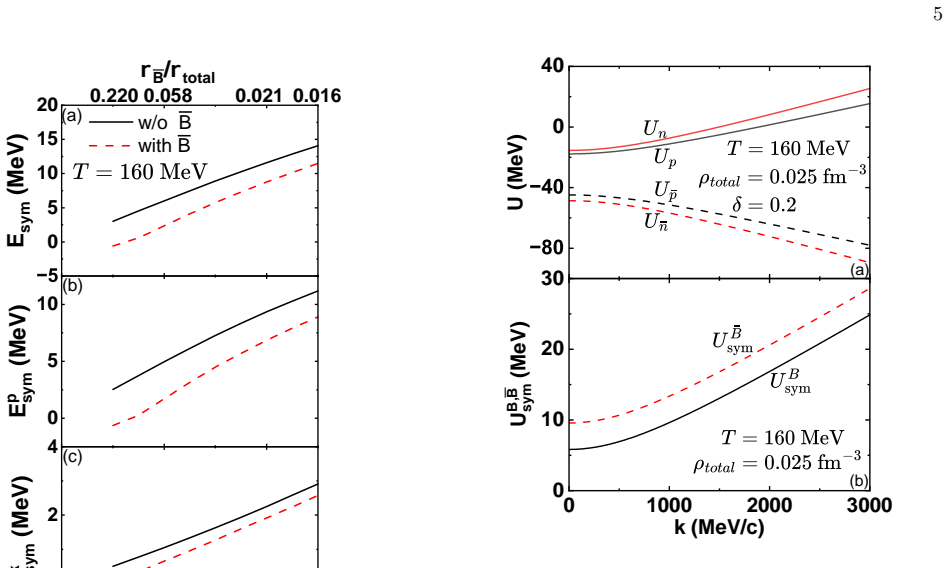
In baryon- and neutron-rich nuclear matter the isospin symmetry energy is considerably reduced even with a small fraction of antinucleons compared to the traditional case with only nucleons. The potential difference between nucleons and antinucleons correlates with the potential contribution of the baryon-antibaryon symmetry energy, which arises mainly from the vector interaction. A more attractive antineutron potential than antiproton potential is observed, and the isospin splitting of the mean-field potential for antinucleons is intrinsically larger than that for nucleons.
What carries the argument
The relativistic mean-field Lagrangian with G-parity invariance, which equates nucleon and antinucleon couplings and permits definition of the baryon-antibaryon symmetry energy.
If this is right
- The baryon-antibaryon symmetry energy quantifies the energy cost of baryon-antibaryon asymmetry and is dominated by vector interactions in baryon-rich matter.
- The mean-field potential for antinucleons exhibits a larger isospin splitting than the potential for nucleons.
- Antineutron potentials are more attractive than antiproton potentials under the same conditions.
Where Pith is reading between the lines
- Traditional symmetry-energy parametrizations calibrated on nucleon-only matter may overestimate the stiffness of the equation of state once small antinucleon populations appear.
- The predicted reduction could alter predicted particle yield ratios in neutron-rich collision environments.
- Direct comparison of measured antinucleon flow or production asymmetries with nucleon counterparts could test the G-parity assumption without requiring full equilibrium.
Load-bearing premise
G-parity invariance equates the coupling strengths of nucleons and antinucleons in the relativistic mean-field Lagrangian.
What would settle it
An experimental extraction of the isospin symmetry energy from heavy-ion collision data that shows no reduction when antinucleons are present at the few-percent level would falsify the central claim.
Figures
read the original abstract
Based on the relativistic mean-field model and assuming $G$-parity invariance, we have studied the equation of state of baryon- and neutron-rich matter produced in low-energy relativistic heavy-ion collisions. Similar to the traditional isospin symmetry energy, we define the baryon-antibaryon symmetry energy characterizing the energy difference due to the baryon-antibaryon asymmetry. The potential difference between nucleons and antinucleons is correlated with the potential contribution of the baryon-antibaryon symmetry energy mainly from the vector interaction in baryon-rich matter. The isospin symmetry energy is considerably reduced even with a small fraction of antinucleons compared to the traditional case with only nucleons. A more attractive antineutron potential than antiproton potential is observed, and the isospin splitting of the mean-field potential for antinucleons is found to be intrinsically larger than that for nucleons in baryon- and neutron-rich matter.
Editorial analysis
A structured set of objections, weighed in public.
Referee Report
Summary. The manuscript uses the relativistic mean-field model under the assumption of G-parity invariance to study the equation of state of baryon- and neutron-rich matter. It defines a baryon-antibaryon symmetry energy and reports that the conventional isospin symmetry energy is considerably reduced even by a small antinucleon fraction. It further claims a correlation between the nucleon-antinucleon potential difference and the vector contribution to the new symmetry energy, plus an intrinsically larger isospin splitting of the mean-field potential for antinucleons than for nucleons.
Significance. If the central reduction holds, the result would modify standard treatments of symmetry energy in models of low-energy heavy-ion collisions. The introduction of a baryon-antibaryon symmetry energy extends the usual isospin framework in a potentially useful way for matter containing both particles and antiparticles.
major comments (2)
- [Abstract] Abstract: the headline claim that the isospin symmetry energy is 'considerably reduced' with only a small antinucleon fraction is obtained solely by imposing G-parity invariance on the RMF Lagrangian, which forces the isovector (rho) couplings of antinucleons to equal those of nucleons (with sign flip). No sensitivity test to relaxing this assumption for the isovector channel is indicated, yet the skeptic note correctly identifies that violation of G-parity for the rho meson would eliminate both the reported isospin splitting for antinucleons and the consequent suppression of the usual symmetry energy.
- [Abstract] Abstract: the stated correlation between the nucleon-antinucleon potential difference and the vector part of the baryon-antibaryon symmetry energy follows directly from the same G-parity construction; without it the correlation and the reduction in isospin symmetry energy both disappear. The manuscript therefore provides no independent evidence that the reduction survives once the assumption is relaxed.
minor comments (2)
- The abstract refers to 'low-energy relativistic heavy-ion collisions' without specifying the beam energy range or providing any comparison to existing data or transport-model results.
- The new baryon-antibaryon symmetry energy is introduced without an explicit functional definition or equation number in the abstract, making it impossible to verify how its vector contribution is isolated from the total energy.
Simulated Author's Rebuttal
We thank the referee for the careful reading and constructive comments. We respond point by point to the major comments below.
read point-by-point responses
-
Referee: [Abstract] Abstract: the headline claim that the isospin symmetry energy is 'considerably reduced' with only a small antinucleon fraction is obtained solely by imposing G-parity invariance on the RMF Lagrangian, which forces the isovector (rho) couplings of antinucleons to equal those of nucleons (with sign flip). No sensitivity test to relaxing this assumption for the isovector channel is indicated, yet the skeptic note correctly identifies that violation of G-parity for the rho meson would eliminate both the reported isospin splitting for antinucleons and the consequent suppression of the usual symmetry energy.
Authors: We agree that the reported reduction of the isospin symmetry energy and the antinucleon isospin splitting arise directly from the G-parity invariance assumption, which sets the isovector couplings of antinucleons equal (with sign flip) to those of nucleons. The manuscript states this assumption explicitly in the abstract, introduction, and model section. We acknowledge that the absence of a sensitivity study relaxing G-parity specifically in the isovector channel limits the robustness discussion. In the revised version we will add a paragraph clarifying this model dependence and noting that violation of G-parity for the rho meson would remove the reported effects. revision: yes
-
Referee: [Abstract] Abstract: the stated correlation between the nucleon-antinucleon potential difference and the vector part of the baryon-antibaryon symmetry energy follows directly from the same G-parity construction; without it the correlation and the reduction in isospin symmetry energy both disappear. The manuscript therefore provides no independent evidence that the reduction survives once the assumption is relaxed.
Authors: The correlation between the nucleon-antinucleon potential difference and the vector contribution to the baryon-antibaryon symmetry energy is a direct consequence of the G-parity construction within the RMF framework employed. The work does not claim results independent of this assumption; it examines the consequences under the standard G-parity relation used for antinucleon potentials. We will revise the abstract and discussion sections to state more explicitly that the findings are conditional on G-parity invariance and to discuss the implications if the assumption is relaxed for the isovector channel. revision: yes
Circularity Check
No significant circularity; derivation follows from explicit model assumptions
full rationale
The paper states its foundational assumption of G-parity invariance upfront and computes consequences within the standard RMF Lagrangian. The new baryon-antibaryon symmetry energy is defined by direct analogy to the isospin case, and the reported reduction in isospin symmetry energy is presented as a numerical outcome of including antinucleons under that assumption. No equations reduce by construction to fitted inputs, no self-citations are invoked as uniqueness theorems, and no parameters are fitted to the target observables. The chain is therefore independent of the reported results.
Axiom & Free-Parameter Ledger
axioms (1)
- domain assumption G-parity invariance equates nucleon and antinucleon couplings in the relativistic mean-field Lagrangian
Reference graph
Works this paper leans on
-
[1]
Isospin Asymmetry in Nuclei and Neutron Stars
Andrew W. Steiner, Madappa Prakash, James M. Lat- timer, and Paul J. Ellis, “Isospin asymmetry in nuclei and neutron stars,” Phys. Rept.411, 325–375 (2005), arXiv:nucl-th/0410066
work page internal anchor Pith review Pith/arXiv arXiv 2005
-
[2]
Reaction Dynamics with Exotic Beams
V. Baran, M. Colonna, V. Greco, and M. Di Toro, “Re- action dynamics with exotic beams,” Phys. Rept.410, 335–466 (2005), arXiv:nucl-th/0412060
work page internal anchor Pith review Pith/arXiv arXiv 2005
-
[3]
Recent Progress and New Challenges in Isospin Physics with Heavy-Ion Reactions
Bao-An Li, Lie-Wen Chen, and Che Ming Ko, “Recent Progress and New Challenges in Isospin Physics with Heavy-Ion Reactions,” Phys. Rept.464, 113–281 (2008), arXiv:0804.3580 [nucl-th]
work page internal anchor Pith review Pith/arXiv arXiv 2008
-
[4]
M. Baldo and G. F. Burgio, “The nuclear symmetry energy,” Prog. Part. Nucl. Phys.91, 203–258 (2016), arXiv:1606.08838 [nucl-th]
work page internal anchor Pith review Pith/arXiv arXiv 2016
-
[5]
Equations of state for supernovae and compact stars
M. Oertel, M. Hempel, T. Kl¨ ahn, and S. Typel, “Equa- tions of state for supernovae and compact stars,” Rev. Mod. Phys.89, 015007 (2017), arXiv:1610.03361 [astro- ph.HE]
work page internal anchor Pith review Pith/arXiv arXiv 2017
-
[6]
Constraints on the density dependence of the symmetry energy from heavy ion collisions
M. B. Tsanget al., “Constraints on the density de- pendence of the symmetry energy from heavy ion col- lisions,” Prog. Part. Nucl. Phys.66, 400–404 (2011), arXiv:1101.3648 [nucl-ex]
work page internal anchor Pith review Pith/arXiv arXiv 2011
-
[7]
A way forward in the study of the symmetry energy: experiment, theory, and observation
C. J. Horowitz, E. F. Brown, Y. Kim, W. G. Lynch, R. Michaels, A. Ono, J. Piekarewicz, M. B. Tsang, and H. H. Wolter, “A way forward in the study of the sym- metry energy: experiment, theory, and observation,” J. Phys. G41, 093001 (2014), arXiv:1401.5839 [nucl-th]
work page internal anchor Pith review Pith/arXiv arXiv 2014
-
[8]
Equation of state of spin-polarized nuclear matter in the relativistic Hartree-Fock method,
Toi Tachibana, Kouichi Hagino, Kenichi Yoshida, and Qiang Zhao, “Equation of state of spin-polarized nuclear matter in the relativistic Hartree-Fock method,” Phys. Rev. C112, 065806 (2025), arXiv:2507.13597 [nucl-th]
-
[9]
Spin symmetry energy and equation of state of spin-polarized neutron star matter,
Nguyen Hoang Dang Khoa, Ngo Hai Tan, and Dao T. Khoa, “Spin symmetry energy and equation of state of spin-polarized neutron star matter,” Phys. Rev. C105, 065802 (2022), arXiv:2206.00218 [nucl-th]
-
[10]
N. Chamel and S. Goriely, “Spin and spin-isospin insta- bilities in asymmetric nuclear matter at zero and finite temperatures using Skyrme functionals,” Phys. Rev. C 82, 045804 (2010), arXiv:1011.0553 [nucl-th]
work page internal anchor Pith review Pith/arXiv arXiv 2010
-
[11]
Equation of state and magnetic susceptibility of spin polarized isospin asymmetric nuclear matter
Isaac Vidana and Ignazio Bombaci, “Equation of state and magnetic susceptibility of spin polarized isospin asymmetric nuclear matter,” Phys. Rev. C66, 045801 (2002), arXiv:nucl-th/0203061
work page internal anchor Pith review Pith/arXiv arXiv 2002
-
[12]
Elliptic flow splitting as a probe of the QCD phase structure at finite baryon chemical potential
Jun Xu, Taesoo Song, Che Ming Ko, and Feng Li, “Ellip- tic flow splitting as a probe of the QCD phase structure at finite baryon chemical potential,” Phys. Rev. Lett.112, 012301 (2014), arXiv:1308.1753 [nucl-th]
work page internal anchor Pith review Pith/arXiv arXiv 2014
-
[13]
Stefano Carignano, Dominik Nickel, and Michael Buballa, “Influence of vector interaction and Polyakov loop dynamics on inhomogeneous chiral symmetry breaking phases,” Phys. Rev. D82, 054009 (2010), arXiv:1007.1397 [hep-ph]
work page internal anchor Pith review Pith/arXiv arXiv 2010
-
[14]
Role of Vector Interaction and Axial Anomaly in the PNJL Modeling of the QCD Phase Diagram
Nino M. Bratovic, Tetsuo Hatsuda, and Wolfram Weise, “Role of Vector Interaction and Axial Anomaly in the PNJL Modeling of the QCD Phase Diagram,” Phys. Lett. B719, 131–135 (2013), arXiv:1204.3788 [hep-ph]
work page internal anchor Pith review Pith/arXiv arXiv 2013
-
[15]
Pedro Costa, M´ arcio Ferreira, D´ ebora P. Menezes, Jo˜ ao Moreira, and Constan¸ ca Providˆ encia, “Influence of the inverse magnetic catalysis and the vector interaction in the location of the critical end point,” Phys. Rev. D92, 036012 (2015), arXiv:1508.07870 [hep-ph]
work page internal anchor Pith review Pith/arXiv arXiv 2015
-
[16]
Symmetry Energy Expansion with Strange Dense Matter
Yumu Yang, Nikolas Cruz Camacho, Mauricio Hippert, and Jacquelyn Noronha-Hostler, “Symmetry-energy ex- pansion with strange dense matter,” Phys. Rev. C113, 045805 (2026), arXiv:2504.18764 [nucl-th]
work page internal anchor Pith review Pith/arXiv arXiv 2026
-
[17]
Interplay between the symmetry energy and the strangeness content of neutron stars
Constanca Providencia and Aziz Rabhi, “Interplay be- tween the symmetry energy and the strangeness con- tent of neutron stars,” Phys. Rev. C87, 055801 (2013), arXiv:1212.5911 [nucl-th]
work page internal anchor Pith review Pith/arXiv arXiv 2013
-
[18]
Modification of the Symmetry Energy by Strangeness,
I. Bednarek, J. S ladkowski, and J. Syska, “Modification of the Symmetry Energy by Strangeness,” Acta Phys. Polon. B50, 1849–1858 (2019)
2019
-
[19]
Effective Masses in Rela- tivistic Approaches to the Nucleon Nucleus Mean Field,
M. Jaminon and C. Mahaux, “Effective Masses in Rela- tivistic Approaches to the Nucleon Nucleus Mean Field,” 7 Phys. Rev. C40, 354–367 (1989)
1989
-
[20]
Natasha Sharma, Lokesh Kumar, and Sourendu Gupta, “More uses for thermal models,” Eur. Phys. J. C86, 556 (2026), arXiv:2602.15770 [hep-ph]
work page internal anchor Pith review Pith/arXiv arXiv 2026
-
[21]
Global Dirac optical potentials for elastic proton scattering from heavy nuclei,
S. Hama, B. C. Clark, E. D. Cooper, H. S. Sherif, and R. L. Mercer, “Global Dirac optical potentials for elastic proton scattering from heavy nuclei,” Phys. Rev. C41, 2737–2755 (1990)
1990
-
[22]
Global Dirac phenomenology for proton nucleus elastic scattering,
E. D. Cooper, S. Hama, B. C. Clark, and R. L. Mercer, “Global Dirac phenomenology for proton nucleus elastic scattering,” Phys. Rev. C47, 297–311 (1993)
1993
-
[23]
Strong-Interaction Effects in An- tiprotonic Atoms,
P. D. Barneset al., “Strong-Interaction Effects in An- tiprotonic Atoms,” Phys. Rev. Lett.29, 1132–1134 (1972)
1972
-
[24]
Study on anti-Protonic Atoms of Light Nuclei and Isotopes,
H. Pothet al., “Study on anti-Protonic Atoms of Light Nuclei and Isotopes,” Nucl. Phys. A294, 435–449 (1978)
1978
-
[25]
Optical Model Analysis of Exotic Atom Data. II. Anti-protonic and Σ Atoms,
C. J. Batty, “Optical Model Analysis of Exotic Atom Data. II. Anti-protonic and Σ Atoms,” Nucl. Phys. A 372, 433–444 (1981)
1981
-
[26]
Ambiguity in anti-proton nucleus potentials from anti-protonic atom data,
C. Y. Wong, A. K. Kerman, G. R. Satchler, and A. D. Mackellar, “Ambiguity in anti-proton nucleus potentials from anti-protonic atom data,” Phys. Rev. C29, 574–580 (1984)
1984
discussion (0)
Sign in with ORCID, Apple, or X to comment. Anyone can read and Pith papers without signing in.