The Large-Scale Structure of the Universe through the SKA lenses
Pith reviewed 2026-07-01 04:16 UTC · model grok-4.3
The pith
The Square Kilometre Array will detect faint radio emission from plasma in cosmic web filaments and cluster outskirts.
A machine-rendered reading of the paper's core claim, the machinery that carries it, and where it could break.
Core claim
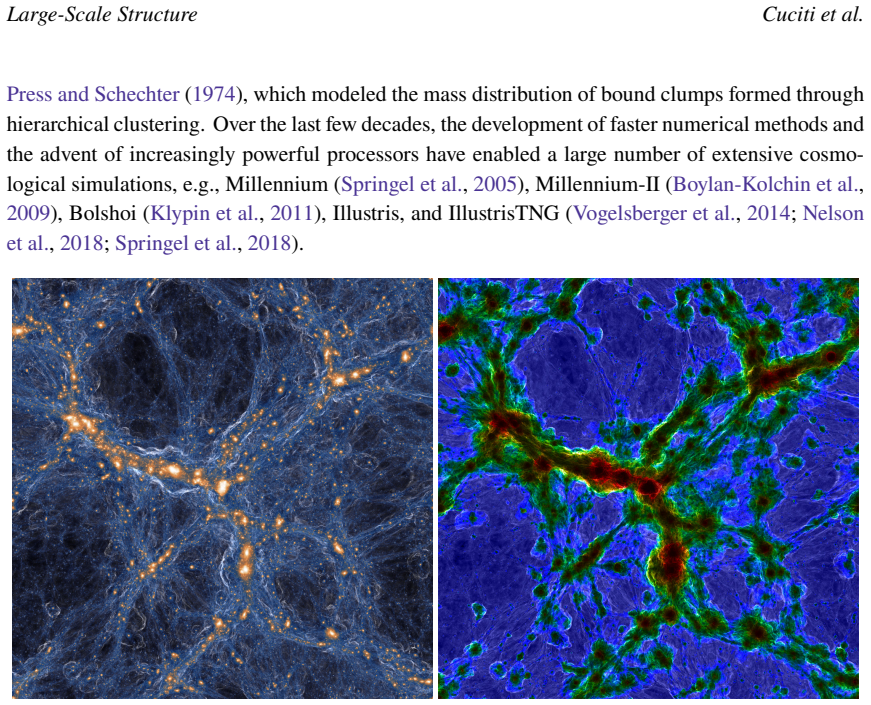
Cosmological simulations within the Lambda-CDM framework reproduce the filamentary cosmic web and predict that its nodes and filaments are filled with tenuous plasma at 10^5-10^8 K. The hottest plasma resides in cluster nodes while cooler gas extends along filaments; galaxies flow along these filaments before accreting onto clusters. Enormous energy is dissipated through plasma processes that accelerate electrons and produce observable radio emission. Current facilities have detected emission from denser regions such as megahalos and cluster-pair bridges, but the fainter emission from cluster outskirts and intergalactic filaments has stayed below detection thresholds. The forthcoming Square
What carries the argument
Faint radio emission from electrons accelerated by plasma processes in the tenuous gas of cosmic-web filaments and cluster outskirts, which traces energy dissipation during structure formation.
If this is right
- Detection of radio megahalos and bridges will trace the flow of galaxies and groups along filaments toward clusters.
- Mapping of the emission will provide direct observational constraints on the baryon content in the warm-hot intergalactic medium.
- Successful observations will test the plasma physics and energy dissipation mechanisms assumed in structure-formation simulations.
- Wider coverage will reveal how the cosmic web evolves across different redshifts and environments.
Where Pith is reading between the lines
- These SKA maps could locate the bulk of the missing baryons by imaging the warm-hot gas in filaments.
- The same data would allow study of accretion shocks and turbulence on scales larger than individual clusters.
- Deviations between observed radio structures and simulation predictions could motivate refinements to feedback or magnetic-field models in cosmology.
Load-bearing premise
That Lambda-CDM simulations correctly predict the temperature and density of the plasma in filaments and cluster outskirts, and that SKA sensitivity will be sufficient to detect the expected faint radio emission.
What would settle it
Non-detection of the predicted radio emission from cluster outskirts and intergalactic filaments in SKA observations at the sensitivity levels expected from current simulations.
Figures
read the original abstract
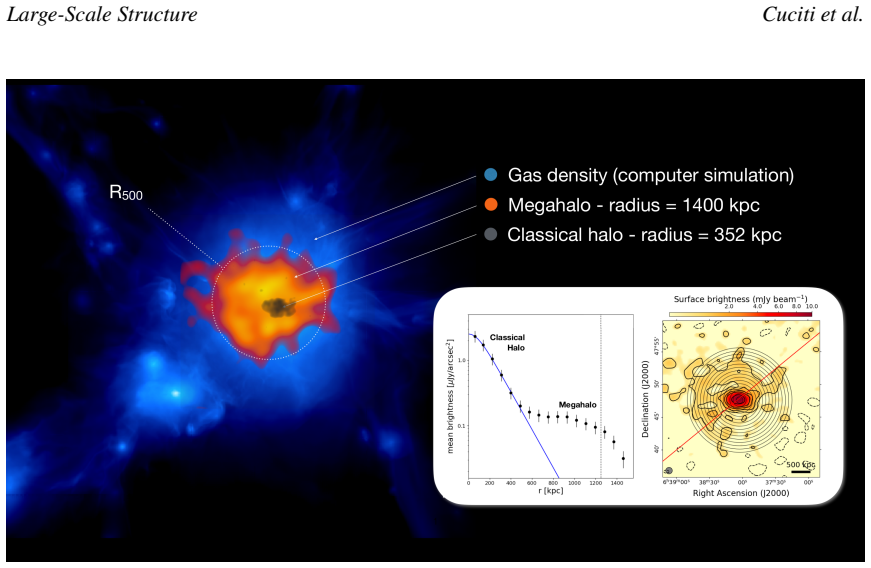
The large-scale distribution of galaxies in the Universe forms an intricate, interconnected network known as the cosmic web. Cosmological simulations within the standard Lambda-CDM framework successfully reproduce this filamentary structure and predict that the nodes and filaments are filled with tenuous plasma at temperatures ranging from 10^5-10^8 K. The hottest and luminous plasma in the nodes corresponds to the intra-cluster medium, while the cooler, more tenuous, gas extends along filaments and cluster outskirts. Galaxies and galaxy groups form and flow along these filaments before accreting onto galaxy clusters (the nodes), outlining the dynamical evolution of large-scale structures. During this process, an enormous amount of energy is dissipated through complex plasma processes that can be traced by radio emitting electrons. Despite strong theoretical support for this picture, observational validation remains limited. While massive clusters have been widely detected across various wavelengths, cluster outskirts and the diffuse intergalactic medium within filaments has remained elusive due to their extremely faint emission. The advent of highly sensitive radio facilities such as LOFAR, uGMRT, and MeerKAT has recently enabled a few successful detections of emission from comparatively denser regions of the cosmic-web. These include radio megahalos, permeating the entire cluster volume, as well as bridges of radio emission connecting cluster pairs. In this chapter, we summarize current theoretical insights into the cosmic web, discuss observational strategies and recent discoveries, and highlight how the forthcoming Square Kilometre Array (SKA) is expected to transform our understanding of the cosmic web and the distribution of baryons in the Universe.
Editorial analysis
A structured set of objections, weighed in public.
Referee Report
Summary. This review chapter summarizes Lambda-CDM predictions for the filamentary cosmic web and the distribution of baryonic plasma (10^5-10^8 K) in nodes and filaments, reviews recent radio detections of diffuse emission (megahalos, cluster bridges) with LOFAR/uGMRT/MeerKAT, and outlines how the SKA is expected to map the large-scale structure and address the baryon distribution.
Significance. The manuscript offers a clear, consensus-level synthesis of theoretical expectations and observational progress in radio studies of the cosmic web. It correctly identifies the gap between simulation predictions and current detections of faint filamentary emission, and positions SKA as the instrument likely to close that gap. No new derivations, quantitative forecasts, or empirical results are advanced; the value is therefore as a consolidated reference rather than a primary research contribution.
minor comments (1)
- [Abstract] Abstract: the phrase 'in this chapter' appears only at the end; moving an explicit statement that the work is a review chapter to the opening sentence would improve reader orientation.
Simulated Author's Rebuttal
We thank the referee for their positive assessment and recommendation to accept the manuscript. The referee's summary correctly reflects the scope and intent of this review chapter on the cosmic web, radio observations, and the role of the SKA.
Circularity Check
No significant circularity; review paper without derivations or fitted predictions
full rationale
The manuscript is a review chapter summarizing Lambda-CDM simulation predictions for the cosmic web, recent detections from LOFAR/uGMRT/MeerKAT, and qualitative SKA prospects. No equations, derivations, parameter fits, or quantitative forecasts are advanced in the provided text or abstract. All load-bearing statements (simulation fidelity for filament plasma, SKA sensitivity) are explicitly inherited from cited external literature rather than generated internally. No self-citation chains, self-definitional steps, or renamings of results occur. This is the expected outcome for a purely descriptive review.
Axiom & Free-Parameter Ledger
Reference graph
Works this paper leans on
-
[1]
and Evrard, August E
Allen, Steven W. and Evrard, August E. and Mantz, Adam B. , title =. Annual Review of Astronomy and Astrophysics , volume =. 2011 , eprint =
2011
-
[2]
The Galactic Faraday rotation sky 2020. , keywords =. doi:10.1051/0004-6361/202140486 , archivePrefix =. 2102.01709 , primaryClass =
-
[3]
Proceedings of Science , volume =
Cassano, Raffaella and others , title =. Proceedings of Science , volume =. 2015 , eprint =
2015
-
[4]
The nature of LOFAR rotation measures and new constraints on magnetic fields in cosmic filaments and on magnetogenesis scenarios. , keywords =. doi:10.1051/0004-6361/202451333 , archivePrefix =. 2411.13499 , primaryClass =
-
[5]
Proceedings of Science , volume =
Maartens, Roy and others , title =. Proceedings of Science , volume =. 2015 , eprint =
2015
-
[6]
Astrophysical Journal , volume =
Bull, Philip and others , title =. Astrophysical Journal , volume =. 2015 , eprint =
2015
-
[7]
and Turok, Neil , title =
Bode, Paul and Ostriker, Jeremiah P. and Turok, Neil , title =. Astrophysical Journal , volume =. 2001 , eprint =
2001
-
[8]
Monthly Notices of the Royal Astronomical Society , volume =
Vogelsberger, Mark and Zavala, Jes\'us and Loeb, Abraham , title =. Monthly Notices of the Royal Astronomical Society , volume =. 2012 , eprint =
2012
-
[9]
Probing the Cosmological Principle in the counts of radio galaxies at different frequencies
Probing the Cosmological Principle in the counts of radio galaxies at different frequencies. , keywords =. doi:10.1088/1475-7516/2018/04/031 , archivePrefix =. 1710.08804 , primaryClass =
work page internal anchor Pith review Pith/arXiv arXiv doi:10.1088/1475-7516/2018/04/031 2018
-
[10]
2019 , eprint=
Anticipated Performance of the Square Kilometre Array -- Phase 1 (SKA1) , author=. 2019 , eprint=
2019
-
[11]
Journal of Korean Astronomical Society , keywords =
Diffusive Shock Acceleration Efficiencies for Weak ICM Shocks in the Test-Particle Regime. Journal of Korean Astronomical Society , keywords =. doi:10.5303/JKAS.2024.57.2.155 , archivePrefix =. 2409.18425 , primaryClass =
-
[12]
Proceedings of Science , volume =
Camera, Stefano and others , title =. Proceedings of Science , volume =. 2015 , eprint =
2015
-
[13]
2015 , publisher=
Advancing Astrophysics with the Square Kilometre Array (AASKA14) , author=. 2015 , publisher=
2015
-
[14]
Bailyn , title =
John F. Bailyn , title =. Natural Language & Linguistic Theory , year =
-
[15]
Magnetic fields and relativistic electrons fill entire galaxy cluster. Science Advances , keywords =. doi:10.1126/sciadv.abq7623 , archivePrefix =. 2211.01493 , primaryClass =
-
[16]
Exploring the origins of mega radio halos. , keywords =. doi:10.1051/0004-6361/202346784 , archivePrefix =. 2306.03764 , primaryClass =
-
[17]
Cosmological simulations of the generation of cluster-scale radio emission from turbulent re-acceleration. , keywords =. doi:10.1051/0004-6361/202450763 , archivePrefix =. 2406.09859 , primaryClass =
-
[18]
Second-order Fermi Reacceleration Mechanisms and Large-Scale Synchrotron Radio Emission in Intracluster Bridges. , keywords =. doi:10.1103/PhysRevLett.124.051101 , archivePrefix =. 2001.07718 , primaryClass =
-
[19]
Cosmic rays in galaxy clusters and their non-thermal emission
Cosmic Rays in Galaxy Clusters and Their Nonthermal Emission. International Journal of Modern Physics D , keywords =. doi:10.1142/S0218271814300079 , archivePrefix =. 1401.7519 , primaryClass =
work page internal anchor Pith review Pith/arXiv arXiv doi:10.1142/s0218271814300079
-
[20]
Synchrotron emission from virial shocks around stacked OVRO-LWA galaxy clusters. , keywords =. doi:10.1093/mnras/stad785 , archivePrefix =. 2210.09317 , primaryClass =
-
[21]
The LOFAR Two-metre Sky Survey. II. First data release. , keywords =. doi:10.1051/0004-6361/201833559 , archivePrefix =. 1811.07926 , primaryClass =
work page internal anchor Pith review Pith/arXiv arXiv doi:10.1051/0004-6361/201833559
-
[22]
The LOFAR Two-metre Sky Survey. V. Second data release. , keywords =. doi:10.1051/0004-6361/202142484 , archivePrefix =. 2202.11733 , primaryClass =
-
[23]
LOFAR discovery of a double radio halo system in Abell 1758 and radio/X-ray study of the cluster pair. , keywords =. doi:10.1093/mnras/sty1102 , archivePrefix =. 1804.09187 , primaryClass =
work page internal anchor Pith review Pith/arXiv arXiv doi:10.1093/mnras/sty1102
-
[24]
, archivePrefix = "arXiv", eprint =
A low-frequency radio halo associated with a cluster of galaxies. , archivePrefix = "arXiv", eprint =. doi:10.1038/nature07379 , adsurl =
-
[25]
Galaxy clusters enveloped by vast volumes of relativistic electrons. , keywords =. doi:10.1038/s41586-022-05149-3 , archivePrefix =. 2209.13617 , primaryClass =
-
[26]
Baryons in the Warm-Hot Intergalactic Medium
Baryons in the Warm-Hot Intergalactic Medium. , keywords =. doi:10.1086/320548 , archivePrefix =. astro-ph/0007217 , primaryClass =
work page internal anchor Pith review Pith/arXiv arXiv doi:10.1086/320548
-
[27]
Deep study of A399-401: Application of a wide-field facet calibration. , keywords =. doi:10.1051/0004-6361/202244346 , archivePrefix =. 2209.13930 , primaryClass =
-
[28]
Mind the gap between A2061 and A2067: Unveiling new diffuse, large-scale radio emission. , keywords =. doi:10.1051/0004-6361/202451529 , archivePrefix =. 2409.15412 , primaryClass =
-
[29]
MeerKAT discovery of gigahertz radio emission extending from Abell 3017 towards Abell 3016. , keywords =. doi:10.1051/0004-6361/202453200 , archivePrefix =. 2412.00204 , primaryClass =
-
[30]
Abell 0399-Abell 0401 radio bridge spectral index: First multi-frequency detection. , keywords =. doi:10.1051/0004-6361/202450051 , archivePrefix =. 2405.00772 , primaryClass =
-
[31]
Constraints on the distribution and energetics of fast radio bursts using cosmological hydrodynamic simulations. , keywords =. doi:10.1093/mnras/stv1190 , archivePrefix =. 1412.4829 , primaryClass =
work page internal anchor Pith review Pith/arXiv arXiv doi:10.1093/mnras/stv1190
-
[32]
Testing cosmic-ray acceleration with radio relics: a high-resolution study using MHD and tracers
Testing cosmic ray acceleration with radio relics: a high-resolution study using MHD and tracers. , keywords =. doi:10.1093/mnras/stw2631 , archivePrefix =. 1610.05305 , primaryClass =
work page internal anchor Pith review Pith/arXiv arXiv doi:10.1093/mnras/stw2631
-
[33]
A giant radio bridge connecting two galaxy clusters in Abell 1758. , keywords =. doi:10.1093/mnrasl/slaa142 , archivePrefix =. 2008.09613 , primaryClass =
-
[34]
Clusters of galaxies : observational properties of the diffuse radio emission
Clusters of galaxies: observational properties of the diffuse radio emission. , keywords =. doi:10.1007/s00159-012-0054-z , archivePrefix =. 1205.1919 , primaryClass =
work page internal anchor Pith review Pith/arXiv arXiv doi:10.1007/s00159-012-0054-z 1919
-
[35]
A radio ridge connecting two galaxy clusters in a filament of the cosmic web
A radio ridge connecting two galaxy clusters in a filament of the cosmic web. Science , keywords =. doi:10.1126/science.aat7500 , archivePrefix =. 1906.07584 , primaryClass =
work page internal anchor Pith review Pith/arXiv arXiv doi:10.1126/science.aat7500 1906
-
[36]
Universal thermodynamic properties of the intracluster medium over two decades in radius in the X-COP sample. , keywords =. doi:10.1051/0004-6361/201833325 , archivePrefix =. 1805.00042 , primaryClass =
work page internal anchor Pith review Pith/arXiv arXiv doi:10.1051/0004-6361/201833325
-
[37]
Adaptive friend-of-friends algorithm for identifying gravitationally bound cosmological structures. , keywords =. doi:10.1103/PhysRevD.108.103509 , archivePrefix =. 2311.15468 , primaryClass =
-
[38]
Imprint of Intergalactic Shocks on the Radio Sky
Imprint of Intergalactic Shocks on the Radio Sky. , keywords =. doi:10.1086/424837 , archivePrefix =. astro-ph/0402320 , primaryClass =
work page internal anchor Pith review Pith/arXiv arXiv doi:10.1086/424837
-
[39]
The large-scale structure of the Universe
The large-scale structure of the Universe. , keywords =. doi:10.1038/nature04805 , archivePrefix =. astro-ph/0604561 , primaryClass =
work page internal anchor Pith review Pith/arXiv arXiv doi:10.1038/nature04805
-
[40]
, year = 1972, month = aug, volume =
Formation of Clusters of Galaxies; Protocluster Fragmentation and Intergalactic Gas Heating. , year = 1972, month = aug, volume =
1972
-
[41]
Detecting shocked intergalactic gas with X-ray and radio observations
Detecting shocked intergalactic gas with X-ray and radio observations. , keywords =. doi:10.1051/0004-6361/201935439 , archivePrefix =. 1903.04166 , primaryClass =
work page internal anchor Pith review Pith/arXiv arXiv doi:10.1051/0004-6361/201935439 1903
-
[42]
Discovery of magnetic fields along stacked cosmic filaments as revealed by radio and X-ray emission. , keywords =. doi:10.1093/mnras/stab1301 , archivePrefix =. 2101.09331 , primaryClass =
-
[43]
Polarized accretion shocks from the cosmic web. Science Advances , keywords =. doi:10.1126/sciadv.ade7233 , archivePrefix =. 2302.08072 , primaryClass =
-
[44]
, year = 1972, month = aug, volume = 20, pages = 189, adsurl =
Formation of Clusters of Galaxies; Protocluster Fragmentation and Intergalactic Gas Heating. , year = 1972, month = aug, volume = 20, pages = 189, adsurl =
1972
-
[45]
Galaxy Clustering in the Completed SDSS Redshift Survey: The Dependence on Color and Luminosity
Galaxy Clustering in the Completed SDSS Redshift Survey: The Dependence on Color and Luminosity. , keywords =. doi:10.1088/0004-637X/736/1/59 , archivePrefix =. 1005.2413 , primaryClass =
work page internal anchor Pith review Pith/arXiv arXiv doi:10.1088/0004-637x/736/1/59
-
[46]
A Comprehensive Study of the Radio Properties of Brightest Cluster Galaxies
A comprehensive study of the radio properties of brightest cluster galaxies. , keywords =. doi:10.1093/mnras/stv1517 , archivePrefix =. 1507.03019 , primaryClass =
work page internal anchor Pith review Pith/arXiv arXiv doi:10.1093/mnras/stv1517
-
[47]
Brightest Cluster Galaxies as Standard Candles. , keywords =. doi:10.1086/175144 , adsurl =
-
[48]
Pair-production multiplicities in rotation-powered pulsars
Revisiting Brightest Cluster Galaxy Evolution with the Las Campanas Distant Cluster Survey. , year = 2002, month = feb, volume =. doi:10.1086/337959 , archivePrefix =. astro-ph/0107209 , primaryClass =
work page internal anchor Pith review Pith/arXiv arXiv doi:10.1086/337959 2002
-
[49]
High statistics study of the reaction $\gamma p\to p\pi^0\eta$
Multiwavelength investigations of co-evolution of bright cluster galaxies and their host clusters. , keywords =. doi:10.1093/mnras/stu253 , archivePrefix =. 1402.4125 , primaryClass =
work page internal anchor Pith review Pith/arXiv arXiv doi:10.1093/mnras/stu253
-
[50]
Molecular Energy Relations From Chemical Kinetics
How Special Are Brightest Cluster Galaxies? The Impact of Near-Infrared Luminosities on Scaling Relations for BCGs. , year = 2007, month = jul, volume =. doi:10.1086/520518 , archivePrefix =. 0706.0552 , primaryClass =
work page internal anchor Pith review Pith/arXiv arXiv doi:10.1086/520518 2007
-
[51]
Observational Evidence of AGN Feedback
Observational Evidence of Active Galactic Nuclei Feedback. , year = 2012, month = sep, volume =. doi:10.1146/annurev-astro-081811-125521 , archivePrefix =. 1204.4114 , primaryClass =
work page internal anchor Pith review Pith/arXiv arXiv doi:10.1146/annurev-astro-081811-125521 2012
-
[52]
Mechanical Feedback from Active Galactic Nuclei in Galaxies, Groups, and Clusters
Mechanical feedback from active galactic nuclei in galaxies, groups and clusters. New Journal of Physics , year = 2012, month = may, volume =. doi:10.1088/1367-2630/14/5/055023 , archivePrefix =. 1204.0006 , primaryClass =
work page internal anchor Pith review Pith/arXiv arXiv doi:10.1088/1367-2630/14/5/055023 2012
-
[53]
, year = 2018, month = mar, volume =
AGN outflows and feedback twenty years on. , year = 2018, month = mar, volume =. doi:10.1038/s41550-018-0403-6 , adsurl =
-
[54]
, year = 2018, month = mar, volume =
Observing positive and negative AGN feedback. , year = 2018, month = mar, volume =. doi:10.1038/s41550-018-0404-5 , adsurl =
-
[55]
and Busarello, G
Merluzzi, P. and Busarello, G. and Haines, C. P. and Mercurio, A. and Okabe, N. and Pimbblet, K. J. and Dopita, M. A. and Grado, A. and Limatola, L. and Bourdin, H. and Mazzotta, P. and Capaccioli, M. and Napolitano, N. R. and Schipani, P. , title =. Monthly Notices of the Royal Astronomical Society , volume =. 2015 , doi =
2015
-
[56]
Shapley supercluster survey: mapping the dark matter distribution , volume=
Higuchi, Yuchi and Okabe, Nobuhiro and Merluzzi, Paola and Haines, Christopher Paul and Busarello, Giovanni and Grado, Aniello and Mercurio, Amata , year=. Shapley supercluster survey: mapping the dark matter distribution , volume=. Monthly Notices of the Royal Astronomical Society , publisher=. doi:10.1093/mnras/staa1766 , number=
-
[57]
and Busarello, G
Merluzzi, P. and Busarello, G. and Dopita, M. A. and Haines, C. P. and Steinhauser, D. and Bourdin, H. and Mazzotta, P. and Mercurio, A. and Grado, A. and Limatola, L. and Reiprich, T. H. and Br. The Shapley Supercluster Survey: Galaxy evolution from filaments to cluster cores , journal =. 2015 , doi =
2015
-
[58]
and Busarello, G
Merluzzi, P. and Busarello, G. and Dopita, M. A. and Steinhauser, D. and Bourdin, H. and Mazzotta, P. and Haines, C. P. and Mercurio, A. and Grado, A. and Limatola, L. and Reiprich, T. H. and Br. Ram-pressure stripping in the Shapley Supercluster: the case of SOS 114372 at z=0.05 , journal =. 2016 , doi =
2016
-
[59]
and Merluzzi, P
Mercurio, A. and Merluzzi, P. and Busarello, G. and Grado, A. and Limatola, L. and La Barbera, F. and Longo, G. and Haines, C. P. and Dopita, M. A. and Steinhauser, D. and Bourdin, H. and Mazzotta, P. and Reiprich, T. H. and Br. The Shapley Supercluster Survey (ShaSS). I. Optical imaging of the Shapley Supercluster core , journal =. 2015 , doi =
2015
-
[60]
Dissecting a miniature universe: A multi-wavelength view of galaxy quenching in the Shapley supercluster. , keywords =. doi:10.1051/0004-6361/202348672 , archivePrefix =. 2402.18455 , primaryClass =
-
[61]
Morphologies of galaxies within voids. , keywords =. doi:10.1051/0004-6361/202450809 , archivePrefix =. 2411.02129 , primaryClass =
-
[62]
The Supercluster-Void Network I. The Supercluster Catalogue and Large-Scale Distribution
The supercluster-void network I. The supercluster catalogue and large-scale distribution. , keywords =. doi:10.1051/aas:1997340 , archivePrefix =. astro-ph/9610088 , primaryClass =
work page internal anchor Pith review Pith/arXiv arXiv doi:10.1051/aas:1997340
-
[63]
Astronomy and Astrophysics Supplement Series , year =
Einasto, Maret and Tago, Erik and Jaaniste, Jaak and Einasto, Jaan and Andernach, Heinz , title =. Astronomy and Astrophysics Supplement Series , year =
-
[64]
and Suhhonenko, I
Einasto, J. and Suhhonenko, I. and Hütsi, G. and Saar, E. and Einasto, M. and Liivamägi, L. J. and Müller, V. and Starobinsky, A. A. and Tago, E. and Tempel, E. , title =. , year =
-
[65]
Sutter, P. M. and Lavaux, G. and Wandelt, B. D. and Weinberg, D. H. , title =. Monthly Notices of the Royal Astronomical Society , year =
-
[66]
Monthly Notices of the Royal Astronomical Society , year =
Nadathur, Seshadri , title =. Monthly Notices of the Royal Astronomical Society , year =
-
[67]
New constraints on the magnetic field in cosmic web filaments. , keywords =. doi:10.1051/0004-6361/202140526 , archivePrefix =. 2101.06051 , primaryClass =
-
[68]
CHEX-MATE: A LOFAR pilot X-ray - radio study on five radio halo clusters. , keywords =. doi:10.1051/0004-6361/202347965 , archivePrefix =. 2402.18654 , primaryClass =
-
[69]
Only the Lonely: H I Imaging of Void Galaxies
Only the Lonely: H I Imaging of Void Galaxies. , keywords =. doi:10.1088/0004-6256/141/1/4 , archivePrefix =. 1008.4616 , primaryClass =
work page internal anchor Pith review Pith/arXiv arXiv doi:10.1088/0004-6256/141/1/4
-
[70]
The Void Galaxy Survey: Optical Properties and H I Morphology and Kinematics
The Void Galaxy Survey: Optical Properties and H I Morphology and Kinematics. , keywords =. doi:10.1088/0004-6256/144/1/16 , archivePrefix =. 1204.5185 , primaryClass =
work page internal anchor Pith review Pith/arXiv arXiv doi:10.1088/0004-6256/144/1/16
-
[71]
Galaxy properties from Voids to Clusters in the SDSS-DR4
Galaxy properties from voids to clusters in the SDSS-DR4. , keywords =. doi:10.1051/0004-6361:20065789 , archivePrefix =. astro-ph/0608368 , primaryClass =
work page internal anchor Pith review Pith/arXiv arXiv doi:10.1051/0004-6361:20065789
-
[72]
Journal of Astrophysics and Astronomy , keywords =
Decoding the giant extragalactic radio sources. Journal of Astrophysics and Astronomy , keywords =. doi:10.1007/s12036-022-09898-5 , archivePrefix =. 2208.02130 , primaryClass =
-
[73]
, year = 2024, month = sep, volume =
Black hole jets on the scale of the cosmic web. , keywords =. doi:10.1038/s41586-024-07879-y , archivePrefix =. 2411.08630 , primaryClass =
-
[74]
The radio luminosity-environmental density relation for radio galaxies in action
Luminous giants populate the dense Cosmic Web. The radio luminosity-environmental density relation for radio galaxies in action. , keywords =. doi:10.1051/0004-6361/202347115 , archivePrefix =. 2404.17776 , primaryClass =
-
[75]
Search and analysis of giant radio galaxies with associated nuclei (SAGAN). IV. Interplay with the Supercluster environment. , keywords =. doi:10.1051/0004-6361/202450011 , archivePrefix =. 2405.19154 , primaryClass =
-
[76]
Identification of Superclusters and Their Properties in the Sloan Digital Sky Survey Using the WHL Cluster Catalog. , keywords =. doi:10.3847/1538-4357/acfaeb , archivePrefix =. 2309.06251 , primaryClass =
-
[77]
Galaxy Superclusters and Their Complexes in the Cosmic Web. Universe , keywords =. doi:10.3390/universe11060167 , archivePrefix =. 2505.22082 , primaryClass =
-
[78]
Detection of magnetic fields in superclusters of galaxies. , keywords =. doi:10.1051/0004-6361/202553709 , adsurl =
-
[79]
How Filaments are Woven into the Cosmic Web
How filaments of galaxies are woven into the cosmic web. , keywords =. doi:10.1038/380603a0 , archivePrefix =. astro-ph/9512141 , primaryClass =
work page internal anchor Pith review Pith/arXiv arXiv doi:10.1038/380603a0
-
[80]
Living Reviews in Computational Astrophysics , keywords =
Large-scale dark matter simulations. Living Reviews in Computational Astrophysics , keywords =. doi:10.1007/s41115-021-00013-z , archivePrefix =. 2112.05165 , primaryClass =
discussion (0)
Sign in with ORCID, Apple, or X to comment. Anyone can read and Pith papers without signing in.