REVIEW 4 major objections 4 cited by
FARS: A Fully Automated Research System Deployed at Scale
T0 review · 4 major / 0 minor · reviewed 2026-07-14 · grok-4.5
Pith's one-line read A fully automated multi-agent system can write complete AI research papers at scale, and a large human review of its live output maps both review-worthy work and recurring failure modes.
desk verdict Real systems paper: 166 uncurated AI-generated papers with full artifacts and a large human review study; the “occasionally strong” tail is thinner and noisier than the headline suggests. read the letter →
The pith
A machine-rendered reading of the paper's core claim, the machinery that carries it, and where it could break.
The reading
What carries the argument
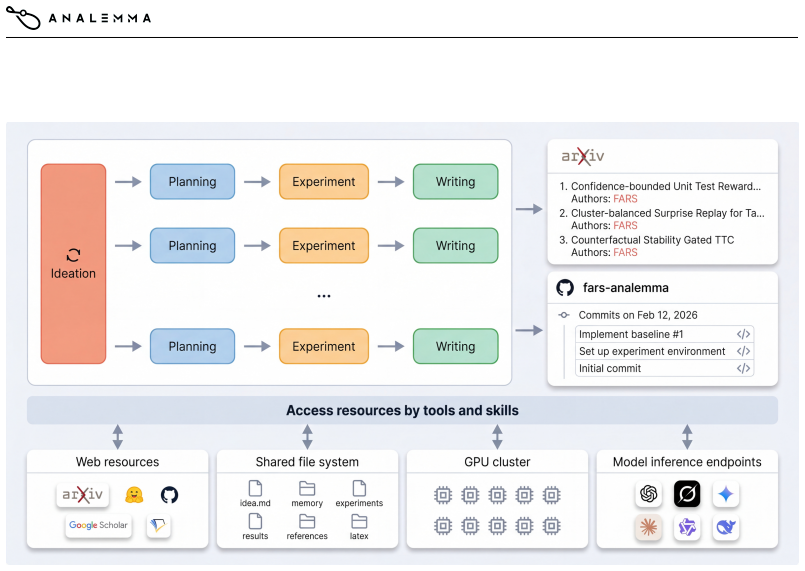
The shared auditable workspace linking four sequential stages—Ideation, Planning, Experiment, and Writing—so each project is a focused hypothesis-and-validation attempt whose proposals, plans, code, logs, results, and manuscript remain inspectable end to end.
What would settle it
Have independent expert reviewers, without self-selection and with mandatory artifact checks, re-score a random subset of the same papers and re-run key experiments from the released code and logs; if quality ranks collapse or claimed numbers routinely fail to match artifacts, the deployment claim does not hold.
Extended reading notes
Core claim
FARS shows that a fully automated, stage-structured research system can generate a large, unaudited-in-advance corpus of complete AI/ML papers and that expert structured review of that live distribution finds reviewable and sometimes strong artifacts alongside systematic shortfalls in experimental scope, methodology, and claim integrity.
Load-bearing premise
That volunteer reviewers who self-claim papers, rather than an independent venue committee, and who often use language models for polishing, give a fair enough reading of scientific quality and integrity for the whole deployment corpus.
Editorial extensions
If this is right
- Automated research can be run as a continuous public pipeline that preserves weak and negative outcomes instead of only curated successes.
- Human evaluation of AI-generated papers needs artifact-grounded integrity checks, not only surface scores or fluent presentation.
- The main bottlenecks for reliable automated science are contribution value, experimental sufficiency, and claim faithfulness, not manuscript polish.
- Progress means agents that design decisive experiments, audit claims against provenance, learn from failed trajectories, and withhold unsupported outputs.
Reading between the lines
- The same deployment pattern will be harder in fields where hypotheses cannot be reduced to code, shared benchmarks, and GPU runs.
- A permanent public artifact store of failed plans and negative results could become a training and auditing resource for later research agents.
- If automated reviewers systematically rate the same corpus higher than expert humans, deployment monitoring cannot rest on automated review alone.
- Treating short, falsifiable negative-result papers as first-class outputs may change how fields track progress under automation.
Editorial analysis
A structured set of objections, weighed in public.
Referee Report
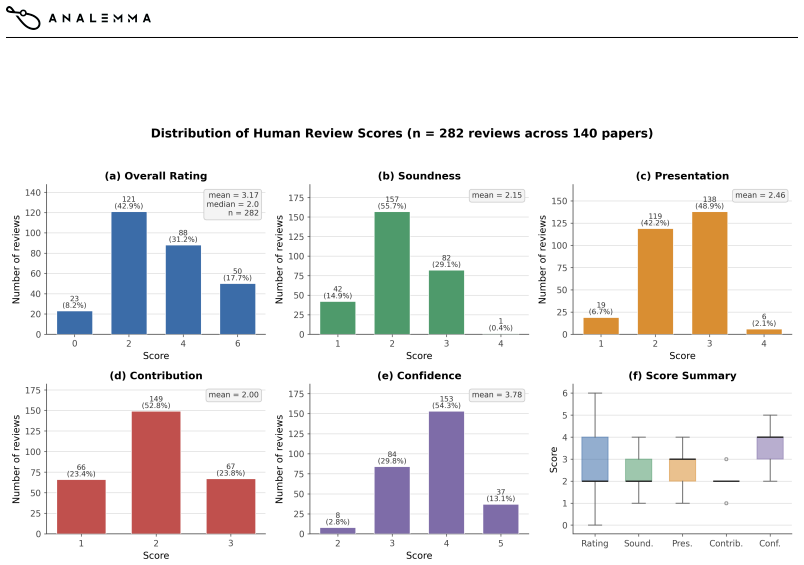
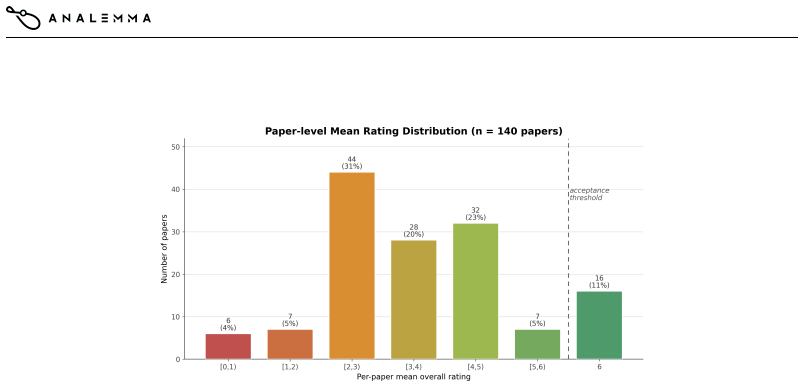
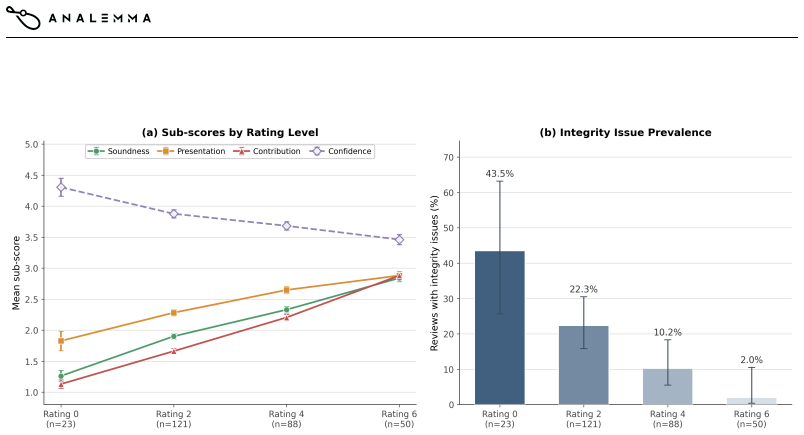
Summary. The paper presents FARS, a multi-agent AI-for-AI research system that autonomously runs Ideation, Planning, Experiment, and Writing stages through a shared auditable workspace. In a continuous public deployment (417 hours, ~$186k, 21.6B tokens), FARS produced 166 complete papers spanning 67 AI/ML topics, preserving proposals, code, logs, results, and manuscripts rather than a curated success set. Quality is assessed via 282 structured volunteer reviews of 140 papers (ICLR-style overall ratings and sub-scores, integrity audit against artifacts, LLM-use disclosure) and a uniform Stanford Agentic Reviewer comparison against public outputs of six prior systems. The authors report a left-skewed quality distribution (paper-level mean overall rating 3.23; 11.4% of reviewed papers with mean ≥6), recurring weaknesses in experimental sufficiency and methodology, integrity flags on 27.9% of reviewed papers, and a higher automated SAR mean for FARS than for prior systems’ released papers.
Significance. If the deployment and evaluation hold, this is a substantial systems contribution: it shifts evidence for autonomous research from selected demos and human-scoped tasks to a live, large-scale idea-to-paper distribution with inspectable intermediate artifacts. Strengths that should be credited explicitly include the artifact-centered design (shared workspace, dual verification, checkpointed experiment loop), the decision to retain weak and negative trajectories, the AI Integrity Audit grounded in code/logs rather than text alone, public release of papers and most reviews, and unusually detailed reporting of cost, topic emergence, score distributions, agreement, and failure modes. For the AI-agent and automated-science communities, a calibrated account of what continuous end-to-end generation actually yields—and where it fails—is more useful than another curated showcase.
major comments (4)
- §5.2 and Figure 3: the load-bearing claim that FARS produces “occasionally strong” artifacts (abstract; §1; §7) rests on 16/140 papers with mean overall rating ≥6, of which 14 had a single review and only 2 of 95 multi-reviewed papers reached mean 6. Combined with self-claim assignment (§5.1) rather than blinded/centralized matching, the high-score prevalence is not yet established as a stable property of the corpus. Either (i) report multi-review-only statistics as the primary “strong tail” estimate, (ii) obtain additional independent reviews for the high-scoring singleton papers, or (iii) substantially soften “occasionally strong” to a claim about review-worthiness with a thin, sparsely multi-reviewed upper tail.
- §6 and Table 6: the cross-system ranking under SAR is presented as evidence that FARS is competitive with or stronger than prior systems, yet baseline n ranges from 3 to 71, release criteria differ, domains are non-matched, and SAR is systematically more lenient than the human panel on FARS (5.00 vs 3.23). The paper already labels this “for reference only,” but the abstract/conclusion still lean on competitiveness. Restrict Table 6 to a clearly secondary relative ranking, drop or heavily caveat percentage-at-threshold claims when no baseline paper reaches ≥6 under SAR, and do not use SAR to support scientific quality claims that the human study is meant to carry.
- §5.1–5.3: integrity and experimental-sufficiency findings are among the paper’s strongest results (flags concentrated in low ratings; experimental weaknesses in 92.9% of reviews; code-verifiable modes almost always escalated). However, the qualitative coding of strengths/weaknesses and integrity modes uses a single LLM annotator (Claude Opus 4.6, T=0) without reported human agreement or double-coding. Because these percentages structure the failure-mode narrative, provide inter-annotator agreement on a subsample or human validation of the category assignments; otherwise mark the category rates as exploratory.
- §3–4 vs evaluation: the system description asserts design choices intended to improve faithfulness (experiment contract, effectiveness gate, dual verification, blueprint-before-prose, numerical checks against artifacts), yet §5 still finds non-trivial integrity and sufficiency failures. The manuscript does not quantify how often gates fired, retries occurred, or negative-result paths were taken, nor ablate which stage mechanisms reduce integrity flags. Without process metrics linking mechanisms to outcomes, the architecture section overclaims causal contribution relative to the evaluation evidence. Add deployment process statistics (gate pass/fail rates, retries, negative-result fraction) or clearly separate design intent from measured effect.
Circularity Check
No circular derivation: FARS quality claims rest on external volunteer human reviews and a third-party automated reviewer, not on self-defined success metrics or fitted-as-prediction loops.
full rationale
This is an empirical systems paper, not a first-principles derivation. The load-bearing claims are (i) that a continuous deployment produced 166 complete papers across 67 topics with preserved artifacts, and (ii) that 282 structured volunteer reviews of 140 papers (plus a uniform Stanford Agentic Reviewer comparison) show review-worthy and occasionally strong outputs alongside recurring experimental, methodological, and integrity failures. Neither claim reduces to its inputs by construction: paper counts and artifact traces are deployment facts; quality scores come from external human reviewers under an ICLR-style rubric and from an independent automated reviewer applied uniformly to FARS and prior systems’ public papers. There is no self-definitional X-from-Y loop, no parameter fitted to data and re-labeled as a prediction, no uniqueness theorem imported from the authors’ prior work to force the result, and no ansatz smuggled in via self-citation. Related-work citations to other autonomous research systems are ordinary literature positioning, not load-bearing premises of the evaluation. Author–reviewer name overlap (two Analemma authors appear in the named reviewer list) is a possible conflict-of-interest concern, not a circular reduction of a claimed derivation. Under the stated criteria the honest finding is no significant circularity.
Assumptions & free parameters
free parameters (3)
- seed research topics (9)
- compute and token budget per project
- ICLR-style scoring rubric adapted for short focused papers
assumptions (4)
- domain assumption A focused hypothesis plus an empirical or theoretical validation attempt is a valid unit of automated research, including well-documented negative results.
- domain assumption Structured volunteer expert reviews with artifact access can measure soundness, contribution, and integrity of AI-generated papers.
- ad hoc to paper Stage outputs exchanged through a shared workspace plus dual verification (agent self-assessment + harness checks) yield auditable experimental evidence.
- domain assumption Standard multi-agent and ML tooling assumptions (LLM agents, GPU training stacks, curated skill libraries) behave as described under long-horizon unattended runs.
invented entities (2)
-
FARS multi-agent pipeline (Ideation/Planning/Experiment/Writing + shared workspace)
independent evidence
-
AI Integrity Audit (eight failure modes checked against code/logs)
independent evidence
Cite this review
Pith. "Pith review of FARS: A Fully Automated Research System Deployed at Scale." pith.science (2026). https://pith.science/paper/T7S5LMXE
@misc{pith2026260631651,
  author       = {Pith},
  title        = {Pith review of: FARS: A Fully Automated Research System Deployed at Scale},
  year         = {2026},
  howpublished = {\url{https://pith.science/paper/T7S5LMXE}},
  note         = {Machine review of arXiv:2606.31651}
}
read the original abstract
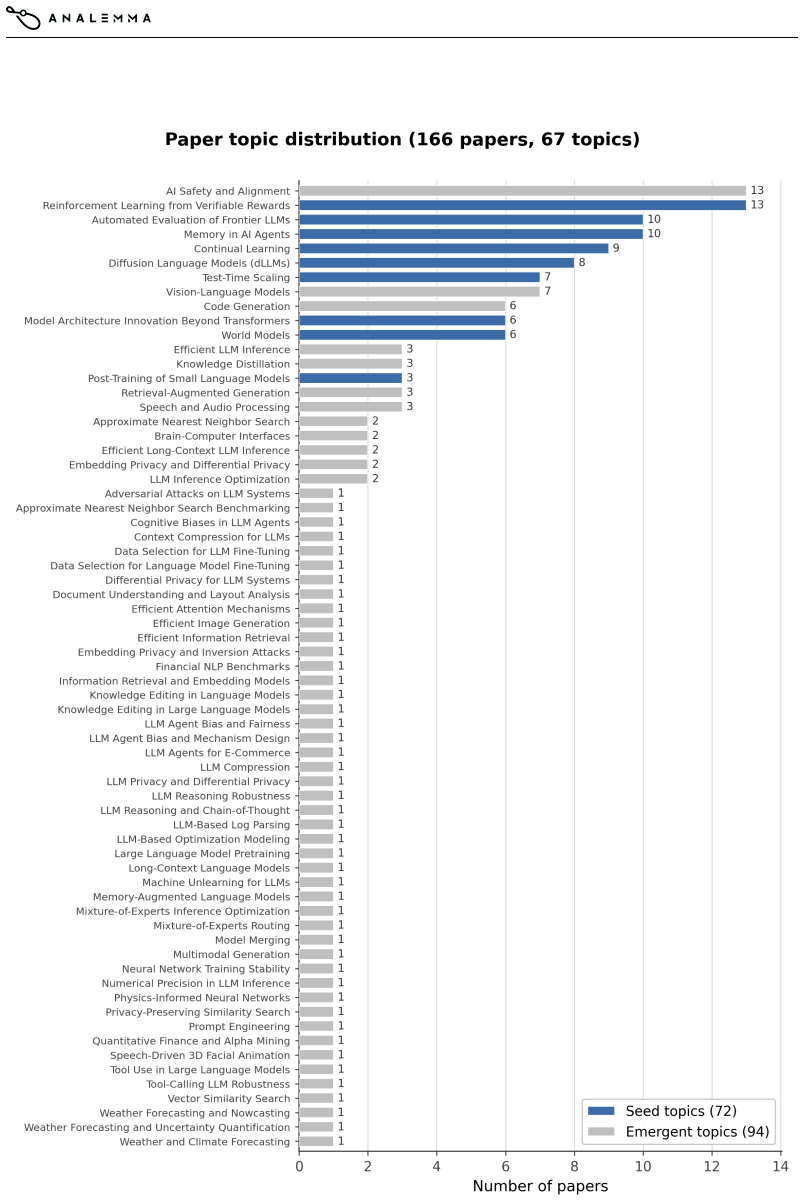
Recent automated research systems show that language-model agents can generate hypotheses, run experiments, and write complete manuscripts, but most evidence still comes from selected examples, human-framed topics, or a few pre-defined research tasks. We present FARS (Fully Automated Research System), a fully automated AI-for-AI research system designed to operate across research topics at scale. FARS autonomously generates and advances projects through ideation, planning, experimentation, and writing, using stage-specific agents coordinated through a shared workspace that records proposals, code, logs, results, and manuscripts. In its first public deployment, FARS produced 166 complete research papers spanning 67 fine-grained AI/ML topics while preserving intermediate artifacts as an auditable corpus rather than a curated set of successes. We evaluate this corpus with 282 structured reviews from volunteer reviewers covering 140 papers, including overall ratings, sub-scores, integrity checks, and LLM-use disclosure. The reviews indicate that FARS can produce review-worthy and occasionally strong AI/ML research artifacts in a large-scale public deployment, while also exposing recurring failure modes in narrow experimental scope, methodological limitations, and integrity issues.
Figures
Figures from the paper (2 more)
Forward citations
Cited by 4 Pith papers
-
Argus: A General-Purpose Agentic Runtime for Long-Horizon Reasoning
Argus demonstrates that a fixed-weight, self-evolving multi-role agentic runtime with verification-gated persistence can achieve competitive benchmark results and retain reusable state across long-horizon tasks.
-
IdeaTrail: Full-Process Agent Trajectories for Scientific Ideation
IdeaTrail provides 1,170 reverse-synthesized, multi-turn agent trajectories for scientific ideation, generated from known research artifacts via a Generator–Advisor loop with leakage and grounding checks.
-
IdeaTrail: Full-Process Agent Trajectories for Scientific Ideation
IdeaTrail reverse-synthesizes 1,170 grounded multi-turn agent trajectories from real papers via a Generator–Advisor loop for scientific ideation process supervision.
-
IdeaTrail: Full-Process Agent Trajectories for Scientific Ideation
IdeaTrail releases 1,170 reverse-to-forward Generator–Advisor trajectories that jointly log tools, evidence, intermediate artifacts, and reasoning for scientific ideation and proposal generation.
Reference graph
Works this paper leans on
-
[1]
URLhttps://arxiv. org/abs/2411.14199. Jinheon Baek, Sujay Kumar Jauhar, Silviu Cucerzan, and Sung Ju Hwang. Researchagent: Itera- tive research idea generation over scientific literature with large language models,
-
[2]
URL https://arxiv.org/abs/2404.07738. Alina Beygelzimer, Yann N. Dauphin, Percy Liang, and Jennifer Wortman Vaughan. Has the ma- chine learning review process become more arbitrary as the field has grown? the neurips 2021 consistency experiment,
arXiv 2021
-
[3]
URLhttps://arxiv.org/abs/2306.03262. Hui Chen, Miao Xiong, Yujie Lu, Wei Han, Ailin Deng, Yufei He, Jiaying Wu, Yibo Li, Yue Liu, and Bryan Hooi. Mlr-bench: Evaluating ai agents on open-ended machine learning research,
-
[4]
Ali Essam Ghareeb, Benjamin Chang, Ludovico Mitchener, Angela Yiu, Caralyn J
URLhttps://arxiv.org/abs/2505.19955. Ali Essam Ghareeb, Benjamin Chang, Ludovico Mitchener, Angela Yiu, Caralyn J. Szostkiewicz, Dmytro Shved, Gavin J. Gyimesi, Jon M. Laurent, Samantha M. Wright, Muhammed T. Razzak, Andrew D. White, Silvia C. Finnemann, Michaela M. Hinks, and Samuel G. Rodriques. A multi-agent system for automating scientific discovery.Nature,
-
[5]
URLhttps://www.nature.com/articles/ s41586-026-10652-y
doi: 10.1038/s41586-026-10652-y. URLhttps://www.nature.com/articles/ s41586-026-10652-y. Google. Nano Banana Pro: Gemini 3 Pro Image model from Google DeepMind.https://blog. google/innovation-and-ai/products/nano-banana-pro/, 11
-
[6]
Accessed: 2026-03-19. 16 Jiawei Gu, Xuhui Jiang, Zhichao Shi, Hexiang Tan, Xuehao Zhai, Chengjin Xu, Wei Li, Yinghan Shen, Shengjie Ma, Honghao Liu, Saizhuo Wang, Kun Zhang, Yuanzhuo Wang, Wen Gao, Lionel Ni, and Jian Guo. A survey on llm-as-a-judge,
2026
-
[7]
URLhttps://arxiv.org/abs/ 2411.15594. Tarun Gupta and Danish Pruthi. All that glitters is not novel: Plagiarism in AI generated research. InProceedings of ACL 2025,
arXiv 2025
- [8]
Show all 26 references
-
[9]
Weld, and Peter Clark
Peter Alexander Jansen, Oyvind Tafjord, Marissa Radensky, Pao Siangliulue, Tom Hope, Bhavana Dalvi, Bodhisattwa Prasad Majumder, Daniel S. Weld, and Peter Clark. CodeScientist: End- to-end semi-automated scientific discovery with code-based experimentation. InFindings of the A...
2025
-
[10]
URLhttps://arxiv.org/abs/2511.15462. Patrick Tser Jern Kon, Jiachen Liu, Xinyi Zhu, Qiuyi Ding, Jingjia Peng, Jiarong Xing, Yibo Huang, Yiming Qiu, Jayanth Srinivasa, Myungjin Lee, Mosharaf Chowdhury, Matei Zaharia, and Ang Chen. Exp-bench: Can ai conduct ai research experiments?,
-
[11]
org/abs/2505.24785
URLhttps://arxiv. org/abs/2505.24785. Ruochen Li, Teerth Patel, Qingyun Wang, and Xinya Du. Mlr-copilot: Autonomous machine learn- ing research based on large language models agents,
-
[12]
URLhttps://arxiv.org/abs/ 2408.14033. Yu Li, Chenyang Shao, Xinyang Liu, Ruotong Zhao, Peijie Liu, Hongyuan Su, Zhibin Chen, Qing- long Yang, Anjie Xu, Yi Fang, Qingbin Zeng, Tianxing Li, Jingbo Xu, Fengli Xu, Yong Li, and Tie-Yan Liu. AutoSOTA: An end-to-end automated researc...
-
[13]
URL https://arxiv.org/abs/2310.01783. Jiaqi Liu, Shi Qiu, Mairui Li, Bingzhou Li, Haonian Ji, Siwei Han, Xinyu Ye, Peng Xia, Zihan Dong, Meng Chen, Congyu Zhang, Letian Zhang, Guiming Chen, Haoqin Tu, Xinyu Yang, Lu Feng, Xujiang Zhao, Haifeng Chen, Jiawei Zhou, Xiao Wang, Wei...
-
[14]
Zijun Liu, Kaiming Liu, Yiqi Zhu, Xuanyu Lei, Zonghan Yang, Zhenhe Zhang, Peng Li, and Yang Liu
URL https://arxiv.org/abs/2605.20025. Zijun Liu, Kaiming Liu, Yiqi Zhu, Xuanyu Lei, Zonghan Yang, Zhenhe Zhang, Peng Li, and Yang Liu. Aigs: Generating science from ai-powered automated falsification,
-
[15]
Chris Lu, Cong Lu, Robert Tjarko Lange, Jakob Foerster, Jeff Clune, and David Ha
URLhttps: //arxiv.org/abs/2411.11910. Chris Lu, Cong Lu, Robert Tjarko Lange, Jakob Foerster, Jeff Clune, and David Ha. The ai scientist: Towards fully automated open-ended scientific discovery,
-
[16]
URLhttps://arxiv.org/ abs/2408.06292. Rui Meng, Bhavana Dalvi Mishra, Jiefeng Chen, Chun-Liang Li, Palash Goyal, Mihir Parmar, Yiwen Song, Yale Song, Rajarishi Sinha, Parthasarathy Ranganathan, Burak Gokturk, Jinsung Yoon, and Tomas Pfister. Scientistone: Towards human-level a...
-
[17]
URLhttps://arxiv.org/abs/2605.26340. David B. Resnik, Mohammad Hosseini, and Rico Hauswald. Autonomous artificial intelligence, scientific research, and human values.AI and Ethics,
-
[18]
17 Samuel Schmidgall, Yusheng Su, Ze Wang, Ximeng Sun, Jialian Wu, Xiaodong Yu, Jiang Liu, Michael Moor, Zicheng Liu, and Emad Barsoum
doi: 10.1007/s43681-025-00908-0. 17 Samuel Schmidgall, Yusheng Su, Ze Wang, Ximeng Sun, Jialian Wu, Xiaodong Yu, Jiang Liu, Michael Moor, Zicheng Liu, and Emad Barsoum. Agent laboratory: Using llm agents as research assistants,
-
[19]
Chenglei Si, Diyi Yang, and Tatsunori Hashimoto
URLhttps://arxiv.org/abs/2501.04227. Chenglei Si, Diyi Yang, and Tatsunori Hashimoto. Can llms generate novel research ideas? a large-scale human study with 100+ nlp researchers,
-
[20]
Chenglei Si, Tatsunori Hashimoto, and Diyi Yang
URLhttps://arxiv.org/abs/ 2409.04109. Chenglei Si, Tatsunori Hashimoto, and Diyi Yang. The ideation-execution gap: Execution outcomes of LLM-generated versus human research ideas.arXiv preprint arXiv:2506.20803,
-
[21]
Yixuan Weng, Minjun Zhu, Guangsheng Bao, Hongbo Zhang, Jindong Wang, Yue Zhang, and Linyi Yang
URLhttps://arxiv.org/abs/2505.18705. Yixuan Weng, Minjun Zhu, Guangsheng Bao, Hongbo Zhang, Jindong Wang, Yue Zhang, and Linyi Yang. Cycleresearcher: Improving automated research via automated review. InThe Thirteenth International Conference on Learning Representations, 2025a...
-
[22]
Ruofeng Yang, Yongcan Li, and Shuai Li
URLhttps://arxiv.org/abs/2504.08066. Ruofeng Yang, Yongcan Li, and Shuai Li. Aris: Autonomous research via adversarial multi-agent collaboration,
-
[23]
Jianxiang Yu, Zichen Ding, Jiaqi Tan, Kangyang Luo, Zhenmin Weng, Chenghua Gong, Long Zeng, Renjing Cui, Chengcheng Han, Qiushi Sun, Zhiyong Wu, Yunshi Lan, and Xiang Li
URLhttps://arxiv.org/abs/2605.03042. Jianxiang Yu, Zichen Ding, Jiaqi Tan, Kangyang Luo, Zhenmin Weng, Chenghua Gong, Long Zeng, Renjing Cui, Chengcheng Han, Qiushi Sun, Zhiyong Wu, Yunshi Lan, and Xiang Li. Automated peer reviewing in paper sea: Standardization, evaluation, a...
-
[24]
Lianmin Zheng, Wei-Lin Chiang, Ying Sheng, Siyuan Zhuang, Zhanghao Wu, Yonghao Zhuang, Zi Lin, Zhuohan Li, Dacheng Li, Eric P
URLhttps: //arxiv.org/abs/2407.12857. Lianmin Zheng, Wei-Lin Chiang, Ying Sheng, Siyuan Zhuang, Zhanghao Wu, Yonghao Zhuang, Zi Lin, Zhuohan Li, Dacheng Li, Eric P. Xing, Hao Zhang, Joseph E. Gonzalez, and Ion Stoica. Judging llm-as-a-judge with mt-bench and chatbot arena,
-
[25]
Kunlun Zhu, Jiaxun Zhang, Ziheng Qi, et al
URLhttps://arxiv.org/ abs/2306.05685. Kunlun Zhu, Jiaxun Zhang, Ziheng Qi, et al. SafeScientist: Toward risk-aware scientific discoveries by LLM agents.arXiv preprint arXiv:2505.23559,
-
[26]
A DEPLOYMENTTOPICDISTRIBUTION Figure 5 groups the 166 generated papers by whether they fall under the nine seed topics provided at launch or under emergent topics discovered during autonomous exploration. B INTEGRITYFAILUREMODES The AI Integrity Audit in our review standard (S...
Reviewed July 14, 2026 · model on record in the stance chip above.
Discussion (0). Sign in to comment.