The Cooperation Ceiling: Extrinsic Population Dynamics and the Intrinsic Escape
Pith reviewed 2026-07-01 02:54 UTC · model grok-4.3
The pith
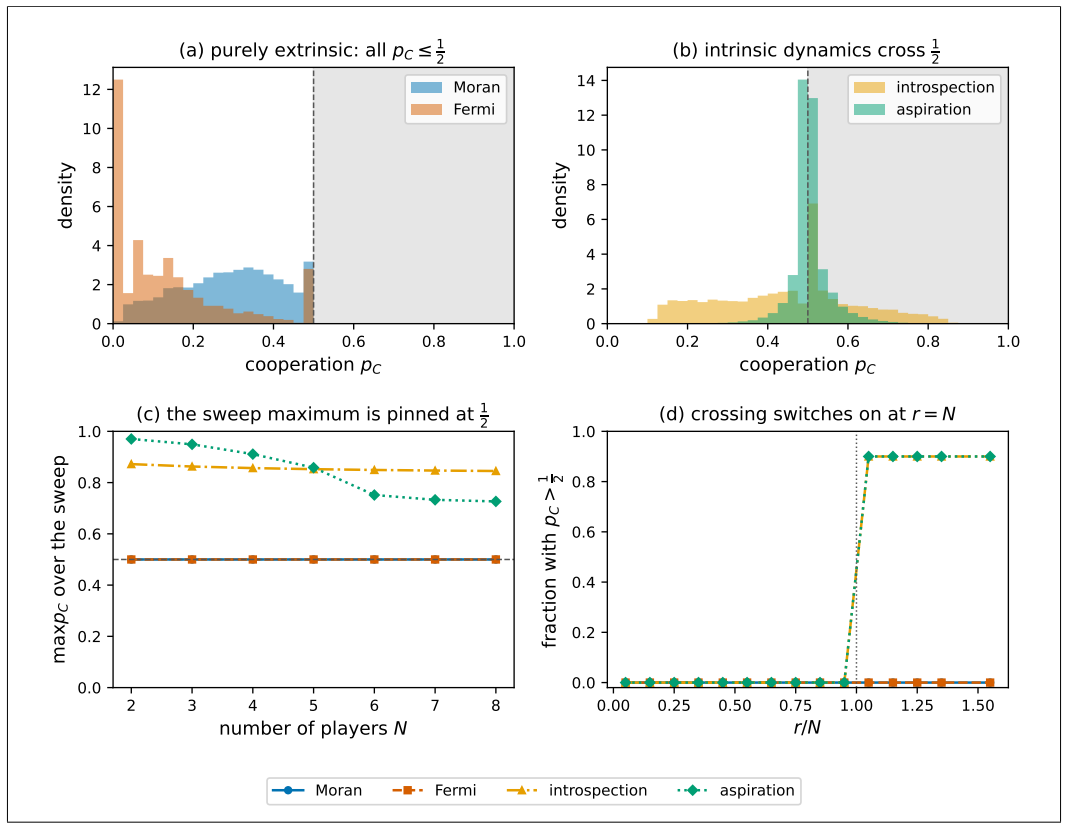
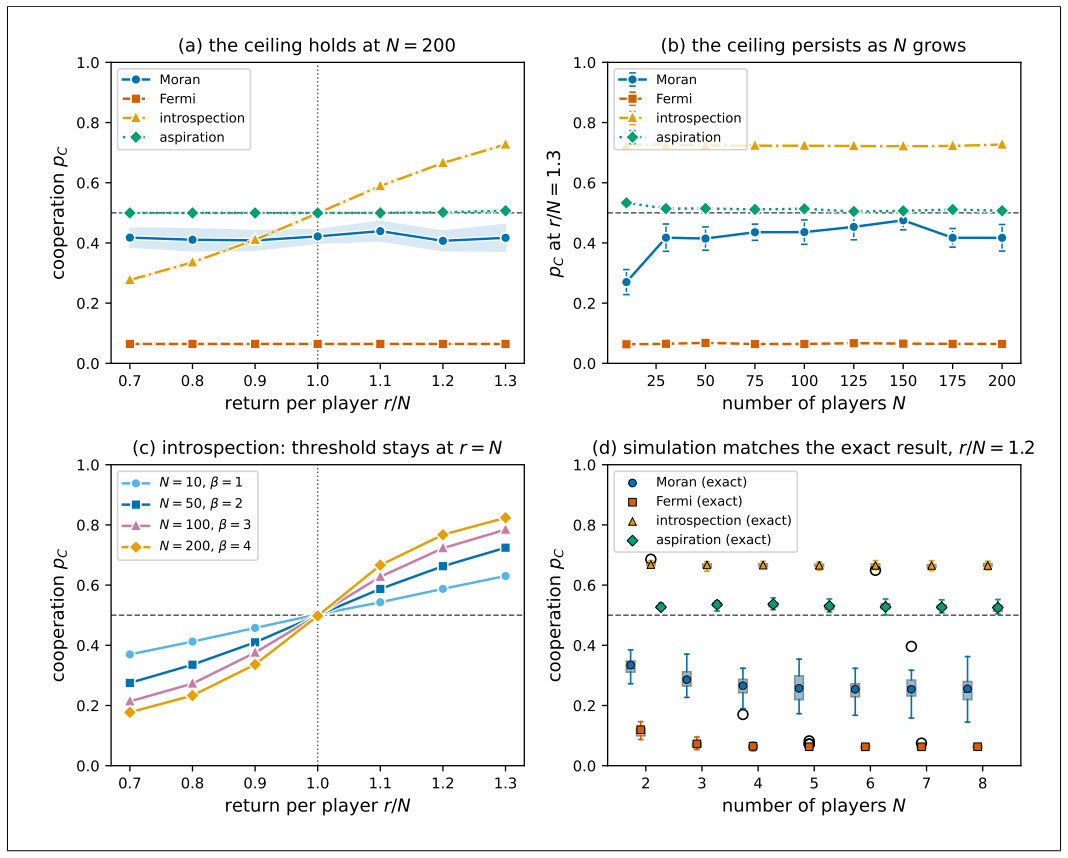
Extrinsic population dynamics set a ceiling on cooperation that intrinsic dynamics can exceed in heterogeneous groups.
A machine-rendered reading of the paper's core claim, the machinery that carries it, and where it could break.
Core claim
The paper establishes that extrinsic population dynamics, which base strategy updates on comparisons with other players' payoffs, impose a ceiling on the rate of cooperation in heterogeneous populations. This ceiling can be exceeded by intrinsic population dynamics, which base updates on a player's own attributes or potential payoffs. The result is shown through analysis and simulation of the public goods game in which individuals make different contribution amounts.
What carries the argument
Categorization of population dynamics as extrinsic (outward payoff comparison) versus intrinsic (inward self-assessment), applied to the public goods game with heterogeneous contributions.
Load-bearing premise
The division of population dynamics into extrinsic and intrinsic categories is exhaustive and relevant for heterogeneous populations.
What would settle it
Observing an extrinsic dynamic that achieves cooperation above the identified ceiling in the public goods game with heterogeneous contributions would disprove the claim.
Figures



read the original abstract
Evolutionary game theory provides a framework by which to study the emergence of cooperation in a population of self-interested actors. In such a framework, players' decisions on whether or not to cooperate evolve according to decision rules called population dynamics. However, often games are studied under the assumption that all individuals play under the same conditions, and many common choices of update rule are not well suited for a heterogeneous population. In this paper, we categorise and compare four different population dynamics in such a population as ``extrinsic'', where players learn by looking outward at the payoffs of other players, and ``intrinsic'', where players look inwardly at their own attributes or potential payoffs. We show that extrinsic population dynamics admit a ceiling on the rate of cooperation which can be exceeded by intrinsic population dynamics, and demonstrate this using the public goods game with heterogeneous contributions.
Editorial analysis
A structured set of objections, weighed in public.
Referee Report
Summary. The manuscript categorizes four population dynamics in evolutionary game theory for heterogeneous populations into extrinsic (learning from other players' payoffs) and intrinsic (based on own attributes or potential payoffs). Using the public goods game with heterogeneous contributions as a test case, it claims to demonstrate that extrinsic dynamics exhibit a ceiling on the rate of cooperation which intrinsic dynamics can exceed.
Significance. If the demonstration holds, the result would be significant for evolutionary game theory as it identifies a structural limitation of common extrinsic update rules in heterogeneous settings and shows how intrinsic rules can achieve higher cooperation levels. The scoped claim in a specific game provides a concrete, falsifiable test case rather than an overgeneralized assertion.
minor comments (1)
- Abstract: a single sentence previewing the four dynamics or the quantitative nature of the ceiling would improve accessibility without altering the claim.
Simulated Author's Rebuttal
We thank the referee for their careful reading of the manuscript, for the positive summary and significance assessment, and for the recommendation to accept. We are gratified that the scoped claim and the distinction between extrinsic and intrinsic dynamics were viewed as providing a concrete, falsifiable contribution to evolutionary game theory.
Circularity Check
No significant circularity; derivation is self-contained demonstration
full rationale
The paper defines extrinsic (outward payoff comparison) versus intrinsic (inward attribute or potential payoff) population dynamics as a categorization, then demonstrates via simulation in the heterogeneous-contribution public goods game that the former exhibits a cooperation ceiling the latter can exceed. No equations, self-citations, or fitted parameters are presented in the abstract or described setup that reduce a claimed prediction or uniqueness result to the inputs by construction. The central result is scoped as a comparative demonstration for four chosen rules rather than a general theorem derived from prior self-work, so the derivation chain does not collapse.
Axiom & Free-Parameter Ledger
Reference graph
Works this paper leans on
-
[1]
Tibor Antal, Martin A. Nowak, and Arne Traulsen. Strategy abundance in 2×2 games for arbitrary mutation rates. Journal of Theoretical Biology, 257(2):340–344, 2009
work page 2009
-
[2]
Marco Archetti and Istv´ an Scheuring. Review: Game theory of public goods in one-shot social dilemmas without assortment.Journal of Theoretical Biology, 299:9–20, 2012. Evolution of Cooperation
work page 2012
-
[3]
Md. Rajib Arefin and Jun Tanimoto. Evolution of cooperation in social dilemmas under the coexistence of aspiration and imitation mechanisms.Phys. Rev. E, 102:032120, Sep 2020
work page 2020
-
[4]
Effective choice in the prisoner’s dilemma.The Journal of Conflict Resolution, 24(1):3–25, 1980
Robert Axelrod. Effective choice in the prisoner’s dilemma.The Journal of Conflict Resolution, 24(1):3–25, 1980
work page 1980
-
[5]
Marta Couto, S Giaimo, and Christian Hilbe. Introspection dynamics: A simple model of counterfactual learning in asymmetric games.New Journal of Physics, 24, 06 2022
work page 2022
-
[6]
Marta Couto and Saptarshi Pal. Introspection dynamics in asymmetric multiplayer games.Dynamic Games and Applications, 13:1–30, 09 2023
work page 2023
-
[7]
Aspiration dynamics in structured population acts as if in a well-mixed one
Jia Du, Bin Wu, and Long Wang. Aspiration dynamics in structured population acts as if in a well-mixed one. Scientific Reports, 5:8014, 2015
work page 2015
-
[8]
Jinming Du, Bin Wu, Philipp M. Altrock, and Long Wang. Aspiration dynamics of multi-player games in finite populations.Journal of The Royal Society Interface, 11(99):20140778, 2014
work page 2014
-
[9]
Lucas S. Flores, Mendeli H. Vainstein, Heitor C. M. Fernandes, and Marco A. Amaral. Heterogeneous contributions can jeopardize cooperation in the public goods game.Phys. Rev. E, 108:024111, Aug 2023
work page 2023
-
[10]
ludics.https://github.com/hefos/ludics, 2026
Harry Foster and Vince Knight. ludics.https://github.com/hefos/ludics, 2026
work page 2026
-
[11]
ludics documentation.https://hefos.github.io/ludics/, 2026
Harry Foster and Vince Knight. ludics documentation.https://hefos.github.io/ludics/, 2026
work page 2026
-
[12]
hefos/ludics (v0.4.3).https://doi.org/10.5281/zenodo.20812318, 2026
Harry Foster and Vincent Knight. hefos/ludics (v0.4.3).https://doi.org/10.5281/zenodo.20812318, 2026
-
[13]
Harry Foster, Vincent Knight, and Sebastian Krapohl. Data for the cooperation ceiling: Extrinsic population dy- namics and the intrinsic escape.https://doi.org/10.5281/zenodo.20594161, 2026
-
[14]
Harry Foster, Vincent A. Knight, and Sebastian Krapohl. Introspection dynamics with mutation in additive games. 2026
work page 2026
-
[15]
Nowak, Christine Taylor, and Lorens A
Drew Fudenberg, Martin A. Nowak, Christine Taylor, and Lorens A. Imhof. Evolutionary game dynamics in finite populations with strong selection and weak mutation.Theoretical Population Biology, 70(3):352–363, 2006
work page 2006
-
[16]
Alexander G. Ginsberg and Feng Fu. Evolution of cooperation in public goods games with stochastic opting-out. Games, 10(1), 2019
work page 2019
-
[17]
Frank Harary, John P. Hayes, and Horng-Jyh Wu. A survey of the theory of hypercube graphs.Computers & Mathematics with Applications, 15(4):277–289, 1988
work page 1988
-
[18]
The tragedy of the commons.Science, 162(3859):1243–1248, 1968
Garrett Hardin. The tragedy of the commons.Science, 162(3859):1243–1248, 1968
work page 1968
-
[19]
Christoph Hauert, Silvia De Monte, Josef Hofbauer, and Karl Sigmund. Volunteering as Red Queen mechanism for cooperation in public goods games.Science, 296(5570):1129–1132, 2002
work page 2002
-
[20]
Christoph Hauert and Michael Doebeli. Spatial structure often inhibits the evolution of cooperation in the snowdrift game.Nature, 428(6983):643–646, April 2004
work page 2004
-
[21]
The dynamics of public goods.Discrete and Continuous Dynamical Systems - B, 4(3):575–587, 2004
Christoph Hauert, Nina Haiden, and Karl Sigmund. The dynamics of public goods.Discrete and Continuous Dynamical Systems - B, 4(3):575–587, 2004. 20
work page 2004
-
[22]
Hauser, Christian Hilbe, Krishnendu Chatterjee, and Martin A
Oliver P. Hauser, Christian Hilbe, Krishnendu Chatterjee, and Martin A. Nowak. Social dilemmas among unequals. Nature, 572(7770):524–527, 2019
work page 2019
-
[23]
Cambridge University Press, 1998
Josef Hofbauer and Karl Sigmund.Evolutionary Games and Population Dynamics. Cambridge University Press, 1998
work page 1998
-
[24]
Teturo Kamae, Ulrich Krengel, and George L. O’Brien. Stochastic inequalities on partially ordered spaces.The Annals of Probability, 5(6):899–912, 1977
work page 1977
-
[25]
Michihiro Kandori, George J. Mailath, and Rafael Rob. Learning, mutation, and long run equilibria in games. Econometrica, 61(1):29–56, 1993
work page 1993
-
[26]
Vincent Knight, Owen Campbell, Marc Harper, Karol M. Langner, Jonathan Campbell, Thomas Campbell, Alex Carney, Martin Chorley, Cameron Davidson-Pilon, Kristian Glass, Nikoleta Glynatsi, Tom´ aˇ s Ehrlich, Martin Jones, Georgios Koutsovoulos, Jamie Muller, Geraint Ng, Remi Noble, Nikolay Ryzhikov, Jessica Standen, Jon Taylor, Michail Theodorakis, Yingrong ...
work page 2018
-
[27]
Chuang Lei, Te Wu, Jian-Yuan Jia, Rui Cong, and Long Wang. Heterogeneity of allocation promotes cooperation in public goods games.Physica A: Statistical Mechanics and its Applications, 389(21):4708–4714, 2010
work page 2010
-
[28]
Aspiration promotes cooperation in the prisoner’s dilemma game with the imitation rule.Phys
Xuesong Liu, Mingfeng He, Yibin Kang, and Qiuhui Pan. Aspiration promotes cooperation in the prisoner’s dilemma game with the imitation rule.Phys. Rev. E, 94:012124, Jul 2016
work page 2016
-
[29]
Xuesong Liu, Mingfeng He, Yibin Kang, and Qiuhui Pan. Fixation of strategies with the moran and fermi processes in evolutionary games.Physica A: Statistical Mechanics and its Applications, 484:336–344, 2017
work page 2017
-
[30]
Xuesong Liu, Qiuhui Pan, Yibin Kang, and Mingfeng He. Fixation probabilities in evolutionary games with the moran and fermi processes.Journal of Theoretical Biology, 364:242–248, 2015
work page 2015
-
[31]
Xiaojian Ma, Ji Quan, and Xianjia Wang. Effect of reputation-based heterogeneous investment on cooperation in spatial public goods game.Chaos, Solitons & Fractals, 152:111353, 2021
work page 2021
-
[32]
Manfred Milinski, Torsten R¨ ohl, and Jochem Marotzke. Cooperative interaction of rich and poor can be catalyzed by intermediate climate targets.Climatic Change, 109(3-4):807–814, 2011
work page 2011
-
[33]
Sommerfeld, Hans-J¨ urgen Krambeck, Floyd A
Manfred Milinski, Ralf D. Sommerfeld, Hans-J¨ urgen Krambeck, Floyd A. Reed, and Jochem Marotzke. The collective- risk social dilemma and the prevention of simulated dangerous climate change.Proceedings of the National Academy of Sciences, 105(7):2291–2294, 2008
work page 2008
-
[34]
P. A. P. Moran. Random processes in genetics.Mathematical Proceedings of the Cambridge Philosophical Society, 54(1):60–71, 1958
work page 1958
-
[35]
NOWAK.Evolutionary Dynamics: Exploring the Equations of Life
MARTIN A. NOWAK.Evolutionary Dynamics: Exploring the Equations of Life. Harvard University Press, 2006
work page 2006
-
[36]
Martin A. Nowak and Robert M. May. Evolutionary games and spatial chaos.Nature, 359:826–829, 1992
work page 1992
-
[37]
Nowak, Akira Sasaki, Christine Taylor, and Drew Fudenberg
Martin A. Nowak, Akira Sasaki, Christine Taylor, and Drew Fudenberg. Emergence of cooperation and evolutionary stability in finite populations.Nature, 428:646–650, 2004
work page 2004
-
[38]
Hisashi Ohtsuki, Pedro Bordalo, and Martin A. Nowak. The one-third law of evolutionary dynamics.Journal of Theoretical Biology, 249(2):289–295, 2007
work page 2007
-
[39]
Matjaˇ z Perc, Jes´ us G´ omez-Garde˜ nes, Attila Szolnoki, Luis M. Flor´ ıa, and Yamir Moreno. Evolutionary dynamics of group interactions on structured populations: a review.Journal of the Royal Society Interface, 10(80):20120997, 2013
work page 2013
-
[40]
Ji Quan, Yawen Zhou, Xianjia Wang, and Jian-Bo Yang. Evidential reasoning based on imitation and aspiration information in strategy learning promotes cooperation in optional spatial public goods game.Chaos, Solitons & Fractals, 133:109634, 2020
work page 2020
-
[41]
Geir Kjetil Sandve et al. Ten simple rules for reproducible computational research.PLoS Computational Biology, 9(10):e1003285, 2013. 21
work page 2013
-
[42]
Francisco C. Santos and Jorge M. Pacheco. Scale-free networks provide a unifying framework for the emergence of cooperation.Physical Review Letters, 95:098104, 2005
work page 2005
-
[43]
Francisco C. Santos and Jorge M. Pacheco. Risk of collective failure provides an escape from the tragedy of the commons.Proceedings of the National Academy of Sciences, 108(26):10421–10425, 2011
work page 2011
-
[44]
Francisco C. Santos, Marta D. Santos, and Jorge M. Pacheco. Social diversity promotes the emergence of cooperation in public goods games.Nature, 454:213–216, 2008
work page 2008
-
[45]
Princeton University Press, 2010
Karl Sigmund.The Calculus of Selfishness:. Princeton University Press, 2010
work page 2010
-
[46]
William J. Stewart.Probability, Markov Chains, Queues, and Simulation: The Mathematical Basis of Performance Modeling. Princeton University Press, 2009
work page 2009
-
[47]
Bailey, Ewa Deelman, Yolanda Gil, Brooks Hanson, Michael A
Victoria Stodden, Marcia McNutt, David H. Bailey, Ewa Deelman, Yolanda Gil, Brooks Hanson, Michael A. Her- oux, John P.A. Ioannidis, and Michela Taufer. Enhancing reproducibility for computational methods.Science, 354(6317):1240–1241, 2016
work page 2016
-
[48]
Evolutionary games on graphs.Physics Reports, 446:97–216, 2007
Gy¨ orgy Szab´ o and G´ abor F´ ath. Evolutionary games on graphs.Physics Reports, 446:97–216, 2007
work page 2007
-
[49]
Evolutionary prisoner’s dilemma game on a square lattice.Phys
Gy¨ orgy Szab´ o and Csaba T˝ oke. Evolutionary prisoner’s dilemma game on a square lattice.Phys. Rev. E, 58:69–73, Jul 1998
work page 1998
-
[50]
Tarnita, Hisashi Ohtsuki, Tibor Antal, Feng Fu, and Martin A
Corina E. Tarnita, Hisashi Ohtsuki, Tibor Antal, Feng Fu, and Martin A. Nowak. Strategy selection in structured populations.Journal of theoretical biology, 259(3), August 2009
work page 2009
-
[51]
The Turing Way Community.The Turing Way: A Handbook for Reproducible, Ethical and Collaborative Data Science. Zenodo, 2022. Zenodo. DOI: 10.5281/zenodo.3233853
-
[52]
Arne Traulsen, Martin A. Nowak, and Jorge M. Pacheco. Stochastic dynamics of invasion and fixation.Physical Review E, 74(1):011909, 2006
work page 2006
-
[53]
Si-Yi Wang, Qing-Lian Wang, Xiao-Wei Zhang, and Rui-Wu Wang. Evolutionary cooperation dynamics of com- bining imitation and super-rational aspiration induced strategy updating.Applied Mathematics and Computation, 456:128134, 2023
work page 2023
-
[54]
Weitz, Ceyhun Eksin, Keith Paarporn, Sam P
Joshua S. Weitz, Ceyhun Eksin, Keith Paarporn, Sam P. Brown, and William C. Ratcliff. An oscillating tragedy of the commons in replicator dynamics with game-environment feedback.Proceedings of the National Academy of Sciences, 113(47):E7518–E7525, 2016
work page 2016
-
[55]
Greg Wilson, D. A. Aruliah, C. Titus Brown, Neil P. Chue Hong, Matt Davis, Richard T. Guy, Steven H. D. Haddock, Kathryn D. Huff, Ian M. Mitchell, Mark D. Plumbley, Ben Waugh, Ethan P. White, and Paul Wilson. Best practices for scientific computing.PLOS Biology, 12(1):e1001745, jan 2014
work page 2014
-
[56]
Good enough practices in scientific computing.PLoS Computational Biology, 13(6):e1005510, 2017
Greg Wilson et al. Good enough practices in scientific computing.PLoS Computational Biology, 13(6):e1005510, 2017
work page 2017
-
[57]
Jun Zhang, Bin Hu, Yi Jie Huang, Zheng Hong Deng, and Tao Wu. The evolution of cooperation affected by aspiration-driven updating rule in multi-games with voluntary participation.Chaos, Solitons & Fractals, 139:110067, 2020
work page 2020
-
[58]
Lei Zhou, Bin Wu, Jinming Du, and Long Wang. Aspiration dynamics generate robust predictions in heterogeneous populations.Nature Communications, 12(1):3250, May 2021. 22
work page 2021
discussion (0)
Sign in with ORCID, Apple, or X to comment. Anyone can read and Pith papers without signing in.