Modeling of the diffuse background produced by the Vera C. Rubin Observatory M2 baffle scattered light
Pith reviewed 2026-07-01 02:39 UTC · model grok-4.3
The pith
Light scattered by the M2 baffle adds a diffuse background to LSSTCam images that can be predicted from dome tests via a relation derived from stellar and lunar data.
A machine-rendered reading of the paper's core claim, the machinery that carries it, and where it could break.
Core claim
The M2 baffle produces scattered light that forms a diffuse background whose on-sky impact from bright and red stars and from the Moon is quantified by retrofitting in-dome CBP measurements with ray-tracing simulations and on-sky data; an approximate relation obtained by comparing CBP and off-axis stellar illumination footprints and by mapping stellar SEDs onto the CBP wavelengths converts dome results into on-sky predictions across the full magnitude range.
What carries the argument
The retrofit process that combines ray-tracing simulation with CBP in-dome illumination footprints and on-sky stellar/Moon observations to determine scattered-light intensity and distribution.
If this is right
- The scattered-light contribution is quantified separately for bright and red stars and for the Moon.
- An approximate relation exists that converts in-dome CBP measurements into on-sky background predictions.
- The relation accounts for differences in illumination footprint and spectral energy distribution between the CBP and real sources.
- A complete description of the M2 baffle scattered-light contribution is available across the full range of stellar magnitudes.
Where Pith is reading between the lines
- The conversion relation could be inserted into image-processing pipelines to subtract or flag this background component before science analysis.
- The same retrofit approach might be tested on other wide-field telescopes that use similar secondary baffles.
- Repeating the on-sky campaign under varying lunar phases or with fainter stars would test how well the magnitude extrapolation holds.
Load-bearing premise
That the CBP illumination footprint on the detector matches the footprint produced by an off-axis star closely enough and that mapping stellar spectral energy distributions onto the CBP's discrete wavelengths accurately reproduces the scattered-light intensity and pattern.
What would settle it
Acquire on-sky images of stars with known magnitudes and spectra, apply the derived conversion relation to the corresponding dome CBP data, and check whether the measured diffuse background levels match the model predictions within the stated uncertainties.
Figures
read the original abstract
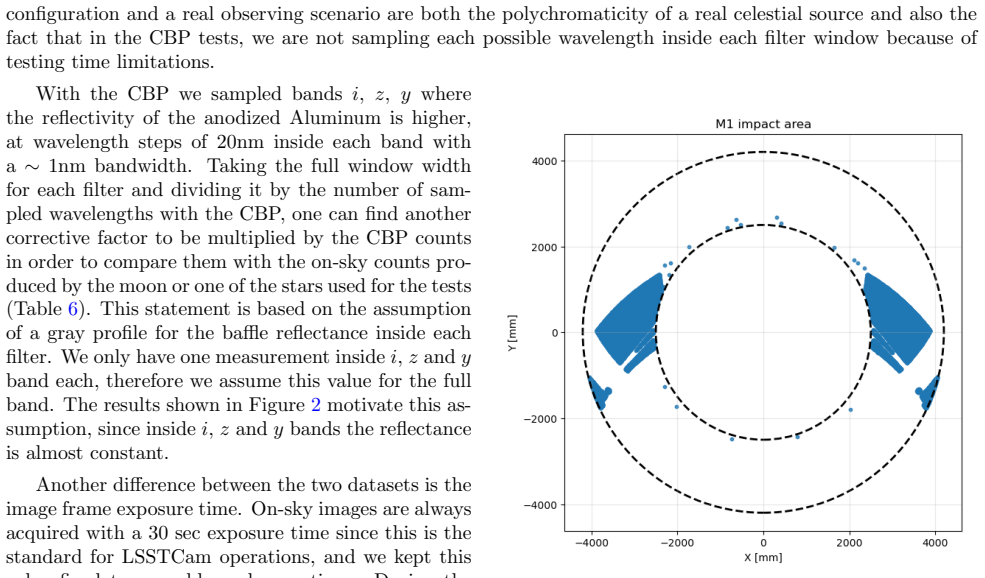
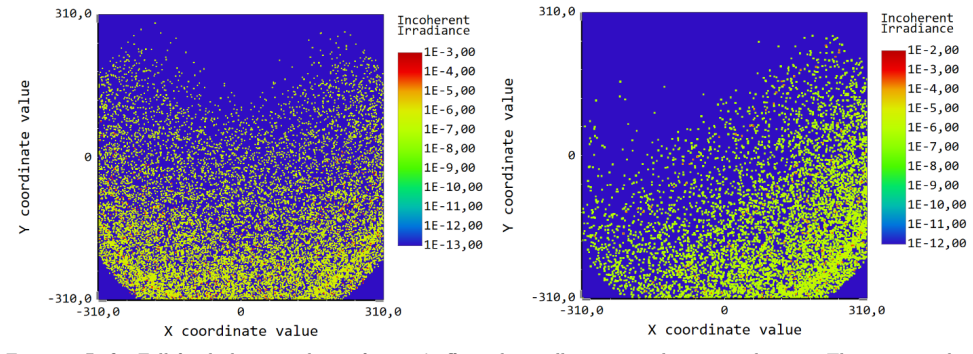
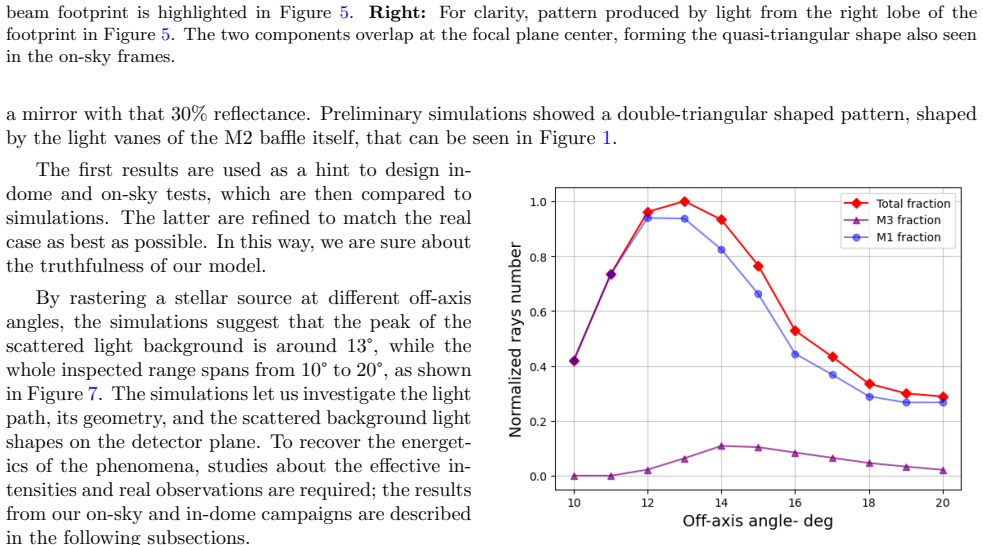
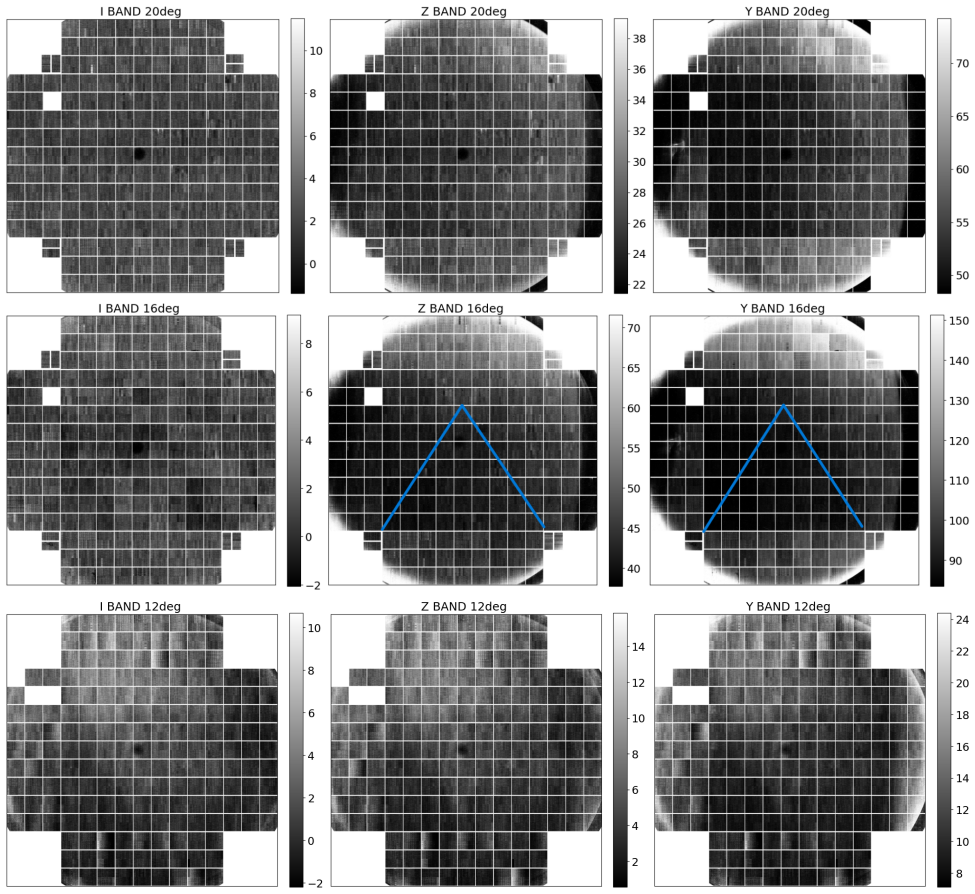
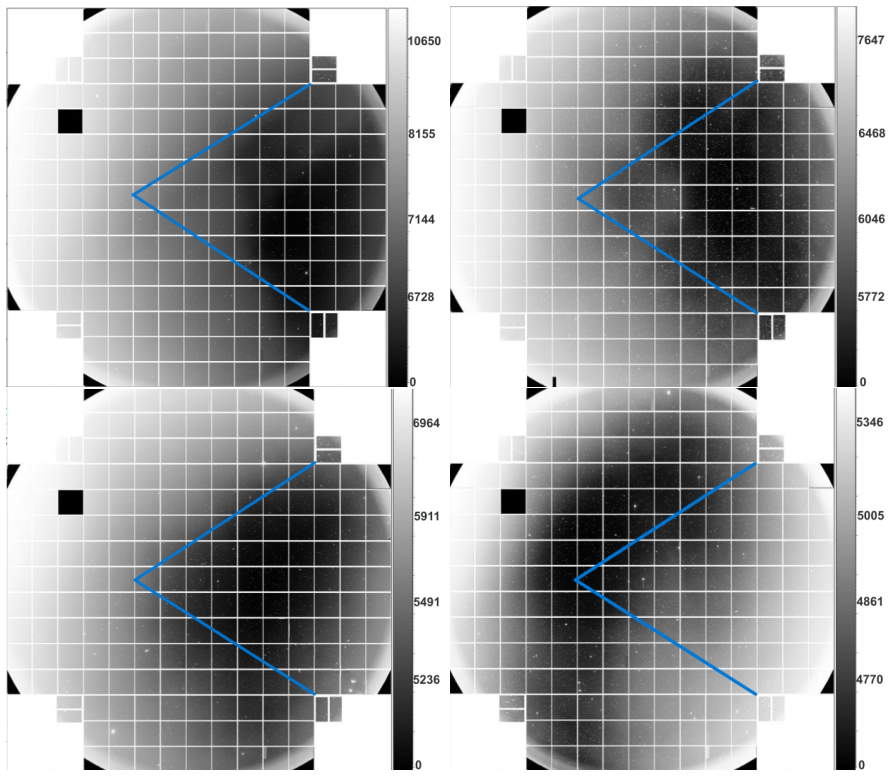
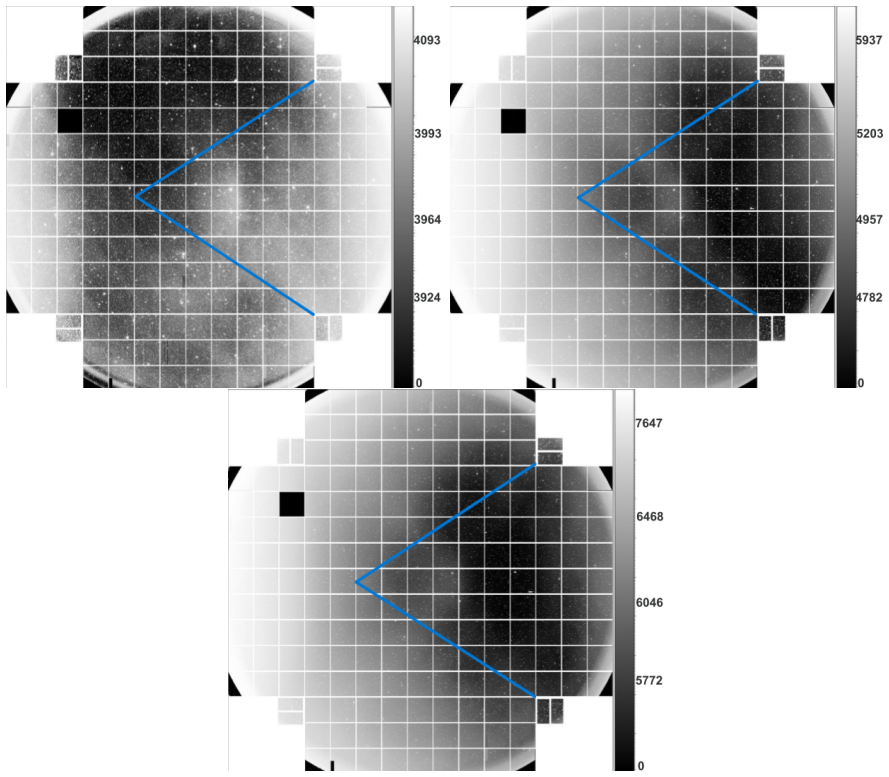
The Vera C. Rubin Observatory, with its unprecedented field of view and fast focal ratio, will survey the entire sky every 3.5 nights. This unique capacity requires dealing with off axis light that can produce stray light artefacts on the images. The secondary mirror (M2) baffle restricts the light that reaches the LSSTCam detector and it contributes to shaping the inner edge of the telescope optical pupil. This work studies the contribution to the background from the light scattered by the M2 baffle itself. The evanescence of this feature, together with the challenge of isolating it from the sky background, led to the necessity of performing in dome tests using a Collimated Beam Projector (CBP), normally used for calibration purposes. To complete the analysis, in addition to the in dome tests, an on sky observational campaign was conducted. This campaign employed both stellar targets and the Moon as illumination sources in order to determine the actual energy associated with the feature. The test data have been retro fitted thanks to the combination of ray tracing simulation, CBP and on sky data to infer the intensity and spatial distribution of the background scattered light within the different LSSTCam filters. We quantified the on sky impact of scattered light from the M2 baffle, both for light coming from bright and red stars and from the Moon. We also developed an approximate relation to transform the in dome measurements into predictions of on sky behavior. This transformation was achieved by comparing the illumination footprint produced by an off axis star with that generated by the CBP and by mapping the stellar Spectral Energy Distribution (SED) onto the CBP's set of discrete wavelengths. Finally, we extrapolated the scattered light behavior of the Moon to stellar sources, in order to build a compplete description of the M2 baffle contribution over the full range of magnitudes.
Editorial analysis
A structured set of objections, weighed in public.
Referee Report
Summary. The manuscript describes in-dome CBP tests, ray-tracing simulations, and limited on-sky observations (stars and Moon) to characterize scattered light from the M2 baffle in the Vera C. Rubin Observatory. It claims to have retrofitted these data to derive an approximate transformation relating CBP illumination to off-axis stellar footprints and to map stellar SEDs onto the CBP's discrete wavelengths, thereby quantifying the on-sky background contribution in LSSTCam filters for bright/red stars and the Moon and providing a complete description across magnitudes.
Significance. If the footprint-equivalence and SED-mapping steps hold with quantified accuracy, the work supplies a practical model for a previously uncharacterized stray-light source that affects LSSTCam background levels. The multi-method approach (simulation + CBP + on-sky) is a positive feature, but the absence of any reported error budget, sensitivity tests, or residual comparisons between predicted and measured on-sky levels limits the immediate utility for survey operations.
major comments (1)
- [Abstract] The retrofit procedure that underpins the central claim (comparing CBP vs. stellar illumination footprints and discretizing continuous SEDs) is described only at a high level in the abstract; no quantitative validation, residual plots, or sensitivity analysis to angular extent, polarization, or wavelength sampling is presented, leaving the accuracy of the extrapolated background levels for bright/red stars and the Moon unquantified.
Simulated Author's Rebuttal
We thank the referee for their constructive comments on our manuscript. We address the major comment below and will revise the manuscript to incorporate additional quantitative details as outlined.
read point-by-point responses
-
Referee: [Abstract] The retrofit procedure that underpins the central claim (comparing CBP vs. stellar illumination footprints and discretizing continuous SEDs) is described only at a high level in the abstract; no quantitative validation, residual plots, or sensitivity analysis to angular extent, polarization, or wavelength sampling is presented, leaving the accuracy of the extrapolated background levels for bright/red stars and the Moon unquantified.
Authors: The abstract is intentionally a concise summary of the work. The full manuscript details the retrofit procedure in Sections 4 and 5, combining ray-tracing simulations with CBP dome tests and on-sky stellar/Moon observations to compare illumination footprints and map SEDs onto discrete CBP wavelengths. We agree, however, that explicit quantitative validation (residual plots, sensitivity tests to angular extent/polarization/wavelength sampling, and an overall error budget) and direct comparisons of predicted vs. measured on-sky levels are not included. We will add these in the revised version to better quantify the accuracy of the extrapolated background levels for bright/red stars and the Moon. revision: yes
Circularity Check
No significant circularity; derivation uses independent measurements and simulations
full rationale
The paper's central result—an approximate transformation relating CBP in-dome measurements to on-sky scattered-light predictions—is obtained by direct comparison of illumination footprints (off-axis star vs. CBP) and by mapping stellar SEDs onto the CBP's discrete wavelengths, combined with ray-tracing simulations and separate on-sky stellar/Moon data. None of these steps reduces a claimed prediction to its own inputs by construction, nor invokes self-citations or ansatzes as load-bearing premises. The work is self-contained against external benchmarks (CBP hardware, on-sky observations, ray-tracing).
Axiom & Free-Parameter Ledger
Reference graph
Works this paper leans on
-
[1]
Lsst: From science drivers to reference design and anticipated data products,
Ivezi´ c, Z., Kahn, S. M., Tyson, J. A., Abel, B., Acosta, E., Allsman, R., Alonso, D., AlSayyad, Y., Anderson, S. F., Andrew, J., P. Angel, J. R., Angeli, G. Z., Ansari, R., Antilogus, P., Araujo, C., Armstrong, R., Arndt, K. T., Astier, P., Aubourg, E., Auza, N., Axelrod, T. S., Bard, D. J., Barr, J. D., Barrau, A., Bartlett, J. G., Bauer, A. E., Bauman...
2019
-
[2]
The Mersenne-Schmidt - A three-mirror survey telescope,
Willstrop, R. V., “The Mersenne-Schmidt - A three-mirror survey telescope,”MNRAS210, 597–609 (Oct. 1984)
1984
-
[3]
Design for an 8-m Telescope with a 3 Degree Field at f/1.25: The Dark Matter Telescope,
Angel, R., Lesser, M., Sarlot, R., and Dunham, E., “Design for an 8-m Telescope with a 3 Degree Field at f/1.25: The Dark Matter Telescope,” in [Imaging the Universe in Three Dimensions], van Breugel, W. and Bland-Hawthorn, J., eds.,Astronomical Society of the Pacific Conference Series195, 81 (Jan. 2000)
2000
-
[4]
Lsst primary/tertiary monolithic mirror,
Sebag, J., Gressler, W., Liang, M., Neill, D., Araujo-Hauck, C., Andrew, J., Angeli, G., Cho, M., Claver, C., Daruich, F., Gessner, C., Hileman, E., Krabbendam, V., Muller, G., Poczulp, G., Repp, R., Wiecha, O., Xin, B., Kenagy, K., Martin, H. M., Tuell, M. T., and West, S. C., “Lsst primary/tertiary monolithic mirror,”Proc. SPIE9906, 99063E–99063E–14 (2016)
2016
-
[5]
The Vera C. Rubin’s M2 support system integration and verification at the TMA,
Rodeghiero, G., Rosignoli, L., Canestrari, R., Giro, E., Zorzi, P., Tsai, T.-W., Drass, H., Kang, Y., Tighe, R., Neil, D., Colleoni, F., Daruich, F., Lutfi, M., Homar, G. M., Quint, B. C., Ribeiro, T., Roberts, A., Sebag, J., Stalder, B., Siruno, K., Sonaniskar, M., Fanning, K., Ferguson, P., Kub´ anek, P., Thomas, S. J., Claver, C., Clemens, A. W., Reil,...
2024
-
[6]
Research of different black coatings on stray light suppression in optical baffle,
Ma, Z., Chen, Q., Wang, H., Xue, Y., Shen, Y., Lin, S., and Zhai, H., “Research of different black coatings on stray light suppression in optical baffle,” in [International Conference on Optical Communication, Signal Processing, and Optical Engineering (OCSPOE 2026)], Yang, L. and Wang, X., eds.,14185, 1418506, International Society for Optics and Photoni...
2026
-
[7]
An overview of the stray light findings and interpretation during the lsstcam commissioning on-sky,
Rodeghiero, G., Drlica-Wagner, A., Taranto, A., and Rosignoli, L., “An overview of the stray light findings and interpretation during the lsstcam commissioning on-sky,” Paper to be published on Proc. of SPIE 2026 for Ground-based and Airborne Telescopes XI (2026)
2026
-
[8]
Sunshades and out-of-field stray light performance for well-baffled systems,
King, P. and Koshel, R. J., “Sunshades and out-of-field stray light performance for well-baffled systems,” in [Optical Modeling and Performance Predictions XV], Kahan, M. A. and Merrill, C., eds.,13594, 135940A, International Society for Optics and Photonics, SPIE (2025)
2025
-
[9]
Stray light suppression for a large etendue monolithic space telescope,
Choi, H., Douglas, E. S., Ingraham, P., Kautz, M., Kim, Y.-S., Schneider, J., Kim, H., Duque, M., Rosen- bluth, J., and Kim, D., “Stray light suppression for a large etendue monolithic space telescope,” in [Astro- nomical Optics: Design, Manufacture, and Test of Space and Ground Systems V], Hull, T. B., Kim, D., and Hallibert, P., eds.,13624, 136240A, Int...
2025
-
[10]
Character- ization of the reflectivity of various black materials,
Marshall, J. L., Williams, P., Rheault, J.-P., Prochaska, T., Allen, R. D., and DePoy, D. L., “Character- ization of the reflectivity of various black materials,” in [Ground-based and Airborne Instrumentation for Astronomy V], Ramsay, S. K., McLean, I. S., and Takami, H., eds.,9147, 91474F, SPIE (July 2014)
2014
-
[11]
Stray Light Analysis of the LSST 8.4m Wide Field Telescope
Ellis, S., “Stray Light Analysis of the LSST 8.4m Wide Field Telescope.” Photon Engineering, LLC 440 S. Williams Boulevard, Suite 106 Tucson, Arizona 85711 14 November 2006 (2006)
2006
-
[12]
The Vera C. Rubin Observatory Data Preview 1,
Vera C. Rubin Observatory Team, Acero-Cuellar, T., Acosta, E., Adair, C. L., Adari, P., Adelman- McCarthy, J. K., Alexov, A., Allbery, R., Allsman, R., AlSayyad, Y., Amado, J., Amouroux, N., Antilogus, P., Aracena Alcayaga, A., Aravena-Rojas, G., Araya Cortes, C. H., Aubourg, ´E., Axelrod, T. S., Banovetz, J., Barr´ ıa, C., Bauer, A. E., Bauman, B. J., Be...
2026
-
[13]
Forty-seven Milky Way-sized, Extremely Diffuse Galaxies in the Coma Cluster,
van Dokkum, P. G., Abraham, R., Merritt, A., Zhang, J., Geha, M., and Conroy, C., “Forty-seven Milky Way-sized, Extremely Diffuse Galaxies in the Coma Cluster,”apjl798, L45 (Jan. 2015)
2015
-
[14]
The stellar halo of isolated central galaxies in the Hyper Suprime-Cam imaging survey,
Wang, W., Han, J., Sonnenfeld, A., Yasuda, N., Li, X., Jing, Y., More, S., Price, P. A., Lupton, R., Rykoff, E. S., Stark, D. V., Lan, T.-W., Takada, M., Huang, S., Luo, W., Bahcall, N. A., and Komiyama, Y., “The stellar halo of isolated central galaxies in the Hyper Suprime-Cam imaging survey,”mnras487, 1580–1606 (Aug. 2019)
2019
-
[15]
SITCOMTN-165: Surface brightness profiles around massive galaxies in LSSTComCam data,
Zhou, C., Jeltema, T., von der Linden, A., Kelvin, L. S., Dell’Antonio, I., Taranu, D. S., Englert, A., and Leauthaud, A., “SITCOMTN-165: Surface brightness profiles around massive galaxies in LSSTComCam data,” tech. rep., NSF-DOE Vera C. Rubin Observatory (2025)
2025
-
[16]
Intracluster light: a luminous tracer for dark matter in clusters of galaxies,
Montes, M. and Trujillo, I., “Intracluster light: a luminous tracer for dark matter in clusters of galaxies,” mnras482, 2838–2851 (Jan. 2019)
2019
-
[17]
Sky subtraction in an era of low surface brightness astronomy,
Kelvin, L. S., Hasan, I., and Tyson, J. A., “Sky subtraction in an era of low surface brightness astronomy,” mnras520, 2484–2516 (Apr. 2023)
2023
-
[18]
LSST secondary mirror assembly,
Gressler, W. J., Neill, D. R., Bagnasco, J., Lotz, P. J., Mills, D., Warner, M., Wiecha, O., Bogan, G. N., Ellis, J. M., Zajac, D. C., Szklany, S. A., Broccolo, R. T., O’Sullivan, M. N., Carbone, F. A., and Merle, C. K., “LSST secondary mirror assembly,” in [Ground-based and Airborne Telescopes VII], Marshall, H. K. and Spyromilio, J., eds.,10700, 1070019...
2018
-
[19]
Ansys Zemax OpticStudio,
Ansys, Inc., “Ansys Zemax OpticStudio,” (2024).https://www.ansys.com/products/optics/ ansys-zemax-opticstudio
2024
-
[20]
Identifying specific rays using filter strings
“Identifying specific rays using filter strings.”https://optics.ansys.com/hc/en-us/articles/ 42661949492755-Identifying-specific-rays-using-filter-strings(2026)
2026
-
[21]
The Vera C. Rubin Observatory 8.4m telescope calibration system status,
Ingraham, P., Fagrelius, P., Stubbs, C. W., Lupton, R. H., Liang, M., Neill, D., Muller, G., Claver, C. F., Sebag, J., Thomas, S., and Owen, R., “The Vera C. Rubin Observatory 8.4m telescope calibration system status,” in [Ground-based and Airborne Telescopes IX], Marshall, H. K., Spyromilio, J., and Usuda, T., eds., 12182, 121820R, International Society ...
2022
-
[22]
The LSST calibration hardware system design and development,
Ingraham, P., Stubbs, C. W., Claver, C., Lupton, R., Araujo, C., Liang, M., Andrew, J., Barr, J., Brannon, K., Coughlin, M., Fisher-Levine, M., Gressler, W., Sebag, J., Thomas, S., Wiecha, O., and Yoachim, P., “The LSST calibration hardware system design and development,” in [Ground-based and Airborne Telescopes VI], Hall, H. J., Gilmozzi, R., and Marshal...
2016
-
[23]
Laboratory Measurements of Instrumental Signatures of the LSST Camera Focal Plane,
Snyder, A., Barrau, A., Bradshaw, A., Bowdish, B., Chiang, J., Combet, C., Digel, S., Dubois, R., Eraud, L., Juramy, C., Lage, C., Lange, T., Migliore, M., Nomerotski, A., O’Connor, P., Park, H., Rasmussen, A., Reil, K., Roodman, A., Shestakov, A., Utsumi, Y., and Wood, D., “Laboratory Measurements of Instrumental Signatures of the LSST Camera Focal Plane...
-
[24]
The LSST Camera (LSSTCam),
SLAC National Accelerator Laboratory and NSF-DOE Vera C. Rubin Observatory, “The LSST Camera (LSSTCam),” (2025)
2025
-
[25]
Study of the Linearity of the CCDs of the Vera C. Rubin Observatory,
Calderon, J., Murillo, L. M. G., Lage, C. S., and Malag´ on, A. A. P., “Study of the Linearity of the CCDs of the Vera C. Rubin Observatory,” (2025)
2025
-
[26]
The Brightness of Earthshine on the Moon,
Jackson, J., “The Brightness of Earthshine on the Moon,”Monthly Notes of the Astronomical Society of South Africa2, 24 (Jan. 1943)
1943
-
[27]
Survey strategy constraints
LSST Project Science Team, “Survey strategy constraints.” GitHub repository,https://github.com/ lsst-pst/survey_strategy/blob/main/Constraints.md(2018). Accessed: 2026-05-22
2018
-
[28]
Development of the LSST raft tower modules,
O’Connor, P., Kotov, I., Takacs, P. Z., Frank, J. S., Plate, S., Berg, R. V., Newcomer, M., Antilogus, P., Lebbolo, H., Tocut, V., Juramy, C., Doherty, P., and Felt, N., “Development of the LSST raft tower modules,” in [High Energy, Optical, and Infrared Detectors for Astronomy V], Holland, A. D. and Beletic, J. W., eds.,8453, 84530L, International Societ...
2012
-
[29]
Study of a large-angle off-axis stray light path in rubin observatory commissioning,
Drlica-Wagner, A., Taranto, A., Rodeghiero, G., Meyers, J. E., and Neill, D. R., “Study of a large-angle off-axis stray light path in rubin observatory commissioning,” Paper number 14147-121, to be published on Proc. of SPIE 2026 for Ground-based and Airborne Telescopes XI (2026)
2026
discussion (0)
Sign in with ORCID, Apple, or X to comment. Anyone can read and Pith papers without signing in.