Adaptive Cluster-First Route-Second Decomposition for Industrial-Scale Vehicle Routing
Pith reviewed 2026-07-01 05:20 UTC · model grok-4.3
The pith
An LLM-guided adaptive decomposition procedure solves large-scale capacitated vehicle routing problems by iteratively selecting clustering and refinement steps.
A machine-rendered reading of the paper's core claim, the machinery that carries it, and where it could break.
Core claim
The authors claim that employing an LLM as a high-level decision maker in an adaptive CFRS framework allows the system to jointly partition customers and vehicles in a capacity-aware manner, adapting partitioning decisions to each problem's characteristics, which results in competitive performance on benchmark instances and improved scalability and robust quality on much larger problems.
What carries the argument
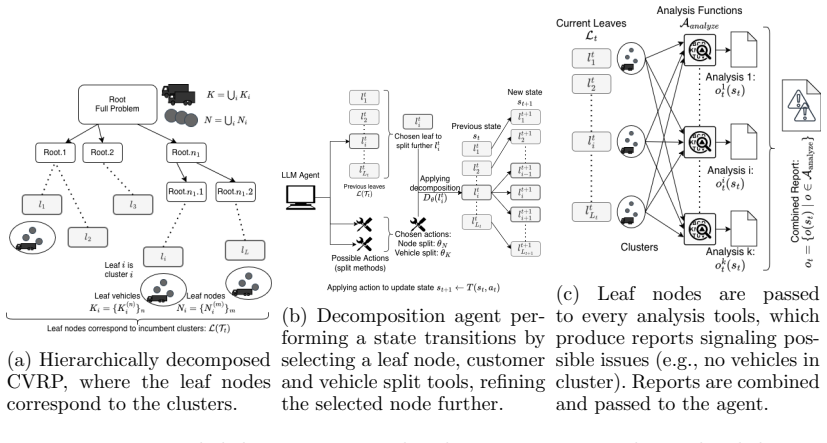
The LLM acting as a high-level decision maker that analyzes the evolving decomposition state and selectively applies clustering, balancing, and refinement operators.
If this is right
- Competitive performance is achieved on benchmark-scale instances.
- Improved scalability is exhibited on substantially larger problems.
- Robust routing quality is maintained on problems with up to 500,000 customers.
- The approach shows potential as a practical method for industrial-scale vehicle routing and large-scale logistics planning.
Where Pith is reading between the lines
- If the LLM decisions prove consistent, the method could reduce the need for problem-specific tuning in routing software.
- The iterative decision framing might extend to other decomposition-based optimization tasks in logistics.
- Validation on real-world industrial data would clarify how well the adaptation handles varied operational constraints.
Load-bearing premise
The approach assumes that an LLM can reliably analyze the evolving decomposition state and select appropriate operators to produce competitive solutions across varied problem characteristics.
What would settle it
Running the algorithm on a collection of large CVRP instances with known high-quality solutions and comparing the obtained routing costs and feasibility against established methods would test if the performance claims hold.
Figures

read the original abstract
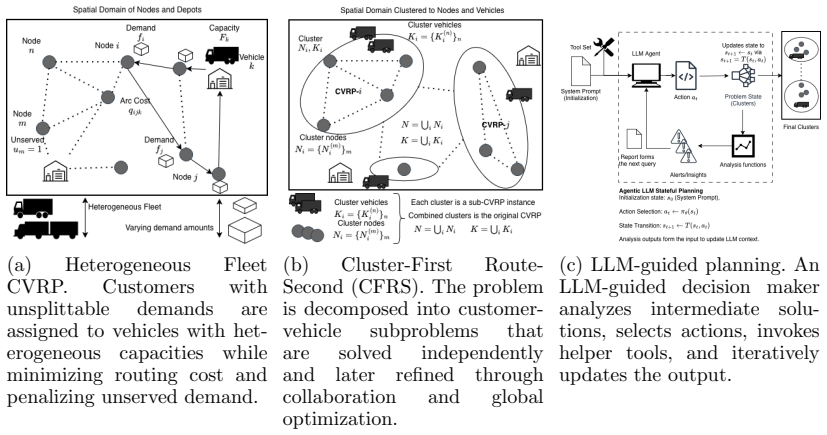
Large-scale capacitated vehicle routing problems (CVRPs) are commonly addressed using cluster-first route-second (CFRS) approaches that split a routing instance into smaller, computationally tractable subproblems. Existing splitting methods typically rely on fixed partitioning rules, predefined optimization objectives, or learned policies, which may perform inconsistently across instances exhibiting different spatial, demand, and operational characteristics. In this work, we propose an adaptive CFRS system that formulates a decomposition procedure as an iterative decision-making process. Motivated by the recent success of large language models (LLMs) in reasoning and tool selection, the system employs an LLM as a high-level decision maker that analyzes the evolving decomposition state and selectively applies further clustering, balancing, and refinement operators. The proposed algorithm jointly partitions customers and vehicles, enabling capacity-aware clustering while adapting partitioning decisions to the characteristics of each problem. We evaluate the approach on synthetic and benchmark-derived CVRP instances containing up to 500,000 customers. Experimental results demonstrate competitive performance on benchmark-scale instances while exhibiting improved scalability and robust routing quality on substantially larger problems. These results highlight the potential of adaptive, LLM-guided decision support as a practical approach for industrial-scale vehicle routing and large-scale logistics planning.
Editorial analysis
A structured set of objections, weighed in public.
Referee Report
Summary. The paper proposes an adaptive cluster-first route-second (CFRS) decomposition framework for large-scale capacitated vehicle routing problems (CVRPs). It formulates the decomposition as an iterative decision process in which an LLM analyzes the evolving state and selects among clustering, balancing, and refinement operators, jointly partitioning customers and vehicles in a capacity-aware manner. The approach is evaluated on synthetic and benchmark-derived instances up to 500,000 customers and is claimed to achieve competitive performance on standard benchmarks together with improved scalability and routing quality on substantially larger problems.
Significance. If the LLM-driven operator selection can be shown to be reliable and to outperform fixed or learned policies, the method would offer a practical route to instance-adaptive decomposition heuristics for industrial-scale VRP without extensive manual tuning. The absence of any reported validation of the LLM component, however, prevents assessment of whether the claimed gains are attributable to the adaptive mechanism.
major comments (2)
- [Abstract / Experimental results] Abstract and experimental claims: the manuscript asserts competitive performance on benchmark-scale instances and improved scalability on instances up to 500k customers, yet supplies no description of the experimental design, LLM model identity, prompt templates, temperature or sampling settings, baseline algorithms, performance metrics, or statistical tests. Without these elements the reported results cannot be evaluated or reproduced.
- [LLM-guided decision process] LLM decision-maker section: the central claim that the LLM reliably analyzes the decomposition state and selects appropriate operators rests on an unvalidated assumption. No ablation against fixed policies, no oracle-agreement metric, and no decision-quality statistics are provided, so performance gains cannot be attributed to the adaptive LLM component rather than the underlying operators alone.
minor comments (1)
- The abstract refers to 'synthetic and benchmark-derived CVRP instances' without naming the benchmark sources or describing the instance-generation procedure.
Simulated Author's Rebuttal
We thank the referee for the constructive feedback. The comments correctly identify gaps in experimental reporting and validation of the LLM component. We will revise the manuscript to supply the missing details and analyses.
read point-by-point responses
-
Referee: [Abstract / Experimental results] Abstract and experimental claims: the manuscript asserts competitive performance on benchmark-scale instances and improved scalability on instances up to 500k customers, yet supplies no description of the experimental design, LLM model identity, prompt templates, temperature or sampling settings, baseline algorithms, performance metrics, or statistical tests. Without these elements the reported results cannot be evaluated or reproduced.
Authors: We agree that the current manuscript omits key experimental details required for reproducibility. In the revision we will add a dedicated experimental setup subsection that specifies the LLM model and version, full prompt templates, temperature and sampling parameters, all baseline algorithms with their configurations, the exact performance metrics, and any statistical tests used. This will enable full evaluation and reproduction of the reported results on both benchmark and large-scale instances. revision: yes
-
Referee: [LLM-guided decision process] LLM decision-maker section: the central claim that the LLM reliably analyzes the decomposition state and selects appropriate operators rests on an unvalidated assumption. No ablation against fixed policies, no oracle-agreement metric, and no decision-quality statistics are provided, so performance gains cannot be attributed to the adaptive LLM component rather than the underlying operators alone.
Authors: We acknowledge the absence of explicit validation for the LLM decision process. The revised manuscript will include an ablation study comparing the full adaptive LLM policy against fixed operator sequences and random selection on the same instance set. Where feasible we will also report operator-selection agreement with an oracle policy and basic decision-quality statistics to better isolate the contribution of the adaptive mechanism. revision: yes
Circularity Check
No circularity: new algorithmic proposal with independent experimental claims
full rationale
The paper introduces an adaptive CFRS framework that uses an LLM for iterative operator selection on decomposition states. No equations, fitted parameters, or self-citations are presented that reduce the central claims to inputs by construction. The performance assertions rest on external benchmark evaluations up to 500k customers rather than any self-referential definition or renamed known result. This is a standard case of a self-contained algorithmic contribution.
Axiom & Free-Parameter Ledger
Reference graph
Works this paper leans on
-
[1]
Abdelhakim Abdellaoui, Loubna Benabbou, and Issmail El Hallaoui. Towards a connection between the capacitated vehicle routing problem and the constrained centroid-based clustering.arXiv preprint arXiv:2403.14013, 2024
-
[2]
Constrained clustering for the capacitated vehicle routing problem (cc-cvrp).Applied artificial intelligence, 36(1):1995658, 2022
Francesco Alesiani, Gulcin Ermis, and Konstantinos Gkiotsalitis. Constrained clustering for the capacitated vehicle routing problem (cc-cvrp).Applied artificial intelligence, 36(1):1995658, 2022
2022
-
[3]
Efficiently solving very large-scale routing problems.Computers & operations research, 107:32–42, 2019
Florian Arnold, Michel Gendreau, and Kenneth S¨ orensen. Efficiently solving very large-scale routing problems.Computers & operations research, 107:32–42, 2019
2019
-
[4]
The pollution-routing problem.Transportation Research Part B, 2011
Tolga Bekta¸ s and Gilbert Laporte. The pollution-routing problem.Transportation Research Part B, 2011
2011
-
[5]
Spatial, temporal, and hybrid decom- positions for large-scale vehicle routing with time windows
Russell Bent and Pascal Van Hentenryck. Spatial, temporal, and hybrid decom- positions for large-scale vehicle routing with time windows. InCPAIOR, 2008
2008
-
[6]
Springer, 1997
Julien Bramel and David Simchi-Levi.The logic of logistics: theory, algorithms, and applications for logistics management. Springer, 1997
1997
-
[7]
Balancing the cardinality of clusters with a distance constraint: a fast algorithm.Annals of Operations Research, 351(1):629–651, 2025
Herminia I Calvete, Carmen Gal´ e, and Jos´ e A Iranzo. Balancing the cardinality of clusters with a distance constraint: a fast algorithm.Annals of Operations Research, 351(1):629–651, 2025
2025
-
[8]
T. C. Edwin Cheng, Sachin S. Kamble, Amine Belhadi, Nelson Oly Ndubisi, Kee hung Lai, and Manoj Govind Kharat. Linkages between big data analytics, circu- lar economy, sustainable supply chain flexibility, and sustainable performance in manufacturing firms.International Journal of Production Research, 60(22):6908– 6922, 2022
2022
-
[9]
Samuel JK Chin and Maximilian Schiffer. Neural cluster first, route second: One-shot capacitated vehicle routing via differentiable optimal transport.arXiv preprint arXiv:2605.09301, 2026
work page internal anchor Pith review Pith/arXiv arXiv 2026
-
[10]
An algorithm for the vehicle-dispatching problem.Journal of the Operational Research Society, 20(3):309–318, 1969
Nicos Christofides and Samuel Eilon. An algorithm for the vehicle-dispatching problem.Journal of the Operational Research Society, 20(3):309–318, 1969
1969
-
[11]
Last-mile delivery efficiency: en route transloading in the parcel delivery industry.International Journal of Production Research, 60(9):2983–3000, 2022
Juan David Cortes and Yoshinori Suzuki. Last-mile delivery efficiency: en route transloading in the parcel delivery industry.International Journal of Production Research, 60(9):2983–3000, 2022
2022
-
[12]
Large language models for combinatorial optimization: A systematic review.ACM Com- puting Surveys, 58(11):1–53, 2026
Francesca Da Ros, Michael Soprano, Luca Di Gaspero, and Kevin Roitero. Large language models for combinatorial optimization: A systematic review.ACM Com- puting Surveys, 58(11):1–53, 2026
2026
-
[13]
React: Synergizing reasoning and acting in language models
Yao et al. React: Synergizing reasoning and acting in language models. 2023
2023
-
[14]
Or-tools routing library
Vincent Furnon and Laurent Perron. Or-tools routing library
-
[15]
A heuristic algorithm for the vehicle-dispatch problem.Operations research, 22(2):340–349, 1974
Billy E Gillett and Leland R Miller. A heuristic algorithm for the vehicle-dispatch problem.Operations research, 22(2):340–349, 1974
1974
-
[16]
Agentic llms in the supply chain: towards autonomous multi-agent consensus-seeking.International Journal of Production Research, pages 1–31, 2026
Valeria Jannelli, Stefan Schoepf, Matthias Bickel, Torbjørn Netland, and Alexan- dra Brintrup. Agentic llms in the supply chain: towards autonomous multi-agent consensus-seeking.International Journal of Production Research, pages 1–31, 2026
2026
-
[17]
A cluster-based optimization frame- work for vehicle routing problem with workload balance.Computers & Industrial Engineering, 169:108221, 2022
LI Jingjing, Yaohuiqiong Fang, and Na Tang. A cluster-based optimization frame- work for vehicle routing problem with workload balance.Computers & Industrial Engineering, 169:108221, 2022
2022
-
[18]
Christoph Kerscher and Stefan Minner. Spatial-temporal-demand clustering for solving large-scale vehicle routing problems with time windows.arXiv preprint arXiv:2402.00041, 2024
-
[19]
A hybrid adap- 19 tive large neighbourhood search for multi-depot open vehicle routing problems
Rahma Lahyani, Anne-Lise Gouguenheim, and Leandro C Coelho. A hybrid adap- 19 tive large neighbourhood search for multi-depot open vehicle routing problems. International Journal of Production Research, 57(22):6963–6976, 2019
2019
-
[20]
Fifty years of vehicle routing.Transportation Science, 43(4):408– 416, 2009
Gilbert Laporte. Fifty years of vehicle routing.Transportation Science, 43(4):408– 416, 2009
2009
-
[21]
Complexity of vehicle routing and scheduling problems.Networks, 11(2):221–227, 1981
Jan Karel Lenstra and Alexander Hendrik Georg Rinnooy Kan. Complexity of vehicle routing and scheduling problems.Networks, 11(2):221–227, 1981
1981
-
[22]
An overview and experimental study of learning-based optimization algorithms for the vehicle routing problem.IEEE/CAA Journal of Automatica Sinica, 9(7):1115–1138, 2022
Bingjie Li, Guohua Wu, Yongming He, Mingfeng Fan, and Witold Pedrycz. An overview and experimental study of learning-based optimization algorithms for the vehicle routing problem.IEEE/CAA Journal of Automatica Sinica, 9(7):1115–1138, 2022
2022
-
[23]
An llm-powered milp modelling engine for workforce scheduling guided by expert knowledge.International Jour- nal of Production Research, pages 1–21, 2026
Qingyang Li, Lele Zhang, and Vicky Mak-Hau. An llm-powered milp modelling engine for workforce scheduling guided by expert knowledge.International Jour- nal of Production Research, pages 1–21, 2026
2026
-
[24]
Mathe- matical models for the vehicle routing problem by considering balancing load and customer compactness.Sustainability, 14(19):12937, 2022
Rodrigo Linfati, Fernando Y´ a˜ nez-Concha, and John Willmer Escobar. Mathe- matical models for the vehicle routing problem by considering balancing load and customer compactness.Sustainability, 14(19):12937, 2022
2022
-
[25]
Least squares quantization in pcm.IEEE transactions on infor- mation theory, 28(2):129–137, 1982
Stuart Lloyd. Least squares quantization in pcm.IEEE transactions on infor- mation theory, 28(2):129–137, 1982
1982
-
[26]
Batoul Mahvash, Anjali Awasthi, and Satyaveer Chauhan. A column generation based heuristic for the capacitated vehicle routing problem with three-dimensional loading constraints.International Journal of Production Research, 55(6):1730– 1747, 2017
2017
-
[27]
Real-time routing in flexible flow shops: a self-adaptive swarm-based control model.International journal of production research, 45(21):5157–5172, 2007
Lakshmanan Meyyappan, Can Saygin, and Cihan H Dagli. Real-time routing in flexible flow shops: a self-adaptive swarm-based control model.International journal of production research, 45(21):5157–5172, 2007
2007
-
[28]
Erfaneh Nikzad and Mahdi Bashiri. A two-stage stochastic programming model for collaborative asset protection routing problem enhanced with machine learn- ing: a learning-based matheuristic algorithm.International Journal of Production Research, 61(1):81–113, 2023
2023
-
[29]
Knowledge-based learning for solving vehicle routing problem
Thananut Phiboonbanakit, Teerayut Horanont, Thepchai Supnithi, and Van-Nam Huynh. Knowledge-based learning for solving vehicle routing problem. InPro- ceedings of the 2018 ACM International Joint Conference and 2018 International Symposium on Pervasive and Ubiquitous Computing and Wearable Computers, pages 1103–1111, 2018
2018
-
[30]
Qwen2.5 technical report, 2025
Qwen, :, An Yang, Baosong Yang, Beichen Zhang, Binyuan Hui, Bo Zheng, Bowen Yu, Chengyuan Li, Dayiheng Liu, Fei Huang, Haoran Wei, Huan Lin, Jian Yang, Jianhong Tu, Jianwei Zhang, Jianxin Yang, Jiaxi Yang, Jingren Zhou, Junyang Lin, Kai Dang, Keming Lu, Keqin Bao, Kexin Yang, Le Yu, Mei Li, Mingfeng Xue, Pei Zhang, Qin Zhu, Rui Men, Runji Lin, Tianhao Li,...
2025
-
[31]
Decompo- sition strategies for vehicle routing heuristics.INFORMS Journal on Computing, 35(3):543–559, 2023
Alberto Santini, Michael Schneider, Thibaut Vidal, and Daniele Vigo. Decompo- sition strategies for vehicle routing heuristics.INFORMS Journal on Computing, 35(3):543–559, 2023
2023
-
[32]
Op- timAI: Optimizing optimization problems with AI,
Raghav Thind, Youran Sun, Ling Liang, and Haizhao Yang. Optimai: Opti- mization from natural language using llm-powered ai agents.arXiv preprint arXiv:2504.16918, 2025
-
[33]
SIAM, 2014
Paolo Toth and Daniele Vigo.Vehicle Routing: Problems, Methods, and Applica- tions. SIAM, 2014. 20
2014
-
[34]
A spatial parallel heuristic approach for solving very large-scale vehicle routing problems.Transactions in GIS, 21(6):1130–1147, 2017
Wei Tu, Qingquan Li, Qiuping Li, Jiasong Zhu, Baoding Zhou, and Biyu Chen. A spatial parallel heuristic approach for solving very large-scale vehicle routing problems.Transactions in GIS, 21(6):1130–1147, 2017
2017
-
[35]
New benchmark instances for the capacitated vehicle rout- ing problem.European Journal of Operational Research, 257(3):845–858, 2017
Eduardo Uchoa, Diego Pecin, Artur Pessoa, Marcus Poggi, Thibaut Vidal, and Anand Subramanian. New benchmark instances for the capacitated vehicle rout- ing problem.European Journal of Operational Research, 257(3):845–858, 2017
2017
-
[36]
Hybrid genetic search for the cvrp: Open-source implementation and swap* neighborhood.Computers & Operations Research, 140:105643, 2022
Thibaut Vidal. Hybrid genetic search for the cvrp: Open-source implementation and swap* neighborhood.Computers & Operations Research, 140:105643, 2022
2022
-
[37]
The rise and potential of large language model based agents: A survey.Science China Information Sciences, 68(2):121101, 2025
Zhiheng Xi, Wenxiang Chen, Xin Guo, Wei He, Yiwen Ding, Boyang Hong, Ming Zhang, Junzhe Wang, Senjie Jin, Enyu Zhou, et al. The rise and potential of large language model based agents: A survey.Science China Information Sciences, 68(2):121101, 2025
2025
-
[38]
Large Language Models for Operations Research: A Comprehensive Survey
Xianchao Xiu, Jianhao Li, Jun Fan, and Wanquan Liu. Large language models for operations research: A comprehensive survey.arXiv preprint arXiv:2605.20849, 2026
work page internal anchor Pith review Pith/arXiv arXiv 2026
-
[39]
Qwen3 technical report, 2025
An Yang, Anfeng Li, Baosong Yang, Beichen Zhang, Binyuan Hui, Bo Zheng, Bowen Yu, Chang Gao, Chengen Huang, Chenxu Lv, Chujie Zheng, Dayiheng Liu, Fan Zhou, Fei Huang, Feng Hu, Hao Ge, Haoran Wei, Huan Lin, Jialong Tang, Jian Yang, Jianhong Tu, Jianwei Zhang, Jianxin Yang, Jiaxi Yang, Jing Zhou, Jingren Zhou, Junyang Lin, Kai Dang, Keqin Bao, Kexin Yang, ...
2025
-
[40]
Glop: Learning global partition and local construction for solving large-scale routing problems in real-time
Haoran Ye, Jiarui Wang, Helan Liang, Zhiguang Cao, Yong Li, and Fanzhang Li. Glop: Learning global partition and local construction for solving large-scale routing problems in real-time. InProceedings of the AAAI conference on artificial intelligence, volume 38, pages 20284–20292, 2024. Appendix A. Decomposition Agent: Splitting Tools The following tool i...
2024
discussion (0)
Sign in with ORCID, Apple, or X to comment. Anyone can read and Pith papers without signing in.