Modal CEGAR-tableaux with RECAR and resolution-based SAT-shortcuts
Pith reviewed 2026-07-01 02:43 UTC · model grok-4.3
The pith
KSP resolution oracle as SAT-shortcut makes CEGAR-tableaux outperform both pure CEGAR-tableaux and pure KSP on modal satisfiability.
A machine-rendered reading of the paper's core claim, the machinery that carries it, and where it could break.
Core claim
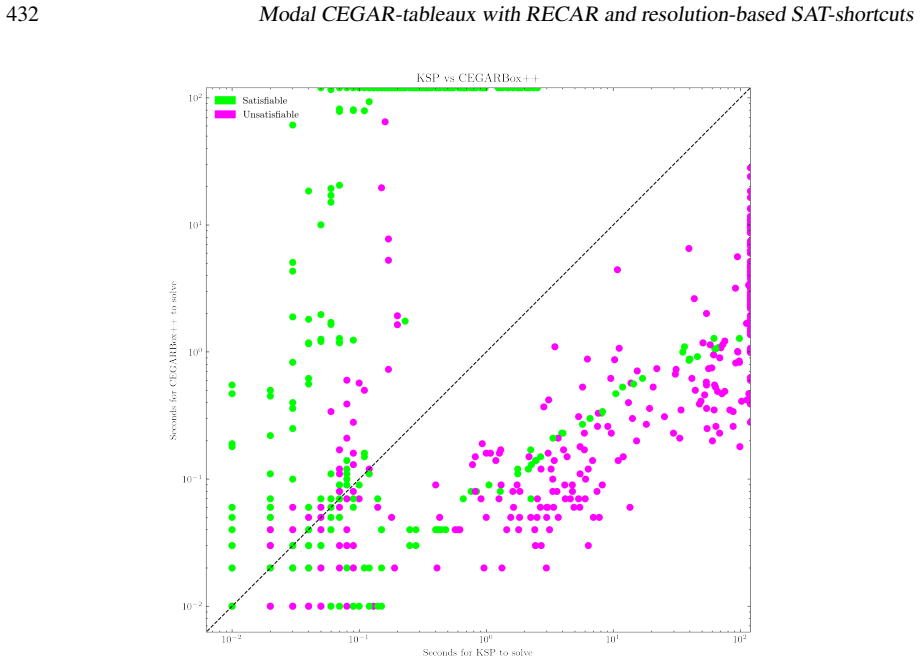
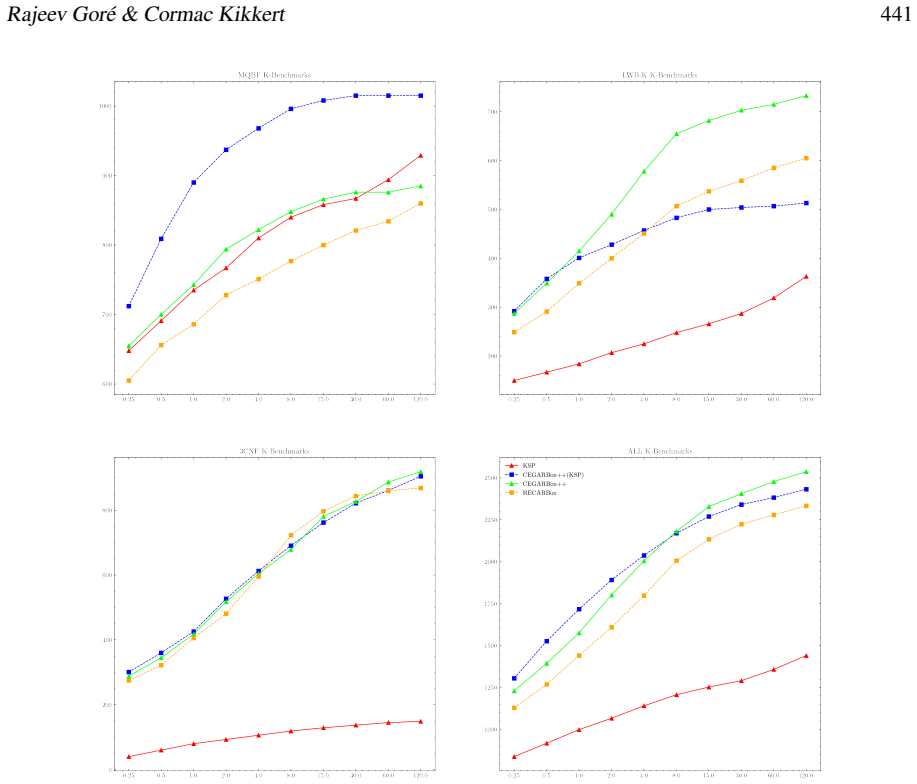
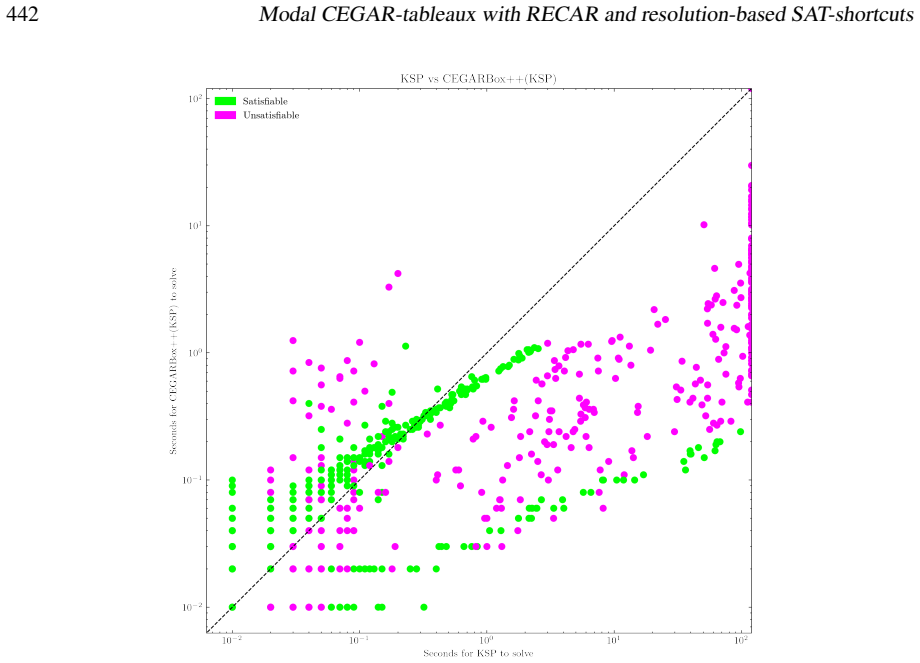
CEGARBox++ using KSP to provide SAT-shortcuts is superior to both CEGARBox++ and KSP, particularly on large satisfiable problems. This is the first effective integration of SAT, tableaux and resolution methods for modal satisfiability which performs better than its parts.
What carries the argument
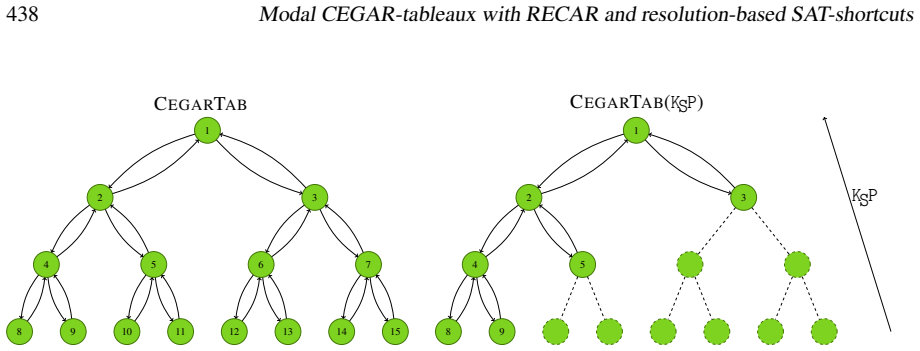
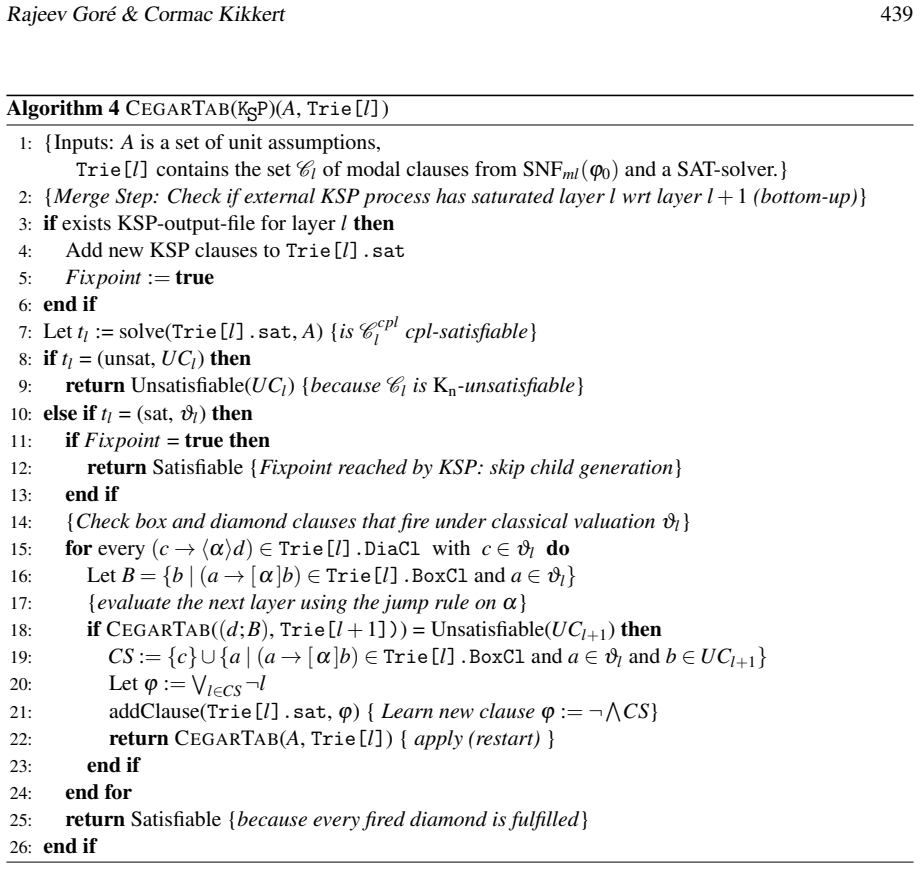
KSP resolution prover used as an oracle to supply SAT-shortcuts inside CEGAR-tableaux, contrasted with RECAR-based shortcuts.
If this is right
- Hybrid tableau-resolution systems can handle larger modal instances than either paradigm alone.
- Resolution oracles can prune expensive tableau branches on satisfiable cases.
- Modal satisfiability benefits when multiple proof methods are combined rather than used in isolation.
Where Pith is reading between the lines
- The same oracle pattern could be tried in other modal or description logics where resolution provers exist.
- Performance gains may depend on how often the oracle is called and on the cost of translating between tableau and resolution representations.
- The approach might extend to related problems such as modal model checking if suitable oracles are available.
Load-bearing premise
The benchmark runs compare the three systems fairly without implementation bias, unequal test selection, or hidden differences in how each is executed.
What would settle it
A collection of large satisfiable modal formulas on which the KSP-oracle hybrid solves fewer instances or takes more total time than the faster of standalone CEGARBox++ and standalone KSP.
Figures

read the original abstract
We investigate two approaches for extending CEGAR-tableaux with SAT-shortcuts using a previously known approach called RECAR but also a totally new approach using the modal resolution theorem prover KSP as an oracle. Our experiments using our C++ implementation CEGARBox++ of CEGAR-tableaux show that: (1) CEGARBox++ with RECAR SAT-shortcuts is not competitive (2) CEGARBox++ using KSP to provide SAT-shortcuts is superior to both CEGARBox++ and KSP, particularly on large satisfiable problems. As far as we know, this is the first effective integration of SAT, tableaux and resolution methods for modal satisfiability which performs better than its parts.
Editorial analysis
A structured set of objections, weighed in public.
Referee Report
Summary. The manuscript investigates extending CEGAR-tableaux for modal satisfiability checking with SAT-shortcuts, comparing the RECAR approach against a novel integration that uses the KSP modal resolution prover as an oracle. The authors' C++ implementation CEGARBox++ is used to demonstrate that the KSP-based variant outperforms both pure CEGARBox++ and standalone KSP, especially on large satisfiable instances, and is presented as the first effective combination of SAT, tableaux, and resolution methods that exceeds the performance of its components.
Significance. If the reported performance gains are reproducible under controlled conditions, the work would be significant for automated modal reasoning by providing the first demonstrated hybrid that surpasses its constituent methods. The release of a C++ implementation is a positive step toward reproducibility of the empirical claims.
major comments (1)
- [Abstract and experimental evaluation] Abstract and experimental evaluation: the central claim that CEGARBox++ using KSP SAT-shortcuts is superior (particularly on large satisfiable problems) is unsupported by any description of the benchmark suite, hardware, time limits, number of instances solved by each variant, or statistical measures; without these controls the observed advantage cannot be attributed to the integration rather than implementation or selection bias.
Simulated Author's Rebuttal
We thank the referee for highlighting the need for greater transparency in our experimental claims. We address the major comment below and will revise the manuscript to strengthen the presentation of results.
read point-by-point responses
-
Referee: [Abstract and experimental evaluation] Abstract and experimental evaluation: the central claim that CEGARBox++ using KSP SAT-shortcuts is superior (particularly on large satisfiable problems) is unsupported by any description of the benchmark suite, hardware, time limits, number of instances solved by each variant, or statistical measures; without these controls the observed advantage cannot be attributed to the integration rather than implementation or selection bias.
Authors: We agree that the current manuscript does not provide sufficient detail on the experimental setup to fully support the performance claims. The abstract and experimental section mention the superiority of CEGARBox++ with KSP-based SAT-shortcuts over CEGARBox++ and standalone KSP (especially on large satisfiable instances) but omit explicit descriptions of the benchmark suite, hardware configuration, time limits, per-variant solved-instance counts, and statistical measures. In the revised manuscript we will add a dedicated experimental evaluation subsection that specifies: (i) the benchmark sources and instance counts (including how large satisfiable problems were selected), (ii) hardware details (CPU, memory, OS), (iii) uniform time limits applied to all solvers, (iv) tables or figures reporting the number of instances solved by each variant, and (v) basic statistical summaries (e.g., average runtime on solved instances, success rates). This will allow readers to assess whether the observed advantage stems from the hybrid integration rather than implementation artifacts. revision: yes
Circularity Check
No circularity in experimental comparison of modal CEGAR-tableaux implementations
full rationale
The paper reports an experimental evaluation of CEGARBox++ with RECAR and KSP-based SAT-shortcuts for modal satisfiability. No mathematical derivations, equations, fitted parameters, uniqueness theorems, or ansatzes are present. Claims rest on runtime comparisons of implementations against benchmarks, which are externally verifiable and do not reduce to self-definitions or self-citations by construction. This is a standard empirical systems paper with no load-bearing circular steps.
Axiom & Free-Parameter Ledger
Reference graph
Works this paper leans on
-
[1]
Foundations of Artificial Intelligence 3, pp
Franz Baader, Ian Horrocks & Ulrike Sattler (2008): Description logics. Foundations of Artificial Intelligence 3, pp. 135–179
2008
-
[2]
Aaron R. Bradley (2011): SAT-Based Model Checking without Unrolling . In Ranjit Jhala & David A. Schmidt, editors: Verification, Model Checking, and Abstract Interpretation - 12th International Conference, VMCAI 2011, Austin, TX, USA, January 23-25, 2011. Proceedings , Lecture Notes in Computer Science 6538, Springer, pp. 70–87, doi:10.1007/978-3-642-18275-4_7
-
[4]
T. Y . Chen, Jean-Louis Lassez & Graeme S. Port (1986): Maximal Unifiable Subsets and Minimal Nonunifi- able Subsets. New Gener. Comput. 4(2), pp. 133–152, doi:10.1007/BF03037439
-
[5]
Koen Claessen & Dan Rosén (2015): SAT Modulo Intuitionistic Implications . In Martin Davis, Ansgar Fehnker, Annabelle McIver & Andrei V oronkov, editors:Logic for Programming, Artificial Intelligence, and Reasoning - 20th International Conference, LPAR-20 2015, Suva, Fiji, November 24-28, 2015, Proceedings, Lecture Notes in Computer Science 9450, Springer...
-
[6]
Edmund M. Clarke, Orna Grumberg, Somesh Jha, Yuan Lu & Helmut Veith (2003): Counterexample- guided abstraction refinement for symbolic model checking . J. ACM 50(5), pp. 752–794, doi:10.1145/876638.876643
-
[7]
http: // minisat
Niklas Eén (2006): The Minisat page. http: // minisat. se/
2006
-
[8]
Luca Geatti, Nicola Gigante & Angelo Montanari (2021): BLACK: A Fast, Flexible and Reliable LTL Satis- fiability Checker. In Dario Della Monica, Gian Luca Pozzato & Enrico Scala, editors: Proceedings of the 3rd Workshop on Artificial Intelligence and Formal Verification, Logic, Automata, and Synthesis hosted by the Twelfth International Symposium on Games...
2021
-
[9]
Rajeev Goré & Cormac Kikkert (2021): CEGAR-Tableaux: Improved Modal Satisfiability via Modal Clause- Learning and SAT. In Anupam Das & Sara Negri, editors: Automated Reasoning with Analytic Tableaux and Related Methods - 30th International Conference, TABLEAUX 2021, Birmingham, UK, September 6-9, 2021, Proceedings, Lecture Notes in Computer Science 12842,...
-
[10]
Rajeev Goré & Linh Anh Nguyen (2009): Clausal Tableaux for Multimodal Logics of Belief . Fundam. Informaticae 94(1), pp. 21–40, doi:10.3233/FI-2009-115
-
[11]
Rajeev Goré & Jimmy Thomson (2013): An Improved BDD Method for Intuitionistic Propositional Logic: BDDIntKt System Description. In Maria Paola Bonacina, editor: Automated Deduction - CADE-24 - 24th International Conference on Automated Deduction, Lake Placid, NY , USA, June 9-14, 2013. Proceedings , Lecture Notes in Computer Science 7898, Springer, pp. 27...
-
[12]
Jean-Marie Lagniez, Daniel Le Berre, Tiago de Lima & Valentin Montmirail (2017):A Recursive Shortcut for CEGAR: Application To The Modal Logic K Satisfiability Problem. In Carles Sierra, editor: Proceedings of the Twenty-Sixth International Joint Conference on Artificial Intelligence, IJCAI 2017, Melbourne, Australia, August 19-25, 2017, ijcai.org, pp. 67...
-
[13]
Vardi (2015): SAT-Based Explicit LTL Reasoning
Jianwen Li, Shufang Zhu, Geguang Pu & Moshe Y . Vardi (2015): SAT-Based Explicit LTL Reasoning . In Nir Piterman, editor: Hardware and Software: Verification and Testing - 11th International Haifa Verification Conference, HVC 2015, Haifa, Israel, November 17-19, 2015, Proceedings , Lecture Notes in Computer Science 9434, Springer, pp. 209–224, doi:10.1007...
-
[14]
Vardi (2019): SAT-based explicit LTL reasoning and its application to satisfiability checking
Jianwen Li, Shufang Zhu, Geguang Pu, Lijun Zhang & Moshe Y . Vardi (2019): SAT-based explicit LTL reasoning and its application to satisfiability checking . Formal Methods Syst. Des. 54(2), pp. 164–190, doi:10.1007/S10703-018-00326-5
-
[15]
In: International Conference on Computer Logic, Springer, pp
Grigori Mints (1988): Gentzen-type systems and resolution rules part I propositional logic. In: International Conference on Computer Logic, Springer, pp. 198–231, doi:10.1007/3-540-52335-9_55
-
[16]
Cláudia Nalon, Clare Dixon & Ullrich Hustadt (2019): Modal Resolution: Proofs, Layers, and Refinements. ACM Trans. Comput. Log. 20(4), pp. 23:1–23:38, doi:10.1145/3331448
-
[17]
Cláudia Nalon, Ullrich Hustadt & Clare Dixon (2017): KSP: A Resolution-based Prover for Multimodal K, Abridged Report. In Carles Sierra, editor: Proceedings of the Twenty-Sixth International Joint Conference on Artificial Intelligence, IJCAI 2017, Melbourne, Australia, August 19-25, 2017, ijcai.org, pp. 4919–4923, doi:10.24963/ijcai.2017/694
-
[18]
Linh Anh Nguyen (1999): A New Space Bound for the Modal Logics K4, KD4 and S4 . In Miroslaw Kuty- lowski, Leszek Pacholski & Tomasz Wierzbicki, editors: Mathematical Foundations of Computer Science 1999, 24th International Symposium, MFCS’99, Szklarska Poreba, Poland, September 6-10, 1999, Proceed- ings, Lecture Notes in Computer Science 1672, Springer, p...
-
[19]
Australian National University
Thomas Pagram (2015): Using decision diagrams for modal and intuitionisic theorem proving . Australian National University
2015
-
[20]
Rabe & Leander Tentrup (2015): CAQE: A Certifying QBF Solver
Markus N. Rabe & Leander Tentrup (2015): CAQE: A Certifying QBF Solver. In Roope Kaivola & Thomas Wahl, editors: Formal Methods in Computer-Aided Design, FMCAD 2015, Austin, Texas, USA, September 27-30, 2015, IEEE, pp. 136–143, doi:10.1109/FMCAD.2015.7542263
-
[21]
Automation of reasoning: 2: Classical papers on computational logic 1967–1970, pp
Grigori S Tseitin (1983): On the complexity of derivation in propositional calculus. Automation of reasoning: 2: Classical papers on computational logic 1967–1970, pp. 466–483, doi:10.1007/978-3-642-81955-1_28
-
[22]
In: Eu- ropean Conference on Computer Vision (2020),https://doi.org/10.1007/978- 3-030-58452-8_241
Moshe Y . Vardi (2009): From Philosophical to Industrial Logics . In Ramaswamy Ramanujam & Sundar Sarukkai, editors: Logic and Its Applications, Third Indian Conference, ICLA 2009, Chennai, India, January 7-11, 2009. Proceedings, Lecture Notes in Computer Science 5378, Springer, pp. 89–115, doi:10.1007/978- 3-540-92701-3_7
-
[23]
Chao Wang, Aarti Gupta & Franjo Ivancic (2007): Induction in CEGAR for Detecting Counterex- amples. In: Formal Methods in Computer-Aided Design, 7th International Conference, FMCAD 2007, Austin, Texas, USA, November 11-14, 2007, Proceedings , IEEE Computer Society, pp. 77–84, doi:10.1109/FAMCAD.2007.21
-
[24]
Wolfram (1989): Intractable Unifiability Problems and Backtracking
David A. Wolfram (1989): Intractable Unifiability Problems and Backtracking. J. Autom. Reason. 5(1), pp. 37–47, doi:10.1007/BF00245020
discussion (0)
Sign in with ORCID, Apple, or X to comment. Anyone can read and Pith papers without signing in.