An overview of stray light findings and interpretation during on-sky commissioning of LSSTCam
Pith reviewed 2026-07-01 02:41 UTC · model grok-4.3
The pith
The commissioning team built tools to track stray light from discovery through ray-tracing simulation to corrective actions.
A machine-rendered reading of the paper's core claim, the machinery that carries it, and where it could break.
Core claim
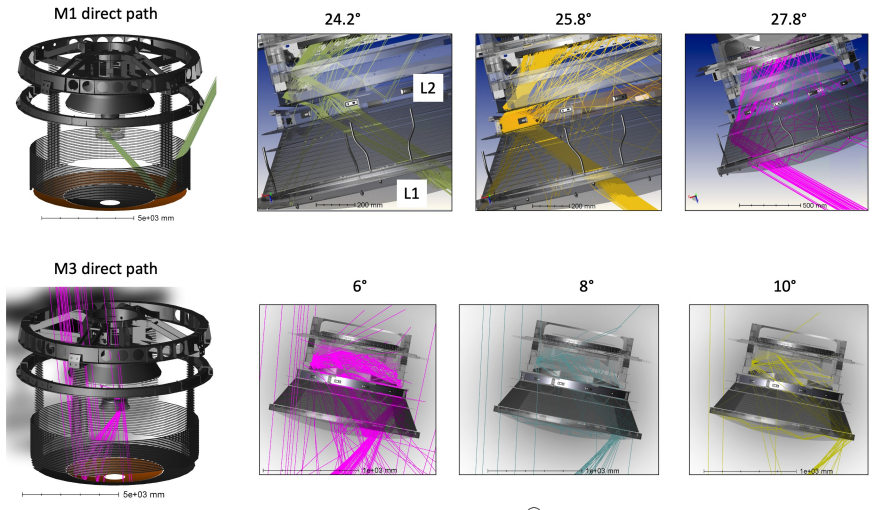
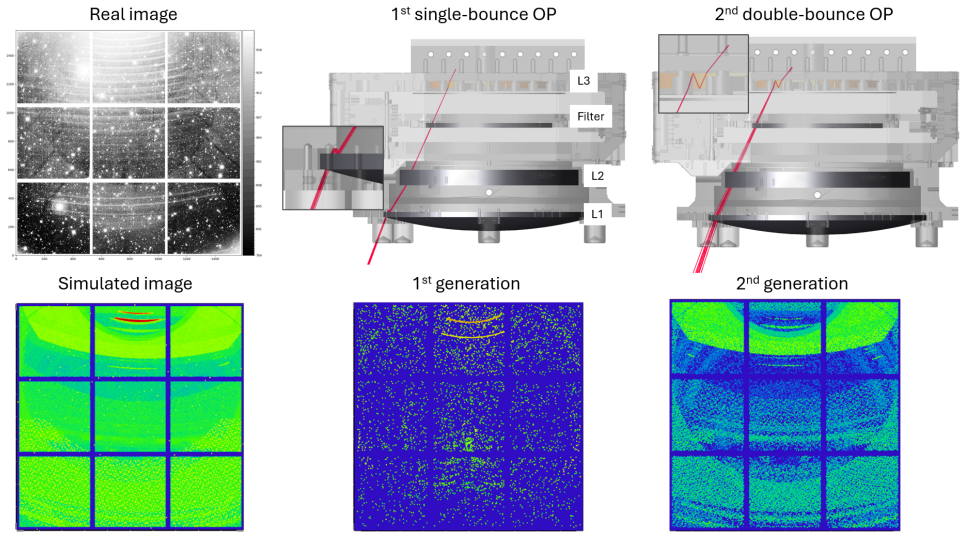
The commissioning team created a series of testing and analysis tools to track stray light artifacts from their initial discovery through reproduction with timely observations, simulation using ray tracing to identify opto-mechanical origins, and finally devising corrective actions.
What carries the argument
The workflow of observation reproduction, ray-tracing simulation of the opto-mechanical system, and corrective-action development.
If this is right
- Stray light artifacts can be reproduced with targeted observations and traced to specific opto-mechanical sources.
- Ray-tracing models can locate the origins of complex contamination patterns in the telescope.
- Corrective actions developed from the simulations reduce the impact of stray light on images.
- The encountered features supply lessons for shielding designs in future wide-field telescopes.
Where Pith is reading between the lines
- If the workflow proves repeatable, similar campaigns could shorten commissioning time for other large telescopes.
- Data-quality gains from reduced stray light would directly benefit statistical measurements in long-duration sky surveys.
- Unmodeled scattering mechanisms, if present, would require additional diagnostic observations beyond the current simulations.
Load-bearing premise
Ray-tracing simulations of the opto-mechanical system can reliably identify the physical origins of the observed stray light features without significant unmodeled contributions from other sources.
What would settle it
Implementing the corrective actions derived from the simulations produces no measurable reduction in the stray light features seen in later on-sky images.
Figures
read the original abstract
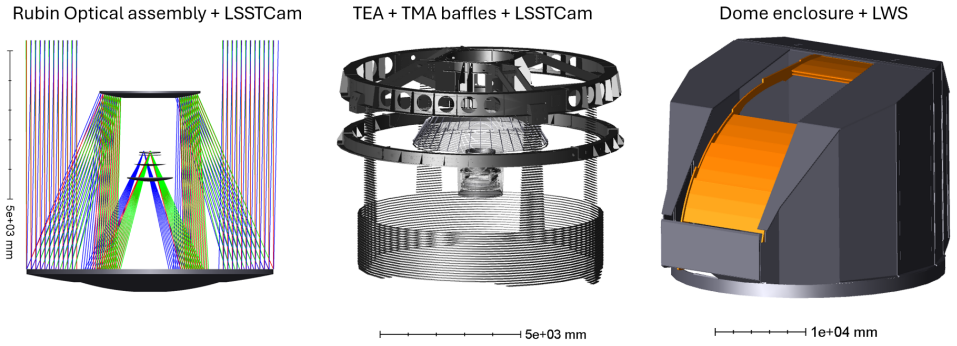
Wide-field telescopes are intrinsically difficult to shield from unwanted stray and scattered light, while the search to identify sources of contaminating light is frequently a challenging task. The Vera C.~Rubin Observatory, which achieved its first photon with the LSST Camera (LSSTCam) on April 15, 2025, will initiate a revolutionary era for the study of dark matter, dark energy, the transient sky, the Solar System, and the Milky Way. LSSTCam will provide near seeing-limited images of the sky in six bands ($u,g,r,i,z,y$) over a $3.^\circ 5$-diameter field of view, and over the course of a decade, it will execute the Legacy Survey of Space and Time (LSST). This work provides an overview of the dedicated stray and scattered light test campaign that has been undertaken since the start of Rubin commissioning. In particular, we highlight the processes used to characterize, model, and mitigate stray light present in LSSTCam images. The Rubin commissioning team created a series of testing and analysis tools to track stray light artifacts from their initial discovery through reproduction with timely observations, simulation using ray tracing to identify opto-mechanical origins, and finally devising corrective actions. The complex stray light features encountered by Rubin provide a wealth of experience for the future wide-field and extremely wide-field observatories. This work covers the many stages of a long journey that started with conceiving an innovative and challenging optical design, followed by the engineering and system engineering efforts to build it, to finally delivering an optimized and revolutionary cutting-edge facility.
Editorial analysis
A structured set of objections, weighed in public.
Referee Report
Summary. The manuscript provides an overview of the stray light test campaign undertaken during on-sky commissioning of LSSTCam at the Vera C. Rubin Observatory. It describes the development of testing and analysis tools to track artifacts from initial discovery through reproduction via targeted observations, identification of opto-mechanical origins via ray-tracing simulations, and implementation of corrective actions, while noting the broader relevance of these experiences for future wide-field facilities.
Significance. If the workflow and attributions hold, the paper supplies a detailed engineering case study on stray-light management in a complex, wide-field system that is directly relevant to achieving the photometric and image-quality requirements of the LSST. The emphasis on an end-to-end process from observation to mitigation offers transferable lessons for other large-aperture, large-field telescopes.
major comments (1)
- [ray-tracing simulation and origin identification] The central claim that ray-tracing simulations identify the opto-mechanical origins of observed stray-light features (abstract and workflow description) is load-bearing yet unsupported by any reported quantitative validation metrics such as pixel-by-pixel residuals, feature-shape correlation coefficients, or sensitivity tests to coating BRDF uncertainties. Without these, alternative explanations (e.g., unmodeled scattering) cannot be ruled out.
minor comments (1)
- The abstract would be strengthened by naming at least one concrete stray-light feature and its mitigation outcome to give readers an immediate sense of the results obtained.
Simulated Author's Rebuttal
We thank the referee for their careful reading and for highlighting the importance of quantitative validation for the ray-tracing results. We address the single major comment below and outline the revisions we will make.
read point-by-point responses
-
Referee: [ray-tracing simulation and origin identification] The central claim that ray-tracing simulations identify the opto-mechanical origins of observed stray-light features (abstract and workflow description) is load-bearing yet unsupported by any reported quantitative validation metrics such as pixel-by-pixel residuals, feature-shape correlation coefficients, or sensitivity tests to coating BRDF uncertainties. Without these, alternative explanations (e.g., unmodeled scattering) cannot be ruled out.
Authors: We agree that the manuscript does not report quantitative validation metrics for the ray-tracing identifications. The current text relies on visual feature matching, reproduction via targeted observations, and the outcomes of subsequent mitigations. While these elements provide supporting evidence, they do not constitute the pixel-by-pixel residuals, shape correlation coefficients, or BRDF sensitivity tests requested. We will therefore revise the manuscript to add quantitative comparisons (including feature-shape correlation coefficients for representative cases) and a limited sensitivity analysis to coating BRDF uncertainties where the available data permit. A short discussion of remaining validation limitations will also be included. These changes will be made in the revised version. revision: yes
Circularity Check
Descriptive engineering report with no derivations or self-referential predictions
full rationale
The paper is an overview of commissioning activities for stray light in LSSTCam. It describes a workflow of discovery, observation, ray-tracing simulation, and mitigation without any equations, fitted parameters, predictions derived from models, or load-bearing self-citations. No derivation chain exists that could reduce to its inputs by construction. The central claim is a factual report of processes used, not a mathematical result.
Axiom & Free-Parameter Ledger
Reference graph
Works this paper leans on
-
[1]
The Astrophysical Journal , year =
Ivezi´ c,ˇZ., Kahn, S. M., Tyson, J. A., Abel, B., Acosta, E., Allsman, R., Alonso, D., AlSayyad, Y., Anderson, S. F., Andrew, J., Angel, J. R. P., Angeli, G. Z., Ansari, R., Antilogus, P., Araujo, C., Armstrong, R., Arndt, K. T., Astier, P., Aubourg, ´E., Auza, N., Axelrod, T. S., Bard, D. J., Barr, J. D., Barrau, A., Bartlett, J. G., Bauer, A. E., Bauma...
-
[2]
doi:10.71929/rubin/2571927 , url =
SLAC National Accelerator Laboratory and NSF-DOE Vera C. Rubin Observatory, “The LSST Camera (LSSTCam),” (Jan. 2025). DOI:https://doi.org/10.71929/RUBIN/2571927
-
[3]
Rubin Observatory: It Is Happening!,
Blum, B., “Rubin Observatory: It Is Happening!,”The NOIRLab Mirror8, 22 (Jan. 2025)
2025
-
[4]
Flaugher, B., Diehl, H. T., Honscheid, K., Abbott, T. M. C., Alvarez, O., Angstadt, R., Annis, J. T., Antonik, M., Ballester, O., Beaufore, L., Bernstein, G. M., Bernstein, R. A., Bigelow, B., Bonati, M., Boprie, D., Brooks, D., Buckley-Geer, E. J., Campa, J., Cardiel-Sas, L., Castander, F. J., Castilla, J., Cease, H., Cela-Ruiz, J. M., Chappa, S., Chi, E...
-
[5]
Ghost Images in DECam,
Kent, S. M., “Ghost Images in DECam,” FERMILAB-SLIDES-20-114-SCD (2013)
2013
-
[6]
Chang, C., Drlica-Wagner, A., Kent, S. M., Nord, B., Wang, D. M., and Wang, M. H. L. S., “A Machine Learning Approach to the Detection of Ghosting and Scattered Light Artifacts in Dark Energy Survey Images,”arXiv e-prints, arXiv:2105.10524 (May 2021)
-
[7]
Tanoglidis, D., ´Ciprijanovi´ c, A., Drlica-Wagner, A., Nord, B., Wang, M. H. L. S., Amsellem, A. J., Downey, K., Jenkins, S., Kafkes, D., and Zhang, Z., “DeepGhostBusters: Using Mask R-CNN to detect and mask ghosting and scattered-light artifacts from optical survey images,”Astronomy and Computing39, 100580 (Apr. 2022). DOI:https://doi.org/10.1016/j.asco...
-
[8]
Very large telescope paranal science operations omegacam user manual,
“Very large telescope paranal science operations omegacam user manual,” (2020).https://www.eso.org/ sci/facilities/paranal/instruments/omegacam/doc/VST-MAN-OCM-23100-3110_p106_v2.pdf
2020
-
[9]
The spherex satellite mission,
Bock, J. J., Aboobaker, A. M., Adamo, J., Akeson, R., Alred, J. M., Alibay, F., Ashby, M. L. N., Bach, Y. P., Bleem, L. E., Bolton, D., Braun, D. F., Bruton, S., Bryan, S. A., Chang, T.-C., Chen, S.-S., Cheng, Y.-T., Cheshire, J. R., Chiang, Y.-K., de Janvry, J. C., Condon, S., Cook, W. R., Cooray, A., Crill, B. P., Cukierman, A. J., Dor´ e, O., Dowell, C...
-
[10]
Seeking euclid’s hidden stars: commissioning looks up,
“Seeking euclid’s hidden stars: commissioning looks up,” (2023).https://www.esa.int/Science_ Exploration/Space_Science/Euclid/Seeking_Euclid_s_hidden_stars_commissioning_looks_up
2023
-
[11]
Stray Light Analysis of the LSST 8.4m Wide Field Telescope
Ellis, S., “Stray Light Analysis of the LSST 8.4m Wide Field Telescope.” Photon Engineering, LLC 440 S. Williams Boulevard, Suite 106 Tucson, Arizona 85711 14 November 2006
2006
-
[12]
Design for an 8-m Telescope with a 3 Degree Field at f/1.25: The Dark Matter Telescope,
Angel, R., Lesser, M., Sarlot, R., and Dunham, E., “Design for an 8-m Telescope with a 3 Degree Field at f/1.25: The Dark Matter Telescope,” in [Imaging the Universe in Three Dimensions], van Breugel, W. and Bland-Hawthorn, J., eds.,Astronomical Society of the Pacific Conference Series195, 81 (Jan. 2000)
2000
-
[13]
The Large-aperture Synoptic Survey Telescope.,
Tyson, A. and Angel, R., “The Large-aperture Synoptic Survey Telescope.,” in [The New Era of Wide Field Astronomy], Clowes, R., Adamson, A., and Bromage, G., eds.,Astronomical Society of the Pacific Conference Series232, 347 (Jan. 2001)
2001
-
[14]
LSST as a precision probe of dark energy,
Tyson, T., Wittman, D., Hennawi, J., and Spergel, D., “LSST as a precision probe of dark energy,” in [APS April Meeting Abstracts],APS Meeting Abstracts, Y6.004 (Apr. 2002)
2002
-
[15]
NSF’s National Optical-infrared Astronomy Research Laboratory: Pre- Operations of the Vera C. Rubin Observatory
Mountain, C. M. and Blum, R. D., “NSF’s National Optical-infrared Astronomy Research Laboratory: Pre- Operations of the Vera C. Rubin Observatory.” NSF Award Number 1836783. Directorate for Mathematical and Physical Sciences, Division Of Astronomical Sciences. 2018. (Oct. 2018)
2018
-
[16]
Lsst primary/tertiary monolithic mirror,
Sebag, J., Gressler, W., Liang, M., Neill, D., Araujo-Hauck, C., Andrew, J., Angeli, G., Cho, M., Claver, C., Daruich, F., Gessner, C., Hileman, E., Krabbendam, V., Muller, G., Poczulp, G., Repp, R., Wiecha, O., Xin, B., Kenagy, K., Martin, H. M., Tuell, M. T., and West, S. C., “Lsst primary/tertiary monolithic mirror,” (2016). DOI:https://doi.org/10.1117...
-
[17]
Rubin Observatory rotating enclosure (dome) progress and status,
Marchiori, G., De Lorenzi, S., Martinez, J., et al., “Rubin Observatory rotating enclosure (dome) progress and status,” in [Ground-based and Airborne Telescopes X], Marshall, H. K., Spyromilio, J., and Usuda, T., eds.,Society of Photo-Optical Instrumentation Engineers (SPIE) Conference Series13094, 1309404 (Aug. 2024). DOI:https://doi.org/10.1117/12.3018132
-
[18]
Stray light characteristics of the Large Synoptic Survey Telescope (LSST),
Ellis, K. S., “Stray light characteristics of the Large Synoptic Survey Telescope (LSST),” in [Optical Modeling and Performance Predictions IV], Kahan, M. A., ed.,7427, 742708, International Society for Optics and Photonics, SPIE (2009). DOI:https://doi.org/10.1117/12.830599
-
[19]
The Vera C. Rubin Observatory Data Preview 1,
Vera C Rubin Observatory Team, Acero Cuellar, T., Acosta, E., Adair, C. L., Adari, P., Adelman McCarthy, J. K., Alexov, A., Allbery, R., Allsman, R., AlSayyad, Y., Amado, J., Amouroux, N., Antilogus, P., Aracena Alcayaga, A., Aravena Rojas, G., Araya Cortes, C. H., Aubourg, E., Axelrod, T. S., Banovetz, J., Barria, C., E Bauer, A., Bauman, B. J., Bechtol,...
-
[20]
Rubin commissioning camera: integration, functional testing, and lab performance,
Stalder, B., Reil, K., Claver, C., Liang, M., Tsai, T. W., Lange, T., Haupt, J., Wiecha, O., Lopez, M., Poczulp, G., Hascall, D., Neill, D., Sebag, J., Johnson, B., Mills, N., Cho, M., Neal, H., Newbry, S., Osier, S., Schindler, R., Onoprienko, D., Johnson, A., Morris, R. G., Turri, M., Eisner, A., Cisneros, S., Xiong, V., Huffer, M., Thayer, G., Harris, ...
2020
-
[21]
Sitcomtn-149: An interim report on the lsstcomcam on-sky campaign
Rubin Observatory Project, “Sitcomtn-149: An interim report on the lsstcomcam on-sky campaign.”https: //sitcomtn-149.lsst.io/SITCOMTN-149.pdf
-
[22]
Selvy, B. M., Roberts, A., Reuter, M., Claver, C. C., Comoretto, G., Jenness, T., O’Mullane, W., Serio, A., Bovill, R., Sebag, J., Thomas, S., Bajaj, M., Zwemer, D., and Klaveren, B. V., “V&V planning and execution in an integrated model-based engineering environment using MagicDraw, Syndeia, and Jira,” in [Modeling, Systems Engineering, and Project Manag...
-
[23]
What is love: learnings and challenges in developing a real time monitoring system for the vera c rubin observatory operations,
Aranda Sanchez, S., “What is love: learnings and challenges in developing a real time monitoring system for the vera c rubin observatory operations,” Paper number 14155-155, to be published on Proc. of SPIE 2026 for Software and Cyberinfrastructure for Astronomy IX
2026
-
[24]
Stellarium 26.1 user guide
“Stellarium 26.1 user guide.”https://stellarium.org/files/guide.pdf
-
[25]
Testing the lsst difference image analysis pipeline using synthetic source injection analysis,
Liu, S., Wood-Vasey, W. M., Armstrong, R., Narayan, G., S ˜A¡nchez, B. O., and Collaboration, T. D. E. S., “Testing the lsst difference image analysis pipeline using synthetic source injection analysis,”The Astrophysical Journal967, 10 (may 2024). DOI:https://doi.org/10.3847/1538-4357/ad3635
-
[26]
Study of a large-angle off-axis stray light path in rubin observatory commissioning,
Drlica-Wagner, A., Taranto, A., Rodeghiero, G., Meyers, J. E., Neill, D. R., et al., “Study of a large-angle off-axis stray light path in rubin observatory commissioning,” Paper number 14147-121, to be published on Proc. of SPIE 2026 for Ground-based and Airborne Telescopes XI
2026
-
[27]
Measurement of telescope transmission using a collimated beam projector,
Mondrik, N., Coughlin, M., Betoule, M., Bongard, S., Rice, J. P., Shaw, P.-S., Stubbs, C. W., Woodward, J. T., and Collaboration, L. D. E. S., “Measurement of telescope transmission using a collimated beam projector,”Publications of the Astronomical Society of the Pacific135, 035001 (mar 2023). DOI:https: //doi.org/10.1088/1538-3873/acbe1c
-
[28]
Optical ghosts: quantifying their impact and using them to probe lsstcam optics,
Pai, A., Drlica-Wagner, A., Kelvin, L. S., Meyers, J. E., Urbach, E. K., Mueller, F., and Lupton, R. H., “Optical ghosts: quantifying their impact and using them to probe lsstcam optics,” Paper number 14152-92, to be published on Proc. of SPIE 2026 for Modeling, Systems Engineering, and Project Management for Astronomy XII
2026
-
[29]
Meyers, J. E., Kirkby, D., and Thomas, D., “batoid.” [Computer Software]https://doi.org/10.11578/ dc.20200708.1(oct 2019). DOI:https://doi.org/10.11578/dc.20200708.1
-
[30]
Identifying specific rays using filter strings
“Identifying specific rays using filter strings.”https://optics.ansys.com/hc/en-us/articles/ 42661949492755-Identifying-specific-rays-using-filter-strings
-
[31]
Mechanical studies of an additional light baffle for the lsst camera,
Pollek, H. M. M., Rodeghiero, G., Andrew, J., Drlica-Wagner, A., and Taranto, A., “Mechanical studies of an additional light baffle for the lsst camera,” Paper number 14152-91, to be published on Proc. of SPIE 2026 for Modeling, Systems Engineering, and Project Management for Astronomy XII
2026
-
[32]
Modeling of the diffuse back- ground produced by the vera c. rubin observatory m2 baffle scattered light,
Taranto, A., Rodeghiero, G., Rosignoli, L., Urbach, K. E., and M¨ uller, F., “Modeling of the diffuse back- ground produced by the vera c. rubin observatory m2 baffle scattered light,” Paper number 14152-98, to be published on Proc. of SPIE 2026 for Modeling, Systems Engineering, and Project Management for Astron- omy XII
2026
-
[33]
Observatory system specifications (oss)
“Observatory system specifications (oss).” Charles F. Claver and the LSST Systems Engineering Integrated Project Team, LSE-30 (rel20.1), Latest Revision Date: May 8, 2024
2024
discussion (0)
Sign in with ORCID, Apple, or X to comment. Anyone can read and Pith papers without signing in.