Efficient entanglement of three remote single-atom quantum-network nodes
Pith reviewed 2026-07-01 04:56 UTC · model grok-4.3
The pith
Three single atoms in separate labs form an entangled three-qubit state with 77% fidelity.
A machine-rendered reading of the paper's core claim, the machinery that carries it, and where it could break.
Core claim
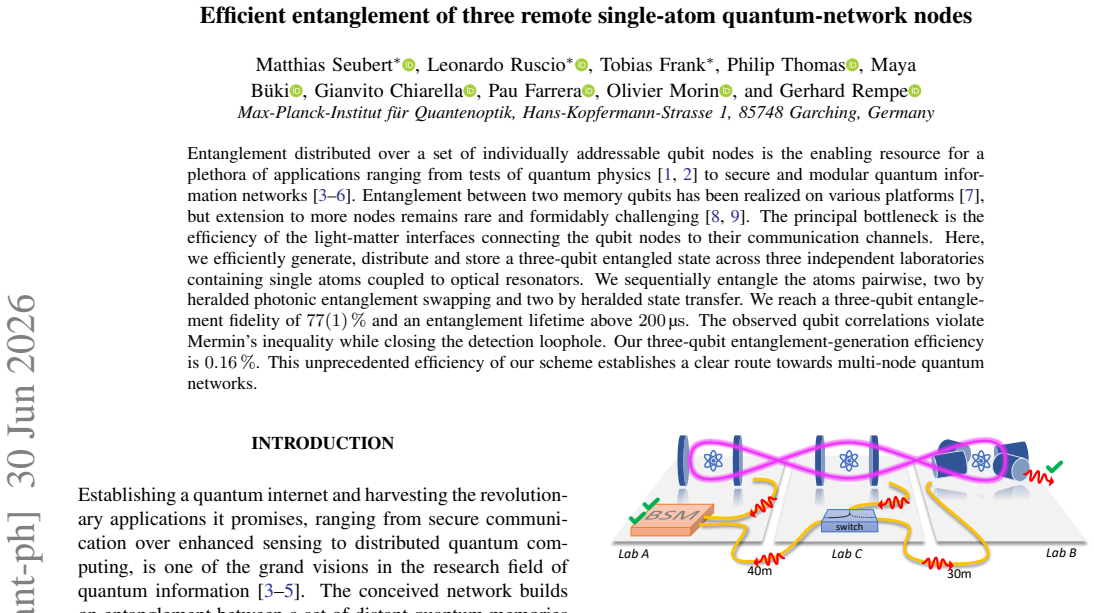
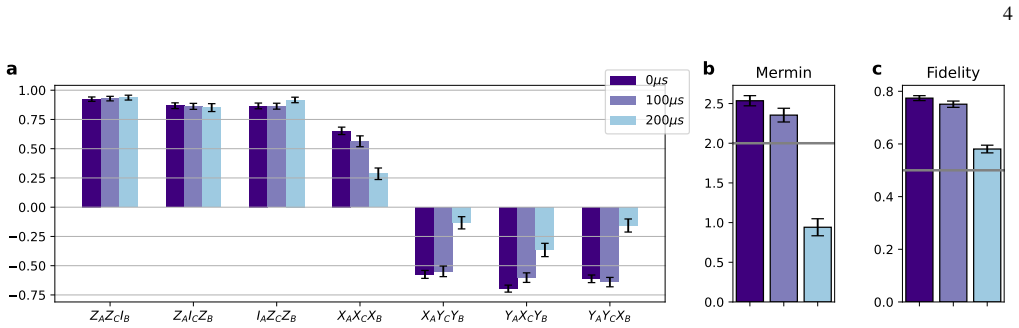
We efficiently generate, distribute and store a three-qubit entangled state across three independent laboratories containing single atoms coupled to optical resonators. We sequentially entangle the atoms pairwise, two by heralded photonic entanglement swapping and two by heralded state transfer. We reach a three-qubit entanglement fidelity of 77(1)% and an entanglement lifetime above 200us. The observed qubit correlations violate Mermin's inequality while closing the detection loophole. Our three-qubit entanglement-generation efficiency is 0.16%.
What carries the argument
Sequential pairwise heralded photonic entanglement swapping and state transfer between single atoms coupled to optical resonators.
If this is right
- The scheme supplies a working method to connect more than two nodes in a quantum network.
- The closed detection loophole allows the network to be used for fundamental tests of quantum mechanics.
- The reported efficiency removes the principal bottleneck that has prevented multi-node entanglement distribution.
- The stored entanglement lifetime above 200 microseconds supports further operations on the shared state.
Where Pith is reading between the lines
- Scaling the same resonator coupling to four or more nodes would test whether the efficiency remains usable for larger entangled states.
- The heralded swapping technique could be combined with other qubit platforms that achieve comparable light-matter efficiency.
- If the detection loophole remains closed at higher node counts, the network could serve as a testbed for multipartite Bell inequalities.
Load-bearing premise
The sequential pairwise heralded operations produce genuine tripartite entanglement without unaccounted errors or decoherence that would invalidate the reported fidelity and Mermin violation.
What would settle it
A measurement of three-qubit fidelity well below 77 percent or a failure to violate Mermin's inequality after full error accounting would show the claimed genuine tripartite entanglement was not achieved.
Figures
read the original abstract
Entanglement distributed over a set of individually addressable qubit nodes is the enabling resource for a plethora of applications ranging from tests of quantum physics to secure and modular quantum information networks. Entanglement between two memory qubits has been realized on various platforms, but extension to more nodes remains rare and formidably challenging. The principal bottleneck is the efficiency of the light-matter interfaces connecting the qubit nodes to their communication channels. Here, we efficiently generate, distribute and store a three-qubit entangled state across three independent laboratories containing single atoms coupled to optical resonators. We sequentially entangle the atoms pairwise, two by heralded photonic entanglement swapping and two by heralded state transfer. We reach a three-qubit entanglement fidelity of 77(1)% and an entanglement lifetime above 200us. The observed qubit correlations violate Mermin's inequality while closing the detection loophole. Our three-qubit entanglement-generation efficiency is 0.16%. This unprecedented efficiency of our scheme establishes a clear route towards multi-node quantum networks.
Editorial analysis
A structured set of objections, weighed in public.
Referee Report
Summary. The manuscript reports an experimental demonstration in which three remote single-atom nodes, each in a separate laboratory and coupled to an optical resonator, are entangled into a three-qubit GHZ-like state. The protocol proceeds via sequential pairwise operations: two heralded photonic entanglement-swapping steps and two heralded state-transfer steps. The authors measure a three-qubit state fidelity of 77(1)%, an entanglement lifetime exceeding 200 μs, a violation of Mermin’s inequality that closes the detection loophole, and an overall entanglement-generation efficiency of 0.16%.
Significance. If the reported numbers hold, the work constitutes a clear advance in distributed quantum information processing by realizing genuine tripartite entanglement across independent laboratories with a heralded, efficiency-competitive protocol. The combination of atom-resonator interfaces, loophole-free Mermin violation, and quantified efficiency supplies a concrete benchmark and a scalable route toward larger modular quantum networks.
minor comments (3)
- [Abstract] Abstract and §2: the 0.16% efficiency figure is presented without an explicit definition (e.g., success probability per full experimental cycle versus per heralding attempt); a one-sentence clarification would remove ambiguity for readers comparing to prior two-node results.
- [§4.2] §4.2 (tomography): the maximum-likelihood reconstruction and the quoted 1% uncertainty on fidelity should state the total number of experimental runs and the precise statistical procedure used to obtain the error bar.
- [Figure 4] Figure 4 (Mermin data): the plotted correlations would be easier to assess if the raw coincidence counts and the precise detection-efficiency correction factors were tabulated in the caption or supplementary material.
Simulated Author's Rebuttal
We thank the referee for their positive assessment of the work, the recognition of its significance for distributed quantum networks, and the recommendation for minor revision. No specific major comments were listed in the report.
Circularity Check
No significant circularity
full rationale
The paper is a purely experimental demonstration of remote three-qubit entanglement generation via sequential heralded photonic operations. Reported values (fidelity 77(1)%, lifetime >200 μs, efficiency 0.16%, Mermin violation) are direct measurement outcomes from tomography and correlation data, not quantities obtained by fitting parameters to the same dataset or by any derivation chain. No equations, ansatzes, uniqueness theorems, or self-citations appear as load-bearing steps in the provided text; the central claims rest on experimental error budgets and detection accounting that are independently verifiable from the raw data. The result is therefore self-contained against external benchmarks with no reduction of outputs to inputs by construction.
Axiom & Free-Parameter Ledger
axioms (1)
- standard math Standard quantum mechanics and cavity quantum electrodynamics govern atom-photon interactions and heralded entanglement.
Reference graph
Works this paper leans on
-
[1]
M., Horne, M
Greenberger, D. M., Horne, M. A. & Zeilinger, A. inBell’s Theorem, Quantum Theory and Conceptions of the Universe (ed. Kafatos, M.) 69–72 (Springer, 1989)
1989
-
[2]
Mermin, N. D. Extreme quantum entanglement in a superposi- tion of macroscopically distinct states.Phys. Rev. Lett.65, 1838 (1990)
1990
-
[3]
Kimble, H. J. The quantum internet.Nature453, 1023–1030 (2008)
2008
-
[4]
& Hanson, R
Wehner, S., Elkouss, D. & Hanson, R. Quantum internet: A vision for the road ahead.Science362, eaam9288 (2018)
2018
-
[5]
Awschalom, D. et al. Development of Quantum Interconnects (QuICs) for Next-Generation Information TechnologiesPRX Quantum2, 017002 (2021)
2021
-
[6]
Ramya, R., Kumar, P., Dhanasekaran, D., Kumar, R. S. & Shar- avan, S. A. A review of quantum communication and informa- tion networks with advanced cryptographic applications using machine learning, deep learning techniques.Franklin Open10, 100223 (2025)
2025
-
[7]
Wei, S.-H. et al. Towards Real-World Quantum Networks: A Review. Laser & Photonics Reviews 2022,16, 2100219
2022
-
[8]
Jing, B. et al. Entanglement of three quantum memories via in- terference of three single photons.Nature Photon13, 210–213 (2019)
2019
-
[9]
Pompili, M. et al. Realization of a multinode quantum network of remote solid-state qubits.Science372, 259-264 (2021)
2021
-
[10]
Moehring, D. L. et al.Nature449, 68–71 (2007)
2007
-
[11]
Stephenson, L.J. et al. High-Rate, High-Fidelity Entanglement of Qubits Across an Elementary Quantum NetworkPhys. Rev. Lett.124, 110501 (2020)
2020
-
[12]
Kucera, S. et al. Demonstration of quantum network protocols over a 14-km urban fiber link.npj Quantum Inf.10, 88 (2024)
2024
-
[13]
Hofmann, J. et al. Heralded Entanglement Between Widely Separated Atoms.Science337, 72–75 (2012)
2012
-
[14]
Ritter, S. et al. An elementary quantum network of single atoms in optical cavities.Nature484, 195–200 (2012)
2012
-
[15]
Krutyanskiy, V . et al. Entanglement of Trapped-Ion Qubits Sep- arated by 230 Meters.Phys. Rev. Lett.130, 050803 (2023)
2023
-
[16]
Matsukevich, D. N. et al. Entanglement of Remote Atomic QubitsPhys. Rev. Lett.96, 030405 (2006)
2006
-
[17]
Chou, C.-W. et al. Functional Quantum Nodes for Entangle- ment Distribution over Scalable Quantum Networks.Science 316, 1316-1320 (2007)
2007
-
[18]
Pu, YF. et al. Experimental demonstration of memory-enhanced scaling for entanglement connection of quantum repeater seg- ments.Nat. Photonics15, 374–378 (2021)
2021
-
[19]
Liu, J.-L. et al. Creation of memory–memory entanglement in a metropolitan quantum network.Nature629, 579–585 (2024)
2024
-
[20]
Delteil, A. et al. Generation of heralded entanglement between distant hole spins.Nature Phys12, 218–223 (2016)
2016
-
[21]
Hensen, B. et al. Loophole-free Bell inequality violation us- ing electron spins separated by 1.3 kilometres.Nature526, 682–686 (2015)
2015
-
[22]
Knaut, C.M. et al. Entanglement of nanophotonic quantum memory nodes in a telecom network.Nature629, 573–578 (2024)
2024
-
[23]
V ., Seri, A
Lago-Rivera, D., Grandi, S., Rakonjac, J. V ., Seri, A. & de Riedmatten, H. Telecom-heralded entanglement between multimode solid-state quantum memories.Nature594, 37–40 (2021)
2021
-
[24]
& Rempe, G
Thomas, P., Ruscio, L., Morin, O. & Rempe, G. Efficient gener- ation of entangled multiphoton graph states from a single atom. Nature608, 677–681 (2022)
2022
-
[25]
& Rempe, G
Brekenfeld, M., Niemietz, D., Christesen, J.D. & Rempe, G. A quantum network node with crossed optical fibre cavities. Nature Phys.16, 647–651 (2020)
2020
-
[26]
& Rempe, G
Morin, O., Körber, M., Langenfeld, S. & Rempe, G. Deter- ministic shaping and reshaping of single-photon temporal wave functions.Phys. Rev. Lett.123, 133602 (2019)
2019
-
[27]
& Wehner, S
Brunner, N., Cavalcanti, D., Pironio, S., Scarani, V . & Wehner, S. Bell nonlocality.Rev. Mod. Phys.86, 419 (2014), Erratum 6 Rev. Mod. Phys.86, 839 (2014)
2014
-
[28]
Necessary and sufficient detector-efficiency con- ditions for the Greenberger-Horne-Zeilinger paradox.Phys
Larsson, J.-Å. Necessary and sufficient detector-efficiency con- ditions for the Greenberger-Horne-Zeilinger paradox.Phys. Rev. A57, R3145(R) (1998)
1998
-
[29]
& Tóth, G
Gühne, O. & Tóth, G. Entanglement detection.Phys. Rep.474, 1–75 (2009)
2009
-
[30]
& Wehner, S
Avis, G., Rozp˛ edek, F. & Wehner, S. Analysis of multipar- tite entanglement distribution using a central quantum-network node.Phys. Rev. A107, 012609 (2023)
2023
-
[31]
& Rempe, G
Hartung, L., Seubert, M., Welte, S., Distante, E. & Rempe, G. A quantum-network register assembled with optical tweezers in an optical cavity.Science385, 179-183 (2024)
2024
-
[32]
Krutyanskiy, V . et al. Multimode Ion-Photon Entanglement over 101 Kilometers.PRX Quantum5, 020308 (2024)
2024
-
[33]
Körber, M. et al. Decoherence-protected memory for a single- photon qubit.Nature Photon12, 18–21 (2018)
2018
-
[34]
Hein, M. et al. inQuantum Computers, Algorithms and Chaoshttps://ebooks.iospress.nl/publication/27431 115–218 (IOS Press, 2006)
2006
-
[35]
Briegel, H.-J., Dür, W., Cirac, J. I. & Zoller, P. Quantum Re- peaters: The Role of Imperfect Local Operations in Quantum Communication.Phys. Rev. Lett.81, 5932-5935 (1998)
1998
-
[36]
Epping, M. et al. Large-scale quantum networks based on graphs.New J. Phys.18, 053036 (2016)
2016
-
[37]
& Dür, W
Fröwis, F. & Dür, W. Stable macroscopic quantum superposi- tions.Phys. Rev. Lett.106, 110402 (2011) METHODS ENTANGLEMENT GENERATION RATE Our nominal rate of11/sis defined as the product of the success probability and the attempt frequency:R nom = ηAC ηCB/τent. Our raw rate is defined as the number of suc- cessfully heralded GHZ states divided by the total...
2011
-
[38]
In both laboratories, the atom is pumped to the|F= 2, m F = 0⟩state
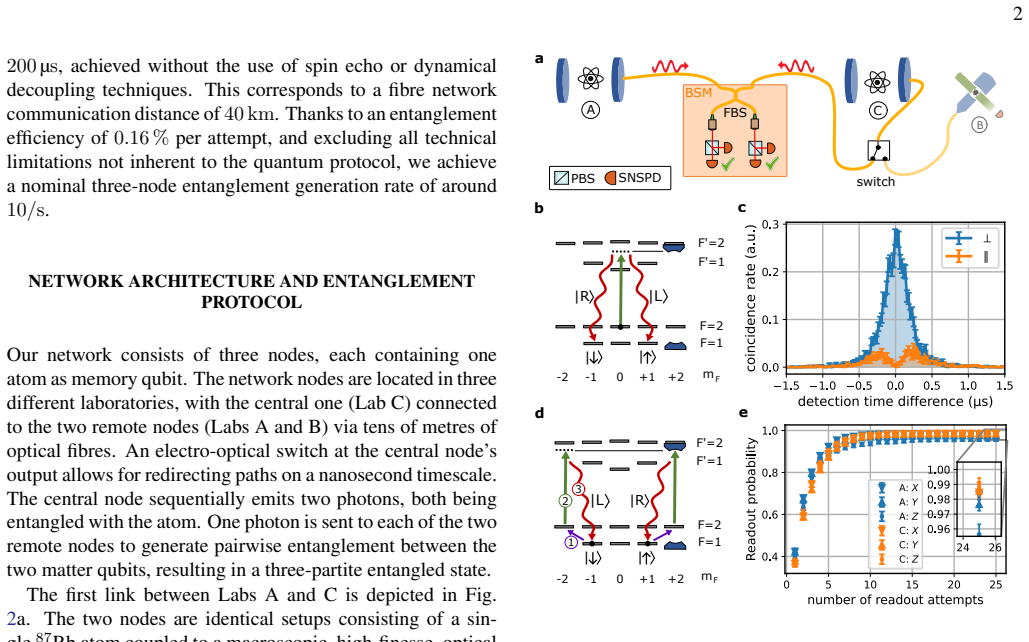
Labs A and C are synchronised. In both laboratories, the atom is pumped to the|F= 2, m F = 0⟩state. Each atom generates an entangled photon using the vSTIRAP process, as shown in Fig. 2b. Both photons are guided to the BSM setup, where a BSM is performed to project the two atoms onto an entangled state. An electrical signal send to Lab B triggers the prep...
2000
discussion (0)
Sign in with ORCID, Apple, or X to comment. Anyone can read and Pith papers without signing in.