FaceMoE: Mixture of Experts for Low-Resolution Face Recognition
Pith reviewed 2026-07-01 05:19 UTC · model grok-4.3
The pith
A mixture of experts transformer with a top-k router enables resolution-aware feature extraction for low-resolution face recognition while mitigating catastrophic forgetting.
A machine-rendered reading of the paper's core claim, the machinery that carries it, and where it could break.
Core claim
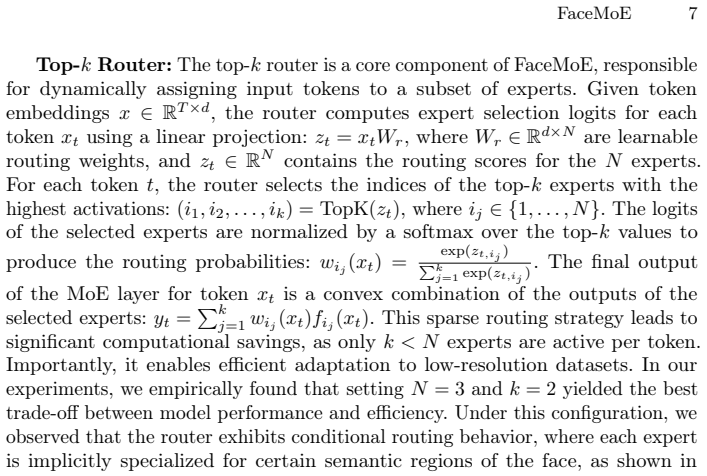
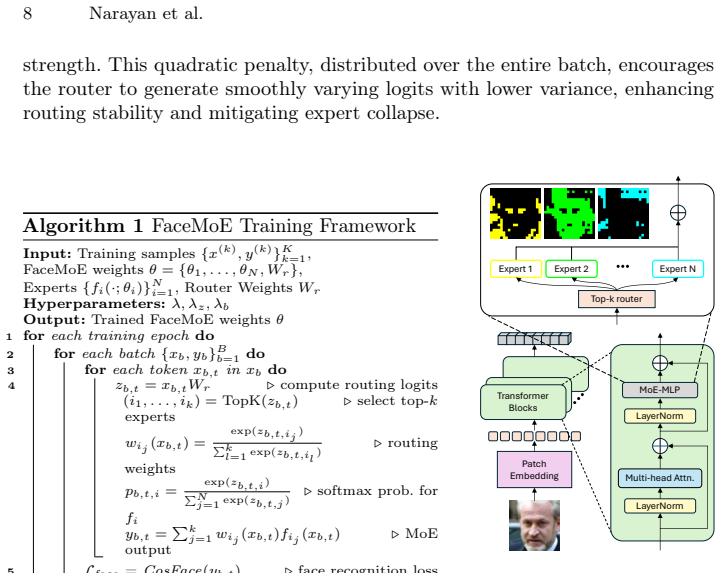
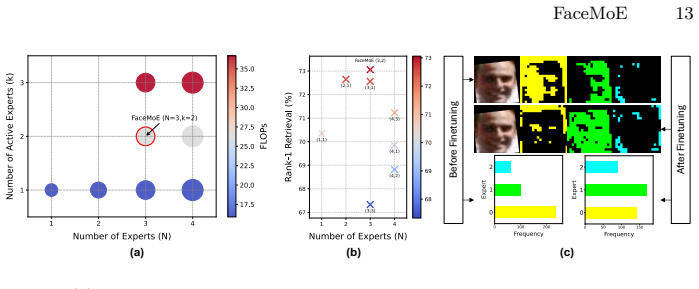
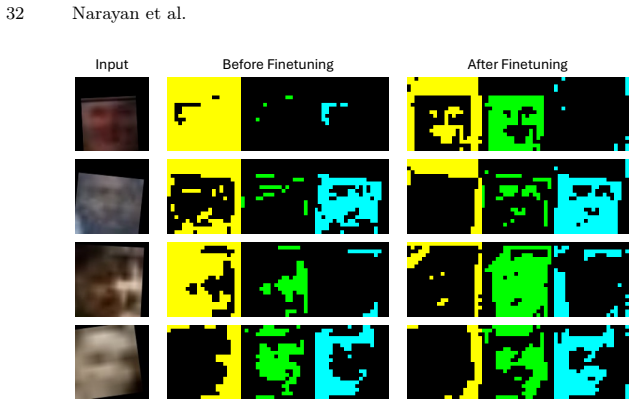
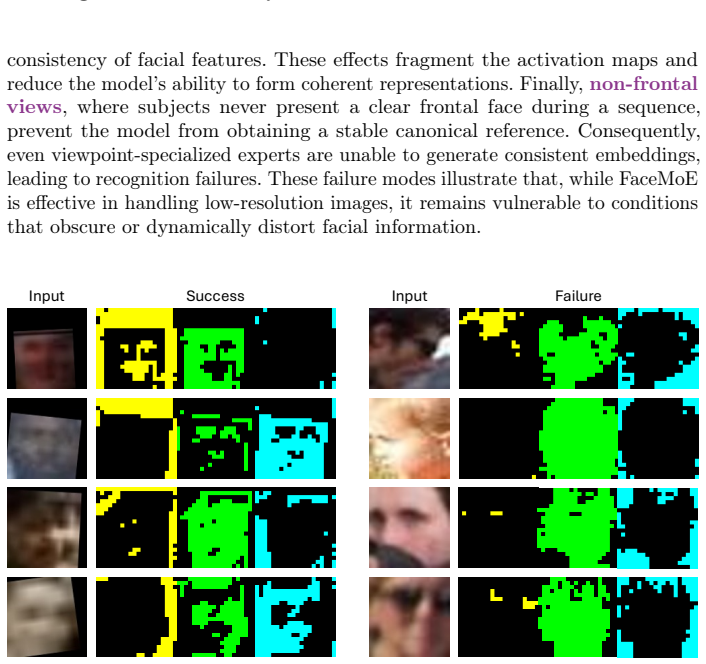
FaceMoE adapts the Mixture of Experts transformer by replacing standard feed-forward networks with multiple specialized FFN experts and adding a top-k router that dynamically assigns tokens to appropriate experts. This produces emergent specialization across semantic face regions and resolutions for resolution-aware feature extraction. The top-k router enables sparse activation that preserves pretrained knowledge during fine-tuning on low-resolution data. Training uses a combined face recognition loss, router z-loss, and load balancing loss to enforce specialization and stability. The result is the first application of MoE to low-resolution face recognition with gains across HR, mixed, and L
What carries the argument
The top-k router that dynamically assigns tokens to multiple specialized FFN experts inside the transformer blocks to induce resolution-aware specialization.
If this is right
- Sparse expert activation preserves pretrained high-resolution knowledge during adaptation to low-resolution data.
- Increased model capacity occurs without proportional computational overhead due to top-k routing.
- Emergent expert specialization supports better feature extraction under degradations such as blur and low contrast.
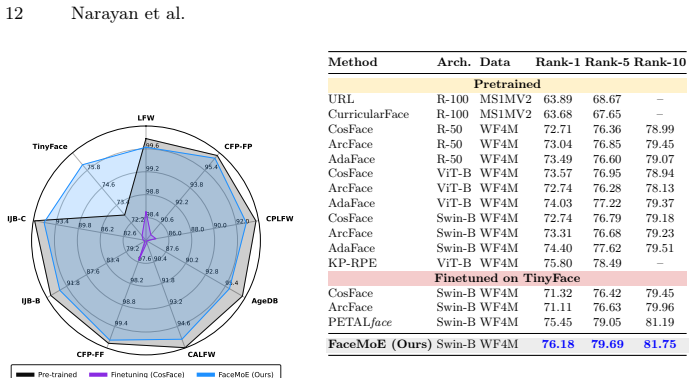
- Performance gains appear consistently across high-resolution, mixed-quality, and low-resolution face recognition benchmarks.
Where Pith is reading between the lines
- The same router-driven specialization pattern could apply to other vision tasks that involve domain shifts between training and test distributions.
- Inspecting activation patterns of individual experts on images of known resolutions might expose which face regions drive the resolution adaptation.
- The approach might combine with explicit resolution estimation modules to further guide routing in extremely variable quality settings.
Load-bearing premise
That the domain gap between high-resolution and low-resolution images plus catastrophic forgetting cannot be handled adequately by a single encoder and that the top-k router will produce reliable resolution-aware specialization without further regularization.
What would settle it
A controlled comparison where a single-encoder transformer is fine-tuned on the identical low-resolution datasets using the same combined losses and then evaluated on the eleven benchmarks; if it matches or exceeds FaceMoE accuracy, the necessity of the expert structure would be questioned.
Figures
read the original abstract
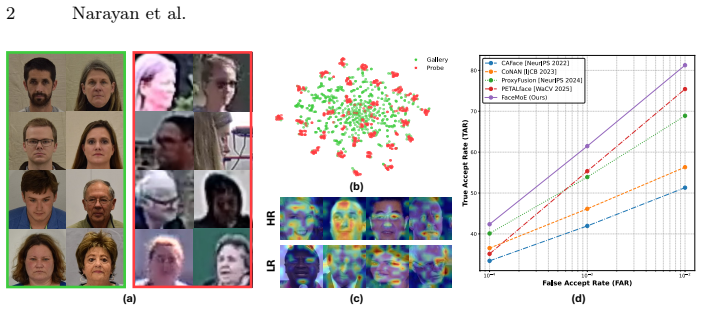
Low-resolution face recognition (LR-FR) remains a challenging task due to poor feature extraction and aggregation, as probe images often contain limited identity information resulting from extreme degradations such as blur, occlusion, and low contrast. Additionally, the domain gap between high-resolution (HR) gallery images and low-resolution (LR) probe images poses a significant challenge. A single feature encoder struggles to generalize effectively across both domains when fine-tuned on an LR dataset, and this issue is further magnified by catastrophic forgetting. To address these challenges, we propose FaceMoE, an effective adaptation of Mixture of Experts (MoE) transfomer architecture for low-resolution face-recognition . Specifically, we introduce multiple specialized feed-forward network (FFN) experts and incorporate a top-k router, which dynamically assigns tokens to appropriate experts. This design emergently promotes specialization across experts for different semantic regions of the face, which enables FaceMoE to perform resolution-aware feature extraction. Moreover, the top-k router facilitates sparse expert activation, enabling the model to preserve pretrained knowledge when finetuned on a LR dataset, while increasing model capacity without proportional computational overhead. FaceMoE is trained with a combined face recognition loss, router z-loss, and load balancing loss to ensure expert specialization and stable training. To the best of our knowledge, this is the first work leveraging MoE for LR-FR. Extensive experiments across eleven datasets, spanning HR, mixed-quality, and LR benchmarks, demonstrate that FaceMoE significantly outperforms state-of-the-art methods. Code: https://github.com/Kartik-3004/FaceMoE
Editorial analysis
A structured set of objections, weighed in public.
Referee Report
Summary. The paper proposes FaceMoE, a Mixture-of-Experts adaptation of a transformer for low-resolution face recognition. It replaces standard FFNs with multiple specialized experts routed by a top-k router, trained with a face-recognition loss plus router z-loss and load-balancing loss. The design is claimed to produce emergent resolution-aware specialization, preserve pretrained knowledge during LR fine-tuning, and avoid catastrophic forgetting. The central empirical claim is that FaceMoE significantly outperforms prior methods on eleven HR, mixed-quality, and LR face-recognition benchmarks; the work positions itself as the first application of MoE to LR-FR.
Significance. If the reported gains are reproducible and the ablations confirm that the MoE components are responsible, the result would be notable: it would demonstrate that sparse expert activation can simultaneously increase capacity and mitigate domain-gap/forgetting issues that plague single-encoder fine-tuning in LR-FR. The emergent-specialization observation, if substantiated, would also add to the growing literature on what MoE routers learn in vision tasks.
major comments (2)
- [Abstract] Abstract: the claim of significant outperformance on eleven datasets is presented without any quantitative tables, ablation results, error bars, dataset-split details, training protocols, or statistical testing. Because the central contribution is empirical, the absence of these elements in the manuscript text prevents verification of the reported gains and of the emergent-specialization hypothesis.
- The weakest assumption—that a single encoder cannot adequately handle the HR–LR domain gap and that top-k routing will reliably produce resolution-aware specialization without further regularization—is load-bearing for the motivation and for the interpretation of any performance delta. No section provides a controlled comparison (e.g., single-encoder baseline vs. MoE under identical fine-tuning) that isolates this effect.
minor comments (2)
- [Abstract] Abstract, line 3: “transfomer” should be “transformer”.
- [Abstract] Abstract: “finetuned” should be hyphenated as “fine-tuned” for consistency with standard usage.
Simulated Author's Rebuttal
We thank the referee for the constructive feedback. We address each major comment below, providing clarifications on the experimental evidence presented in the full manuscript and agreeing to targeted revisions that strengthen verifiability without altering the core claims.
read point-by-point responses
-
Referee: [Abstract] Abstract: the claim of significant outperformance on eleven datasets is presented without any quantitative tables, ablation results, error bars, dataset-split details, training protocols, or statistical testing. Because the central contribution is empirical, the absence of these elements in the manuscript text prevents verification of the reported gains and of the emergent-specialization hypothesis.
Authors: The abstract is kept concise per standard practice, but the full manuscript contains the requested elements: quantitative comparisons across eleven datasets in Tables 1–3, ablation studies isolating MoE components in Section 4.3, dataset splits and training protocols in Sections 3.2 and 4.1, and discussion of emergent specialization in Section 4.4. Error bars appear in several figures. To improve accessibility, we will revise the abstract to reference key quantitative gains and explicitly point to the ablation and specialization analyses. revision: yes
-
Referee: [—] The weakest assumption—that a single encoder cannot adequately handle the HR–LR domain gap and that top-k routing will reliably produce resolution-aware specialization without further regularization—is load-bearing for the motivation and for the interpretation of any performance delta. No section provides a controlled comparison (e.g., single-encoder baseline vs. MoE under identical fine-tuning) that isolates this effect.
Authors: The manuscript motivates the domain-gap issue from prior literature and provides indirect evidence via comparisons to single-encoder SOTA methods plus MoE ablations. A direct head-to-head single-encoder vs. FaceMoE experiment under identical fine-tuning is not currently present. We will add this controlled comparison in the revised version to isolate the contribution of the top-k routed experts. revision: yes
Circularity Check
No significant circularity
full rationale
The paper is an empirical architecture proposal (MoE adaptation with top-k router and specialized FFNs) whose central claim is outperformance on 11 datasets. No derivation chain, equations, or first-principles result is presented that reduces a prediction to a fitted input or self-citation by construction. The 'emergent specialization' is stated as an outcome of standard MoE components and is tested via ablation and benchmarks rather than assumed via internal definition. Self-citation is absent from the provided text, and the 'first work' claim is a novelty statement, not a load-bearing premise.
Axiom & Free-Parameter Ledger
free parameters (3)
- number of experts
- top-k value
- loss weighting coefficients for router z-loss and load balancing loss
axioms (2)
- domain assumption A single shared encoder cannot simultaneously generalize across HR and LR domains without catastrophic forgetting when fine-tuned on LR data.
- ad hoc to paper Top-k routing will produce emergent specialization across semantic face regions.
Reference graph
Works this paper leans on
-
[1]
In: Proceedings of the IEEE/CVF Conference on Computer Vision and Pattern Recognition
Chai, J.C.L., Ng, T.S., Low, C.Y., Park, J., Teoh, A.B.J.: Recognizability embed- ding enhancement for very low-resolution face recognition and quality estimation. In: Proceedings of the IEEE/CVF Conference on Computer Vision and Pattern Recognition. pp. 9957–9967 (2023)
2023
-
[2]
IEEE Signal Processing Letters (2025)
Chen, Q., Xu, Y., Mandelli, S., Li, S., Li, B.: Adaptive mixture of low-rank experts for robust audio spoofing detection. IEEE Signal Processing Letters (2025)
2025
-
[3]
In: Computer Vision– ACCV 2018: 14th Asian Conference on Computer Vision, Perth, Australia, De- cember 2–6, 2018, Revised Selected Papers, Part III 14
Cheng, Z., Zhu, X., Gong, S.: Low-resolution face recognition. In: Computer Vision– ACCV 2018: 14th Asian Conference on Computer Vision, Perth, Australia, De- cember 2–6, 2018, Revised Selected Papers, Part III 14. pp. 605–621. Springer (2019)
2018
-
[4]
In: Proceedings of the IEEE/CVF Winter Conference on Applications of Computer Vision
Cornett, D., Brogan, J., Barber, N., Aykac, D., Baird, S., Burchfield, N., Dukes, C., Duncan, A., Ferrell, R., Goddard, J., et al.: Expanding accurate person recognition to new altitudes and ranges: The briar dataset. In: Proceedings of the IEEE/CVF Winter Conference on Applications of Computer Vision. pp. 593–602 (2023)
2023
-
[5]
In: Proceedings of the IEEE/CVF conference on computer vision and pattern recognition
Deng, J., Guo, J., Xue, N., Zafeiriou, S.: Arcface: Additive angular margin loss for deep face recognition. In: Proceedings of the IEEE/CVF conference on computer vision and pattern recognition. pp. 4690–4699 (2019)
2019
-
[6]
Journal of Machine Learning Research 23(120), 1–39 (2022)
Fedus, W., Zoph, B., Shazeer, N.: Switch transformers: Scaling to trillion parameter models with simple and efficient sparsity. Journal of Machine Learning Research 23(120), 1–39 (2022)
2022
-
[7]
In: Proceedings of the AAAI conference on artificial intelligence
Ge, S., Zhang, K., Liu, H., Hua, Y., Zhao, S., Jin, X., Wen, H.: Look one and more: Distilling hybrid order relational knowledge for cross-resolution image recognition. In: Proceedings of the AAAI conference on artificial intelligence. vol. 34, pp. 10845– 10852 (2020)
2020
-
[8]
IEEE Transactions on Image Processing28(4), 2051–2062 (2018)
Ge, S., Zhao, S., Li, C., Li, J.: Low-resolution face recognition in the wild via selective knowledge distillation. IEEE Transactions on Image Processing28(4), 2051–2062 (2018)
2051
-
[9]
arXiv preprint arXiv:2410.15732 (2024)
Han, X., Wei, L., Dou, Z., Wang, Z., Qiang, C., He, X., Sun, Y., Han, Z., Tian, Q.: Vimoe: An empirical study of designing vision mixture-of-experts. arXiv preprint arXiv:2410.15732 (2024)
-
[10]
Gaussian Error Linear Units (GELUs)
Hendrycks, D., Gimpel, K.: Gaussian error linear units (gelus). arXiv preprint arXiv:1606.08415 (2016)
work page internal anchor Pith review Pith/arXiv arXiv 2016
-
[11]
IEEE Access12, 37288–37309 (2024) 16 Narayan et al
Hidayat, F., Elviani, U., Situmorang, G.B.G., Ramadhan, M.Z., Alunjati, F.A., Sucipto, R.F.: Face recognition for automatic border control: a systematic literature review. IEEE Access12, 37288–37309 (2024) 16 Narayan et al
2024
-
[12]
IEEE Transactions on Image Processing28(12), 6225–6236 (2019)
Hsu, C.C., Lin, C.W., Su, W.T., Cheung, G.: Sigan: Siamese generative adversarial network for identity-preserving face hallucination. IEEE Transactions on Image Processing28(12), 6225–6236 (2019)
2019
-
[13]
In: Workshop on faces in’Real-Life’Images: detection, alignment, and recognition (2008)
Huang, G.B., Mattar, M., Berg, T., Learned-Miller, E.: Labeled faces in the wild: A database forstudying face recognition in unconstrained environments. In: Workshop on faces in’Real-Life’Images: detection, alignment, and recognition (2008)
2008
-
[14]
In: Computer Vision–ECCV 2020: 16th European Conference, Glasgow, UK, August 23–28, 2020, Proceedings, Part XXX 16
Huang, Y., Shen, P., Tai, Y., Li, S., Liu, X., Li, J., Huang, F., Ji, R.: Improving face recognition from hard samples via distribution distillation loss. In: Computer Vision–ECCV 2020: 16th European Conference, Glasgow, UK, August 23–28, 2020, Proceedings, Part XXX 16. pp. 138–154. Springer (2020)
2020
-
[15]
In: proceedings of the IEEE/CVF conference on computer vision and pattern recognition
Huang, Y., Wang, Y., Tai, Y., Liu, X., Shen, P., Li, S., Li, J., Huang, F.: Curricu- larface: adaptive curriculum learning loss for deep face recognition. In: proceedings of the IEEE/CVF conference on computer vision and pattern recognition. pp. 5901–5910 (2020)
2020
-
[16]
Neural computation3(1), 79–87 (1991)
Jacobs, R.A., Jordan, M.I., Nowlan, S.J., Hinton, G.E.: Adaptive mixtures of local experts. Neural computation3(1), 79–87 (1991)
1991
-
[17]
Advances in Neural Information Processing Systems36, 69625–69637 (2023)
Jain, Y., Behl, H., Kira, Z., Vineet, V.: Damex: Dataset-aware mixture-of-experts for visual understanding of mixture-of-datasets. Advances in Neural Information Processing Systems36, 69625–69637 (2023)
2023
-
[18]
IEEE Transactions on Biometrics, Behavior, and Identity Science (2024)
Jawade, B., Mohan, D.D., Shetty, P., Fedorishin, D., Setlur, S., Govindaraju, V.: Conan: Conditional neural aggregation network for unconstrained long range biometric feature fusion. IEEE Transactions on Biometrics, Behavior, and Identity Science (2024)
2024
-
[19]
Advances in Neural Information Processing Systems37, 70130–70147 (2024)
Jawade, B., Stone, A., Mohan, D.D., Wang, X., Setlur, S., Govindaraju, V.: Prox- yfusion: Face feature aggregation through sparse experts. Advances in Neural Information Processing Systems37, 70130–70147 (2024)
2024
-
[20]
Deep CNN Denoiser and Multi-layer Neighbor Component Embedding for Face Hallucination
Jiang,J.,Yu,Y.,Hu,J.,Tang,S.,Ma,J.:Deepcnndenoiserandmulti-layerneighbor component embedding for face hallucination. arXiv preprint arXiv:1806.10726 (2018)
work page internal anchor Pith review Pith/arXiv arXiv 2018
-
[21]
ACM Transactions on Graphics (TOG)41(4), 1–11 (2022)
Jiang, Y., Yang, S., Qiu, H., Wu, W., Loy, C.C., Liu, Z.: Text2human: Text-driven controllable human image generation. ACM Transactions on Graphics (TOG)41(4), 1–11 (2022)
2022
-
[22]
In: 2018 IEEE 9th international conference on biometrics theory, applications and systems (BTAS)
Kalka, N.D., Maze, B., Duncan, J.A., O’Connor, K., Elliott, S., Hebert, K., Bryan, J., Jain, A.K.: Ijb–s: Iarpa janus surveillance video benchmark. In: 2018 IEEE 9th international conference on biometrics theory, applications and systems (BTAS). pp. 1–9. IEEE (2018)
2018
-
[23]
In: Proceedings of the IEEE/CVF conference on computer vision and pattern recognition
Kim, M., Jain, A.K., Liu, X.: Adaface: Quality adaptive margin for face recognition. In: Proceedings of the IEEE/CVF conference on computer vision and pattern recognition. pp. 18750–18759 (2022)
2022
-
[24]
Advances in Neural Information Processing Systems35, 36054–36066 (2022)
Kim, M., Liu, F., Jain, A.K., Liu, X.: Cluster and aggregate: Face recognition with large probe set. Advances in Neural Information Processing Systems35, 36054–36066 (2022)
2022
-
[25]
arXiv preprint arXiv:2404.08452 (2024)
Kong, C., Luo, A., Bao, P., Yu, Y., Li, H., Zheng, Z., Wang, S., Kot, A.C.: Moe-ffd: Mixture of experts for generalized and parameter-efficient face forgery detection. arXiv preprint arXiv:2404.08452 (2024)
-
[26]
IEEE Transactions on Dependable and Secure Computing (2025)
Kong, C., Luo, A., Bao, P., Yu, Y., Li, H., Zheng, Z., Wang, S., Kot, A.C.: Moe-ffd: Mixture of experts for generalized and parameter-efficient face forgery detection. IEEE Transactions on Dependable and Secure Computing (2025)
2025
-
[27]
GShard: Scaling Giant Models with Conditional Computation and Automatic Sharding
Lepikhin, D., Lee, H., Xu, Y., Chen, D., Firat, O., Huang, Y., Krikun, M., Shazeer, N., Chen, Z.: Gshard: Scaling giant models with conditional computation and automatic sharding. arXiv preprint arXiv:2006.16668 (2020) FaceMoE 17
work page internal anchor Pith review Pith/arXiv arXiv 2006
-
[28]
IEEE Transactions on Information Forensics and Security14(8), 2000–2012 (2019)
Li, P., Prieto, L., Mery, D., Flynn, P.J.: On low-resolution face recognition in the wild: Comparisons and new techniques. IEEE Transactions on Information Forensics and Security14(8), 2000–2012 (2019)
2000
-
[29]
IEEE transactions on pattern analysis and machine intelligence40(12), 2935–2947 (2017)
Li, Z., Hoiem, D.: Learning without forgetting. IEEE transactions on pattern analysis and machine intelligence40(12), 2935–2947 (2017)
2017
-
[30]
Lin, M., Chen, Q., Yan, S.: Network in network. arXiv preprint arXiv:1312.4400 (2013)
work page internal anchor Pith review Pith/arXiv arXiv 2013
-
[31]
In: Proceedings of the IEEE conference on computer vision and pattern recognition
Liu, W., Wen, Y., Yu, Z., Li, M., Raj, B., Song, L.: Sphereface: Deep hypersphere embedding for face recognition. In: Proceedings of the IEEE conference on computer vision and pattern recognition. pp. 212–220 (2017)
2017
-
[32]
IEEE Transactions on Information Forensics and Security17, 3062–3076 (2022)
Low, C.Y., Teoh, A.B.J.: An implicit identity-extended data augmentation for low-resolution face representation learning. IEEE Transactions on Information Forensics and Security17, 3062–3076 (2022)
2022
-
[33]
IEEE Signal Processing Letters 28, 354–358 (2021)
Low, C.Y., Teoh, A.B.J., Park, J.: Mind-net: A deep mutual information distillation network for realistic low-resolution face recognition. IEEE Signal Processing Letters 28, 354–358 (2021)
2021
-
[34]
Image and Vision Computing99, 103927 (2020)
Massoli, F.V., Amato, G., Falchi, F.: Cross-resolution learning for face recognition. Image and Vision Computing99, 103927 (2020)
2020
-
[35]
In: 2018 international conference on biometrics (ICB)
Maze, B., Adams, J., Duncan, J.A., Kalka, N., Miller, T., Otto, C., Jain, A.K., Niggel, W.T., Anderson, J., Cheney, J., et al.: Iarpa janus benchmark-c: Face dataset and protocol. In: 2018 international conference on biometrics (ICB). pp. 158–165. IEEE (2018)
2018
-
[36]
In: proceedings of the IEEE conference on computer vision and pattern recognition workshops
Moschoglou, S., Papaioannou, A., Sagonas, C., Deng, J., Kotsia, I., Zafeiriou, S.: Agedb: the first manually collected, in-the-wild age database. In: proceedings of the IEEE conference on computer vision and pattern recognition workshops. pp. 51–59 (2017)
2017
-
[37]
In: 2025 IEEE 19th International Conference on Automatic Face and Gesture Recognition (FG)
Nair, N.G., Narayan, K., Suin, M., Kathirvel, R.P., Xu, J., Stevens, S., Gleason, J., Shnidman, N., Chellappa, R., Patel, V.: Improved representation learning for unconstrained face recognition. In: 2025 IEEE 19th International Conference on Automatic Face and Gesture Recognition (FG). pp. 1–10. IEEE (2025)
2025
-
[38]
In: Proceedings of the IEEE/CVF conference on computer vision and pattern recognition
Narayan, K., Agarwal, H., Mittal, S., Thakral, K., Kundu, S., Vatsa, M., Singh, R.: Desi: Deepfake source identifier for social media. In: Proceedings of the IEEE/CVF conference on computer vision and pattern recognition. pp. 2858–2867 (2022)
2022
-
[39]
In: 2022 IEEE International Joint Conference on Biometrics (IJCB)
Narayan, K., Agarwal, H., Thakral, K., Mittal, S., Vatsa, M., Singh, R.: Deephy: On deepfake phylogeny. In: 2022 IEEE International Joint Conference on Biometrics (IJCB). pp. 1–10. IEEE (2022)
2022
-
[40]
In: Proceedings of the IEEE/CVF Conference on Computer Vision and Pattern Recognition
Narayan, K., Agarwal, H., Thakral, K., Mittal, S., Vatsa, M., Singh, R.: Df-platter: Multi-face heterogeneous deepfake dataset. In: Proceedings of the IEEE/CVF Conference on Computer Vision and Pattern Recognition. pp. 9739–9748 (2023)
2023
-
[41]
In: 2025 IEEE/CVF Winter Conference on Applications of Computer Vision (WACV)
Narayan, K., Nair, N.G., Xu, J., Chellappa, R., Patel, V.M.: Petalface: Parameter efficient transfer learning for low-resolution face recognition. In: 2025 IEEE/CVF Winter Conference on Applications of Computer Vision (WACV). pp. 804–814. IEEE (2025)
2025
-
[42]
In: 2024 IEEE 18th International Conference on Automatic Face and Gesture Recognition (FG)
Narayan, K., Patel, V.M.: Hyp-oc: Hyperbolic one class classification for face anti- spoofing. In: 2024 IEEE 18th International Conference on Automatic Face and Gesture Recognition (FG). pp. 1–10. IEEE (2024)
2024
-
[43]
IEEE Transactions on Biometrics, Behavior, and Identity Science (2026)
Narayan, K., Vibashan, V., Patel, V.M.: Facexbench: Evaluating multimodal llms on face understanding. IEEE Transactions on Biometrics, Behavior, and Identity Science (2026)
2026
-
[44]
arXiv preprint arXiv:2403.12960 (2024) 18 Narayan et al
Narayan, K., VS, V., Chellappa, R., Patel, V.M.: Facexformer: A unified transformer for facial analysis. arXiv preprint arXiv:2403.12960 (2024) 18 Narayan et al
-
[45]
In: Proceedings of the AAAI Conference on Artificial Intelligence
Narayan, K., Vs, V., Patel, V.M.: Segface: Face segmentation of long-tail classes. In: Proceedings of the AAAI Conference on Artificial Intelligence. vol. 39, pp. 6182–6190 (2025)
2025
-
[46]
arXiv preprint arXiv:2309.14976 (2023)
Oksuz, K., Kuzucu, S., Joy, T., Dokania, P.K.: Mocae: Mixture of calibrated experts significantly improves object detection. arXiv preprint arXiv:2309.14976 (2023)
-
[47]
MEGAN: Mixture of Experts of Generative Adversarial Networks for Multimodal Image Generation
Park, D.K., Yoo, S., Bahng, H., Choo, J., Park, N.: Megan: Mixture of experts of generative adversarial networks for multimodal image generation. arXiv preprint arXiv:1805.02481 (2018)
work page internal anchor Pith review Pith/arXiv arXiv 2018
-
[48]
arXiv preprint arXiv:2308.00951 (2023)
Puigcerver, J., Riquelme, C., Mustafa, B., Houlsby, N.: From sparse to soft mixtures of experts. arXiv preprint arXiv:2308.00951 (2023)
-
[49]
Advances in Neural Information Processing Systems34, 8583–8595 (2021)
Riquelme, C., Puigcerver, J., Mustafa, B., Neumann, M., Jenatton, R., Susano Pinto, A., Keysers, D., Houlsby, N.: Scaling vision with sparse mixture of experts. Advances in Neural Information Processing Systems34, 8583–8595 (2021)
2021
-
[50]
IET Image Processing19(1), e13303 (2025)
Rossi, L., Bernuzzi, V., Fontanini, T., Bertozzi, M., Prati, A.: Swin2-mose: A new single image supersolution model for remote sensing. IET Image Processing19(1), e13303 (2025)
2025
-
[51]
In: 2025 International Conference on Machine Learning and Autonomous Systems (ICMLAS)
Roy, M., Datta, S., Khan, M., Paroi, M., Hasan, M.M.: Ai-powered face authentica- tion system for web and native apps. In: 2025 International Conference on Machine Learning and Autonomous Systems (ICMLAS). pp. 1406–1412. IEEE (2025)
2025
-
[52]
arXiv preprint arXiv:2401.10191 (2024)
Rypeść, G., Cygert, S., Khan, V., Trzciński, T., Zieliński, B., Twardowski, B.: Divide and not forget: Ensemble of selectively trained experts in continual learning. arXiv preprint arXiv:2401.10191 (2024)
-
[53]
In: IEEE Conference on Applications of Computer Vision (February 2016)
Sengupta, S., Cheng, J., Castillo, C., Patel, V., Chellappa, R., Jacobs, D.: Frontal to profile face verification in the wild. In: IEEE Conference on Applications of Computer Vision (February 2016)
2016
-
[54]
Outrageously Large Neural Networks: The Sparsely-Gated Mixture-of-Experts Layer
Shazeer, N., Mirhoseini, A., Maziarz, K., Davis, A., Le, Q., Hinton, G., Dean, J.: Outrageously large neural networks: The sparsely-gated mixture-of-experts layer. arXiv preprint arXiv:1701.06538 (2017)
work page internal anchor Pith review Pith/arXiv arXiv 2017
-
[55]
IEEE Transactions on Pattern Analysis and Machine Intelligence 44(10), 6569–6577 (2021)
Singh, M., Nagpal, S., Singh, R., Vatsa, M.: Derivenet for (very) low resolution image classification. IEEE Transactions on Pattern Analysis and Machine Intelligence 44(10), 6569–6577 (2021)
2021
-
[56]
In: Proceedings of the IEEE conference on computer vision and pattern recognition workshops
Singh, M., Nagpal, S., Vatsa, M., Singh, R., Majumdar, A.: Identity aware synthesis for cross resolution face recognition. In: Proceedings of the IEEE conference on computer vision and pattern recognition workshops. pp. 479–488 (2018)
2018
-
[57]
IEEE Transactions on Biometrics, Behavior, and Identity Science7(1), 132–145 (2024)
Thakral, K., Agarwal, H., Narayan, K., Mittal, S., Vatsa, M., Singh, R.: Deep- hynet: Toward detecting phylogeny in deepfakes. IEEE Transactions on Biometrics, Behavior, and Identity Science7(1), 132–145 (2024)
2024
-
[58]
In: 2026 IEEE 20th International Conference on Automatic Face and Gesture Recognition (FG)
Tu, A., Narayan, K., Gleason, J., Xu, J., Meyn, M., Goldstein, T., Patel, V.M.: Transfira: Transfer learning for face image recognizability assessment. In: 2026 IEEE 20th International Conference on Automatic Face and Gesture Recognition (FG). pp. 1–9. IEEE (2026)
2026
-
[59]
Advances in neural information processing systems30(2017)
Vaswani, A., Shazeer, N., Parmar, N., Uszkoreit, J., Jones, L., Gomez, A.N., Kaiser, Ł., Polosukhin, I.: Attention is all you need. Advances in neural information processing systems30(2017)
2017
-
[60]
In: Modern Approaches in Machine Learning and Cognitive Science: A Walkthrough: Latest Trends in AI, Volume 2, pp
Vishnuvardhan, G., Ravi, V.: Face recognition using transfer learning on facenet: application to banking operations. In: Modern Approaches in Machine Learning and Cognitive Science: A Walkthrough: Latest Trends in AI, Volume 2, pp. 301–309. Springer (2021)
2021
-
[61]
In: Proceedings of the IEEE conference on computer vision and pattern recognition
Wang, H., Wang, Y., Zhou, Z., Ji, X., Gong, D., Zhou, J., Li, Z., Liu, W.: Cosface: Large margin cosine loss for deep face recognition. In: Proceedings of the IEEE conference on computer vision and pattern recognition. pp. 5265–5274 (2018) FaceMoE 19
2018
-
[62]
In: Uncertainty in artificial intelligence
Wang, X., Yu, F., Dunlap, L., Ma, Y.A., Wang, R., Mirhoseini, A., Darrell, T., Gonzalez, J.E.: Deep mixture of experts via shallow embedding. In: Uncertainty in artificial intelligence. pp. 552–562. PMLR (2020)
2020
-
[63]
In: Computer vision–ECCV 2016: 14th European conference, amsterdam, the netherlands, October 11–14, 2016, proceedings, part VII 14
Wen, Y., Zhang, K., Li, Z., Qiao, Y.: A discriminative feature learning approach for deep face recognition. In: Computer vision–ECCV 2016: 14th European conference, amsterdam, the netherlands, October 11–14, 2016, proceedings, part VII 14. pp. 499–515. Springer (2016)
2016
-
[64]
In: proceedings of the IEEE conference on computer vision and pattern recognition workshops
Whitelam, C., Taborsky, E., Blanton, A., Maze, B., Adams, J., Miller, T., Kalka, N., Jain, A.K., Duncan, J.A., Allen, K., et al.: Iarpa janus benchmark-b face dataset. In: proceedings of the IEEE conference on computer vision and pattern recognition workshops. pp. 90–98 (2017)
2017
-
[65]
Multicolumn Networks for Face Recognition
Xie, W., Zisserman, A.: Multicolumn networks for face recognition. arXiv preprint arXiv:1807.09192 (2018)
work page internal anchor Pith review Pith/arXiv arXiv 2018
-
[66]
Advances in Neural Information Processing Systems36, 41693–41706 (2023)
Xue, Z., Song, G., Guo, Q., Liu, B., Zong, Z., Liu, Y., Luo, P.: Raphael: Text- to-image generation via large mixture of diffusion paths. Advances in Neural Information Processing Systems36, 41693–41706 (2023)
2023
-
[67]
In: Proceedings of the IEEE conference on computer vision and pattern recognition
Yang, J., Ren, P., Zhang, D., Chen, D., Wen, F., Li, H., Hua, G.: Neural aggregation network for video face recognition. In: Proceedings of the IEEE conference on computer vision and pattern recognition. pp. 4362–4371 (2017)
2017
-
[68]
In: Proceedings of the Asian Conference on Computer Vision (2020)
Yin, X., Tai, Y., Huang, Y., Liu, X.: Fan: Feature adaptation network for surveillance face recognition and normalization. In: Proceedings of the Asian Conference on Computer Vision (2020)
2020
-
[69]
In: Proceedings of the IEEE conference on computer vision and pattern recognition
Yu, X., Fernando, B., Hartley, R., Porikli, F.: Super-resolving very low-resolution face images with supplementary attributes. In: Proceedings of the IEEE conference on computer vision and pattern recognition. pp. 908–917 (2018)
2018
-
[70]
Signal processing128, 389–408 (2016)
Yue, L., Shen, H., Li, J., Yuan, Q., Zhang, H., Zhang, L.: Image super-resolution: The techniques, applications, and future. Signal processing128, 389–408 (2016)
2016
-
[71]
arXiv preprint arXiv:2409.19291 (2024)
Zhang, J., Qu, X., Zhu, T., Cheng, Y.: Clip-moe: Towards building mixture of experts for clip with diversified multiplet upcycling. arXiv preprint arXiv:2409.19291 (2024)
-
[72]
In: Proceedings of the European conference on computer vision (ECCV)
Zhang, K., Zhang, Z., Cheng, C.W., Hsu, W.H., Qiao, Y., Liu, W., Zhang, T.: Super-identity convolutional neural network for face hallucination. In: Proceedings of the European conference on computer vision (ECCV). pp. 183–198 (2018)
2018
-
[73]
Beijing University of Posts and Telecom- munications, Tech
Zheng, T., Deng, W.: Cross-pose lfw: A database for studying cross-pose face recognition in unconstrained environments. Beijing University of Posts and Telecom- munications, Tech. Rep5(7), 5 (2018)
2018
-
[74]
Cross-Age LFW: A Database for Studying Cross-Age Face Recognition in Unconstrained Environments
Zheng, T., Deng, W., Hu, J.: Cross-age lfw: A database for studying cross-age face recognition in unconstrained environments. arXiv preprint arXiv:1708.08197 (2017)
work page internal anchor Pith review Pith/arXiv arXiv 2017
-
[75]
In: Proceedings of the 30th ACM international conference on multimedia
Zhou, Q., Zhang, K.Y., Yao, T., Yi, R., Ding, S., Ma, L.: Adaptive mixture of experts learning for generalizable face anti-spoofing. In: Proceedings of the 30th ACM international conference on multimedia. pp. 6009–6018 (2022)
2022
-
[76]
In: ICASSP 2019-2019 IEEE International Conference on Acoustics, Speech and Signal Processing (ICASSP)
Zhu, M., Han, K., Zhang, C., Lin, J., Wang, Y.: Low-resolution visual recognition via deep feature distillation. In: ICASSP 2019-2019 IEEE International Conference on Acoustics, Speech and Signal Processing (ICASSP). pp. 3762–3766. IEEE (2019)
2019
-
[77]
In: Proceedings of the IEEE/CVF Conference on Computer Vision and Pattern Recognition
Zhu, Z., Huang, G., Deng, J., Ye, Y., Huang, J., Chen, X., Zhu, J., Yang, T., Lu, J., Du, D., et al.: Webface260m: A benchmark unveiling the power of million-scale deep face recognition. In: Proceedings of the IEEE/CVF Conference on Computer Vision and Pattern Recognition. pp. 10492–10502 (2021) 20 Narayan et al. Appendix –Related Work: MoE in Face Analys...
2021
-
[78]
As shown in Table 8.13, the routing distribution across the three experts remains highly stable: 30 Narayan et al
Routing is Stable Across PerturbationsTo assess stability, we measure token-to-expert assignments under several common perturbations (FGSM, PGD, MIM). As shown in Table 8.13, the routing distribution across the three experts remains highly stable: 30 Narayan et al. Attack Rank-1 Rank-5 Rank-20 Expert 0 Expert 1 Expert 2 FGSM 74.88 79.09 81.63 33.2 33.5 33...
-
[79]
Controlled Expert Ablations Reveal Causal Contribution of SpecializationTo evaluate whether FaceMoE’s performance stems from learned specialization rather than increased parameters, we run two sets of interventions as shown in Table 8.14: (a) Dropping Individual Experts Removing any one expert while keeping model capacity nearly unchanged produces only a ...
discussion (0)
Sign in with ORCID, Apple, or X to comment. Anyone can read and Pith papers without signing in.