A Filtered Mixture-of-Generators for Fully Synthetic Survival Training
Pith reviewed 2026-07-02 19:53 UTC · model grok-4.3
The pith
Filtering samples from a mixture of tabular generators using scores from a real-data survival ensemble produces synthetic training sets that match or exceed real clinical data for downstream survival models.
A machine-rendered reading of the paper's core claim, the machinery that carries it, and where it could break.
Core claim
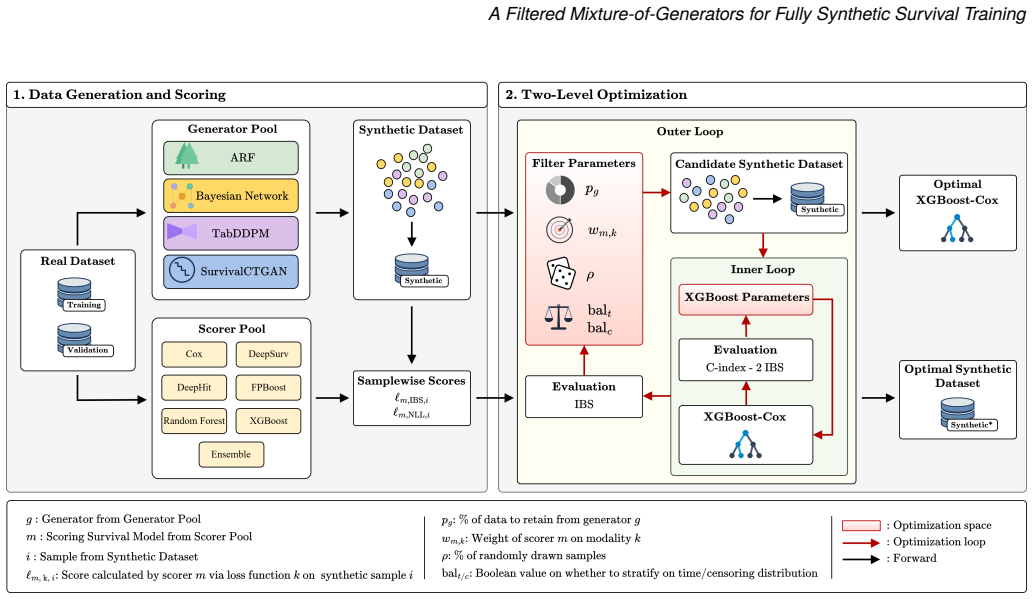
FoGS reframes synthetic-data construction as sample selection rather than generation. A candidate pool is drawn from four architecturally distinct tabular generators, and each sample is scored by an ensemble of seven survival models trained on real data, using proper scoring rules as a per-sample plausibility proxy. A two-level pipeline optimizes, in its outer loop, a selection policy -- generator quotas, scorer weights, a random complement, and stratified balancing on event time and censoring -- against held-out downstream performance, while an inner loop tunes the downstream model (XGBoost-Cox). On 16 public datasets under train-on-synthetic, test-on-real (C-index and IBS, 0--100 scale), F
What carries the argument
The two-level optimization pipeline that selects and balances samples from a heterogeneous generator pool using per-sample plausibility scores supplied by a real-data survival-model ensemble.
Load-bearing premise
An ensemble of survival models trained on the real data supplies an unbiased per-sample plausibility proxy that generalizes to held-out test distributions without introducing selection bias that favors the downstream model architecture.
What would settle it
A new clinical cohort where models trained on the filtered synthetic data show statistically lower C-index or higher IBS than models trained on the real data, or where nearest-neighbour privacy distance drops below the unfiltered baseline.
Figures



read the original abstract
Survival analysis models time-to-event data, but in clinical settings training data are costly and scarce: events accrue over years of follow-up, cohorts are small, and privacy regulations restrict sharing across institutions. Tabular generative models promise augmentation and privacy-preserving cohort sharing, yet are themselves data-hungry -- on the small cohorts typical of survival analysis, a single generator rarely characterizes the population well enough for downstream models trained on its output to match real-data performance. FoGS (Filtered Mixture-of-Generators for Survival analysis) reframes synthetic-data construction as sample selection rather than generation. A candidate pool is drawn from four architecturally distinct tabular generators, and each sample is scored by an ensemble of seven survival models trained on real data, using proper scoring rules as a per-sample plausibility proxy. A two-level pipeline optimizes, in its outer loop, a selection policy -- generator quotas, scorer weights, a random complement, and stratified balancing on event time and censoring -- against held-out downstream performance, while an inner loop tunes the downstream model (XGBoost-Cox). On 16 public datasets under train-on-synthetic, test-on-real (C-index and IBS, $0$--$100$ scale), FoGS yields mean improvements of $+2.17$ in C-index and $+0.67$ in IBS, improving both metrics on 9 of 16 datasets and at least one on 13 (one-sided Wilcoxon $p=0.039$ and $p=0.035$). It matches or exceeds real-data training on most cohorts, with no significant change in nearest-neighbour privacy margin relative to unfiltered sampling. Sample filtering over a heterogeneous generator pool is thus a viable substitute for real-data training in privacy-restricted clinical settings.
Editorial analysis
A structured set of objections, weighed in public.
Referee Report
Summary. The manuscript presents FoGS, which constructs synthetic survival data by sampling from four tabular generators, scoring candidates with an ensemble of seven survival models via proper scoring rules, and optimizing (outer loop) generator quotas, scorer weights, random complement, and stratified balancing on event/censoring to maximize held-out XGBoost-Cox performance, while an inner loop tunes the downstream model. On 16 public datasets under train-on-synthetic/test-on-real (C-index and IBS scaled 0-100), it reports mean gains of +2.17 C-index and +0.67 IBS, with both metrics improved on 9/16 datasets and at least one on 13/16 (one-sided Wilcoxon p=0.039, 0.035), matching or exceeding real-data training on most cohorts and no significant privacy degradation.
Significance. If the outer-loop optimization can be shown to produce a selection policy that is not overfit to XGBoost-Cox biases, the multi-generator filtering approach would offer a practical route to privacy-preserving synthetic cohorts that rival real-data performance in survival tasks. The use of proper scoring rules for per-sample plausibility and the scale of the empirical evaluation across 16 datasets are strengths that would support broader adoption in clinical settings if the central methodological concern is addressed.
major comments (2)
- [§4 (outer-loop optimization)] §4 (outer-loop optimization): The selection policy is tuned explicitly against held-out XGBoost-Cox performance. This creates a risk that the reported gains (+2.17 C-index, +0.67 IBS) reflect selection tuned to that model's inductive biases rather than an architecture-agnostic plausibility filter. The manuscript must specify the exact nested CV structure ensuring optimization folds are disjoint from final test folds and should report results with at least one additional downstream model (e.g., CoxPH or RSF) to test generalizability.
- [Results section (Table 2 or equivalent)] Results section (Table 2 or equivalent): The headline Wilcoxon tests and 'matches or exceeds real-data training' claim are computed after policy optimization for XGBoost-Cox. Without an ablation showing that the ensemble-derived scores alone (without outer-loop tuning) produce comparable gains, the central claim that FoGS is a 'viable substitute' for real data rests on a potentially circular selection process.
minor comments (2)
- [Abstract] Abstract: C-index and IBS are reported on a 0-100 scale; standard definitions use 0-1, so the scaling factor should be stated explicitly for readers.
- [§3.1 (generators and ensemble)] §3.1 (generators and ensemble): The choice of the four generators and seven scorers, along with any hyperparameter settings, should be listed in a table for full reproducibility.
Simulated Author's Rebuttal
We thank the referee for the constructive comments, which highlight important considerations for the robustness of our evaluation. We address each major point below and commit to revisions that strengthen the manuscript.
read point-by-point responses
-
Referee: §4 (outer-loop optimization): The selection policy is tuned explicitly against held-out XGBoost-Cox performance. This creates a risk that the reported gains (+2.17 C-index, +0.67 IBS) reflect selection tuned to that model's inductive biases rather than an architecture-agnostic plausibility filter. The manuscript must specify the exact nested CV structure ensuring optimization folds are disjoint from final test folds and should report results with at least one additional downstream model (e.g., CoxPH or RSF) to test generalizability.
Authors: We agree that explicit description of the nested CV is necessary to confirm disjoint folds. The outer optimization loop operates on folds separate from the final test set, with the inner loop performing downstream model tuning only within the optimization folds; we will add a precise description of this structure (including fold counts and disjointness) to §4. To address generalizability beyond XGBoost-Cox, we will also report results using CoxPH as an additional downstream model in the revised results section. revision: yes
-
Referee: Results section (Table 2 or equivalent): The headline Wilcoxon tests and 'matches or exceeds real-data training' claim are computed after policy optimization for XGBoost-Cox. Without an ablation showing that the ensemble-derived scores alone (without outer-loop tuning) produce comparable gains, the central claim that FoGS is a 'viable substitute' for real data rests on a potentially circular selection process.
Authors: The outer loop is designed to optimize the selection policy parameters using the ensemble scores as the core plausibility signal. We recognize the benefit of an ablation to isolate components. In the revision we will add results comparing (i) unfiltered baselines, (ii) ensemble-score filtering with fixed (non-optimized) policy, and (iii) the full optimized FoGS, allowing readers to assess the contribution of the outer-loop tuning separately from the ensemble filtering itself. revision: yes
Circularity Check
No reduction of reported metrics to fitted selection parameters by construction
full rationale
The central claims consist of empirical C-index and IBS improvements measured on held-out real test data after training downstream models on the filtered synthetic samples. The outer-loop optimization tunes generator quotas, scorer weights and balancing against held-out performance, yet the published test-set numbers are not algebraically or statistically defined in terms of those fitted parameters; they remain independent external benchmarks. No self-definitional equations, fitted-input-called-prediction steps, or load-bearing self-citations appear in the abstract or described pipeline. This places the work in the normal non-circular range (0-2).
Axiom & Free-Parameter Ledger
free parameters (3)
- generator quotas
- scorer weights
- stratification bins
axioms (1)
- domain assumption Proper scoring rules applied to survival models trained on real data yield a monotonic proxy for sample plausibility that transfers to held-out distributions.
Reference graph
Works this paper leans on
-
[1]
Optuna: A next-generation hyperparameter optimization frame- work
Takuya Akiba, Shotaro Sano, Toshihiko Yanase, Takeru Ohta, and Masanori Koyama. Optuna: A next-generation hyperparameter optimization frame- work. InProceedings of the 25th ACM SIGKDD international conference on knowledge discovery & data mining, pages 2623–2631, 2019
work page 2019
-
[2]
Haleh Akrami, Sergul Aydore, Richard M Leahy, and Anand A Joshi. Robust variational autoencoder for tabular data with beta divergence.arXiv preprint arXiv:2006.08204, 2020
-
[3]
pgmpy: Apython toolkit for bayesian networks.Journal of Machine Learning Research, 25(265):1–8, 2024
AnkurAnkanandJohannesTextor. pgmpy: Apython toolkit for bayesian networks.Journal of Machine Learning Research, 25(265):1–8, 2024
work page 2024
-
[4]
Alberto Archetti, Eugenio Lomurno, Diego Piccinotti, and Matteo Matteucci. Fpboost: Fully parametric gradient boosting for survival analysis.arXiv preprint arXiv:2409.13363, 2024
-
[5]
Xgboost: A scal- able tree boosting system
Tianqi Chen and Carlos Guestrin. Xgboost: A scal- able tree boosting system. InProceedings of the 22nd acm sigkdd international conference on knowl- edge discovery and data mining, pages 785–794, 2016
work page 2016
-
[6]
D. R. Cox. Regression models and life-tables.Jour- nal of the Royal Statistical Society. Series B (Method- ological), 34(2):187–220, 1972. ISSN 00359246
work page 1972
-
[7]
Neural spline flows.Ad- vances in neural information processing systems, 32, 2019
Conor Durkan, Artur Bekasov, Iain Murray, and George Papamakarios. Neural spline flows.Ad- vances in neural information processing systems, 32, 2019
work page 2019
-
[8]
W Brier Glenn et al. Verification of forecasts ex- pressed in terms of probability.Monthly weather review, 78(1):1–3, 1950
work page 1950
-
[9]
Tilmann Gneiting and Adrian E Raftery. Strictly properscoringrules,prediction,andestimation.Jour- nal of the American statistical Association, 102(477): 359–378, 2007
work page 2007
-
[10]
Frank E Harrell Jr, Kerry L Lee, and Daniel B Mark. Multivariable prognostic models: issues in develop- ing models, evaluating assumptions and adequacy, and measuring and reducing errors.Statistics in medicine, 15(4):361–387, 1996
work page 1996
-
[11]
Hemant Ishwaran, Udaya B. Kogalur, Eugene H. Blackstone, and Michael S. Lauer. Random survival forests.The Annals of Applied Statistics, 2(3):841 – 860, 2008. doi:10.1214/08-AOAS169
-
[12]
Edward L Kaplan and Paul Meier. Nonparametric estimation from incomplete observations.Journal of the American statistical association, 53(282):457– 481, 1958
work page 1958
-
[13]
Jared L Katzman, Uri Shaham, Alexander Cloninger, Jonathan Bates, Tingting Jiang, and Yuval Kluger. Deepsurv: personalized treatment recommender systemusingacoxproportionalhazardsdeepneural network.BMC medical research methodology, 18: 1–12, 2018
work page 2018
-
[14]
Auto- encoding variational bayes, 2013
Diederik P Kingma, Max Welling, et al. Auto- encoding variational bayes, 2013
work page 2013
-
[15]
John P Klein, Melvin L Moeschberger, et al.Sur- vivalanalysis: techniquesforcensoredandtruncated data, volume 1230. Springer, 2003
work page 2003
-
[16]
Tabddpm: Modelling tabular data with diffusion models
Akim Kotelnikov, Dmitry Baranchuk, Ivan Rubachev, and Artem Babenko. Tabddpm: Modelling tabular data with diffusion models. InInternational Confer- ence on Machine Learning, pages 17564–17579. PMLR, 2023
work page 2023
-
[17]
Deephit: A deep learning approach to survival analysis with competing risks
Changhee Lee, William Zame, Jinsung Yoon, and Mihaela Van Der Schaar. Deephit: A deep learning approach to survival analysis with competing risks. InProceedings of the AAAI conference on artificial intelligence, volume 32, page 1, 2018
work page 2018
-
[18]
Inference-Time Refinement Closes the Synthetic-Real Gap in Tabular Diffusion
Eugenio Lomurno, Filippo Balzarini, Francesco Benelle, Francesca Pia Panaccione, and Matteo Matteucci. Inference-time refinement closes the synthetic-real gap in tabular diffusion.arXiv preprint arXiv:2605.06261, 2026
work page internal anchor Pith review Pith/arXiv arXiv 2026
-
[19]
Survivalgan: Generating time-to-event data for survival analysis
Alexander Norcliffe, Bogdan Cebere, Fergus Imrie, Pietro Lio, and Mihaela van der Schaar. Survivalgan: Generating time-to-event data for survival analysis. InInternational Conference on Artificial Intelligence and Statistics, pages 10279–10304. PMLR, 2023
work page 2023
-
[20]
Zhaozhi Qian, Rob Davis, and Mihaela Van Der Schaar. Synthcity: a benchmark framework for diverse use cases of tabular synthetic data.Ad- vances in neural information processing systems, 36: 3173–3188, 2023
work page 2023
-
[21]
Your image gen- erator is your new private dataset.Image and Vision Computing, page 105727, 2025
Nicolò Francesco Resmini, Eugenio Lomurno, Cris- tian Sbrolli, and Matteo Matteucci. Your image gen- erator is your new private dataset.Image and Vision Computing, page 105727, 2025
work page 2025
-
[22]
Deep unsuper- vised learning using nonequilibrium thermodynam- ics
Jascha Sohl-Dickstein, Eric Weiss, Niru Mah- eswaranathan, and Surya Ganguli. Deep unsuper- vised learning using nonequilibrium thermodynam- ics. InInternational conference on machine learning, pages 2256–2265. pmlr, 2015. 8 A Filtered Mixture-of-Generators for Fully Synthetic Survival Training
work page 2015
-
[23]
Ioannis Tsamardinos, Laura E Brown, and Con- stantinF Aliferis. The max-minhill-climbing bayesian network structure learning algorithm.Machine learn- ing, 65:31–78, 2006
work page 2006
-
[24]
Ma- chine learning for survival analysis: A survey.ACM Computing Surveys (CSUR), 51(6):1–36, 2019
Ping Wang, Yan Li, and Chandan K Reddy. Ma- chine learning for survival analysis: A survey.ACM Computing Surveys (CSUR), 51(6):1–36, 2019
work page 2019
-
[25]
Adversarial random forests for density estimation and generative modeling
David S Watson, Kristin Blesch, Jan Kapar, and Mar- vin N Wright. Adversarial random forests for density estimation and generative modeling. InInternational Conference on Artificial Intelligence and Statistics, pages 5357–5375. PMLR, 2023
work page 2023
-
[26]
Lei Xu, Maria Skoularidou, Alfredo Cuesta-Infante, and Kalyan Veeramachaneni. Modeling tabular data using conditional gan.Advances in neural informa- tion processing systems, 32, 2019
work page 2019
-
[27]
Anonymization through data synthe- sis using generative adversarial networks (ads-gan)
Jinsung Yoon, Lydia N Drumright, and Mihaela Van Der Schaar. Anonymization through data synthe- sis using generative adversarial networks (ads-gan). IEEE journal of biomedical and health informatics, 24(8):2378–2388, 2020. 9 A Filtered Mixture-of-Generators for Fully Synthetic Survival Training Table 4:Outer-Optuna search space (21 parameters). The 14 sco...
discussion (0)
Sign in with ORCID, Apple, or X to comment. Anyone can read and Pith papers without signing in.