Spectroscopic Monitoring of Metal Lines in Polluted White Dwarfs
Pith reviewed 2026-07-02 17:11 UTC · model grok-4.3
The pith
Accretion rates onto four polluted white dwarfs remain stable within 15-30 percent over 15-18 years.
A machine-rendered reading of the paper's core claim, the machinery that carries it, and where it could break.
Core claim
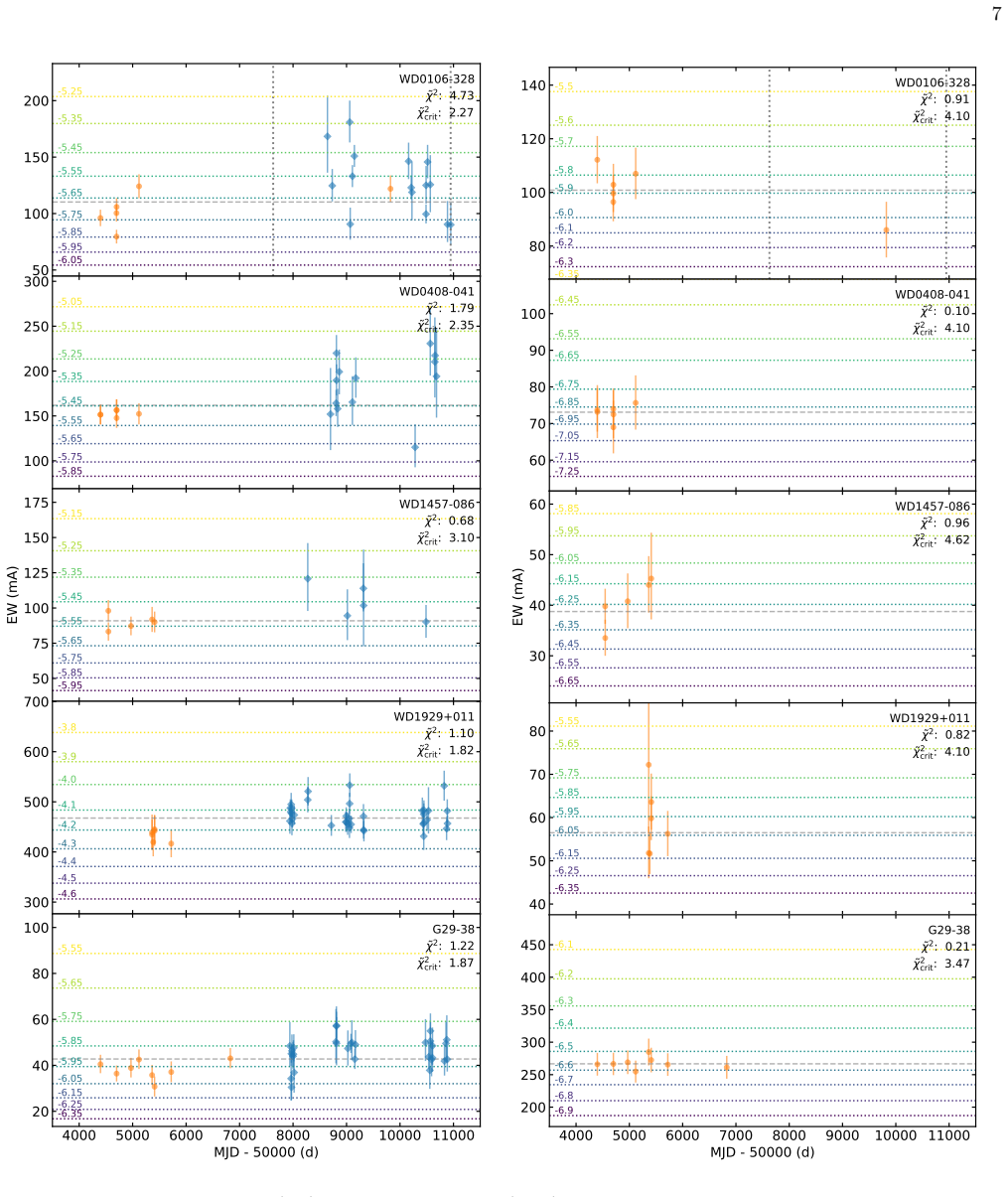
At four of the five warm polluted white dwarfs, equivalent widths of metal lines show no statistically significant variability over 15-18 year baselines, yielding accretion rates stable to within 15-30 percent at 1 sigma and indicating remarkably stable accretion on decadal timescales. The exception WD 0106-328 exhibits variability in the ground-based Mg II 4481 A doublet, yet HST ultraviolet spectra from 2016 and 2025 reveal no equivalent width or abundance shifts, consistent with a possible stochastic excursion rather than a sustained change in bulk accretion rate.
What carries the argument
Long-term monitoring of photospheric metal absorption line equivalent widths to track inferred accretion rates across many diffusion timescales.
If this is right
- The processes that deliver disrupted planetary material must remain steady on decadal timescales in these four systems.
- Accretion does not fluctuate strongly on timescales of hundreds to thousands of diffusion times.
- If underlying accretion varies, photospheric processes must smooth the resulting abundance changes on the observed baselines.
- The single case of line variability may reflect a transient event rather than a permanent shift in the overall rate.
Where Pith is reading between the lines
- Steady accretion could mean that debris disks around these white dwarfs maintain consistent feeding over long periods rather than episodic delivery.
- Extending the same monitoring to cooler white dwarfs with longer diffusion times would test whether the stability persists under different conditions.
- Direct comparison of these observational limits with models of tidal disruption and disk evolution could identify which mechanisms produce the observed steadiness.
Load-bearing premise
That observed stability or changes in metal line equivalent widths can be read directly as stability or changes in the bulk accretion rate without dominant uncharacterized photospheric processes smoothing the variations.
What would settle it
Detection of statistically significant equivalent-width changes in the metal lines of several additional polluted white dwarfs over comparable 15-year baselines would falsify the reported stability.
Figures
read the original abstract
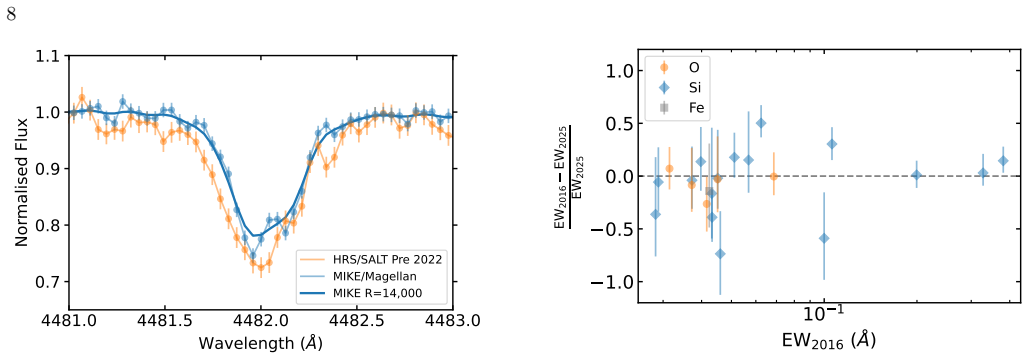
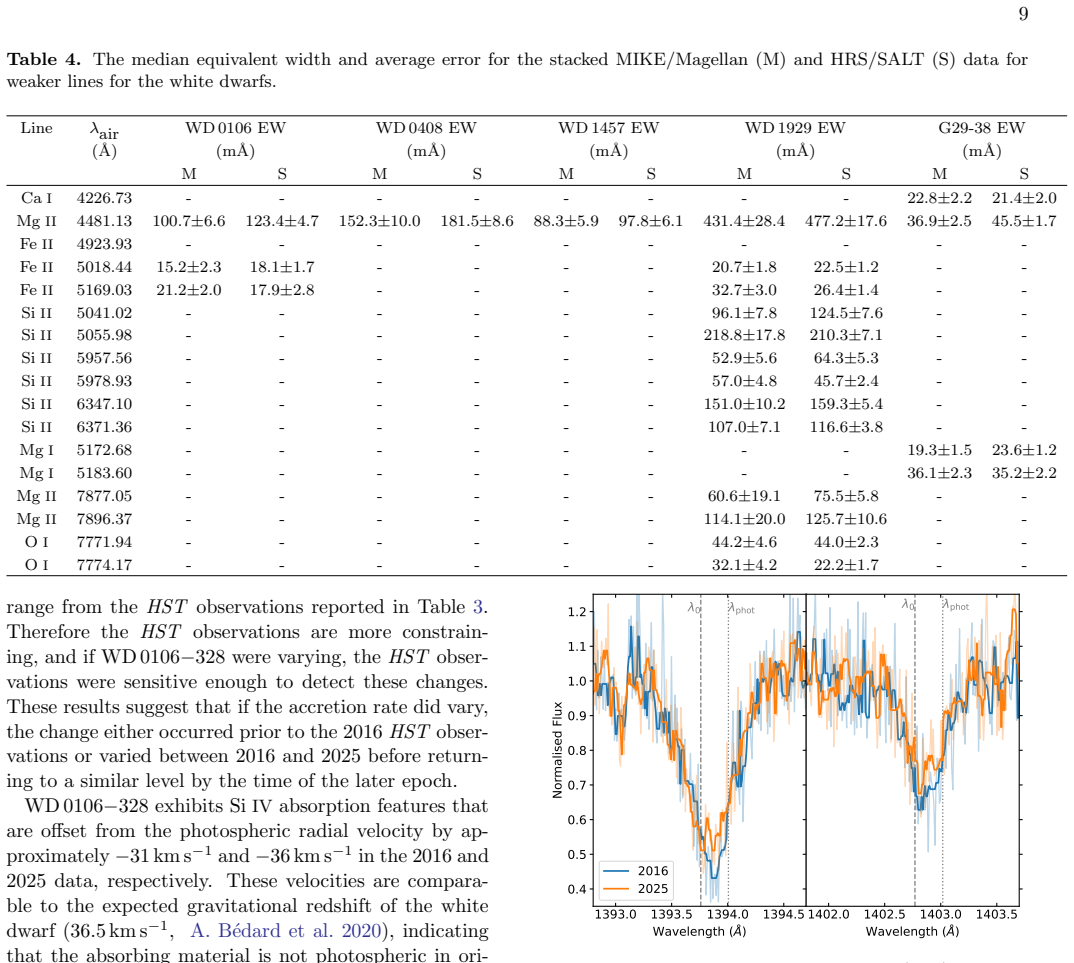
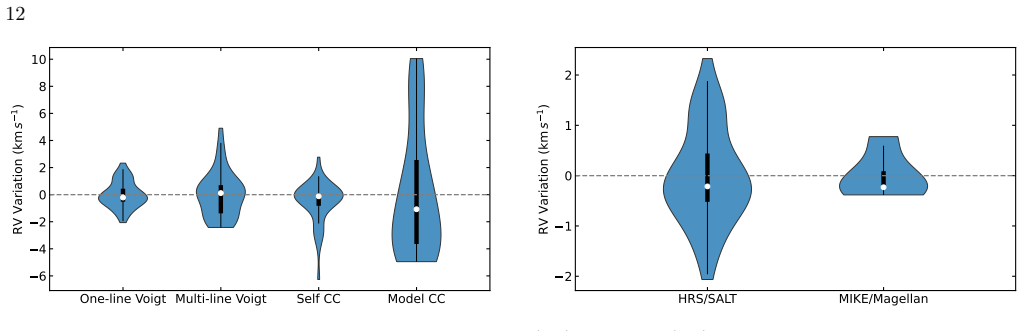
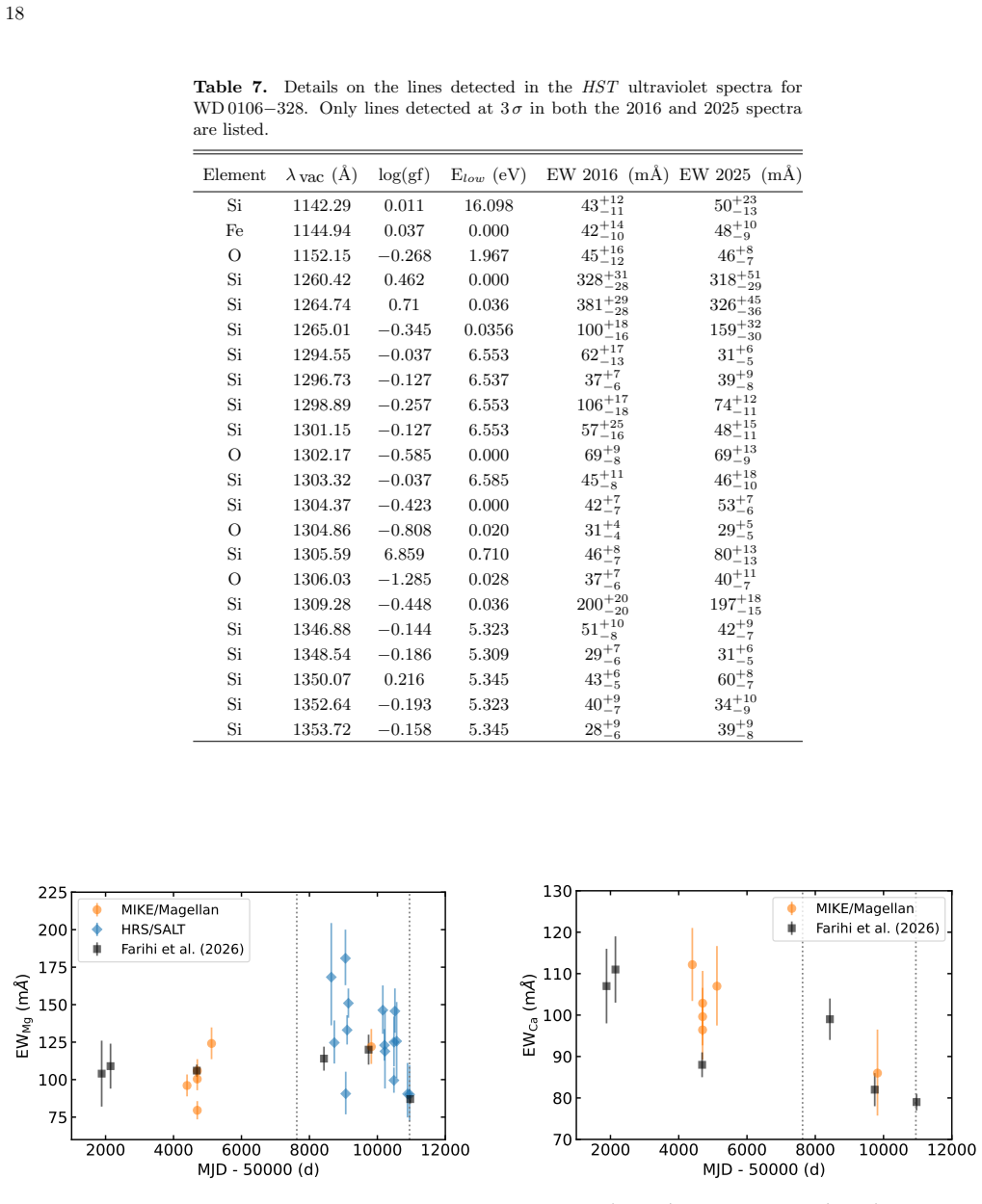
The disruption and accretion of planetary material onto white dwarfs is expected to be inherently dynamic and stochastic, potentially driving variability in the accretion rate and therefore the shape and depth of the photospheric metal absorption lines. This paper presents an 18-year optical spectroscopic monitoring campaign of five warm (11,000-23,000K) polluted white dwarfs with sinking timescales of days-months, observed using Magellan/MIKE and SALT/HRS to directly test this prediction. At four of the five systems, no statistically significant variability is detected over baselines of 15-18 years corresponding to hundreds to thousands of diffusion timescales, with inferred accretion rates stable to within 15-30% (1$\sigma$) showing remarkably stable accretion on decadal timescales. This implies that either the processes maintaining the accretion of the disrupted planetary material are stable on the same timescales, or that currently uncharacterized photospheric processes act to smooth observable abundance variations on these timescales. The one exception, WD 0106$-$328, shows statistically significant variability in the 4481A Mg II doublet from the ground-based data. Yet no significant equivalent width or abundance changes are seen between two Hubble Space Telescope ultraviolet spectra taken in 2016 and 2025, despite probing a larger set of transitions. This may imply that the ground-based observations witnessed a stochastic excursion from a stable baseline accretion rate, rather than a sustained change in the bulk accretion rate.
Editorial analysis
A structured set of objections, weighed in public.
Referee Report
Summary. This paper reports results from an 18-year optical spectroscopic monitoring campaign of five warm (11,000–23,000 K) polluted white dwarfs with short sinking timescales, using Magellan/MIKE and SALT/HRS. The central observational result is that four of the five systems exhibit no statistically significant variability in photospheric metal line equivalent widths over baselines of 15–18 years (hundreds to thousands of diffusion timescales), with inferred accretion rates stable to within 15–30% (1σ). One exception (WD 0106−328) shows significant variability in the 4481 Å Mg II doublet from ground-based spectra, but no equivalent width or abundance changes are detected between two HST UV spectra (2016 and 2025). The authors interpret the overall lack of variability as implying either stable accretion processes or uncharacterized photospheric smoothing of abundance variations.
Significance. If the reported stability holds after full scrutiny of the error budget and line-formation assumptions, the work supplies a rare long-baseline observational constraint on the temporal behavior of planetary accretion onto white dwarfs. The multi-instrument approach and the explicit cross-check with HST UV data for one target strengthen the empirical case that accretion rates (or their observable signatures) remain steady on decadal timescales, which bears directly on models of debris-disk dynamics and diffusion in polluted atmospheres.
major comments (2)
- [Abstract and §3] Abstract and §3 (results): the statement that accretion rates are 'stable to within 15–30% (1σ)' is load-bearing for the central claim, yet the abstract provides no explicit description of how the 1σ uncertainties were derived, whether they incorporate systematic contributions from continuum placement or model-atmosphere assumptions, or how the statistical test for 'no significant variability' was performed across multiple lines and epochs.
- [Abstract] Abstract: the alternative explanation (uncharacterized photospheric processes smoothing abundance variations) is correctly noted, but the manuscript does not quantify the expected smoothing timescale or amplitude under plausible mixing or diffusion scenarios, leaving the two interpretations difficult to distinguish on the basis of the presented data alone.
minor comments (2)
- [Abstract] The abstract refers to 'hundreds to thousands of diffusion timescales' without citing the specific diffusion times adopted for each object or the source of those values.
- Notation for the Mg II doublet (4481 Å) should be clarified as to whether it is the 4481.13/4481.33 Å pair or a blended measurement.
Simulated Author's Rebuttal
We thank the referee for their positive assessment of the manuscript and for the constructive comments, which we address point by point below.
read point-by-point responses
-
Referee: [Abstract and §3] Abstract and §3 (results): the statement that accretion rates are 'stable to within 15–30% (1σ)' is load-bearing for the central claim, yet the abstract provides no explicit description of how the 1σ uncertainties were derived, whether they incorporate systematic contributions from continuum placement or model-atmosphere assumptions, or how the statistical test for 'no significant variability' was performed across multiple lines and epochs.
Authors: We agree that the abstract would benefit from a concise description of the uncertainty methodology. Section 3 already details the equivalent-width measurements from multiple lines, the χ²-based statistical tests for variability across epochs, and the incorporation of both statistical and systematic uncertainties (including continuum placement and model-atmosphere assumptions) into the final 1σ error budget. In the revised manuscript we will add one sentence to the abstract summarizing this approach so that the quoted stability level is self-contained. revision: yes
-
Referee: [Abstract] Abstract: the alternative explanation (uncharacterized photospheric processes smoothing abundance variations) is correctly noted, but the manuscript does not quantify the expected smoothing timescale or amplitude under plausible mixing or diffusion scenarios, leaving the two interpretations difficult to distinguish on the basis of the presented data alone.
Authors: We acknowledge that a quantitative estimate of photospheric smoothing would help separate the two interpretations. Such an estimate would require dedicated hydrodynamic or mixing-length calculations of the white-dwarf atmosphere that lie outside the scope of this observational study. We will revise the discussion to state this limitation explicitly and to note that future theoretical work is needed to quantify the expected smoothing timescale and amplitude. revision: partial
Circularity Check
Purely observational campaign; no derivation reduces to inputs
full rationale
The paper reports direct spectroscopic measurements of metal line equivalent widths over 15-18 year baselines for five white dwarfs, with accretion rates inferred from standard diffusion timescales. No equations, fitted parameters, or predictions are presented that reduce by construction to the input data. The central claim of stability (or the alternative of photospheric smoothing) is framed as an empirical result with both interpretations retained. No self-citation chains, ansatzes, or uniqueness theorems are invoked as load-bearing elements. This is a standard observational monitoring study whose conclusions rest on the measurements themselves.
Axiom & Free-Parameter Ledger
Reference graph
Works this paper leans on
-
[1]
1967, JQSRT, 7, 61, doi: 10.1016/0022-4073(67)90057-X
Armstrong, B. 1967, JQSRT, 7, 61, doi: 10.1016/0022-4073(67)90057-X
-
[2]
Aungwerojwit, A., G¨ ansicke, B. T., Dhillon, V. S., et al. 2024, MNRAS, 530, 117, doi: 10.1093/mnras/stae750
-
[3]
Barnes, S. I., Cottrell, P. L., Albrow, M. D., et al. 2008, in Society of Photo-Optical Instrumentation Engineers (SPIE) Conference Series, Vol. 7014, Ground-based and Airborne Instrumentation for Astronomy II, ed. I. S. McLean & M. M. Casali, 70140K, doi: 10.1117/12.788219 15 https://scipy.org 16 https://emcee.readthedocs.io/en/stable
-
[4]
Barstow, M. A., Barstow, J. K., Casewell, S. L., Holberg, J. B., & Hubeny, I. 2014, MNRAS, 440, 1607, doi: 10.1093/mnras/stu216
-
[5]
Bauer, E. B., & Bildsten, L. 2018, ApJL, 859, L19, doi: 10.3847/2041-8213/aac492
-
[6]
Bauer, E. B., & Bildsten, L. 2019, ApJ, 872, 96, doi: 10.3847/1538-4357/ab0028
-
[7]
E., Farihi, J., Jura, M., et al
Becklin, E. E., Farihi, J., Jura, M., et al. 2005, ApJL, 632, L119, doi: 10.1086/497826 B´ edard, A., Bergeron, P., Brassard, P., & Fontaine, G. 2020, ApJ, 901, 93, doi: 10.3847/1538-4357/abafbe 18 T able 7.Details on the lines detected in theHSTultraviolet spectra for WD 0106−328. Only lines detected at 3σin both the 2016 and 2025 spectra are listed. Ele...
-
[8]
Bernstein, R., Shectman, S. A., Gunnels, S. M., Mochnacki, S., & Athey, A. E. 2003, in Society of Photo-Optical Instrumentation Engineers (SPIE) Conference Series, Vol. 4841, Instrument Design and Performance for Optical/Infrared Ground-based Telescopes, ed. M. Iye & A. F. M. Moorwood, 1694–1704, doi: 10.1117/12.461502
-
[9]
Bhattacharjee, S., Vanderbosch, Z. P., Hollands, M. A., et al. 2025, arXiv e-prints, arXiv:2502.05502, doi: 10.48550/arXiv.2502.05502
-
[10]
Blackman, J. W., Beaulieu, J. P., Bennett, D. P., et al. 2021, Nature, 598, 272, doi: 10.1038/s41586-021-03869-6
-
[11]
Bonsor, A., Farihi, J., Wyatt, M. C., & van Lieshout, R. 2017, MNRAS, 468, 154, doi: 10.1093/mnras/stx425
-
[12]
G., Sharples, R., Tyas, L., et al
Bramall, D. G., Sharples, R., Tyas, L., et al. 2010, in Society of Photo-Optical Instrumentation Engineers (SPIE) Conference Series, Vol. 7735, Ground-based and Airborne Instrumentation for Astronomy III, ed. I. S
2010
-
[13]
McLean, S. K. Ramsay, & H. Takami, 77354F, doi: 10.1117/12.856382
-
[14]
G., Schmoll, J., Tyas, L
Bramall, D. G., Schmoll, J., Tyas, L. M. G., et al. 2012, in Society of Photo-Optical Instrumentation Engineers (SPIE) Conference Series, Vol. 8446, Ground-based and Airborne Instrumentation for Astronomy IV, ed. I. S
2012
-
[15]
McLean, S. K. Ramsay, & H. Takami, 84460A, doi: 10.1117/12.925935
-
[16]
Brinkworth, C. S., G¨ ansicke, B. T., Girven, J. M., et al. 2012, ApJ, 750, 86, doi: 10.1088/0004-637X/750/1/86
-
[17]
Brouwers, M. G., Bonsor, A., & Malamud, U. 2022, MNRAS, 509, 2404, doi: 10.1093/mnras/stab3009
-
[18]
M., Tremblay, P.-E., B´ edard, A., Bauer, E
Buchan, A. M., Tremblay, P.-E., B´ edard, A., Bauer, E. B., & Cunningham, T. 2025, MNRAS, 544, 2098, doi: 10.1093/mnras/staf1832
-
[19]
Buckley, D. A. H., Swart, G. P., & Meiring, J. G. 2006, in Society of Photo-Optical Instrumentation Engineers (SPIE) Conference Series, Vol. 6267, Ground-based and Airborne Telescopes, ed. L. M. Stepp, 62670Z, doi: 10.1117/12.673750
-
[20]
1995a, ApJS, 99, 189, doi: 10.1086/192184
Chayer, P., Fontaine, G., & Wesemael, F. 1995a, ApJS, 99, 189, doi: 10.1086/192184
-
[21]
Chayer, P., Vennes, S., Pradhan, A. K., et al. 1995b, ApJ, 454, 429, doi: 10.1086/176494
-
[22]
A., Sharples, R
Crause, L. A., Sharples, R. M., Bramall, D. G., et al. 2014, in Society of Photo-Optical Instrumentation Engineers (SPIE) Conference Series, Vol. 9147, Ground-based and Airborne Instrumentation for Astronomy V, ed. S. K
2014
-
[23]
Ramsay, I. S. McLean, & H. Takami, 91476T, doi: 10.1117/12.2055635
-
[24]
2019, MNRAS, 488, 2503, doi: 10.1093/mnras/stz1759
Cunningham, T., Tremblay, P.-E., Freytag, B., Ludwig, H.-G., & Koester, D. 2019, MNRAS, 488, 2503, doi: 10.1093/mnras/stz1759
-
[25]
Cunningham, T., Wheatley, P. J., Tremblay, P.-E., et al. 2022, Nature, 602, 219, doi: 10.1038/s41586-021-04300-w
-
[26]
Cunningham, T., Tremblay, P.-E., Bauer, E. B., et al. 2021, MNRAS, 503, 1646, doi: 10.1093/mnras/stab553
-
[27]
H., Kilic, M., Faedi, F., et al
Debes, J. H., Kilic, M., Faedi, F., et al. 2012, ApJ, 754, 59, doi: 10.1088/0004-637X/754/1/59
-
[28]
Debes, J. H., & L´ opez-Morales, M. 2008, ApJL, 677, L43, doi: 10.1086/587550
-
[29]
Debes, J. H., & Sigurdsson, S. 2002, ApJ, 572, 556, doi: 10.1086/340291
-
[30]
Dennihy, E., Clemens, J. C., Debes, J. H., et al. 2017, ApJ, 849, 77, doi: 10.3847/1538-4357/aa8ef2
-
[31]
Dennihy, E., Clemens, J. C., Dunlap, B. H., et al. 2018, ApJ, 854, 40, doi: 10.3847/1538-4357/aaa89b
-
[32]
2020, ApJ, 905, 5, doi: 10.3847/1538-4357/abc339
Dennihy, E., Xu, S., Lai, S., et al. 2020, ApJ, 905, 5, doi: 10.3847/1538-4357/abc339
-
[33]
2012, ApJ, 749, 6, doi: 10.1088/0004-637X/749/1/6
Dufour, P., Kilic, M., Fontaine, G., et al. 2012, ApJ, 749, 6, doi: 10.1088/0004-637X/749/1/6
-
[34]
Farihi, J., G¨ ansicke, B. T., Steele, P. R., et al. 2012, MNRAS, 421, 1635, doi: 10.1111/j.1365-2966.2012.20421.x
-
[35]
2010, ApJ, 714, 1386, doi: 10.1088/0004-637X/714/2/1386
Farihi, J., Jura, M., Lee, J.-E., & Zuckerman, B. 2010, ApJ, 714, 1386, doi: 10.1088/0004-637X/714/2/1386
-
[36]
Farihi, J., van Lieshout, R., Cauley, P. W., et al. 2018, MNRAS, 481, 2601, doi: 10.1093/mnras/sty2331
-
[37]
Farihi, J., Hermes, J. J., Marsh, T. R., et al. 2022, MNRAS, 511, 1647, doi: 10.1093/mnras/stab3475
-
[38]
Farihi, J., Noor, H. T., Melis, C., et al. 2026, MNRAS, doi: 10.1093/mnras/stag176 Gaia Collaboration, Prusti, T., de Bruijne, J. H. J., et al. 2016, A&A, 595, A1, doi: 10.1051/0004-6361/201629272 Gaia Collaboration, Vallenari, A., Brown, A. G. A., et al. 2023, A&A, 674, A1, doi: 10.1051/0004-6361/202243940 G¨ ansicke, B. T., Koester, D., Farihi, J., et a...
-
[39]
Rebassa-Mansergas, A., & Southworth, J. 2008, MNRAS, 391, L103, doi: 10.1111/j.1745-3933.2008.00565.x G¨ ansicke, B. T., Marsh, T. R., & Southworth, J. 2007, MNRAS, 380, L35, doi: 10.1111/j.1745-3933.2007.00343.x G¨ ansicke, B. T., Marsh, T. R., Southworth, J., &
-
[40]
2006, Science, 314, 1908, doi: 10.1126/science.1135033 G¨ ansicke, B
Rebassa-Mansergas, A. 2006, Science, 314, 1908, doi: 10.1126/science.1135033 G¨ ansicke, B. T., Aungwerojwit, A., Marsh, T. R., et al. 2016, ApJL, 818, L7, doi: 10.3847/2041-8205/818/1/L7 Gentile Fusillo, N. P., Manser, C. J., G¨ ansicke, B. T., et al. 2021, MNRAS, 504, 2707, doi: 10.1093/mnras/stab992
-
[41]
Gianninas, A., Bergeron, P., & Ruiz, M. T. 2011, ApJ, 743, 138, doi: 10.1088/0004-637X/743/2/138 20
-
[42]
Guidry, J. A., Hermes, J. J., De, K., et al. 2024, ApJ, 972, 126, doi: 10.3847/1538-4357/ad5be7
-
[43]
Harrison, J. H. D., Bonsor, A., & Madhusudhan, N. 2018, MNRAS, 479, 3814, doi: 10.1093/mnras/sty1700
-
[44]
Johnson, T. M., Klein, B. L., Koester, D., et al. 2022, ApJ, 941, 113, doi: 10.3847/1538-4357/aca089
-
[45]
2003, ApJL, 584, L91, doi: 10.1086/374036
Jura, M. 2003, ApJL, 584, L91, doi: 10.1086/374036
-
[46]
2007, ApJ, 663, 1285, doi: 10.1086/518767
Jura, M., Farihi, J., & Zuckerman, B. 2007, ApJ, 663, 1285, doi: 10.1086/518767
-
[47]
Kelson, D. D. 2003, PASP, 115, 688, doi: 10.1086/375502
-
[48]
2000, ApJ, 531, 159, doi: 10.1086/308445
Franx, M. 2000, ApJ, 531, 159, doi: 10.1086/308445
-
[49]
Kleinman, S. J., Nather, R. E., Winget, D. E., et al. 1998, ApJ, 495, 424, doi: 10.1086/305259
-
[50]
Kniazev, A. Y., Gvaramadze, V. V., & Berdnikov, L. N. 2016, MNRAS, 459, 3068, doi: 10.1093/mnras/stw889
-
[51]
Y., Gvaramadze, V
Kniazev, A. Y., Gvaramadze, V. V., & Berdnikov, L. N. 2017, in Astronomical Society of the Pacific Conference
2017
-
[52]
SALT spectroscopy of evolved massive stars
Series, Vol. 510, Stars: From Collapse to Collapse, ed. Y. Y. Balega, D. O. Kudryavtsev, I. I. Romanyuk, & I. A. Yakunin, 480, doi: 10.48550/arXiv.1612.00292
work page internal anchor Pith review Pith/arXiv arXiv doi:10.48550/arxiv.1612.00292
-
[53]
2009, A&A, 498, 517, doi: 10.1051/0004-6361/200811468
Koester, D. 2009, A&A, 498, 517, doi: 10.1051/0004-6361/200811468
-
[54]
Koester, D., G¨ ansicke, B. T., & Farihi, J. 2014, A&A, 566, A34, doi: 10.1051/0004-6361/201423691
-
[55]
Koester, D., Kepler, S. O., & Irwin, A. W. 2020, A&A, 635, A103, doi: 10.1051/0004-6361/202037530
-
[56]
2021, ApJ, 920, 156, doi: 10.3847/1538-4357/ac1354
Lai, S., Dennihy, E., Xu, S., et al. 2021, ApJ, 920, 156, doi: 10.3847/1538-4357/ac1354
-
[57]
Laor, A., & Draine, B. T. 1993, ApJ, 402, 441, doi: 10.1086/172149
-
[58]
Manser, C. J., G¨ ansicke, B. T., Koester, D., Marsh, T. R., & Southworth, J. 2016a, MNRAS, 462, 1461, doi: 10.1093/mnras/stw1760
-
[59]
Manser, C. J., G¨ ansicke, B. T., Marsh, T. R., et al. 2016b, MNRAS, 455, 4467, doi: 10.1093/mnras/stv2603
-
[60]
Manser, C. J., G¨ ansicke, B. T., Eggl, S., et al. 2019, Science, 364, 66, doi: 10.1126/science.aat5330
-
[61]
McDonald, C. H., & Veras, D. 2021, MNRAS, 506, 4031, doi: 10.1093/mnras/stab1906
-
[62]
2011, ApJ, 732, 90, doi: 10.1088/0004-637X/732/2/90
Melis, C., Farihi, J., Dufour, P., et al. 2011, ApJ, 732, 90, doi: 10.1088/0004-637X/732/2/90
-
[63]
2010, ApJ, 722, 1078, doi: 10.1088/0004-637X/722/2/1078
Melis, C., Jura, M., Albert, L., Klein, B., & Zuckerman, B. 2010, ApJ, 722, 1078, doi: 10.1088/0004-637X/722/2/1078
-
[64]
Melis, C., Klein, B., Doyle, A. E., et al. 2020, ApJ, 905, 56, doi: 10.3847/1538-4357/abbdfa
-
[65]
2012, ApJL, 751, L4, doi: 10.1088/2041-8205/751/1/L4
Melis, C., Dufour, P., Farihi, J., et al. 2012, ApJL, 751, L4, doi: 10.1088/2041-8205/751/1/L4
-
[66]
Noor, H. T., Farihi, J., Kenyon, S. J., et al. 2025, MNRAS, 543, 1602, doi: 10.1093/mnras/staf1380 Ould Rouis, L. B., Hermes, J. J., G¨ ansicke, B. T., et al. 2024, ApJ, 976, 156, doi: 10.3847/1538-4357/ad86bb
-
[67]
Rafikov, R. R. 2011, MNRAS, 416, L55, doi: 10.1111/j.1745-3933.2011.01096.x
-
[68]
Rocchetto, M., Farihi, J., G¨ ansicke, B. T., & Bergfors, C. 2015, MNRAS, 449, 574, doi: 10.1093/mnras/stv282
-
[69]
2022, PhD thesis, Apollo - University of Cambridge Repository, doi: 10.17863/CAM.92120
Rogers, L. 2022, PhD thesis, Apollo - University of Cambridge Repository, doi: 10.17863/CAM.92120
-
[70]
Rogers, L. K., Xu, S., Bonsor, A., et al. 2020, MNRAS, 494, 2861, doi: 10.1093/mnras/staa873
-
[71]
Rogers, L. K., Bonsor, A., Xu, S., et al. 2024a, MNRAS, 527, 6038, doi: 10.1093/mnras/stad3557
-
[72]
Rogers, L. K., Debes, J., Anslow, R. J., et al. 2024b, MNRAS, 527, 977, doi: 10.1093/mnras/stad3098
-
[73]
Rogers, L. K., Manser, C. J., Bonsor, A., et al. 2025a, MNRAS, 537, L72, doi: 10.1093/mnrasl/slae117
-
[74]
K., Bonsor, A., Le Bourdais, ´E., et al
Rogers, L. K., Bonsor, A., Le Bourdais, ´E., et al. 2025b, MNRAS, 542, 293, doi: 10.1093/mnras/staf1221
-
[75]
K., Debes, J., Steele, A., et al
Steckloff, J. K., Debes, J., Steele, A., et al. 2021, ApJL, 913, L31, doi: 10.3847/2041-8213/abfd39
-
[76]
2021, ApJ, 911, 25, doi: 10.3847/1538-4357/abc262
Steele, A., Debes, J., Xu, S., Yeh, S., & Dufour, P. 2021, ApJ, 911, 25, doi: 10.3847/1538-4357/abc262
-
[77]
Swan, A., Farihi, J., & Wilson, T. G. 2019, MNRAS, 484, L109, doi: 10.1093/mnrasl/slz014
-
[78]
Swan, A., Farihi, J., Wilson, T. G., & Parsons, S. G. 2020, MNRAS, 496, 5233, doi: 10.1093/mnras/staa1688
-
[79]
Swan, A., Kenyon, S. J., Farihi, J., et al. 2021, MNRAS, 506, 432, doi: 10.1093/mnras/stab1738
-
[80]
Young, E. D. 2022, ApJ, 936, 30, doi: 10.3847/1538-4357/ac86d5
discussion (0)
Sign in with ORCID, Apple, or X to comment. Anyone can read and Pith papers without signing in.