Learning dynamical systems from noisy data with Weak-form Kernel Ridge Regression
Pith reviewed 2026-07-02 19:24 UTC · model grok-4.3
The pith
Weak-form kernel ridge regression identifies dynamical systems from noisy data by integrating residuals against test functions.
A machine-rendered reading of the paper's core claim, the machinery that carries it, and where it could break.
Core claim
The authors introduce Weak-form Kernel Ridge Regression (WKRR) that substitutes the weak form of the differential equations into the kernel ridge regression objective. This produces a linear system whose solution recovers the model parameters; the weak form supplies an inherent filtering mechanism that improves performance under noise. The approach is shown to outperform standard kernel ridge regression and other baselines on both synthetic chaotic attractors and high-dimensional fluid data.
What carries the argument
The weak-form residual, obtained by integrating the governing equation against compactly supported test functions, which supplies noise filtering before kernel ridge regression solves for the unknown coefficients.
If this is right
- WKRR applies unchanged to both clean and noisy time-series measurements.
- The method scales to chaotic systems in at least 64 dimensions and to fluid data with 15,000 variables.
- A bias-variance decomposition explains why the weak form improves robustness.
- Implementation reduces to solving a single linear system after forming the integrated kernel matrices.
Where Pith is reading between the lines
- The same weak-form filtering idea could be inserted into other kernel or regression techniques used for inverse problems.
- Direct comparison on data with structured or non-Gaussian noise would test whether the benefit is specific to the white-noise case examined here.
- Extension to online or streaming settings might allow real-time model updates from noisy sensors.
Load-bearing premise
Integration of the residual against test functions attenuates noise enough to improve the accuracy of the subsequent kernel ridge regression step.
What would settle it
A side-by-side test on a known chaotic system with added noise where WKRR yields larger long-term trajectory errors than ordinary kernel ridge regression would refute the claimed noise-robustness benefit.
Figures






read the original abstract
Accurate prediction of complex dynamical systems from noisy measurements remains a significant challenge in scientific computing. Kernel ridge regression learning strategies are often effective when applied to clean data, but have limited success with noisy data. Recent work has observed that a weak formulation can act to filter noisy data, and different learning strategies have achieved increased noise robustness with a weak-form framework. In this manuscript, we give an overview of the filtering mechanism behind the weak formulation and provide a bias-variance error decomposition. Using these insights, we combine a weak formulation with a kernel learning strategy to propose Weak-form Kernel Ridge Regression (WKRR) for learning dynamical systems. The proposed framework is simple to implement, effective for both clean and noisy data, and outperforms several baseline methods. We demonstrate the performance of WKRR on chaotic benchmark systems in up to 64 dimensions, as well as 15,000-dimensional real-world fluid data.
Editorial analysis
A structured set of objections, weighed in public.
Referee Report
Summary. The manuscript proposes Weak-form Kernel Ridge Regression (WKRR) for identifying dynamical systems from noisy measurements. It reviews the noise-filtering property of weak formulations, derives a bias-variance error decomposition to motivate the approach, combines the weak form with kernel ridge regression, and reports that the resulting method is simple to implement, performs well on both clean and noisy data, and outperforms several baselines on chaotic benchmark systems (up to 64 dimensions) as well as 15,000-dimensional real-world fluid data.
Significance. If the central claims hold, the work would be a useful contribution to data-driven modeling of dynamical systems. The explicit bias-variance analysis and the combination of weak-form filtering with kernel methods address a practical limitation of standard KRR on noisy data. Demonstrations on high-dimensional chaotic systems and real fluid data provide evidence of scalability and applicability; the emphasis on simplicity and reproducibility is a positive feature.
minor comments (3)
- [Abstract] Abstract: the claim of outperformance is stated without naming the baseline methods or reporting quantitative metrics; a single sentence summarizing the key numerical improvements would strengthen the abstract.
- [Section 3 (or wherever the decomposition appears)] The bias-variance decomposition is central to the motivation; ensure that the decomposition is stated with explicit dependence on the weak-form test functions and the kernel hyperparameters so that readers can trace how the filtering effect enters the variance term.
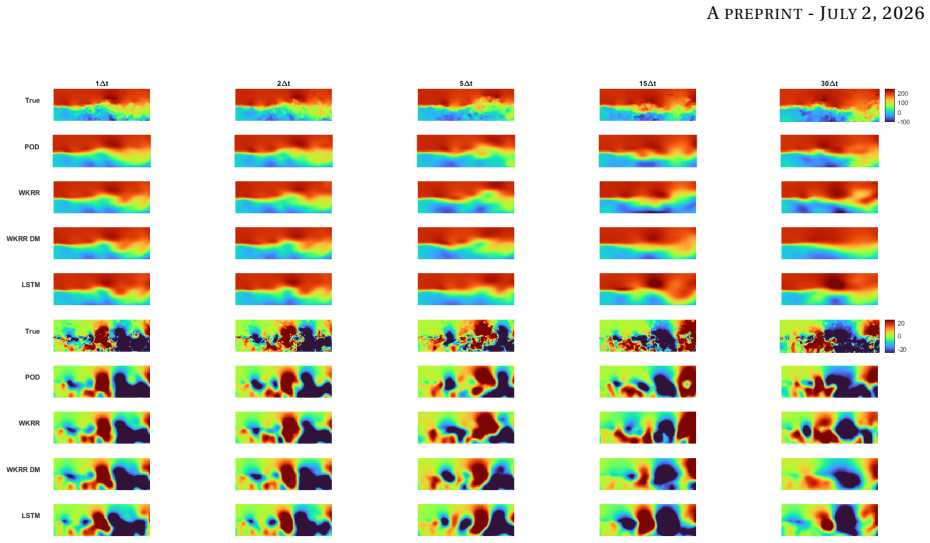
- [Results section on fluid data] Figure captions and axis labels for the high-dimensional fluid example should explicitly state the noise level, the number of snapshots, and the dimension reduction (if any) used prior to applying WKRR.
Simulated Author's Rebuttal
We thank the referee for the positive summary, significance assessment, and recommendation of minor revision. The feedback highlights the value of the bias-variance analysis and the practical combination of weak-form filtering with kernel methods. No specific major comments were provided in the report, so we have no points to address point-by-point. We will incorporate any minor suggestions during revision.
Circularity Check
No significant circularity detected
full rationale
The paper's core contribution is the WKRR method obtained by pairing an existing weak-form filtering insight with kernel ridge regression, followed by a bias-variance analysis and empirical validation on benchmark systems and fluid data. No equations, parameter fits, or uniqueness claims in the abstract or summary reduce by construction to the inputs; the weak-form filtering is presented as an external observation rather than a self-derived tautology. The derivation chain therefore remains independent of the target results and does not exhibit any of the enumerated circularity patterns.
Axiom & Free-Parameter Ledger
Reference graph
Works this paper leans on
-
[1]
Exploration and prediction of fluid dynamical systems using auto-encoder technology.Physics of Fluids, 32(6), 2020
Lionel Agostini. Exploration and prediction of fluid dynamical systems using auto-encoder technology.Physics of Fluids, 32(6), 2020
2020
-
[2]
Kernel ridge regression hybrid method for wheat yield prediction with satellite-derived predictors.Remote Sensing, 14(5):1136, 2022
AA Masrur Ahmed, Ekta Sharma, S Janifer Jabin Jui, Ravinesh C Deo, Thong Nguyen-Huy, and Mumtaz Ali. Kernel ridge regression hybrid method for wheat yield prediction with satellite-derived predictors.Remote Sensing, 14(5):1136, 2022
2022
-
[3]
Sampling procedures in function spaces and asymptotic equivalence with Shannon’ s sampling theory.Numerical functional analysis and optimization, 15(1-2):1–21, 1994
Akram Aldroubi, Michael Unser, and Akram Aldroubi. Sampling procedures in function spaces and asymptotic equivalence with Shannon’ s sampling theory.Numerical functional analysis and optimization, 15(1-2):1–21, 1994
1994
-
[4]
Complete ensemble empirical mode decomposition hybridized with random forest and kernel ridge regression model for monthly rainfall forecasts
Mumtaz Ali, Ramendra Prasad, Yong Xiang, and Zaher Mundher Yaseen. Complete ensemble empirical mode decomposition hybridized with random forest and kernel ridge regression model for monthly rainfall forecasts. Journal of Hydrology, 584:124647, 2020
2020
-
[5]
Dynamic data-driven local traffic state estimation and prediction.Transportation Research Part C: Emerging Technologies, 34:89–107, 2013
Constantinos Antoniou, Haris N Koutsopoulos, and George Yannis. Dynamic data-driven local traffic state estimation and prediction.Transportation Research Part C: Emerging Technologies, 34:89–107, 2013
2013
-
[6]
Data-driven analysis and forecasting of highway traffic dynamics.Nature communications, 11(1):2090, 2020
Allan M Avila and Igor Mezi´ c. Data-driven analysis and forecasting of highway traffic dynamics.Nature communications, 11(1):2090, 2020
2090
-
[7]
Approximation error for quasi-interpolators and (multi-) wavelet expansions
Thierry Blu and Michael Unser. Approximation error for quasi-interpolators and (multi-) wavelet expansions. Applied and Computational Harmonic Analysis, 6(2):219–251, 1999
1999
-
[8]
Weak form-based data-driven modeling: computationally efficient and noise robust equation learning and parameter inference
David M Bortz, Daniel A Messenger, and April Tran. Weak form-based data-driven modeling: computationally efficient and noise robust equation learning and parameter inference. InHandbook of Numerical Analysis, volume 25, pages 53–82. Elsevier, 2024
2024
-
[9]
John Wiley & Sons, 2015
George EP Box, Gwilym M Jenkins, Gregory C Reinsel, and Greta M Ljung.Time series analysis: forecasting and control. John Wiley & Sons, 2015
2015
-
[10]
Predicting regime changes and durations in Lorenz’ s atmospheric convection model.Chaos: An Interdisciplinary Journal of Nonlinear Science, 30(10), 2020
Eduardo L Brugnago, Jason AC Gallas, and Marcus W Beims. Predicting regime changes and durations in Lorenz’ s atmospheric convection model.Chaos: An Interdisciplinary Journal of Nonlinear Science, 30(10), 2020
2020
-
[11]
Cambridge University Press, 2022
Steven L Brunton and J Nathan Kutz.Data-driven science and engineering: Machine learning, dynamical systems, and control. Cambridge University Press, 2022
2022
-
[12]
Discovering governing equations from data by sparse identification of nonlinear dynamical systems.Proceedings of the national academy of sciences, 113(15):3932– 3937, 2016
Steven L Brunton, Joshua L Proctor, and J Nathan Kutz. Discovering governing equations from data by sparse identification of nonlinear dynamical systems.Proceedings of the national academy of sciences, 113(15):3932– 3937, 2016
2016
-
[13]
Sparse identification of nonlinear dynamics with control (SINDYc).IFAC-PapersOnLine, 49(18):710–715, 2016
Steven L Brunton, Joshua L Proctor, and J Nathan Kutz. Sparse identification of nonlinear dynamics with control (SINDYc).IFAC-PapersOnLine, 49(18):710–715, 2016
2016
-
[14]
An intelligent system for financial time series prediction combining dynami- cal systems theory, fractal theory, and statistical methods
Oscar Castillo and Patricia Melin. An intelligent system for financial time series prediction combining dynami- cal systems theory, fractal theory, and statistical methods. InProceedings of 1995 Conference on Computational Intelligence for Financial Engineering (CIFEr), pages 151–155. IEEE, 1995
1995
-
[15]
Neural ordinary differential equations.Advances in neural information processing systems, 31, 2018
Ricky TQ Chen, Yulia Rubanova, Jesse Bettencourt, and David K Duvenaud. Neural ordinary differential equations.Advances in neural information processing systems, 31, 2018
2018
-
[16]
Machine learning with data assimilation and uncertainty quantification for dynamical systems: a review.IEEE/CAA Journal of Automatica Sinica, 10(6):1361–1387, 2023
Sibo Cheng, César Quilodrán-Casas, Said Ouala, Alban Farchi, Che Liu, Pierre Tandeo, Ronan Fablet, Di- dier Lucor, Bertrand Iooss, Julien Brajard, et al. Machine learning with data assimilation and uncertainty quantification for dynamical systems: a review.IEEE/CAA Journal of Automatica Sinica, 10(6):1361–1387, 2023
2023
-
[17]
From reliable weather forecasts to skilful climate response: A dynamical systems approach.Quarterly Journal of the Royal Meteorological Society, 145(720):1052–1069, 2019
Hannah M Christensen and Judith Berner. From reliable weather forecasts to skilful climate response: A dynamical systems approach.Quarterly Journal of the Royal Meteorological Society, 145(720):1052–1069, 2019
2019
-
[18]
Diffusion maps.Applied and computational harmonic analysis, 21(1):5–30, 2006
Ronald R Coifman and Stéphane Lafon. Diffusion maps.Applied and computational harmonic analysis, 21(1):5–30, 2006
2006
-
[19]
Graph Laplacian tomography from unknown random projections.IEEE Transactions on Image Processing, 17(10):1891–1899, 2008
Ronald R Coifman, Yoel Shkolnisky, Fred J Sigworth, and Amit Singer. Graph Laplacian tomography from unknown random projections.IEEE Transactions on Image Processing, 17(10):1891–1899, 2008
2008
-
[20]
The mpedmd algorithm for data-driven computations of measure-preserving dynamical systems.SIAM Journal on Numerical Analysis, 61(3):1585–1608, 2023
Matthew J Colbrook. The mpedmd algorithm for data-driven computations of measure-preserving dynamical systems.SIAM Journal on Numerical Analysis, 61(3):1585–1608, 2023
2023
-
[21]
Residual dynamic mode decomposition: robust and verified Koopmanism.Journal of Fluid Mechanics, 955:A21, 2023
Matthew J Colbrook, Lorna J Ayton, and Máté Sz˝ oke. Residual dynamic mode decomposition: robust and verified Koopmanism.Journal of Fluid Mechanics, 955:A21, 2023. 29 APREPRINT- JULY2, 2026
2023
-
[22]
Lyapunov exponents of the Kuramoto–Sivashinsky PDE.The ANZIAM Journal, 61(3):270–285, 2019
Russell A Edson, Judith E Bunder, Trent W Mattner, and Anthony J Roberts. Lyapunov exponents of the Kuramoto–Sivashinsky PDE.The ANZIAM Journal, 61(3):270–285, 2019
2019
-
[23]
Combining physics-based and data-driven modeling in well construction: Hybrid fluid dynamics modeling.Journal of Natural Gas Science and Engineering, 97:104348, 2022
Oney Erge and Eric Van Oort. Combining physics-based and data-driven modeling in well construction: Hybrid fluid dynamics modeling.Journal of Natural Gas Science and Engineering, 97:104348, 2022
2022
-
[24]
Nonlinear forecasting with many predictors using kernel ridge regression.International Journal of Forecasting, 32(3):736–753, 2016
Peter Exterkate, Patrick JF Groenen, Christiaan Heij, and Dick van Dijk. Nonlinear forecasting with many predictors using kernel ridge regression.International Journal of Forecasting, 32(3):736–753, 2016
2016
-
[25]
Data-driven discovery of intrinsic dynamics.Nature Machine Intelli- gence, 4(12):1113–1120, 2022
Daniel Floryan and Michael D Graham. Data-driven discovery of intrinsic dynamics.Nature Machine Intelli- gence, 4(12):1113–1120, 2022
2022
-
[26]
Next generation reservoir computing
Daniel J Gauthier, Erik Bollt, Aaron Griffith, and Wendson AS Barbosa. Next generation reservoir computing. Nature communications, 12(1):5564, 2021
2021
-
[27]
Data-driven prediction in dynamical systems: recent developments
Amin Ghadami and Bogdan I Epureanu. Data-driven prediction in dynamical systems: recent developments. Philosophical transactions. Series A, Mathematical, physical, and engineering sciences, 380(2229):20210213, 2022
2022
-
[28]
Learning dynamics from large biological data sets: machine learning meets systems biology.Current Opinion in Systems Biology, 22:1–7, 2020
William Gilpin, Yitong Huang, and Daniel B Forger. Learning dynamics from large biological data sets: machine learning meets systems biology.Current Opinion in Systems Biology, 22:1–7, 2020
2020
-
[29]
PhD thesis, University of the Balearic Islands (UIB); Institute for Cross-Disciplinary Physics and Complex Systems, 2024
Àlex Giménez-Romero.Theoretical and data-driven models in Ecology. PhD thesis, University of the Balearic Islands (UIB); Institute for Cross-Disciplinary Physics and Complex Systems, 2024
2024
-
[30]
Gaussian process priors with uncertain inputs application to multiple-step ahead time series forecasting.Advances in neural information processing systems, 15, 2002
Agathe Girard, Carl Rasmussen, Joaquin Q Candela, and Roderick Murray-Smith. Gaussian process priors with uncertain inputs application to multiple-step ahead time series forecasting.Advances in neural information processing systems, 15, 2002
2002
-
[31]
Georg A Gottwald and Sebastian Reich. Combining machine learning and data assimilation to forecast dynamical systems from noisy partial observations.Chaos: An Interdisciplinary Journal of Nonlinear Science, 31(10), 2021
2021
-
[32]
Supervised learning from noisy observations: Combining machine- learning techniques with data assimilation.Physica D: Nonlinear Phenomena, 423:132911, 2021
Georg A Gottwald and Sebastian Reich. Supervised learning from noisy observations: Combining machine- learning techniques with data assimilation.Physica D: Nonlinear Phenomena, 423:132911, 2021
2021
-
[33]
Neural ODEs with irregular and noisy data.arXiv preprint arXiv:2205.09479, 2022
Pawan Goyal and Peter Benner. Neural ODEs with irregular and noisy data.arXiv preprint arXiv:2205.09479, 2022
-
[34]
Diffusion maps kernel ridge regression.arXiv preprint, in preparation, 2026
John Harlim, Daning Huang, Jiwoo Song, and Alex Townsend. Diffusion maps kernel ridge regression.arXiv preprint, in preparation, 2026
2026
-
[35]
Long short-term memory.Neural computation, 9(8):1735–1780, 1997
Sepp Hochreiter and Jürgen Schmidhuber. Long short-term memory.Neural computation, 9(8):1735–1780, 1997
1997
-
[36]
Learning vector fields of differential equations on manifolds with geometrically constrained operator-valued kernels
Daning Huang, Hanyang He, John Harlim, and Yan Li. Learning vector fields of differential equations on manifolds with geometrically constrained operator-valued kernels. InThe Thirteenth International Conference on Learning Representations, 2025
2025
-
[37]
A dynamic neural network architecture with immunology inspired optimization for weather data forecasting.Big data research, 14:81–92, 2018
Abir Jaafar Hussain, Panos Liatsis, Mohammed Khalaf, Hissam Tawfik, and Haya Al-Asker. A dynamic neural network architecture with immunology inspired optimization for weather data forecasting.Big data research, 14:81–92, 2018
2018
-
[38]
SINDy-PI: a robust algorithm for parallel implicit sparse identification of nonlinear dynamics.Proceedings
Kadierdan Kaheman, J Nathan Kutz, and Steven L Brunton. SINDy-PI: a robust algorithm for parallel implicit sparse identification of nonlinear dynamics.Proceedings. Mathematical, physical, and engineering sciences, 476(2242):20200279, 2020
2020
-
[39]
A new approach to linear filtering and prediction problems.Transactions of the ASME–Journal of Basic Engineering, 1960
Rudolph Emil Kalman. A new approach to linear filtering and prediction problems.Transactions of the ASME–Journal of Basic Engineering, 1960
1960
-
[40]
Fourth-order time-stepping for stiff PDEs.SIAM Journal on Scientific Computing, 26(4):1214–1233, 2005
Aly-Khan Kassam and Lloyd N Trefethen. Fourth-order time-stepping for stiff PDEs.SIAM Journal on Scientific Computing, 26(4):1214–1233, 2005
2005
-
[41]
SIAM, 2016
J Nathan Kutz, Steven L Brunton, Bingni W Brunton, and Joshua L Proctor.Dynamic mode decomposition: data-driven modeling of complex systems. SIAM, 2016
2016
-
[42]
The Lorenz system: hidden boundary of practical stability and the Lyapunov dimension.Nonlinear Dyn, 102:713–732, 2020
NV Kuznetsov, TN Mokaev, OA Kuznetsova, and EV Kudryashova. The Lorenz system: hidden boundary of practical stability and the Lyapunov dimension.Nonlinear Dyn, 102:713–732, 2020
2020
-
[43]
Qianxiao Li, Felix Dietrich, Erik M Bollt, and Ioannis G Kevrekidis. Extended dynamic mode decomposition with dictionary learning: A data-driven adaptive spectral decomposition of the Koopman operator.Chaos: An Interdisciplinary Journal of Nonlinear Science, 27(10), 2017. 30 APREPRINT- JULY2, 2026
2017
-
[44]
A Weak Penalty Neural ODE for Learning Chaotic Dynamics from Noisy Time Series
Xuyang Li, John Harlim, Dibyajyoti Chakraborty, and Romit Maulik. A weak penalty neural ODE for learning chaotic dynamics from noisy time series.arXiv preprint arXiv:2511.06609, 2025
work page internal anchor Pith review Pith/arXiv arXiv 2025
-
[45]
A survey on long short-term memory networks for time series prediction.Procedia Cirp, 99:650–655, 2021
Benjamin Lindemann, Timo Müller, Hannes Vietz, Nasser Jazdi, and Michael Weyrich. A survey on long short-term memory networks for time series prediction.Procedia Cirp, 99:650–655, 2021
2021
-
[46]
On a measure of lack of fit in time series models.Biometrika, 65(2):297–303, 1978
Greta M Ljung and George EP Box. On a measure of lack of fit in time series models.Biometrika, 65(2):297–303, 1978
1978
-
[47]
Hybridnet: integrating model-based and data-driven learning to predict evolution of dynamical systems
Yun Long, Xueyuan She, and Saibal Mukhopadhyay. Hybridnet: integrating model-based and data-driven learning to predict evolution of dynamical systems. InConference on robot learning, pages 551–560. PMLR, 2018
2018
-
[48]
Deterministic nonperiodic flow 1
Edward N Lorenz. Deterministic nonperiodic flow 1. InUniversality in Chaos, 2nd edition, pages 367–378. Routledge, 2017
2017
-
[49]
Ecological forecasting and data assimilation in a data-rich era.Ecological Applications, 21(5):1429– 1442, 2011
Yiqi Luo, Kiona Ogle, Colin Tucker, Shenfeng Fei, Chao Gao, Shannon LaDeau, James S Clark, and David S Schimel. Ecological forecasting and data assimilation in a data-rich era.Ecological Applications, 21(5):1429– 1442, 2011
2011
-
[50]
Academic press, 1982
Peter S Maybeck.Stochastic models, estimation, and control, volume 3. Academic press, 1982
1982
-
[51]
Weak SINDy for partial differential equations.Journal of Computational Physics, 443:110525, 2021
Daniel A Messenger and David M Bortz. Weak SINDy for partial differential equations.Journal of Computational Physics, 443:110525, 2021
2021
-
[52]
Weak SINDy: Galerkin-based data-driven model selection.Multiscale Modeling & Simulation, 19(3):1474–1497, 2021
Daniel A Messenger and David M Bortz. Weak SINDy: Galerkin-based data-driven model selection.Multiscale Modeling & Simulation, 19(3):1474–1497, 2021
2021
-
[53]
Asymptotic consistency of the WSINDy algorithm in the limit of continuum data.IMA Journal of Numerical Analysis, 45(6):3264–3312, 2025
Daniel A Messenger and David M Bortz. Asymptotic consistency of the WSINDy algorithm in the limit of continuum data.IMA Journal of Numerical Analysis, 45(6):3264–3312, 2025
2025
-
[54]
The weak form is stronger than you think
Daniel A Messenger, April Tran, Vanja Dukic, and David M Bortz. The weak form is stronger than you think. arXiv preprint arXiv:2409.06751, 2024
-
[55]
On numerical approximations of the Koopman operator.Mathematics, 10(7):1180, 2022
Igor Mezi´ c. On numerical approximations of the Koopman operator.Mathematics, 10(7):1180, 2022
2022
-
[56]
Springer, 2021
Kohei Nakajima and Ingo Fischer.Reservoir computing. Springer, 2021
2021
-
[57]
Data-driven methods for weather forecast
Elias David Nino-Ruiz and Felipe J Acevedo García. Data-driven methods for weather forecast. InInternational Conference on Computational Science, pages 326–336. Springer, 2021
2021
-
[58]
A review of data-driven discovery for dynamic systems.International Statistical Review, 91(3):464–492, 2023
Joshua S North, Christopher K Wikle, and Erin M Schliep. A review of data-driven discovery for dynamic systems.International Statistical Review, 91(3):464–492, 2023
2023
-
[59]
Comprehensive review of neural differential equations for time series analysis, 2025
YongKyung Oh, Seungsu Kam, Jonghun Lee, Dong-Young Lim, Sungil Kim, and Alex Bui. Comprehensive review of neural differential equations for time series analysis.arXiv preprint arXiv:2502.09885, 2025
-
[60]
Data-driven discovery of dynamical models in biology.arXiv preprint arXiv:2509.06735, 2025
Bartosz Prokop and Lendert Gelens. Data-driven discovery of dynamical models in biology.arXiv preprint arXiv:2509.06735, 2025
work page internal anchor Pith review arXiv 2025
-
[61]
Smoothing and differentiation of data by simplified least squares procedures.Analytical chemistry, 36(8):1627–1639, 1964
Abraham Savitzky and Marcel JE Golay. Smoothing and differentiation of data by simplified least squares procedures.Analytical chemistry, 36(8):1627–1639, 1964
1964
-
[62]
Oliver T Schmidt, Aaron Towne, Adrian Lozano-Duran, Scott Dawson, and Ricardo Vinuesa. Data-driven reduced-complexity modeling of fluid flows: A community challenge.arXiv preprint arXiv:2601.06183, 2026
-
[63]
Communication in the presence of noise.Proceedings of the IRE, 37(1):10–21, 1949
Claude E Shannon. Communication in the presence of noise.Proceedings of the IRE, 37(1):10–21, 1949
1949
-
[64]
Application of dynamic data driven application system in environmental science.Environmental Reviews, 22(3):287–297, 2014
Jingwei Song, Bo Xiang, Xinyuan Wang, Li Wu, and Chun Chang. Application of dynamic data driven application system in environmental science.Environmental Reviews, 22(3):287–297, 2014
2014
-
[65]
Jiwoo Song, Daning Huang, and John Harlim. Learning solution operator of dynamical systems with diffusion maps kernel ridge regression.arXiv preprint arXiv:2512.17203, 2025
-
[66]
Recent advances in physical reservoir computing: A review
Gouhei Tanaka, Toshiyuki Yamane, Jean Benoit Héroux, Ryosho Nakane, Naoki Kanazawa, Seiji Takeda, Hidetoshi Numata, Daiju Nakano, and Akira Hirose. Recent advances in physical reservoir computing: A review. Neural Networks, 115:100–123, 2019
2019
-
[67]
Sampling-50 years after Shannon.Proceedings of the IEEE, 88(4):569–587, 2002
Michael Unser. Sampling-50 years after Shannon.Proceedings of the IEEE, 88(4):569–587, 2002
2002
-
[68]
A general sampling theory for nonideal acquisition devices.IEEE Transactions on Signal Processing, 42(11):2915–2925, 2002
Michael Unser and Akram Aldroubi. A general sampling theory for nonideal acquisition devices.IEEE Transactions on Signal Processing, 42(11):2915–2925, 2002
2002
-
[69]
Polynomial spline signal approximations: filter design and asymptotic equivalence with Shannon’ s sampling theorem.IEEE Transactions on Information Theory, 38(1):95–103, 2002
Michael Unser, Akram Aldroubi, and Murray Eden. Polynomial spline signal approximations: filter design and asymptotic equivalence with Shannon’ s sampling theorem.IEEE Transactions on Information Theory, 38(1):95–103, 2002. 31 APREPRINT- JULY2, 2026
2002
-
[70]
A generalized sampling theory without band-limiting constraints.IEEE transactions on circuits and systems II: analog and digital signal processing, 45(8):959–969, 2002
Michael Unser and Josiane Zerubia. A generalized sampling theory without band-limiting constraints.IEEE transactions on circuits and systems II: analog and digital signal processing, 45(8):959–969, 2002
2002
-
[71]
Pantelis R Vlachas, Wonmin Byeon, Zhong Y Wan, Themistoklis P Sapsis, and Petros Koumoutsakos. Data- driven forecasting of high-dimensional chaotic systems with long short-term memory networks.Proceedings of the Royal Society A: Mathematical, Physical and Engineering Sciences, 474(2213):20170844, 2018
2018
-
[72]
Kernel ridge regression
Vladimir Vovk. Kernel ridge regression. InEmpirical inference: Festschrift in honor of vladimir n. vapnik, pages 105–116. Springer, 2013
2013
-
[73]
Data-driven neural modeling and chaos control in fractional-order financial dynamical systems.AIP Advances, 16(1), 2026
Shamaila Waheed, Mubashir Qayyum, Omar Khan, and Gilbert Chambashi. Data-driven neural modeling and chaos control in fractional-order financial dynamical systems.AIP Advances, 16(1), 2026
2026
-
[74]
Gaussian process dynamical models.Advances in neural information processing systems, 18, 2005
Jack Wang, Aaron Hertzmann, and David J Fleet. Gaussian process dynamical models.Advances in neural information processing systems, 18, 2005
2005
-
[75]
A data–driven approximation of the Koopman operator: Extending dynamic mode decomposition.Journal of Nonlinear Science, 25(6):1307–1346, 2015
Matthew O Williams, Ioannis G Kevrekidis, and Clarence W Rowley. A data–driven approximation of the Koopman operator: Extending dynamic mode decomposition.Journal of Nonlinear Science, 25(6):1307–1346, 2015
2015
-
[76]
Introduction to ‘communication in the presence of noise’ by CE Shannon
Aaron D Wyner and Shlomo Shamai. Introduction to ‘communication in the presence of noise’ by CE Shannon. Proc. IEEE, 86(2):442–446, 1998
1998
-
[77]
Reconstructing data-driven governing equations for cell phenotypic transitions: integration of data science and systems biology.Physical Biology, 19(6):061001, 2022
Jianhua Xing. Reconstructing data-driven governing equations for cell phenotypic transitions: integration of data science and systems biology.Physical Biology, 19(6):061001, 2022
2022
-
[78]
Big data driven mobile traffic understanding and forecasting: A time series approach.IEEE transactions on services computing, 9(5):796–805, 2016
Fengli Xu, Yuyun Lin, Jiaxin Huang, Di Wu, Hongzhi Shi, Jeungeun Song, and Yong Li. Big data driven mobile traffic understanding and forecasting: A time series approach.IEEE transactions on services computing, 9(5):796–805, 2016
2016
-
[79]
Emerging opportunities and challenges for the future of reservoir computing.Nature Communications, 15(1):2056, 2024
Min Yan, Can Huang, Peter Bienstman, Peter Tino, Wei Lin, and Jie Sun. Emerging opportunities and challenges for the future of reservoir computing.Nature Communications, 15(1):2056, 2024
2056
-
[80]
Gaussian process for long-term time-series forecasting
Weizhong Yan, Hai Qiu, and Ya Xue. Gaussian process for long-term time-series forecasting. In2009 interna- tional joint conference on neural networks, pages 3420–3427. IEEE, 2009
2009
discussion (0)
Sign in with ORCID, Apple, or X to comment. Anyone can read and Pith papers without signing in.