Surface Platinum Alloying for Passivation of Oxide Interfaces on Superconducting Niobium Films
Pith reviewed 2026-07-02 04:22 UTC · model grok-4.3
The pith
Annealing a thin platinum layer on oxidized niobium creates a stable alloy that blocks further oxide growth.
A machine-rendered reading of the paper's core claim, the machinery that carries it, and where it could break.
Core claim
Thermal annealing transforms a thin Pt layer on native niobium oxide into a chemically stable metallic Nb-Pt alloy layer whose formation is confirmed by spectroscopy and microscopy; the alloy suppresses further oxide growth on surfaces and sidewalls while ab initio calculations trace the atomic rearrangement and electronic changes that accompany Pt incorporation.
What carries the argument
The Nb-Pt alloy layer produced by Pt diffusion into native niobium oxide during annealing, which acts as a metallic passivation barrier.
If this is right
- Both top surfaces and etched sidewalls of Nb films receive the same protection.
- The process leaves the bulk Nb film with unchanged superconducting transition temperature.
- Ab initio results map the atomic-scale pathway by which Pt stabilizes the oxidized surface.
- The method supplies a scalable route for chemically robust Nb interfaces in quantum circuits.
Where Pith is reading between the lines
- Device-level coherence measurements on transmons fabricated with this surface treatment would directly test whether the passivation improves qubit performance.
- The sidewall protection could matter for complex 3D resonator or coupler geometries where oxide on vertical walls dominates loss.
- Similar alloying steps might be explored on other oxidation-prone superconductors if the Nb-Pt electronic structure changes prove generalizable.
Load-bearing premise
The Nb-Pt alloy layer adds no new loss mechanisms and preserves superconducting performance when incorporated into working qubit devices.
What would settle it
Continued growth of niobium oxide or emergence of additional dielectric loss peaks after the Pt deposition and annealing sequence would show the alloy does not passivate the interface.
Figures
read the original abstract
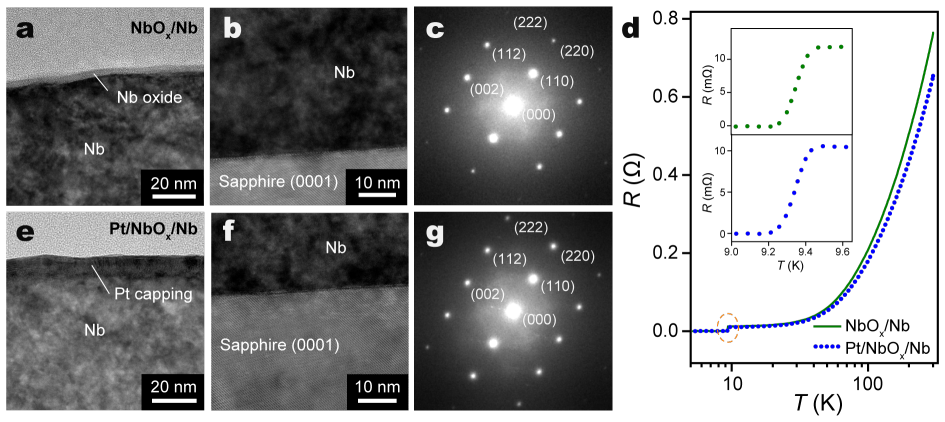
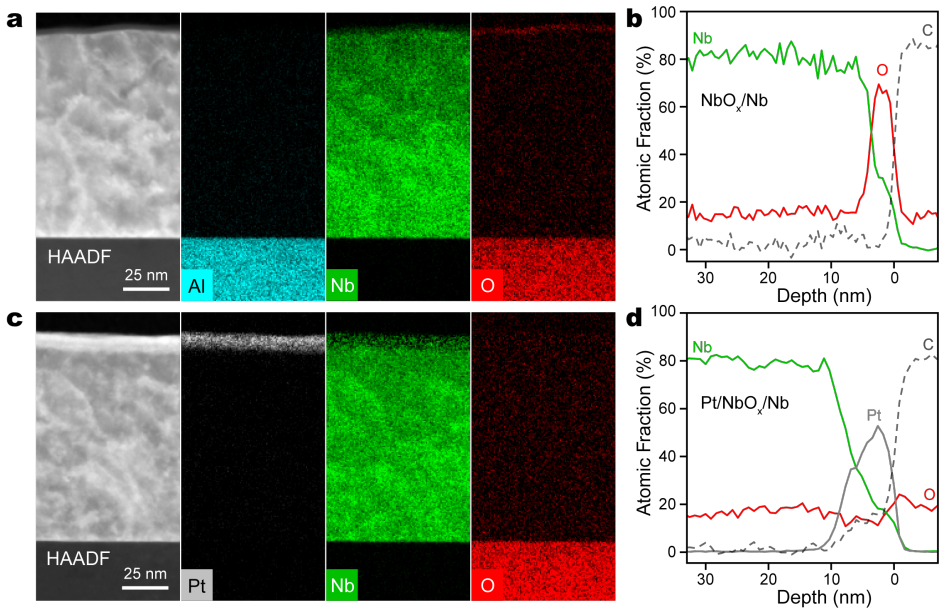
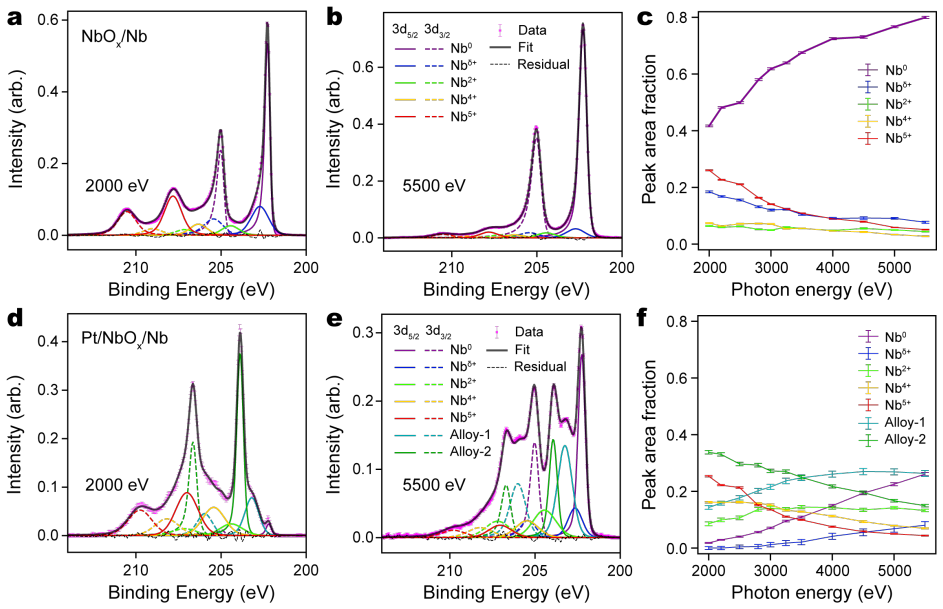
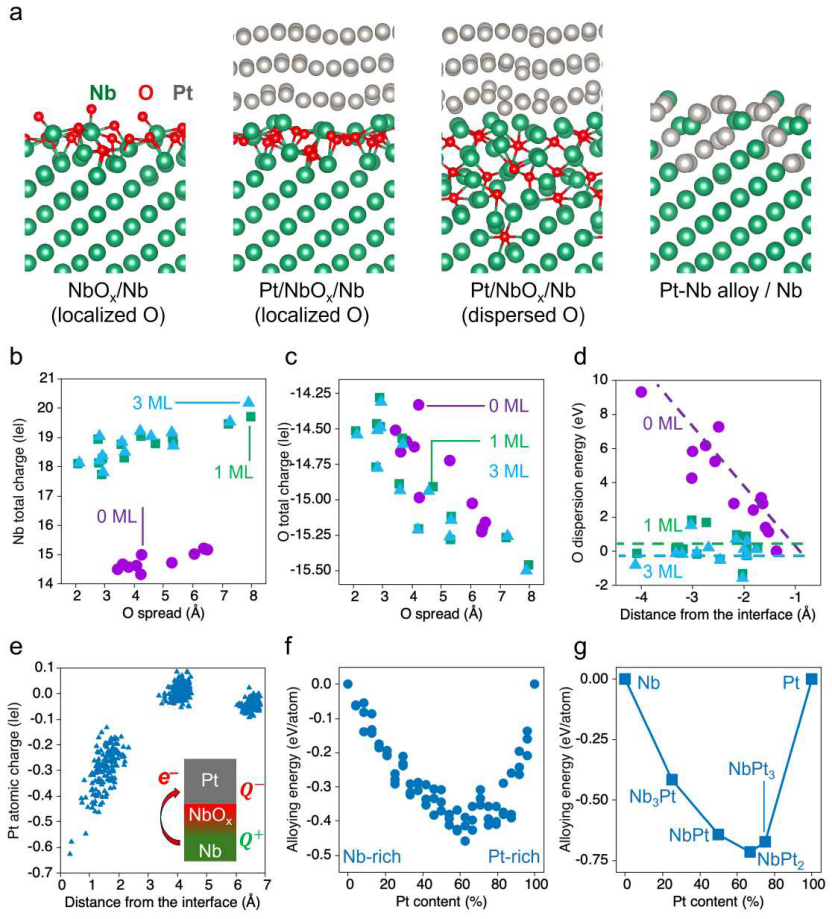
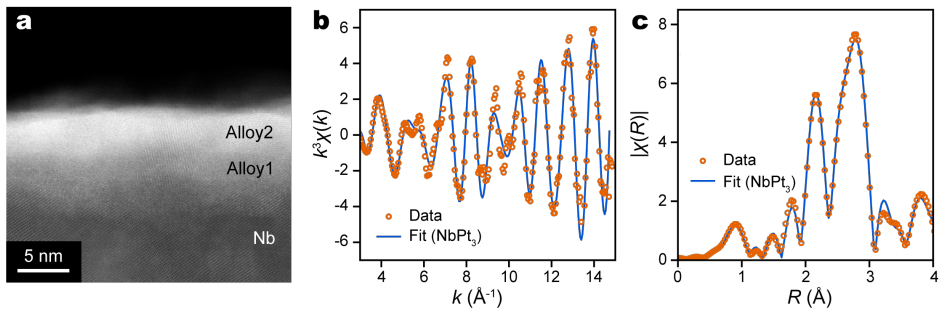
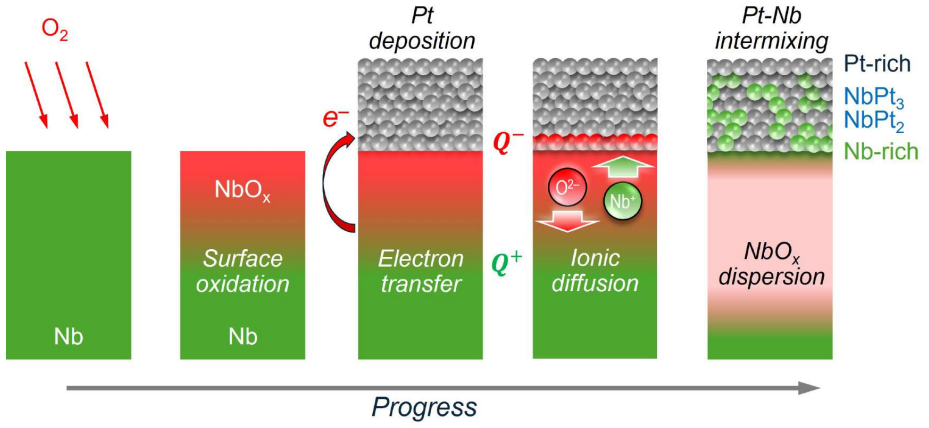
Dielectric loss arising from two-level systems (TLS) at surfaces and interfaces remains a primary limitation to coherence in superconducting transmon qubits. Niobium (Nb), a widely used material in superconducting quantum circuits, readily forms native oxides under ambient conditions, leading to lossy dielectric interfaces that degrade device performance. Here, a robust and scalable fabrication strategy is demonstrated for chemically stabilizing Nb surfaces and mitigating further oxidation, including protection of both surface and sidewall regions. High-purity Nb films were fabricated with bulk-like superconducting transition temperatures ($T_c = 9.30\pm0.10$) K. We demonstrate that a thin Pt encapsulation layer, deposited after native oxide formation, can be transformed via thermal annealing into a Nb-Pt alloy at the surface. Spectroscopic and microscopic analyses confirm the formation of a chemically stable metallic alloy layer and its ability to suppress further oxide growth. Ab initio simulations elucidate the atomic-scale rearrangement and electronic structure evolution associated with Pt incorporation on native niobium oxide, providing insight into the stabilization mechanism of the alloyed surface. This approach offers a materials pathway for engineering chemically robust Nb interfaces, including sidewalls, toward higher-coherence superconducting qubit architectures."
Editorial analysis
A structured set of objections, weighed in public.
Referee Report
Summary. The manuscript demonstrates a fabrication strategy for passivating Nb surfaces in superconducting circuits: after native oxide formation on high-purity Nb films (Tc = 9.30 ± 0.10 K), a thin Pt encapsulation layer is deposited and transformed by thermal annealing into a surface Nb-Pt alloy. Spectroscopic and microscopic analyses confirm formation of a chemically stable metallic alloy that suppresses further oxide growth; ab initio simulations provide atomic-scale insight into the rearrangement and electronic structure. The work is framed as offering a materials pathway toward higher-coherence qubit architectures, including sidewall protection.
Significance. If the central materials result holds, the approach supplies a scalable, post-oxide method to stabilize Nb interfaces against further oxidation, which is directly relevant to reducing TLS loss in Nb-based quantum circuits. The combination of experiment and ab initio modeling strengthens the mechanistic understanding. However, the significance for qubit coherence remains conditional on the untested premise that the alloy introduces no new loss channels; the manuscript provides no device metrics to evaluate this.
major comments (2)
- [Abstract] Abstract: The central framing that the Nb-Pt alloy enables 'higher-coherence superconducting qubit architectures' rests on the assumption that the alloyed interface preserves or improves qubit-relevant performance and introduces no new loss mechanisms. No transmon, resonator, or other device structures are fabricated, and no T1/T2, TLS density, or comparison to untreated Nb controls are reported. This leaves the key performance claim untested and load-bearing for the stated motivation.
- [Abstract] The manuscript reports bulk-like Tc = 9.30 ± 0.10 K for the Nb films but provides no details on measurement method, sample statistics, or comparison to controls in the main text or supplementary information. This datum is used to establish film quality yet lacks the supporting data needed to evaluate its reliability.
minor comments (1)
- [Abstract] The abstract states that 'spectroscopic, microscopic, and ab initio analyses confirm the claims' but supplies no quantitative metrics, error bars, or sample sizes; these should be summarized with references to specific figures or tables.
Simulated Author's Rebuttal
We thank the referee for the constructive review and for highlighting points that improve the clarity and accuracy of our presentation. We address each major comment below and will incorporate revisions accordingly.
read point-by-point responses
-
Referee: [Abstract] Abstract: The central framing that the Nb-Pt alloy enables 'higher-coherence superconducting qubit architectures' rests on the assumption that the alloyed interface preserves or improves qubit-relevant performance and introduces no new loss mechanisms. No transmon, resonator, or other device structures are fabricated, and no T1/T2, TLS density, or comparison to untreated Nb controls are reported. This leaves the key performance claim untested and load-bearing for the stated motivation.
Authors: We agree that the abstract language positions the result as a pathway toward higher-coherence qubits without direct device-level validation, which overstates the immediate performance implications. The manuscript is a materials study demonstrating chemical stabilization and oxide suppression; no claim of measured coherence improvement was intended. We will revise the abstract to emphasize the demonstrated metallic alloy formation and its ability to suppress further oxidation, while qualifying the motivation as providing a scalable interface-engineering approach whose impact on TLS loss and qubit metrics remains to be tested in future device work. revision: yes
-
Referee: [Abstract] The manuscript reports bulk-like Tc = 9.30 ± 0.10 K for the Nb films but provides no details on measurement method, sample statistics, or comparison to controls in the main text or supplementary information. This datum is used to establish film quality yet lacks the supporting data needed to evaluate its reliability.
Authors: We acknowledge that the Tc value is presented without accompanying experimental details. In the revised manuscript we will add a methods subsection describing the measurement technique (four-probe resistivity), the number of samples measured, the observed transition width, and a direct comparison to literature values for bulk Nb, with the raw data placed in the supplementary information. revision: yes
Circularity Check
No circularity; experimental results are self-contained
full rationale
The paper reports an experimental materials demonstration: Nb film fabrication, Pt deposition, thermal annealing to form a surface alloy, followed by spectroscopic/microscopic characterization and separate ab initio simulations. No equations, fitted parameters, or predictions are presented that reduce by construction to the inputs. No self-citations are invoked as load-bearing uniqueness theorems or ansatzes. The central claim rests on direct measurements and external computation rather than any of the enumerated circular patterns. The qubit-coherence framing in the abstract is an application goal, not a derived result within the paper.
Axiom & Free-Parameter Ledger
axioms (1)
- domain assumption Niobium readily forms native oxides under ambient conditions leading to lossy dielectric interfaces.
Reference graph
Works this paper leans on
-
[1]
J. M. Martinis,Quantum Entanglement and Information Processing, edited by D. Est` eve, J.-M. Raimond, and J. Dalibard, Les Houches, Vol. 79 (Elsevier, 2004) pp. 487–520
2004
-
[2]
Kjaergaard, M
M. Kjaergaard, M. E. Schwartz, J. Braum¨ uller, P. Krantz, J. I.-J. Wang, S. Gustavsson, and W. D. Oliver, Superconducting qubits: Current state of play, Annual Review of Condensed Matter Physics11, 369 (2020)
2020
-
[3]
C. Wang, C. Axline, Y. Y. Gao, T. Brecht, Y. Chu, L. Frunzio, M. H. Devoret, and R. J. Schoelkopf, Surface participation and dielectric loss in superconducting qubits, Applied Physics Letters107, 162601 (2015)
2015
-
[4]
O. Dial, D. T. McClure, S. Poletto, J. M. Gambetta, D. W. Abraham, J. M. Chow, and M. Steffen, Bulk and surface loss in superconducting transmon qubits, Physical Review Ap- plied6, 044005 (2016)
2016
-
[5]
A. P. M. Place, L. V. H. Rodgers, P. Mundada, B. M. Smitham, M. Fitzpatrick, Z. Leng, A. Premkumar, J. Bryon, S. Sussman, G. Cheng, T. Madhavan, H. K. Babla, B. J¨ ack, A. Gyenis, N. Yao, R. J. Cava, N. P. de Leon, and A. A. Houck, New material platform for superconducting transmon qubits with coherence times exceeding 0.3 milliseconds, Nature Materials20...
2021
-
[6]
A. Chattaraj, M. Liu, A. K. Anbalagan, and J. Cho, Materials studies of niobium thin films for quantum circuit applications: Progress and challenges, Advanced Quantum Technologies 9, 10.1002/qute.202500763 (2025)
-
[7]
Anferov, K.-H
A. Anferov, K.-H. Lee, F. Zhao, J. Simon, and D. I. Schuster, Improved coherence in optically defined niobium trilayer-junction qubits, Physical Review Applied21, 024047 (2024)
2024
-
[8]
A. A. Murthy, P. M. Das, S. M. Ribet, C. Kopas, J. Lee, M. J. Reagor, L. Zhou, M. J. Kramer, M. C. Hersam, M. Checchin, A. Grassellino, R. dos Reis, V. P. Dravid, and A. Romanenko, Developing a chemical and structural understanding of the surface oxide in a niobium super- conducting qubit, ACS Nano16, 17257 (2022)
2022
-
[9]
Kalboussi, I
Y. Kalboussi, I. Curci, F. Miserque, D. Troadec, N. Brun, M. Walls, G. Jullien, F. Eozenou, M. Baudrier, and et al., Crystallinity in niobium oxides: A pathway to mitigate two-level- 48 system defects in niobium three-dimensional resonators for quantum applications, Physical Review Applied23, 044023 (2025)
2025
-
[10]
Berman, A
S. Berman, A. Zhussupbekova, B. Walls, K. Walshe, S. I. Bozhko, A. Ionov, D. D. O’Regan, I. V. Shvets, and K. Zhussupbekov, Unraveling the atomic and electronic structure of nanocrys- tals on superconducting nb(110): Impact of the oxygen monolayer, Physical Review B107, 165425 (2023)
2023
-
[11]
Verjauw, A
J. Verjauw, A. Potoˇ cnik, M. Mongillo, R. Acharya, F. Mohiyaddin, G. Simion, A. Pacco, T. Ivanov, D. Wan, and et al., Investigation of microwave loss induced by oxide regrowth in high-q niobium resonators, Physical Review Applied16, 014018 (2021)
2021
-
[12]
Premkumar, C
A. Premkumar, C. Weiland, S. Hwang, B. J¨ ack, A. P. M. Place, I. Waluyo, A. Hunt, V. Bisogni, J. Pelliciari, A. Barbour, M. S. Miller, P. Russo, F. Camino, K. Kisslinger, X. Tong, M. S. Hybertsen, A. A. Houck, and I. Jarrige, Microscopic relaxation channels in materials for superconducting qubits, Communications Materials2, 72 (2021)
2021
-
[13]
M. V. P. Alto´ e, A. Banerjee, C. Berk, A. Hajr, A. Schwartzberg, C. Song, M. Alghadeer, S. Aloni, M. J. Elowson,et al., Localization and mitigation of loss in niobium superconducting circuits, PRX Quantum3, 020312 (2022)
2022
-
[14]
C. J. Kopas, D. P. Goronzy, T. Pham, C. G. Torres Castanedo, M. Cheng, R. Cochrane, P. Nast, E. Lachman, N. Z. Zhelev, A. Valli` eres, and et al., Enhanced superconducting qubit performance through ammonium fluoride etch, Materials for Quantum Technology4, 045101 (2024)
2024
-
[15]
C. G. Torres-Castanedo, D. P. Goronzy, T. Pham, A. McFadden, N. Materise, P. M. Das, M. Cheng, D. Lebedev, S. M. Ribet, and et al., Formation and microwave losses of hydrides in superconducting niobium thin films resulting from fluoride chemical processing, Advanced Functional Materials34, 2401365 (2024)
2024
-
[16]
C. T. Earnest, J. H. B´ ejanin, T. G. McConkey, E. A. Peters, A. Korinek, H. Yuan, and M. Mariantoni, Substrate surface engineering for high-quality silicon/aluminum supercon- ducting resonators, Superconductor Science and Technology31, 125013 (2018)
2018
-
[17]
Zheng, D
K. Zheng, D. Kowsari, N. J. Thobaben, X. Du, X. Song, S. Ran, E. A. Henriksen, D. S. Wis- bey, and K. W. Murch, Nitrogen plasma passivated niobium resonators for superconducting quantum circuits, Applied Physics Letters120, 102601 (2022). 49
2022
-
[18]
Alghadeer, A
M. Alghadeer, A. Banerjee, K. Lee, H. Hussein, H. Fariborzi, and S. Rao, Mitigating coherent loss in superconducting circuits using molecular self-assembled monolayers, Scientific Reports 14, 27340 (2024)
2024
-
[19]
S. Kar, C. Weiland, C. Zhou, E. Bhatia, B. Martinick, J. Nalaskowski, J. Mucci, S. Olson, P. Y. Hung, I. Wells, H. Frost, C. S. Johnson, T. Murray, V. Kaushik, S. Kirkpatrick, K. Chau, M. J. Walsh, M. Liu, and S. S. P. Rao, Engineering of niobium surfaces through accelerated neutral atom beam technology for quantum applications, Journal of Applied Physics...
2023
-
[20]
M. Calero de Ory, V. Rollano, D. Rodriguez, M. T. Magaz, D. Granados, and A. Gomez, Low loss hybrid nb/au superconducting resonators for quantum circuit applications, Advanced Quantum Technologies 10.1002/qute.202400699 (2025)
-
[21]
M. Bal, A. A. Murthy, S. Zhu, F. Crisa, X. You, Z. Huang, T. Roy, J. Lee, D. van Zanten, R. Pilipenko, I. Nekrashevich, A. Lunin, D. Bafia, Y. Krasnikova, C. J. Kopas, E. O. Lachman, D. Miller, J. Y. Mutus, M. J. Reagor, H. Cansizoglu, J. Marshall, D. P. Pappas, K. Vu, K. Yadavalli,et al., Systematic improvements in transmon qubit coherence enabled by nio...
2024
-
[22]
R. D. Chang, N. Shumiya, R. A. McLellan, Y. Zhang, M. P. Bland, F. Bahrami, J. Mun, C. Zhou, K. Kisslinger, G. Cheng, B. M. Smitham, A. C. Pakpour-Tabrizi, N. Yao, Y. Zhu, M. Liu, R. J. Cava, S. Gopalakrishnan, A. A. Houck, and N. P. de Leon, Eliminating surface oxides of superconducting circuits with noble metal encapsulation, Physical Review Letters 134...
2025
-
[23]
A. T. Chattaraj, T. Nanayakkara, A. K. Anbalagan, X. Tong, K. T. Kisslinger, A. L. Walter, T. Brower-Thomas, and M. Liu, Preventing native oxide formation in niobium thin films through platinum encapsulation, Vacuum , 114850 (2025)
2025
-
[24]
Prudnikava, Y
A. Prudnikava, Y. Tamashevich, S. Babenkov, A. Makarova, D. Smirnov, V. Aristov, O. Molodtsova, O. Kugeler, J. Viefhaus, and B. Foster, Systematic study of niobium ther- mal treatments for superconducting radio frequency cavities employing x-ray photoelectron spectroscopy, Superconductor Science and Technology35, 065019 (2022)
2022
-
[25]
A. Dacc` a, G. Gemme, L. Mattera, and R. Parodi, Xps analysis of the surface compo- sition of niobium for superconducting rf cavities, Applied Surface Science 10.1016/S0169- 4332(97)00790-3 (1998). 50
-
[26]
C. E. Nwanna, P. E. Imoisili, and T.-C. Jen, Preparation and characterization of nbxoy thin films: A review, Coatings10, 1246 (2020)
2020
-
[27]
Naito and T
K. Naito and T. Matsui, Review on phase equilibria and defect structures in the niobium- oxygen system, Solid State Ionics12, 125 (1984)
1984
-
[28]
S. L. Hemmingson and C. T. Campbell, Trends in adhesion energies of metal nanoparticles on oxide surfaces: Understanding support effects in catalysis and nanotechnology, ACS Nano 11, 1196 (2017)
2017
-
[29]
A. Jain, S. P. Ong, G. Hautier, W. Chen, W. D. Richards, S. Dacek, S. Cholia, D. Gunter, D. Skinner, G. Ceder, and K. a. Persson, The Materials Project: A materials genome approach to accelerating materials innovation, APL Materials1, 011002 (2013)
2013
-
[30]
Ravel and M
B. Ravel and M. Newville, ATHENA, ARTEMIS, HEPHAESTUS: data analysis for X-ray absorption spectroscopy using IFEFFIT, Journal of Synchrotron Radiation12, 537 (2005)
2005
-
[31]
Kresse and J
G. Kresse and J. Furthm¨ uller, Efficient iterative schemes for ab initio total-energy calculations using a plane-wave basis set, Physical Review B54, 11169 (1996)
1996
-
[32]
J. P. Perdew, K. Burke, and M. Ernzerhof, Generalized gradient approximation made simple, Physical Review Letters77, 3865 (1996)
1996
-
[33]
P. E. Bl¨ ochl, Projector augmented-wave method, Physical Review B50, 17953 (1994)
1994
-
[34]
Henkelman, A
G. Henkelman, A. Arnaldsson, and H. J´ onsson, A fast and robust algorithm for bader decom- position of charge density, Computational Materials Science36, 354 (2006)
2006
-
[35]
Naito and T
K. Naito and T. Matsui, Review on phase equilibria and defect structures in the niobium- oxygen system, Solid State Ionics12, 125 (1984). 51
1984
discussion (0)
Sign in with ORCID, Apple, or X to comment. Anyone can read and Pith papers without signing in.