Slow heat-driven flow in a gas of hard disks
Pith reviewed 2026-07-02 05:38 UTC · model grok-4.3
The pith
Incorporating a non-ideal hard-disk equation of state extends isobaric hydrodynamics to match simulations of slow heat-driven flows at finite densities.
A machine-rendered reading of the paper's core claim, the machinery that carries it, and where it could break.
Core claim
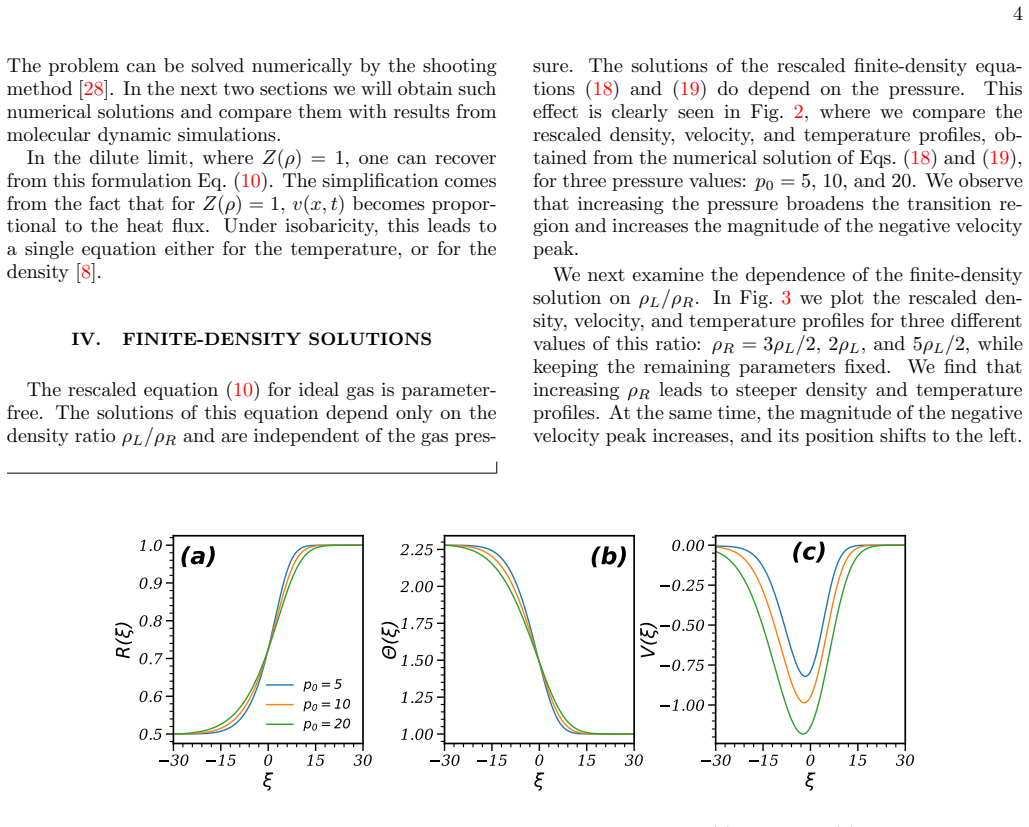
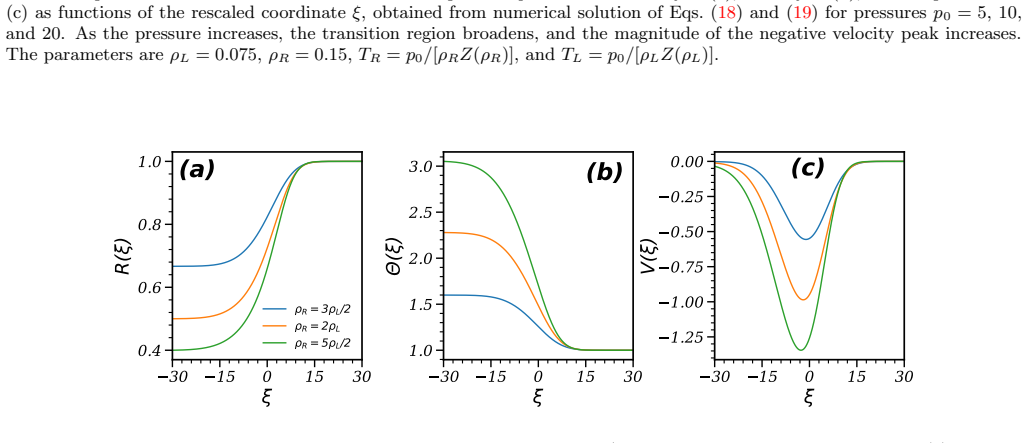
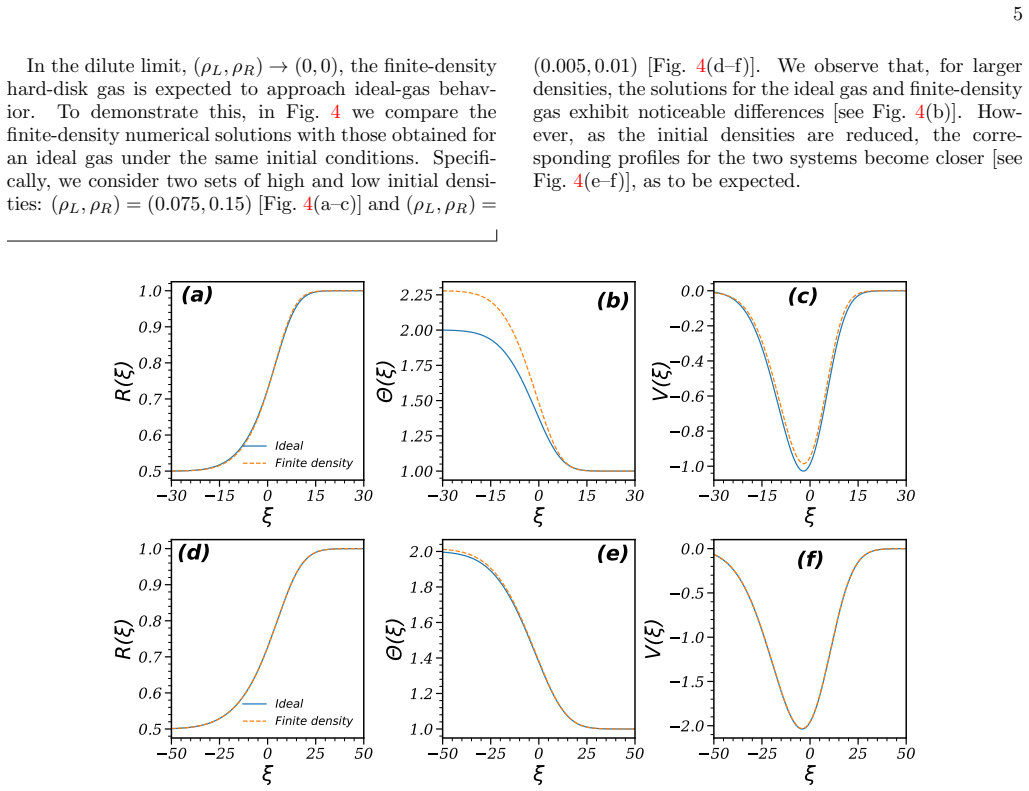
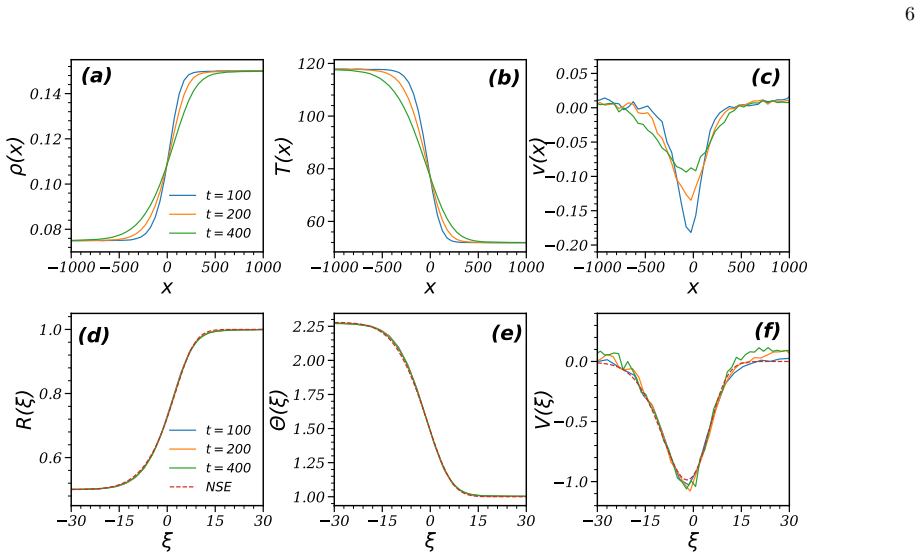
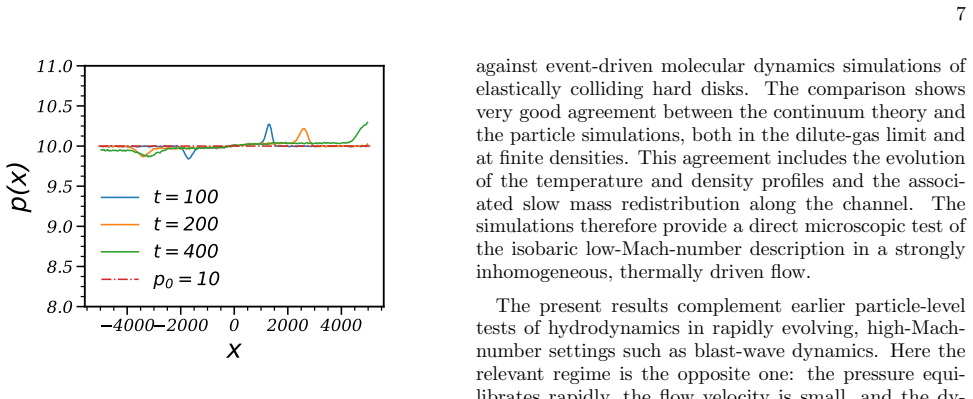
We extend the ideal-gas isobaric hydrodynamic theory to finite densities by incorporating a non-ideal equation of state of a hard-disk fluid, and solve the resulting one-dimensional equations numerically. Finite-density effects produce appreciable deviations from the ideal-gas prediction. We then test the theory directly against event-driven molecular dynamics simulations of hard disks and find very good agreement in both the dilute and finite-density regimes. The results provide the first particle-level test of isobaric gas dynamics of a strongly inhomogeneous cooling flow.
What carries the argument
The closed one-dimensional isobaric hydrodynamic equations supplied with the non-ideal hard-disk equation of state.
If this is right
- The ideal-gas description underestimates or overestimates the flow evolution once density becomes appreciable.
- Numerical solutions of the extended system can replace full particle simulations for this class of nearly isobaric cooling problems.
- The same reduction applies to both dilute and moderately dense hard-disk gases under the stated initial conditions.
- The low-Mach isobaric approximation is validated at the particle level for strongly inhomogeneous temperature profiles.
Where Pith is reading between the lines
- The same non-ideal correction could be inserted into isobaric models of other confined molecular or granular gases that start with pressure balance.
- Similar reductions might be tested in two-dimensional systems with different interaction potentials to check how much the agreement depends on the hard-disk equation of state.
- The framework offers a route to benchmark hydrodynamic closures against event-driven simulations without needing to resolve the full compressible equations.
- If the low-Mach assumption holds, the method could be used to explore parameter regimes that are expensive to simulate directly.
Load-bearing premise
The flow remains low-Mach-number and nearly isobaric, allowing the full hydrodynamic equations to collapse to a closed one-dimensional system.
What would settle it
Event-driven molecular-dynamics trajectories at finite density that systematically deviate from the numerical solutions of the extended isobaric equations would falsify the claim.
Figures
read the original abstract
We study a slow heat-driven flow in a gas of elastically colliding hard disks confined to a long channel. The initial state consists of two regions with large temperature and density contrasts but nearly equal pressures, leading to a low-Mach-number, nearly isobaric evolution. In the dilute limit, the corresponding isobaric hydrodynamic theory reduces to a previously known ideal-gas description. We extend this theory to finite densities by incorporating a non-ideal equation of state of a hard-disk fluid, and solve the resulting one-dimensional equations numerically. Finite-density effects produce appreciable deviations from the ideal-gas prediction. We then test the theory directly against event-driven molecular dynamics simulations of hard disks and find very good agreement in both the dilute and finite-density regimes. The results provide, to our knowledge, the first particle-level test of isobaric gas dynamics of a strongly inhomogeneous cooling flow.
Editorial analysis
A structured set of objections, weighed in public.
Referee Report
Summary. The manuscript studies slow heat-driven flow in a confined gas of hard disks with initial large temperature and density contrasts but nearly equal pressures, leading to low-Mach nearly isobaric evolution. It extends the known ideal-gas isobaric hydrodynamic description to finite densities by incorporating a non-ideal hard-disk equation of state, solves the resulting one-dimensional equations numerically, and reports very good agreement with event-driven molecular dynamics simulations in both dilute and finite-density regimes, claiming the first particle-level test of isobaric gas dynamics for strongly inhomogeneous cooling flows.
Significance. If the low-Mach isobaric reduction remains valid, the work shows that finite-density effects produce appreciable, measurable deviations from ideal-gas predictions that are captured by the extended model. The direct, independent comparison to MD simulations supplies a concrete particle-level validation of the reduced description, which is a notable strength for applications to moderately dense molecular or granular systems.
major comments (1)
- [Hydrodynamic theory and numerical solution] The reduction to a closed 1D isobaric system (described in the extension of the hydrodynamic theory) retains the ideal-gas form of the continuity and energy equations while modifying only the EOS. At finite packing fraction this is potentially inconsistent because the non-ideal EOS changes the adiabatic sound speed and effective thermal diffusivity, which can make pressure-equilibration timescales comparable to the heat-driven flow time. No explicit diagnostic (maximum local Mach number or |∇p|/p) is reported from the MD runs to confirm the assumption survives in the dense regime where deviations are claimed to be appreciable.
Simulated Author's Rebuttal
We thank the referee for the careful reading and constructive comment. We address the concern about the validity of the isobaric reduction at finite density below and will strengthen the manuscript with the requested diagnostics.
read point-by-point responses
-
Referee: The reduction to a closed 1D isobaric system (described in the extension of the hydrodynamic theory) retains the ideal-gas form of the continuity and energy equations while modifying only the EOS. At finite packing fraction this is potentially inconsistent because the non-ideal EOS changes the adiabatic sound speed and effective thermal diffusivity, which can make pressure-equilibration timescales comparable to the heat-driven flow time. No explicit diagnostic (maximum local Mach number or |∇p|/p) is reported from the MD runs to confirm the assumption survives in the dense regime where deviations are claimed to be appreciable.
Authors: We agree that an explicit check of the low-Mach assumption is desirable, especially where finite-density deviations are appreciable. The non-ideal EOS does alter the sound speed, so the pressure-equilibration time could in principle approach the flow time scale. However, the quantitative agreement we obtain between the extended hydrodynamic model and the MD simulations in the dense regime already indicates that the separation of time scales remains intact. To directly address the point, we will extract and report the maximum local Mach number together with the relative pressure variation |∇p|/p from the MD data for both the dilute and dense cases. These quantities will be added to the revised manuscript (likely as a new panel or table) and will confirm that Mach numbers stay well below 0.1 while |∇p|/p remains ≪ 1. We will also insert a short paragraph clarifying that the continuity and energy equations retain their ideal-gas form under the asymptotic low-Mach isobaric reduction even when the EOS is non-ideal, because the leading-order pressure is spatially uniform by construction. This constitutes a major revision. revision: yes
Circularity Check
No circularity: derivation uses external EOS and validates against independent MD
full rationale
The paper takes the ideal-gas isobaric reduction as given from prior literature, inserts a non-ideal hard-disk EOS also drawn from prior literature, solves the resulting 1D system numerically, and compares the output profiles directly to separate event-driven MD runs. No equation is defined in terms of its own output, no fitted parameter is relabeled as a prediction, and no load-bearing step reduces to a self-citation whose content is itself unverified. The central claim therefore rests on external benchmarks rather than on internal re-derivation.
Axiom & Free-Parameter Ledger
axioms (2)
- domain assumption The flow remains low-Mach-number and nearly isobaric throughout the evolution
- domain assumption A non-ideal equation of state for the hard-disk fluid is available and accurate
Reference graph
Works this paper leans on
-
[1]
R. G. Rehm and H. R. Baum, J. Res. Natl. Bur. Stand. 83, 297 (1978)
1978
-
[2]
Majda and J
A. Majda and J. Sethian, Combust. Sci. Technol.42, 185 (1985)
1985
-
[3]
Majda,Compressible Fluid Flow and Systems of Con- servation Laws in Several Space Variables(Springer Sci- ence & Business Media, 2012)
A. Majda,Compressible Fluid Flow and Systems of Con- servation Laws in Several Space Variables(Springer Sci- ence & Business Media, 2012)
2012
-
[4]
F. A. Williams,Combustion Theory, 2nd ed. (Benjamin Cummings, Menlo Park, CA, 1985) p. 445
1985
-
[5]
Poinsot and D
T. Poinsot and D. Veynante,Theoretical and Numerical Combustion(RT Edwards, Inc., 2005)
2005
-
[6]
Ogura and N
Y. Ogura and N. A. Phillips, J. Atmos. Sci.19, 173 (1962)
1962
-
[7]
D. R. Durran, J. Atmos. Sci.46, 1453 (1989)
1989
-
[8]
Meerson, Phys
B. Meerson, Phys. Fluids A1, 887 (1989)
1989
-
[9]
Kaganovich, B
D. Kaganovich, B. Meerson, A. Zigler, C. Cohen, and J. Levin, Phys. Plasmas3, 631 (1996)
1996
-
[10]
Glasner, E
A. Glasner, E. Livne, and B. Meerson, Phys. Rev. Lett. 78, 2112 (1997)
1997
-
[11]
Meerson, P
B. Meerson, P. V. Sasorov, and K. Sekimoto, Phys. Rev. E61, 1403 (2000)
2000
-
[12]
Kamin and L
S. Kamin and L. Dascal, inOptimal Control and Partial Differential Equations, edited by J. L. Menaldi, E. Rof- man, and A. Sulem (IOS Press, Amsterdam, 2001) pp. 171–180
2001
-
[13]
Goldhirsch, Annu
I. Goldhirsch, Annu. Rev. Fluid Mech.35, 267 (2003)
2003
-
[14]
Bromberg, E
Y. Bromberg, E. Livne, and B. Meerson, inGranular Gas Dynamics, Lecture Notes in Physics, Vol. 624, edited by T. P¨ oschel and N. Brilliantov (Springer, Berlin, 2003) pp. 251–266. 8
2003
-
[15]
Volfson, B
D. Volfson, B. Meerson, and L. S. Tsimring, Phys. Rev. E73, 061305 (2006)
2006
-
[16]
J. P. Joy, S. N. Pathak, and R. Rajesh, J. Stat. Phys. 182, 1 (2021)
2021
-
[17]
J. P. Joy and R. Rajesh, J. Stat. Phys.184, 1 (2021)
2021
-
[18]
Chakraborti, S
S. Chakraborti, S. Ganapa, P. L. Krapivsky, and A. Dhar, Phys. Rev. Lett.126, 244503 (2021)
2021
-
[19]
Ganapa, S
S. Ganapa, S. Chakraborti, P. L. Krapivsky, and A. Dhar, Phys. Fluids33, 087113 (2021)
2021
-
[20]
Chakraborti, A
S. Chakraborti, A. Dhar, and P. Krapivsky, SciPost Phys. 13, 074 (2022)
2022
-
[21]
Kumar and R
A. Kumar and R. Rajesh, J. Stat. Phys.188, 1 (2022)
2022
-
[22]
S. K. Singh, S. Chakraborti, A. Dhar, and P. L. Krapivsky, J. Stat. Phys.190, 118 (2023)
2023
-
[23]
Kumar and R
A. Kumar and R. Rajesh, J. Stat. Phys.192, 121 (2025)
2025
-
[24]
Kumar and R
A. Kumar and R. Rajesh, J. Stat. Phys.192, 17 (2025)
2025
-
[25]
Kumar and R
A. Kumar and R. Rajesh, J. Stat. Phys.192, 119 (2025)
2025
-
[26]
Kumar, A
U. Kumar, A. Dhar, and P. Krapivsky, J. Stat. Mech. Theory Exp.2026, 023216 (2026)
2026
-
[27]
G. I. Barenblatt,Scaling, Self-similarity, and Intermedi- ate Asymptotics: Dimensional Analysis and Intermediate Asymptotics(Cambridge University Press, Cambridge, UK, 1996)
1996
-
[28]
Stoer and R
J. Stoer and R. Bulirsch,Introduction to Numerical Anal- ysis(Springer-Verlag, New York, 1980)
1980
-
[29]
Barrat and E
A. Barrat and E. Trizac, Phys. Rev. E66, 051303 (2002)
2002
-
[30]
L. D. Landau and E. M. Lifshitz,Fluid Mechanics, Course of Theoretical Physics, Vol. 6 (Butterworth- Heinemann, Oxford, UK, 1987)
1987
-
[31]
Z. U. A. Warsi,Fluid Dynamics: Theoretical and Com- putational Approaches(CRC Press, 2005)
2005
-
[32]
Huang,Statistical Mechanics(John Wiley & Sons, 2008)
K. Huang,Statistical Mechanics(John Wiley & Sons, 2008)
2008
-
[33]
Reif,Fundamentals of Statistical and Thermal Physics (Waveland Press, 2009)
F. Reif,Fundamentals of Statistical and Thermal Physics (Waveland Press, 2009)
2009
-
[34]
J. R. Dorfman, H. van Beijeren, and T. R. Kirkpatrick, Contemporary Kinetic Theory of Matter(Cambridge University Press, 2021)
2021
-
[35]
D. M. Gass, J. Chem. Phys.54, 1898 (1971)
1971
-
[36]
Garc´ ıa-Rojo, S
R. Garc´ ıa-Rojo, S. Luding, and J. J. Brey, Phys. Rev. E 74, 061305 (2006)
2006
-
[37]
G. M. Kremer,An Introduction to the Boltzmann Equa- tion and Transport Processes in Gases(Springer Science & Business Media, 2010)
2010
-
[38]
B. J. Alder and T. Wainwright, Physical review A1, 18 (1970)
1970
-
[39]
Ernst, E
M. Ernst, E. Hauge, and J. Van Leeuwen, Phys. Rev. Lett.25, 1254 (1970)
1970
-
[40]
Pomeau and P
Y. Pomeau and P. R´ esibois, Phys. Rep.19, 63 (1975)
1975
-
[41]
D. C. Rapaport,The Art of Molecular Dynamics Simu- lation(Cambridge University Press, 2004)
2004
-
[42]
Isobe, Mol
M. Isobe, Mol. Simul.42, 1317 (2016)
2016
discussion (0)
Sign in with ORCID, Apple, or X to comment. Anyone can read and Pith papers without signing in.