Charmonium-nucleon femtoscopy as a possible probe of the nucleon gravitational form factor
Pith reviewed 2026-07-02 10:28 UTC · model grok-4.3
The pith
Charmonium-nucleon correlation functions depend on the nucleon's D-form factor when the interaction is built from gravitational form factors.
A machine-rendered reading of the paper's core claim, the machinery that carries it, and where it could break.
Core claim
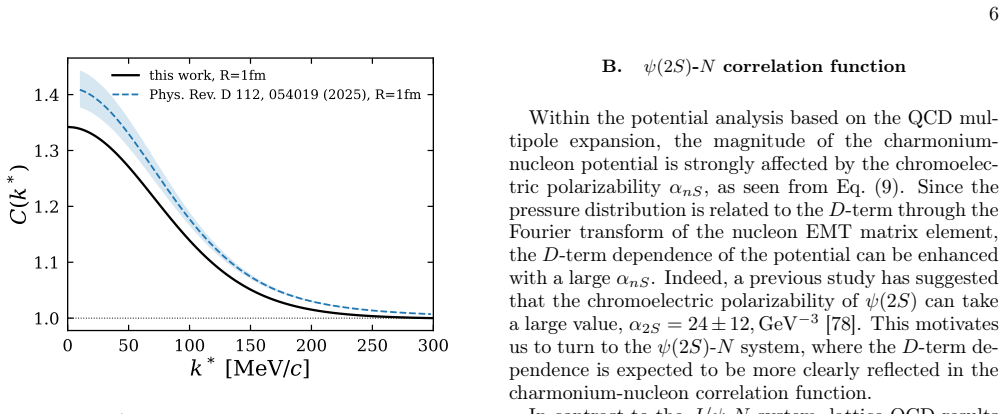
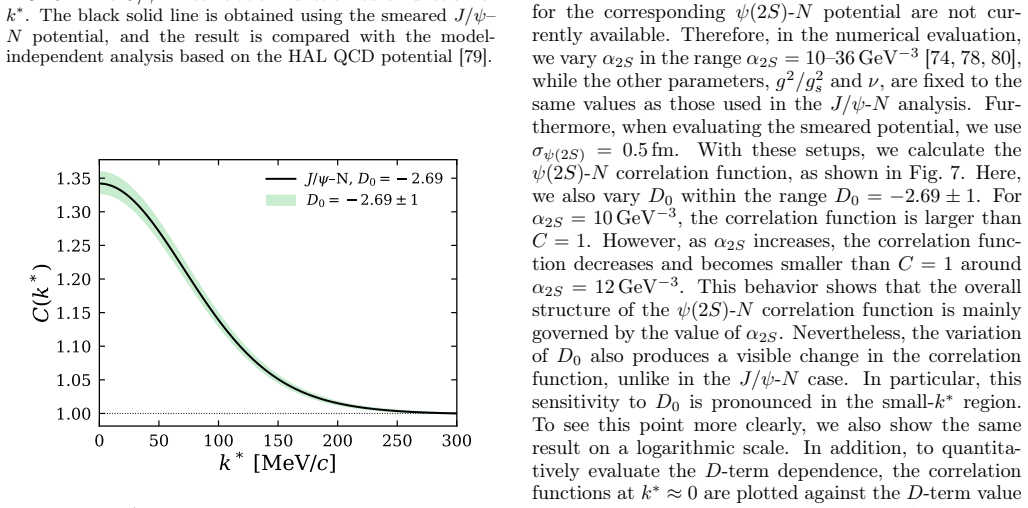
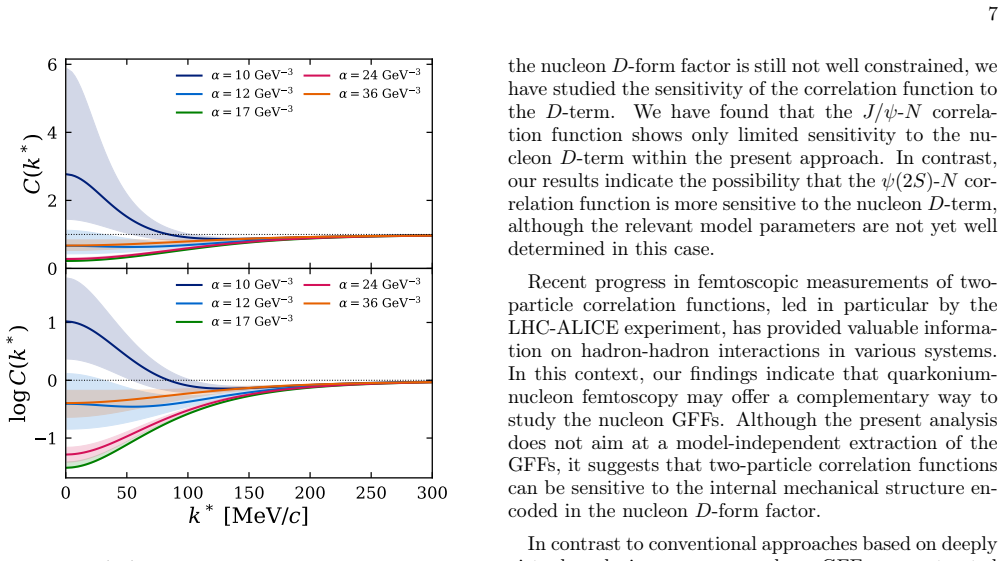
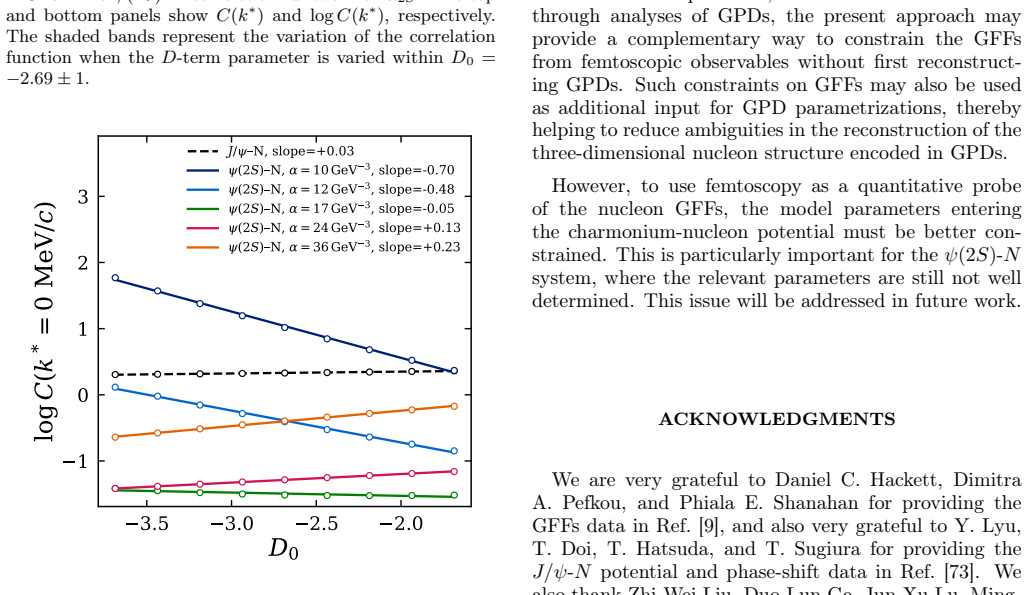
The J/ψ-N and ψ(2S)-N correlation functions, obtained from a potential expressed through lattice-fitted gravitational form factors in the leading chromoelectric dipole approximation and calibrated to HAL QCD data, display measurable sensitivity to the nucleon's D-form factor.
What carries the argument
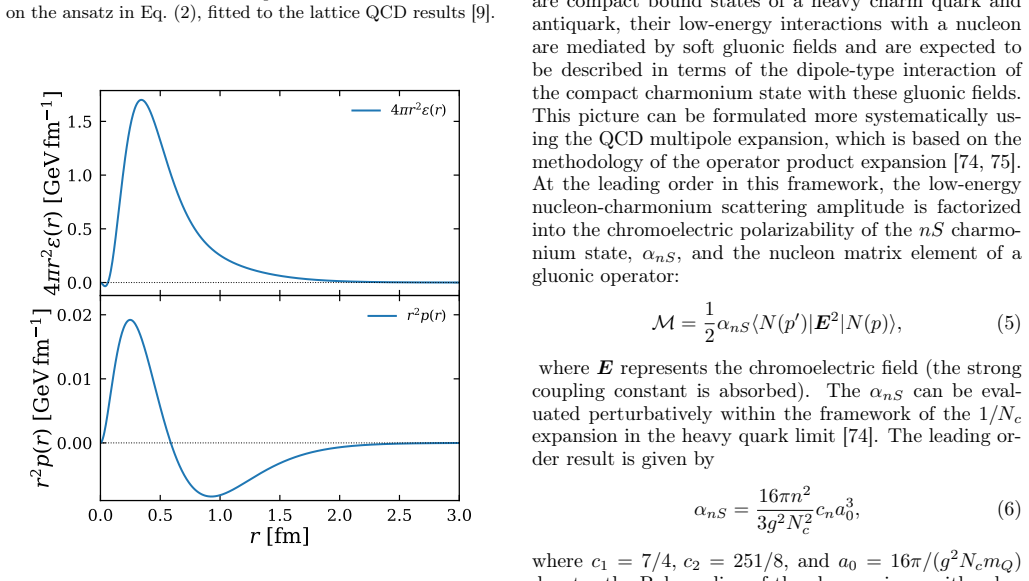
Effective potential from the leading chromoelectric dipole term of the QCD multipole expansion, written in terms of the nucleon's energy and pressure distributions extracted from gravitational form factors.
If this is right
- The correlation function can be inverted to extract or constrain the D-form factor once data become available.
- The same framework applies to the ψ(2S)-N system with only the charmonium wave function changed.
- Femtoscopic measurements in heavy-ion collisions or fixed-target experiments become a practical route to gravitational form factors.
- The method supplies an independent cross-check on lattice determinations of the D-form factor.
Where Pith is reading between the lines
- If the sensitivity survives full QCD corrections, femtoscopy could become a standard tool for mapping the nucleon's mechanical properties.
- The approach could be extended to bottomonium-nucleon systems to test whether the same D-form factor governs both charm and bottom sectors.
- A mismatch between the predicted and measured correlation functions would indicate that higher-order multipole terms or short-distance physics must be included explicitly.
Load-bearing premise
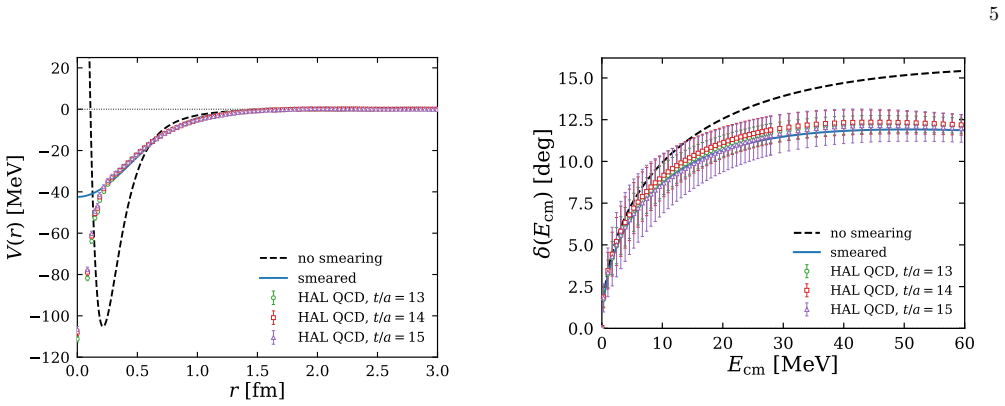
The leading chromoelectric dipole approximation together with energy and pressure distributions taken from lattice gravitational form factors yields a potential whose correlation-function predictions remain reliable once parameters are adjusted to match the HAL QCD J/ψ-N potential at moderate distances.
What would settle it
A lattice or experimental determination of the J/ψ-N correlation function that shows no change when the input D-form factor is varied while all other inputs are held fixed.
Figures
read the original abstract
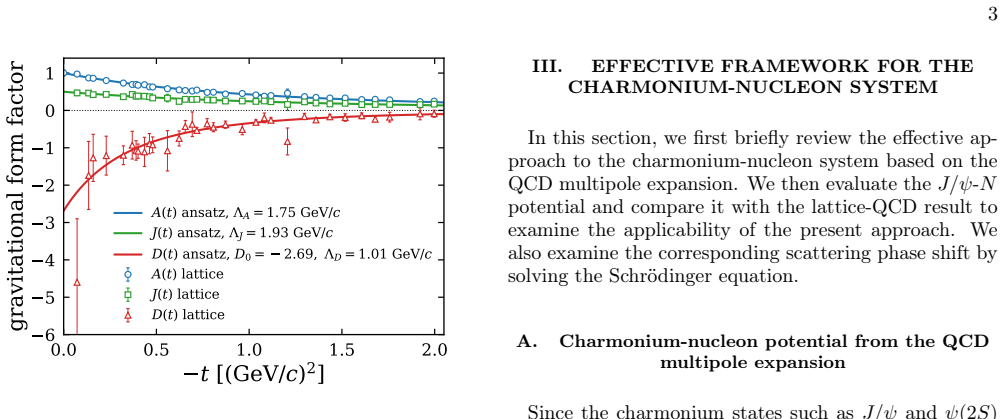
We investigate the charmonium-nucleon interaction, focusing on its connection with the internal structure of the nucleon encoded in the gravitational form factors. To describe this interaction, we employ an effective potential based on the QCD multipole expansion within the leading chromoelectric dipole approximation. In this framework, the potential is expressed in terms of the energy and pressure distributions inside the nucleon. We first construct these distributions from the gravitational form factors fitted to lattice-QCD data. The remaining model parameters are then fixed by requiring that the resulting $J/\psi$-$N$ potential reproduce the HAL QCD potential outside the short-distance region, as well as the scattering phase shift estimated from the HAL QCD data. Based on this potential, we evaluate the $J/\psi$-$N$ correlation function and further investigate the $\psi(2S)$-$N$ system. We then examine the sensitivity of these correlation functions to the nucleon $D$-form factor.
Editorial analysis
A structured set of objections, weighed in public.
Referee Report
Summary. The manuscript claims that femtoscopy of charmonium-nucleon systems can probe the nucleon's D-form factor. An effective potential is constructed via the leading chromoelectric dipole term of the QCD multipole expansion, expressed in terms of the nucleon's energy and pressure distributions obtained from lattice-QCD gravitational form factors. Remaining model parameters are fixed so that the resulting J/ψ-N potential reproduces the HAL QCD result outside short distances and matches estimated phase shifts; correlation functions are then evaluated for the J/ψ-N and ψ(2S)-N systems and their sensitivity to the D-form factor is examined.
Significance. If the sensitivity of the correlation functions to the D-form factor is shown to survive the parameter-fitting step, the work would supply a concrete phenomenological link between femtoscopy observables and the nucleon's gravitational form factors, offering a potential experimental route to the D-term and associated mechanical properties of the nucleon. The combination of lattice GFF inputs with the multipole-expansion potential is a methodological strength that could be tested against forthcoming data.
major comments (1)
- [parameter-fixing procedure] Parameter-fixing procedure (text following construction of the potential from GFFs): after the potential is built from the lattice-fitted energy and pressure distributions (which incorporate the D-term), the remaining free parameters are tuned to reproduce the HAL QCD J/ψ-N potential outside short distances and the associated phase shifts. Because D-term variations primarily alter the potential at intermediate distances, this post-insertion fit can compensate for changes in the D-form factor, leaving open whether the final correlation functions retain independent sensitivity. An explicit test—varying the D-term, refitting the parameters, and demonstrating distinguishable correlation functions—is required to substantiate the central claim.
Simulated Author's Rebuttal
We thank the referee for the careful reading of our manuscript and the constructive comment on the parameter-fixing procedure. We address this point below.
read point-by-point responses
-
Referee: [parameter-fixing procedure] Parameter-fixing procedure (text following construction of the potential from GFFs): after the potential is built from the lattice-fitted energy and pressure distributions (which incorporate the D-term), the remaining free parameters are tuned to reproduce the HAL QCD J/ψ-N potential outside short distances and the associated phase shifts. Because D-term variations primarily alter the potential at intermediate distances, this post-insertion fit can compensate for changes in the D-form factor, leaving open whether the final correlation functions retain independent sensitivity. An explicit test—varying the D-term, refitting the parameters, and demonstrating distinguishable correlation functions—is required to substantiate the central claim.
Authors: We thank the referee for highlighting this subtlety in our fitting procedure. The free parameters in the model (primarily the charmonium size parameter in the dipole approximation and an overall strength factor) are adjusted once to reproduce the HAL QCD potential for r greater than the short-distance cutoff together with the associated phase shifts. The D-form factor enters exclusively through the radial profiles of the energy and pressure distributions, which are taken directly from the lattice GFF parametrization and therefore possess a fixed functional shape. Because these profiles are not arbitrary but are constrained by the lattice data, a limited number of free parameters cannot fully absorb arbitrary changes in the D-term while still matching the HAL QCD results at intermediate distances. Nevertheless, to make the sensitivity claim fully robust we agree that an explicit numerical test—varying the D-term within its lattice uncertainty, refitting the free parameters for each choice, and comparing the resulting correlation functions—is the cleanest way to demonstrate that distinguishable signals survive the fit. We will perform this test and include the corresponding figures and discussion in the revised manuscript. revision: yes
Circularity Check
No significant circularity; derivation relies on external lattice and HAL QCD inputs without reduction by construction
full rationale
The paper constructs energy/pressure distributions from lattice-fitted GFFs, builds an effective potential in the leading chromoelectric dipole approximation, tunes remaining parameters to reproduce the HAL QCD J/ψ-N potential outside short distances plus estimated phase shifts, then computes correlation functions and examines their sensitivity to the D-form factor. No quoted equation or step shows a claimed prediction or result reducing to the inputs by construction (e.g., no self-definitional loop, no fitted quantity renamed as independent prediction, no load-bearing self-citation chain). The procedure is a calibrated model whose sensitivity claim is external to the fit itself and does not equate the output to the input data by definition. This is the normal case of a model using external benchmarks.
Axiom & Free-Parameter Ledger
free parameters (1)
- remaining model parameters
axioms (1)
- domain assumption QCD multipole expansion in the leading chromoelectric dipole approximation accurately describes the charmonium-nucleon interaction
discussion (0)
Sign in with ORCID, Apple, or X to comment. Anyone can read and Pith papers without signing in.