Constraining the model-based uncertainties of asteroseismic magnetic field measurements in red giants
Pith reviewed 2026-07-02 06:16 UTC · model grok-4.3
The pith
The global magnetic sensitivity in red giant models recovers to 10% uncertainty with precise metallicity data.
A machine-rendered reading of the paper's core claim, the machinery that carries it, and where it could break.
Core claim
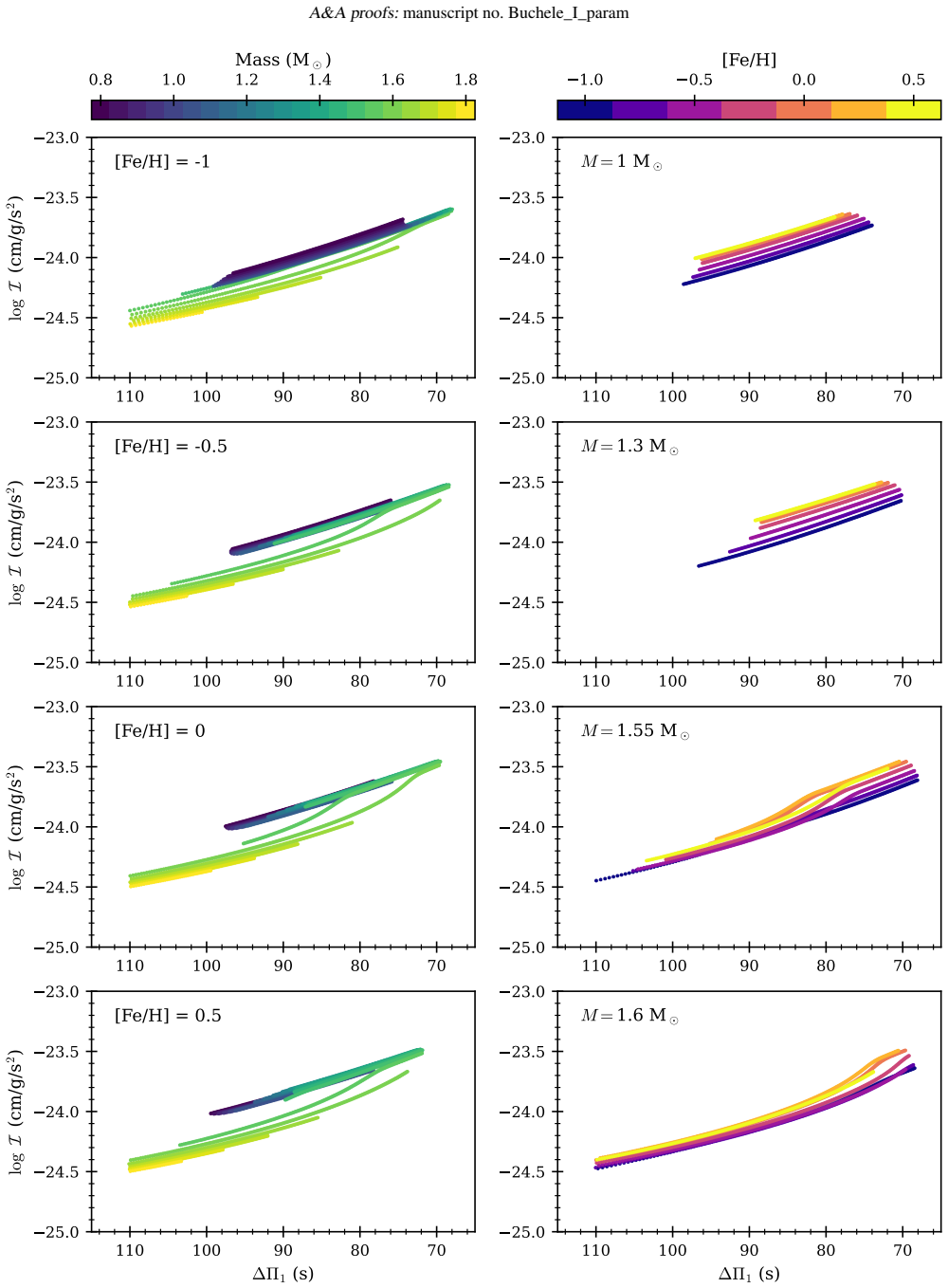
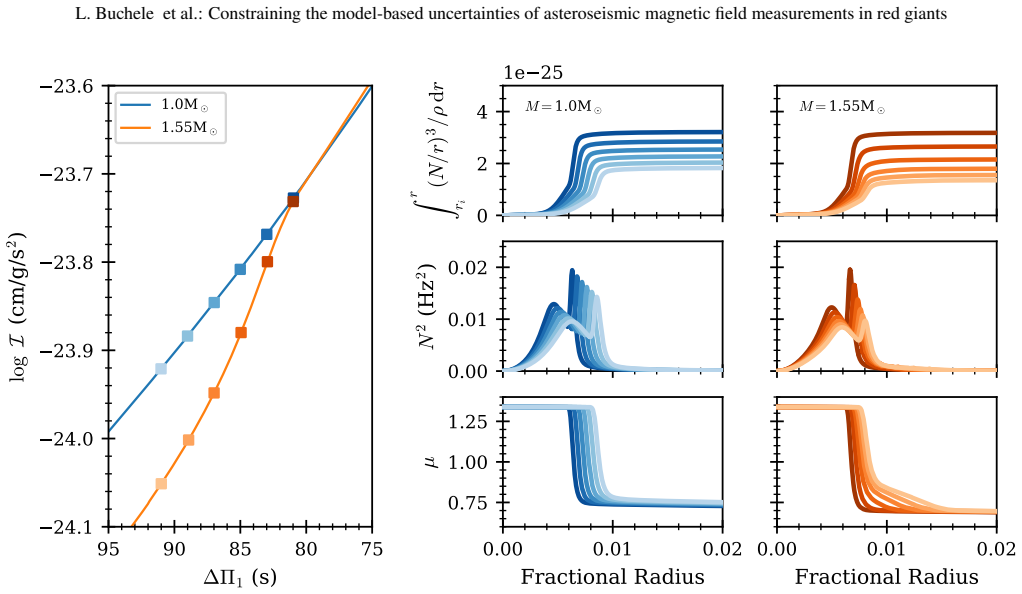
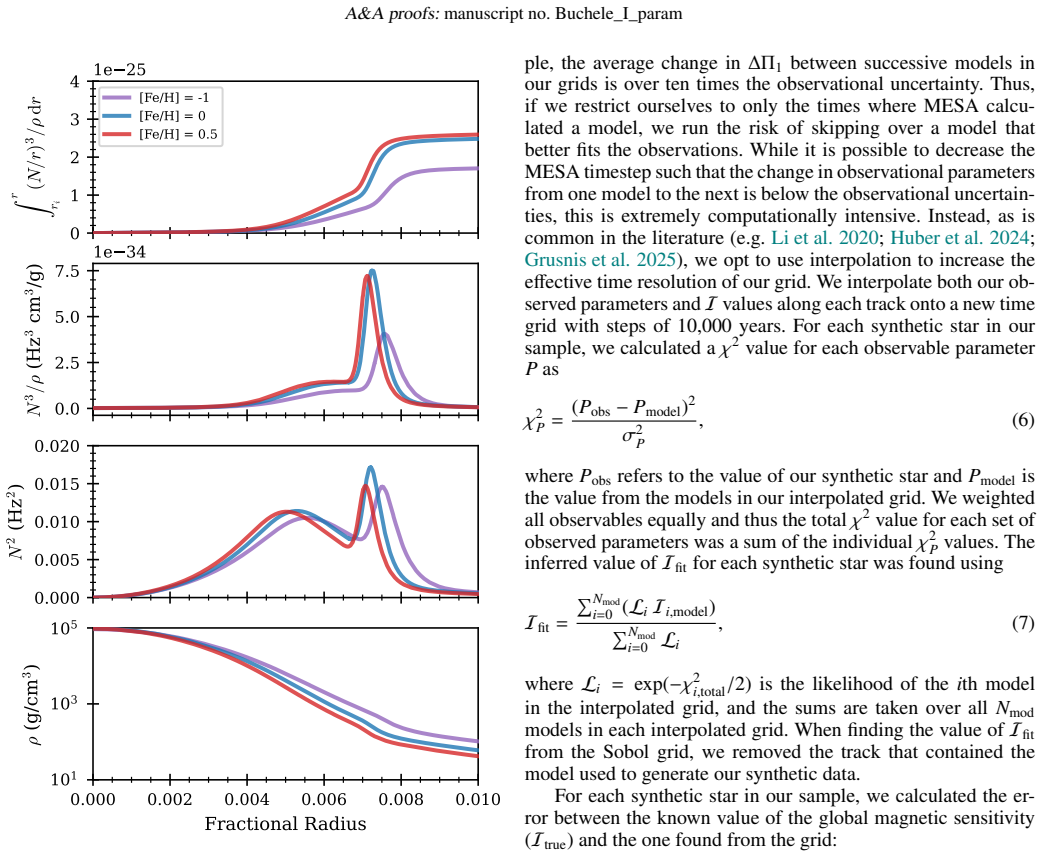
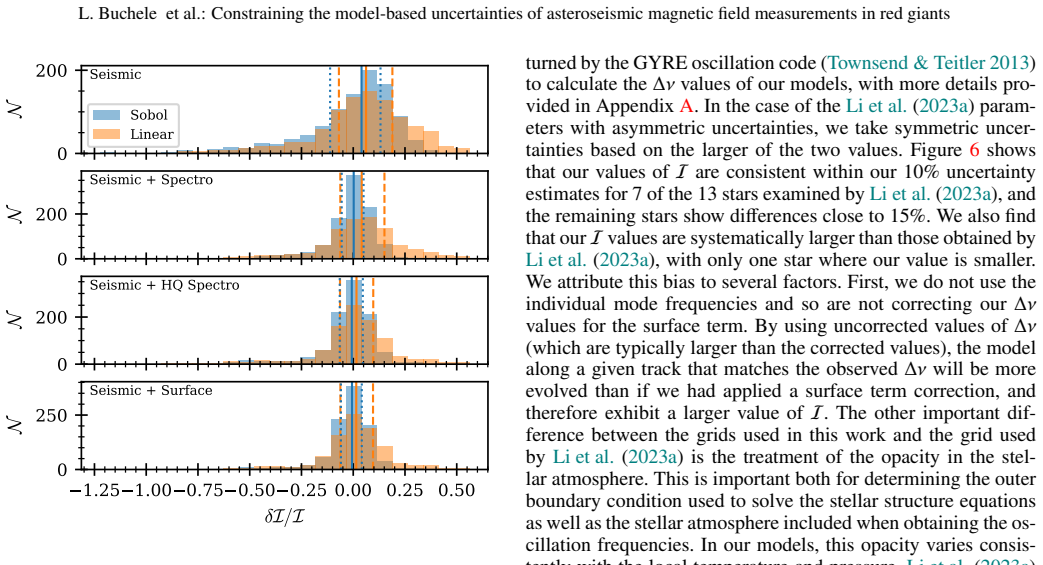
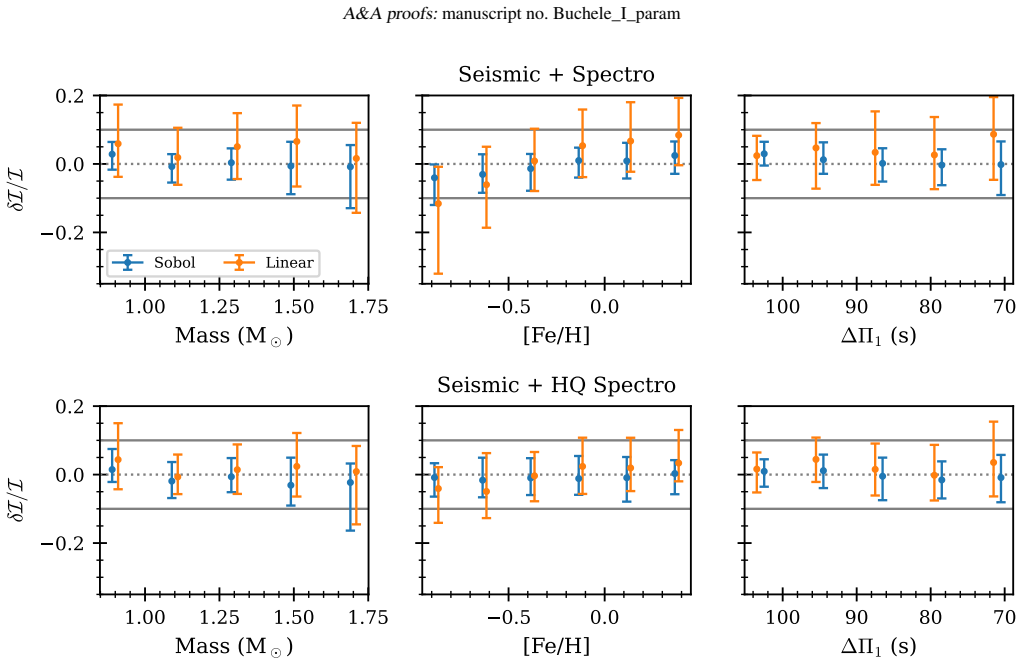
Using MESA models, the global magnetic sensitivity shows a stronger dependence on mass for higher mass models and a stronger metallicity dependence for lower metallicity models. Recovery tests on synthetic stars demonstrate that the parameter recovers well, with an uncertainty of 10% when precise metallicity measurements are used. For stars with existing magnetic field measurements the dominant uncertainty is usually observational, although precise modeling can reduce the magnetic field uncertainty for stars with exceptional data. The recommendation is to obtain the global magnetic sensitivity from both asteroseismic and high-quality spectroscopic data and to adopt a model-based uncertainty
What carries the argument
The global magnetic sensitivity (core structure parameter), the factor that converts an observed frequency shift into a radial magnetic field strength inside the asymptotic framework for red giant oscillations.
If this is right
- The sensitivity depends more strongly on mass in higher-mass models and more strongly on metallicity in lower-metallicity models.
- Recovery to 10% is possible when precise metallicity is supplied to the fitting process.
- For stars with the best data, reducing the model uncertainty on sensitivity measurably tightens the final magnetic field error bar.
- In most published cases the observational error remains larger than the 10% model contribution.
- Future measurements should combine asteroseismic frequencies with high-quality spectroscopy to reach the 10% floor.
Where Pith is reading between the lines
- A standard 10% model floor could be folded into error budgets for other red-giant asteroseismic quantities that also rely on core structure.
- If unmodeled physics in real cores produces a larger scatter than the synthetic tests show, the adopted uncertainty would need to be increased.
- High-precision spectroscopic metallicities become a high-leverage input for any magnetic-field campaign that uses this method.
- The same recovery exercise could be repeated with alternate evolution codes to test whether the 10% figure is code-dependent.
Load-bearing premise
MESA models correctly reproduce the core structure that sets the true global magnetic sensitivity in real red giants, so that recovery tests on synthetic stars drawn from the same models bound the real model errors.
What would settle it
A systematic offset between the sensitivities recovered from MESA grids and the values required to bring model magnetic fields into agreement with independent field measurements on the same stars.
Figures
read the original abstract
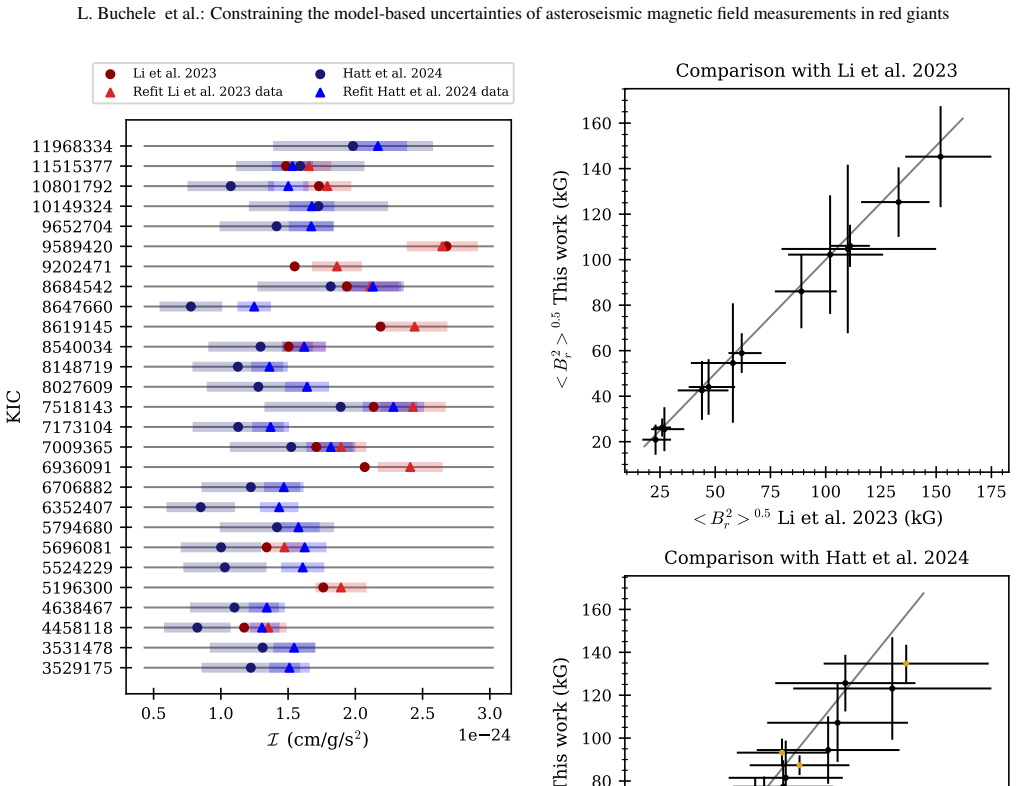
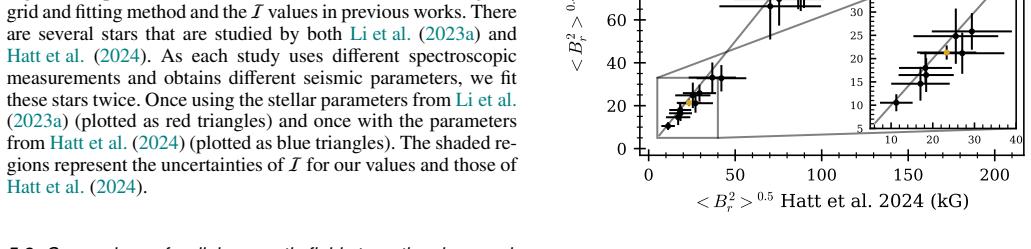
Magnetic fields inside red giants are measured using shifts to the oscillation frequencies. However, in the asymptotic framework, converting a frequency shift into a radial magnetic field strength requires knowing the global magnetic sensitivity. This parameter (also called the core structure parameter) must be inferred from stellar models, introducing a source of uncertainty. We seek to understand how the global magnetic sensitivity depends on stellar properties such as mass and metallicity, and to quantify the model-based uncertainty on magnetic field measurements. We also explore which stellar properties are key to finding a precise and accurate estimate of the global magnetic sensitivity. Using MESA models, we examine how the global magnetic sensitivity changes with mass, metallicity, and age. We then create a set of synthetic stars and test how well we recover the sensitivity parameter. We consider different grid construction approaches and the choice of which observables are used in the fitting process. We find that the global magnetic sensitivity shows a stronger dependence on mass for higher mass models and a stronger metallicity dependence for lower metallicity models. Our approach recovers the sensitivity parameter well, with an uncertainty of 10% when precise metallicity measurements are used. We apply our method to stars with existing magnetic field measurements. In most cases, the dominant source of uncertainty remains observational, although precise modeling can significantly reduce the magnetic field uncertainty for stars with exceptional data. With careful fitting, models yield accurate values for the global magnetic sensitivity. We recommend that future work obtain the global magnetic sensitivity using both asteroseismic and high-quality spectroscopic data. Under these conditions, we recommend adopting a model-based uncertainty of 10% on the sensitivity parameter.
Editorial analysis
A structured set of objections, weighed in public.
Referee Report
Summary. The manuscript uses MESA stellar models to examine how the global magnetic sensitivity (core structure parameter) in red giants depends on mass, metallicity, and age. It constructs synthetic stars from the same model grid and performs recovery tests under varying grid approaches and observable choices, concluding that the parameter is recovered with 10% uncertainty when precise metallicity measurements are used. The paper recommends adopting a 10% model-based uncertainty on this parameter for asteroseismic magnetic field measurements and suggests combining asteroseismic and high-quality spectroscopic data.
Significance. If the central result holds, the work supplies a practical, quantitative prescription for model uncertainties in converting asteroseismic frequency shifts to magnetic field strengths, which could help standardize error budgets in the field. The finding that precise metallicity reduces the uncertainty and that observational errors often dominate is useful for observers. The internal consistency of the MESA-based pipeline is demonstrated, but the absence of external validation limits broader impact.
major comments (1)
- [Abstract and synthetic recovery tests] Abstract and synthetic star recovery tests: Recovery accuracy is demonstrated on synthetic stars generated from the identical MESA model grid used to compute the sensitivity values. This quantifies scatter from grid sampling and metallicity precision but tests only internal consistency of the modeling pipeline rather than accuracy of the core structure parameter against independent data or alternative stellar models (e.g., different codes or observed benchmarks). If MESA systematically offsets the sensitivity relative to nature, the quoted 10% figure underestimates the true model contribution to magnetic-field error.
minor comments (2)
- The abstract and methods description lack specifics on MESA grid resolution (e.g., mass and metallicity spacing), the exact set of fitting observables, and whether any post-hoc data cuts were applied; these details are required to evaluate the robustness of the 10% recovery claim.
- The dependence statements (stronger mass dependence at higher masses, stronger metallicity dependence at lower metallicities) are stated qualitatively; quantitative measures such as partial derivatives or tabulated trends with uncertainties would strengthen the presentation.
Simulated Author's Rebuttal
We thank the referee for the constructive report. The primary concern is that our synthetic recovery tests demonstrate only internal consistency within the MESA grid rather than external accuracy. We address this point directly below and agree that clarification is warranted.
read point-by-point responses
-
Referee: [Abstract and synthetic recovery tests] Abstract and synthetic star recovery tests: Recovery accuracy is demonstrated on synthetic stars generated from the identical MESA model grid used to compute the sensitivity values. This quantifies scatter from grid sampling and metallicity precision but tests only internal consistency of the modeling pipeline rather than accuracy of the core structure parameter against independent data or alternative stellar models (e.g., different codes or observed benchmarks). If MESA systematically offsets the sensitivity relative to nature, the quoted 10% figure underestimates the true model contribution to magnetic-field error.
Authors: We agree that the recovery tests use synthetic stars drawn from the same MESA grid and therefore quantify internal consistency of the pipeline (grid sampling, observable selection, and metallicity precision) rather than absolute accuracy against independent stellar models or observations. This scope was chosen because the global magnetic sensitivity is itself a model-derived quantity; the 10% figure we recommend is the uncertainty arising from the modeling procedure within MESA when high-quality spectroscopic metallicity is available. We acknowledge that any systematic offset between MESA and nature (or other codes) would represent an additional, unquantified contribution to the total model uncertainty. We will revise the abstract and the final discussion paragraph to state explicitly that the quoted 10% uncertainty applies to the MESA-based recovery process and that external validation against other codes would be a valuable extension. revision: yes
Circularity Check
Recovery tests on synthetic stars from the same MESA grid quantify internal consistency of the sensitivity parameter rather than external model accuracy
specific steps
-
fitted input called prediction
[Abstract]
"We then create a set of synthetic stars and test how well we recover the sensitivity parameter. ... Our approach recovers the sensitivity parameter well, with an uncertainty of 10% when precise metallicity measurements are used. ... We recommend adopting a model-based uncertainty of 10% on the sensitivity parameter."
Synthetic stars are drawn from the same MESA grid used to compute the global magnetic sensitivity (core structure parameter). The recovery test therefore measures scatter due to grid sampling, observable choice, and metallicity precision within the model framework, making the 10% figure a measure of internal pipeline consistency rather than an independent bound on model error for real stars.
full rationale
The paper's recommendation of a 10% model-based uncertainty on the global magnetic sensitivity is derived from recovery experiments on synthetic stars generated from the identical MESA model grid used to compute the sensitivity values themselves. This tests how well the fitting procedure recovers known inputs under controlled conditions but does not validate the core structure parameter against real red giants or independent modeling frameworks. The derivation chain for the uncertainty figure therefore reduces to internal model consistency by construction. No other load-bearing steps exhibit the enumerated circularity patterns.
Axiom & Free-Parameter Ledger
axioms (1)
- domain assumption MESA stellar evolution models accurately reproduce the core properties that set the global magnetic sensitivity in real red giants
Reference graph
Works this paper leans on
-
[1]
The Astronomy and Astrophysics Review , author =
Giant star seismology , volume =. The Astronomy and Astrophysics Review , author =. 2017 , note =. doi:10.1007/s00159-017-0101-x , abstract =
-
[2]
Li, Gang and Deheuvels, Sébastien and Ballot, Jérôme and Lignières, François , month = oct, year =. Magnetic fields of 30 to 100. Nature , publisher =. doi:10.1038/s41586-022-05176-0 , abstract =
-
[3]
Astronomy & Astrophysics , author =
Magnetic signatures on mixed-mode frequencies:. Astronomy & Astrophysics , author =. 2021 , pages =. doi:10.1051/0004-6361/202039159 , abstract =
-
[4]
Astronomy & Astrophysics , author =
Internal magnetic fields in 13 red giants detected by asteroseismology , volume =. Astronomy & Astrophysics , author =. 2023 , pages =. doi:10.1051/0004-6361/202347260 , abstract =
-
[5]
Astronomy & Astrophysics , author =
Strong magnetic fields detected in the cores of 11 red giant stars using gravity-mode period spacings , volume =. Astronomy & Astrophysics , author =. 2023 , pages =. doi:10.1051/0004-6361/202245282 , abstract =
-
[6]
Monthly Notices of the Royal Astronomical Society , author =
Asteroseismic signatures of core magnetism and rotation in hundreds of low-luminosity red giants , volume =. Monthly Notices of the Royal Astronomical Society , author =. 2024 , pages =. doi:10.1093/mnras/stae2053 , abstract =
-
[7]
The Astrophysical Journal Supplement Series , author =
Asteroseismology of 16,000. The Astrophysical Journal Supplement Series , author =. 2018 , pages =. doi:10.3847/1538-4365/aaaf74 , abstract =
-
[8]
Paxton, B. and Bildsten, L. and Dotter, A. and Herwig, F. and Lesaffre, P. and Timmes, F. , month = jan, year =. Modules for. doi:10.1088/0067-0049/192/1/3 , journal =
-
[9]
Paxton, B. and Cantiello, M. and Arras, P. and Bildsten, L. and Brown, E. F. and Dotter, A. and Mankovich, C. and Montgomery, M. H. and Stello, D. and Timmes, F. X. and Townsend, R. , month = sep, year =. Modules for. doi:10.1088/0067-0049/208/1/4 , journal =
work page internal anchor Pith review doi:10.1088/0067-0049/208/1/4
-
[10]
Modules for Experiments in Stellar Astrophysics (MESA): Binaries, Pulsations, and Explosions
Paxton, B. and Marchant, P. and Schwab, J. and Bauer, E. B. and Bildsten, L. and Cantiello, M. and Dessart, L. and Farmer, R. and Hu, H. and Langer, N. and Townsend, R. H. D. and Townsley, D. M. and Timmes, F. X. , month = sep, year =. Modules for. doi:10.1088/0067-0049/220/1/15 , journal =
work page internal anchor Pith review doi:10.1088/0067-0049/220/1/15
-
[11]
Paxton, B. and Schwab, J. and Bauer, E. B. and Bildsten, L. and Blinnikov, S. and Duffell, P. and Farmer, R. and Goldberg, J. A. and Marchant, P. and Sorokina, E. and Thoul, A. and Townsend, R. H. D. and Timmes, F. X. , month = feb, year =. Modules for. doi:10.3847/1538-4365/aaa5a8 , journal =
work page internal anchor Pith review doi:10.3847/1538-4365/aaa5a8
-
[12]
Modules for. , author =. 2019 , keywords =. doi:10.3847/1538-4365/ab2241 , number =
-
[13]
Modules for. , author =. 2023 , keywords =. doi:10.3847/1538-4365/acae8d , number =
-
[14]
The Astrophysical Journal , author =
Beyond. The Astrophysical Journal , author =. 2025 , pages =. doi:10.3847/1538-4357/ae0c1a , abstract =
-
[15]
The evolution of AGB stars with convective overshoot
The evolution of AGB stars with convective overshoot. , keywords =. doi:10.48550/arXiv.astro-ph/0007139 , archivePrefix =. astro-ph/0007139 , primaryClass =
work page internal anchor Pith review Pith/arXiv arXiv doi:10.48550/arxiv.astro-ph/0007139
-
[16]
On the distribution of points in a cube and the approximate evaluation of integrals
On the distribution of points in a cube and the approximate evaluation of integrals , journal =. 1967 , issn =. doi:https://doi.org/10.1016/0041-5553(67)90144-9 , url =
-
[17]
The Astrophysical Journal , author =. 2016 , pages =. doi:10.3847/0004-637X/830/1/31 , abstract =
-
[18]
Monthly Notices of the Royal Astronomical Society , author =. 2013 , pages =. doi:10.1093/mnras/stt1533 , abstract =
-
[19]
The Astrophysical Journal , author =. 2013 , pages =. doi:10.1088/2041-8205/765/2/L41 , abstract =
-
[20]
Astronomy & Astrophysics , author =
Seismic signature of electron degeneracy in the core of red giants:. Astronomy & Astrophysics , author =. 2022 , pages =. doi:10.1051/0004-6361/202142094 , abstract =
-
[21]
Takata, Masao and Murphy, Simon J. and Kurtz, Donald W. and Saio, Hideyuki and Shibahashi, Hiromoto , month = nov, year =. Asteroseismic detection of a predominantly toroidal magnetic field in the deep interior of the main-sequence. doi:10.48550/arXiv.2512.00786 , abstract =
-
[22]
Angular momentum and chemical transport by azimuthal magnetorotational instability in radiative stellar interiors. , keywords =. doi:10.1051/0004-6361/202347672 , adsurl =
-
[23]
Asteroseismology of evolved stars to constrain the internal transport of angular momentum. VI. Testing a parametric formulation for the azimuthal magneto-rotational instability. , keywords =. doi:10.1051/0004-6361/202245519 , archivePrefix =. 2302.07811 , primaryClass =
-
[24]
Rotation in stellar interiors: General formulation and an asteroseismic-calibrated transport by the Tayler instability. , keywords =. doi:10.1051/0004-6361/202243781 , archivePrefix =. 2309.17396 , primaryClass =
-
[25]
Angular momentum transport in a contracting stellar radiative zone embedded in a large-scale magnetic field. , keywords =. doi:10.1051/0004-6361/202141613 , archivePrefix =. 2201.02645 , primaryClass =
-
[26]
Asteroseismology of evolved stars to constrain the internal transport of angular momentum. II. Test of a revised prescription for transport by the Tayler instability. , keywords =. doi:10.1051/0004-6361/201936348 , archivePrefix =. 2001.11525 , primaryClass =
-
[27]
Slowing the Spins of Stellar Cores
Slowing the spins of stellar cores. , keywords =. doi:10.1093/mnras/stz514 , archivePrefix =. 1902.08227 , primaryClass =
work page internal anchor Pith review Pith/arXiv arXiv doi:10.1093/mnras/stz514 1902
-
[28]
Angular momentum transport efficiency in post-main sequence low-mass stars
Angular momentum transport efficiency in post-main sequence low-mass stars. , keywords =. doi:10.1051/0004-6361/201527591 , archivePrefix =. 1603.01119 , primaryClass =
work page internal anchor Pith review Pith/arXiv arXiv doi:10.1051/0004-6361/201527591
-
[29]
Angular momentum transport within evolved low-mass stars
Angular Momentum Transport within Evolved Low-mass Stars. , keywords =. doi:10.1088/0004-637X/788/1/93 , archivePrefix =. 1405.1419 , primaryClass =
work page internal anchor Pith review Pith/arXiv arXiv doi:10.1088/0004-637x/788/1/93
-
[30]
Asteroseismic measurement of core and envelope rotation rates for 2006 red giant branch stars. , keywords =. doi:10.1051/0004-6361/202449882 , archivePrefix =. 2405.12116 , primaryClass =
-
[31]
Seismic evidence for near solid-body rotation in two Kepler subgiants and implications for angular momentum transport. , keywords =. doi:10.1051/0004-6361/202038578 , archivePrefix =. 2007.02585 , primaryClass =
-
[32]
Core rotation braking on the red giant branch for various mass ranges
Core rotation braking on the red giant branch for various mass ranges. , keywords =. doi:10.1051/0004-6361/201832822 , archivePrefix =. 1802.04558 , primaryClass =
work page internal anchor Pith review Pith/arXiv arXiv doi:10.1051/0004-6361/201832822
-
[33]
Internal rotation of 13 low-mass low-luminosity red giants in the Kepler field
Internal rotation of 13 low-mass low-luminosity red giants in the Kepler field. , keywords =. doi:10.1051/0004-6361/201629186 , archivePrefix =. 1702.07910 , primaryClass =
work page internal anchor Pith review Pith/arXiv arXiv doi:10.1051/0004-6361/201629186
-
[34]
Internal rotation of the red-giant star KIC 4448777 by means of asteroseismic inversion
Internal Rotation of the Red-giant Star KIC 4448777 by Means of Asteroseismic Inversion. , keywords =. doi:10.3847/0004-637X/817/1/65 , archivePrefix =. 1511.06160 , primaryClass =
work page internal anchor Pith review Pith/arXiv arXiv doi:10.3847/0004-637x/817/1/65
-
[35]
Seismic constraints on the radial dependence of the internal rotation profiles of six Kepler subgiants and young red giants. , keywords =. doi:10.1051/0004-6361/201322779 , archivePrefix =. 1401.3096 , primaryClass =
work page internal anchor Pith review Pith/arXiv arXiv doi:10.1051/0004-6361/201322779
-
[36]
Spin down of the core rotation in red giants
Spin down of the core rotation in red giants. , keywords =. doi:10.1051/0004-6361/201220106 , archivePrefix =. 1209.3336 , primaryClass =
work page internal anchor Pith review Pith/arXiv arXiv doi:10.1051/0004-6361/201220106
-
[37]
Fast core rotation in red-giant stars revealed by gravity-dominated mixed modes
Fast core rotation in red-giant stars as revealed by gravity-dominated mixed modes. , keywords =. doi:10.1038/nature10612 , archivePrefix =. 1112.2825 , primaryClass =
work page internal anchor Pith review Pith/arXiv arXiv doi:10.1038/nature10612
-
[38]
The robustness of inferred envelope and core rotation rates of red giant stars from asteroseismology. , keywords =. doi:10.1051/0004-6361/202449901 , archivePrefix =. 2411.05515 , primaryClass =
-
[39]
The Astrophysical Journal Supplement Series , author =. 2025 , pages =. doi:10.3847/1538-4365/ad9fef , abstract =
-
[40]
Gaia Data Release 2: first stellar parameters from Apsis
Gaia Data Release 2. First stellar parameters from Apsis. , keywords =. doi:10.1051/0004-6361/201732516 , archivePrefix =. 1804.09374 , primaryClass =
work page internal anchor Pith review Pith/arXiv arXiv doi:10.1051/0004-6361/201732516
-
[41]
Rogers, F. J. and Nayfonov, A. , month = sep, year =. Updated and. doi:10.1086/341894 , journal =
-
[42]
Irwin, Alan. W. , year =. The
-
[43]
Skye:. , author =. 2021 , keywords =. doi:10.3847/1538-4357/abf48e , number =
-
[44]
Standard Solar Composition. , keywords =. doi:10.1023/A:1005161325181 , adsurl =
-
[45]
Iglesias, C. A. and Rogers, F. J. , month = jun, year =. Updated. doi:10.1086/177381 , journal =
-
[46]
Iglesias, C. A. and Rogers, F. J. , month = aug, year =. Radiative opacities for carbon- and oxygen-rich mixtures , volume =. doi:10.1086/172958 , journal =
-
[47]
Ferguson, J. W. and Alexander, D. R. and Allard, F. and Barman, T. and Bodnarik, J. G. and Hauschildt, P. H. and Heffner-Wong, A. and Tamanai, A. , month = apr, year =. Low-. doi:10.1086/428642 , journal =
-
[48]
The Astrophysical Journal , author =
An. The Astrophysical Journal , author =. 2024 , pages =. doi:10.3847/1538-4357/ad4355 , abstract =
-
[49]
Cyburt, R. H. and Amthor, A. M. and Ferguson, R. and Meisel, Z. and Smith, K. and Warren, S. and Heger, A. and Hoffman, R. D. and Rauscher, T. and Sakharuk, A. and Schatz, H. and Thielemann, F. K. and Wiescher, M. , month = jul, year =. The. doi:10.1088/0067-0049/189/1/240 , journal =
-
[50]
A compilation of charged-particle induced thermonuclear reaction rates , volume =. , author =. 1999 , pages =. doi:10.1016/S0375-9474(99)00030-5 , number =
-
[51]
Fuller, G. M. and Fowler, W. A. and Newman, M. J. , month = jun, year =. Stellar weak interaction rates for intermediate-mass nuclei. doi:10.1086/163208 , journal =
-
[52]
Oda, T. and Hino, M. and Muto, K. and Takahara, M. and Sato, K. , month = mar, year =. Rate. doi:10.1006/adnd.1994.1007 , journal =
-
[53]
Langanke, K. and Martínez-Pinedo, G. , month = jun, year =. Shell-model calculations of stellar weak interaction rates:. doi:10.1016/S0375-9474(00)00131-7 , journal =
-
[54]
Studies in Stellar Evolution. III. The Calculation of Model Envelopes. , year = 1965, month = oct, volume =. doi:10.1086/148357 , adsurl =
-
[55]
Buchele, Lynn , month = jul, year =. Exploring. Research Notes of the AAS , publisher =. doi:10.3847/2515-5172/adf06d , abstract =
-
[56]
Characterization of the power excess of solar-like oscillations in red giants with Kepler. , keywords =. doi:10.1051/0004-6361/20111735210.1086/141952 , archivePrefix =. 1110.0980 , primaryClass =
-
[57]
Asteroseismic fingerprints of stellar mergers. , keywords =. doi:10.1093/mnras/stab2528 , archivePrefix =. 2108.10322 , primaryClass =
-
[58]
Astronomy & Astrophysics , author =
The role of stellar model input in correcting the asteroseismic scaling relations:. Astronomy & Astrophysics , author =. 2025 , pages =. doi:10.1051/0004-6361/202554089 , abstract =
-
[59]
Monthly Notices of the Royal Astronomical Society , author =
A prescription for the asteroseismic surface correction , volume =. Monthly Notices of the Royal Astronomical Society , author =. 2023 , pages =. doi:10.1093/mnras/stad1445 , abstract =
-
[60]
Seismic detection of core magnetic fields in red giants using the gravity offset. arXiv e-prints , keywords =. doi:10.48550/arXiv.2602.14570 , archivePrefix =. 2602.14570 , primaryClass =
-
[61]
Astronomy & Astrophysics , author =
Improved asteroseismic inversions for red-giant surface rotation rates , volume =. Astronomy & Astrophysics , author =. 2022 , pages =. doi:10.1051/0004-6361/202142510 , abstract =
-
[62]
Asteroseismology of 3642 Kepler Red Giants: Correcting the Scaling Relations Based on Detailed Modeling. , keywords =. doi:10.3847/1538-4357/ac4fbf , archivePrefix =. 2201.09577 , primaryClass =
-
[63]
Determining ages from detailed modelling
Asteroseismology of 36 Kepler subgiants - II. Determining ages from detailed modelling. , keywords =. doi:10.1093/mnras/staa1350 , archivePrefix =. 2006.00901 , primaryClass =
-
[64]
Stellar Models are Reliable at Low Metallicity: An Asteroseismic Age for the Ancient Very Metal-poor Star KIC 8144907. , keywords =. doi:10.3847/1538-4357/ad7110 , archivePrefix =. 2407.17566 , primaryClass =
-
[65]
TESS Subgiant and Lower-red-giant Asteroseismology in the Continuous Viewing Zones. , keywords =. doi:10.3847/1538-4357/ae0711 , archivePrefix =. 2509.12513 , primaryClass =
-
[66]
Realistic Uncertainties for Fundamental Properties of Asteroseismic Red Giants and the Interplay between Mixing Length, Metallicity, and max. , keywords =. doi:10.3847/1538-4357/ad6c3e , archivePrefix =. 2407.09967 , primaryClass =
-
[67]
A new correction of stellar oscillation frequencies for near-surface effects
A new correction of stellar oscillation frequencies for near-surface effects. , keywords =. doi:10.1051/0004-6361/201424325 , archivePrefix =. 1408.0986 , primaryClass =
work page internal anchor Pith review Pith/arXiv arXiv doi:10.1051/0004-6361/201424325
-
[68]
PLATO hare-and-hounds exercise: asteroseismic model fitting of main-sequence solar-like pulsators. , keywords =. doi:10.1093/mnras/stab2886 , archivePrefix =. 2110.03332 , primaryClass =
-
[69]
Astronomy & Astrophysics , author =
Probing the internal magnetism of stars using asymptotic magneto-asteroseismology , volume =. Astronomy & Astrophysics , author =. 2021 , pages =. doi:10.1051/0004-6361/202039180 , abstract =
-
[70]
Astronomy & Astrophysics , author =
Asymmetries of frequency splittings of dipolar mixed modes:. Astronomy & Astrophysics , author =. 2023 , pages =. doi:10.1051/0004-6361/202346832 , abstract =
-
[71]
The Astrophysical Journal , author =
Detectability of. The Astrophysical Journal , author =. 2024 , pages =. doi:10.3847/1538-4357/ad4708 , abstract =
-
[72]
Astronomy & Astrophysics , author =
Unveiling complex magnetic field configurations in red giant stars , volume =. Astronomy & Astrophysics , author =. 2024 , pages =. doi:10.1051/0004-6361/202450918 , abstract =
-
[73]
Asteroseismology Can Reveal Strong Internal Magnetic Fields in Red Giant Stars
Asteroseismology can reveal strong internal magnetic fields in red giant stars. Science , keywords =. doi:10.1126/science.aac6933 , archivePrefix =. 1510.06960 , primaryClass =
work page internal anchor Pith review Pith/arXiv arXiv doi:10.1126/science.aac6933
-
[74]
Effect of a strong magnetic field on gravity-mode period spacings in red giant stars. , keywords =. doi:10.1093/mnras/staa1823 , archivePrefix =. 2006.08635 , primaryClass =
-
[75]
Asteroseismic g-mode period spacings in strongly magnetic rotating stars. , keywords =. doi:10.1093/mnras/stad3461 , archivePrefix =. 2310.19873 , primaryClass =
-
[76]
Perturbative analysis of the effect of a magnetic field on gravito-inertial modes. , keywords =. doi:10.1051/0004-6361/202348243 , archivePrefix =. 2311.13296 , primaryClass =
-
[77]
Near-critical magnetic fields in Kepler red giants
Deheuvels, S. and Ballot, J. and Lignières, F. and Li, G. and Villate, M. , month = apr, year =. Near-critical magnetic fields in. doi:10.48550/arXiv.2604.09901 , abstract =
work page internal anchor Pith review Pith/arXiv arXiv doi:10.48550/arxiv.2604.09901
-
[78]
Astronomy & Astrophysics , author =
Magnetic signatures on mixed-mode frequencies:. Astronomy & Astrophysics , author =. 2022 , pages =. doi:10.1051/0004-6361/202243167 , abstract =
-
[79]
Astronomy & Astrophysics , author =
Modeling of magneto-rotational stellar evolution:. Astronomy & Astrophysics , author =. 2021 , pages =. doi:10.1051/0004-6361/202039253 , abstract =
-
[80]
Surface rotation of Kepler red giant stars
Surface rotation of Kepler red giant stars. , keywords =. doi:10.1051/0004-6361/201629884 , archivePrefix =. 1707.05989 , primaryClass =
work page internal anchor Pith review Pith/arXiv arXiv doi:10.1051/0004-6361/201629884
discussion (0)
Sign in with ORCID, Apple, or X to comment. Anyone can read and Pith papers without signing in.