A linear, decoupled and positivity-preserving time-staggered block-centered finite difference method for the multi-species Keller-Segel chemotaxis system
Pith reviewed 2026-07-02 07:51 UTC · model grok-4.3
The pith
A prediction-then-projection block-centered finite difference scheme for the multi-species Keller-Segel system is positivity-preserving, mass-conserving, and second-order accurate on non-uniform grids.
A machine-rendered reading of the paper's core claim, the machinery that carries it, and where it could break.
Core claim
The proposed scheme is a linearly implicit, second-order block-centered finite difference prediction-then-projection method that integrates a standard Crank-Nicolson time-marching algorithm with an L2 projection step. On non-uniform spatio-temporal grids with variable time steps and time-staggered discretization, it fully decouples the multi-species cell density variables from the chemoattractant concentration. The scheme is uniquely solvable, positivity-preserving and mass-conserving, with cell densities converging at second order in the discrete L2 norm and the chemoattractant at second order in the discrete H1 norm, as proved by mathematical induction and energy analysis.
What carries the argument
The time-staggered block-centered finite difference discretization combined with an L2 projection step that enforces positivity and mass conservation while maintaining linear decoupling.
If this is right
- The scheme is uniquely solvable at each time step.
- Cell densities remain positive and both cell densities and chemoattractant conserve mass.
- Cell densities converge at second order in the discrete L2 norm and the chemoattractant converges at second order in the discrete H1 norm.
- Variable time steps and non-uniform grids permit adaptive resolution near blow-up while retaining positivity and mass conservation.
- Time-staggered discretization decouples the multi-species densities from the chemoattractant, yielding a linear system at each step.
Where Pith is reading between the lines
- The same projection-plus-staggering construction could be applied to other positivity-constrained reaction-diffusion systems that require decoupling for efficiency.
- Non-uniform grids with this method may improve resolution of localized singularities in related pattern-formation models without custom mesh refinement techniques.
- Variable time-step control could support stable continuation past initial aggregation events in long-time chemotaxis simulations.
- The energy-analysis technique used for convergence might extend to other block-centered schemes on staggered grids.
Load-bearing premise
The L2 projection step combined with time-staggered discretization on non-uniform grids preserves the second-order accuracy of the Crank-Nicolson scheme without order reduction or loss of decoupling.
What would settle it
A blow-up test case in which the computed cell densities become negative, total mass is not conserved, or observed convergence rates in the discrete L2 and H1 norms fall below second order.
Figures


read the original abstract
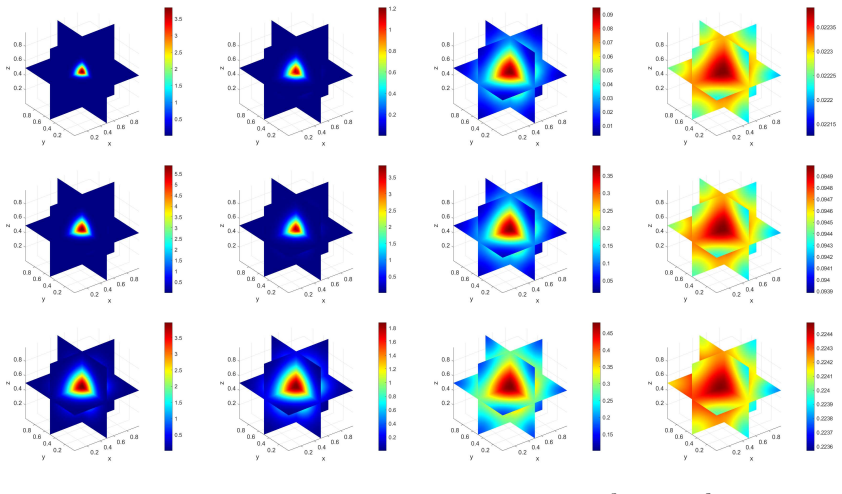
In this paper, we present a linearly implicit, second-order block-centered finite difference (BCFD) prediction-then-projection scheme for the multi-species Keller-Segel chemotaxis system on non-uniform spatio-temporal grids. The proposed scheme integrates a standard Crank-Nicolson time-marching algorithm with an $L^2$ projection step to enforce positivity and mass conservation. The use of variable time stepsize and time-staggered discretization fully decouples the solutions of the multi-species cell density variables and the chemoattractant concentration variable while facilitating linearization, thereby greatly enhancing computational efficiency. Notably, the variable time-stepping algorithm and non-uniform grid BCFD discretization jointly enable adaptive resolution and local refinement near blow-up, thereby improving efficiency and accuracy without compromising the desired physical property-preserving in the simulation. Furthermore, using the mathematical induction method and the energy analysis approach, the unique solvability of the proposed scheme is rigorously proved, and we show that cell densities achieve second-order convergence in both time and space in the discrete $L^2$ norm, while the chemoattractant concentration achieves second-order convergence in the discrete $H^1$ norm. Representative numerical experiments are presented to validate the theoretical findings and demonstrate the reliability of the proposed scheme in simulating the blow-up phenomenon.
Editorial analysis
A structured set of objections, weighed in public.
Referee Report
Summary. The paper proposes a linearly implicit, second-order block-centered finite difference (BCFD) prediction-then-projection scheme for the multi-species Keller-Segel chemotaxis system on non-uniform spatio-temporal grids. It combines Crank-Nicolson time marching with time-staggered discretization to fully decouple the cell-density and chemoattractant equations while linearizing the system, followed by an L² projection step that enforces positivity and mass conservation. The authors prove unique solvability, positivity preservation, and mass conservation, and establish second-order convergence in the discrete L² norm for cell densities and in the discrete H¹ norm for the chemoattractant concentration, using mathematical induction together with energy estimates. Numerical experiments are presented to illustrate the scheme’s behavior near blow-up.
Significance. If the claimed convergence rates are rigorously established without order reduction, the method supplies an efficient, structure-preserving discretization that supports adaptive non-uniform grids and variable time steps for multi-species chemotaxis models. The decoupling and linearization reduce computational cost while preserving key physical properties, which is valuable for long-time simulations of blow-up phenomena.
major comments (1)
- [Convergence analysis (induction and energy estimates)] In the energy analysis and induction argument establishing second-order convergence (abstract and the convergence theorem), the L² projection step is asserted to preserve the O(τ² + h²) accuracy of the Crank-Nicolson predictor. On non-uniform grids the projection operator’s approximation properties in the discrete H¹ seminorm must be controlled explicitly; without a bound showing that the projection error remains O(τ² + h²) uniformly in the staggered-time, variable-grid setting, the inductive step for the chemoattractant H¹ estimate does not close at second order.
Simulated Author's Rebuttal
We thank the referee for the careful reading and constructive comments on our manuscript. We address the single major comment below.
read point-by-point responses
-
Referee: In the energy analysis and induction argument establishing second-order convergence (abstract and the convergence theorem), the L² projection step is asserted to preserve the O(τ² + h²) accuracy of the Crank-Nicolson predictor. On non-uniform grids the projection operator’s approximation properties in the discrete H¹ seminorm must be controlled explicitly; without a bound showing that the projection error remains O(τ² + h²) uniformly in the staggered-time, variable-grid setting, the inductive step for the chemoattractant H¹ estimate does not close at second order.
Authors: We agree that an explicit bound on the L² projection error in the discrete H¹ seminorm is needed to close the induction on non-uniform grids. The original proof invoked standard approximation properties of the projection within the BCFD setting but did not derive the required uniform estimate for the staggered-time, variable-grid case. In the revised manuscript we will add a dedicated lemma establishing that the projection error remains O(τ² + h²) in the discrete H¹ seminorm, using the block-centered structure and the non-uniform mesh regularity assumptions already present in the paper. This addition will allow the energy estimates and inductive step for the chemoattractant to close at second order without altering the overall proof architecture. revision: yes
Circularity Check
No significant circularity in the derivation chain
full rationale
The paper constructs a prediction-then-projection scheme from standard Crank-Nicolson discretization and L2 projection operators on non-uniform grids, then proves unique solvability, positivity, mass conservation, and second-order convergence via mathematical induction plus energy estimates. No equations reduce to fitted inputs renamed as predictions, no self-definitional loops appear in the scheme definition or convergence claims, and no load-bearing steps rely on self-citations or imported uniqueness theorems. The central claims rest on explicit inductive arguments and energy analysis that are independent of the target results, rendering the derivation self-contained.
Axiom & Free-Parameter Ledger
axioms (2)
- standard math Block-centered finite difference operators on non-uniform grids satisfy the discrete summation-by-parts identities needed for energy estimates.
- domain assumption The L2 projection step onto the positive cone preserves the second-order truncation error of the Crank-Nicolson scheme.
Reference graph
Works this paper leans on
- [1]
- [2]
-
[3]
A. Chertock, Y. Epshteyn, H. Hu, A. Kurganov, High-order positivity preserving hybrid finite- volume-finite-difference methods for chemotaxis systems, A dv. Comput. Math. 44 (2018) 327– 350. 24
work page 2018
-
[4]
J. Slotboom, Computer-aided two-dimensional analysis of bipolar transistors, Electron Devices 20 (1973) 669–679
work page 1973
-
[5]
S. jin, B. Yan, A class of asymptotic-preserving schemes for the Fokker-Planck-Landau equation, J. Comput. Phys. 230 (2011) 6420–6437
work page 2011
-
[6]
J. Hu, X. Zhang, Positivity-preserving and energy-diss ipative finite difference schemes for the Fokker–Planck and Keller–Segel equations, IMA J. Numer. An al 43 (2023) 1450–1484
work page 2023
-
[7]
J. Liu, L. Wang, Z. Zhou, Positivity-preserving and asym ptotic preserving method for 2D Keller– Segel equations, Math. Comp. 87 (2018) 1165–1189
work page 2018
- [8]
- [9]
-
[10]
F. Tong, Y. Cai, Positivity preserving and mass conserv ative projection mthod for the Poisson– Nernst–Planck equation, SIAM J. Numer. Anal. 62 (4) (2024) 2 002–2024
work page 2024
-
[11]
T. Arbogast, M. Wheeler, I. Yotov, Mixed finite elements for elliptic problems with tensor coefficients as cell-centered finite differences, SIAM J. Nume r. Anal. 34 (1997) 828–852
work page 1997
-
[12]
H. Rui, H. Pan, A block-centered finite difference method for the Darcy–Forchheimer model, SIAM J. Numer. Anal. 50 (2012) 2612–2631
work page 2012
-
[13]
H. Rui, W. Liu, A two-grid block-centered finite differen ce method for Darcy–Forchheimer flow in porous media, SIAM J. Numeri. Anal. 53 (2015) 1941–1962
work page 2015
-
[14]
J. Xu, S. Xie, H. Fu, A two-grid block-centered finite diff erence method for the nonlinear regularized long wave equation, Appl. Numer. Math. 171 (202 2) 128–148
-
[15]
X. Wang, J. Xu, H. Fu, A linearlized mass-conservative f ourth-order block-centered finite differ- ence method for the semilinear Sobolev equation with variab le coefficients, Commun. Nonlinear Sci. Numer. Simul. 130 (2024) 107778
work page 2024
-
[16]
Y. Shi, S. Xie, D. Liang, K. Fu, High order compact block- centered finite difference schemes for elliptic and parabolic problems, J. Sci. Comput. 87 (2021) 8 6
work page 2021
-
[17]
X. Li, J. Shen, H. Rui, Energy stability and convergence of SA V block-centered finite difference method for gradient flows, Math. Comp. 88 (2019) 2047–2068
work page 2019
-
[18]
J. Xu, H. Fu, A decoupled linear, mass-conservative blo ck-centered finite difference method for the Keller–Segel chemotaxis system, J. Comput. Phys. 526 (2 025) 113775
- [19]
- [20]
-
[21]
H. Rui, H. Pan, Block-centered finite difference methods for parabolic equation with time- dependent coefficient, Jpn. J. Ind. Appl. Math. 30 (2013) 681– 699
work page 2013
-
[22]
G. Berikelashvili, M. Gupta, M. Mirianashvili, Conver gence of fourth order compact difference schemes for three-dimensional convection-diffusion equat ions, SIAM J. Numer. Anal. 45 (2007) 443–455. 25
work page 2007
- [23]
-
[24]
Plemmons, M-matrix characterizations
R. Plemmons, M-matrix characterizations. I—nonsingul ar M-matrices, Linear Algebra Appl. 18 (1977) 175–188
work page 1977
- [25]
- [26]
-
[27]
Lin, The fully parabolic multi-species chemotaxis s ystem in R2, Eur.J
K. Lin, The fully parabolic multi-species chemotaxis s ystem in R2, Eur.J. Appl. Math. 35 (2024) 675–706
work page 2024
-
[28]
K. Wang, E. Liu, X. Feng, Optimal error estimate of uncon ditionally positivity-preserving, mass- conserving and energy stable method for the Keller–Segel ch emotaxis model, Math. Comp. 94 (2025) 2761–2793
work page 2025
-
[29]
J. Shen, J. Xu, Unconditionally bound preserving and en ergy dissipative schemes for a class of Keller–Segel equations, SIAM J. Numer. Anal. 58 (2020) 1674 –1695
work page 2020
-
[30]
D. Acosta-Soba, F. Guillén-González, J. Rodríguez-Ga lván, An unconditionally energy stable and positive upwind DG scheme for the Keller–Segel model, J. Sci. Comput. 97 (2023) 18. 26
work page 2023
discussion (0)
Sign in with ORCID, Apple, or X to comment. Anyone can read and Pith papers without signing in.