LSR-Net: Long-Short-Range Operator Learning for Pattern Dynamics on Manifolds
Pith reviewed 2026-07-02 01:55 UTC · model grok-4.3
The pith
LSR-Net decomposes evolution operators into long-range Fourier multipliers and short-range geometric terms to predict pattern dynamics on manifolds.
A machine-rendered reading of the paper's core claim, the machinery that carries it, and where it could break.
Core claim
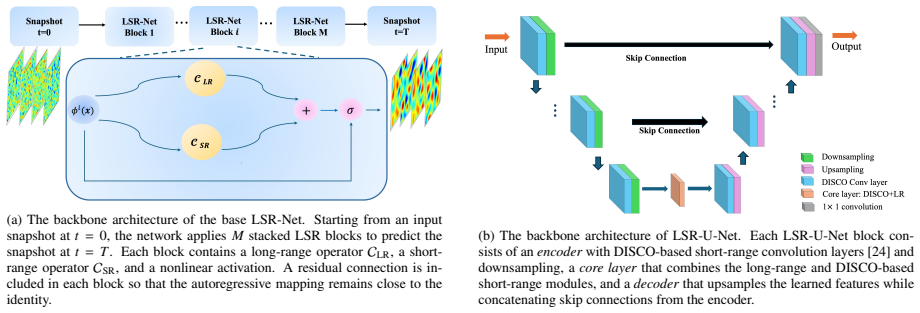
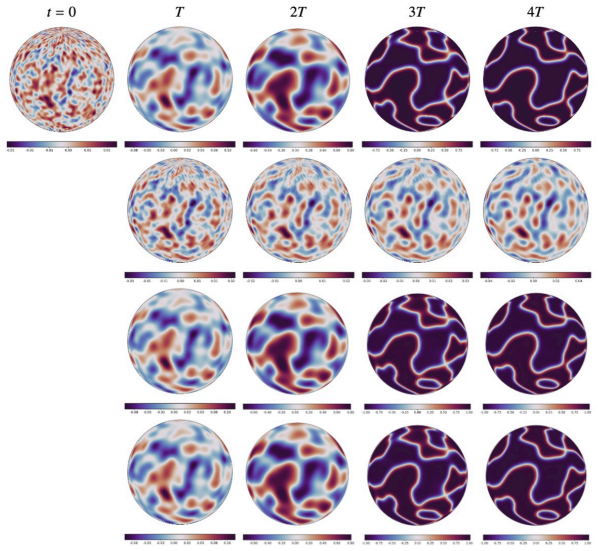
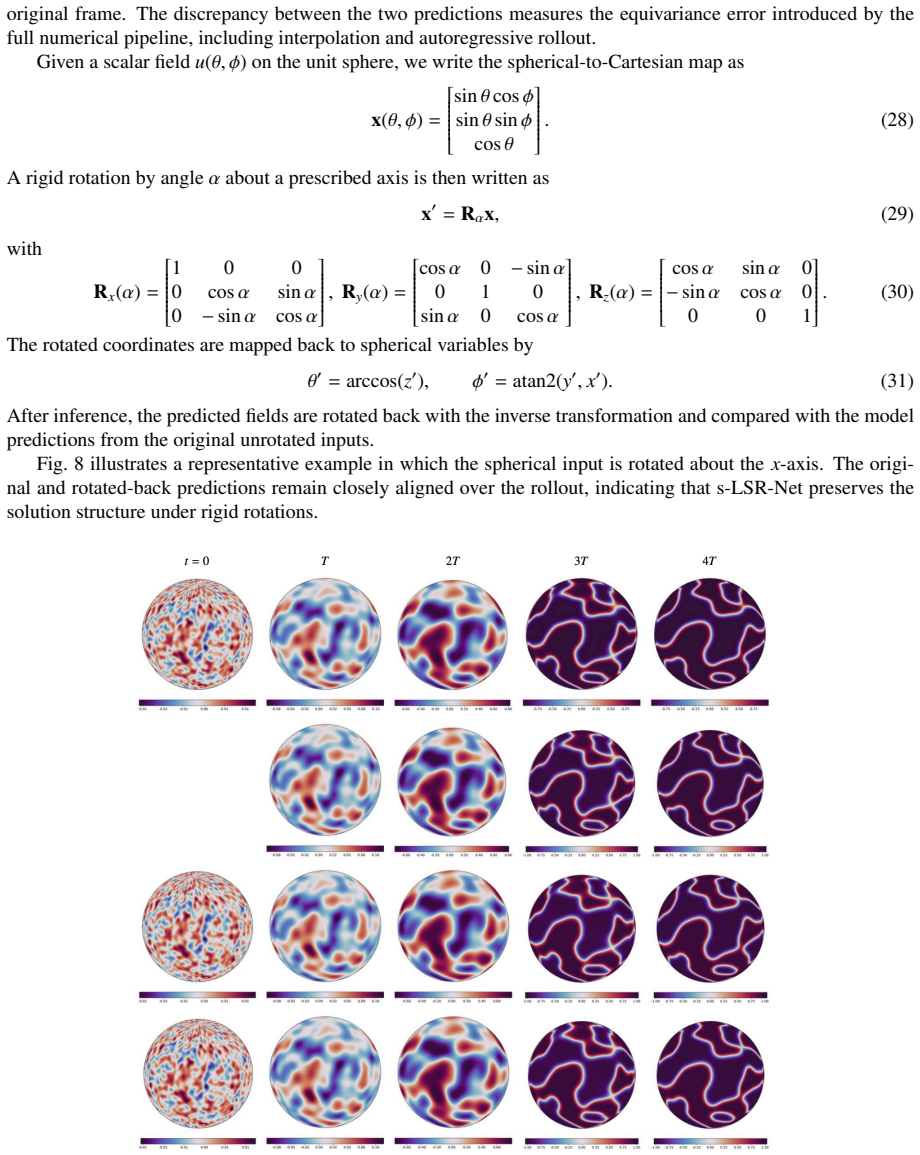
LSR-Net represents the forward evolution operator as the sum of a long-range component given by a compact Fourier multiplier constructed via the Sum-of-Exponentials approximation and a short-range component adapted to the manifold geometry. For point-cloud manifolds, the long-range part is computed by gridding to a regular auxiliary grid, applying the multiplier via FFT, and interpolating back. This yields higher accuracy and stability on benchmarks including Allen-Cahn dynamics on the sphere, where RMSE drops by roughly three orders of magnitude relative to the Spherical Fourier Neural Operator, and the learned operator respects rotation and reflection equivariance.
What carries the argument
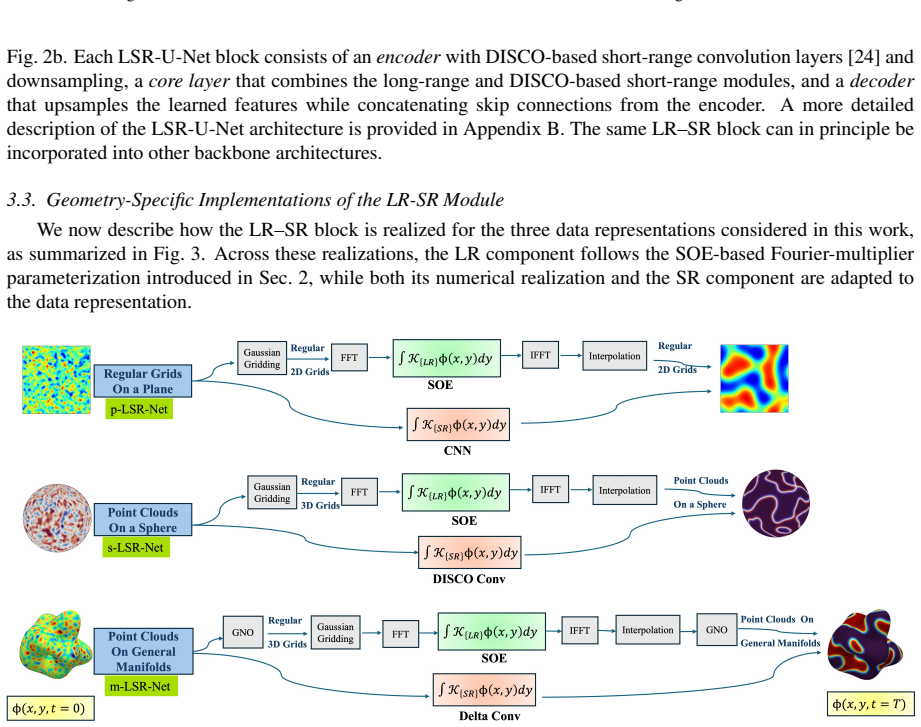
The long-short-range decomposition of the forward evolution operator, with the long-range part implemented as a Fourier multiplier via Sum-of-Exponentials approximation and Gaussian gridding for manifolds.
Load-bearing premise
Gaussian gridding of irregular manifold point clouds onto an auxiliary regular grid, followed by FFT application of the Fourier multiplier and interpolation back, preserves sufficient accuracy for the learned operator without introducing geometry-dependent errors.
What would settle it
A simulation on Allen-Cahn dynamics on the sphere where the reported three-order-of-magnitude RMSE reduction relative to SFNO fails to appear under longer time horizons or different point-cloud samplings.
Figures
read the original abstract
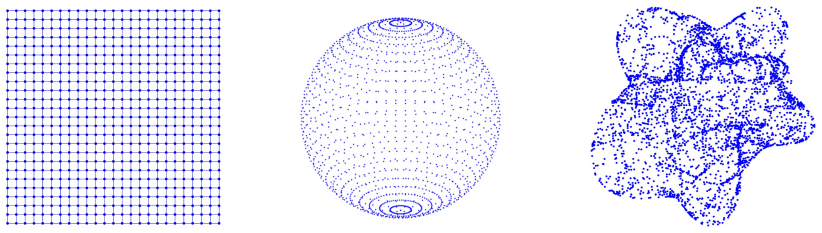
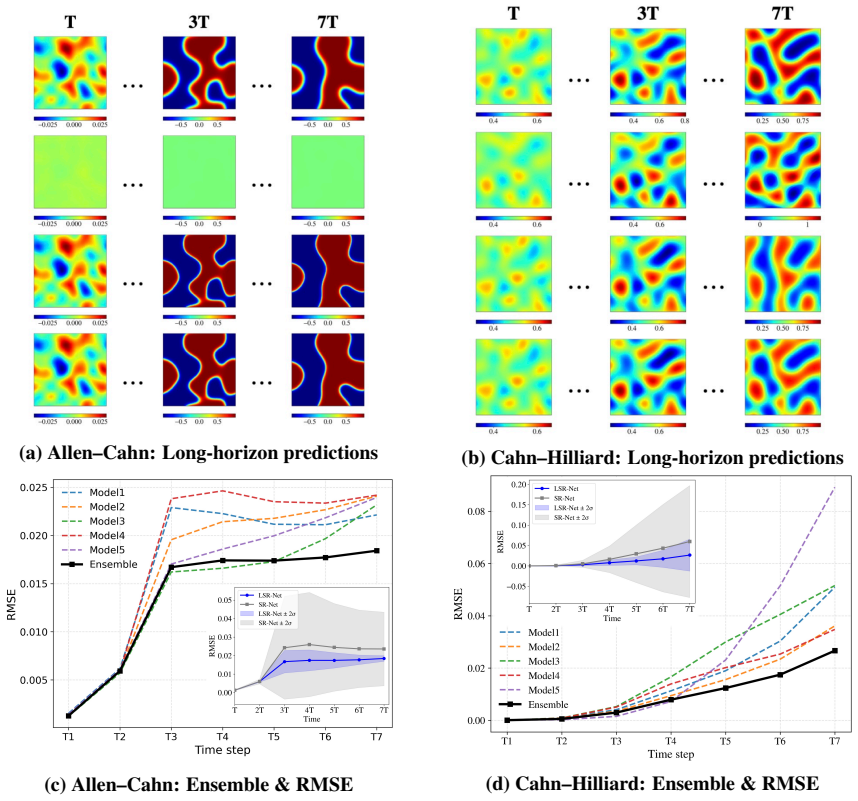
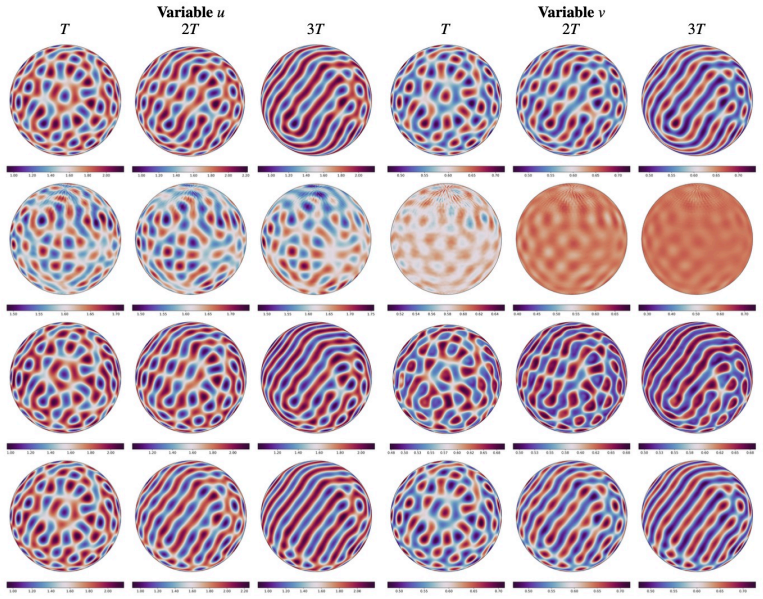
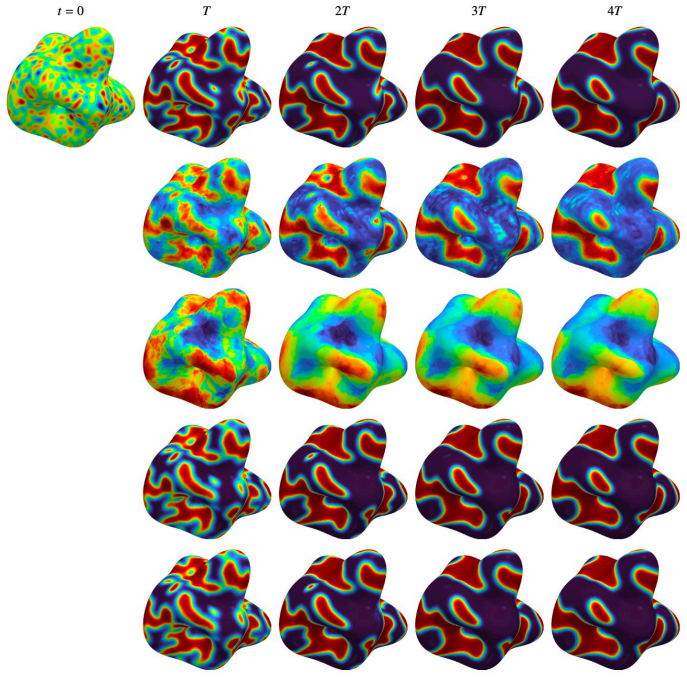
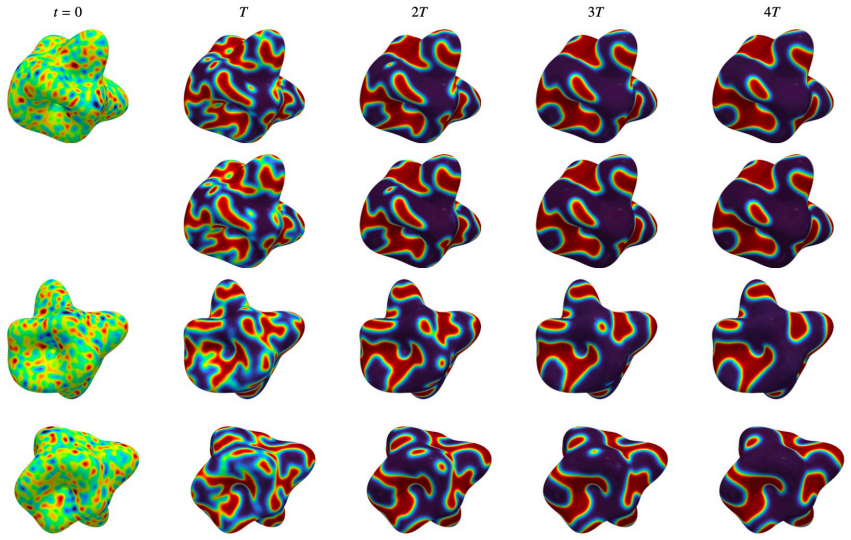
We propose the Long-Short-Range Neural Network (LSR-Net), an extensible operator-learning framework for predicting pattern dynamics on planar domains, spherical surfaces, and general manifolds. The method decomposes the forward evolution operator into a long-range component, represented by a compact Fourier multiplier constructed via the Sum-of-Exponentials (SOE) approximation, and a short-range component adapted to the underlying geometry and its intrinsic symmetries. For general manifolds represented by irregularly sampled point clouds, the long-range component is implemented by Gaussian gridding onto an auxiliary regular grid, where the Fourier multiplier is efficiently applied in k-space using FFT and the result is interpolated back to the original sample points. We evaluate LSR-Net on several benchmark systems, including the Allen-Cahn, Cahn-Hilliard, Schnakenberg, and Turing systems, over planar domains, spherical surfaces, and a blob-shaped manifold. Numerical results demonstrate that LSR-Net consistently achieves higher accuracy and improved stability compared with baseline operator-learning models. In particular, for Allen-Cahn dynamics on the sphere, the RMSE is reduced by approximately three orders of magnitude compared with the Spherical Fourier Neural Operator (SFNO). Rotation and reflection equivariance tests further confirm that the learned operator is consistent with these geometric transformations. These results indicate that LSR-Net provides an effective and robust approach for learning pattern dynamics on complex geometries.
Editorial analysis
A structured set of objections, weighed in public.
Referee Report
Summary. The manuscript proposes LSR-Net, an operator-learning framework for pattern dynamics on planar domains, spheres, and general manifolds. It decomposes the forward operator into a long-range component (compact Fourier multiplier via Sum-of-Exponentials approximation) and a short-range component adapted to geometry and symmetries. For irregular manifold point clouds, the long-range term is realized by Gaussian gridding to an auxiliary regular grid, FFT application of the multiplier, and interpolation back to the samples. Experiments on Allen-Cahn, Cahn-Hilliard, Schnakenberg, and Turing systems report consistently higher accuracy and stability than baselines, with an approximately three-order-of-magnitude RMSE reduction versus SFNO for Allen-Cahn on the sphere, plus rotation/reflection equivariance.
Significance. If the numerical claims hold after verification of the manifold discretization, LSR-Net would provide a practical, extensible route to spectral-style operator learning on non-Euclidean domains by separating long-range interactions (handled efficiently via FFT on an auxiliary grid) from local geometric adaptations. The equivariance tests and the SOE construction for the multiplier are concrete strengths that could be reusable beyond the reported benchmarks.
major comments (2)
- [Methods (Gaussian gridding paragraph) and Numerical results (Allen-Cahn sphere case)] The headline claim (abstract: Allen-Cahn on the sphere, RMSE reduced by approximately three orders of magnitude versus SFNO) rests on the accuracy of the Gaussian-gridding step for the long-range Fourier multiplier. No error analysis, convergence rates with respect to auxiliary-grid size or Gaussian width, or ablation on interpolation order is supplied; any curvature- or sampling-density-dependent truncation or aliasing errors would accumulate over time steps and could artifactually produce the reported stability and accuracy gains.
- [Numerical experiments section] The abstract states that LSR-Net achieves “higher accuracy and improved stability” across multiple systems, yet supplies neither error bars, training-set sizes, nor ablation studies on the relative contribution of the long-range versus short-range terms. Without these, it is impossible to determine whether the three-order RMSE improvement is robust or sensitive to the auxiliary-grid parameters.
minor comments (1)
- [Methods] Notation for the short-range operator and its adaptation to intrinsic symmetries is introduced only descriptively; explicit equations or pseudocode would improve reproducibility.
Simulated Author's Rebuttal
We thank the referee for the constructive feedback on the numerical foundations and experimental reporting of LSR-Net. We address each major comment below and will incorporate revisions to strengthen the manuscript.
read point-by-point responses
-
Referee: [Methods (Gaussian gridding paragraph) and Numerical results (Allen-Cahn sphere case)] The headline claim (abstract: Allen-Cahn on the sphere, RMSE reduced by approximately three orders of magnitude versus SFNO) rests on the accuracy of the Gaussian-gridding step for the long-range Fourier multiplier. No error analysis, convergence rates with respect to auxiliary-grid size or Gaussian width, or ablation on interpolation order is supplied; any curvature- or sampling-density-dependent truncation or aliasing errors would accumulate over time steps and could artifactually produce the reported stability and accuracy gains.
Authors: We agree that the manuscript would benefit from a dedicated error analysis of the Gaussian gridding step. Although the technique follows established non-uniform FFT practices, we did not supply convergence rates or interpolation-order ablations in the original submission. In the revision we will add an empirical study of truncation and aliasing errors versus auxiliary-grid size and Gaussian width for the sphere case, including observed convergence rates. This will directly address whether the reported RMSE gains remain robust under the discretization. revision: yes
-
Referee: [Numerical experiments section] The abstract states that LSR-Net achieves “higher accuracy and improved stability” across multiple systems, yet supplies neither error bars, training-set sizes, nor ablation studies on the relative contribution of the long-range versus short-range terms. Without these, it is impossible to determine whether the three-order RMSE improvement is robust or sensitive to the auxiliary-grid parameters.
Authors: We acknowledge that error bars, explicit training-set sizes, and long-range versus short-range ablations are missing from the main text. Training-set sizes and other protocol details appear in the supplementary material; we will move the essential information into the main numerical-experiments section. We will also add error bars from repeated runs with different random seeds and a new ablation that isolates the contribution of each term. These additions will clarify the robustness of the accuracy gains. revision: yes
Circularity Check
No circularity: empirical performance claims rest on external baselines, not self-referential fits or definitions.
full rationale
The paper presents LSR-Net as an operator-learning architecture that decomposes evolution into a long-range Fourier multiplier (via SOE) and geometry-adapted short-range terms, with manifold handling via Gaussian gridding + FFT. All reported gains (e.g., three-order RMSE reduction on spherical Allen-Cahn versus SFNO) are direct numerical comparisons to independent external models. No equation, parameter fit, or uniqueness claim reduces the target result to a quantity defined inside the same work; the method is self-contained against external benchmarks and contains no load-bearing self-citations or ansatz smuggling.
Axiom & Free-Parameter Ledger
Reference graph
Works this paper leans on
-
[1]
G. Zhu, J. Kou, S. Sun, J. Yao, A. Li, Decoupled, energy stable schemes for a phase-field surfactant model, Comput. Phys. Commun. 233 (2018) 67–77.doi:10.1016/j.cpc.2018.07.003
-
[2]
D. A. Cogswell, M. Z. Bazant, Coherency strain and the kinetics of phase separation in LiFePO4 nanoparti- cles, ACS nano 6 (3) (2012) 2215–2225
2012
-
[3]
S. Chan, A. H. Elsheikh, A machine learning approach for efficient uncertainty quantification using multiscale methods, J. Comput. Phys. 354 (2018) 493–511.doi:10.1016/j.jcp.2017.10.034
-
[4]
J. Shen, J. Xu, J. Yang, The scalar auxiliary variable (sav) approach for gradient flows, J. Comput. Phys. 353 (2018) 407–416
2018
-
[5]
J. Shen, J. Xu, J. Yang, A new class of efficient and robust energy stable schemes for gradient flows, SIAM Rev. 61 (3) (2019) 474–506
2019
-
[6]
J. Kou, H. Chen, A. Salama, S. Sun, An energy stable and positivity-preserving computational method for compressible and immiscible two-phase flow in porous media, J. Comput. Phys. 519 (2024) 113391.doi: 10.1016/j.jcp.2024.113391
-
[7]
L. Lu, P. Jin, G. Pang, Z. Zhang, G. E. Karniadakis, Learning nonlinear operators via deeponet based on the universal approximation theorem of operators, Nat. Mach. Intell. 3 (3) (2021) 218–229.doi:10.1038/ s42256-021-00302-5
2021
-
[8]
N. H. Nelsen, A. M. Stuart, The random feature model for input-output maps between banach spaces, SIAM J. Sci. Comput. 43 (5) (2021) A3212–A3243
2021
-
[9]
Anandkumar, K
A. Anandkumar, K. Azizzadenesheli, K. Bhattacharya, N. Kovachki, Z. Li, B. Liu, A. M. Stuart, Neural operator: Graph kernel network for partial differential equations (2020)
2020
-
[10]
Z. Li, N. Kovachki, K. Azizzadenesheli, B. Liu, K. Bhattacharya, A. M. Stuart, A. Anandkumar, Fourier neural operator for parametric partial differential equations, arXiv preprint arXiv:2010.08895 (2020)
work page internal anchor Pith review Pith/arXiv arXiv 2010
-
[11]
H. Wu, H. Luo, H. Wang, J. Wang, M. Long, Transolver: A fast transformer solver for PDEs on general geometries, arXiv preprint arXiv:2402.02366 (2024)
work page internal anchor Pith review Pith/arXiv arXiv 2024
-
[12]
Z. Hao, Z. Wang, H. Su, et al., Gnot: A general neural operator transformer for operator learning, in: Pro- ceedings of the International Conference on Machine Learning (ICML), PMLR, 2023, pp. 12556–12569
2023
- [13]
-
[14]
Z. Li, N. Kovachki, C. Choy, J. Chen, B. Liu, K. Azizzadenesheli, A. Anandkumar, Geometry-informed neural operator for large-scale 3d pdes, in: Adv. Neural Inf. Process. Syst., V ol. 36, 2023, pp. 35836–35854
2023
-
[15]
He, et al., Novel DeepONet architecture to predict stresses in elastoplastic structures with variable complex geometries and loads, Comput
J. He, et al., Novel DeepONet architecture to predict stresses in elastoplastic structures with variable complex geometries and loads, Comput. Methods Appl. Mech. Eng. 415 (2023) 116277
2023
-
[16]
Z. Li, D. Z. Huang, B. Liu, A. Anandkumar, Fourier neural operator with learned deformations for pdes on general geometries, J. Mach. Learn. Res. 24 (388) (2023) 1–26
2023
-
[17]
G. Beylkin, L. Monzón, On approximation of functions by exponential sums, Appl. Comput. Harmon. Anal. 19 (1) (2005) 17–48.doi:10.1016/j.acha.2005.01.004
-
[18]
G. Beylkin, L. Monzón, Approximation by exponential sums revisited, Appl. Comput. Harmon. Anal. 28 (2) (2010) 131–149.doi:10.1016/j.acha.2009.04.003
-
[19]
Jiang, L
S. Jiang, L. Greengard, Efficient representation of nonreflecting boundary conditions for the time-dependent Schrödinger equation in two dimensions, Commun. Pure Appl. Math. 61 (2) (2008) 261–288
2008
-
[20]
A. Dutt, V . Rokhlin, Fast fourier transforms for nonequispaced data, SIAM J. Sci. Comput. 14 (6) (1993) 1368–1393
1993
-
[21]
Greengard, J.-Y
L. Greengard, J.-Y . Lee, Accelerating the nonuniform fast fourier transform, SIAM Rev. 46 (3) (2004) 443– 454. 25
2004
-
[22]
exponential of semicircle
A. H. Barnett, J. Magland, L. af Klinteberg, A parallel nonuniform fast fourier transform library based on an “exponential of semicircle" kernel, SIAM J. Sci. Comput. 41 (5) (2019) C479–C504
2019
-
[23]
Y . Peng, L. Lin, L. Ying, L. Zepeda-Núñez, Efficient long-range convolutions for point clouds, J. Comput. Phys. 473 (2023) 111692
2023
- [24]
-
[25]
Wiersma, A
R. Wiersma, A. Nasikun, E. Eisemann, K. Hildebrandt, Deltaconv: anisotropic operators for geometric deep learning on point clouds, ACM Trans. Graph. 41 (4) (2022) 1–10
2022
-
[26]
Bonev, T
B. Bonev, T. Kurth, C. Hundt, J. Pathak, M. Baust, K. Kashinath, A. Anandkumar, Spherical fourier neural operators: Learning stable dynamics on the sphere, in: ICML, PMLR, 2023, pp. 2806–2823
2023
-
[27]
R. A. DeV ore, A. Kunoth, Multiscale, nonlinear and adaptive approximation, Springer, 2009
2009
-
[28]
Z. Gao, J. Liang, Z. Xu, A kernel-independent sum-of-exponentials method, J. Sci. Comput. 93 (2) (2022) 40
2022
- [29]
-
[30]
Rahaman, A
N. Rahaman, A. Baratin, D. Arpit, F. Draxler, M. Lin, F. Hamprecht, Y . Bengio, A. Courville, On the spectral bias of neural networks, in: International conference on machine learning, PMLR, 2019, pp. 5301–5310
2019
-
[31]
Z.-Q. J. Xu, Y . Zhang, T. Luo, Overview frequency principle/spectral bias in deep learning, Commun. Appl. Math. Comput. (2024) 1–38
2024
-
[32]
P. P. Ewald, Ewald summation, Ann. Phys 369 (253) (1921) 1–2
1921
-
[33]
J. W. Eastwood, R. W. Hockney, D. Lawrence, P3M3DP-The three-dimensional periodic particle- particle/particle-mesh program, Comput. Phys. Commun. 19 (2) (1980) 215–261
1980
-
[34]
Darden, D
T. Darden, D. York, L. Pedersen, et al., Particle mesh Ewald: An N log (N) method for Ewald sums in large systems, J. Chem. Phys. 98 (12) (1993) 10089–10092
1993
-
[35]
Hashemi, R
A. Hashemi, R. P. Peláez, S. Natesh, B. Sprinkle, O. Maxian, Z. Gan, A. Donev, Computing hydrodynamic interactions in confined doubly periodic geometries in linear time, J. Chem. Phys. 158 (15) (2023)
2023
-
[36]
Z. Gan, X. Gao, J. Liang, Z. Xu, Fast algorithm for quasi-2D Coulomb systems, J. Comput. Phys. 524 (2025) 113733
2025
-
[37]
Accelerating Molecular Dynamics Simulations using Fast Ewald Summation with Prolates
J. Liang, L. Lu, A. Barnett, L. Greengard, S. Jiang, Accelerating fast Ewald summation with prolates for molecular dynamics simulations, arXiv preprint arXiv:2505.09727 (2025)
work page internal anchor Pith review Pith/arXiv arXiv 2025
-
[38]
Fast Ewald Summation using Prolate Spheroidal Wave Functions
E. Boström, A.-K. Tornberg, L. a. Klinteberg, Fast Ewald summation using prolate spheroidal wave functions, arXiv preprint arXiv:2602.16591 (2026)
work page internal anchor Pith review Pith/arXiv arXiv 2026
- [39]
-
[40]
Cheng, Latent Ewald summation for machine learning of long-range interactions, npj Comput
B. Cheng, Latent Ewald summation for machine learning of long-range interactions, npj Comput. Mater. 11 (1) (2025) 80
2025
-
[41]
Y . Ji, J. Liang, Z. Xu, Machine-learning interatomic potentials for long-range systems, Phys. Rev. Lett. 135 (17) (2025) 178001
2025
-
[42]
Ronneberger, P
O. Ronneberger, P. Fischer, T. Brox, U-net: Convolutional networks for biomedical image segmentation, in: Medical Image Computing and Computer-Assisted Intervention – MICCAI 2015, Springer, Cham, 2015, pp. 234–241
2015
-
[43]
I. Khurjekar, I. Saha, L. Graham-Brady, S. Goswami, Enhanced accuracy through ensembling of randomly initialized auto-regressive models for time-dependent pdes, arXiv preprint arXiv:2507.03863 (2025). 26
-
[44]
R. J. Williams, D. Zipser, A learning algorithm for continually running fully recurrent neural networks, Neural Comput. 1 (2) (1989) 270–280.doi:10.1162/neco.1989.1.2.270
-
[45]
Bengio, O
S. Bengio, O. Vinyals, N. Jaitly, N. Shazeer, Scheduled sampling for sequence prediction with recurrent neural networks, in: Advances in Neural Information Processing Systems, V ol. 28, 2015
2015
-
[46]
A. M. Lamb, A. Goyal, Y . Zhang, S. Zhang, A. Courville, Y . Bengio, Professor forcing: A new algorithm for training recurrent networks, in: Advances in Neural Information Processing Systems, V ol. 29, 2016
2016
-
[47]
S. M. Allen, J. W. Cahn, A microscopic theory for antiphase boundary motion and its application to antiphase domain coarsening, Acta Metall. 27 (6) (1979) 1085–1095
1979
-
[48]
J. W. Cahn, J. E. Hilliard, Free energy of a nonuniform system. i. interfacial free energy, J. Chem. Phys. 28 (1958) 258–267
1958
-
[49]
M. C. Cross, P. C. Hohenberg, Pattern formation outside of equilibrium, Rev. Mod. Phys. 65 (3) (1993) 851
1993
-
[50]
Steinbach, Phase-field models in materials science, Model
I. Steinbach, Phase-field models in materials science, Model. Simul. Mater. Sc. 17 (7) (2009) 073001
2009
-
[51]
C. L. Epstein, L. Greengard, Debye sources and the numerical solution of the time harmonic Maxwell equa- tions, Comm. Pure Appl. Math. 63 (4) (2010) 413–463
2010
-
[52]
O’Neil, Second-kind integral equations for the Laplace-Beltrami problem on surfaces in three dimensions, Adv
M. O’Neil, Second-kind integral equations for the Laplace-Beltrami problem on surfaces in three dimensions, Adv. Comput. Math. 44 (5) (2018) 1385–1409
2018
-
[53]
Schnakenberg, Simple chemical reaction systems with limit cycle behaviour, J
J. Schnakenberg, Simple chemical reaction systems with limit cycle behaviour, J. Theor. Biol. 81 (3) (1979) 389–400.doi:10.1016/0022-5193(79)90042-0
-
[54]
Rahimi, B
A. Rahimi, B. Recht, Random features for large-scale kernel machines, NeurIPS 20 (2007)
2007
-
[55]
W. B. March, G. Biros, Far-field compression for fast kernel summation methods in high dimensions, Appl. Comput. Harmon. Anal. 43 (1) (2017) 39–75
2017
-
[56]
Hertrich, Fast kernel summation in high dimensions via slicing and Fourier transforms, SIAM J
J. Hertrich, Fast kernel summation in high dimensions via slicing and Fourier transforms, SIAM J. Math. Data Sci. 6 (4) (2024) 1109–1137
2024
-
[57]
J. Hertrich, T. Jahn, M. Quellmalz, Fast summation of radial kernels via QMC slicing, arXiv preprint arXiv:2410.01316 (2024)
-
[58]
S. Jiang, L. Greengard, S. Wang, Efficient sum-of-exponentials approximations for the heat kernel and their applications, Adv. Comput. Math. 41 (2015) 529–551.doi:10.1007/s10444-014-9370-0
-
[59]
Stewart, Life’s Other Secret: The New Mathematics of the Living World, Allen Lane, London, 1998
I. Stewart, Life’s Other Secret: The New Mathematics of the Living World, Allen Lane, London, 1998
1998
-
[60]
A. M. Turing, The chemical basis of morphogenesis, Phil. Trans. R. Soc. B 237 (641) (1952) 37–72.doi: 10.1098/rstb.1952.0012
-
[61]
Fortunato, A high-order fast direct solver for surface pdes, SIAM J
D. Fortunato, A high-order fast direct solver for surface pdes, SIAM J. Sci. Comput. 46 (4) (2024) A2582– A2606. 27
2024
discussion (0)
Sign in with ORCID, Apple, or X to comment. Anyone can read and Pith papers without signing in.