Stitched Embeddings: A Unified Latent Space for 3D Garments and 2D Patterns
Pith reviewed 2026-07-02 13:52 UTC · model grok-4.3
The pith
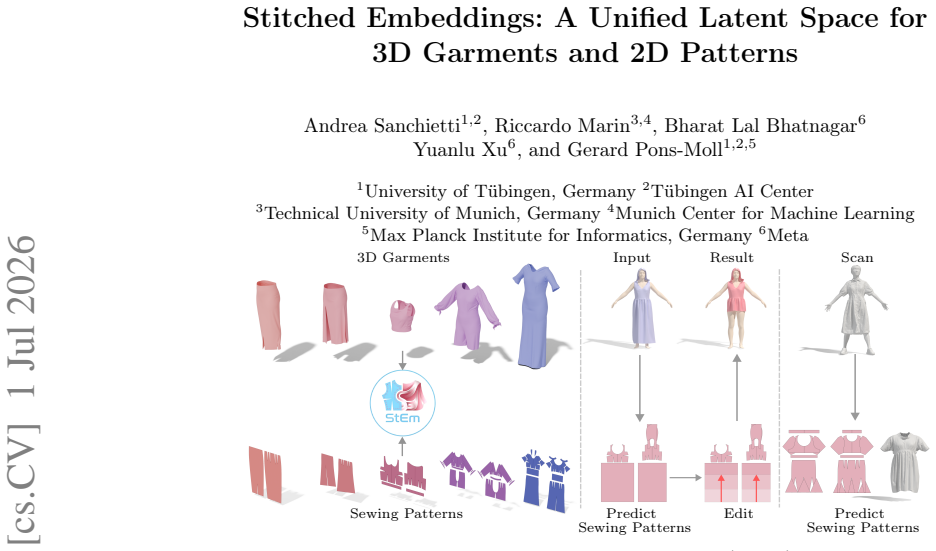
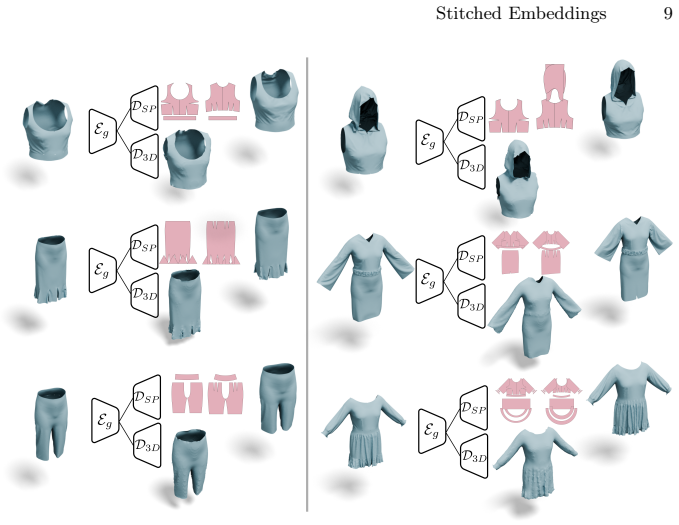
Stitched Embeddings create a single bidirectional latent space that maps 3D garments to 2D sewing patterns and back without simulation.
A machine-rendered reading of the paper's core claim, the machinery that carries it, and where it could break.
Core claim
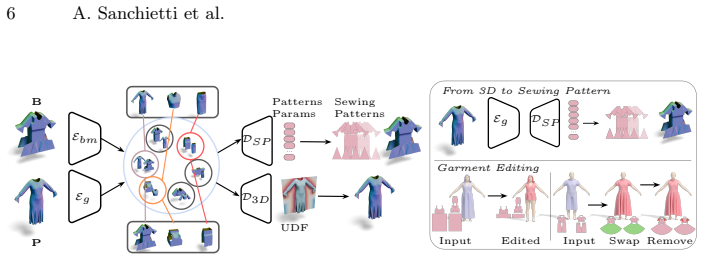
Stitched Embeddings is the first simulation-free framework to unify 3D garment reconstruction and sewing pattern inference within a single bidirectional latent space. By leveraging the geometric priors of a pretrained 3D foundation model, the approach overcomes data scarcity. The BoxMesh serves as a critical intermediate representation to align 2D panels into 3D configurations without the computational overhead of a simulator. This architecture achieves state-of-the-art accuracy in pattern reconstruction while significantly improving efficiency. The differentiable pipeline enables pattern recovery from meshes and 3D editing from 2D patterns, providing a scalable link between neural 3D vision
What carries the argument
The bidirectional latent space of Stitched Embeddings, which uses BoxMesh as the intermediate representation to align 2D panels into 3D without simulation.
If this is right
- Achieves state-of-the-art accuracy in pattern reconstruction.
- Significantly improves efficiency compared with simulation-based methods.
- Enables pattern recovery from meshes.
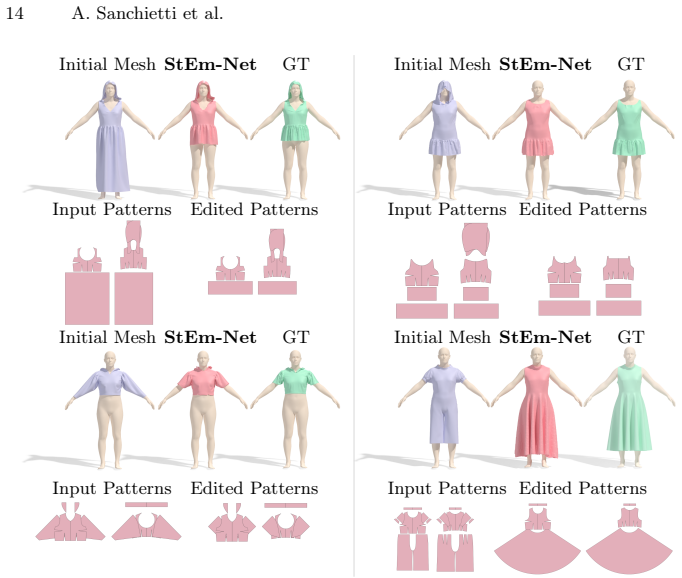
- Allows 3D editing from modifications to 2D patterns.
- Provides a scalable link between neural 3D vision and the physical garment manufacturing pipeline.
Where Pith is reading between the lines
- Design tools could let users switch freely between editing a 2D pattern and seeing the immediate 3D result in the same space.
- The latent space might support fit prediction on varied body shapes by treating body variation as an additional conditioning signal.
- The same alignment approach could be tested on other flat-to-3D manufacturing tasks such as sheet-metal bending or inflatable structures.
- A direct check would measure whether seam lengths and panel areas remain consistent across the 2D-to-3D round trip without extra constraints.
Load-bearing premise
The BoxMesh representation can align 2D panels into accurate 3D configurations without simulation, and the pretrained 3D model supplies enough geometric priors to handle the scarcity of garment data.
What would settle it
Running the model on a set of 3D garment meshes and finding that the output 2D patterns, when physically sewn, produce shapes that deviate measurably from the input meshes in key dimensions such as seam lengths or overall fit.
Figures
read the original abstract
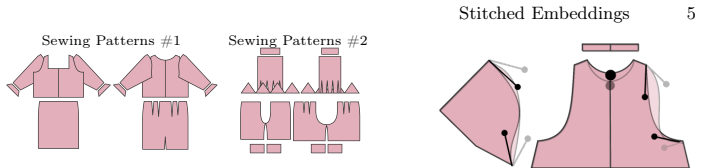
While garments are essential for realistic digital humans, their topological variety makes them much harder to model than parametric bodies. Traditional tailoring relies on 2D sewing patterns, yet bridging these patterns to 3D geometry currently requires physical simulations. We present Stitched Embeddings, the first simulation-free framework to unify 3D garment reconstruction and sewing pattern inference within a single bidirectional latent space. By leveraging the geometric priors of a pretrained 3D foundation model, our approach overcomes the data scarcity typically associated with high-quality garment modeling. We propose to use the BoxMesh as a critical intermediate representation to align 2D panels into 3D configurations without the computational overhead of a simulator. This architecture achieves state-of-the-art accuracy in pattern reconstruction while significantly improving efficiency. Furthermore, our differentiable pipeline enables novel applications, including pattern recovery from meshes and 3D editing from 2D patterns. Finally, this work provides a scalable link between neural 3D vision and the physical garment manufacturing pipeline. Project Page: https://andreus00.github.io/stitchedembeddings
Editorial analysis
A structured set of objections, weighed in public.
Referee Report
Summary. The manuscript presents Stitched Embeddings, the first simulation-free framework to unify 3D garment reconstruction and sewing pattern inference within a single bidirectional latent space. It leverages geometric priors from a pretrained 3D foundation model to address data scarcity and proposes the BoxMesh as an intermediate representation to align 2D panels into 3D configurations without physical simulation. The architecture is claimed to achieve state-of-the-art accuracy in pattern reconstruction with improved efficiency, while the differentiable pipeline enables applications such as pattern recovery from meshes and 3D editing from 2D patterns, providing a scalable link between neural 3D vision and garment manufacturing.
Significance. If the empirical claims hold, the work would represent a meaningful advance in 3D garment modeling by removing the computational cost of simulations and enabling bidirectional inference between 2D patterns and 3D geometry. The use of pretrained priors to mitigate data scarcity and the introduction of BoxMesh as an alignment mechanism are potentially impactful if shown to be robust. The bidirectional latent space and differentiability open avenues for downstream tasks in digital humans and manufacturing pipelines.
major comments (2)
- [Abstract] Abstract: the central claim of 'state-of-the-art accuracy in pattern reconstruction' and 'significantly improving efficiency' is presented without any quantitative results, baseline comparisons, error metrics, or ablation studies. This absence is load-bearing for the superiority assertion and prevents assessment of whether the data or methods support the stated performance.
- [Abstract] Abstract: the claim that BoxMesh serves as 'a critical intermediate representation to align 2D panels into 3D configurations without the computational overhead of a simulator' is a load-bearing assumption, yet no description of the alignment procedure, geometric constraints, or validation against simulation-based methods is provided. Without this, it is impossible to evaluate whether the approach truly avoids hidden simulation-like costs or failure modes.
minor comments (1)
- The project page URL is referenced but the manuscript should include a stable citation or DOI for reproducibility.
Simulated Author's Rebuttal
We thank the referee for their comments, which focus on strengthening the abstract's support for its claims. We address each point below and will revise the abstract accordingly.
read point-by-point responses
-
Referee: [Abstract] Abstract: the central claim of 'state-of-the-art accuracy in pattern reconstruction' and 'significantly improving efficiency' is presented without any quantitative results, baseline comparisons, error metrics, or ablation studies. This absence is load-bearing for the superiority assertion and prevents assessment of whether the data or methods support the stated performance.
Authors: The referee is correct that the abstract, as written, states these performance claims at a high level without supporting numbers. The full manuscript reports quantitative results, baselines, error metrics, and ablations in the experiments section. To address the concern directly, we will revise the abstract to include concise quantitative highlights (e.g., key error reductions and runtime improvements) drawn from those results. revision: yes
-
Referee: [Abstract] Abstract: the claim that BoxMesh serves as 'a critical intermediate representation to align 2D panels into 3D configurations without the computational overhead of a simulator' is a load-bearing assumption, yet no description of the alignment procedure, geometric constraints, or validation against simulation-based methods is provided. Without this, it is impossible to evaluate whether the approach truly avoids hidden simulation-like costs or failure modes.
Authors: The referee correctly notes that the abstract provides no procedural details on BoxMesh alignment. The manuscript describes the alignment procedure, geometric constraints, and validation (including comparisons to simulation) in the methods and experiments sections. We will revise the abstract to add a brief clause summarizing the alignment approach and its validation, while keeping the abstract concise. revision: yes
Circularity Check
No significant circularity detected
full rationale
The provided text is limited to the abstract, which contains no equations, derivations, or load-bearing methodological steps. No specific quotes from the paper can be exhibited to show any reduction by construction, self-definition, fitted inputs called predictions, or self-citation chains. Per the hard rules, circularity requires quoting the paper and exhibiting the specific reduction; absent any such technical content, the finding is no significant circularity (score 0). The high-level claims about BoxMesh and pretrained priors cannot be inspected for circularity from the given material alone.
Axiom & Free-Parameter Ledger
Reference graph
Works this paper leans on
-
[1]
In: 2024 international conference on 3D vision (3DV)
Antić, D., Tiwari, G., Ozcomlekci, B., Marin, R., Pons-Moll, G.: Close: A 3d cloth- ing segmentation dataset and model. In: 2024 international conference on 3D vision (3DV). pp. 591–601. IEEE (2024)
2024
-
[2]
In: Computer Graphics Forum
Bang, S., Korosteleva, M., Lee, S.H.: Estimating garment patterns from static scan data. In: Computer Graphics Forum. vol. 40, pp. 273–287. Wiley Online Library (2021)
2021
-
[3]
Acm Transactions on Graphics (TOG)32(4), 1–12 (2013)
Berthouzoz, F., Garg, A., Kaufman, D.M., Grinspun, E., Agrawala, M.: Parsing sewing patterns into 3d garments. Acm Transactions on Graphics (TOG)32(4), 1–12 (2013)
2013
-
[4]
In: Proceedings of the IEEE/CVF Inter- national Conference on Computer Vision (ICCV) (October 2019)
Bhatnagar, B.L., Tiwari, G., Theobalt, C., Pons-Moll, G.: Multi-garment net: Learning to dress 3d people from images. In: Proceedings of the IEEE/CVF Inter- national Conference on Computer Vision (ICCV) (October 2019)
2019
-
[5]
Bian, S., Xu, C., Xiu, Y., Grigorev, A., Liu, Z., Lu, C., Black, M.J., Feng, Y.: Chat- garment: Garment estimation, generation and editing via large language models (2025)
2025
-
[6]
arXiv preprint arXiv:2601.09658 (2026)
Can, S.E., Ackermann, J., Nakayama, K., Liu, R., Wu, T., Zheng, Y., Bertiche, H., Chai, M., Beeler, T., Wetzstein, G.: Image2garment: Simulation-ready garment generation from a single image. arXiv preprint arXiv:2601.09658 (2026)
-
[7]
In: Proceedings of the IEEE/CVF Winter Conference on Applications of Computer Vision (WACV)
Chen, C.H., Su, J.W., Hu, M.C., Yao, C.Y., Chu, H.K.: Panelformer: Sewing pat- tern reconstruction from 2d garment images. In: Proceedings of the IEEE/CVF Winter Conference on Applications of Computer Vision (WACV). pp. 454–463 (January 2024)
2024
-
[8]
ACM Transactions on Graphics (TOG)34(6), 1–12 (2015)
Chen, X., Zhou, B., Lu, F., Wang, L., Bi, L., Tan, P.: Garment modeling with a depth camera. ACM Transactions on Graphics (TOG)34(6), 1–12 (2015)
2015
-
[9]
In: Advances in Neural Information Processing Systems (NeurIPS) (December 2020)
Chibane, J., Mir, A., Pons-Moll, G.: Neural unsigned distance fields for im- plicit function learning. In: Advances in Neural Information Processing Systems (NeurIPS) (December 2020)
2020
-
[10]
In: Proceedings of the IEEE/CVF Conference on Computer Vision and Pattern Recognition
De Luigi, L., Li, R., Guillard, B., Salzmann, M., Fua, P.: Drapenet: Garment gen- eration and self-supervised draping. In: Proceedings of the IEEE/CVF Conference on Computer Vision and Pattern Recognition. pp. 1451–1460 (2023)
2023
-
[11]
Advances in Neural Information Processing Systems36, 35799–35813 (2023)
Deitke, M., Liu, R., Wallingford, M., Ngo, H., Michel, O., Kusupati, A., Fan, A., Laforte, C., Voleti, V., Gadre, S.Y., et al.: Objaverse-xl: A universe of 10m+ 3d objects. Advances in Neural Information Processing Systems36, 35799–35813 (2023)
2023
-
[12]
In: Proceedings of the IEEE/CVF conference on computer vision and pattern recognition
Deitke, M., Schwenk, D., Salvador, J., Weihs, L., Michel, O., VanderBilt, E., Schmidt, L., Ehsani, K., Kembhavi, A., Farhadi, A.: Objaverse: A universe of annotated 3d objects. In: Proceedings of the IEEE/CVF conference on computer vision and pattern recognition. pp. 13142–13153 (2023)
2023
-
[13]
In: Proceedings of the IEEE/CVF Conference on Computer Vision and Pattern Recognition Workshops (CVPRW)
Eskandar, D., Kabadayi, B., Tiwari, G., Pons-Moll, G.: Dama: Disentangled body- anchored gaussians for controllable multi-layered avatars. In: Proceedings of the IEEE/CVF Conference on Computer Vision and Pattern Recognition Workshops (CVPRW). pp. 5799–5811 (June 2026)
2026
-
[14]
Computers & Graphics p
Garavaso, D., Masi, F., Musoni, P., Castellani, U.: Point cloud segmentation for 3d clothed human layering. Computers & Graphics p. 104393 (2025)
2025
-
[15]
arXiv preprint arXiv:2405.12663 (2024) Stitched Embeddings 17
Gong, J., Ji, S., Foo, L.G., Chen, K., Rahmani, H., Liu, J.: Laga: Layered 3d avatar generation and customization via gaussian splatting. arXiv preprint arXiv:2405.12663 (2024) Stitched Embeddings 17
-
[16]
In: Proceedings of the 29th annual conference on Computer graphics and interactive techniques
Gu, X., Gortler, S.J., Hoppe, H.: Geometry images. In: Proceedings of the 29th annual conference on Computer graphics and interactive techniques. pp. 355–361 (2002)
2002
-
[17]
Guo, J., Chen, J., Chen, W., Sun, Z., Li, L., Zhao, B., Zhu, L., Wang, X., Liu, Q.: Garmentx: Autoregressive parametric representations for high-fidelity 3d garment generation (2025)
2025
-
[18]
In: Proceedings of the IEEE/CVF Conference on Computer Vision and Pattern Recognition (CVPR)
Guo, M., Chiang, M.J.Y., Santesteban, I., Sarafianos, N., Chen, H.y., Halimi, O., Božič, A., Saito, S., Wu, J., Liu, C.K., Stuyck, T., Larionov, E.: Pgc: Physics-based gaussian cloth from a single pose. In: Proceedings of the IEEE/CVF Conference on Computer Vision and Pattern Recognition (CVPR). pp. 21215–21225 (June 2025)
2025
-
[19]
ACM Transactions on Graph- ics (TOG)43(4), 1–13 (2024)
He, K., Yao, K., Zhang, Q., Yu, J., Liu, L., Xu, L.: Dresscode: Autoregressively sewing and generating garments from text guidance. ACM Transactions on Graph- ics (TOG)43(4), 1–13 (2024)
2024
-
[20]
In: 2023 nicograph international (NicoInt)
He, Y., Xie, H., Miyata, K.: Sketch2cloth: Sketch-based 3d garment generation with unsigned distance fields. In: 2023 nicograph international (NicoInt). pp. 38–
2023
-
[21]
In: Computer Vision – ECCV 2020
Heming, Z., Yu, C., Hang, J., Weikai, C., Dong, D., Zhangye, W., Shuguang, C., Xiaoguang, H.: Deep fashion3d: A dataset and benchmark for 3d garment recon- struction from single images. In: Computer Vision – ECCV 2020. pp. 512–530. Springer International Publishing (2020)
2020
-
[22]
Neural computation 9(8), 1735–1780 (1997)
Hochreiter, S., Schmidhuber, J.: Long short-term memory. Neural computation 9(8), 1735–1780 (1997)
1997
-
[23]
arXiv preprint arXiv:2203.00806 , year=
Howell, T.A., Le Cleac’h, S., Kolter, J.Z., Schwager, M., Manchester, Z.: Dojo: A differentiable simulator for robotics. arXiv preprint arXiv:2203.008069(2), 4 (2022)
-
[24]
IEEE Transactions on Visualization and Computer Graphics32(7), 6350–6362 (2026)
Jin, L., Jin, Z., Ye, Z., Pang, H., Han, X., Zheng, Y., Li, H.: Inversedraping: Recovering sewing patterns from 3d garment surfaces via boxmesh bridging. IEEE Transactions on Visualization and Computer Graphics32(7), 6350–6362 (2026)
2026
-
[25]
In: Computer Graphics Forum
Jung, M., Lee, D., Lee, I.K.: Clothingtwin: Reconstructing inner and outer layers of clothing using 3d gaussian splatting. In: Computer Graphics Forum. vol. 44, p. e70240. Wiley Online Library (2025)
2025
-
[26]
In: Computer Vision – ECCV 2024 (2024)
Korosteleva, M., Kesdogan, T.L., Kemper, F., Wenninger, S., Koller, J., Zhang, Y., Botsch, M., Sorkine-Hornung, O.: GarmentCodeData: A dataset of 3D made- to-measure garments with sewing patterns. In: Computer Vision – ECCV 2024 (2024)
2024
-
[27]
In: Vanschoren, J., Yeung, S
Korosteleva, M., Lee, S.H.: Generating datasets of 3d garments with sewing pat- terns. In: Vanschoren, J., Yeung, S. (eds.) Proceedings of the Neural Information Processing Systems Track on Datasets and Benchmarks. vol. 1 (2021)
2021
-
[28]
ACM Trans
Korosteleva, M., Lee, S.H.: Neuraltailor: Reconstructing sewing pattern structures from 3d point clouds of garments. ACM Trans. Graph.41(4) (2022)
2022
-
[29]
ACM Transaction on Graphics42(6) (2023), sIGGRAPH ASIA 2023 issue
Korosteleva, M., Sorkine-Hornung, O.: GarmentCode: Programming parametric sewing patterns. ACM Transaction on Graphics42(6) (2023), sIGGRAPH ASIA 2023 issue
2023
-
[30]
In: European Conference on Computer Vision (ECCV) (2026)
Kostyrko,M.,Xue,Y.,Tiwari,G.,Pons-Moll,G.:Revisitingavatar-as-image:High- fidelity registration is all you need. In: European Conference on Computer Vision (ECCV) (2026)
2026
-
[31]
ReWeaver: Towards Simulation-Ready and Topology-Accurate Garment Reconstruction
Li, M., Shan, H., Zheng, K., Shen, C., Liu, S., Fu, Y., Chen, Z., Huang, X.: Reweaver: Towards simulation-ready and topology-accurate garment reconstruc- tion. arXiv preprint arXiv:2601.16672 (2026) 18 A. Sanchietti et al
work page internal anchor Pith review Pith/arXiv arXiv 2026
-
[32]
ACM Transactions on Graphics (TOG)44(6), 1–23 (2025)
Li, S., Liu, R., Liu, C., Wang, Z., He, G., Li, Y.L., Jin, X., Wang, H.: Garmagenet: A multimodal generative framework for sewing pattern design and generic garment modeling. ACM Transactions on Graphics (TOG)44(6), 1–23 (2025)
2025
-
[33]
In: Kwok, J
Li, X., Yao, Q., Wang, Y.: Garmentdiffusion: 3d garment sewing pattern genera- tion with multimodal diffusion transformers. In: Kwok, J. (ed.) Proceedings of the Thirty-Fourth International Joint Conference on Artificial Intelligence, IJCAI-25. pp. 1458–1466. International Joint Conferences on Artificial Intelligence Organiza- tion (8 2025), main Track
2025
-
[34]
In: ProceedingsoftheIEEE/CVFConferenceonComputerVisionandPatternRecog- nition (CVPR) (June 2024)
Li, Y., Chen, H.y., Larionov, E., Sarafianos, N., Matusik, W., Stuyck, T.: Dif- fAvatar: Simulation-ready garment optimization with differentiable simulation. In: ProceedingsoftheIEEE/CVFConferenceonComputerVisionandPatternRecog- nition (CVPR) (June 2024)
2024
-
[35]
ACM Transactions on Graphics (SIGGRAPH Asia) (2023)
Liu, L., Xu, X., Lin, Z., Liang, J., Yan, S.: Towards garment sewing pattern recon- struction from a single image. ACM Transactions on Graphics (SIGGRAPH Asia) (2023)
2023
-
[36]
Inter- national Conference on Computer Vision (ICCV) (2025)
Liu, S., Cheng, Y., Chen, Z., Ren, X., Zhu, W., Li, L., Bi, M., Yang, X., Yan, Y.: Multimodal latent diffusion model for complex sewing pattern generation. Inter- national Conference on Computer Vision (ICCV) (2025)
2025
-
[37]
IEEE Transactions on Visualization and Computer Graphics31(4), 2142–2154 (2024)
Liu, X., Li, J., Lu, G.: Reconstructing complex shaped clothing from a single image with feature stable unsigned distance fields. IEEE Transactions on Visualization and Computer Graphics31(4), 2142–2154 (2024)
2024
-
[38]
liu et al
Liu, Y., Tang, J., Zheng, C., Zhu, J., Wang, C., Huang, D.: Clothedreamer: Text- guided garment generation with 3d gaussians: Y. liu et al. Applied Intelligence 55(10), 767 (2025)
2025
-
[39]
In: ICLR (2024)
Liu, Z., Feng, Y., Xiu, Y., Liu, W., Paull, L., Black, M.J., Schölkopf, B.: Ghost on the shell: An expressive representation of general 3d shapes. In: ICLR (2024)
2024
-
[40]
Loper, M., Mahmood, N., Romero, J., Pons-Moll, G., Black, M.J.: SMPL: A skinnedmulti-personlinearmodel.ACMTrans.Graphics(Proc.SIGGRAPHAsia) 34(6), 248:1–248:16 (Oct 2015)
2015
-
[41]
IEEE Transactions on Circuits and Systems for Video Technology (2025)
Luo, J., Qu, H., Zhao, Y., Zhang, J., Yang, Y.: Deep learning for 3d fashion design: A survey from a sewing pattern-driven perspective. IEEE Transactions on Circuits and Systems for Video Technology (2025)
2025
-
[42]
In: NVIDIA GPU Technology Conference (GTC)
Macklin, M.: Warp: A high-performance python framework for gpu simulation and graphics. In: NVIDIA GPU Technology Conference (GTC). vol. 3 (2022)
2022
-
[43]
In: European Conference on Computer Vision (ECCV) (2026)
Mir, A., Guler, R.A., Tang, X., Wonka, P., Pons-Moll, G.: Ahoy! animatable hu- mans under occlusion from youtube videos with gaussian splatting and video dif- fusion priors. In: European Conference on Computer Vision (ECCV) (2026)
2026
-
[44]
In: Smart Tools and Applications in Graphics - Eurographics Italian Chapter Conference
Musoni, P., Melzi, S., Castellani, U.: Gim3d: A 3d dataset for garment segmenta- tion. In: Smart Tools and Applications in Graphics - Eurographics Italian Chapter Conference. The Eurographics Association (2022)
2022
-
[45]
Graphical models129, 101187 (2023)
Musoni, P., Melzi, S., Castellani, U.: Gim3d plus: A labeled 3d dataset to design data-driven solutions for dressed humans. Graphical models129, 101187 (2023)
2023
-
[46]
In: European Conference on Computer Vision
Musoni, P., Melzi, S., Castellani, U.: Capturing and modeling real cloth deforma- tions for virtual garment design. In: European Conference on Computer Vision. pp. 320–336. Springer (2024)
2024
-
[47]
In: Proceedings of the Computer Vision and Pattern Recognition Conference
Nakayama, K., Ackermann, J., Kesdogan, T.L., Zheng, Y., Korosteleva, M., Sorkine-Hornung, O., Guibas, L.J., Yang, G., Wetzstein, G.: Aipparel: A multi- modal foundation model for digital garments. In: Proceedings of the Computer Vision and Pattern Recognition Conference. pp. 8138–8149 (2025) Stitched Embeddings 19
2025
-
[48]
In: SIGGRAPH Conference Papers ’26 (2026)
Nakayama, K., Shen, I.C., Liu, R., Wang, Y., Wetzstein, G., Igarashi, T.: Garment particles: A 2d–3d symmetric garment representation for generation and editing. In: SIGGRAPH Conference Papers ’26 (2026)
2026
-
[49]
Graph.41(4), 157–1 (2022)
Pietroni, N., Dumery, C., Falque, R., Liu, M., Vidal-Calleja, T.A., Sorkine- Hornung,O.:Computationalpatternmakingfrom3dgarmentmodels.ACMTrans. Graph.41(4), 157–1 (2022)
2022
-
[50]
ACM Transactions on Graphics (ToG)36(4), 1–15 (2017)
Pons-Moll, G., Pujades, S., Hu, S., Black, M.J.: Clothcap: Seamless 4d clothing capture and retargeting. ACM Transactions on Graphics (ToG)36(4), 1–15 (2017)
2017
-
[51]
In: 2025 International Conference on 3D Vision (3DV)
Rong, B., Grigorev, A., Wang, W., Black, M.J., Thomaszewski, B., Tsalicoglou, C., Hilliges, O.: Gaussian garments: Reconstructing simulation-ready clothing with photorealistic appearance from multi-view video. In: 2025 International Conference on 3D Vision (3DV). pp. 1054–1063. IEEE (2025)
2025
-
[52]
In: European Conference on Computer Vision
Shen, Y., Liang, J., Lin, M.C.: Gan-based garment generation using sewing pat- tern images. In: European Conference on Computer Vision. pp. 225–247. Springer (2020)
2020
-
[53]
In: ACM SIGGRAPH 2025 Conference Proceedings (2025)
Tatsukawa, Y., Qi, A., Shen, I.C., Igarashi, T.: Garmentimage: Raster encoding of garment sewing patterns with diverse topologies. In: ACM SIGGRAPH 2025 Conference Proceedings (2025)
2025
-
[54]
Team, T.H.: Hunyuan3d 2.1: From images to high-fidelity 3d assets with production-ready pbr material (2025)
2025
-
[55]
In: European Con- ference on Computer Vision
Tiwari, G., Bhatnagar, B.L., Tung, T., Pons-Moll, G.: Sizer: A dataset and model for parsing 3d clothing and learning size sensitive 3d clothing. In: European Con- ference on Computer Vision. pp. 1–18. Springer (2020)
2020
-
[56]
In: Proceedings of the IEEE/CVF International Conference on Computer Vision
Tiwari, G., Sarafianos, N., Tung, T., Pons-Moll, G.: Neural-gif: Neural general- ized implicit functions for animating people in clothing. In: Proceedings of the IEEE/CVF International Conference on Computer Vision. pp. 11708–11718 (2021)
2021
-
[57]
In: British Machine Vision Conference (BMVC) (2025)
Vuran, O., Ho, H.I.: Remu: Reconstructing multi-layer 3d clothed human from images. In: British Machine Vision Conference (BMVC) (2025)
2025
-
[58]
In: Proceedings of the Computer Vision and Pattern Recognition Conference
Wang, J., Chen, M., Karaev, N., Vedaldi, A., Rupprecht, C., Novotny, D.: Vggt: Visual geometry grounded transformer. In: Proceedings of the Computer Vision and Pattern Recognition Conference. pp. 5294–5306 (2025)
2025
-
[59]
IEEE Transactions on Image Processing (2025)
Wang, K., Wang, C., Yang, J., Zhang, G.: Clocap-gs: clothed human performance capture with 3d gaussian splatting. IEEE Transactions on Image Processing (2025)
2025
-
[60]
Learning a Shared Shape Space for Multimodal Garment Design
Wang, T.Y., Ceylan, D., Popovic, J., Mitra, N.J.: Learning a shared shape space for multimodal garment design. arXiv preprint arXiv:1806.11335 (2018)
work page internal anchor Pith review Pith/arXiv arXiv 2018
-
[61]
In: Proceedings of the IEEE/CVF Conference on Computer Vision and Pattern Recognition
Wang, W., Ho, H.I., Guo, C., Rong, B., Grigorev, A., Song, J., Zarate, J.J., Hilliges, O.: 4d-dress: A 4d dataset of real-world human clothing with semantic annotations. In: Proceedings of the IEEE/CVF Conference on Computer Vision and Pattern Recognition. pp. 550–560 (2024)
2024
-
[62]
arXiv preprint arXiv:2503.08678 (2025)
Wang, Y., Zhang, C., Frazão, G., Yang, J., Ichim, A.E., Beeler, T., De la Torre, F.: Garmentcrafter: Progressive novel view synthesis for single-view 3d garment reconstruction and editing. arXiv preprint arXiv:2503.08678 (2025)
-
[63]
In: Proceedings of the IEEE/CVF International Conference on Computer Vision
Wen, M., Wu, S., Wang, K., Liang, D.: Intergsedit: Interactive 3d gaussian splat- ting editing with 3d geometry-consistent attention prior. In: Proceedings of the IEEE/CVF International Conference on Computer Vision. pp. 26136–26145 (2025)
2025
-
[64]
In: European Conference on Computer Vision
Wolf, Y., Bracha, A., Kimmel, R.: Gs2mesh: Surface reconstruction from gaussian splatting via novel stereo views. In: European Conference on Computer Vision. pp. 207–224. Springer (2024)
2024
-
[65]
Wolff, K., Herholz, P., Sorkine-Hornung, O.: Reflection symmetry in textured sewing patterns. In: VMV. pp. 11–18 (2019) 20 A. Sanchietti et al
2019
-
[66]
In: Computer Graphics Fo- rum
Wolff, K., Herholz, P., Ziegler, V., Link, F., Brügel, N., Sorkine-Hornung, O.: De- signing personalized garments with body movement. In: Computer Graphics Fo- rum. vol. 42, pp. 180–194. Wiley Online Library (2023)
2023
-
[67]
In: European Conference on Computer Vision
Wu, Q., Zheng, J., Cai, J.: Surface reconstruction from 3d gaussian splatting via local structural hints. In: European Conference on Computer Vision. pp. 441–458. Springer (2024)
2024
-
[68]
In: 2020 International Con- ference on 3D Vision (3DV)
Xiang, D., Prada, F., Wu, C., Hodgins, J.: Monoclothcap: Towards temporally coherent clothing capture from monocular rgb video. In: 2020 International Con- ference on 3D Vision (3DV). pp. 322–332. IEEE (2020)
2020
-
[69]
In: Proceedings of the IEEE/CVF conference on computer vision and pattern recognition
Xiang, J., Lv, Z., Xu, S., Deng, Y., Wang, R., Zhang, B., Chen, D., Tong, X., Yang, J.: Structured 3d latents for scalable and versatile 3d generation. In: Proceedings of the IEEE/CVF conference on computer vision and pattern recognition. pp. 21469–21480 (2025)
2025
-
[70]
Xue, Y., Xie, X., Marin, R., Pons-Moll, G.: Human-3diffusion: realistic avatar creationviaexplicit3dconsistentdiffusionmodels.AdvancesinNeuralInformation Processing Systems37, 99601–99645 (2024)
2024
-
[71]
IEEE Transactions on Pattern Analysis and Machine Intelligence (2025)
Xue, Y., Xie, X., Marin, R., Pons-Moll, G.: Gen-3diffusion: Realistic image-to-3d generation via 2d & 3d diffusion synergy. IEEE Transactions on Pattern Analysis and Machine Intelligence (2025)
2025
-
[72]
Arxiv (2024)
Xueting, L., Yuan, Y., De Mello, S., Daviet, G., Leaf, J., Macklin, M., Kautz, J., Iqbal, U.: Simavatar: Simulation-ready avatars with layered hair and clothing. Arxiv (2024)
2024
-
[73]
Yang, S., Ambert, T., Pan, Z., Wang, K., Yu, L., Berg, T., Lin, M.C.: Detailed garmentrecoveryfromasingle-viewimage.arXivpreprintarXiv:1608.01250(2016)
work page internal anchor Pith review Pith/arXiv arXiv 2016
-
[74]
Computer Graphics Forum (2024)
Yu, B., Cordier, F., Seo, H.: Inverse garment and pattern modeling with a differ- entiable simulator. Computer Graphics Forum (2024)
2024
-
[75]
arXiv preprint arXiv:2311.17050 (2023)
Yu, Z., Dou, Z., Long, X., Lin, C., Li, Z., Liu, Y., Müller, N., Komura, T., Haber- mann, M., Theobalt, C., et al.: Surf-d: High-quality surface generation for arbitrary topologies using diffusion models. arXiv preprint arXiv:2311.17050 (2023)
-
[76]
In: Proceedings of the IEEE conference on computer vision and pattern recognition
Zhang, C., Pujades, S., Black, M.J., Pons-Moll, G.: Detailed, accurate, human shape estimation from clothed 3d scan sequences. In: Proceedings of the IEEE conference on computer vision and pattern recognition. pp. 4191–4200 (2017)
2017
-
[77]
IEEE transactions on pattern analysis and machine intelligence46(8), 5625–5644 (2024)
Zhang, J., Huang, J., Jin, S., Lu, S.: Vision-language models for vision tasks: A survey. IEEE transactions on pattern analysis and machine intelligence46(8), 5625–5644 (2024)
2024
-
[78]
In: Proceedings of the IEEE/CVF International Conference on Computer Vision
Zhang, X., Liu, Z., Zhang, Y., Ge, X., He, D., Xu, T., Wang, Y., Lin, Z., Yan, S., Zhang, J.: Mega: Memory-efficient 4d gaussian splatting for dynamic scenes. In: Proceedings of the IEEE/CVF International Conference on Computer Vision. pp. 27828–27838 (2025)
2025
-
[79]
In: Pro- ceedings of the Computer Vision and Pattern Recognition Conference
Zhou, F., Liu, R., Liu, C., He, G., Li, Y.L., Jin, X., Wang, H.: Design2garmentcode: Turning design concepts to tangible garments through program synthesis. In: Pro- ceedings of the Computer Vision and Pattern Recognition Conference. pp. 23712– 23722 (2025)
2025
-
[80]
In: Proceedings of the IEEE/CVF Conference on Computer Vision and Pattern Recognition
Zou, X., Han, X., Wong, W.: Cloth4d: A dataset for clothed human reconstruction. In: Proceedings of the IEEE/CVF Conference on Computer Vision and Pattern Recognition. pp. 12847–12857 (2023)
2023
discussion (0)
Sign in with ORCID, Apple, or X to comment. Anyone can read and Pith papers without signing in.