REVIEW 3 major objections 6 minor 18 references
EFlow: Learning Evidence Flow for Long-Video Reasoning with Adaptive Reflection
T0 review · 3 major / 6 minor · reviewed 2026-08-02 · deepseek-v4-flash
Pith's one-line read Separating temporal grounding from answer reasoning, and re-reading the full video only when confidence is low, makes long-video question answering more accurate across five benchmarks.
desk verdict Useful training recipe, but the staged 'evidence-first' mechanism is never isolated and the reflection gains are threshold-fitted. read the letter →
The pith
A machine-rendered reading of the paper's core claim, the machinery that carries it, and where it could break.
The reading
What carries the argument
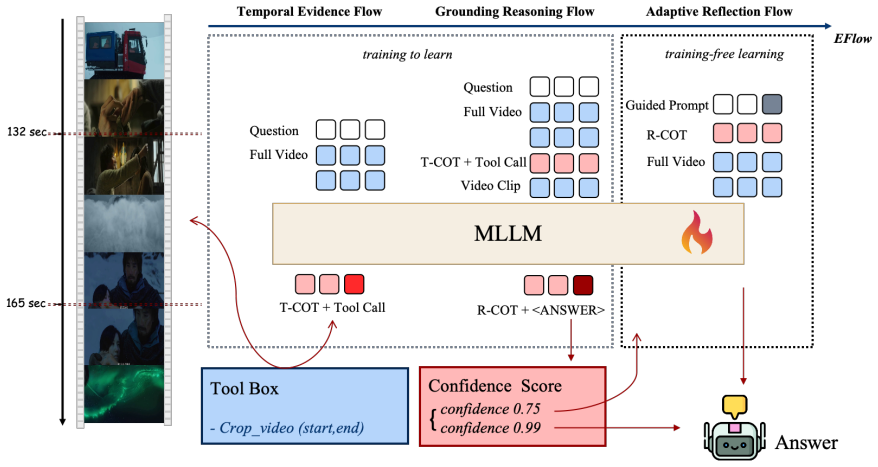
The load-bearing object is the three-stage evidence flow: Temporal Evidence Flow (T-CoT plus a crop_video tool call), Grounded Reasoning Flow (R-CoT plus final answer), and Adaptive Reflection Flow (a training-free re-read triggered by a competition-based confidence score). The confidence score is the probability margin c = P(top1) − P(top2) over multiple-choice answer tokens at the decoding step where the answer label is generated; a low margin signals possible evidence insufficiency and triggers global re-reading with a guided reflection prompt. The same machinery makes the separation trainable: SFT teaches the trajectory format, RL rewards temporal IoU plus answer correctness via a judge,
What would settle it
Take samples where the margin is low but the first crop actually contains the evidence; if forced reflection on those samples does not improve accuracy over directly returning the first answer, the margin is not detecting evidence insufficiency. Equivalently, measure accuracy gain from re-reading on low-margin vs high-margin samples: the mechanism is only doing work if the gain concentrates on low-margin decisions.
Extended reading notes
Core claim
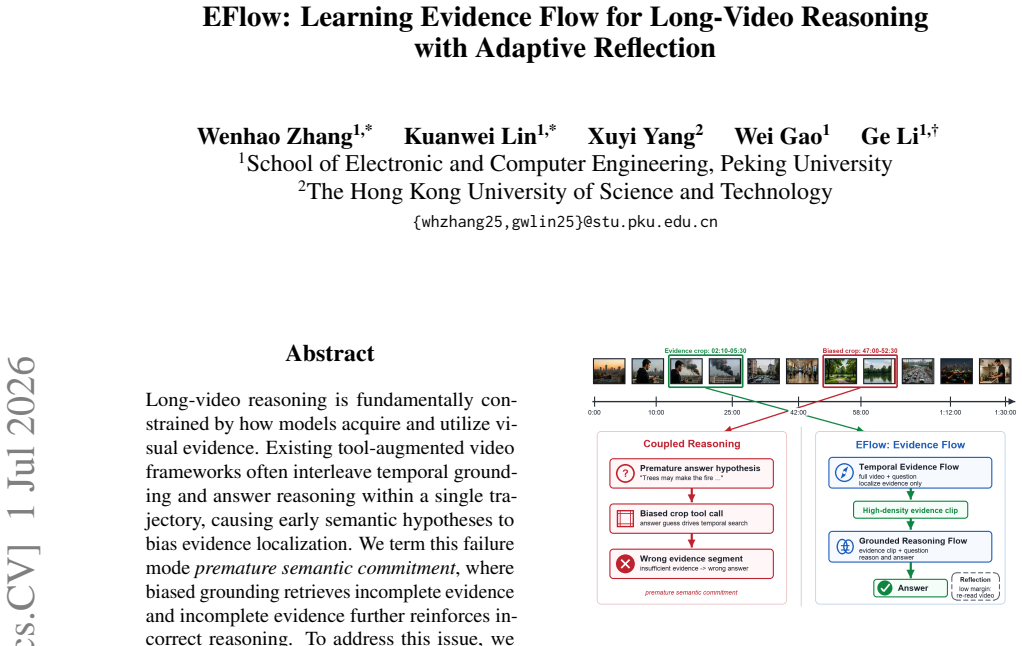
EFlow's central claim is that explicitly separating CoT for Temporal Grounding (T-CoT) from CoT for Reasoning (R-CoT) prevents 'premature semantic commitment' — the failure mode where an early answer hypothesis biases which video segment gets cropped and viewed, producing incomplete evidence that then reinforces the wrong answer. At inference, the model first issues a crop command over the full video without producing an answer, then reasons over the cropped high-density clip, and finally computes a confidence margin as the softmax probability difference between the top-two answer tokens; if the margin falls below a tuned threshold, it re-reads the full video with the previous reasoning trac
Load-bearing premise
Reflection helps only if the top-two answer-token probability margin is a well-calibrated signal that the retrieved clip's evidence is insufficient; when it is miscalibrated, gains depend on per-benchmark threshold tuning rather than on the mechanism itself.
Editorial extensions
If this is right
- Evidence-before-answer ordering should be adopted as an explicit stage in tool-augmented video agents rather than left implicit in an interleaved trajectory.
- Reflection should be used sparingly: triggering too often (loose threshold) discards the benefit of focused clips and hurts accuracy, so confidence-gated re-reading is a repair mechanism, not a replacement for local evidence.
- Margin-based confidence can be ported to open-ended settings by substituting average token probability or perplexity for the discrete choice margin.
- Reinforcement fine-tuning on reward-filtered trajectories consolidates grounding and tool-calling behaviors, stabilizing gains beyond SFT alone.
- Staged evidence flow transfers to temporal grounding (NextGQA), suggesting the benefit is not limited to multiple-choice QA.
Reading between the lines
- Editorial: the premature-semantic-commitment diagnosis predicts a testable signature — errors in early grounding should causally precede and predict wrong final answers; if that causal chain is absent, the gains may come only from the extra inference-time computation.
- Editorial: the margin trigger could be replaced by a learned verifier or by asking the model directly whether evidence is sufficient, which might make reflection less sensitive to per-benchmark threshold tuning.
- Editorial: the same 'acquire evidence, then reason, then verify' ordering may transfer to other retrieval-augmented settings, such as document grounding or embodied navigation, where premature semantic commitment is also a risk.
- Editorial: the reported efficiency trade-off implies an optimal reflection rate that could be predicted from calibration curves rather than tuned per benchmark.
Editorial analysis
A structured set of objections, weighed in public.
Referee Report
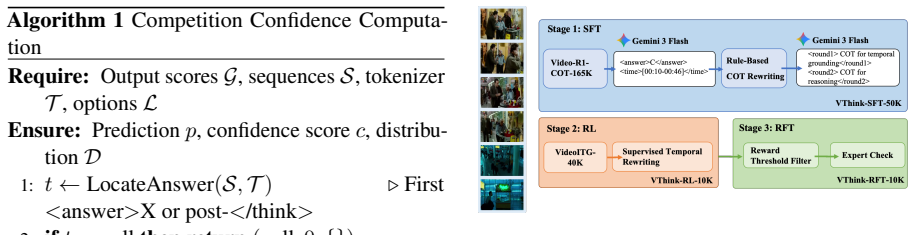
Summary. EFlow proposes a tool-augmented framework for long-video QA built on Qwen3-VL. The pipeline separates temporal grounding (T-CoT, implemented as a crop_video tool call) from answer reasoning (R-CoT), with the stated goal of avoiding what the authors call premature semantic commitment. A confidence margin computed from the top-2 answer-token logits (Eq. 2) triggers a training-free Adaptive Reflection pass over the full video when the margin falls below a threshold τ. The model is post-trained with SFT on ~50K generated trajectories, GRPO RL with format/temporal-IoU/LLM-judge answer rewards, and RFT on filtered high-reward rollouts. Experiments on VideoMME, LVBench, LongVideoBench, NextGQA, VSI-Bench, and Video-MMMU report gains over a Qwen3-VL baseline, with ablations showing cumulative improvement from SFT to RL to RFT and threshold-dependent reflection behavior.
Significance. The paper identifies an important and plausible failure mode for tool-augmented long-video reasoning and proposes a concrete, easily described staged inference design. The strengths include the explicit T-CoT/R-CoT trajectory format, the use of a temporal-IoU reward in addition to answer correctness, the construction of dedicated SFT/RL/RFT datasets, and the analysis of reflection trigger rates as a function of the confidence threshold. If the ordering claim were confirmed with proper controls, EFlow would be a useful contribution to agentic long-video understanding. However, the current experiments do not isolate the staged ordering mechanism from generic tool-use post-training, and the reflection threshold is selected per benchmark post hoc. These are load-bearing gaps for the paper's central causal claims, and they are acknowledged in part in §6.
major comments (3)
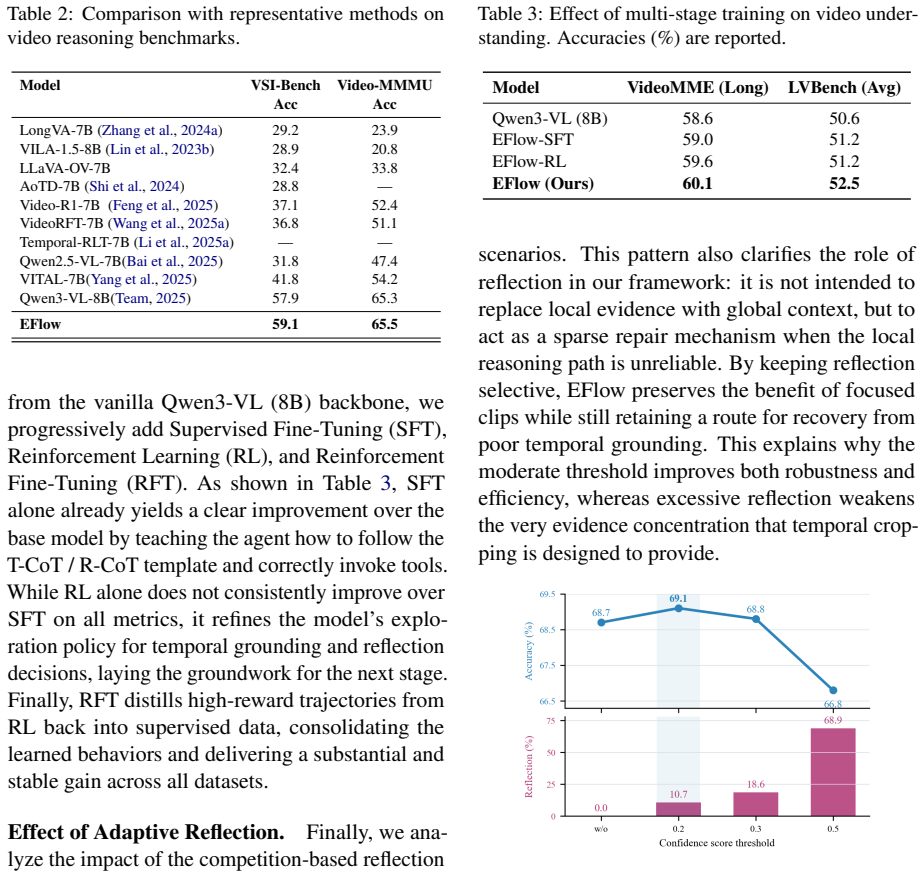
- [§4.3, Table 3] The central claim is causal: separating T-CoT and R-CoT into an evidence-first staged flow mitigates premature semantic commitment. Table 3 does not test this ordering. All trained rows (EFlow-SFT, EFlow-RL, EFlow) use the proposed staged format; the gains over Qwen3-VL could be produced by any tool-use post-training on curated trajectories, independent of whether grounding and reasoning are staged or interleaved. The LongVT comparison in Table 1 is cross-method (different backbone, data, training budget), not a same-data control. I request an ablation that trains the identical SFT/RL/RFT pipeline on the same datasets with an interleaved iMCoTT-style trajectory (grounding and reasoning alternated in a single trace) and reports both benchmarks at matched inference settings. Without this control, the paper's proposed mechanism—premature semantic commitment and its mitigation—is not directl
- [§3.1 Eq. (2); §4.1, Figure 4; §6] The reflection gain depends on the margin-based confidence score c in Eq. (2), and the trigger threshold τ is described in §4.1 as 'empirically adjusted depending on benchmark complexity' and in §4.3 as 'dynamic thresholding across benchmarks.' Because τ is chosen per benchmark after seeing test accuracy, the reported reflection improvements are at risk of being selection artifacts rather than evidence for a robust mechanism. The Limitations section explicitly concedes that when the margin is poorly calibrated, reflection requires task-specific priors, threshold tuning, or multiple validation passes. Please provide a prospective validation protocol (e.g., τ fixed on a held-out split), report paired runs with and without reflection at matched compute, and include multiple seeds or bootstrap confidence intervals for the numbers in Tables 1 and 3. The differences over the Qwen3-VL baseline
- [Tables 1–3] The main results and ablations are reported without variance or significance testing. The gains over the Qwen3-VL baseline in Table 1 are modest (VideoMME Overall +1.2, LVBench +1.9, LongVideoBench +1.2, NextGQA +0.9), and the ablation increments in Table 3 are also small (e.g., 58.6→59.0→59.6→60.1). With stochastic GRPO training and threshold-dependent inference, single-run numbers are not sufficient to support the paper's 'consistently improves' claim. Please report at least three seeds (or bootstrap confidence intervals) for the central comparisons, and state the number of evaluation runs averaged.
minor comments (6)
- [Eq. (2), Algorithm 1] The confidence score is computed at the decoding step 'where the answer label is generated'. For multi-token answer labels or free-form answers, the tokenization and choice of step are underspecified; clarify whether the logits come from the first answer token and how valid answer tokens are enumerated outside multiple-choice settings.
- [Figure 4] The axes and exact numeric values are missing; include the threshold values, corresponding accuracy, and reflection trigger rate in the figure or a table so the reader can verify the claimed threshold dynamics.
- [Table 2] The Temporal-RLT-7B row contains '—' values with no explanation; remove it or populate it, and clarify whether it was evaluated on these benchmarks.
- [Table 1 caption] The text contains a spacing artifact ('LLaV A-Video'), and the caption should state explicitly that both Qwen3-VL* and EFlow use the 8B Qwen3-VL checkpoint.
- [Eq. (5), §4.1] The IoU scaling factor λ_iou is a free parameter but its value is not reported; report the value used and ideally ablate it, since the temporal grounding reward is a distinctive part of the training pipeline.
- [§3.3, Stage 3] The term 'Reinforcement Fine-Tuning' is used for SFT on high-reward RL rollouts, which is a form of self-distillation rather than online RL. The paper states this, but the name is likely to confuse readers; consider 'reward-filtered SFT' or a clearly parenthetical definition.
Circularity Check
Adaptive Reflection threshold is tuned per benchmark, so the reported reflection gain is a selected maximum rather than a prediction; the core staged-flow ordering is not isolated by a same-data control.
-
fitted input called prediction
[§3.1 Eq. (2), §4.1 threshold tuning, Figure 4, §6 Limitations]
"According to the dynamic confidence heuristic, the confidence threshold τ for triggering reflection is empirically adjusted depending on the benchmark complexity. ... An optimal tight threshold (τ=0.2) achieves the best accuracy."
Adaptive Reflection's contribution is validated by setting τ per benchmark to the value that maximizes that benchmark's accuracy (Figure 4). Since c in Eq. (2) is just the model's own top-2 answer-logit margin and τ is selected after observing evaluation-set accuracy, the reported reflection gain is the maximum over thresholds of the accuracy curve—not an out-of-sample prediction that low margin detects insufficient evidence. The paper's own Limitations concede that 'reflection may require task-specific priors, threshold tuning, or multiple validation passes,' so part of the claimed gain is a fitted artifact of τ selection rather than a derived property of the evidence-flow mechanism.
full rationale
EFlow's training pipeline and the staged T-CoT/R-CoT format are not circular: SFT/RL/RFT are trained on external data (Video-R1-CoT, VideoITG, reward-filtered rollouts), and the main benchmark numbers are compared against external baselines. The only overlapping-author citation (Videomem) is used as background motivation and is not load-bearing; no uniqueness theorem is imported. The central 'evidence-first' ordering claim, however, is not isolated by a same-data interleaved control, so it cannot be verified as the causal driver—but that is an experimental-validity gap, not definitional circularity. The one load-bearing circular element is the Adaptive Reflection evaluation: τ is chosen per benchmark to maximize accuracy, so the 'confidence margin detects insufficient evidence' story is not independently predicted; the reported reflection gain is a selected maximum rather than a forecast. The paper's own Limitations confirm this calibration dependence. This partial fit affects the reflection component, not the entire framework, so the score is moderate rather than severe.
Assumptions & free parameters
free parameters (3)
- Confidence threshold τ for Adaptive Reflection =
0.2 / 0.3 / 0.5 explored; final dynamic per-benchmark values not fully reported
- λ_iou temporal IoU reward scaling =
not specified
- Frame sampling rate =
1 FPS for both full video and cropped clips
assumptions (5)
- ad hoc to paper The softmax margin between top-1 and top-2 answer token probabilities is a calibrated proxy for evidence insufficiency.
- domain assumption Ground-truth final answers in VideoMME, LVBench, LongVideoBench, NextGQA, VSI-Bench, Video-MMMU, and ground-truth intervals in VideoITG are correct and complete.
- domain assumption The crop_video tool returns a semantically coherent clip that preserves the evidence needed to answer the query.
- domain assumption GRPO with a summed reward R = r_format + r_iou + r_ans shapes evidence-flow behavior rather than overfitting to reward hack.
- domain assumption Filtering Gemini-3-Flash trajectories to answer-correct samples yields a sufficiently diverse, unbiased SFT distribution.
Cite this review
Pith. "Pith review of EFlow: Learning Evidence Flow for Long-Video Reasoning with Adaptive Reflection." pith.science (2026). https://pith.science/paper/3NMQTI3X
@misc{pith2026260700867,
  author       = {Pith},
  title        = {Pith review of: EFlow: Learning Evidence Flow for Long-Video Reasoning with Adaptive Reflection},
  year         = {2026},
  howpublished = {\url{https://pith.science/paper/3NMQTI3X}},
  note         = {Machine review of arXiv:2607.00867}
}
read the original abstract
Long-video reasoning is fundamentally constrained by how models acquire and utilize visual evidence. Existing tool-augmented video frameworks often interleave temporal grounding and answer reasoning within a single trajectory, causing early semantic hypotheses to bias evidence localization. We term this failure mode premature semantic commitment, where biased grounding retrieves incomplete evidence and incomplete evidence further reinforces incorrect reasoning. To address this issue, we propose EFlow, an evidence-first video reasoning framework built upon Qwen3-VL. EFlow explicitly separates temporal grounding and logical reasoning through CoT for Temporal Grounding and CoT for Reasoning, enabling the model to retrieve relevant evidence before answer inference. In addition, EFlow introduces a confidence-aware reflection mechanism that re-evaluates the full video when retrieved evidence is potentially insufficient. We further construct dedicated trajectory datasets and train EFlow through supervised fine-tuning, reinforcement learning, and reinforcement fine-tuning. Extensive experiments across five video understanding benchmarks demonstrate that EFlow consistently improves long-video reasoning performance.
Figures
Figures from the paper (1 more)
Reference graph
Works this paper leans on
-
[3]
arXiv preprint arXiv:2512.22315
Videozoomer: Reinforcement- learned temporal focusing for long video reasoning. arXiv preprint arXiv:2512.22315. Kaituo Feng, Kaixiong Shao, Zihan Liu, Dongxu Xu, Yue Zhu, Bin Xie, and Feng Li
-
[4]
Kairui Hu, Penghao Wu, Fanyi Pu, Wang Xiao, Yuan- han Zhang, Xiang Yue, Bo Li, and Ziwei Liu
Video-r1: Reinforcing video reasoning in mllms.arXiv preprint arXiv:2503.21776. Kairui Hu, Penghao Wu, Fanyi Pu, Wang Xiao, Yuan- han Zhang, Xiang Yue, Bo Li, and Ziwei Liu
-
[5]
Hongbo Jin, Qingyuan Wang, Wenhao Zhang, Yang Liu, and Sijie Cheng
Video-mmmu: Evaluating knowledge acquisition from multi-discipline professional videos.arXiv preprint arXiv:2501.13826. Hongbo Jin, Qingyuan Wang, Wenhao Zhang, Yang Liu, and Sijie Cheng
-
[6]
Peng Jin, Jinfa Ryu, Yuan Huang, Bin Lin, and 1 others
Videomem: Enhancing ultra-long video understanding via adaptive memory management.arXiv preprint arXiv:2512.04540. Peng Jin, Jinfa Ryu, Yuan Huang, Bin Lin, and 1 others
-
[8]
Hongyu Li, Songhao Han, Yue Liao, Junfeng Luo, Jialin Gao, Shuicheng Yan, and Si Liu
Llava- onevision: Easy visual task transfer.arXiv preprint arXiv:2408.03326. Hongyu Li, Songhao Han, Yue Liao, Junfeng Luo, Jialin Gao, Shuicheng Yan, and Si Liu. 2025a. Reinforcement learning tuning for videollms: Re- ward design and data efficiency.arXiv preprint arXiv:2506.01908. Xinhao Li, Ziang Yan, Desen Meng, Lu Dong, Xiangyu Zeng, Yinan He, Yali W...
-
[10]
Kun Ouyang, Yuanxin Liu, Linli Yao, Yishuo Cai, Hao Zhou, Fandong Meng, Jie Zhou, and Xu Sun
Video-chatgpt: Towards detailed video understanding via large vision and language models.arXiv preprint arXiv:2306.05424. Kun Ouyang, Yuanxin Liu, Linli Yao, Yishuo Cai, Hao Zhou, Fandong Meng, Jie Zhou, and Xu Sun
-
[11]
Timechat: A time-sensitive multimodal large language model for long video understanding.arXiv preprint arXiv:2312.02051. Timo Schick, Jane Dwivedi-Yu, Roberto Dessì, Roberta Raileanu, Maria Lomeli, Luke Zettlemoyer, Nicola Cancedda, and Thomas Scialom
-
[12]
9 Yongliang Shen, Kaitao Song, Xu Tan, Dongsheng Li, Weiming Lu, and Yueting Zhuang
Deepseekmath: Pushing the limits of mathematical reasoning in open lan- guage models.arXiv preprint arXiv:2402.03300. 9 Yongliang Shen, Kaitao Song, Xu Tan, Dongsheng Li, Weiming Lu, and Yueting Zhuang
Show all 18 references
-
[13]
Noah Shinn, Federico Cassano, Ashwin Gopinath, Karthik Narasimhan, and Shunyu Yao
Enhancing video-llm reasoning via agent-of-thoughts distillation.arXiv preprint arXiv:2412.01694. Noah Shinn, Federico Cassano, Ashwin Gopinath, Karthik Narasimhan, and Shunyu Yao
-
[14]
Qi Wang, Yanrui Yu, Ye Yuan, Rui Mao, and Tianfei Zhou
Qwen3 technical report.arXiv preprint arXiv:2505.09388. Qi Wang, Yanrui Yu, Ye Yuan, Rui Mao, and Tianfei Zhou
-
[15]
thinking with videos
Videorft: Incentivizing video reason- ing capability in mllms via reinforced fine-tuning. Advances in neural information processing systems, 38:4350–4376. Shihao Wang, Guo Chen, De-an Huang, Zhiqi Li, Ming- han Li, Guilin Li, Jose M Alvarez, Lei Zhang, and Zhiding Yu. 2025a. V...
-
[16]
Jihan Yang, Shusheng Yang, Anjali W
Longvideobench: A benchmark for long-context interleaved video-language understanding.arXiv preprint arXiv:2407.15754. Jihan Yang, Shusheng Yang, Anjali W. Gupta, Rilyn Han, Li Fei-Fei, and Saining Xie
-
[17]
Zuhao Yang, Sudong Wang, Kaichen Zhang, Keming Wu, Sicong Leng, Yifan Zhang, Bo Li, Chengwei Qin, Shijian Lu, Xingxuan Li, and 1 others
Thinking in space: How multimodal large language models see, remember, and recall spaces.arXiv preprint arXiv:2412.14171. Zuhao Yang, Sudong Wang, Kaichen Zhang, Keming Wu, Sicong Leng, Yifan Zhang, Bo Li, Chengwei Qin, Shijian Lu, Xingxuan Li, and 1 others
-
[18]
InInternational Conference on Learning Representations
React: Synergizing reasoning and acting in language models. InInternational Conference on Learning Representations. Congzhi Zhang, Zhibin Wang, Yinchao Ma, Jiawei Peng, Yihan Wang, Qiang Zhou, Jun Song, and Bo Zheng. 2025a. Rewatch-r1: Boosting com- plex video reasoning in lar...
-
[2023]
Bo Li, Yuanhan Zhang, Dong Guo, Renrui Zhang, Feng Li, Hao Zhang, Kaichen Zhang, Yanwei Li, Ziwei Liu, and Chunyuan Li
Chat-univi: Unified visual representation em- powers large language models with image and video understanding.arXiv preprint arXiv:2311.08046. Bo Li, Yuanhan Zhang, Dong Guo, Renrui Zhang, Feng Li, Hao Zhang, Kaichen Zhang, Yanwei Li, Ziwei Liu, and Chunyuan Li
-
[2024]
arXiv preprint arXiv:2412.19437
Deepseek-v3 technical report. arXiv preprint arXiv:2412.19437. Yang Ding, Yizhen Zhang, Xin Lai, Ruihang Chu, and Yujiu Yang
- [2025]
-
[2026]
Muhammad Maaz, Hanoona Rasheed, Salman Khan, and Fahad Shahbaz Khan
Videoauto-r1: Video auto reasoning via thinking once, answering twice.arXiv preprint arXiv:2601.05175. Muhammad Maaz, Hanoona Rasheed, Salman Khan, and Fahad Shahbaz Khan
Reviewed August 2, 2026 · model on record in the stance chip above.
Discussion (0). Sign in to comment.