Quantum entanglement of photon pairs at proton-proton colliders
Pith reviewed 2026-07-02 09:49 UTC · model grok-4.3
The pith
A method using the Bethe-Heitler process in trackers measures quantum entanglement of photon pairs at proton-proton colliders.
A machine-rendered reading of the paper's core claim, the machinery that carries it, and where it could break.
Core claim
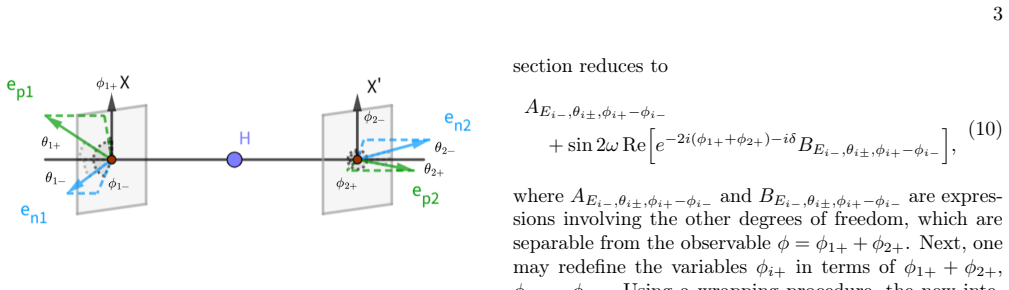
Diphoton systems serve as qubits whose entanglement can be measured at high-energy colliders through the analyzing power of the Bethe-Heitler process in the tracker material. Photons scatter off nuclei to produce electron-positron pairs, and the joint angular distribution of these pairs encodes the polarization state of the diphoton system. This enables exploration of quantum entanglement properties at the high-energy frontier.
What carries the argument
The Bethe-Heitler process in the tracker, providing spin analyzing power via joint angular distributions of electron-positron pairs from photon conversion.
If this is right
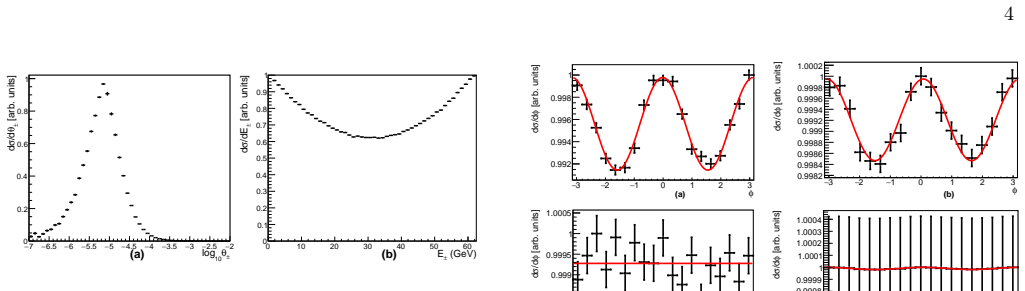
- Statistical significance of entanglement in Higgs to diphoton is 0.007 sigma under HL-LHC conditions.
- Continuum diphoton process q bar q to gamma gamma can reach about 1.5 sigma.
- Absence of dedicated polarimeters at colliders is addressed by this tracker-based method.
- This helps understand quantum nature of particles and search for new physics.
Where Pith is reading between the lines
- If the method works, it could be extended to other high-energy processes involving polarized particles.
- Successful measurement would allow testing of quantum mechanics predictions at energies far above previous experiments.
- Detector material effects might need careful calibration in real data to achieve the simulated sensitivities.
Load-bearing premise
The joint angular distribution of electron-positron pairs produced in the Bethe-Heitler process accurately reflects the polarization of the incoming diphoton system with little dilution from other effects.
What would settle it
Observing no correlation or incorrect angular distributions in the electron-positron pairs from photon conversions in the tracker would falsify the claim that this process encodes the diphoton polarization.
Figures
read the original abstract
Diphoton systems, with photon polarizations measurable at low energies, serve as ideal qubits and were first used to demonstrate quantum entanglement. However, due to the current absence of dedicated polarimeters at high-energy colliders, the entanglement properties of diphoton systems remain largely unexplored at the high-energy frontier. Studying quantum entanglement at the high-energy frontier, where particle colliders serve as a natural relativistic laboratory, helps us better understand the quantum nature and seek new physics. In this letter, we propose a novel method to measure the entanglement of diphoton systems at proton-proton colliders. The photon spin analyzing power arises from the Bethe-Heitler process occurring in the tracker, where photons scatter off nuclei to produce electron-positron pairs whose joint angular distribution encodes the polarization of the diphoton system. Simulation results show that, under HL-LHC conditions, the statistical significance of quantum entanglement in the Higgs $\to \gamma\gamma$ process is $0.007\sigma$, while measuring the continuum diphoton process $q\bar{q} \to \gamma\gamma$ alone can reach about $1.5\sigma$.
Editorial analysis
A structured set of objections, weighed in public.
Referee Report
Summary. The manuscript proposes a novel method to measure quantum entanglement of diphoton systems produced at proton-proton colliders. Photon polarization is analyzed via the Bethe-Heitler process in tracker material, where the joint angular distribution of electron-positron pairs from photon conversion encodes the diphoton polarization state. Simulations under HL-LHC conditions are reported to yield a statistical significance of 0.007σ for entanglement in the Higgs → γγ channel and 1.5σ for the continuum q q-bar → γγ process.
Significance. If the Bethe-Heitler analyzing power can be shown to encode polarization with high fidelity and without substantial dilution, the approach would enable the first exploration of diphoton entanglement at collider energies, extending quantum-information studies into the relativistic regime. The reported significances, however, are marginal to negligible, which limits the practical impact even if the underlying assumption holds.
major comments (3)
- [Abstract] Abstract: The reported statistical significance of 0.007σ for the Higgs → γγ channel is negligible and indicates that the proposed method provides essentially no sensitivity to entanglement in this channel, which is load-bearing for the central claim that the technique enables measurements at the high-energy frontier.
- [Abstract] Abstract: No details are supplied on the simulation assumptions, background modeling, detector effects, or the precise mapping from e+e− angular distributions to the entanglement witness, preventing assessment of whether the 1.5σ result for the continuum channel is robust or already incorporates dilution from multiple scattering.
- [Abstract] The manuscript does not address the characteristic pair opening angle m_e/E_γ ≲ 8 mrad at E_γ ≈ 60–125 GeV or quantify multiple-scattering deflections in tracker material (θ_MS ≈ 13.6 MeV/(βp) √(x/X0)), which are comparable in size and could suppress the analyzing power below usability.
Simulated Author's Rebuttal
We thank the referee for the careful review and constructive comments on our manuscript proposing a Bethe-Heitler-based method to probe diphoton entanglement at pp colliders. We agree that the reported significances are marginal and that additional details and limitations must be addressed. We provide point-by-point responses below and will revise the manuscript accordingly.
read point-by-point responses
-
Referee: [Abstract] Abstract: The reported statistical significance of 0.007σ for the Higgs → γγ channel is negligible and indicates that the proposed method provides essentially no sensitivity to entanglement in this channel, which is load-bearing for the central claim that the technique enables measurements at the high-energy frontier.
Authors: We agree that 0.007σ constitutes negligible sensitivity for the Higgs → γγ channel and does not support a claim of practical measurement capability there. The manuscript's primary contribution is the conceptual proposal of using tracker conversions for polarization analysis at collider energies; the continuum qq̄ → γγ channel provides the only non-negligible reach under our assumptions. We will revise the abstract to explicitly note the lack of sensitivity in the Higgs channel and to position the continuum result as the relevant demonstration of the method. revision: yes
-
Referee: [Abstract] Abstract: No details are supplied on the simulation assumptions, background modeling, detector effects, or the precise mapping from e+e− angular distributions to the entanglement witness, preventing assessment of whether the 1.5σ result for the continuum channel is robust or already incorporates dilution from multiple scattering.
Authors: As a letter-format manuscript, detailed simulation parameters were omitted. In the revision we will add an explicit description of the assumptions (HL-LHC luminosity 3000 fb⁻¹, photon acceptance, conversion probability, and the construction of the entanglement witness from the joint e⁺e⁻ angular distribution). The quoted 1.5σ does not incorporate multiple-scattering dilution or full detector effects; we will state this clearly and note that the number is an idealized estimate. revision: yes
-
Referee: [Abstract] The manuscript does not address the characteristic pair opening angle m_e/E_γ ≲ 8 mrad at E_γ ≈ 60–125 GeV or quantify multiple-scattering deflections in tracker material (θ_MS ≈ 13.6 MeV/(βp) √(x/X0)), which are comparable in size and could suppress the analyzing power below usability.
Authors: We acknowledge that the intrinsic opening angle is a few mrad and that multiple scattering in tracker material can produce deflections of comparable magnitude, which would dilute the analyzing power. Our present simulation assumes perfect angular reconstruction without these effects. We will add a paragraph discussing this limitation, providing order-of-magnitude estimates, and stating that a dedicated GEANT4-level study is required to determine whether the analyzing power remains usable. This discussion will be included without new quantitative results. revision: partial
Circularity Check
No circularity: proposal and simulation outputs are independent of the entanglement claim.
full rationale
The paper proposes using Bethe-Heitler conversion in tracker material to analyze diphoton polarization and reports simulation-derived significances (0.007σ and 1.5σ) as numerical outputs rather than quantities defined in terms of the entanglement witness itself. No self-definitional steps, fitted inputs renamed as predictions, or load-bearing self-citations appear in the provided text. The derivation chain consists of a physical proposal plus Monte Carlo results; these are not equivalent to the input assumptions by construction.
Axiom & Free-Parameter Ledger
Reference graph
Works this paper leans on
-
[1]
J. S. Bell, On the Einstein-Podolsky-Rosen paradox, Physics Physique Fizika1, 195 (1964)
1964
-
[2]
S. J. Freedman and J. F. Clauser, Experimental test of local hidden-variable theories, Phys. Rev. Lett.28, 938 (1972)
1972
-
[3]
Aspect, J
A. Aspect, J. Dalibard, and G. Roger, Experimental test of Bell’s inequalities using time varying analyzers, Phys. Rev. Lett.49, 1804 (1982)
1982
-
[4]
Experimental quantum teleportation
D. Bouwmeester, J.-W. Pan, K. Mattle, M. Eibl, H. We- infurter, and A. Zeilinger, Experimental quantum tele- portation, Nature390, 575 (1997), arXiv:1901.11004 [quant-ph]
work page internal anchor Pith review Pith/arXiv arXiv 1997
-
[5]
G. Aadet al.(ATLAS), Observation of quantum entan- glement with top quarks at the ATLAS detector, Nature 633, 542 (2024), arXiv:2311.07288 [hep-ex]
-
[6]
A. Hayrapetyanet al.(CMS), Observation of quan- tum entanglement in top quark pair production in pro- ton–proton collisions at√s= 13TeV, Rept. Prog. Phys. 87, 117801 (2024), arXiv:2406.03976 [hep-ex]
- [7]
-
[8]
G. Aadet al.(ATLAS), Measurements ofZ-boson pair entanglement in decays of Higgs bosons at the ATLAS experiment (2026), arXiv:2603.26463 [hep-ex]
-
[9]
M. Fabbrichesi, R. Floreanini, E. Gabrielli, and L. Marzola, Bell inequality is violated inB 0 → J/ψK ∗(892)0 decays, Phys. Rev. D109, L031104 (2024), arXiv:2305.04982 [hep-ph]
-
[10]
M. Ablikimet al.(BESIII), Test of local realism via en- tangledΛ ¯Λsystem, Nature Commun.16, 4948 (2025), arXiv:2505.14988 [hep-ex]
-
[11]
M. Fabbrichesi, R. Floreanini, and E. Gabrielli, Con- straining new physics in entangled two-qubit systems: top-quark, tau-lepton and photon pairs, Eur. Phys. J. C83, 162 (2023), arXiv:2208.11723 [hep-ph]
-
[12]
Probing CP Violation in $h\rightarrow\gamma\gamma$ with Converted Photons
F. Bishara, Y. Grossman, R. Harnik, D. J. Robinson, J. Shu, and J. Zupan, Probing CP violation inh→γγ with converted photons, JHEP04, 084, arXiv:1312.2955 [hep-ph]
work page internal anchor Pith review Pith/arXiv arXiv
-
[13]
V. Khachatryanet al.(CMS), Constraints on the spin- parity and anomalous HVV couplings of the Higgs boson in proton collisions at 7 and 8 TeV, Phys. Rev. D92, 012004 (2015), arXiv:1411.3441 [hep-ex]
work page internal anchor Pith review Pith/arXiv arXiv 2015
-
[14]
Peres, Separability criterion for density matri- ces, Phys
A. Peres, Separability criterion for density matri- ces, Phys. Rev. Lett.77, 1413 (1996), arXiv:quant- ph/9604005
-
[15]
Horodecki, P
M. Horodecki, P. Horodecki, and R. Horodecki, Separa- bilityofmixedstates: necessaryandsufficientconditions, Physics Letters A223, 1 (1996)
1996
-
[16]
Wootters, Mixed state entanglement and quantum error correction, Phys
C.H.Bennett, D.P.DiVincenzo, J.A.Smolin,andW.K. Wootters, Mixed state entanglement and quantum error correction, Phys. Rev. A54, 3824 (1996), arXiv:quant- ph/9604024
-
[17]
W. K. Wootters, Entanglement of formation of an ar- 7 bitrary state of two qubits, Phys. Rev. Lett.80, 2245 (1998), arXiv:quant-ph/9709029
work page internal anchor Pith review Pith/arXiv arXiv 1998
-
[18]
Berger, J
M. Berger, J. Hubbell, S. Seltzer, J. Chang, J. Coursey, R. Sukumar, D. Zucker, and K. Olsen, Xcom: Photon cross sections database (version 1.5), [Web database] Na- tional Institute of Standards and Technology, Gaithers- burg, MD (2010), nIST Standard Reference Database 8 (SRD 8), Last updated: May 29, 2026
2010
-
[19]
Bethe and W
H. Bethe and W. Heitler, On the Stopping of fast parti- cles and on the creation of positive electrons, Proc. Roy. Soc. Lond. A146, 83 (1934)
1934
-
[20]
T. H. Berlin and L. Madansky, On the detection ofγ- ray polarization by pair production, Phys. Rev.78, 623 (1950)
1950
-
[21]
Barbiellini, G
G. Barbiellini, G. Depaola, and F. Longo, Measuring polarization of high-energy gamma rays, Nucl. Instrum. Meth. A518, 195 (2004)
2004
-
[22]
G. O. Depaola and M. L. Iparraguirre, Angular distribu- tion for the electron recoil in pair production by linearly polarized gamma-rays on electrons, Nucl. Instrum. Meth. A611, 84 (2009)
2009
-
[23]
M. Aaboudet al.(ATLAS), Measurement of the photon identification efficiencies with the ATLAS detector using LHC Run 2 data collected in 2015 and 2016, Eur. Phys. J. C79, 205 (2019), arXiv:1810.05087 [hep-ex]
work page internal anchor Pith review Pith/arXiv arXiv 2015
-
[24]
V. Khachatryanet al.(CMS), Performance of Photon ReconstructionandIdentificationwiththeCMSDetector in Proton-Proton Collisions at sqrt(s) = 8 TeV, JINST 10(08), P08010, arXiv:1502.02702 [physics.ins-det]
work page internal anchor Pith review Pith/arXiv arXiv
-
[25]
D. Bernard, A 5D, polarised, Bethe–Heitler event gen- erator forγ→e +e− conversion, Nuclear Instruments and Methods in Physics Research Section A: Acceler- ators, Spectrometers, Detectors and Associated Equip- ment899, 85 (2018)
2018
-
[26]
Cuba - a library for multidimensional numerical integration
T. Hahn, CUBA: A Library for multidimensional numeri- cal integration, Comput. Phys. Commun.168, 78 (2005), arXiv:hep-ph/0404043
work page internal anchor Pith review Pith/arXiv arXiv 2005
-
[27]
Chatrchyanet al.(CMS), The CMS Experiment at the CERN LHC, JINST3, S08004
S. Chatrchyanet al.(CMS), The CMS Experiment at the CERN LHC, JINST3, S08004
-
[28]
Commissioning and Performance of the CMS Pixel Tracker with Cosmic Ray Muons
S. Chatrchyanet al.(CMS), Commissioning and Per- formance of the CMS Pixel Tracker with Cosmic Ray Muons, JINST5, T03007, arXiv:0911.5434 [physics.ins- det]
work page internal anchor Pith review Pith/arXiv arXiv
-
[29]
Diphoton production at the LHC: a QCD study up to NNLO
S. Catani, L. Cieri, D. de Florian, G. Ferrera, and M. Grazzini, Diphoton production at the LHC: a QCD study up to NNLO, JHEP04, 142, arXiv:1802.02095 [hep-ph]
work page internal anchor Pith review Pith/arXiv arXiv
-
[30]
G. Aadet al.(ATLAS), Measurement of the production cross section of pairs of isolated photons inppcollisions at 13 TeV with the ATLAS detector, JHEP11, 169, arXiv:2107.09330 [hep-ex]
- [31]
-
[32]
G. Aadet al.(ATLAS), Observation of a new particle in the search for the Standard Model Higgs boson with the ATLAS detector at the LHC, Phys. Lett. B716, 1 (2012), arXiv:1207.7214 [hep-ex]
work page internal anchor Pith review Pith/arXiv arXiv 2012
-
[33]
Observation of a new boson at a mass of 125 GeV with the CMS experiment at the LHC
S. Chatrchyanet al.(CMS), Observation of a new bo- son at a mass of 125 GeV with the CMS Experiment at the LHC, Phys. Lett. B716, 30 (2012), arXiv:1207.7235 [hep-ex]
work page internal anchor Pith review Pith/arXiv arXiv 2012
-
[34]
0.1 (2017)
High-Luminosity Large Hadron Collider (HL-LHC): Technical Design Report V. 0.1 (2017)
2017
-
[35]
LHC Machine, JINST3, S08001
-
[36]
C. Mariotti (CMS), Observation of a new boson at a mass of 125 GeV with the CMS Experiment at the LHC, in13th Marcel Grossmann Meeting on Recent Develop- ments in Theoretical and Experimental General Relativ- ity, Astrophysics, and Relativistic Field Theories(2015) pp. 352–372
2015
-
[37]
Tsai, Pair production and bremsstrahlung of charged leptons, Rev
Y.-S. Tsai, Pair production and bremsstrahlung of charged leptons, Rev. Mod. Phys.46, 815 (1974), [Er- ratum: Rev.Mod.Phys. 49, 421–423 (1977)]
1974
-
[38]
M. A. Nielsen and I. L. Chuang,Quantum Computation and Quantum Information(Cambridge University Press, 2012)
2012
-
[39]
R. Rahaman and R. K. Singh, Breaking down the en- tire spectrum of spin correlations of a pair of particles involving fermions and gauge bosons, Nucl. Phys. B984, 115984 (2022), arXiv:2109.09345 [hep-ph]
-
[40]
Navaset al.(Particle Data Group Collaboration), Review of particle physics, Phys
S. Navaset al.(Particle Data Group Collaboration), Review of particle physics, Phys. Rev. D110, 030001 (2024)
2024
-
[41]
G. Aadet al.(ATLAS), Measurement of the Higgs boson mass withH→γγdecays in 140fb −1 of √s= 13TeV pp collisions with the ATLAS detector, Phys. Lett. B847, 138315 (2023), arXiv:2308.07216 [hep-ex]
-
[42]
Y. Afik and J. R. M. de Nova, Quantum informa- tion with top quarks in QCD, Quantum6, 820 (2022), arXiv:2203.05582 [quant-ph]
-
[43]
C. S. Wu and I. Shaknov, The angular correlation of scat- tered annihilation radiation, Phys. Rev.77, 136 (1950)
1950
- [44]
discussion (0)
Sign in with ORCID, Apple, or X to comment. Anyone can read and Pith papers without signing in.