Geometry-Driven Magnetoelectric Coupling in Two-Dimensional Compensated Ferrimagnets
Pith reviewed 2026-07-02 09:31 UTC · model grok-4.3
The pith
In bilayer breathing kagome lattices, out-of-plane polarization interlocks with intralayer distortions to reverse global spin splitting.
A machine-rendered reading of the paper's core claim, the machinery that carries it, and where it could break.
Core claim
Based on a symmetry-decoupled analysis, the paper claims that a geometry-driven spin-ferroelectric coupling mechanism exists in bilayer breathing kagome lattices. Within this framework the out-of-plane electric polarization interlocks with cooperative intralayer structural distortions, so that polarization switching drives a deterministic reversal of the global spin splitting. First-principles calculations on a prototype bilayer Nb3Cl8 validate the mechanism and show the switching occurs via an energetically feasible asynchronous layer-by-layer transition pathway.
What carries the argument
The geometry-driven spin-ferroelectric coupling mechanism, which interlocks out-of-plane electric polarization with cooperative intralayer structural distortions in bilayer breathing kagome lattices to control spin splitting.
If this is right
- Polarization switching produces deterministic reversal of spin splitting without generating stray fields.
- The coupling arises solely from lattice geometry and structural symmetry rather than additional symmetry-breaking terms.
- An asynchronous layer-by-layer transition pathway keeps the switching energy low enough to be feasible.
- The same geometric route supplies switchable spin splitting inside compensated ferrimagnets.
Where Pith is reading between the lines
- Similar geometric interlocking could be searched for in other bilayer lattices that support out-of-plane polarization.
- The mechanism may allow integration of spin-splitting control with existing 2D ferroelectric devices.
- If the reversal is confirmed, device concepts that combine ferroelectric gates with compensated-magnet channels become testable.
- Extension to multilayer stacks might preserve the reversal while increasing the magnitude of the spin splitting.
Load-bearing premise
The lattice geometry in bilayer breathing kagome lattices can interlock out-of-plane polarization with intralayer distortions without residual symmetry mismatch that would block deterministic reversal.
What would settle it
Direct observation that switching the out-of-plane polarization in bilayer Nb3Cl8 leaves the global spin splitting unchanged would falsify the claimed reversal.
Figures
read the original abstract
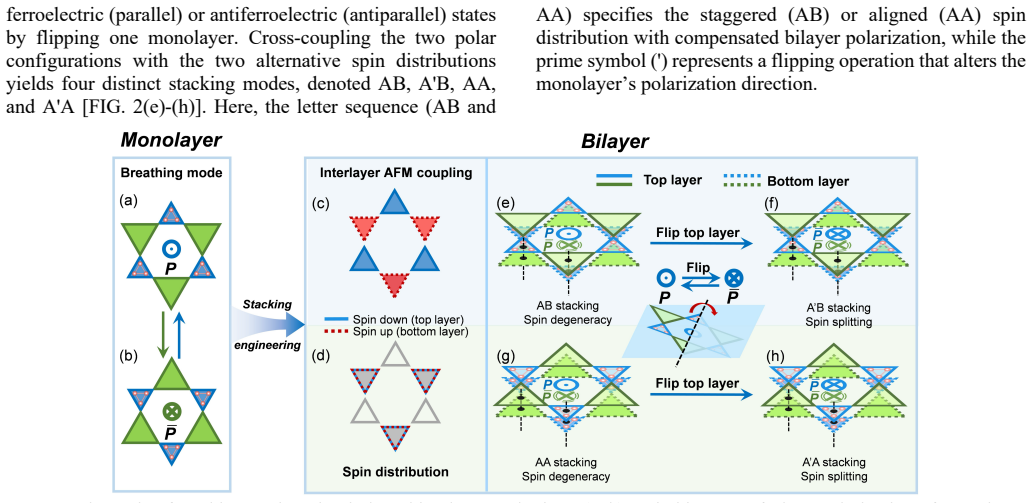
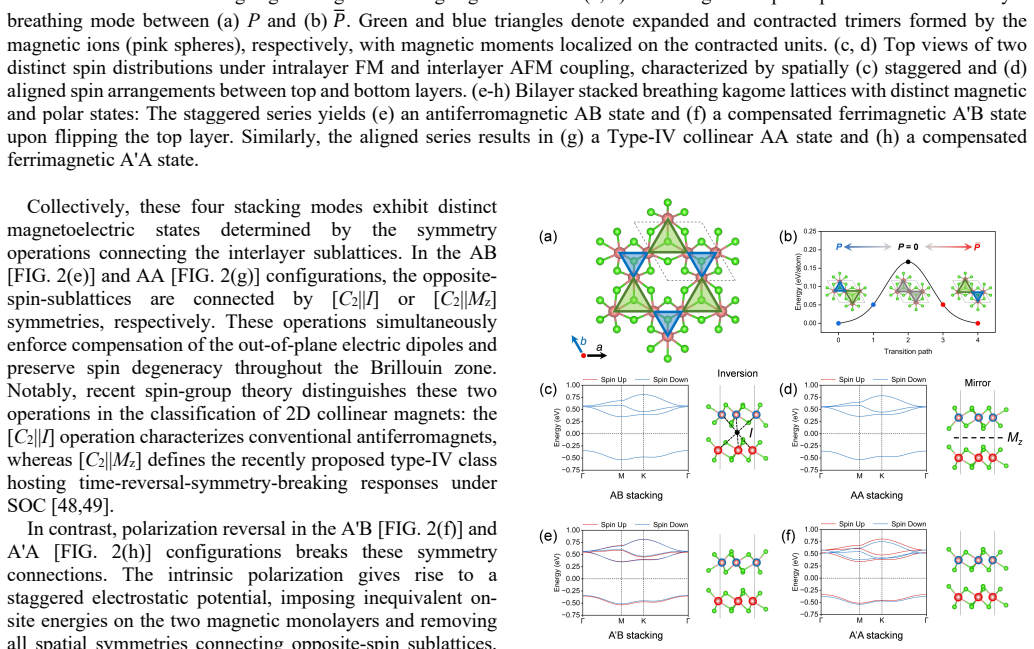
The magnetoelectric coupling in compensated magnets enables stray-field-free manipulation of spin-splitting, holding great promise for spintronics, but inherently hindered by the symmetry mismatch between spatial-inversion-broken ferroelectricity and time-reversal-broken spin states. Here, based on a symmetry-decoupled analysis of magnetoelectric coupling in compensated magnets, we establish a geometry-driven spin-ferroelectric coupling mechanism in bilayer breathing kagome lattices. Within this geometric framework interlocking the out-of-plane electric polarization with cooperative intralayer structural distortions, we demonstrate that polarization switching drives a deterministic reversal of the global spin splitting. First-principles calculations on a prototype bilayer Nb3Cl8 successfully validate this mechanism, demonstrating the switching of spin-splitting states through an energetically feasible, asynchronous layer-by-layer transition pathway. Our proposed coupling originates from lattice geometry and structural symmetry, establishing a unique route toward switchable spin splitting in compensated ferrimagnets.
Editorial analysis
A structured set of objections, weighed in public.
Referee Report
Summary. The manuscript claims that a symmetry-decoupled analysis reveals a geometry-driven magnetoelectric coupling mechanism in bilayer breathing kagome lattices of compensated ferrimagnets. Out-of-plane electric polarization is interlocked with cooperative intralayer structural distortions, so that polarization switching produces deterministic reversal of the global spin splitting. First-principles calculations on bilayer Nb3Cl8 are presented as validation, demonstrating an energetically feasible asynchronous layer-by-layer transition pathway.
Significance. If the central claim holds, the work identifies a lattice-geometry route to stray-field-free, deterministic control of spin splitting in compensated magnets, which is relevant to spintronics. The symmetry-decoupled framing and the explicit demonstration of an asynchronous switching path constitute concrete strengths that could be generalized to other breathing-kagome systems.
major comments (1)
- [Abstract and §3] Abstract and §3 (computational validation): the statement that DFT calculations 'successfully validate' the mechanism is not accompanied by quantitative results, energy barriers, error estimates, or comparison to alternative pathways, which is load-bearing for the claim that the asynchronous transition is both feasible and deterministic.
minor comments (2)
- Define 'global spin splitting' explicitly when the system is a compensated ferrimagnet; the term appears without a supporting equation or figure reference.
- Figure captions should state the k-point sampling and functional used for the spin-splitting plots to allow direct comparison with the symmetry analysis.
Simulated Author's Rebuttal
We thank the referee for the positive assessment of the significance of our work and for the detailed comments. We address the major comment below and have revised the manuscript to incorporate additional quantitative information as requested.
read point-by-point responses
-
Referee: [Abstract and §3] Abstract and §3 (computational validation): the statement that DFT calculations 'successfully validate' the mechanism is not accompanied by quantitative results, energy barriers, error estimates, or comparison to alternative pathways, which is load-bearing for the claim that the asynchronous transition is both feasible and deterministic.
Authors: We agree with the referee that the validation in the abstract and Section 3 would be strengthened by the inclusion of quantitative results. In the revised manuscript, we have expanded Section 3 to include the calculated energy barriers for the asynchronous layer-by-layer transition pathway, estimates of the numerical errors from the DFT setup, and a direct comparison of the energy landscape with the synchronous transition pathway. These additions provide the necessary quantitative support for the feasibility and deterministic character of the proposed mechanism. revision: yes
Circularity Check
No significant circularity; derivation self-contained via symmetry analysis and DFT validation
full rationale
The paper's central mechanism is introduced via a symmetry-decoupled analysis of magnetoelectric coupling, then validated by explicit first-principles DFT calculations on bilayer Nb3Cl8 demonstrating an asynchronous layer-by-layer switching pathway. No equations, fitted parameters presented as predictions, self-citations as load-bearing uniqueness theorems, or ansatzes smuggled via prior work appear in the provided text. The geometric interlocking of polarization and distortions is presented as a derived consequence of lattice symmetry rather than a redefinition of inputs. External computational validation supplies independent content, satisfying the criteria for a non-circular result.
Axiom & Free-Parameter Ledger
Reference graph
Works this paper leans on
-
[1]
Y. Che, H. Lv, X. Wu, and J. Yang, Bilayer Metal–Organic Framework Altermagnets with Electrically Tunable Spin-Split Valleys, J. Am. Chem. Soc. 147, 14806 (2025). [44] H. Lv, Y. Niu, X. Wu, and J. Yang, Electric-Field Tunable Magnetism in van der Waals Bilayers with A-Type Antiferromagnetic Order: Unipolar versus Bipolar Magnetic Semiconductor, Nano Lett....
2025
-
[2]
Kresse and J
G. Kresse and J. Furthmüller, Efficient iterative schemes for ab initio total-energy calculations using a plane-wave basis set, Phys. Rev. B 54, 11169 (1996). [59] G. Kresse and J. Furthmüller, Efficiency of ab-initio total energy calculations for metals and semiconductors using a plane-wave basis set, Comput. Mater. Sci. 6, 15 (1996). [60] S. Grimme, J. ...
1996
discussion (0)
Sign in with ORCID, Apple, or X to comment. Anyone can read and Pith papers without signing in.