Limitations of Error Model Approximations in Quantum Network Simulation
Pith reviewed 2026-07-02 12:01 UTC · model grok-4.3
The pith
Simplified error models like Pauli twirling produce large quantitative and qualitative errors in quantum network protocol predictions.
A machine-rendered reading of the paper's core claim, the machinery that carries it, and where it could break.
Core claim
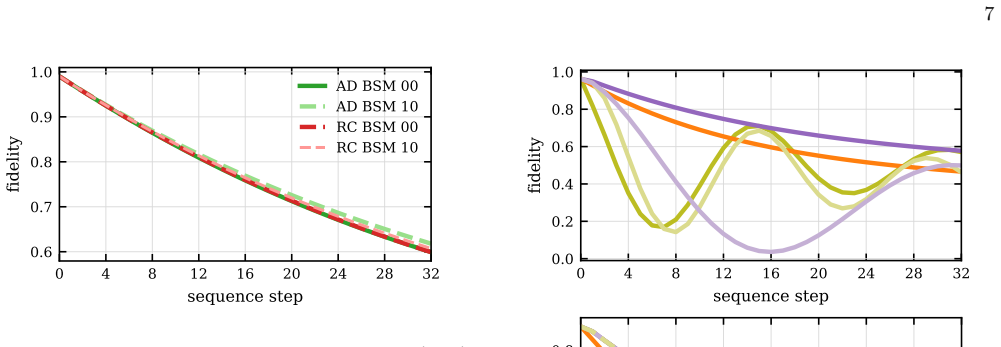
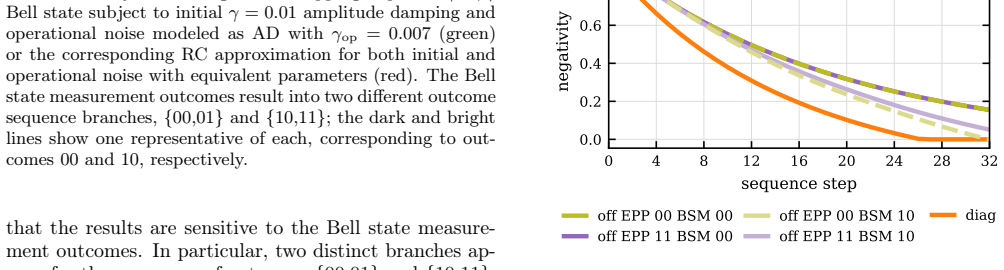
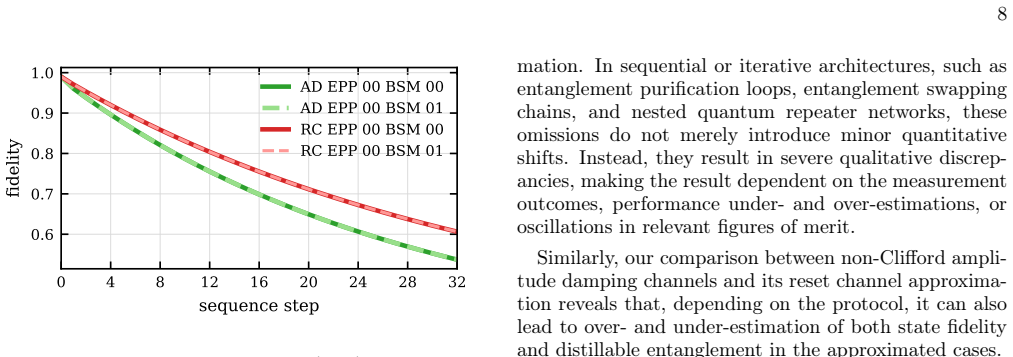
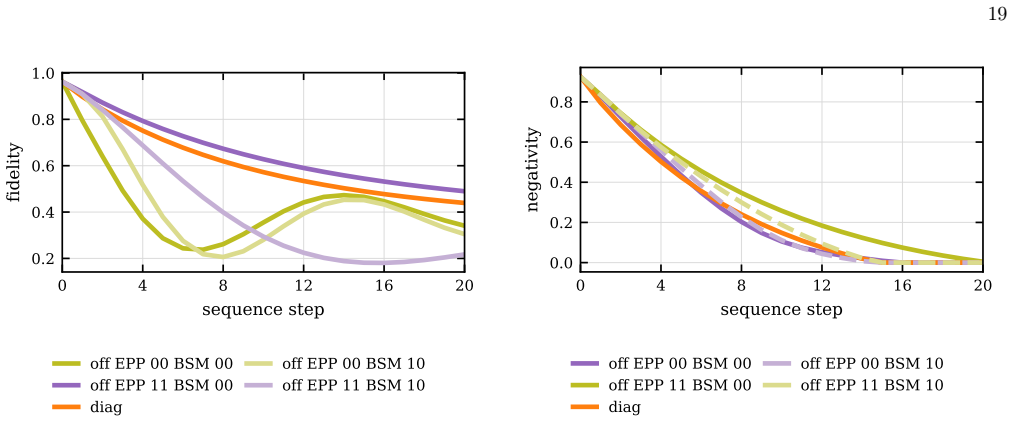
Simplified error models that consider only a restricted set of operators to describe noisy channels lead to severe discrepancies in protocol performance predictions compared to full noise architectures. In entanglement purification, entanglement swapping, and repeater chains, neglected error contributions cause performance under- and over-estimations, measurement-outcome dependency, and fidelity oscillations that are entirely overlooked by the approximations. These results show that rigorous validation of complete noise architectures is indispensable for accurately predicting operational thresholds.
What carries the argument
Full noise architecture used as reference, contrasted with approximated channels restricted to subsets of operators such as those in Pauli twirling or reset channels.
Load-bearing premise
The full noise architecture constitutes the correct reference model against which approximations are judged, and the observed discrepancies are caused by the neglected terms.
What would settle it
Simulating an entanglement purification protocol or repeater chain with both the full noise model and a Pauli twirling approximation, then checking whether fidelity oscillations and measurement-outcome dependencies appear only in the full model.
Figures
read the original abstract
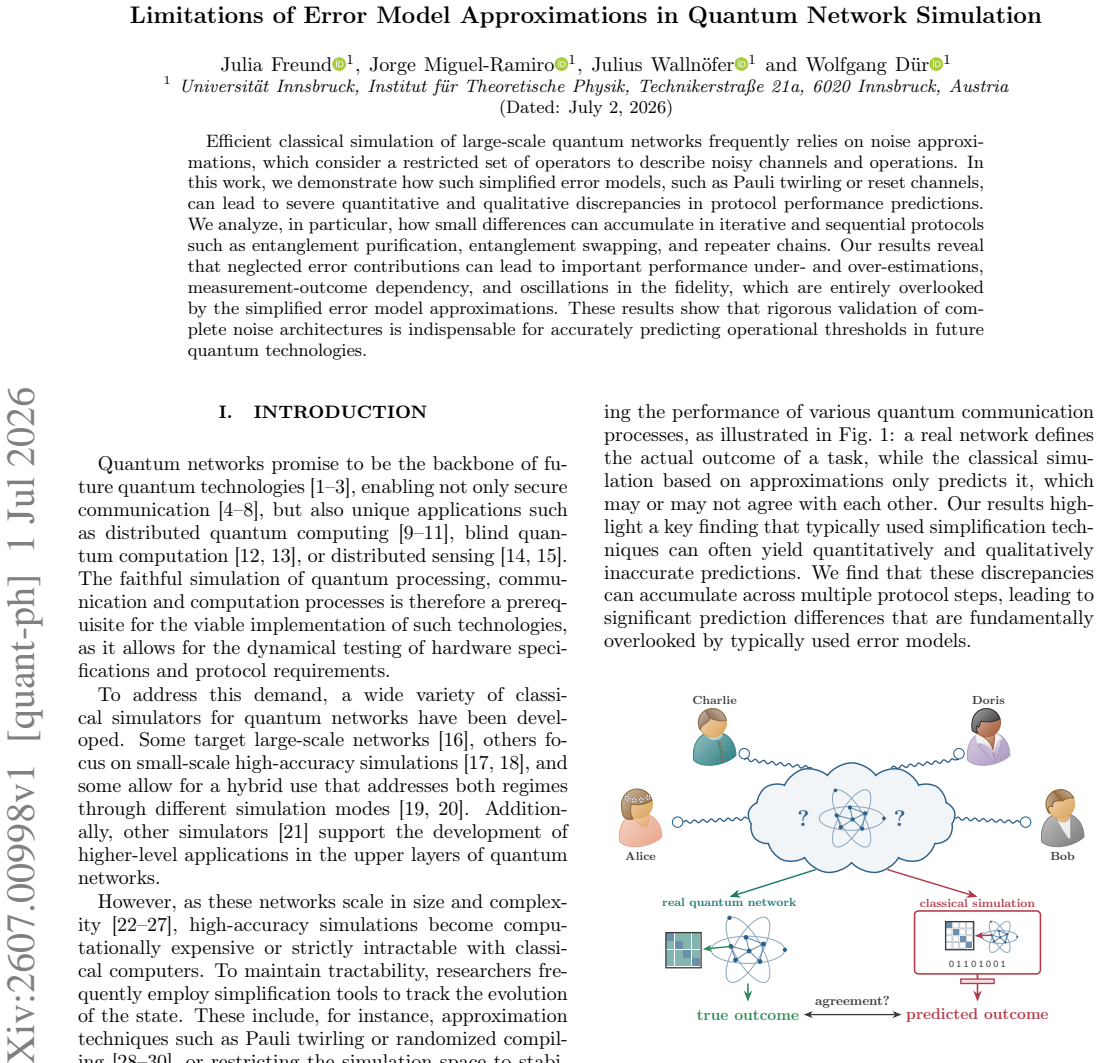
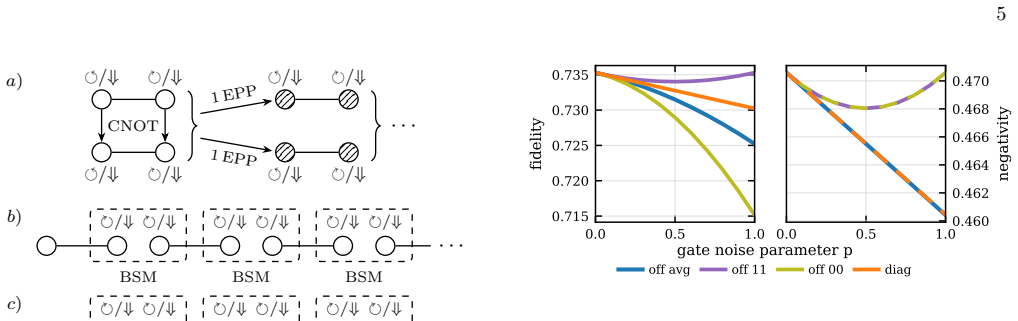
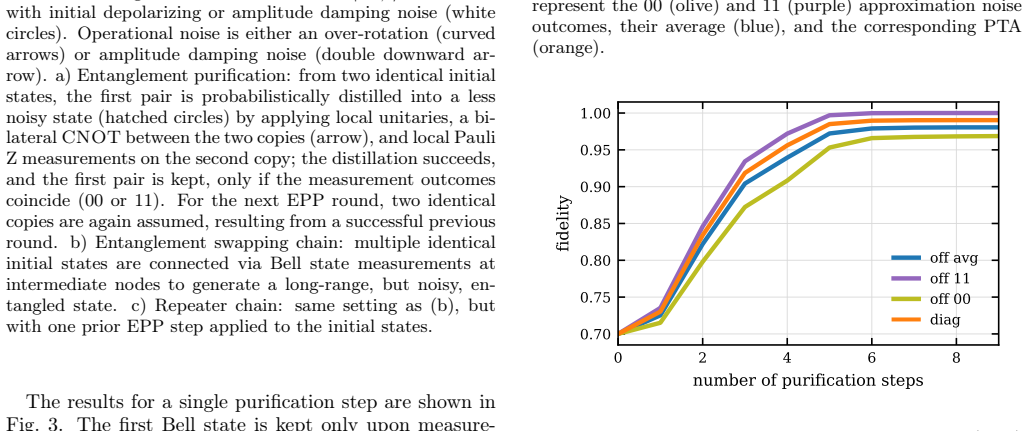
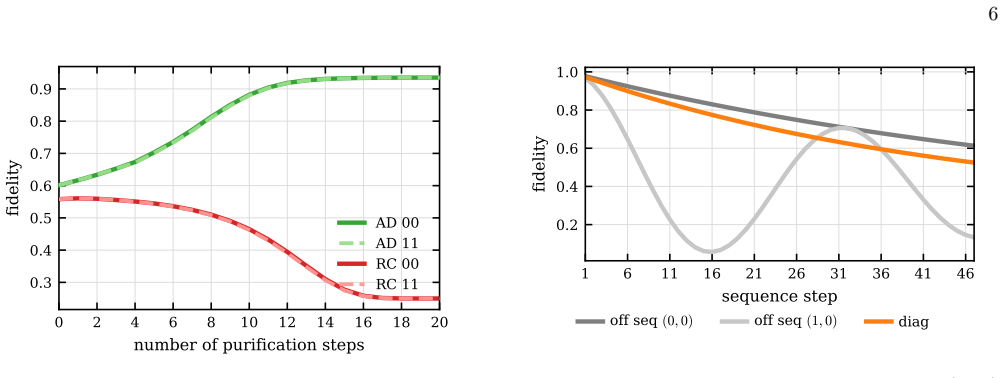
Efficient classical simulation of large-scale quantum networks frequently relies on noise approximations, which consider a restricted set of operators to describe noisy channels and operations. In this work, we demonstrate how such simplified error models, such as Pauli twirling or reset channels, can lead to severe quantitative and qualitative discrepancies in protocol performance predictions. We analyze, in particular, how small differences can accumulate in iterative and sequential protocols such as entanglement purification, entanglement swapping, and repeater chains. Our results reveal that neglected error contributions can lead to important performance under- and over-estimations, measurement-outcome dependency, and oscillations in the fidelity, which are entirely overlooked by the simplified error model approximations. These results show that rigorous validation of complete noise architectures is indispensable for accurately predicting operational thresholds in future quantum technologies.
Editorial analysis
A structured set of objections, weighed in public.
Referee Report
Summary. The manuscript claims that simplified error models commonly used in classical simulations of quantum networks, such as Pauli twirling and reset channels, produce severe quantitative and qualitative discrepancies relative to more complete noise architectures when applied to iterative protocols including entanglement purification, entanglement swapping, and repeater chains. Neglected error terms are shown to induce performance under- and over-estimations, measurement-outcome dependencies, and fidelity oscillations that the approximations entirely miss, leading to the conclusion that rigorous validation of complete noise models is required to predict operational thresholds reliably.
Significance. If the reported discrepancies are robust to the choice of full noise architecture and simulation parameters, the result is significant for the quantum-network simulation community. It supplies concrete evidence that approximation choices can alter predicted thresholds in protocols where errors accumulate over many iterations, thereby affecting design decisions for near-term quantum repeaters and distributed quantum computing. The work does not claim experimental validation of the reference model, only that comparative differences exist and can be large.
minor comments (3)
- The abstract and introduction would benefit from an explicit statement of the precise noise channels and parameter values that constitute the 'complete' reference model versus each approximation; this would allow readers to reproduce the claimed discrepancies without ambiguity.
- Section 4 (or equivalent results section) should include a short table or paragraph quantifying the magnitude of the fidelity oscillations and measurement-outcome dependencies for at least one protocol, with error bars or sensitivity analysis to simulation hyperparameters.
- The discussion of 'measurement-outcome dependency' would be clearer if the authors indicated whether this arises from the stochastic nature of the simulation or from an intrinsic property of the channel composition; a brief derivation or pseudocode snippet would help.
Simulated Author's Rebuttal
We thank the referee for their accurate summary of our manuscript and for recommending minor revision. We are pleased that the significance of the demonstrated discrepancies in simplified error models for iterative quantum network protocols is recognized.
Circularity Check
No significant circularity
full rationale
The paper conducts a direct comparative simulation study of full vs. approximated noise models in quantum protocols (entanglement purification, swapping, repeater chains). Claims rest on explicit numerical discrepancies arising from neglected error terms, with no fitted parameters, self-definitional equations, or load-bearing self-citations that reduce the central result to its own inputs. The full noise architecture is used as an explicit reference model for illustration, not derived from the approximations being critiqued.
Axiom & Free-Parameter Ledger
Reference graph
Works this paper leans on
-
[1]
Deterministic over-rotations A common example is a systematic over-rotation with angleφaround a Pauli axisJ∈ {X,Y,Z}, which can be described by the following unitary: UJ(φ) =e iφJ = cos(φ)11+ i sin(φ) J.(2) As already mentioned, this formulation describes a sys- tematic error that may produce a constant drift in the properties of the resulting state, whic...
-
[2]
Physically, this can, for instance, corre- spond to a laser source experiencing fluctuations
Probabilistic over-rotations Alternatively, these over-rotations can also manifest stochastically. Physically, this can, for instance, corre- spond to a laser source experiencing fluctuations. Math- ematically, this is modeled as a completely positive and trace-preserving (CPTP) map: Eprob(ρ) = (1−p)ρ+pU J(φ)ρU † J(φ),(3) where the over-rotation only occu...
-
[3]
Pauli twirling approximation The Pauli Twirling Approximation [28] is one of the most widely adopted simplification techniques in quan- tum information processing. Operationally, a general quantum channelEis mapped to a purely diagonal Pauli channelE PTA by averaging the state evolution over the group ofn-qubit Pauli operatorsP n: EPTA(ρ) = 1 4n X P∈Pn PE...
-
[4]
The depolarizing channel probabilistically replaces the state ρwith the maximally mixed state
Depolarizing noise To model noise and imperfections such as memory de- coherence, the depolarizing channel is frequently used, as it can be interpreted as a worst case scenario [69]. The depolarizing channel probabilistically replaces the state ρwith the maximally mixed state. We use it as an initial noise model for distributed Bell pairs by applying it t...
-
[5]
Amplitude damping and reset approximations Amplitude damping (AD) [67] represents a non- Clifford noise channel that models the energy dissipation of a physical system to its ground state. Because it can- not be expressed within the standard stabilizer formal- ism, an exact classical simulation of large systems subject to AD noise may scale exponentially ...
-
[6]
P. P. Rohde, Z. Huang, Y. Ouyang, H.-L. Huang, Z.-E. Su, S. Devitt, R. Ramakrishnan, A. Mantri, S.-H. Tan, N. Liu, S. Harrison, C. Radhakrishnan, G. K. Brennen, B. Q. Baragiola, J. P. Dowling, T. Byrnes, and W. J. Munro, arXiv:2501.12107 [quant- ph] 10.48550/arXiv.2501.12107 (2025)
-
[9]
P. W. Shor and J. Preskill, Phys. Rev. Lett.85, 441 (2000)
2000
-
[10]
Gottesman and H.-K
D. Gottesman and H.-K. Lo, IEEE Transactions on In- formation Theory49, 457 (2003)
2003
-
[11]
Zhao and Z.-Q
Y.-B. Zhao and Z.-Q. Yin, International Journal of Mod- ern Physics: Conference Series33, 1460370 (2014)
2014
-
[12]
Murta, F
G. Murta, F. Grasselli, H. Kampermann, and D. Bruß, Adv. Quantum Technol.3, 2000025 (2020)
2020
-
[13]
F. Hahn, J. de Jong, and A. Pappa, PRX Quantum1, 020325 (2020)
2020
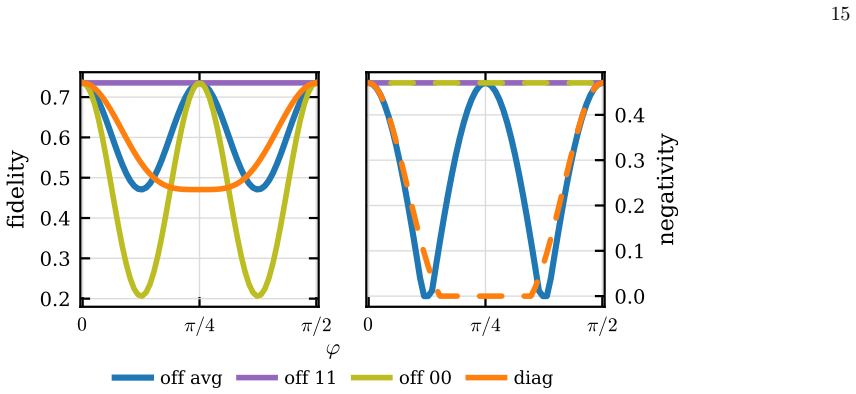
-
[14]
J. I. Cirac, A. K. Ekert, S. F. Huelga, and C. Macchi- avello, Phys. Rev. A59, 4249 (1999)
1999
-
[15]
Hayashi and T
M. Hayashi and T. Morimae, Phys. Rev. Lett.115, 220502 (2015)
2015
-
[16]
A. S. Cacciapuoti, M. Caleffi, F. Tafuri, F. S. Cataliotti, S. Gherardini, and G. Bianchi, IEEE Network34, 137 (2020)
2020
-
[17]
S. Barz, E. Kashefi, A. Broadbent, J. F. Fitzsimons, A. Zeilinger, and P. Walther, Science335, 303–308 (2012)
2012
-
[18]
J. F. Fitzsimons, npj Quantum Information3, 23 (2017)
2017
-
[19]
Giovannetti, S
V. Giovannetti, S. Lloyd, and L. Maccone, Nature Pho- tonics5, 222–229 (2011)
2011
-
[20]
Sekatski, S
P. Sekatski, S. Wölk, and W. Dür, Phys. Rev. Research 2, 023052 (2020)
2020
-
[21]
Satoh, M
R. Satoh, M. Hajdušek, N. Benchasattabuse, S. Na- gayama, K. Teramoto, T. Matsuo, S. A. Metwalli, P. Pathumsoot, T. Satoh, S. Suzuki, and R. V. Meter, in 2022 IEEE International Conference on Quantum Com- puting and Engineering (QCE)(2022) pp. 353–364
2022
-
[22]
X. Wu, A. Kolar, J. Chung, D. Jin, T. Zhong, R. Ket- timuthu, and M. Suchara, Quantum Science and Tech- nology6, 045027 (2021). 9
2021
-
[23]
Wallnöfer, F
J. Wallnöfer, F. Hahn, F. Wiesner, N. Walk, and J. Eis- ert, PRX Quantum5, 010351 (2024)
2024
-
[24]
Coopmans, R
T. Coopmans, R. Knegjens, A. Dahlberg, D. Maier, L. Nijsten, J. de Oliveira Filho, M. Papendrecht, J. Rabbie, F. Rozpędek, M. Skrzypczyk, L. Wubben, W. de Jong, D. Podareanu, A. Torres-Knoop, D. Elkouss, and S. Wehner, Communications Physics4, 164 (2021)
2021
-
[25]
Pearson, F
A. Pearson, F. Mazza, M. Caleffi, and A. S. Cacciapuoti, Computer Networks283, 112292 (2026)
2026
-
[26]
Dahlberg and S
A. Dahlberg and S. Wehner, Quantum Science and Tech- nology4, 015001 (2018)
2018
-
[27]
Yehia, M
R. Yehia, M. Schiavon, V. Marulanda Acosta, T. Coop- mans, I. Kerenidis, D. Elkouss, and E. Diamanti, New Journal of Physics26, 073015 (2024)
2024
-
[28]
Pérez-Castro, J
D. Pérez-Castro, J. Fernández-Herrerín, A. Fernández- Vilas, M. Fernández-Veiga, and R. P. Díaz-Redondo, Computer Networks282, 112249 (2026)
2026
-
[29]
van Dam, G
J. van Dam, G. Avis, T. B. Propp, F. Ferreira da Silva, J. A. Slater, T. E. Northup, and S. Wehner, Quantum Science and Technology9, 045031 (2024)
2024
-
[30]
S. K. Jha, A. N. Hati, and S. K. Singh, Quantum Infor- mation Processing25, 100 (2026)
2026
-
[31]
Brevi, F
L. Brevi, F. Grasselli, A. Caraceni, M. Proietti, M. Dis- penza, and E. Prati, Advanced Quantum Technologies9, e00870 (2026)
2026
-
[32]
X. Wu, A. Kolar, J. Chung, D. Jin, M. Suchara, and R. Kettimuthu, ACM Trans. Model. Comput. Simul.34, 10.1145/3634701 (2024)
-
[33]
M. R. Geller and Z. Zhou, Phys. Rev. A88, 012314 (2013)
2013
-
[34]
J. J. Wallman and J. Emerson, Phys. Rev. A94, 052325 (2016)
2016
-
[35]
Hashim, R
A. Hashim, R. K. Naik, A. Morvan, J.-L. Ville, B. Mitchell, J. M. Kreikebaum, M. Davis, E. Smith, C. Iancu, K. P. O’Brien, I. Hincks, J. J. Wallman, J. Emerson, and I. Siddiqi, Phys. Rev. X11, 041039 (2021)
2021
-
[36]
Gottesman,The Heisenberg Representation of Quan- tum Computers, Tech
D. Gottesman,The Heisenberg Representation of Quan- tum Computers, Tech. Rep. LA-UR-98-2848; CONF- 980788- (Los Alamos National Laboratory, Los Alamos, NM, 1998)
1998
-
[37]
P.-S. Yan, L. Zhou, W. Zhong, and Y.-B. Sheng, Sci- ence China Physics, Mechanics & Astronomy66, 250301 (2023)
2023
-
[38]
Dür and H
W. Dür and H. J. Briegel, Reports on Progress in Physics 70, 1381–1424 (2007)
2007
-
[39]
Deutsch, A
D. Deutsch, A. Ekert, R. Jozsa, C. Macchiavello, S. Popescu, and A. Sanpera, Phys. Rev. Lett.77, 2818 (1996)
1996
-
[40]
C. H. Bennett, G. Brassard, S. Popescu, B. Schumacher, J. A. Smolin, and W. K. Wootters, Phys. Rev. Lett.76, 722 (1996)
1996
-
[41]
Miguel-Ramiro, A
J. Miguel-Ramiro, A. Pirker, and W. Dür, Quantum9, 1702 (2025)
2025
-
[42]
Żukowski, A
M. Żukowski, A. Zeilinger, M. A. Horne, and A. K. Ekert, Phys. Rev. Lett.71, 4287 (1993)
1993
-
[43]
Briegel, W
H.-J. Briegel, W. Dür, J. I. Cirac, and P. Zoller, Phys. Rev. Lett.81, 5932 (1998)
1998
-
[44]
Dür, H.-J
W. Dür, H.-J. Briegel, J. I. Cirac, and P. Zoller, Phys. Rev. A59, 169 (1999)
1999
-
[45]
Muralidharan, L
S. Muralidharan, L. Li, J. Kim, N. Lütkenhaus, M. D. Lukin, and L. Jiang, Sci. Rep.6, 20463 (2016)
2016
-
[46]
Luong, L
D. Luong, L. Jiang, J. Kim, and N. Lütkenhaus, Applied Physics B122, 96 (2016)
2016
-
[47]
L.-M. Duan, M. D. Lukin, J. I. Cirac, and P. Zoller, Na- ture414, 413 (2001)
2001
-
[48]
N.Sangouard, C.Simon, H.deRiedmatten,andN.Gisin, Rev. Mod. Phys.83, 33 (2011)
2011
-
[49]
Meter and J
R. Meter and J. Touch, IEEE Communications Magazine 51, 64–71 (2013)
2013
-
[50]
van Loock, W
P. van Loock, W. Alt, C. Becher, O. Benson, H. Boche, C. Deppe, J. Eschner, S. Höfling, D. Meschede, P. Mich- ler, F. Schmidt, and H. Weinfurter, Advanced Quantum Technologies3, 1900141 (2020)
2020
-
[51]
Azuma, S
K. Azuma, S. E. Economou, D. Elkouss, P. Hilaire, L. Jiang, H.-K. Lo, and I. Tzitrin, Rev. Mod. Phys.95, 045006 (2023)
2023
-
[52]
Gutiérrez, L
M. Gutiérrez, L. Svec, A. Vargo, and K. R. Brown, Phys. Rev. A87, 030302 (2013)
2013
-
[53]
Magesan, D
E. Magesan, D. Puzzuoli, C. E. Granade, and D. G. Cory, Phys. Rev. A87, 012324 (2013)
2013
-
[54]
Cai and S
Z. Cai and S. C. Benjamin, Scientific Reports9, 11281 (2019)
2019
-
[55]
M. R. Geller, Sci. Rep.5, 14670 (2015)
2015
-
[56]
A. S. Darmawan and D. Poulin, Phys. Rev. Lett.119, 040502 (2017)
2017
-
[57]
Quantum simulation of noisy quantum networks,
F. Riera-Sàbat, J. Miguel-Ramiro, and W. Dür, arXiv:2506.09144 [quant-ph] 10.48550/arXiv.2506.09144 (2025)
-
[58]
Tomita and K
Y. Tomita and K. M. Svore, Phys. Rev. A90, 062320 (2014)
2014
-
[59]
Gutiérrez, C
M. Gutiérrez, C. Smith, L. Lulushi, S. Janardan, and K. R. Brown, Phys. Rev. A94, 042338 (2016)
2016
-
[60]
A dynamical interpretation of the Pauli Twirling Approximation and Quantum Error Correction
A. Katabarwa, arXiv:1701.03708 [quant-ph] 10.48550/arXiv.1701.03708 (2017)
work page internal anchor Pith review Pith/arXiv arXiv doi:10.48550/arxiv.1701.03708 2017
-
[61]
E. H. Chen, S. Chen, L. E. Fischer, A. Eddins, L. C. G. Govia, B. Mitchell, A. He, Y. Kim, L. Jiang, and A. Seif, arXiv:2505.22629 [quant-ph] 10.48550/arXiv.2505.22629 (2026)
-
[62]
Proctor, K
T. Proctor, K. Rudinger, K. Young, M. Sarovar, and R. Blume-Kohout, Phys. Rev. Lett.119, 130502 (2017)
2017
-
[63]
J. M. Epstein, A. W. Cross, E. Magesan, and J. M. Gam- betta, Phys. Rev. A89, 062321 (2014)
2014
-
[64]
J.J.WallmanandS.T.Flammia,NewJournalofPhysics 16, 103032 (2014)
2014
-
[65]
B. Davies, G. Avis, and S. Wehner, arXiv:2509.16689 [quant-ph] 10.48550/arXiv.2509.16689 (2025)
-
[66]
S. Mondal, P. Halder, S. Haldar, and A. S. De, arXiv:2509.18064 [quant-ph] 10.48550/arXiv.2509.18064 (2025)
-
[67]
R.S.Bennink, E.M.Ferragut, T.S.Humble, J.A.Laska, J. J. Nutaro, M. G. Pleszkoch, and R. C. Pooser, Phys. Rev. A95, 062337 (2017)
2017
-
[68]
S. R. Garner, N. M. Myers, M. Wang, S. Stein, C. Liu, and A. Li, Phys. Rev. Res.8, 023134 (2026)
2026
-
[69]
J. Chung, D. Dilley, E. Eastman, A. Gonzales, K. Ho- kenstad, M. S. Islam, V. Jorapur, J. Petrullo, A. C. Y. Li, B. Li, V. Niaouris, A. Ramesh, A. Singal, C. Zhan, M. Bishof, E. Chitambar, J. P. Covey, A. Dibos, X. Han, L. Jiang, P. Kumar, J. Larson, Z. H. Saleem, and R. Kettimuthu, arXiv:2509.19503 [quant-ph] 10.48550/arXiv.2509.19503 (2025)
-
[70]
Wehner, D
S. Wehner, D. Elkouss, and R. Hanson, Science362, eaam9288 (2018)
2018
-
[71]
H. J. Kimble, Nature453, 1023 (2008)
2008
-
[72]
M. A. Nielsen and I. L. Chuang, Quantum Computa- tion and Quantum Information: 10th Anniversary Edi- tion (Cambridge University Press, 2010). 10
2010
-
[73]
Gidney, Quantum5, 497 (2021)
C. Gidney, Quantum5, 497 (2021)
2021
-
[74]
W. Dür, M. Hein, J. I. Cirac, and H.-J. Briegel, Phys. Rev. A72, 052326 (2005). 11 Appendix A: Entanglement purification Entanglement Purification Protocols comprise a set of approaches that allow the distillation of high-fidelity entangle- ment from multiple noisy states, effectively trading quantity for state quality using only local operations and clas...
2005
-
[75]
We first elaborate on the difference of the post-measurement state between the individual protocol outcomes and their averages
Detailed analysis of the DEJMPS protocol In this Appendix, we investigate how the DEJMPS EPP performs when subject to coherent off-diagonal Pauli. We first elaborate on the difference of the post-measurement state between the individual protocol outcomes and their averages. Subsequently, we analytically analyze the DEJMPS protocol and its performance for ...
-
[76]
Thus, we investigate in detail the measurement result11on the subsystemA2andB2of Eq
UB1→B2† CNOT UA1→A2† CNOT = (i)b+b′−d−d′ |Ψa⊕b,b⊕b′⟩ |Ψa⊕b⊕a′⊕b′,b′⟩ ⟨Ψc⊕d,d⊕d′| ⟨Ψc⊕d⊕c′⊕d′,d′|.(A12) As we describe in Section A, the final step of the DEJMPS protocol is to measure the second Bell pair, the subsystems A2andB2, in the computational basis, regarding00or11as successful outcomes. Thus, we investigate in detail the measurement result11on th...
-
[77]
Coherent off-diagonal Pauli noise In this subsection, we investigate the difference between individual successful branches for|Ψ0,0⟩Bell state subject to coherent off-diagonal Pauli noise on one qubit. In particular, we consider the following single-qubit error channel to describe our error model: DY(ρ) = (1−p)ρ+pU Y(φ)ρU † Y(φ) = (1−p)ρ+p(cos(φ)11+ i sin...
-
[78]
Diagonal Pauli noise Continuing the previous subsection, we now consider only the diagonal noise contribution corresponding to the model in Eq. (A16). This corresponds to the Pauli twirled version of this channel and can be considered as its PTA. The resulting initial state is as follows: ρY,diag = (1−p+pcos 2(φ))|Ψ 0,0⟩ ⟨Ψ0,0|+psin 2(φ)|Ψ 1,1⟩ ⟨Ψ1,1|,(A2...
-
[79]
10, we present the complementary figure to Fig
Coherent off-diagonal over-rotation: angular dependency In Fig. 10, we present the complementary figure to Fig. 3. Specifically, we consider the same noisy initial state and vary the over-rotation angleφin the deterministic noise setting (p= 1). Settingp= 1in Eq. (A20) eliminates the |Ψ0,1⟩ ⟨Ψ0,1|contribution, leaving the 11 branch independent of the over...
-
[80]
Analytical treatment of entanglement swapping protocol We define the entanglement swapping operator as a projector onto the Bell basis acting on the second and third qubit of a four-qubit state: Pi,j :=11⊗ |Ψ i,j⟩ ⟨Ψi,j| ⊗11.(B1) The effect of entanglement swapping, which follows from applying the projector Eq. (B1) to a tensor product of 16 two|Ψ 0,0⟩Bel...
-
[81]
We consider two identical copies of a Bell state, where the second qubit of each pair is subject to an over-rotation in the Pauli Z direction
Coherent off-diagonal Pauli noise In this subsection, we derive an analytic expression for a single entanglement swapping operation. We consider two identical copies of a Bell state, where the second qubit of each pair is subject to an over-rotation in the Pauli Z direction. Although we carry out the calculation for Pauli Z over-rotations, the correspondi...
-
[82]
As we want to have the Bell state|Ψ0,0⟩between qubit 1 and 4, we apply the correction operatorZj Xi to qubit 4 of the state Eq. (B6). As theUZ(φ)noise acts on qubit 4, we have to commute the correction operations through, which results in two different cases, depending on the values ofi= 0 andi= 1: (Zj Xi) UZ(φ) Xi Zj = (Zj Xi) cos(φ)11+ i sin(φ) Z Xi Zj ...
discussion (0)
Sign in with ORCID, Apple, or X to comment. Anyone can read and Pith papers without signing in.