Effect of radially heterogeneous band gap collapse on formation of swift heavy ion tracks in Al2O3
Pith reviewed 2026-07-02 09:26 UTC · model grok-4.3
The pith
Radial band gap collapse around a swift heavy ion in Al2O3 forms a transient metal-semiconductor heterojunction that changes how energy reaches the atoms and produces more discontinuous damage tracks.
A machine-rendered reading of the paper's core claim, the machinery that carries it, and where it could break.
Core claim
Impact of a 700 MeV Bi ion induces a transient metal-semiconductor heterojunction in Al2O3: the metallization (the band gap collapse) occurs within a radius of about 2 nm from the ion trajectory. The band gap shrinks at distances of about 3-5 nm, while it remains almost unaffected at radii larger than 5 nm. Using this data, the atomic heating is estimated depending on the degree of band gap reduction at different radii, which refines the damage modeling and produces more pronounced discontinuous damage patterns along the ion path for all crystallographic directions compared to the model that assumes all the energy accumulated in the electron-hole ensemble is delivered to the atoms.
What carries the argument
Radial profile of band-gap reduction obtained by coupling TREKIS Monte Carlo excitation with DFT-based molecular dynamics, which sets the spatially varying fraction of electronic energy that can be transferred to the lattice before electronic relaxation ends.
If this is right
- Atomic heating becomes lower at radii where the band gap has only partially collapsed or stayed open.
- Damage along the ion path appears more discontinuous in every crystallographic direction.
- The model distinguishes regions that metallize, regions that only narrow, and regions that remain semiconducting.
- Earlier uniform-delivery assumptions overestimate lattice heating in the outer shells of the track.
Where Pith is reading between the lines
- The same radial-heterogeneity treatment could be applied to other wide-gap oxides to test whether track continuity changes systematically with band-gap size.
- Comparison of the refined heating profiles with measured track etching rates or conductivity changes might reveal whether the outer shells contribute less to permanent damage than previously thought.
- Extending the calculation to lower ion energies or different projectile masses would show how the radius of full metallization scales with deposited energy density.
Load-bearing premise
The combination of Monte Carlo excitation tracking and density-functional molecular dynamics accurately gives the radial profile of energy that reaches the atoms once the electrons relax, without large missing effects from spatial inhomogeneity or relaxation timing.
What would settle it
Nanoscale mapping of atomic displacements or local lattice temperatures around an experimental 700 MeV Bi track in Al2O3 that shows the predicted radial variation in damage density versus the smoother pattern expected from uniform energy transfer.
Figures
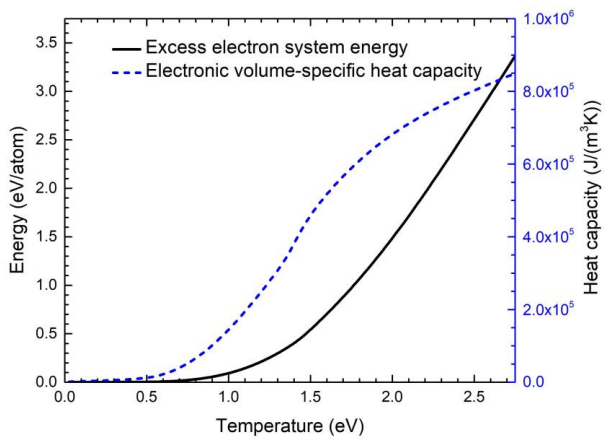
read the original abstract
We estimate the effects of radial heterogeneity in the collapse of the electronic band gap on the damage in Al2O3 after impact of a swift heavy ion decelerated in the electronic stopping regime. The Monte Carlo code TREKIS describes the initial excitation of the electronic and ionic systems following the ion passage, while the density functional theory based molecular dynamics traces changes in the band structure in the ion track. This combination of methods enables us to compute the profile of energy transferred to the lattice by the time of relaxation of the electronic excitation, accounting for the induced spatial inhomogeneity of the band structure around the ion trajectory. We demonstrate that impact of a 700 MeV Bi ion induces a transient metal-semiconductor heterojunction in Al2O3: the metallization (the band gap collapse) occurs within a radius of about 2 nm from the ion trajectory. The band gap shrinks at distances of about 3-5 nm, while it remains almost unaffected at radii larger than 5 nm. Using this data, we estimate the atomic heating depending on the degree of band gap reduction at different radii from the ion trajectory. This approach refines the damage modeling, producing more pronounced discontinuous damage patterns along the ion path for all crystallographic directions compared to the model that assumes all the energy accumulated in the electron-hole ensemble is delivered to the atoms.
Editorial analysis
A structured set of objections, weighed in public.
Referee Report
Summary. The manuscript combines the TREKIS Monte Carlo code for initial electronic excitation with DFT-based molecular dynamics to compute the radial profile of band-gap collapse around a 700 MeV Bi ion track in Al2O3. It reports metallization (gap collapse) within ~2 nm, partial shrinkage at 3–5 nm, and near-normal gap beyond 5 nm, then uses this heterogeneity to estimate a radially varying energy transfer to the lattice. The resulting damage morphology is claimed to exhibit more pronounced discontinuous tracks along the ion path for all crystallographic directions than the conventional uniform-delivery model.
Significance. If the radial mapping from band-gap size to lattice heating is quantitatively reliable, the work supplies a concrete refinement to track-formation models by incorporating transient metal–semiconductor heterojunction effects. This could improve predictions of discontinuous versus continuous damage in wide-gap insulators and is a positive example of multi-scale simulation coupling. The absence of free parameters in the core pipeline and the falsifiable prediction of direction-dependent morphology changes are strengths.
major comments (1)
- [Abstract / energy-transfer estimation paragraph] The central step—conversion of the computed radial band-gap profile into a position-dependent atomic-heating rate—is described only qualitatively (“estimate the atomic heating depending on the degree of band gap reduction”). No explicit functional form, derivation from electron–phonon matrix elements, or validation against self-consistent dynamical calculations is supplied. This mapping is load-bearing for the claim that the heterogeneous model produces quantitatively different (more discontinuous) damage patterns; without it the difference cannot be assessed.
minor comments (1)
- [Abstract] The abstract asserts results “for all crystallographic directions” yet provides no indication of which directions were simulated or how the directional dependence was quantified; a brief statement or reference to a supplementary table would improve clarity.
Simulated Author's Rebuttal
We thank the referee for the careful reading and constructive criticism. We respond to the single major comment below.
read point-by-point responses
-
Referee: [Abstract / energy-transfer estimation paragraph] The central step—conversion of the computed radial band-gap profile into a position-dependent atomic-heating rate—is described only qualitatively (“estimate the atomic heating depending on the degree of band gap reduction”). No explicit functional form, derivation from electron–phonon matrix elements, or validation against self-consistent dynamical calculations is supplied. This mapping is load-bearing for the claim that the heterogeneous model produces quantitatively different (more discontinuous) damage patterns; without it the difference cannot be assessed.
Authors: We agree that the original manuscript presents the radial energy-transfer mapping only at a qualitative level. In the revised manuscript we will supply an explicit functional form: the local lattice-heating rate is taken to scale linearly with the fractional band-gap reduction (ΔEg/Eg0) at each radius, with the proportionality constant fixed by requiring that the radially integrated energy equals the total electronic energy deposited by TREKIS. The functional dependence is motivated by the electron–phonon coupling strength in the TREKIS model, which increases as the gap narrows. We will also add a short validation paragraph comparing the resulting temperature profiles against a uniform-delivery reference run. These additions will make the quantitative difference in track morphology directly verifiable. revision: yes
Circularity Check
No significant circularity; derivation is self-contained simulation pipeline
full rationale
The paper combines TREKIS Monte Carlo for initial electronic excitation with separate DFT-MD runs for radial band-structure snapshots, then estimates position-dependent lattice heating from the resulting gap profile. No quoted step reduces by the paper's own equations to a fitted input or self-definition; the discontinuous damage patterns are presented as an output of the combined codes rather than a renaming or tautological prediction. Self-citations (if any) are not load-bearing for the central claim, and the pipeline remains externally falsifiable against experimental track morphology.
Axiom & Free-Parameter Ledger
axioms (2)
- domain assumption TREKIS Monte Carlo code accurately describes the initial excitation of the electronic and ionic systems following ion passage.
- domain assumption DFT-based molecular dynamics reliably traces changes in the band structure in the ion track.
Reference graph
Works this paper leans on
-
[1]
M. Lang, F. Djurabekova, N. Medvedev, M. Toulemonde, C. Trautmann, Fundamental phenomena and applications of swift heavy ion irradiations, in: Compr. Nucl. Mater., Elsevier, 2020: pp. 485–516. https://doi.org/10.1016/B978-0-12-803581-8.11644-3
-
[2]
Komarov, Nano- and microstructuring of solids by swift heavy ions, Physics-Uspekhi 60 (2017) 435–471
F.F. Komarov, Nano- and microstructuring of solids by swift heavy ions, Physics-Uspekhi 60 (2017) 435–471. https://doi.org/10.3367/UFNe.2016.10.038012
-
[3]
Rizza, From ion-hammering to ion-shaping: an historical overview, J
G. Rizza, From ion-hammering to ion-shaping: an historical overview, J. Phys. Conf. Ser. 629 (2015) 012005. http://stacks.iop.org/1742 - 6596/629/i=1/a=012005?key=crossref.9b02e16972b4c47232da0ff4ccb8d77f
2015
-
[5]
N. Medvedev, F. Akhmetov, R.A. Rymzhanov, R. Voronkov, A.E. Volkov, Modeling time- resolved kinetics in solids induced by extreme electronic excitation, Adv. Theory Simulations 5 (2022) 2200091. https://doi.org/10.1002/ADTS.202200091
-
[6]
R.A. Rymzhanov, N.A. Medvedev, A.E. Volkov, Effect of valence holes kinetics on material excitation in tracks of swift heavy ions, Nucl. Instruments Methods Phys. Res. B 365 (2015) 462–467. https://doi.org/10.1016/j.nimb.2015.08.043
-
[7]
S.I. Kudryashov, V.I. Emel’yanov, Band gap collapse and ultrafast “cold” melting of silicon during femtosecond laser pulse, J. Exp. Theor. Phys. Lett. 2001 735 73 (2001) 228 –231. https://doi.org/10.1134/1.1371059
-
[8]
N. Medvedev, R. Voronkov, A.E. Volkov, Nonthermal effects in solids after swift heavy ion impact, Nucl. Instruments Methods Phys. Res. Sect. B Beam Interact. with Mater. Atoms 547 (2024) 165218. https://doi.org/10.1016/j.nimb.2023.165218
-
[9]
N.A. Medvedev, A.E. Volkov, Nonthermal acceleration of atoms as a mechanism of fast 15 lattice heating in ion tracks, J. Appl. Phys. 225903 (2022) 131. https://doi.org/10.1063/5.0095724
-
[10]
R.A. Rymzhanov, N. Medvedev, J.H. O’Connell, A. Janse van Vuuren, V.A. Skuratov, A.E. Volkov, Recrystallization as the governing mechanism of ion track formation, Sci. Rep. 9 (2019) 3837. https://doi.org/10.1038/s41598-019-40239-9
-
[11]
A. Ibrayeva, A. Mutali, J. O’Connell, A.J. van Vuuren, E. Korneeva, A. Sohatsky, R. Rymzhanov, V. Skuratov, L. Alekseeva, I. Ivanov, Swift heavy ion tracks in nanocrystalline Y4Al2O9, Nucl. Mater. Energy 30 (2022) 101106. https://doi.org/10.1016/J.NME.2021.101106
-
[12]
R.A. Rymzhanov, M. Ćosić, N. Medvedev, A.E. Volkov, From groove to hillocks – Atomic-scale simulations of swift heavy ion grazing impacts on CaF2, Appl. Surf. Sci. 652 (2024) 159310. https://doi.org/10.1016/J.APSUSC.2024.159310
-
[13]
R.A. Voronkov, N. Medvedev, A.E. Volkov, Dependence of nonthermal metallization kinetics on bond ionicity of compounds, Sci. Rep. 10 (2020) 13070. https://doi.org/10.1038/s41598-020-70005-1
-
[14]
N.A. Medvedev, R.A. Rymzhanov, A.E. Volkov, Time -resolved electron kinetics in swift heavy ion irradiated solids, J. Phys. D. Appl. Phys. 48 (2015) 3 55303. https://doi.org/10.1088/0022-3727/48/35/355303
-
[15]
I. Inoue, V. Tkachenko, Y. Kubota, F. Dorchies, T. Hara, H. Höppner, Y. Inubushi, K.J. Kapcia, H.J. Lee, V. Lipp, P. Martinez, E. Nishibori, T. Osaka, S. Toleikis, J. Yamada, M. Yabashi, B. Ziaja, P.A. Heimann, Interplay of thermal and nonthermal effects in x -ray- induced ultrafast melting, Phys. Rev. B 110 (2024) L100102. https://doi.org/10.1103/PhysRev...
-
[16]
V.A. Skuratov, J. O’Connell, N.S. Kirilkin, J. Neethling, On the threshold of damage formation in aluminum oxide via electronic excitations, Nucl. Instruments Methods Phys. Res. Sect. B Beam Interact. with Mater. Atoms 326 (2014) 223 –227. https://doi.org/10.1016/j.nimb.2013.10.037
-
[17]
V.A. Skuratov, S.J. Zinkle, A.E. Efimov, K. H avancsak, Swift heavy ion -induced modification of Al2O3 and MgO surfaces, Nucl. Instruments Methods Phys. Res. Sect. B Beam Interact. with Mater. Atoms 203 (2003) 136 –140. https://doi.org/10.1016/S0168 - 583X(02)02197-3
-
[18]
R. Rymzhanov, N.A. Medvedev, A.E . Volkov, Damage threshold and structure of swift 16 heavy ion tracks in Al2O3, J. Phys. D. Appl. Phys. 50 (2017) 475301. https://doi.org/10.1088/1361-6463/aa8ff5
-
[19]
N. Medvedev, R. Rymzhanov, A. Volkov, TREKIS -3 [Computer Software], (2023) https://doi.org/10.5281/zenodo.8394462. https://doi.org/10.5281/zenodo.8394462
-
[20]
R.A. Rymzhanov, N.A. Medvedev, A.E. Volkov, Effects of model approximations for electron, hole, and photon transport in swift heavy ion tracks, Nucl. Instruments Methods Phys. Res. Sect. B Beam Interact. with Mater. Atoms 388 (2016) 41 –52. https://doi.org/10.1016/j.nimb.2016.11.002
-
[21]
L. Van Hove, Correlations in Space and Time and Born Approximation Scattering in Systems of Interacting Particles, Phys. Rev. 95 (1954) 249 –262. https://doi.org/10.1103/PhysRev.95.249
-
[22]
Kittel, C.Y
C. Kittel, C.Y. (Ching-yao) Fong, Quantum theory of solids, Wiley, 1987
1987
-
[23]
B.Y. Mueller, B. Rethfeld, Relaxation dynamics in laser -excited metals under nonequilibrium conditions, Phys. Rev. B 87 (2013) 35139. https://doi.org/10.1103/PhysRevB.87.035139
-
[24]
N. Medvedev, D.I. Zainutdinov, A.E. Volkov, A. Mach Learn, Non -ionizing cross section of electron scattering on atoms in matter accounting for dynamical screening effect, J. Appl. Phys. 137 (2025) 15903. https://doi.org/10.1063/5.0242080
-
[25]
Barkas, Nuclear research emulsions., Academic Press, New York, 1963
W.H. Barkas, Nuclear research emulsions., Academic Press, New York, 1963. http://hdl.handle.net/2027/uc1.b3533401 (accessed November 20, 2013)
1963
-
[26]
P. Giannozzi, S. Baroni, N. Bonini, M. Calandra, R. Car, C. Cavazzoni, QUANTUM ESPRESSO : a modular and open -source software project for quantum simulations of materials, J. Phys. Condens. Matter 21 (2009) 395502. https://doi.org/10.1088/0953 - 8984/21/39/395502
-
[27]
R. Clausius, XVI. On a mechanical theorem applicable to heat , London, Edinburgh, Dublin Philos. Mag. J. Sci. 40 (1870) 122–127. https://doi.org/10.1080/14786447008640370
-
[28]
N. Medvedev, A.E. Volkov, B. Ziaja, Electronic and atomic kinetics in solids irradiated with free-electron lasers or swift-heavy ions, Nucl. Instruments Methods Phys. Res. Sect. B Beam Interact. with Mater. Atoms 365 (2015) 437 –446. https://doi.org/10.1016/j.nimb.2015.08.063
-
[29]
P. Vashishta, R.K. Kalia, A. Nakano, J.P. Rino, Interaction potential for silicon carbide: A molecular dynamics study of elastic constants and vibrational density of states for 17 crystalline and amorphous silicon carbide, J. Appl. Phys. 101 (2007). https://doi.org/10.1063/1.2724570
-
[30]
N. Medvedev, A.E. Volkov, R. Rymzhanov, F. Akhmetov, S. Gorbunov, R. Voronkov, P. Babaev, Frontiers, challenges, and solutions in modeling of swift heavy ion effects in materials, J. Appl. Phys. 133 (2023) 100701. https://doi.org/10.1063/5.0128774
-
[31]
X. Gonze, B. Amadon, G. Antonius, F. Arnardi, L. Baguet, J. -M. Beuken, J. Bieder, F . Bottin, J. Bouchet, E. Bousquet, N. Brouwer, F. Bruneval, G. Brunin, T. Cavignac, J. -B. Charraud, W. Chen, M. Côté, S. Cottenier, J. Denier, G. Geneste, P. Ghosez, M. Giantomassi, Y. Gillet, O. Gingras, D.R. Hamann, G. Hautier, X. He, N. Helbig, N. Holzwarth, Y. Jia, F...
-
[32]
Generalized gradient approximation made simple,
J.P. Perdew, K. Burke, M. Ernzerhof, Generalized Gradient Approximation Made Simple, Phys. Rev. Lett. 77 (1996) 3865–3868. https://doi.org/10.1103/PhysRevLett.77.3865
-
[33]
S. V Faleev, M. van Schilfgaarde, T. Kotani, F. Léonard, M.P. Desjarlais, Finite - temperature quasiparticle self -consistent GW approximation, Phys. Rev. B 74 (2006) 33101. https://doi.org/10.1103/PhysRevB.74.033101
-
[34]
C. Molteni, L. Colombo, L. Miglio, Tight -binding molecular dynamics in liquid III -V compounds. I. Potential generation, J. Phys. Condens. Matter 6 (1994) 5243 –5254. https://doi.org/10.1088/0953-8984/6/28/003
-
[35]
Graves, Electronic and structural response of semiconductors to ultra -intense laser pulses, Texas A{\&}M University, 1997
J.S. Graves, Electronic and structural response of semiconductors to ultra -intense laser pulses, Texas A{\&}M University, 1997
1997
-
[36]
Plimpton, Fast Parallel Algor ithms for Short -Range Molecular Dynamics, J
S. Plimpton, Fast Parallel Algor ithms for Short -Range Molecular Dynamics, J. Comput. Phys. 117 (1995) 1–19. https://doi.org/10.1006/jcph.1995.1039
-
[37]
H.J.C. Berendsen, J.P.M. Postma, W.F. van Gunsteren, A. DiNola, J.R. Haak, Molecular dynamics with coupling to an external bath, J. Che m. Phys. 81 (1984) 3684 –3690. https://doi.org/10.1063/1.448118
-
[38]
N.S. Kirilkin, R.A. Rymzhanov, J.H. O’Connell, V.A. Skuratov, A. Akilbekov, A. Dauletbekova, Z. Ospanova, Effect of Irradiation Temperature on the Optical Properties 18 and Structure of Swif t Heavy Ion Irradiated Al2O3, J. Nucl. Mater. 625 (2026) 156525. https://doi.org/10.1016/j.jnucmat.2026.156525
-
[39]
H.M. van Driel, Kinetics of high -density plasmas generated in Si by 1.06 - and 0.53- μm picosecond laser pulses, Phys. Rev. B 35 (1987) 8166 –8176. https://doi.org/10.1103/PhysRevB.35.8166
-
[40]
C.S. Schnohr, E. Wendler, K. Gärtner, W. Wesch, K. Ellmer, Ion -beam induced effects at 15 K in α-Al2O3 of different orientations, J. Appl. Phys. 99 (2006). https://doi.org/10.1063/1.2204748
discussion (0)
Sign in with ORCID, Apple, or X to comment. Anyone can read and Pith papers without signing in.