Foreground Characterization and Mitigation in the Observations of the CD/EoR with the SKA
Pith reviewed 2026-07-02 06:30 UTC · model grok-4.3
The pith
The SKA-Low AA* configuration enhances suppression of foreground contamination to recover the 21-cm cosmological signal.
A machine-rendered reading of the paper's core claim, the machinery that carries it, and where it could break.
Core claim
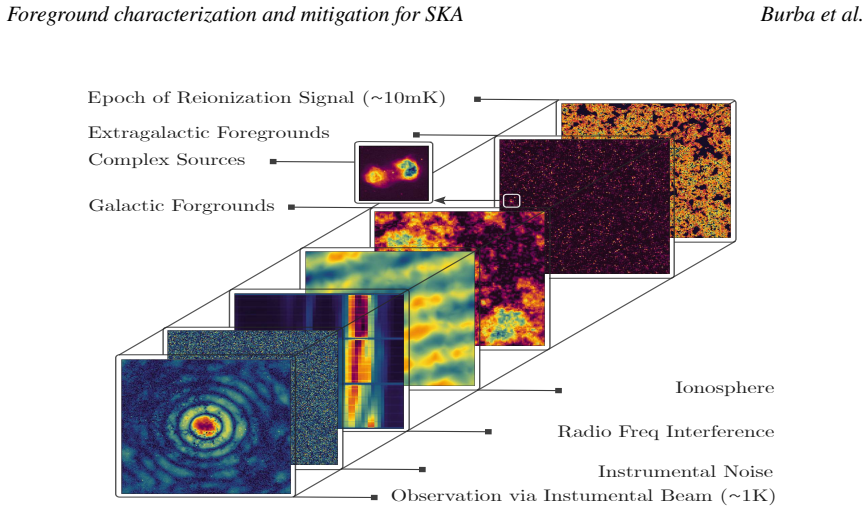
The SKA is poised to detect the 21-cm signal by mitigating foregrounds that are 4-5 orders of magnitude stronger than the cosmological signal. The optimized array design, wide field of view, and improved calibration accuracy of the SKA-Low AA* configuration enhance the capacity to suppress foreground contamination and recover the signal. The SKA Observatory Foreground Challenge plays a pivotal role by bringing together the community to develop, compare, and validate foreground removal pipelines using realistic simulated datasets, building on experience from LOFAR, MWA, and HERA.
What carries the argument
The SKA-Low AA* configuration, whose optimized array design, wide field of view, and calibration accuracy carry the argument for improved foreground suppression.
If this is right
- The SKA will probe the thermal and ionization history of the early Universe with unprecedented precision.
- Statistical and machine learning-based approaches for signal recovery will be refined through community comparison.
- Lessons from pathfinder telescopes will directly inform SKA foreground mitigation strategies.
- Validated pipelines will enable detection of the redshifted 21-cm signal across the CD and EoR epochs.
Where Pith is reading between the lines
- Success would allow detailed mapping of neutral hydrogen during reionization that current instruments cannot achieve.
- The same array-design principles could be tested on other low-frequency arrays facing similar foreground problems.
- Real-data discrepancies might require hybrid simulation-plus-observation calibration loops not yet specified.
Load-bearing premise
Pipelines validated only on simulated datasets will recover the faint cosmological signal from real SKA observations without introducing significant biases or residuals.
What would settle it
Application of the validated pipelines to actual SKA data produces residuals or parameter biases that exceed the amplitude expected for the 21-cm signal.
Figures
read the original abstract
The Square Kilometre Array (SKA), with its unprecedented sensitivity, frequency coverage, and large collecting area, is poised to revolutionize our understanding of the Cosmic Dawn (CD) and Epoch of Reionization (EoR) epochs marking the formation of the first luminous sources and the subsequent reionization of the intergalactic medium (IGM). However, detecting the faint redshifted 21-cm signal from neutral hydrogen remains one of the foremost challenges in observational cosmology, as it is buried beneath bright foregrounds from Galactic synchrotron radiation, free-free emission, and extragalactic point sources that are 4-5 orders of magnitude stronger than the cosmological signal. In this chapter, we highlight the key components and characteristics of these foregrounds and review ongoing efforts to model, characterize, and mitigate them. We emphasize how the SKA-Low AA* configuration, through its optimized array design, wide field of view, and improved calibration accuracy, enhances our capacity to suppress foreground contamination and recover the cosmological signal. The SKA Observatory Foreground Challenge plays a pivotal role in this effort by bringing together the global EoR/CD community to develop, compare, and validate foreground removal pipelines using realistic simulated datasets. Building on the experience of existing pathfinders such as LOFAR, MWA, and HERA, these collaborative initiatives are helping refine statistical and machine learning-based approaches for signal recovery. Together, these advancements are laying the groundwork for the SKA to probe the thermal and ionization history of the early Universe with unprecedented precision.
Editorial analysis
A structured set of objections, weighed in public.
Referee Report
Summary. This manuscript is a review chapter summarizing the challenges posed by bright foregrounds (Galactic synchrotron, free-free, and extragalactic sources) that are 4-5 orders of magnitude stronger than the redshifted 21-cm signal from the Cosmic Dawn and Epoch of Reionization. It reviews foreground characterization and mitigation strategies, highlights the SKA-Low AA* array configuration's optimized design, wide field of view, and calibration accuracy as key advantages for suppression, and describes the role of the SKA Observatory Foreground Challenge in validating pipelines on simulated data, building on pathfinder experience from LOFAR, MWA, and HERA.
Significance. As a synthesis of ongoing community efforts, the chapter could serve as a useful reference for researchers entering the field if the cited simulation results and pathfinder lessons are accurately represented. However, because the manuscript contains no new quantitative results, error budgets, or direct comparisons demonstrating that AA* design features close the gap between simulated and real-data performance, its significance is limited to overview rather than providing evidence that would advance the central claim of enhanced foreground recovery.
major comments (2)
- [Abstract] Abstract: The assertion that the SKA-Low AA* configuration 'enhances our capacity to suppress foreground contamination and recover the cosmological signal' is presented without any quantitative metrics, error analysis, or validation against real observations; the text relies on references to the Foreground Challenge simulations but provides no demonstration that these pipelines generalize without bias from unmodeled effects such as ionospheric residuals or direction-dependent calibration errors.
- The manuscript's central claim regarding transfer from simulation-validated pipelines to actual SKA data is load-bearing yet unsupported: no section presents a quantitative assessment of residual foreground levels after mitigation or a comparison of recovery fidelity between AA* and prior array designs on either mocks or real data.
Simulated Author's Rebuttal
We thank the referee for their constructive comments. This manuscript is a review chapter synthesizing foreground challenges and mitigation strategies for SKA-Low observations of the CD/EoR; it does not present new quantitative results. We address the major comments below and will revise the text accordingly.
read point-by-point responses
-
Referee: [Abstract] Abstract: The assertion that the SKA-Low AA* configuration 'enhances our capacity to suppress foreground contamination and recover the cosmological signal' is presented without any quantitative metrics, error analysis, or validation against real observations; the text relies on references to the Foreground Challenge simulations but provides no demonstration that these pipelines generalize without bias from unmodeled effects such as ionospheric residuals or direction-dependent calibration errors.
Authors: We agree that the phrasing in the abstract could be more precisely qualified. The statement reflects the anticipated benefits from the AA* array design, wide field of view, and calibration improvements, as informed by the SKA Observatory Foreground Challenge simulations and pathfinder results cited in the manuscript. As this is a review, no new validation or error budgets are included. We will revise the abstract to read 'is expected to enhance...' and add a clause noting the reliance on simulations while acknowledging potential unmodeled effects such as ionospheric residuals. revision: yes
-
Referee: The manuscript's central claim regarding transfer from simulation-validated pipelines to actual SKA data is load-bearing yet unsupported: no section presents a quantitative assessment of residual foreground levels after mitigation or a comparison of recovery fidelity between AA* and prior array designs on either mocks or real data.
Authors: The manuscript does not include new quantitative assessments or direct comparisons, consistent with its role as a review of community efforts rather than original research. The discussion of pipeline transfer is drawn from the Foreground Challenge and pathfinder experiences (LOFAR, MWA, HERA) referenced throughout. We will add a dedicated paragraph in the main text discussing known limitations in generalizing simulation results to real observations, including biases from ionospheric and direction-dependent calibration effects, to provide appropriate balance. revision: partial
- Providing new quantitative assessments of residual foreground levels or direct comparisons of recovery fidelity on real data, as these would require original research beyond the scope of a review chapter.
Circularity Check
No circularity: review paper with no derivations or self-referential predictions
full rationale
This manuscript is a review chapter summarizing foreground characterization efforts, pathfinder results (LOFAR/MWA/HERA), and the SKA Observatory Foreground Challenge. It contains no equations, no fitted parameters, no predictions derived from within the text, and no load-bearing self-citations that close a derivation loop. The central statements about AA* configuration benefits are presented as summaries of external work rather than reductions to quantities defined inside the paper itself. No steps meet the criteria for any of the enumerated circularity kinds.
Axiom & Free-Parameter Ledger
Reference graph
Works this paper leans on
-
[1]
doi: 10.1093/mnras/stz3107. M. Choudhury, A. Chatterjee, A. Datta, and T. R. Choudhury.Mon. Not. R. Astron. Soc., 502(2): 2815–2825, Apr. 2021. doi: 10.1093/mnras/stab180. M. Choudhury, A. Datta, and S. Majumdar.Mon. Not. R. Astron. Soc., 512(4):5010–5022, June
-
[2]
doi: 10.1093/mnras/stac736. J. H. Cook, C. M. Trott, and J. L. B. Line.Mon. Not. R. Astron. Soc., 514(1):790–805, July 2022. doi: 10.1093/mnras/stac1330. A.CoorayandS.R.Furlanetto.Astrophys.J.Lett.,606(1):L5–L8,May2004. doi: 10.1086/421241. A. Datta, S. Bhatnagar, and C. L. Carilli.Astrophys. J., 703(2):1851–1862, Oct. 2009. doi: 10.1088/0004-637X/703/2/1...
-
[3]
doi: 10.1093/mnras/stz3138. J. P. Hamaker, J. D. Bregman, and R. J. Sault.A&AS, 117:137–147, 1996. URLhttps://ui. adsabs.harvard.edu/abs/1996A%26AS..117..137H/abstract. G. J. A. Harker, S. Zaroubi, G. Bernardi, and et al.Monthly Notices of the Royal Astronomical Society, 405:2492–2504, 2010. C. G. T. Haslam et al.Astron. Astrophys., 100:209–219, July 1981...
-
[4]
doi: 10.1093/mnras/staa1151. I. Hothi et al.Mon. Not. R. Astron. Soc., 500(2):2264–2277, Jan. 2021. doi: 10.1093/mnras/ staa3446. N. Hurley-Walker, J. R. Callingham, P. J. Hancock, and et al.Monthly Notices of the Royal Astronomical Society, 464:1146–1157, 2017. M. Iacobelli et al.Astron. Astrophys., 558:A72, Oct. 2013. doi: 10.1051/0004-6361/201322013. H...
work page internal anchor Pith review Pith/arXiv arXiv doi:10.1093/mnras/staa1151 2021
-
[5]
doi: 10.1051/0004-6361/201628536. D. C. Jacobs et al.Astrophys. J., 825(2):114, July 2016. doi: 10.3847/0004-637X/825/2/114. M. J. Jarvis and S. Rawlings.New Astron. Rev., 48(11-12):1173–1185, Dec. 2004. doi: 10.1016/j. newar.2004.09.006. V. Jelić et al.Monthly Notices of the Royal Astronomical Society, 389:1319–1335, 2008. V. Jelić et al.Mon. Not. R. Ast...
-
[6]
30 Foreground characterization and mitigation for SKA Burba et al
doi: 10.1093/mnras/stx1797. 30 Foreground characterization and mitigation for SKA Burba et al. C.H.Jordanetal. In2025URSIAsia-PacificRadioScienceMeeting(AP-RASC),pages1–4,2025. doi: 10.46620/URSIAPRASC25/LSCN1310. R. C. Joseph, C. M. Trott, R. B. Wayth, and A. Nasirudin.Mon. Not. R. Astron. Soc., 492(2): 2017–2028, Feb. 2020. doi: 10.1093/mnras/stz3375. R...
-
[7]
doi: 10.1093/mnras/stad615. L. La Porta, C. Burigana, W. Reich, and P. Reich.Astron. Astrophys., 479(3):641–654, Mar. 2008. doi: 10.1051/0004-6361:20078435. A.E.Lanmanetal.JournalofOpenSourceSoftware,4(37):1234,2019. doi: 10.21105/joss.01234. A.LazarianandD.Pogosyan.Astrophys.J.,747(1):5,Mar.2012.doi: 10.1088/0004-637X/747/1/5. E. Lenc et al.Astrophys. J....
-
[8]
doi: 10.1109/JSTSP.2008.2005327. R. Mondal, S. Bharadwaj, and S. Majumdar.Mon. Not. R. Astron. Soc., 464(3):2992–3004, Jan. 31 Foreground characterization and mitigation for SKA Burba et al
-
[9]
doi: 10.1093/mnras/stw2599. D. F. Moore et al.Astrophys. J., 769(2):154, June 2013. doi: 10.1088/0004-637X/769/2/154. M. F. Morales and J. Hewitt.Astrophys. J., 615:7–18, Nov. 2004. doi: 10.1086/424437. M. F. Morales, B. Hazelton, I. Sullivan, and A. Beardsley.Astrophysical Journal, 752:137, 2012. B. Mort et al. In2010 IEEE International Symposium on Phas...
-
[10]
doi: 10.1093/mnras/sty1195. G. B. Rybicki and A. P. Lightman.Radiative Processes in Astrophysics. Wiley-VCH, New York,
-
[11]
R.Sagaretal.arXive-prints,art.arXiv:2511.02375,Nov.2025
ISBN 9780471035481. R.Sagaretal.arXive-prints,art.arXiv:2511.02375,Nov.2025. doi: 10.48550/arXiv.2511.02375. M. G. Santos, A. Cooray, and L. Knox.Astrophys. J., 625(2):575–587, June 2005. doi: 10.1086/ 429857. M.SathyanarayanaRao,R.Subrahmanyan,N.UdayaShankar,andJ.Chluba.AJ,153(1):26,2017. doi: 10.3847/1538-3881/153/1/26. A. Saxena et al.RAS Techniques an...
-
[12]
doi: 10.21105/joss.06667. P. H. Sims et al.Mon. Not. R. Astron. Soc., 541(3):2262–2281, Aug. 2025. doi: 10.1093/mnras/ staf1109. G. Siringo and S. Dougherty. InProceedings of the 4th URSI Atlantic Radio Science Conference (AT-RASC), Gran Canaria, Spain, May 2024. URLhttps://www.ursi.org/proceedings/ procAT24/papers/0552.pdf. S.K.Sirothiaetal.Astron.Astrop...
-
[13]
A.Tripathi,A.Datta,A.Mazumder,andS.Majumdar.J.Cosmol.Astropart.Phys.,2025(10):035, Oct
doi: 10.1088/1475-7516/2024/10/041. A.Tripathi,A.Datta,A.Mazumder,andS.Majumdar.J.Cosmol.Astropart.Phys.,2025(10):035, Oct. 2025. doi: 10.1088/1475-7516/2025/10/035. A. Tripathi, A. Datta, and G. Kaur.Journal of Astrophysics and Astronomy, 47(1):2, Jan. 2026. doi: 10.1007/s12036-025-10117-0. C. M. Trott, R. B. Wayth, and S. J. Tingay.ApJ, 757(1):101, 2012...
discussion (0)
Sign in with ORCID, Apple, or X to comment. Anyone can read and Pith papers without signing in.