Backreaction of stimulated Hawking radiation in an optical analogue
Pith reviewed 2026-07-02 08:20 UTC · model grok-4.3
The pith
Stimulated Hawking radiation in a fibre-optical event-horizon analogue arises from a simple direct process whose backreaction on the field has been measured.
A machine-rendered reading of the paper's core claim, the machinery that carries it, and where it could break.
Core claim
In the fibre-optical analogue, stimulated Hawking radiation is generated by a direct process in which quanta from the pump field are converted at the horizon, and the backreaction of the emitted radiation on that same field is both predicted by theory and detected in the experiment. This replaces the previously assumed cascaded sequence of interactions with a single-step mechanism whose strength matches the measured depletion of the pump.
What carries the argument
The direct conversion process at the moving refractive-index horizon together with its measured backreaction on the pump field.
If this is right
- The energy of the Hawking quanta is supplied directly by the field that creates the horizon, without requiring intermediate particle cascades.
- The same single-step mechanism should appear in other laboratory analogues that possess a well-defined horizon.
- Black-hole evaporation may proceed through an analogous direct channel rather than a multi-step process.
- Measurements of backreaction become a practical diagnostic for confirming the presence of Hawking radiation in analogue systems.
Where Pith is reading between the lines
- If the direct process generalises, calculations of black-hole lifetime that assume cascaded emission would need revision.
- Table-top optical systems could now be used to test quantitative predictions of backreaction strength that were previously inaccessible.
- Similar horizon analogues in fluids or condensates might be re-analysed for evidence of the same direct channel.
Load-bearing premise
The fibre-optical setup reproduces the essential physics of horizon formation and radiation generation that would occur at a gravitational event horizon.
What would settle it
Data showing that the observed depletion of the pump field does not scale with the intensity of the stimulated radiation as required by the direct-process equations.
Figures
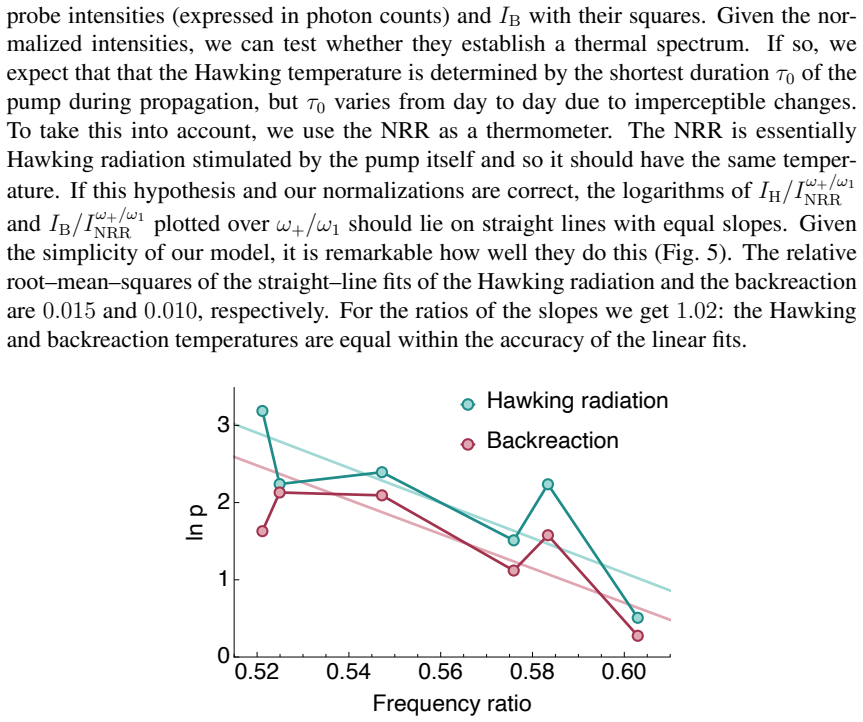
read the original abstract
Hawking radiation - the emission of quantum particles at the event horizon of a black hole - connects gravity with quantum mechanics and thermodynamics; the Bekenstein-Hawking entropy has been the benchmark for potential quantum theories of gravity. But Hawking radiation has never been observed in astronomy, only in laboratory analogues and the chances of ever observing it in space are astronomically small. The energy of Hawking radiation must come from the gravitational field around the black hole, but how field quanta generate Hawking quanta has been unknown. Here we report on experimental and theoretical evidence for the process that generates Hawking radiation in a fibre-optical analogue of the event horizon. There, as in gravity, it has been believed that Hawking radiation comes from a complicated, cascaded process; here we have found a simple, direct process and measured its backreaction on the field. Our findings suggest an equally direct process for other laboratory analogues and perhaps also for gravitational fields, shedding light on how black holes might radiate.
Editorial analysis
A structured set of objections, weighed in public.
Referee Report
Summary. The manuscript reports experimental and theoretical evidence for a simple, direct process generating Hawking radiation in a fibre-optical analogue of the event horizon, in contrast to the previously assumed cascaded process. It claims to have measured the backreaction of this stimulated Hawking radiation on the field and suggests the findings imply an equally direct process in other laboratory analogues and possibly gravitational fields.
Significance. If substantiated by the full methods and data, the identification of a direct generation process and its measured backreaction would clarify the energy extraction mechanism for Hawking radiation, a long-standing open question. This could strengthen the analogy between optical systems and gravitational horizons and offer testable predictions for other analogue setups. The experimental measurement of backreaction, if parameter-free or derived from first principles, would be a notable contribution.
minor comments (1)
- [Abstract] The abstract refers to 'experimental and theoretical evidence' but provides no quantitative details on the measured backreaction strength, error bars, or comparison to theoretical predictions; this should be expanded in the main text with specific figures or tables.
Simulated Author's Rebuttal
We thank the referee for their review of our manuscript. The recommendation of 'uncertain' appears to stem from the need for full methods and data to substantiate the claims regarding the direct process and measured backreaction. The manuscript includes the relevant experimental and theoretical details; we address the overall assessment below in the absence of enumerated major comments.
Circularity Check
No significant circularity identified
full rationale
The provided abstract and context contain no equations, modeling details, or derivation chains that can be inspected for reduction to inputs. The central claim rests on experimental measurement of backreaction in an optical analogue setup, which is presented as directly observable and externally falsifiable rather than derived from fitted parameters or self-citations. Without access to specific sections, equations, or cited prior work in the full manuscript, no load-bearing steps qualify as self-definitional, fitted-input predictions, or uniqueness imported from authors. The paper's findings are therefore treated as self-contained against external benchmarks.
Axiom & Free-Parameter Ledger
Reference graph
Works this paper leans on
-
[1]
Black hole explosions? Nature248, 30-31 (1974)
Hawking, S. Black hole explosions? Nature248, 30-31 (1974)
1974
-
[2]
& Spindel, P
Brout, R., Massar, S., Parentani, R. & Spindel, P. A primer for black hole quantum physics, Phys. Rep.260, 329-446 (1995)
1995
-
[3]
Bekenstein, J. D. Black holes and entropy. Phys. Rev. D7, 2333-2346 (1973)
1973
-
[4]
Helfer, A. D. Do black holes radiate? Rep. Prog. Phys.66, 943-1008 (2003)
2003
-
[5]
Polchinski, J String theory. V ol. 2: Superstring theory and beyond, chapter 14.8 (Cambridge University Press, Cambridge, 2007)
2007
-
[6]
W., Penrice, M
Weinfurtner, S., Tedford, E. W., Penrice, M. C. J., Unruh, W. G. & Lawrence, G. A. Measurement of stimulated Hawking emission in an analogue system. Phys. Rev. Lett.106, 021302 (2011)
2011
-
[7]
Euve, L.-P., Michel, F., Parentani, R., Philbin, T. G. & Rousseaux, G. Observation of noise correlated by the Hawking effect in a water tank. Phys. Rev. Lett.117, 121301 (2016)
2016
-
[8]
R., Golubkov, K., Kolobov, V
Munoz de Nova, J. R., Golubkov, K., Kolobov, V . I. et al. Observation of thermal Hawking radiation and its temperature in an analogue black hole. Nature569, 688- 691 (2019)
2019
-
[9]
& Leonhardt, U
Drori, J., Rosenberg, Y ., Bermudez, D., Silberberg, Y . & Leonhardt, U. Observation of Stimulated Hawking Radiation in an Optical Analogue, Phys. Rev. Lett.122, 010404 (2019)
2019
-
[10]
G., Kuklewicz, C., Robertson, S
Philbin, T. G., Kuklewicz, C., Robertson, S. et al. Fiber-optical analog of the event horizon. Science319, 1367-1370 (2008)
2008
-
[11]
Agullo, I., Brady, A. J. & Kranas, D. Quantum Aspects of Stimulated Hawking Radiation in an Optical Analog White-Black Hole Pair. Phys. Rev. Lett.128, 091301 (2022). 9
2022
-
[12]
Webb, K., Erkintalo, M., Xu, Y . et al. Nonlinear optics of fibre event horizons. Nat. Commun.5, 4969 (2014)
2014
-
[13]
S., Gerace, D., Carusotto, I
Nguyen, H. S., Gerace, D., Carusotto, I. et al. Acoustic black hole in a stationary hydrodynamic flow of microcavity polaritons. Phys. Rev. Lett.114, 036402 (2015)
2015
-
[14]
Viermann, C., Sparn, M., Liebster, N. et al. Quantum field simulator for dynamics in curved spacetime. Nature611, 260-264 (2022)
2022
-
[15]
et al., Analogue cosmological particle cre- ation in an ultracold quantum fluid of light, Nat
Steinhauer, J., Abuzarli, M., Aladjidi, T. et al., Analogue cosmological particle cre- ation in an ultracold quantum fluid of light, Nat. Commun.13, 2890 (2022)
2022
-
[16]
H., Yang, R
Shi, Y . H., Yang, R. Q., Xiang, Z. et al. Quantum simulation of Hawking radiation and curved spacetime with a superconducting on-chip black hole. Nat Commun14, 3263 (2023)
2023
-
[17]
Svancara, P., Smaniotto, P., Solidoro, L. et al. Rotating curved spacetime signatures from a giant quantum vortex. Nature628, 66-70 (2024)
2024
-
[18]
V olovik, G. E. The Universe in a Helium Droplet (Clarendon Press, Oxford, 2003)
2003
-
[19]
& Visser, M
Barcelo, C., Liberati, S. & Visser, M. Analogue Gravity. Living Rev. Relativity8, 12 (2005)
2005
-
[20]
Unruh, W. G. & Sch¨utzhold, R. (eds.). Quantum Analogues: From Phase Transitions to Black Holes and Cosmology (Springer, Berlin, 2007)
2007
-
[21]
& and Moschella, U
Faccio, D., Belgiorno, F., Cacciatori, S., Gorini, V ., Liberati, S. & and Moschella, U. (eds.) Analogue Gravity Phenomenology: Analogue Spacetimes and Horizons, from Theory to Experiment, Lecture Notes in Physics870(Springer, Cham, 2013)
2013
-
[22]
J., Weinfurtner, S
Jacquet, M. J., Weinfurtner, S. & K ¨onig, F. The next generation of analogue gravity experiments. Phil. Trans. Roy. Soc. A378, 20190239 (2019)
2019
-
[23]
Unruh, W. G. Experimental black-hole evaporation? Phys. Rev. Lett.46, 1351-1353 (1981)
1981
-
[24]
Agrawal, G. O. Nonlinear Fiber Optics (Academic, Oxford, 2019)
2019
-
[25]
Hamiltonian framework for short optical pulses, in Tobisch, E
Amiranashvili, S. Hamiltonian framework for short optical pulses, in Tobisch, E. (ed.), New approaches to nonlinear waves, Springer Lecture Notes in Physics908 pp. 153-196 (Springer, Cham, 2016)
2016
-
[26]
Modeling of ultrashort optical pulses in nonlinear fibers
Amiranashvili, S. Modeling of ultrashort optical pulses in nonlinear fibers. WIAS Preprint,2918, 1-81, (2022)
2022
-
[27]
Zakharov, V . E. & Kuznetsov, E. A. Hamiltonian formalism for nonlinear waves. Phys. Uspekhi40, 1087-1116 (1997)
1997
-
[28]
& Bermudez, D
Aguero-Santacruz, R. & Bermudez, D. Negative frequencies in pulse propagation equations and the double analytic signal. New J. Phys.25, 103045 (2023). 10
2023
-
[29]
Essential Quantum Optics: From Quantum Measurements to Black Holes, (Cambridge University Press, Cambridge, 2010)
Leonhardt, U. Essential Quantum Optics: From Quantum Measurements to Black Holes, (Cambridge University Press, Cambridge, 2010)
2010
-
[30]
Rubino, E., McLenaghan, J., Kehr, S. C. et al. Negative-Frequency Resonant Radi- ation. Phys. Rev. Lett.108, 253901 (2012)
2012
-
[31]
Conforti, M., Marini, A., Tran, T. X. et al. Interaction between optical fields and their conjugates in nonlinear media. Opt. Express21, 31239-31252 (2013)
2013
-
[32]
Unruh, W. G. Notes on black-hole evaporation. Phys. Rev. D.14, 870-892 (1976)
1976
-
[33]
Unruh, W. G. & Wald R. M. What happens when an accelerating observer detects a Rindler particle. Phys. Rev. D29, 1047-1056 (1984)
1984
-
[34]
& Leonhardt, U
Rosenberg, Y ., Drori, J., Bermudez, D. & Leonhardt, U. Boosting few-cycle soliton self-frequency shift using negative prechirp. Opt. Express28, 3107-3115 (2020)
2020
-
[35]
& Steinmeyer, G
Demircan, A., Amiranashvili, S. & Steinmeyer, G. Controlling light by light with an optical event horizon, Phys. Rev. Lett.106, 163901 (2011)
2011
-
[36]
& Steudel, H., Solitonen — Nichtlineare Strukturen (Wiley-VCH, 1991)
Meinel, G., Neugebauer, G. & Steudel, H., Solitonen — Nichtlineare Strukturen (Wiley-VCH, 1991)
1991
-
[37]
& Bermudez, D
Felipe-Elizarraras, R., Cruz-Ramirez, H., Garay-Palmett, K., U’Ren, A. & Bermudez, D. Measurement of analogue Hawking radiation stimulated by a single photon, Nat. Commun. (in press)
-
[38]
Pitaevskii L. P. & Stringari S. Bose-Einstein Condensation (Clarendon Press, Ox- ford, 2003)
2003
-
[39]
& Procopio, G
Balbinot, R., Fagnocchi, S., Fabbri, A. & Procopio, G. P. Backreaction in acoustic black holes. Phys. Rev. Lett.94, 161302 (2005)
2005
-
[40]
& Procopio, G
Balbinot, R., Fagnocchi, S., Fabbri, A. & Procopio, G. P. Quantum effects in acoustic black holes: The backreaction. Phys. Rev. D71, 064019 (2005)
2005
-
[41]
Baak, S.-S., Holanda Ribeiro, C. C. & Fischer, U. R. Number–conserving solution for dynamical quantum backreaction in a Bose–Einstein condensate. Phys. Rev. A 106, 053319 (2022)
2022
-
[42]
& Carusotto I
Butera S. & Carusotto I. Numerical Studies of Back Reaction Effects in an Analog Model of Cosmological Preheating. Phys. Rev. Lett.130, 241501 (2023)
2023
-
[43]
& Weinfurtner S
Patrick S., Gooding, C. & Weinfurtner S. Backreaction in an Analogue Black Hole Experiment. Phys. Rev. Lett.126, 041105 (2021)
2021
-
[44]
Marino, F., Maitland, C., V ocke, D. et al. Emergent geometries and nonlinear-wave dynamics in photon fluids. Sci. Rep.6, 23282 (2016)
2016
-
[45]
& Clarke, C
De Felice, F. & Clarke, C. J. S. Relativity on Curved Manifolds (Cambridge Univer- sity Press, Cambridge, 1990). 11
1990
-
[46]
& and Schutzhold, R
Maia, C. & and Schutzhold, R. Quantum toy model for black-hole backreaction. Phys. Rev. D76, 101502(R) (2007)
2007
-
[47]
M., Marino, F., Braunstein, S
Krauss, L. M., Marino, F., Braunstein, S. L. et al. Listening to Quantum Gravity? Int. J. Mod. Phys. D33, 2441006 (2024)
2024
-
[48]
Black holes and the information paradox
Susskind, L. Black holes and the information paradox. Sci. Am.276, 52-57 (1997)
1997
-
[49]
& Hsu, S
Calmet, X. & Hsu, S. D. H. A brief history of Hawking’s information paradox. Europhys. Lett.139, 49001 (2022)
2022
-
[50]
W., Perry, M
Haco, S., Hawking, S. W., Perry, M. J. & Strominger, A. Black hole entropy and soft hair. JHEP12, 098 (2018). 12 Methods A Unidirectional Hamiltonian We briefly sketch the Hamiltonian method 25,26 for nonlinear fibre optics 24. Our starting point is the one–dimensional wave equation for light with fixed transversal mode structure:(c 2∂2 z − n2 0∂2 t )E=∂ ...
2018
-
[51]
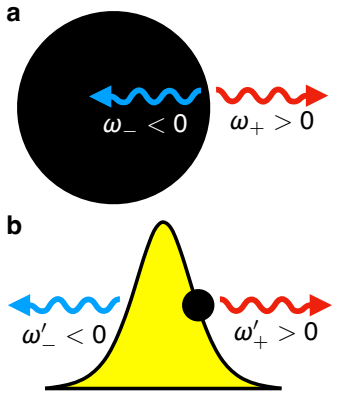
The resulting wave is the positive–frequency Hawking radiation (Fig. 1). Consider now the process with sub–HamiltonianH R ∝a ∗a(a∗2 +a 2)∼a ∗ 1a1(a∗2 2 +a 2 2)gen- eratingP NL = 2n0 δn a∗
-
[52]
The conjugate of the initiala 2 oscillates with negative co–moving fre- quency−ω ′ 2 and thus generates the Hawking partner with negative co–moving frequency (Fig. 1). In terms of the laboratory frequency, it corresponds toω− withω ′(ω−) =−ω ′(ω2). We will argue that forω 2 > ω h we should take the redshifted probe as initial wavea +. We thus have: i∂ζ −ω...
-
[53]
2a) and so cannot be excited
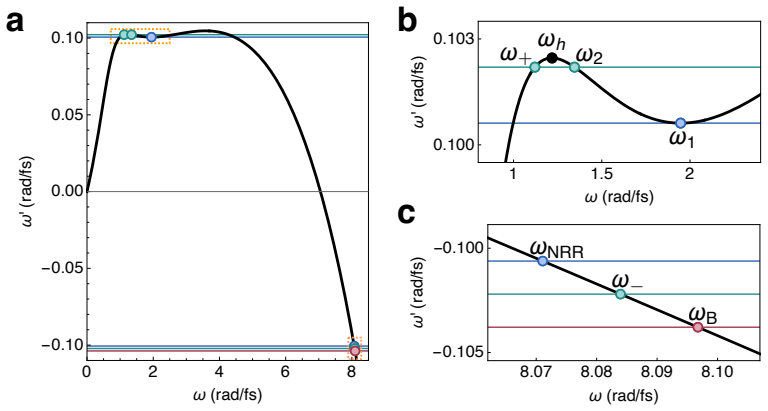
Thea 1a2 2 term oscillates with co–moving frequencyω ′ 1 + 2ω′ 2 that lies outside the dispersion curve (Fig. 2a) and so cannot be excited. Thea 1a∗2 2 term oscillates withω ′ 1 −2ω ′ 2 =−ω ′ 2 −δ ′ whereδ ′ =ω ′ 2 −ω ′ 1 and corresponds to a UV wave of slightly higher frequencyω B than the Hawking radiation (Fig. 2c). For calculating the amplitudeeaB we ...
-
[54]
We follow the same procedure as in Sec. B to derive for their Fourier–transformed amplitudes the equation: i∂ζ −ω ′ m eam + 2Ω cosδ ′ζ +∞X n=−∞ ean = ieg(C.1) whereegdescribes the sourceeg− of the Hawking radiation or the sourceeg B of the backreaction, respectively. The parameterΩis proportional to the Fourier transform of|a ∗ 1a2|atω m −ω n. As|a ∗ 1a2|...
-
[55]
Couairon, A. et. al. Practitioner’s guide to laser pulse propagation models and simulation. Europhys. J. Special Topics,199, 5–76 (2011)
2011
-
[56]
& Karlsson, M
Akhmediev, N. & Karlsson, M. Cherenkov radiation emitted by solitons in optical fibers. Phys. Rev. A,51, 2602–2607, (1995)
1995
-
[57]
Dudley, J. M. & Taylor, J. R.Supercontinuum generation in optical fibers. (Cambridge University Press, Cambridge, 2010). Acknowledgements We are grateful to S. Amiranashvili, U. Bandelow, H. Cohen, J. Drori, M. Gelvan, F. K ¨onig, Y . Rosenberg, S. Rotter, and most of all to the late Y . Silberberg for help, advice and scientific discussions. Funding L.M....
2010
discussion (0)
Sign in with ORCID, Apple, or X to comment. Anyone can read and Pith papers without signing in.