Beta-Particle Transport and Thermalization in Kilonova Ejecta with Detailed Atomic Microphysics
Pith reviewed 2026-07-02 07:06 UTC · model grok-4.3
The pith
Non-local beta-particle transport reduces thermalization efficiency in kilonova ejecta, lowering temperatures and ionization states.
A machine-rendered reading of the paper's core claim, the machinery that carries it, and where it could break.
Core claim
Using detailed atomic microphysics and a fully relativistic charged-particle transport code in spherically symmetric, homologously expanding ejecta under two limiting magnetic-field geometries, the calculation shows that non-local energy deposition and particle escape reduce thermalization efficiency, especially in the inner and outer ejecta, producing lower temperatures and ionization states than local-deposition approximations; Coulomb scattering offsets the reduction at some epochs, ionization by secondary electrons markedly increases the overall ionization rate, and the resulting efficiencies are distilled into analytic, spatially dependent prescriptions.
What carries the argument
Relativistic charged-particle transport framework in spherically symmetric homologously expanding ejecta under two limiting magnetic-field geometries, fed by per-species atomic data for deposition, scattering, and impact ionization.
If this is right
- Thermalization efficiency is lower than in local-deposition models and varies with depth in the ejecta.
- Ejecta temperature and ionization state are reduced compared with local-heating calculations.
- Ionization by secondary electrons significantly raises the total ionization rate.
- Coulomb scattering partially traps particles and offsets efficiency loss at intermediate times.
- Analytic prescriptions for the spatially dependent efficiency can be inserted directly into light-curve codes.
Where Pith is reading between the lines
- Previous kilonova models that assumed local beta heating likely overestimated temperatures and ionization in the inner and outer ejecta layers.
- The same transport treatment could be applied to alpha particles or other decay products to reduce similar uncertainties.
- Light-curve features sensitive to early or late heating might indirectly constrain the effective magnetic geometry once the prescriptions are adopted.
- The framework provides a template for treating charged-particle transport in other expanding astrophysical outflows.
Load-bearing premise
The two limiting magnetic-field geometries are assumed to bracket the range of realistic trapping and streaming behaviors inside the ejecta.
What would settle it
A measurement or simulation demonstrating that actual ejecta magnetic fields produce thermalization efficiencies lying well outside the range spanned by the two limiting geometries.
Figures
read the original abstract
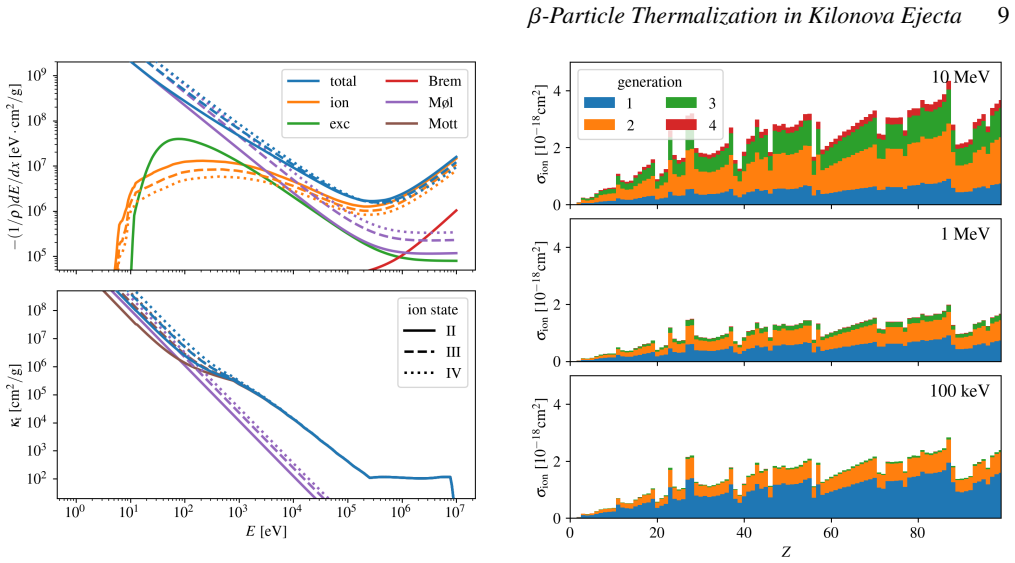
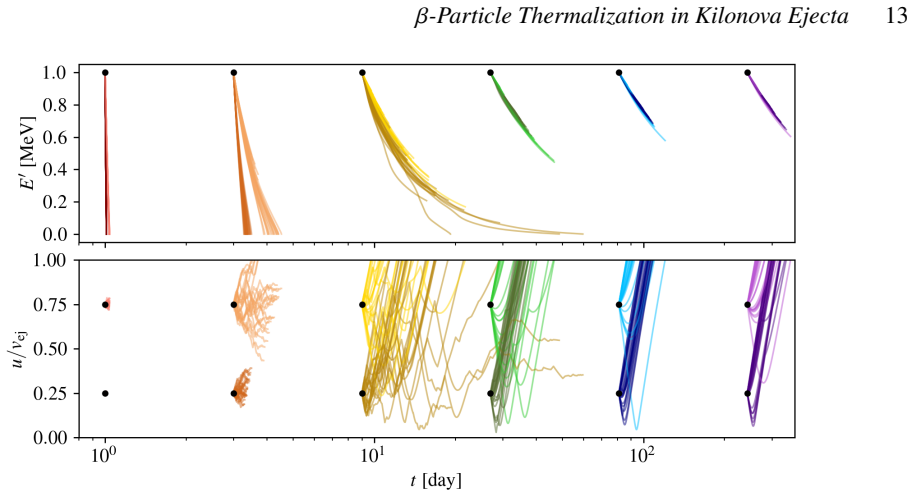
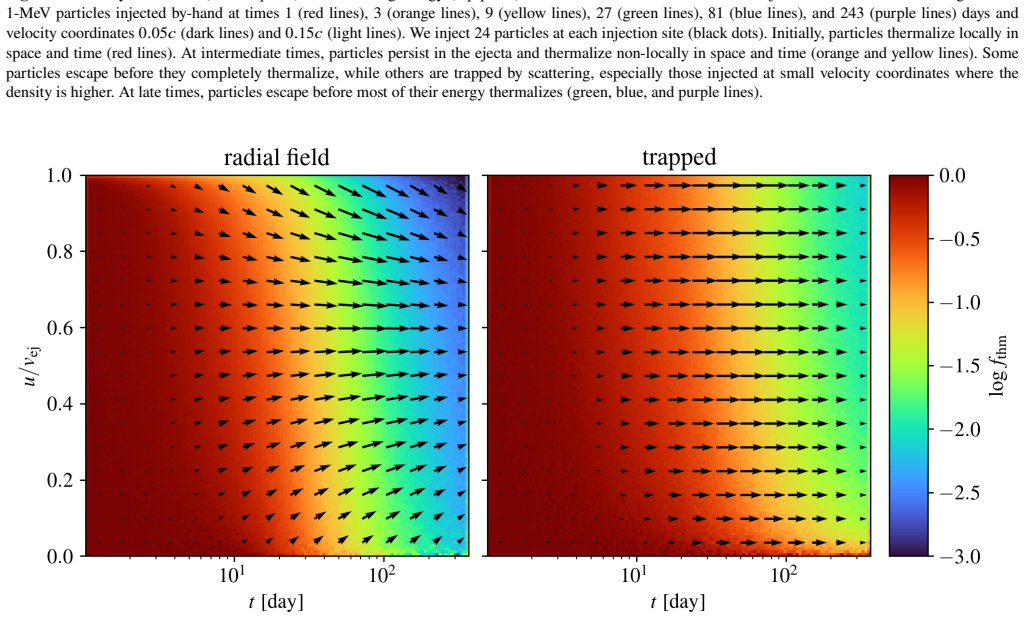
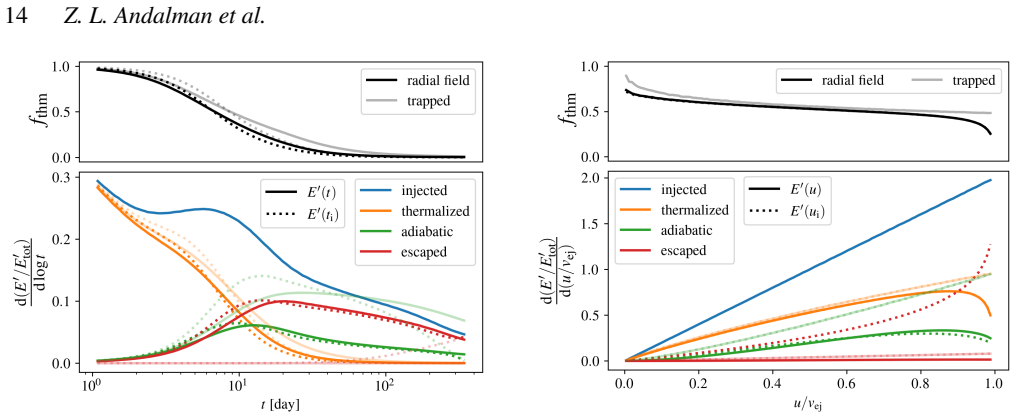
When two neutron stars collide, they eject material containing heavy nuclei formed by the rapid neutron capture process ($r$-process). As these nuclei decay, they power a bright optical/near-infrared transient known as a kilonova (KN). Modeling KN emission is a complex problem involving atomic opacities, radiation transport, and heating powered by the thermalization of radioactive decay products like $\gamma$-rays, $\alpha$-particles, and $\beta$-particles. For heating by $\gamma$-rays, many KN modeling codes do full radiation transport calculations. However, heating by $\alpha$- and $\beta$-particles relies on simplified descriptions of collisions and transport, and remains an important source of uncertainty in KN models. In this paper, we study the thermalization and transport of $\beta$-particles. To study thermalization, we use evaluated atomic physics data to estimate per-species contributions to energy deposition, scattering, and electron impact ionization, which we make available online. To include non-local effects, we develop a fully relativistic framework for charged particle transport in a spherically symmetric, homologously expanding ejecta, considering two limiting magnetic-field geometries. Non-local energy deposition and escape reduce thermalization efficiency, especially in the innermost and outermost ejecta, lowering the ejecta temperature and ionization state compared to local deposition models. Coulomb scattering partially offsets these effects by trapping particles at intermediate times. Ionization by secondary electrons significantly enhances the overall ionization rate. We provide analytic prescriptions for the spatially dependent thermalization efficiency for use in future light-curve calculations. Our results demonstrate that evaluated atomic data and charged-particle transport should be incorporated into the next generation of KN models.
Editorial analysis
A structured set of objections, weighed in public.
Referee Report
Summary. The manuscript develops a relativistic framework for β-particle transport and thermalization in spherically symmetric, homologously expanding kilonova ejecta. It incorporates evaluated atomic data for per-species energy deposition, scattering, and electron-impact ionization, considers two limiting magnetic-field geometries, and reports that non-local deposition plus escape lowers thermalization efficiency relative to local-heating approximations (especially in the innermost and outermost regions). Coulomb scattering is shown to provide partial compensation at intermediate times, secondary electrons enhance ionization rates, and analytic prescriptions for the spatially dependent efficiency are supplied for use in light-curve calculations.
Significance. If the transport results hold, the work supplies a concrete improvement over the simplified local-deposition treatments currently used for β-heating in kilonova models. The release of atomic data tables and the analytic efficiency prescriptions constitute reusable assets that can be directly implemented, strengthening the case for microphysical charged-particle transport in next-generation KN simulations. The finding that non-local effects alter temperature and ionization profiles is potentially important for interpreting multi-messenger observations.
major comments (3)
- [§3.2] §3.2 (Magnetic-field geometries): the assertion that the two limiting (radial and toroidal) configurations bracket realistic ejecta field structures is not supported by any quantitative mapping to MHD merger simulations; intermediate or stochastic topologies with finite correlation length could produce trapping times outside the reported range, directly affecting the efficiency curves in Figs. 8–10 and the analytic prescriptions derived from them.
- [§4.3] §4.3 and Eq. (17): the magnitude of the reduction in thermalization efficiency is presented as a numerical outcome, yet no error budget or sensitivity analysis is given for the relative contributions of non-local escape versus Coulomb scattering; without this, it is unclear whether the reported offset by Coulomb scattering is robust or an artifact of the chosen cross-section implementation.
- [§5] §5 (Analytic prescriptions): the fitting functions are calibrated exclusively to the two limiting geometries; if those geometries do not span the plausible range, the prescriptions cannot be used as drop-in replacements for local heating without additional validation against a broader set of field realizations.
minor comments (2)
- [Figure 3] Figure 3: the color scale for ionization rate enhancement is not labeled with units, making quantitative comparison with local models difficult.
- [§2.1] Notation in §2.1: the definition of the stopping power S(E) is introduced without an explicit reference to the atomic data source used for each r-process species.
Simulated Author's Rebuttal
We thank the referee for their careful reading and valuable comments on our manuscript. We address each of the major comments below and have updated the manuscript accordingly where revisions were warranted.
read point-by-point responses
-
Referee: [§3.2] the assertion that the two limiting (radial and toroidal) configurations bracket realistic ejecta field structures is not supported by any quantitative mapping to MHD merger simulations; intermediate or stochastic topologies with finite correlation length could produce trapping times outside the reported range, directly affecting the efficiency curves in Figs. 8–10 and the analytic prescriptions derived from them.
Authors: We agree that a quantitative mapping to MHD simulations would provide stronger support for the bracketing claim. In the revised manuscript, we have modified the discussion in §3.2 to clarify that the radial and toroidal geometries are idealized limiting cases chosen to explore the range of possible behaviors, rather than claiming they strictly bracket all realistic configurations. We note that intermediate topologies could indeed yield intermediate trapping times and have added a recommendation for future validation against specific MHD field realizations from merger simulations. This qualification does not alter the core results but improves the interpretation of the efficiency curves. revision: partial
-
Referee: [§4.3] the magnitude of the reduction in thermalization efficiency is presented as a numerical outcome, yet no error budget or sensitivity analysis is given for the relative contributions of non-local escape versus Coulomb scattering; without this, it is unclear whether the reported offset by Coulomb scattering is robust or an artifact of the chosen cross-section implementation.
Authors: We appreciate this point and have performed an additional sensitivity analysis to address it. In the revised §4.3, we now include an error budget by varying the Coulomb scattering cross-sections within published uncertainties and recomputing the thermalization efficiencies. The partial compensation by Coulomb scattering persists across the sensitivity tests, with variations in the efficiency offset remaining below 10%. We have also clarified the implementation details of the cross-sections to demonstrate robustness. revision: yes
-
Referee: [§5] the fitting functions are calibrated exclusively to the two limiting geometries; if those geometries do not span the plausible range, the prescriptions cannot be used as drop-in replacements for local heating without additional validation against a broader set of field realizations.
Authors: We concur that the prescriptions are tied to the geometries considered. In the updated §5, we have revised the text to explicitly state that the analytic fits are based on the radial and toroidal limits and should be applied with caution for other field structures. We provide guidance on when they may be used as approximations and suggest that users perform their own checks for specific MHD fields. This makes the prescriptions more responsibly presented for use in light-curve codes. revision: partial
Circularity Check
No significant circularity; derivation is self-contained
full rationale
The paper's central results on non-local beta-particle deposition and thermalization efficiency are obtained from a newly developed relativistic transport framework applied to a spherically symmetric homologous flow, using per-species atomic data drawn from evaluated external sources. No load-bearing equation reduces by construction to a fitted parameter or to a self-citation chain; the two limiting magnetic geometries are treated as explicit modeling choices rather than derived from the target observables. The analytic prescriptions for spatially dependent efficiency follow directly from the transport solutions and are independent of the kilonova light-curve predictions they are intended to inform.
Axiom & Free-Parameter Ledger
Reference graph
Works this paper leans on
-
[1]
Multi-messenger Observations of a Binary Neutron Star Merger
Multi-messenger Observations of a Binary Neutron Star Merger. , keywords =. doi:10.3847/2041-8213/aa91c9 , archivePrefix =. 1710.05833 , primaryClass =
work page internal anchor Pith review Pith/arXiv arXiv doi:10.3847/2041-8213/aa91c9 2041
-
[2]
A gravitational-wave standard siren measurement of the Hubble constant
A gravitational-wave standard siren measurement of the Hubble constant. , keywords =. doi:10.1038/nature24471 , archivePrefix =. 1710.05835 , primaryClass =
work page internal anchor Pith review Pith/arXiv arXiv doi:10.1038/nature24471
-
[3]
The population of merging compact binaries inferred using gravitational waves through GWTC-3
Population of Merging Compact Binaries Inferred Using Gravitational Waves through GWTC-3. Physical Review X , keywords =. doi:10.1103/PhysRevX.13.011048 , archivePrefix =. 2111.03634 , primaryClass =
work page internal anchor Pith review Pith/arXiv arXiv doi:10.1103/physrevx.13.011048
-
[4]
Cosmic-Ray Transport in Simulations of Star-forming Galactic Disks. , keywords =. doi:10.3847/1538-4357/ac1db2 , archivePrefix =. 2108.09356 , primaryClass =
-
[5]
The r-process of stellar nucleosynthesis: Astrophysics and nuclear physics achievements and mysteries. , keywords =. doi:10.1016/j.physrep.2007.06.002 , archivePrefix =. 0705.4512 , primaryClass =
work page internal anchor Pith review Pith/arXiv arXiv doi:10.1016/j.physrep.2007.06.002 2007
-
[6]
Late Time Optical Spectra from the Nickel(56) Model for Type I Supernovae
-
[7]
Cosmic ray transport in mixed magnetic fields and their role on the observed anisotropies. , keywords =. doi:10.1093/mnras/staa3500 , archivePrefix =. 2101.07759 , primaryClass =
-
[8]
Simulations of Early Kilonova Emission from Neutron Star Mergers. , keywords =. doi:10.3847/1538-4357/abae61 , archivePrefix =. 2008.05495 , primaryClass =
-
[9]
Opacity of the Highly Ionized Lanthanides and the Effect on the Early Kilonova. , keywords =. doi:10.3847/1538-4357/ac7565 , archivePrefix =. 2204.06861 , primaryClass =
-
[10]
Nebular spectra of kilonovae with detailed recombination rates -- I. Light r-process composition. arXiv e-prints , keywords =. doi:10.48550/arXiv.2501.18345 , archivePrefix =. 2501.18345 , primaryClass =
-
[11]
Effect of a High Opacity on the Light Curves of Radioactively Powered Transients from Compact Object Mergers. , keywords =. doi:10.1088/0004-637X/775/1/18 , archivePrefix =. 1303.5787 , primaryClass =
work page internal anchor Pith review Pith/arXiv arXiv doi:10.1088/0004-637x/775/1/18
-
[12]
Radioactivity and Thermalization in the Ejecta of Compact Object Mergers and Their Impact on Kilonova Light Curves. , keywords =. doi:10.3847/0004-637X/829/2/110 , archivePrefix =. 1605.07218 , primaryClass =
work page internal anchor Pith review Pith/arXiv arXiv doi:10.3847/0004-637x/829/2/110
-
[13]
Kilonovae Across the Nuclear Physics Landscape: The Impact of Nuclear Physics Uncertainties on r-process-powered Emission. , keywords =. doi:10.3847/1538-4357/ac0aec , archivePrefix =. 2010.11182 , primaryClass =
-
[14]
Systematics of Dynamical Mass Ejection, Nucleosynthesis, and Radioactively Powered Electromagnetic Signals from Neutron-star Mergers. , keywords =. doi:10.1088/0004-637X/773/1/78 , adsurl =
-
[15]
Annalen der Physik , year = 1930, month = jan, volume =
Zur Theorie des Durchgangs schneller Korpuskularstrahlen durch Materie. Annalen der Physik , year = 1930, month = jan, volume =. doi:10.1002/andp.19303970303 , adsurl =
-
[16]
Proceedings of the Royal Society of London Series A , year = 1934, month = aug, volume =
On the Stopping of Fast Particles and on the Creation of Positive Electrons. Proceedings of the Royal Society of London Series A , year = 1934, month = aug, volume =. doi:10.1098/rspa.1934.0140 , adsurl =
-
[17]
Evolution of Binary Compact Objects Which Merge
Evolution of Binary Compact Objects That Merge. , keywords =. doi:10.1086/306265 , archivePrefix =. astro-ph/9802084 , primaryClass =
work page internal anchor Pith review Pith/arXiv arXiv doi:10.1086/306265
-
[18]
Pitch angle diffusion in the Jovian magnetodisc. , keywords =. doi:10.1029/JA089iA05p02699 , adsurl =
-
[19]
Science with the Einstein Telescope: a comparison of different designs
Science with the Einstein Telescope: a comparison of different designs. , keywords =. doi:10.1088/1475-7516/2023/07/068 , archivePrefix =. 2303.15923 , primaryClass =
work page internal anchor Pith review Pith/arXiv arXiv doi:10.1088/1475-7516/2023/07/068 2023
-
[20]
Nonthermal Ionization of Kilonova Ejecta: Observable Impacts. , keywords =. doi:10.3847/1538-4357/ae1b8d , archivePrefix =. 2508.18364 , primaryClass =
-
[21]
Physics Letters A , year=
Superdiffusion in decoupled continuous time random walks , author=. Physics Letters A , year=
-
[22]
POSSIS: predicting spectra, light curves, and polarization for multidimensional models of supernovae and kilonovae. , keywords =. doi:10.1093/mnras/stz2495 , archivePrefix =. 1906.04205 , primaryClass =
-
[23]
The origin of polarization in kilonovae and the case of the gravitational-wave counterpart AT 2017gfo. Nature Astronomy , keywords =. doi:10.1038/s41550-018-0593-y , archivePrefix =. 1809.04078 , primaryClass =
work page internal anchor Pith review Pith/arXiv arXiv doi:10.1038/s41550-018-0593-y
-
[24]
Synthesis of the Elements in Stars. Reviews of Modern Physics , year = 1957, month = jan, volume =. doi:10.1103/RevModPhys.29.547 , adsurl =
-
[25]
Composition Effects on Kilonova Spectra and Light Curves. I. , keywords =. doi:10.3847/1538-4357/ab70b9 , archivePrefix =. 1904.13298 , primaryClass =
-
[26]
Faruk H. Bursal , abstract =. On interpolating between probability distributions , journal =. 1996 , issn =. doi:https://doi.org/10.1016/S0096-3003(95)00216-2 , url =
-
[27]
, year = 1957, month = jun, volume =
Nuclear Reactions in Stars and Nucleogenesis. , year = 1957, month = jun, volume =. doi:10.1086/127051 , adsurl =
-
[28]
Dynamics of baryon ejection in magnetar giant flares: implications for radio afterglows, r-process nucleosynthesis, and fast radio bursts. , keywords =. doi:10.1093/mnras/stae358 , archivePrefix =. 2311.05681 , primaryClass =
-
[29]
J. M. Chambers, C. L. Mallows and B. W. Stuck , title =. Journal of the American Statistical Association , volume =. 1976 , publisher =
1976
-
[30]
Updating Formulae and a Pairwise Algorithm for Computing Sample Variances , author =
-
[31]
Positrons from Supernovae. , keywords =. doi:10.1086/172393 , adsurl =
-
[32]
Non-LTE Ionization Modeling for Helium and Strontium in Neutron Star Merger Ejecta
Non-LTE Ionization Modeling for Helium and Strontium in Neutron Star Merger Ejecta. arXiv e-prints , keywords =. doi:10.48550/arXiv.2604.05703 , archivePrefix =. 2604.05703 , primaryClass =
work page internal anchor Pith review Pith/arXiv arXiv doi:10.48550/arxiv.2604.05703
-
[33]
Formation and evolution of binary neutron stars: mergers and their host galaxies. , keywords =. doi:10.1093/mnras/stab2882 , archivePrefix =. 2110.04687 , primaryClass =
-
[34]
Radiation in a Plasma. I. C erenkov Effect. Physical Review , year = 1961, month = aug, volume =. doi:10.1103/PhysRev.123.711 , adsurl =
-
[35]
1971 , publisher=
Concepts of Nuclear Physics , author=. 1971 , publisher=
1971
-
[36]
The luminosity of type I supernovae. , keywords =. doi:10.1086/183239 , adsurl =
-
[37]
The Origin of r-Process Elements in the Milky Way
The Origin of r-process Elements in the Milky Way. , keywords =. doi:10.3847/1538-4357/aaad67 , archivePrefix =. 1710.05875 , primaryClass =
work page internal anchor Pith review Pith/arXiv arXiv doi:10.3847/1538-4357/aaad67
-
[38]
The theory of atomic structure and spectra
-
[39]
Reviews of Modern Physics , keywords =
Origin of the heaviest elements: The rapid neutron-capture process. Reviews of Modern Physics , keywords =. doi:10.1103/RevModPhys.93.015002 , archivePrefix =. 1901.01410 , primaryClass =
-
[40]
The Electromagnetic Counterpart of the Binary Neutron Star Merger LIGO/Virgo GW170817. II. UV, Optical, and Near-infrared Light Curves and Comparison to Kilonova Models. , keywords =. doi:10.3847/2041-8213/aa8fc7 , archivePrefix =. 1710.05840 , primaryClass =
work page internal anchor Pith review Pith/arXiv arXiv doi:10.3847/2041-8213/aa8fc7 2041
-
[41]
Cullen, D. E. A Survey of Electron Cross Section Data for use in EPICS 2017. 2017
2017
-
[42]
Cullen, D. E. A Survey of Photon Cross Section Data for use in EPICS 2017. 2018
2017
-
[43]
Lisandro Dalcín and Rodrigo Paz and Mario Storti , keywords =. MPI for Python , journal =. 2005 , issn =. doi:https://doi.org/10.1016/j.jpdc.2005.03.010 , url =
-
[44]
Delzanno, G. L. and Roytershteyn, V. , title =. Journal of Geophysical Research: Space Physics , volume =. doi:https://doi.org/10.1029/2019JA027046 , url =. https://agupubs.onlinelibrary.wiley.com/doi/pdf/10.1029/2019JA027046 , abstract =
-
[45]
Merger Rates of Double Neutron Stars and Stellar Origin Black Holes: The Impact of Initial Conditions on Binary Evolution Predictions. , keywords =. doi:10.1088/0004-637X/814/1/58 , archivePrefix =. 1506.03573 , primaryClass =
work page internal anchor Pith review Pith/arXiv arXiv doi:10.1088/0004-637x/814/1/58
-
[46]
Neutrino signatures and the neutrino-driven wind in Binary Neutron Star Mergers
Neutrino Signatures and the Neutrino-Driven Wind in Binary Neutron Star Mergers. , keywords =. doi:10.1088/0004-637X/690/2/1681 , archivePrefix =. 0806.4380 , primaryClass =
work page internal anchor Pith review Pith/arXiv arXiv doi:10.1088/0004-637x/690/2/1681
-
[47]
Australian Journal of Physics , keywords =
Magnetic fields in supernova remnants. Australian Journal of Physics , keywords =. doi:10.1071/PH760435 , adsurl =
-
[48]
Double Compact Objects. I. The Significance of the Common Envelope on Merger Rates. , keywords =. doi:10.1088/0004-637X/759/1/52 , archivePrefix =. 1202.4901 , primaryClass =
work page internal anchor Pith review Pith/arXiv arXiv doi:10.1088/0004-637x/759/1/52
-
[49]
Double Compact Objects. II. Cosmological Merger Rates. , keywords =. doi:10.1088/0004-637X/779/1/72 , archivePrefix =. 1308.1546 , primaryClass =
work page internal anchor Pith review Pith/arXiv arXiv doi:10.1088/0004-637x/779/1/72
-
[50]
Double Compact Objects III: Gravitational Wave Detection Rates
Double Compact Objects III: Gravitational-wave Detection Rates. , keywords =. doi:10.1088/0004-637X/806/2/263 , archivePrefix =. 1405.7016 , primaryClass =
work page internal anchor Pith review Pith/arXiv arXiv doi:10.1088/0004-637x/806/2/263
-
[51]
Light Curves of the Neutron Star Merger GW170817/SSS17a: Implications for R-Process Nucleosynthesis
Light curves of the neutron star merger GW170817/SSS17a: Implications for r-process nucleosynthesis. Science , keywords =. doi:10.1126/science.aaq0049 , archivePrefix =. 1710.05443 , primaryClass =
work page internal anchor Pith review Pith/arXiv arXiv doi:10.1126/science.aaq0049
-
[52]
The Progenitor and Central Engine of a Peculiar GRB 230307A. , keywords =. doi:10.3847/2041-8213/ad22e2 , archivePrefix =. 2402.10587 , primaryClass =
-
[53]
Radio emission from Supernova Remnants
Radio emission from supernova remnants. , keywords =. doi:10.1007/s00159-015-0083-5 , archivePrefix =. 1508.07294 , primaryClass =
work page internal anchor Pith review Pith/arXiv arXiv doi:10.1007/s00159-015-0083-5
-
[54]
The Dynamics of Charged Particles in Turbulent Astrophysical Plasmas. , keywords =. doi:10.1086/173670 , adsurl =
-
[55]
Nucleosynthesis, neutrino bursts and -rays from coalescing neutron stars. , keywords =. doi:10.1038/340126a0 , adsurl =
-
[56]
Fast Magnetic Reconnection and Spontaneous Stochasticity
Fast Magnetic Reconnection and Spontaneous Stochasticity. , keywords =. doi:10.1088/0004-637X/743/1/51 , archivePrefix =. 1103.1882 , primaryClass =
work page internal anchor Pith review Pith/arXiv arXiv doi:10.1088/0004-637x/743/1/51
-
[57]
W.M. Farrell and C.K. Goertz , abstract =. The coherent Cerenkov radiated power from a group of field-aligned test particles in a magnetoplasma , journal =. 1990 , issn =. doi:https://doi.org/10.1016/0032-0633(90)90103-W , url =
-
[58]
arXiv e-prints , keywords =
Effects of magnetically driven shocks on nucleosynthesis and kilonovae from neutron star mergers. arXiv e-prints , keywords =
-
[59]
An Exploration of Recombination of Uranium with application to Kilonovae Spectra
An Exploration of Recombination of Uranium with application to Kilonovae Spectra. arXiv e-prints , keywords =. doi:10.48550/arXiv.2606.11748 , archivePrefix =. 2606.11748 , primaryClass =
work page internal anchor Pith review Pith/arXiv arXiv doi:10.48550/arxiv.2606.11748
-
[60]
Versuch einer Theorie der -Strahlen. I. Zeitschrift fur Physik , year = 1934, month = mar, volume =. doi:10.1007/BF01351864 , adsurl =
-
[61]
Electron-Ion and Ion-Ion Recombination
Flannery, M. Electron-Ion and Ion-Ion Recombination. Springer Handbook of Atomic, Molecular, and Optical Physics. 2006. doi:10.1007/978-0-387-26308-3_54
-
[62]
The Locations of Short Gamma-ray Bursts as Evidence for Compact Object Binary Progenitors
The Locations of Short Gamma-Ray Bursts as Evidence for Compact Object Binary Progenitors. , keywords =. doi:10.1088/0004-637X/776/1/18 , archivePrefix =. 1307.0819 , primaryClass =
work page internal anchor Pith review Pith/arXiv arXiv doi:10.1088/0004-637x/776/1/18
-
[63]
Short GRB Host Galaxies. I. Photometric and Spectroscopic Catalogs, Host Associations, and Galactocentric Offsets. , keywords =. doi:10.3847/1538-4357/ac91d0 , archivePrefix =. 2206.01763 , primaryClass =
-
[64]
The Los Alamos suite of relativistic atomic physics codes. Journal of Physics B Atomic Molecular Physics , year = 2015, month = jul, volume = 48, number = 14, eid =. doi:10.1088/0953-4075/48/14/144014 , adsurl =
-
[65]
A line-binned treatment of opacities for the spectra and light curves from neutron star mergers. , keywords =. doi:10.1093/mnras/staa485 , archivePrefix =. 1904.08781 , primaryClass =
-
[66]
A comparison of three neodymium atomic data sets for kilonova modeling
A Comparison of Three Neodymium Atomic Data Sets for Kilonova Modeling. , keywords =. doi:10.3847/1538-4357/ae5bfe , archivePrefix =. 2604.04362 , primaryClass =
work page internal anchor Pith review Pith/arXiv arXiv doi:10.3847/1538-4357/ae5bfe
-
[67]
R-Process in Neutron Star Mergers. , keywords =. doi:10.1086/312343 , adsurl =
-
[68]
Formation Rates of Black Hole Accretion Disk Gamma-Ray Bursts
Formation Rates of Black Hole Accretion Disk Gamma-Ray Bursts. , keywords =. doi:10.1086/307992 , archivePrefix =. astro-ph/9904122 , primaryClass =
work page internal anchor Pith review Pith/arXiv arXiv doi:10.1086/307992
-
[69]
Supernova Fallback: A Possible Site for the r-Process
Supernova Fallback: A Possible Site for the r-Process. , keywords =. doi:10.1086/507071 , archivePrefix =. astro-ph/0606450 , primaryClass =
work page internal anchor Pith review Pith/arXiv arXiv doi:10.1086/507071
-
[70]
The Effect of the Velocity Distribution on Kilonova Emission. , keywords =. doi:10.3847/1538-4357/ad1036 , archivePrefix =. 2311.05005 , primaryClass =
-
[71]
Constraints on the presence of platinum and gold in the spectra of the kilonova AT2017gfo. , keywords =. doi:10.1093/mnras/stab1861 , archivePrefix =. 2101.08271 , primaryClass =
-
[72]
Heavy element nucleosynthesis associated with a gamma-ray burst. arXiv e-prints , keywords =. doi:10.48550/arXiv.2308.00633 , archivePrefix =. 2308.00633 , primaryClass =
-
[73]
Toward a Theory of Interstellar Turbulence. II. Strong Alfvenic Turbulence. , keywords =. doi:10.1086/175121 , adsurl =
-
[74]
Magnetohydrodynamic Turbulence Revisited. , keywords =. doi:10.1086/304442 , archivePrefix =. astro-ph/9612243 , primaryClass =
work page internal anchor Pith review Pith/arXiv arXiv doi:10.1086/304442
-
[75]
2011, ApJL, 738, L32, doi: 10.1088/2041-8205/738/2/L32
r-process Nucleosynthesis in Dynamically Ejected Matter of Neutron Star Mergers. , keywords =. doi:10.1088/2041-8205/738/2/L32 , adsurl =
-
[76]
The long-term evolution of neutron star merger remnants - II. Radioactively powered transients
The long-term evolution of neutron star merger remnants - II. Radioactively powered transients. , keywords =. doi:10.1093/mnras/stt2503 , archivePrefix =. 1307.2943 , primaryClass =
work page internal anchor Pith review Pith/arXiv arXiv doi:10.1093/mnras/stt2503
-
[77]
An Ordinary Short Gamma-Ray Burst with Extraordinary Implications: Fermi-GBM Detection of GRB 170817A. , keywords =. doi:10.3847/2041-8213/aa8f41 , archivePrefix =. 1710.05446 , primaryClass =
work page internal anchor Pith review Pith/arXiv arXiv doi:10.3847/2041-8213/aa8f41 2041
-
[78]
Classical and Quantum Gravity , keywords =
Characterizing gravitational wave detector networks: from A<inline-formula> </inline-formula> to cosmic explorer. Classical and Quantum Gravity , keywords =. doi:10.1088/1361-6382/ad7b99 , archivePrefix =. 2307.10421 , primaryClass =
-
[79]
Radiation from pulsed electron beams in space plasmas. Radio Science , keywords =. doi:10.1029/RS019i002p00454 , adsurl =
-
[80]
Type Ia Supernova Explosion Models
Type IA Supernova Explosion Models. , keywords =. doi:10.1146/annurev.astro.38.1.191 , archivePrefix =. astro-ph/0006305 , primaryClass =
work page internal anchor Pith review Pith/arXiv arXiv doi:10.1146/annurev.astro.38.1.191
discussion (0)
Sign in with ORCID, Apple, or X to comment. Anyone can read and Pith papers without signing in.