Microscopic origins of inertial magnetization dynamics
Pith reviewed 2026-07-03 19:23 UTC · model grok-4.3
The pith
Inertial magnetization dynamics arise from coherent magnon-phonon interactions in the lattice.
A machine-rendered reading of the paper's core claim, the machinery that carries it, and where it could break.
Core claim
Using a non-Markovian quantum master equation we show that inertial dynamics arise from coherent interactions with optical phonons in the lattice. The fast optical frequency explains the nutation observed on picosecond timescales and accounts for variations between experiments through substrate-dependent phonon damping. By establishing magnon-phonon coupling as the microscopic basis of inertial magnetization, our results open new pathways for tailoring ultrafast spin dynamics and controlling magnetic states at terahertz frequencies.
What carries the argument
non-Markovian quantum master equation capturing coherent magnon-phonon interactions
If this is right
- Nutation occurs on picosecond timescales set by optical phonon frequencies.
- Experimental differences arise from substrate-dependent phonon damping rates.
- Ultrafast spin dynamics can be tailored through lattice interactions.
- Magnetic states become controllable at terahertz frequencies via the same coupling.
Where Pith is reading between the lines
- Lattice engineering to select specific phonon modes could enhance or suppress the inertial response.
- The mechanism may apply to other ordered spin systems where magnon-phonon overlap exists.
- Phonon damping offers an external knob for tuning the strength of inertial effects.
Load-bearing premise
The non-Markovian quantum master equation accurately captures the dominant coherent magnon-phonon interactions and other mechanisms do not contribute substantially to the inertial response.
What would settle it
An observation that inertial magnetization dynamics persist at the same strength in a system engineered to have negligible magnon-phonon coupling, or a measured nutation frequency that fails to match the material's optical phonon frequency.
Figures
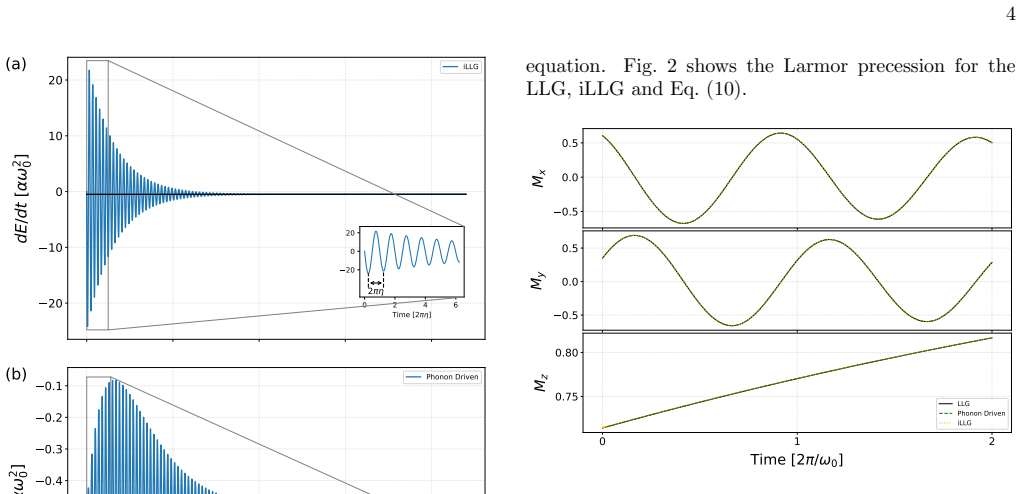


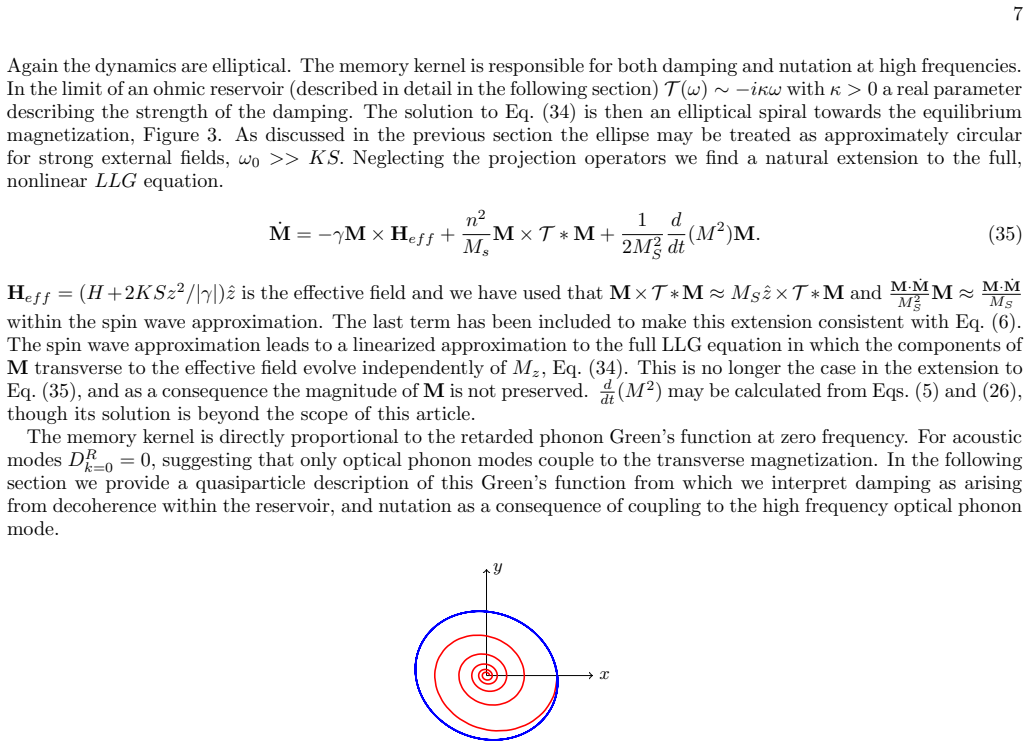
read the original abstract
Ultrafast experiments have uncovered inertial magnetization dynamics in ferromagnets, but their microscopic origin remains elusive. Using a non-Markovian quantum master equation we show that inertial dynamics arise from coherent interactions with optical phonons in the lattice. The fast optical frequency explains the nutation observed on picosecond timescales and accounts for variations between experiments through substrate-dependent phonon damping. By establishing magnon{phonon coupling as the microscopic basis of inertial magnetization, our results open new pathways for tailoring ultrafast spin dynamics and controlling magnetic states at terahertz frequencies.
Editorial analysis
A structured set of objections, weighed in public.
Referee Report
Summary. The manuscript claims that inertial magnetization dynamics in ferromagnets originate from coherent magnon-optical phonon interactions, derived via a non-Markovian quantum master equation. The optical phonon frequency accounts for observed picosecond-scale nutation, while substrate-dependent phonon damping explains variations across experiments.
Significance. If the central derivation holds and the mechanism is shown to be dominant, the work supplies a microscopic basis for inertial effects and suggests routes to THz-frequency spin control via lattice engineering. The non-Markovian QME framework is a constructive choice for capturing coherent dynamics, though its isolation from competing channels remains to be verified.
major comments (2)
- [§3 (master-equation derivation)] The non-Markovian QME derivation (assumed §3 or equivalent) does not contain an explicit check that the inertial term disappears when the optical-phonon bath is removed while retaining other couplings or Markovian limits; without this, the claim that magnon-phonon coupling is the dominant source cannot be isolated from alternative mechanisms.
- [§5 (comparison to experiment)] Substrate-dependent phonon damping rates are invoked to fit experimental scatter, yet no independent calculation, measurement, or sensitivity analysis of these rates is supplied; this leaves open the possibility of post-hoc adjustment rather than predictive use of the model.
minor comments (2)
- Notation for the bath spectral density and coupling operators should be defined once at first use and used consistently thereafter.
- Figure captions could explicitly state the parameter values employed for the phonon damping in each substrate case.
Simulated Author's Rebuttal
We thank the referee for the constructive and detailed comments. These points help clarify the isolation of the proposed mechanism and the predictive aspects of the model. We address each major comment below and indicate the revisions we will make.
read point-by-point responses
-
Referee: [§3 (master-equation derivation)] The non-Markovian QME derivation (assumed §3 or equivalent) does not contain an explicit check that the inertial term disappears when the optical-phonon bath is removed while retaining other couplings or Markovian limits; without this, the claim that magnon-phonon coupling is the dominant source cannot be isolated from alternative mechanisms.
Authors: We agree that an explicit check is necessary to isolate the contribution. In the revised manuscript we will add a dedicated subsection to §3 that demonstrates the inertial term vanishes when the optical-phonon coupling is removed (while retaining other possible system-bath interactions) and also in the Markovian limit. This will be shown both analytically and numerically, thereby confirming that the inertial dynamics originate specifically from the coherent magnon-optical phonon interaction. revision: yes
-
Referee: [§5 (comparison to experiment)] Substrate-dependent phonon damping rates are invoked to fit experimental scatter, yet no independent calculation, measurement, or sensitivity analysis of these rates is supplied; this leaves open the possibility of post-hoc adjustment rather than predictive use of the model.
Authors: The damping rates are taken directly from published experimental values for the respective substrates rather than being adjusted to match the magnetization dynamics. In the revised manuscript we will add an explicit sensitivity analysis (new figure or table in §5 and the supplement) showing how the nutation frequency and damping vary with phonon damping rates within the experimentally reported ranges. We acknowledge that first-principles calculations of substrate-specific phonon lifetimes lie outside the scope of the present work; we will cite the literature sources more prominently to clarify that the rates are not fitted parameters. revision: partial
Circularity Check
No circularity: derivation from non-Markovian QME presented as independent of fitted outputs
full rationale
The abstract states that a non-Markovian quantum master equation is used to show inertial dynamics arise from coherent magnon-phonon interactions, with optical frequency explaining nutation and substrate-dependent damping accounting for variations. No equations, self-citations, or parameter-fitting steps are visible in the provided text that would reduce the claimed origin to a definition or post-hoc fit by construction. The central claim rests on the master equation isolating the phonon channel, but without quoted reductions or load-bearing self-citations in the available material, the derivation chain does not exhibit the enumerated circular patterns. This is the expected honest non-finding when source text supplies no explicit self-referential steps.
Axiom & Free-Parameter Ledger
free parameters (1)
- phonon damping rates
axioms (1)
- domain assumption Non-Markovian quantum master equation is valid and sufficient for the magnon-phonon system in ferromagnets.
Reference graph
Works this paper leans on
-
[1]
In order for the weak cou- pling assumption to hold in Eq. (3) we require that the system dynamics are not strongly hybridized with the reservoir at the frequencyω=ω 0, which will be be sat- isfied for|V 0|2 < ω 0Ω0. At the upper limit of the cou- pling strength, then, the predicted amplitudes scale as |∆θ| ∼(|∆θ| iLLG)2 ∼(ω 0/Ω0)2. At this limit of the G...
-
[2]
T. Gilbert, Classics in Magnetics A Phenomenological Theory of Damping in Ferromagnetic Materials, IEEE Transactions on Magnetics40, 3443 (2004)
work page 2004
-
[3]
A. A. Thiele, On the momentum of ferromagnetic do- mains, Journal of Applied Physics47, 2759 (1976)
work page 1976
-
[4]
K. Neeraj, N. Awari, S. Kovalev, D. Polley, N. Zhou Hagstr¨ om, S. S. P. K. Arekapudi, A. Semisalova, K. Lenz, B. Green, J.-C. Deinert, I. Ilyakov, M. Chen, M. Bawatna, V. Scalera, M. d’Aquino, C. Serpico, O. Hellwig, J.-E. Wegrowe, M. Gensch, and S. Bonetti, Inertial spin dynamics in ferromagnets, Nature Physics 17, 245 (2021)
work page 2021
-
[5]
Y. Li, V. Naletov, O. Klein, J. Prieto, M. Mu˜ noz, V. Cros, P. Bortolotti, A. Anane, C. Serpico, and G. De Loubens, Nutation Spectroscopy of a Nanomagnet Driven into Deeply Nonlinear Ferromagnetic Resonance, Physical Review X9, 041036 (2019)
work page 2019
-
[6]
A. De, J. Schlegel, A. Lentfert, L. Scheuer, B. Stadtm¨ uller, P. Pirro, G. Von Freymann, U. Nowak, and M. Aeschlimann, Magnetic nutation: Transient sep- aration of magnetization from its angular momentum, Physical Review B111, 014432 (2025)
work page 2025
-
[7]
E. Beaurepaire, J.-C. Merle, A. Daunois, and J.-Y. Bigot, Ultrafast Spin Dynamics in Ferromagnetic Nickel, Phys- ical Review Letters76, 4250 (1996)
work page 1996
-
[8]
A. V. Kimel, A. Kirilyuk, P. A. Usachev, R. V. Pisarev, A. M. Balbashov, and T. Rasing, Ultrafast non-thermal control of magnetization by instantaneous photomagnetic pulses, Nature435, 655 (2005)
work page 2005
-
[9]
C. D. Stanciu, F. Hansteen, A. V. Kimel, A. Kirilyuk, A. Tsukamoto, A. Itoh, and T. Rasing, All-Optical Mag- netic Recording with Circularly Polarized Light, Physical Review Letters99, 047601 (2007)
work page 2007
-
[10]
V. Unikandanunni, R. Medapalli, M. Asa, E. Albisetti, D. Petti, R. Bertacco, E. E. Fullerton, and S. Bonetti, In- ertial Spin Dynamics in Epitaxial Cobalt Films, Physical Review Letters129, 237201 (2022)
work page 2022
-
[11]
J.-E. Wegrowe and M.-C. Ciornei, Magnetization dynam- ics, gyromagnetic relation, and inertial effects, American Journal of Physics80, 607 (2012)
work page 2012
-
[12]
M.-C. Ciornei, J. M. Rub´ ı, and J.-E. Wegrowe, Magne- tization dynamics in the inertial regime: Nutation pre- dicted at short time scales, Physical Review B83, 020410 (2011)
work page 2011
-
[13]
S. Bhattacharjee, L. Nordstr¨ om, and J. Fransson, Atom- istic Spin Dynamic Method with both Damping and Mo- ment of Inertia Effects Included from First Principles, Physical Review Letters108, 057204 (2012)
work page 2012
-
[14]
D. B¨ ottcher and J. Henk, Significance of nutation in mag- netization dynamics of nanostructures, Physical Review B86, 020404 (2012)
work page 2012
-
[15]
R. Bastardis, F. Vernay, and H. Kachkachi, Magnetiza- tion nutation induced by surface effects in nanomagnets, Physical Review B98, 165444 (2018)
work page 2018
- [16]
-
[17]
M. G. Quarenta, M. Tharmalingam, T. Ludwig, H. Yuan, L. Karwacki, R. C. Verstraten, and R. A. Duine, Bath- Induced Spin Inertia, Physical Review Letters133, 136701 (2024)
work page 2024
-
[18]
Suhl, Theory of the magnetic damping constant, IEEE Transactions on Magnetics34, 1834 (1998)
H. Suhl, Theory of the magnetic damping constant, IEEE Transactions on Magnetics34, 1834 (1998)
work page 1998
- [19]
- [21]
-
[22]
A. Norambuena, A. Franco, and R. Coto, From the open generalized Heisenberg model to the Landau–Lifshitz equation, New Journal of Physics22, 103029 (2020)
work page 2020
-
[23]
T. Yildirim, A. B. Harris, A. Aharony, and O. Entin- Wohlman, Anisotropic spin Hamiltonians due to spin- orbit and Coulomb exchange interactions, Physical Re- view B52, 10239 (1995)
work page 1995
-
[25]
H. B. Callen, A ferromagnetic dynamical equation, Jour- nal of Physics and Chemistry of Solids4, 256 (1958)
work page 1958
-
[27]
H. Grabert,Projection operator techniques in nonequi- librium statistical mechanics, Springer tracts in modern physics No. 95 (Springer, Berlin Heidelberg New York, 1982)
work page 1982
-
[29]
A. Caldeira and A. Leggett, Path integral approach to quantum Brownian motion, Physica A: Statistical Me- chanics and its Applications121, 587 (1983)
work page 1983
-
[30]
A. Brataas, Y. Tserkovnyak, and G. E. W. Bauer, Scat- tering Theory of Gilbert Damping, Physical Review Let- ters101, 037207 (2008)
work page 2008
-
[31]
K. Gilmore, Y. U. Idzerda, and M. D. Stiles, Identifica- tion of the Dominant Precession-Damping Mechanism in Fe, Co, and Ni by First-Principles Calculations, Physical 6 Review Letters99, 027204 (2007)
work page 2007
-
[32]
V. Kambersk´ y, On ferromagnetic resonance damping in metals, Czechoslovak Journal of Physics26, 1366 (1976)
work page 1976
-
[33]
M. C. Hickey and J. S. Moodera, Origin of Intrinsic Gilbert Damping, Physical Review Letters102, 137601 (2009)
work page 2009
-
[34]
A. Kirilyuk, A. V. Kimel, and T. Rasing, Ultrafast opti- cal manipulation of magnetic order, Reviews of Modern Physics82, 2731 (2010)
work page 2010
-
[35]
D. A. Garanin, Fokker-Planck and Landau-Lifshitz-Bloch equations for classical ferromagnets, Physical Review B 55, 3050 (1997)
work page 1997
- [36]
-
[37]
M. F¨ ahnle, D. Steiauf, and C. Illg, Generalized Gilbert equation including inertial damping: Derivation from an extended breathing Fermi surface model, Physical Re- view B84, 172403 (2011). 1 I. MAGNON PICTURE The magnetization of a sample is a classical, macroscopic vector which, however, emerges from the individual, quantum spins on each site. The dyn...
work page 2011
-
[38]
H. B. Callen, A ferromagnetic dynamical equation, Journal of Physics and Chemistry of Solids4, 256 (1958). 10
work page 1958
- [39]
-
[40]
A. R¨ uckriegel, P. Kopietz, D. A. Bozhko, A. A. Serga, and B. Hillebrands, Magnetoelastic modes and lifetime of magnons in thin yttrium iron garnet films, Physical Review B89, 184413 (2014)
work page 2014
- [41]
-
[42]
T. Yildirim, A. B. Harris, A. Aharony, and O. Entin-Wohlman, Anisotropic spin Hamiltonians due to spin-orbit and Coulomb exchange interactions, Physical Review B52, 10239 (1995)
work page 1995
-
[43]
Moriya, Anisotropic Superexchange Interaction and Weak Ferromagnetism, Physical Review120, 91 (1960)
T. Moriya, Anisotropic Superexchange Interaction and Weak Ferromagnetism, Physical Review120, 91 (1960)
work page 1960
-
[44]
R. M. White,Quantum Theory of Magnetism, edited by M. Cardona, P. Fulde, and H.-J. Queisser, Springer Series in Solid-State Sciences, Vol. 32 (Springer Berlin Heidelberg, Berlin, Heidelberg, 1983)
work page 1983
-
[45]
P. Bruno, Tight-binding approach to the orbital magnetic moment and magnetocrystalline anisotropy of transition-metal monolayers, Physical Review B39, 865 (1989)
work page 1989
-
[46]
M. I. Katsnelson and A. I. Lichtenstein, First-principles calculations of magnetic interactions in correlated systems, Physical Review B61, 8906 (2000)
work page 2000
-
[47]
A. Renuka Balakrishna and R. D. James, A solution to the permalloy problem—A micromagnetic analysis with magne- tostriction, Applied Physics Letters118, 212404 (2021)
work page 2021
-
[48]
B. Lewis, The permalloy problem and anisotropy in nickeliron magnetic films, British Journal of Applied Physics15, 531 (1964)
work page 1964
-
[49]
K.-M. Lee, J. W. Choi, J. Sok, and B.-C. Min, Temperature dependence of the interfacial magnetic anisotropy in W/CoFeB/MgO, AIP Advances7, 065107 (2017)
work page 2017
-
[50]
P. G. Gowtham, G. M. Stiehl, D. C. Ralph, and R. A. Buhrman, Thickness-dependent magnetoelasticity and its effects on perpendicular magnetic anisotropy in Ta/CoFeB/MgO thin films, Physical Review B93, 024404 (2016)
work page 2016
-
[51]
H.-P. Breuer and F. Petruccione,The theory of open quantum systems(Oxford University Press, Oxford ; New York, 2002)
work page 2002
-
[52]
H. Grabert,Projection operator techniques in nonequilibrium statistical mechanics, Springer tracts in modern physics No. 95 (Springer, Berlin Heidelberg New York, 1982)
work page 1982
-
[53]
G. D. Mahan,Many-Particle Physics(Springer US, Boston, MA, 2000)
work page 2000
-
[54]
M. G. Quarenta, M. Tharmalingam, T. Ludwig, H. Yuan, L. Karwacki, R. C. Verstraten, and R. A. Duine, Bath-Induced Spin Inertia, Physical Review Letters133, 136701 (2024)
work page 2024
discussion (0)
Sign in with ORCID, Apple, or X to comment. Anyone can read and Pith papers without signing in.