REVIEW 3 minor 53 references
Lancaster copulas
T0 review · 0 major / 3 minor · reviewed 2026-07-03 · grok-4.3
Pith's one-line read Lancaster copulas are built from orthogonal expansions of continuous Lancaster probabilities, yielding series representations for the copula and density that remain accurate under low-order truncation.
desk verdict Lancaster copulas are a new family from orthogonal expansions of Lancaster probabilities, with explicit series for C and c plus truncation checks that the paper verifies. read the letter →
The pith
A machine-rendered reading of the paper's core claim, the machinery that carries it, and where it could break.
The reading
What carries the argument
Lancaster copulas assembled from orthogonal expansions of continuous Lancaster probabilities, which generate the series forms for the copula and density.
What would settle it
A concrete Lancaster probability whose orthogonal expansion produces a function whose first marginal is not uniform on [0,1].
Extended reading notes
Core claim
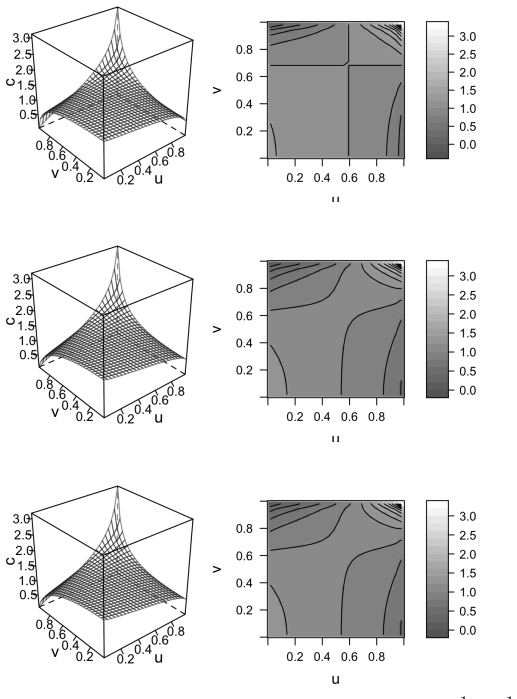
We introduce a new copula class, called Lancaster copulas, built from orthogonal expansions of continuous Lancaster probabilities. We derive infinite-series representations for the copula and its density, study truncation effects, and show in numerical experiments that low-order truncations already provide accurate approximation.
Load-bearing premise
Orthogonal expansions of continuous Lancaster probabilities can be combined into functions that meet every requirement for a copula, including uniform marginal distributions on the unit interval.
Editorial extensions
If this is right
- The copula and its density each possess an explicit infinite-series representation.
- Truncation of the series produces well-defined approximations whose accuracy can be examined term by term.
- Numerical tests confirm that retaining only the lowest-order terms already yields close agreement with the target dependence.
- The resulting family supplies a systematic method for generating copulas whose complexity is adjustable through the truncation order.
Reading between the lines
- The same expansion technique might be applied to other families of probabilities that admit orthogonal bases, producing further copula classes.
- Explicit truncation-error bounds, if derived, would turn the numerical observations into a practical design rule for choosing series length.
- Lancaster copulas may recover familiar parametric copulas as special cases when the underlying Lancaster probability is chosen appropriately.
Editorial analysis
A structured set of objections, weighed in public.
Referee Report
Summary. The paper introduces Lancaster copulas constructed from orthogonal expansions of continuous Lancaster probabilities. It derives infinite-series representations for the copula C and its density c, analyzes truncation effects on these series, and presents numerical experiments showing that low-order truncations yield accurate approximations to the target dependence structures.
Significance. If the construction is valid, the work supplies a new parametric family of copulas with explicit series forms that facilitate both theoretical analysis and practical approximation. The truncation study and numerical validation are direct strengths, as they address usability of the infinite-series objects. This could be of interest in dependence modeling where flexible, series-based representations are needed.
minor comments (3)
- [§2-3] Clarify in §2 or §3 whether the orthogonal expansion is taken with respect to a specific weight function or measure, and state the precise conditions on the Lancaster probabilities that guarantee the resulting series defines a valid copula (uniform margins and 2-increasing property).
- [Numerical experiments section] In the numerical experiments, report the specific copula families or dependence parameters used as targets, and include quantitative error measures (e.g., sup-norm or integrated squared error) rather than qualitative statements of accuracy.
- [Discussion or conclusion] Add a short discussion of computational cost for evaluating the truncated series versus standard copula families, to help readers assess practical utility.
Simulated Author's Rebuttal
We thank the referee for their positive summary of our manuscript, recognition of the potential utility of the Lancaster copula construction, and recommendation of minor revision. We are pleased that the truncation analysis and numerical experiments were viewed as strengths.
Circularity Check
No significant circularity detected
full rationale
The paper constructs Lancaster copulas from orthogonal expansions of continuous Lancaster probabilities, then derives explicit infinite-series forms for the copula and density, analyzes truncation, and validates approximations numerically. No step reduces a claimed result to a fitted input renamed as prediction, a self-definitional loop, or a load-bearing self-citation chain; the copula axioms are addressed by the internal series derivations and experiments rather than assumed or imported. The derivation chain remains self-contained against external benchmarks.
Assumptions & free parameters
assumptions (1)
- domain assumption Continuous Lancaster probabilities admit orthogonal expansions that can be reassembled into valid copula functions.
invented entities (1)
-
Lancaster copulas
Cite this review
Pith. "Pith review of Lancaster copulas." pith.science (2026). https://pith.science/paper/MSAP5UHS
@misc{pith2026260701558,
  author       = {Pith},
  title        = {Pith review of: Lancaster copulas},
  year         = {2026},
  howpublished = {\url{https://pith.science/paper/MSAP5UHS}},
  note         = {Machine review of arXiv:2607.01558}
}
read the original abstract
We introduce a new copula class, called Lancaster copulas, built from orthogonal expansions of continuous Lancaster probabilities. We derive infinite-series representations for the copula and its density, study truncation effects, and show in numerical experiments that low-order truncations already provide accurate approximation.
Figures


Reference graph
Works this paper leans on
-
[1]
Bowman, Adrian W. (1984). An alternative method of cross-validation for the smoothing of density estimates.Biometrika, 71(2), 353–360
work page 1984
-
[2]
Taylor, Charles C. (1990). Orthogonal series estimators and cross- validation.Journal of Statistical Computation and Simulation, 37 (3-4), 151–158
work page 1990
-
[3]
Aas, K., Czado, C., Frigessi, A., & Bakken, H. (2009). Pair-copula con- structions of multiple dependence.Insurance: Mathematics and Eco- nomics, 44(2), 182–198
work page 2009
-
[4]
Ansari, J., & Rockel, M. (2024). Dependence properties of bivariate copula families.Dependence Modeling, 12(1), 20240002
work page 2024
-
[5]
Barrett, J., Lampard, D. (1955). An expansion for some second-order probability distributions and its application to noise problems.IRE Transactions on Information Theory, 1(1), 10–15
work page 1955
-
[6]
Brown, J.L. (1958). A criterion for the diagonal expansion of a second- order probability distribution in orthogonal polynomials.IRE Transac- tions on Information Theory, 4(4), 172–172
work page 1958
-
[7]
Buja, A. (1990). Remarks on functional canonical variates, alternating least squares methods and ACE.The Annals of Statistics, 19(3), 1032– 1069. 27
work page 1990
-
[8]
Bussgang, J. (1952). Crosscorrelation functions of amplitude-distorted gaussian signals.RLE Technical Reports
work page 1952
Show all 53 references
-
[9]
Cuadras, C.M. (2005). Continuous canonical correlation analysis.Re- search Letters in the Information and Mathematical Sciences8, 97-103
2005
-
[10]
Dauxois, J., & Pousse, A. (1975). Une extension de l’analyse canonique. Quelques applications.Annales de l’IHP Probabilités et statistiques, 11, 355–379
1975
-
[11]
Diaconis, P., & Griffiths, R. (2012). Exchangeable pairs of Bernoulli random variables, Krawtchouck polynomials, and Ehrenfest urns.Aus- tralian & New Zealand Journal of Statistics, 54(1), 81–101
2012
-
[12]
Diaconis, P., Khare, K., & Saloff-Coste, L. (2008). Gibbs sampling, ex- ponentialfamiliesandorthogonalpolynomials.Statistical Science, 23(2), 151–178
2008
-
[13]
Downton, F. (1970). Bivariate exponential distributions in reliability theory.Journal of the Royal Statistical Society: Series B (Methodologi- cal), 32(3), 408–417
1970
-
[14]
(2002).Méthodes bayésiennes en statistique
Droesbeke, J.J., Fine, J., & Saporta, G. (2002).Méthodes bayésiennes en statistique. Éditions Technip
2002
-
[15]
Dueck, J., Edelmann, D., Richards, D. (2017). Distance correlation co- efficients for Lancaster distributions.Journal of Multivariate Analysis, 154, 19–39
2017
-
[16]
Frahm, G., Junker, M., & Szimayer, A. (2003). Elliptical copulas: appli- cability and limitations.Statistics & Probability Letters, 63(3), 275–286
2003
-
[17]
Goffard, P.O., Loisel, S., & Pommeret, D. (2017). Polynomial approxi- mations for bivariate aggregate claims amount probability distributions. Methodology and Computing in Applied Probability, 19, 151–174
2017
-
[18]
Griffiths, B. (2009). Stochastic processes with orthogonal polynomial eigenfunctions.Journal of Computational and Applied Mathematics, 233(3), 739–744
2009
-
[19]
Griffiths, R.C., & Spanò, D. (2013). Orthogonal polynomial kernels and canonical correlations for Dirichlet measures.Bernoulli, 19(2), 548–598
2013
-
[20]
Gudendorf, G., & Segers, J. (2010). Extreme-value copulas. In:Copula Theory and Its Applications. Springer 127–145. 28
2010
-
[21]
Guzmics, S., & Pflug, G.C. (2020). A new extreme value copula and new families of univariate distributions based on Freund’s exponential model.Dependence Modeling, 8, 330–360
2020
-
[22]
He, F., Yarahmadi, A., & Soleymani, F. (2024). Investigation of multi- variate pairs trading under copula approach with mixture distribution. Applied Mathematics and Computation, 472, 128635
2024
-
[23]
Hernández-Maldonado, V.M., Erdely, A., Díaz-Viera, M., & Rios, L. (2024). Fast procedure to compute empirical and Bernstein copulas.Ap- plied Mathematics and Computation, 477, 128827
2024
-
[24]
Hofert, M., Mächler, M., & McNeil, A.J. (2013). Archimedean copulas in high dimensions: Estimators and numerical challenges motivated by financial applications.Journal de la Société Française de Statistique, 154(1), 25–63
2013
-
[25]
(2014).Dependence Modeling with Copulas
Joe„ J. (2014).Dependence Modeling with Copulas. CRC Press
2014
-
[26]
(2004).Continuous Multi- variate Distributions, Volume 1: Models and Applications
Kotz, S., Balakrishnan, N., & Johnson, N.L. (2004).Continuous Multi- variate Distributions, Volume 1: Models and Applications. John Wiley & Sons
2004
-
[27]
Koudou, A.E., & Pommeret, D. (2000). A construction of Lancaster probabilities with margins in the multidimensional Meixner class.Aus- tralian & New Zealand Journal of Statistics, 42(1), 59–66
2000
-
[28]
(1995).Problèmes de marges et familles exponentielles naturelles
Koudou., A.E. (1995).Problèmes de marges et familles exponentielles naturelles. PhD thesis, Toulouse, 1995
1995
-
[29]
Probabilités de Lancaster.Expositiones Mathe- maticae, 14, 247–276
Koudou, A.E., (1996). Probabilités de Lancaster.Expositiones Mathe- maticae, 14, 247–276
1996
-
[30]
Lancaster, H. (1958). The structure of bivariate distributions.The An- nals of Mathematical Statistics, 29(3), 719–736
1958
-
[31]
Lancaster, H.O. (1963). Correlations and canonical forms of bivariate distributions.The Annals of Mathematical Statistics, 34(2), 532–538
1963
-
[32]
Lancaster, H.O. (1975). Joint probability distributions in the Meixner classes.Journal of the Royal Statistical Society: Series B (Methodologi- cal), 37(3), 434–443
1975
-
[33]
Longla, M.(2024).Newcopulafamiliesandmixingproperties.Statistical Papers65, 4331–4363. 29
2024
-
[34]
& Palma, F
Mena, R.H. & Palma, F. (2020). Continuous-time Markov processes, orthogonal polynomials and Lancaster probabilities.ESAIM: Probability and Statistics, 24(1), 100–112
2020
-
[35]
Morris, C.N. (1982). Natural exponential families with quadratic vari- ance functions.Annals of Statistics, 10, 65–80
1982
-
[36]
Muia, M.N., Longla, M. (2025). A Point on Discrete versus Continuous State-Space Markov Chains.Dependence Modelling, 13, 1-23
2025
-
[37]
(2007).An Introduction to Copulas
Nelsen., R.B. (2007).An Introduction to Copulas. Springer
2007
-
[38]
Ngounou Bakam, Y.I., & Pommeret, D. (2025). Nonparametric estima- tion of copulas and copula densities by orthogonal projections.Econo- metrics and Statistics, 36, 90–118
2025
-
[39]
Pfeifer, D., Mandle, A., Ragulina, O., & Girschig, C. (2019). New cop- ulas based on general partitions-of-unity (part III) — the continuous case.Dependence Modeling, 7(1), 181-201
2019
-
[40]
Pommeret, D. (2004). A characterization of Lancaster probabilities with margins in a multivariate additive class.Sankhy¯ a: The Indian Journal of Statistics, 66(1), 1–19
2004
-
[41]
Pommeret, D. (2005). Approximate polynomial expansion for joint den- sity.Applicationes Mathematicae, 32, 57–67
2005
-
[42]
Quessy, J.F. (2024). General Construction of Multivariate Dependence StructureswithNonmonotoneMappingsandItsApplications.Statistical Science, 39(3), 391–408
2024
-
[43]
Ren, H., Li, Q., Wu, Q., Zhang, C., Dou, Z., & Chen, J. (2022). Joint forecasting of multi-energy loads for a university based on copula theory and improved LSTM network.Energy Reports, 8, 605–612
2022
-
[44]
Empirical choice of histograms and kernel density estimatorsScandinavian Journal of Statistics, 65–78
Rudemo, Mats (1982). Empirical choice of histograms and kernel density estimatorsScandinavian Journal of Statistics, 65–78
1982
-
[45]
Saminger-Platz, S., Kolesárová, A., Seliga, A., Mesiar, R., & Klement, E.P.(2024).Parameterizedtransformationsandtruncation: Whenisthe result a copula?.Journal of Computational and Applied Mathematics, 436, 115340. 30
2024
-
[46]
Sarmanov, I. (1970). The approximate computation of the coefficient of correlation between functions of dependent random variables.Math. Notes Acad. Sciences USSR, 7, 373–377
1970
-
[47]
Sarmanov, I. (1970). A gamma-correlation process and its properties. Doklady Akademii Nauk, 191, 30–32
1970
-
[48]
Sarmanov, O., & Bratoeva, Z. (1967). Probabilistic properties of bi- linear expansions of Hermite polynomials.Theory of Probability & Its Applications, 12(3), 470–481
1967
-
[49]
Schweitzer, B., Wolff, E.F. (1981). On nonparametric measures of de- pendence for random variables.Annals of Statistics, 9, 879-885
1981
-
[50]
Sklar, M. (1959). Fonction de répartition à n dimensions et leurs marges. Annales de l’ISUP, 8, 229–231
1959
-
[51]
Szego, G. (1975). Orthogonal Polynomials. 4th ed. (reprint). Ameri- can Mathematical Society Colloquium Publications, Vol. 23. American Mathematical Society, Providence, RI
1975
-
[52]
Wong, E. (1964). The construction of a class of stationary Markoff pro- cesses.Stochastic Processes in Mathematical Physics and Engineering, 17, 264–276
1964
-
[53]
Thomas, J
Wong, E., & J. Thomas, J. (1962). On polynomial expansions of second- order distributions.Journal of the Society for Industrial and Applied Mathematics, 10(3), 507–516. 31
1962
Reviewed July 3, 2026 · model on record in the stance chip above.
Discussion (0). Continue with ORCID to comment.