REVIEW 4 major objections 4 minor 32 references
HVAF Spraying of NiTi Coatings: Microstructure, Phase Transformation and Shape Memory Behavior
T0 review · 4 major / 4 minor · reviewed 2026-08-03 · deepseek-v4-flash
Pith's one-line read Thick NiTi shape-memory coatings on steel can be made by warm-spray deposition and restored by annealing.
desk verdict Solid fabrication study with an overreach: the HVAF NiTi coatings are real, but the abstract's functional shape-memory claim is ahead of the evidence. read the letter →
The pith
A machine-rendered reading of the paper's core claim, the machinery that carries it, and where it could break.
The reading
What carries the argument
The mechanism that carries the argument is the martensitic transformation of the NiTi matrix, in particular the B2→R→B19' sequence that emerges after annealing. The process that makes this possible is HVAF's 'warm spray' regime: particles are heated to roughly 1000 °C and accelerated to 600–900 m/s, enough to plastically deform and compact them into a thick adherent layer without melting, which limits oxidation and preserves the NiTi matrix. The annealing step at 500 °C/1 h is the key post-treatment: it partially relieves the dislocation density and internal stress that suppress the transformation in the as-sprayed state.
What would settle it
Heat a plastically deformed, free-standing annealed coating above A_f (about 55 °C) under no load and measure whether it recovers its original shape; if it does not, the observed 'shape memory' is ordinary elasticity. Alternatively, run the 3-point bending cycle at zero stress and see whether the strain-temperature hysteresis persists.
Extended reading notes
Core claim
The paper's central claim is that high-velocity air-fuel spraying can produce thick NiTi shape-memory coatings on mild steel that are adherent and, after post-annealing, functionally thermomechanically active. Using pre-alloyed Ni50Ti50 powder and four parameter sets, the authors deposited 100–300 µm coatings. As-sprayed coatings are austenitic, chemically homogeneous on the macroscale but nanoscale-inhomogeneous, with pores, TiO2 oxides, high dislocation density, and internal stress; DSC shows no clear transformation peaks. Annealing at 500 °C for 1 h produces B2–R–B19' transformation peaks on DSC. In 3-point bending under 300 MPa, one annealed coating (coating 4) shows a hysteretic strain–
Load-bearing premise
The central claim depends on the assumption that the recoverable strains measured in bending, scratch, and nanoindentation come from martensitic transformation of the NiTi matrix rather than from ordinary elastic accommodation of a porous, oxide-laden, cold-worked composite.
Editorial extensions
If this is right
- If the claim holds, HVAF becomes a viable industrial route for placing thick, functional NiTi layers on steel components without the chemical inhomogeneity that defeats plasma spray.
- Annealing at 500 °C for 1 h is sufficient to restore martensitic transformation in as-sprayed coatings, giving a simple post-processing recipe for functional behavior.
- Scratch and multicycle nanoindentation are sensitive to HVAF processing parameters and can serve as substrate-attached screening tools for optimizing the spray process.
- Because the coatings can be separated from the substrate, conventional thermomechanical tests can be run on coating material itself, enabling quantitative property optimization.
- Reducing porosity and oxide content in HVAF coatings should increase the current low tensile strength (~200 MPa) and unlock the full functional thermomechanical performance.
Reading between the lines
- The transformation origin of the observed recoverable strains is not yet directly demonstrated; a free-standing recovery-on-heating test above A_f would confirm whether the 'shape memory' is genuine martensitic recovery or ordinary elasticity of a damaged composite.
- The abstract's 'very good adherence' is an inference: the paper states adhesion was not measured, so the claim rests on the absence of delamination in bending and scratch tests rather than on bond-strength data.
- The scratch-recovery values (57–61%) fall between typical superelastic (69–81%) and shape-memory (37–52%) ranges, suggesting the as-sprayed coatings behave like an intermediate, partially transforming material — annealing studies could tune which regime they enter.
- If the B2–R–B19' transformation is confirmed to be load-bearing, the R-phase (which is absent in Ti-rich NiTi) could itself be used as a sensitive diagnostic for internal stress and Ni-enrichment remaining after HVAF.
Signed reviews
Editorial analysis
A structured set of objections, weighed in public.
Referee Report
Summary. The paper reports fabrication of thick NiTi coatings (100–300 µm) on mild steel by high-velocity air-fuel (HVAF) spraying using four processing-parameter sets, followed by microstructural, compositional, phase-transformation, and mechanical characterization. The authors find as-sprayed coatings are austenitic with no clear DSC peaks; after annealing at 500 °C for 1 h, the coatings show B2–R–B19′ transformations with small, broad DSC peaks. One annealed coating (coating 4) displays hysteretic recoverable bending strain in 3-point bending, while scratch tests on as-fabricated coatings show ~60% elastic recovery and multicycle nanoindentation shows stable recovered depths. The abstract claims 'first ever successful fabrication' of thick NiTi coatings with functional thermomechanical properties and 'very good adherence' to the substrate. The central functional claim is that these recoverable strains arise from the martensitic transformation, i.e., genuine shape-memory behavior.
Significance. If substantiated, the work would identify HVAF as a promising route for thick NiTi coatings, avoiding melting/oxidation issues of plasma spray and adhesion issues of cold spray. The paper is commendable for its direct experimental characterization of composition, porosity, phases, transformation temperatures, and mechanical responses, and for making data available on Zenodo. However, the central claim is not yet established: the only bending demonstration is on one annealed sample with a 'non-standard' hysteresis; the scratch and nanoindentation responses are explicitly stated not to be classifiable as superelastic or shape-memory; adhesion is explicitly not evaluated; and no free-recovery-on-heating test is provided. The reported recoveries may be ordinary elastic accommodation of a porous, oxide-laden, cold-worked composite, in which case the novelty collapses. The paper is a useful process-development and characterization study, but the functional-SMA claim requires substantial additional evidence or significant rewriting.
major comments (4)
- [Abstract and §3.3.2] The abstract claims the coatings 'simultaneously show very good adherence to the substrate,' but §3.3.2 states 'we did not evaluate the adhesion.' The absence of detachment in bending/tensile tests is not a quantitative adhesion measurement. The adhesion claim must be removed or supported by a proper test (e.g., pull-off, scratch adhesion, or interfacial indentation).
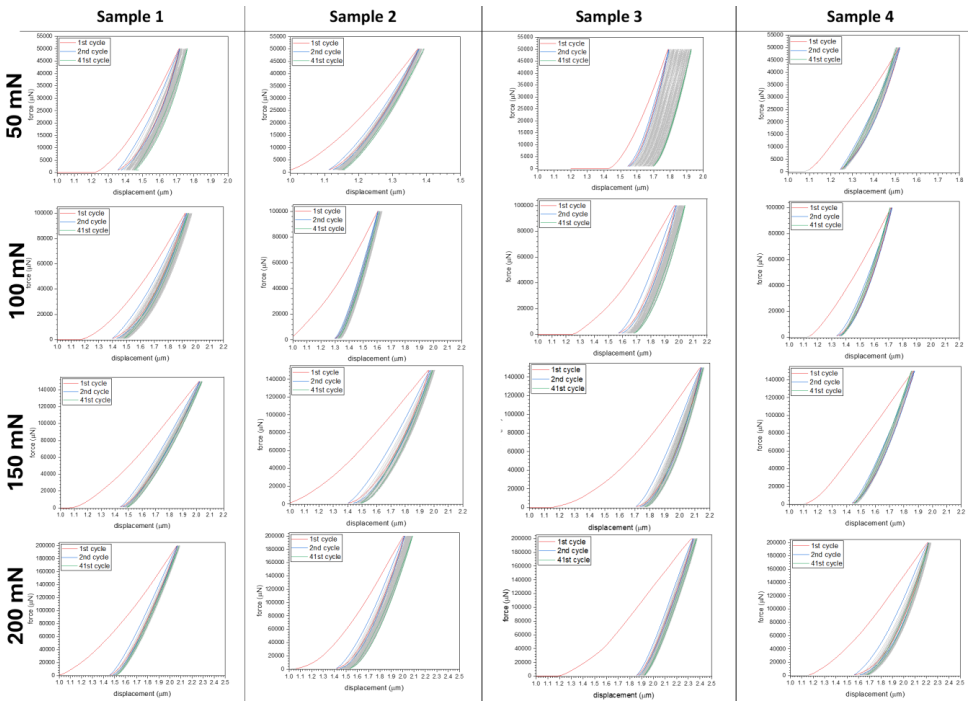
- [§3.4.2, Fig. 11; §3.4.3; §3.4.4] The central claim of functional shape-memory behavior is not demonstrated. The only recoverable strain in bending is reported for one annealed sample (coating 4), and the authors state the hysteresis is 'not standard.' Scratch tests were performed on as-fabricated coatings, and §3.4.3 says the coating 'shows neither superelasticity nor shape memory'; nanoindentation (§3.4.4) 'can be classified neither as superelastic nor as shape memory.' No free-standing recovery-on-heating test (deform below Mf, heat above Af) or constrained-recovery work-output test is reported. The observed recoveries could be ordinary elasticity of a porous, oxide-containing, stressed composite. The authors should either provide direct evidence that recovery is caused by the B2–R–B19′ transformation, or substantially weaken the functional claims.
- [§3.3.4, Table 5, §3.4] The functional-property evidence is thin relative to the breadth of the claim. The only bending functional test is on one annealed coating; the scratch and nanoindentation tests are on as-fabricated coatings; the as-sprayed DSC curves show no clear transformation peaks; and the annealed peaks are small and broad. There is no replication or error quantification for the bending result. The conclusion that HVAF NiTi coatings 'display functional thermomechanical properties' is therefore not supported for the coating family as a whole, only suggestive for one annealed sample.
- [Introduction, Abstract, Refs. 13,14,18] The 'first ever successful fabrication' claim in the abstract needs careful benchmarking. The same group's earlier work (Refs. 13, 14, 18) reports thermal-plasma-sprayed NiTi coatings 'possessing functional properties,' which appears to overlap with the current claim. If the novelty is specifically HVAF, or thickness, or simultaneous adhesion, that must be stated precisely. Otherwise the 'first ever' claim is overreaching and may be inconsistent with the prior literature cited in the paper itself.
minor comments (4)
- [§3.3.4] Typo: 'compar6' should be 'compared.' Also in §3.2, 'temeperatre and tine' and 'the the' should be corrected.
- [Fig. 1 and text] The text references 'DSC peaks ... in Fig. 1f' when comparing powder and coating DSC peaks, but Fig. 1f appears to show EDX chemical-composition results, not DSC. Please correct the cross-reference.
- [Discussion, §4.1] There are two subsections numbered '4.1' ('Microstructure and functional mechanical properties' and 'Characterization of mechanical properties by scratch and nanoindentation'); the second should be renumbered '4.2.'
- [Discussion, text near Table 5/Table 6] The Discussion says 'Ni content ... (Table 5)' and 'Ms temperature ... (Table 6).' Table 5 lists transformation temperatures and Table 6 lists Young's moduli/strengths; chemical composition is in Table 4. Check all table cross-references for consistency.
Circularity Check
No significant circularity: direct measurements, no model-derived predictions; abstract overclaims are evidence gaps, not circular reductions.
full rationale
Walking the claimed derivation chain: the paper does not derive any result from a model whose inputs include the target. Composition, porosity, phase fractions, transformation temperatures, Young's moduli, tensile strengths, scratch depths, and nanoindentation depths are all measured directly on the fabricated coatings (Tables 2-7, Figs. 2-15). The annealing temperature is chosen by standard practice, not fitted to the observed functional response. The only place the authors invoke quantitative benchmarks from their own prior work is the scratch-recovery comparison (69-81% vs 37-52%, refs. 30-32); this is an external empirical benchmark on bulk NiTi, not a term from which the coating's recovery is derived, so it is not load-bearing circularity. The abstract's 'very good adherence' is explicitly unsupported by Section 3.3.2 ('we did not evaluate the adhesion'), and the abstract's 'shape memory effects in nanoindentation and scratch tests' is contradicted by Section 3.4.4 ('can be classified neither as superelastic nor as shape memory'). Those are validity/overclaiming problems about whether the recovery is transformation-based, not circularity: no equation or fitted parameter reduces to itself. Hence score 0.
Assumptions & free parameters
free parameters (1)
- Annealing treatment (500 °C, 1 h, air) =
500 °C / 1 h / air
assumptions (4)
- domain assumption The broad, weak DSC signals and non-standard strain–temperature hysteresis in annealed HVAF coatings are caused by internal stress and chemical heterogeneity, and the observed recoverable strains are still produced by martensitic transformation (B2–R–B19') of the NiTi matrix.
- domain assumption EDX Ni content of 50.2 at.% is consistent with nominal Ni50Ti50 within the stated 2% method uncertainty, so the feedstock chemistry is as intended.
- standard math Rietveld refinement (FullProf, ref. 25) correctly quantifies austenite/martensite/Ni4Ti3 phase fractions from laboratory XRD patterns.
- domain assumption Porosity measured by ImageJ thresholding of SEM cross-sections (single images) is representative of bulk coating porosity.
Cite this review
Pith. "Pith review of HVAF Spraying of NiTi Coatings: Microstructure, Phase Transformation and Shape Memory Behavior." pith.science (2026). https://pith.science/paper/UO76LJHW
@misc{pith2026260701997,
  author       = {Pith},
  title        = {Pith review of: HVAF Spraying of NiTi Coatings: Microstructure, Phase Transformation and Shape Memory Behavior},
  year         = {2026},
  howpublished = {\url{https://pith.science/paper/UO76LJHW}},
  note         = {Machine review of arXiv:2607.01997}
}
read the original abstract
Depositing various coatings on surface of engineering components with the aim to improve their performance concerning wear, corrosion, friction and thermal protection is already a standard practice. Depositing metallic NiTi shape memory alloy coatings may be a viable alternative for hard ceramic coatings. NiTi coatings offer additional benefits originating from unique functional thermomechanical properties. However, fabrication of thick NiTi coatings turned out to be difficult. Standard electroplating and laser cladding methods are not suitable for NiTi the most widely used plasma spray methods tend to produce chemically inhomogeneous coatings that do not transform martensitically, cold sprayed NiTi coatings suffer from poor adhesion to the substrates. In this work we report on first ever successful fabrication of thick NiTi coatings (100-300 um) that display functional thermomechanical properties and simultaneously show very good adherence to the substrate. We used high velocity air fuel thermal spray method to fabricate NiTi coatings deposited on mild steel using four different sets of processing parameters. Chemical composition, porosity, microstructure, phase transformation and functional thermomechanical properties of the NiTi coatings were evaluated. Although the coatings contain inhomogeneous microstructure, voids, oxide particles, high density of dislocation defects and internal stress, they undergo martensitic transformation upon cooling and or mechanical loading. As sprayed NiTi coatings need to be annealed to display functional thermomechanical properties. Despite their limited tensile strength, the coatings displayed thermal actuation in 3 point bending tests and shape memory effects in nanoindentation and scratch tests.
Figures

Reference graph
Works this paper leans on
-
[1]
M.; Leary, M.; Subic, A.; Gibson, M
Jani, J. M.; Leary, M.; Subic, A.; Gibson, M. A. A review of shape memory alloy research, applications and opportunities. Materials & Design 2014, 56, 1078-1113. https://doi.org/10.1016/j.matdes.2013.11.084
-
[2]
Azubuike Amadi, Mysara Mohyaldinn, Syahrir Ridha, Victor Ola, Advancing engineering frontiers with NiTi shape memory alloys: A multifaceted review of properties, fabrication, and application potentials, Journal of Alloys and Compounds 2024, 976, 173227, ISSN 0925-8388, https://doi.org/10.1016/j.jallcom.2023.173227
arXiv 2024
-
[3]
Hongjie Jiang, Shanshan Cao, Changbo Ke, Xiao Ma, Xinping Zhang, Fine-Grained Bulk NiTi Shape Memory Alloy Fabricated by Rapid Solidification Process and Its Mechanical Properties and Damping Performance, Journal of Materials Science & Technology 2013, 29, 855 -862, ISSN 1005 -0302, https://doi.org/10.1016/j.jmst.2013.05.007
-
[4]
Net-Shape NiTi Shape Memory Alloy by Spark plasma Sintering Method
Samal, S.; Molnárová, O.; Průša, F.; Kopeček, J.; Heller, L.; Šittner, P.; M.; Abate, L.; Blanco, I. Net-Shape NiTi Shape Memory Alloy by Spark plasma Sintering Method. Appl. Sci. 2021, 11, 1802. https://doi.org/10.3390/app11041802
-
[5]
Bermingham, M.J., McDonald, S.D., StJohn, D.H. et al. Segregation and grain refinement in cast titanium alloys. Journal of Materials Research 2009, 24, 1529–1535. https://doi.org/10.1557/jmr.2009.0173
arXiv 2009
-
[6]
Samal, Sneha., Sulovský, Mikulas, Kopeček, Jaromír., Šittner, Petr., Deposition and characterization of plasma sprayed NiTi powder on stainless steel and graphite substrate, Materials Chemistry and Physics 2023, 307, 128146, ISSN 0254-0584, https://doi.org/10.1016/j.matchemphys.2023.128146
arXiv 2023
-
[7]
Bram, M., Ahmad-Khanlou, A., Heckmann, A., Fuchs, B., Buchkremer, H.P., Stöver, D., Powder metallurgical fabrication processes for NiTi shape memory alloy parts, Materials Science and Engineering: A 2002, 337, 254- 263, ISSN 0921-5093, https://doi.org/10.1016/S0921-5093(02)00028-X
-
[8]
Dong-Dong Zhuang, Shu-Hao Zhang, Hai-Xia Liu, Jie Chen, Cavitation erosion behavior and anti -cavitation erosion mechanism of NiTi alloys impacted by water jet, Wear 2023, 518 –519, ISSN 0043 -1648, https://doi.org/10.1016/j.wear.2023.204631
arXiv 2023
Show all 32 references
-
[9]
Tomáštík, L
Samal, S., Cibulková, J., Čtvrtlík, R., J. Tomáštík, L. Václavek, J. Kopeček, P. Šittner, Tribological behavior of NiTi alloy produced by spark plasma sintering method, Coatings, 2021, 11, 1246
2021
-
[10]
Journal of Material Engginering and Performance 2019, 28, 6033–6041
Cameron, N., Farhat, Z., Investigation into the Wear and Dent Resistance of Ni/Ti Nanolaminates and Superelastic NiTi Coating. Journal of Material Engginering and Performance 2019, 28, 6033–6041. https://doi.org/10.1007/s11665-019-04377-5
2019 doi
-
[11]
Shugo,Y.; Hanada, S.; Honma, T.; Bull. Res. Inst. Min. Dress. Metall. Tohoku. Univ., 41 1985, 35
1985
-
[12]
Bram, M., Ahmad-Khanlou, A., Buchkremer, H.P., Stöver, D., Vacuum plasma spraying of NiTi protection layers, Materials Letters 2002, 57, 647-651
2002
-
[13]
Fabrication of Thermal Plasma Sprayed NiTi Coatings Possessing Functional Properties
Samal, S.; Tyc, O.; Cizek, J.; Klecka, J.; Lukáč, F.; Molnárová, O.; de Prado, E.; Weiss, Z.; Kopeček, J.; Heller, L.; et al. Fabrication of Thermal Plasma Sprayed NiTi Coatings Possessing Functional Properties. Coatings 2021, 11, 610. https://doi.org/10.3390/coatings11050610 26
2021 doi
-
[14]
Samal, S., Zeman, J., Kopeček, J., Šittner, P., Thermal plasma spraying of NiTi powder for thick coating of shape memory alloy, Journal of Alloys and Compounds 2024, 984, 173962, ISSN 0925-8388, https://doi.org/10.1016/j.jallcom.2024.173962
2024
-
[15]
Samal, S., Thermal plasma technology: The prospective future in material processing, Journal of Cleaner Production 2017, 142, 3131-3150
2017
-
[16]
& Gill, H.S
Kumar, K., Kumar, S. & Gill, H.S. High -Temperature Erosion–Corrosion Performance of Plasma and High - Velocity Oxy-Fuel Sprayed TiC and TiN Enriched Ni -20Cr Coatings in an Actual Boiler Environment. J. of Materi Eng and Perform 2025, 34, 17900–17914. https://doi.org/10.1007/...
2025 doi
-
[17]
Samal, Sneha., Vokoun, David., Stachiv, Ivo., Šittner, Petr., Simulation of thermal stress predictions for NiTi coating on a stainless-steel substrate using thermal plasma spraying, Ceramics International 2025, 51, 12337- 12345, ISSN 0272-8842, https://doi.org/10.1016/j.cerami...
2025 doi
-
[18]
Preparation and Characterization of Multilayer NiTi Coatings by a Thermal Plasma Process
Samal, S.; Zeman, J.; Habr, S.; Pacherová, O.; Kopeček, J.; Šittner, P. Preparation and Characterization of Multilayer NiTi Coatings by a Thermal Plasma Process. Materials 2024, 17, 694. https://doi.org/10.3390/ma17030694
2024 doi
-
[19]
Interfacial Adhesion of Thick NiTi Coating on Substrate Stainless Steel
Samal, S.; Kopeček, J.; Šittner, P. Interfacial Adhesion of Thick NiTi Coating on Substrate Stainless Steel. Materials 2022, 15, 8598. https://doi.org/10.3390/ma15238598
2022 doi
-
[20]
The Microstructure, Hardness, Phase Transformation and Mechanical Properties of a NiTi Coating Applied to Graphite Substrate via a Plasma Spraying Process
Samal, S.; Zeman, J.; Kopeček, J.; Šittner, P. The Microstructure, Hardness, Phase Transformation and Mechanical Properties of a NiTi Coating Applied to Graphite Substrate via a Plasma Spraying Process. Coatings 2023, 13, 1174. https://doi.org/10.3390/coatings13071174
2023 doi
-
[21]
Cano, Coatings, Surface Modifications, Spray Techniques (Cold Spray, HVOF/HV AF), Editor(s): Francisca G
Vicente Albaladejo-Fuentes, Ana Maria Martos, Alessio Silvello, Sergi Dosta, Javier Sanchez, Irene G. Cano, Coatings, Surface Modifications, Spray Techniques (Cold Spray, HVOF/HV AF), Editor(s): Francisca G. Caballero, Encyclopedia of Materials: Metals and Alloys, Elsevier, 20...
2022 doi
-
[22]
Verdian, M.M.; Raeissi, K.; Salehi, M.; Corrosion performance of HVOF and APS thermally sprayed NiTi intermetallic coatings in 3.5% NaCl solution, Corrosion Science 2010, 52, 1052 -1059, ISSN 0010 -938X, https://doi.org/10.1016/j.corsci.2009.11.034
2010 doi
-
[23]
Verdian, M.M.; Raeissi, K.; Salehi, M.; Electrochemical impedance spectroscopy of HVOF -sprayed NiTi intermetallic coatings deposited on AISI 1045 steel, Journal of Alloys and Compounds 2021, 507, 42-46, ISSN 0925-8388, https://doi.org/10.1016/j.jallcom.2010.07.132
2021 doi
-
[24]
https://www.uniquecoat.com/legacy-hvaf-guns
-
[25]
Rodríguez, Carvajal J.; Physica B 192 55(1993)
1993
-
[26]
Mohamed E. Mitwally, Mahmoud Farag, Effect of cold work and annealing on the structure and characteristics of NiTi alloy, Materials Science and Engineering: A 2009, 519, 155 -166, ISSN 0921 -5093, https://doi.org/10.1016/j.msea.2009.04.057
2009 doi
-
[27]
Hongliang Yang, Jian Chen, Yahua Li, Xiaobin Shi, Yongtao Li, Junsong Zhang, Effect of cold work on martensitic transformation of Ni38Ti37V25 alloy reinforced by V nanowires, Journal of Alloys and Compounds, V olume 815, 2020, 152489, ISSN 0925-8388, https://doi.org/10.1016/j....
2020
-
[28]
Fatigue Resistance Improvement in Cold-Drawn NiTi Wires Treated with ALD: A Preliminary Investigation
V okoun, D.; Tyc, O.; Samal, S.M.; Stachiv, I.; Yu, Y .; Kei, C. Fatigue Resistance Improvement in Cold-Drawn NiTi Wires Treated with ALD: A Preliminary Investigation. Applied Science, 2025, 15, 1823. https://doi.org/10.3390/app15041823 27
2025 doi
-
[29]
Thangamani, G., Tamang, S.K., Patel, M.S. et al. Post-processing treatment of Wire Arc Additive Manufactured NiTi shape memory alloy using laser shock peening process: a study on tensile behavior and fractography analysis. Int J Adv Manuf Technol 2025, 136, 3315–3327 https://d...
2025 doi
-
[30]
Václavek, Lukáš; Samal, Sneha; Tomáštík, Jan; Molnárová, Orsolya; Šittner, Petr; Multi-cycle nanoindentation, scratch and wear test on super -elastic (SE) and shape memory (SM) NiTi alloy, Results in Surfaces and Interfaces 2026, 23, 100768, ISSN 2666-8459, https://doi.org/10....
2026
-
[31]
Samal, S., Tomáštík, J., Čtvrtlík, R., Václavek, L., Molnárová, O., Šittner, P., Surface Deformation recovery by thermal annealing of thermal plasma sprayed shape memory NiTi Alloys, Coatings 2023, 13 , 433, 10.3390/coatings13020433
2023 doi
-
[32]
Samal, Sneha., Tomáštík, Jan., Václavek, Lukáš., Chandra, Mohit., Kopeček, Jaromír., Stachiv, Ivo., Šittner, Petr., Recovery of deformation surface of superelastic and shape memory NiTi alloy, Applied Surface Science Advances 2025, 25, 100684, ISSN 2666-5239, https://doi.org/1...
2025
Reviewed August 3, 2026 · model on record in the stance chip above.
Discussion (0). Continue with ORCID to comment.