Compressive Spectrum Sensing via Spectral Multiplexing in Rydberg Atomic Receiver
Pith reviewed 2026-07-03 11:47 UTC · model grok-4.3
The pith
A frequency-modulated local oscillator in a Rydberg atomic receiver compresses more than 640 MHz of spectrum into its native 126 kHz bandwidth.
A machine-rendered reading of the paper's core claim, the machinery that carries it, and where it could break.
Core claim
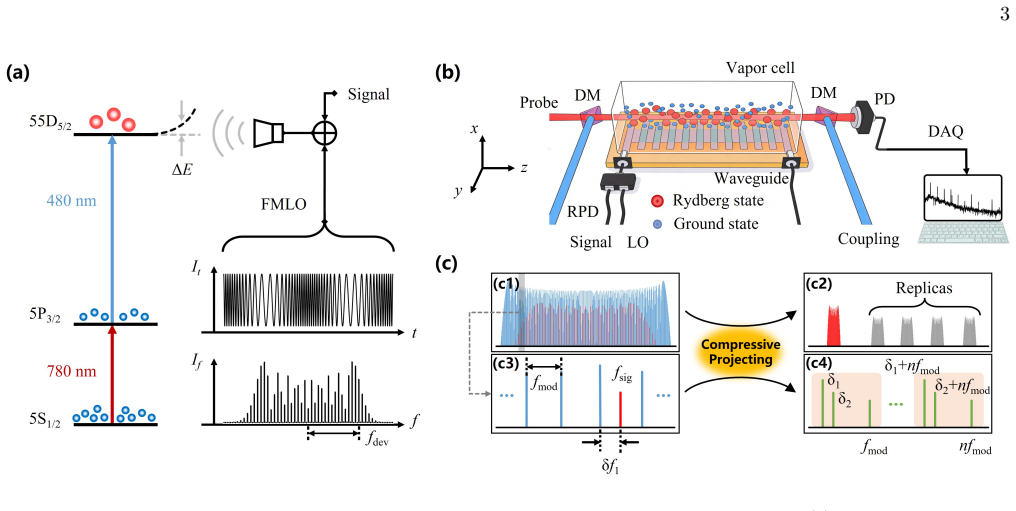
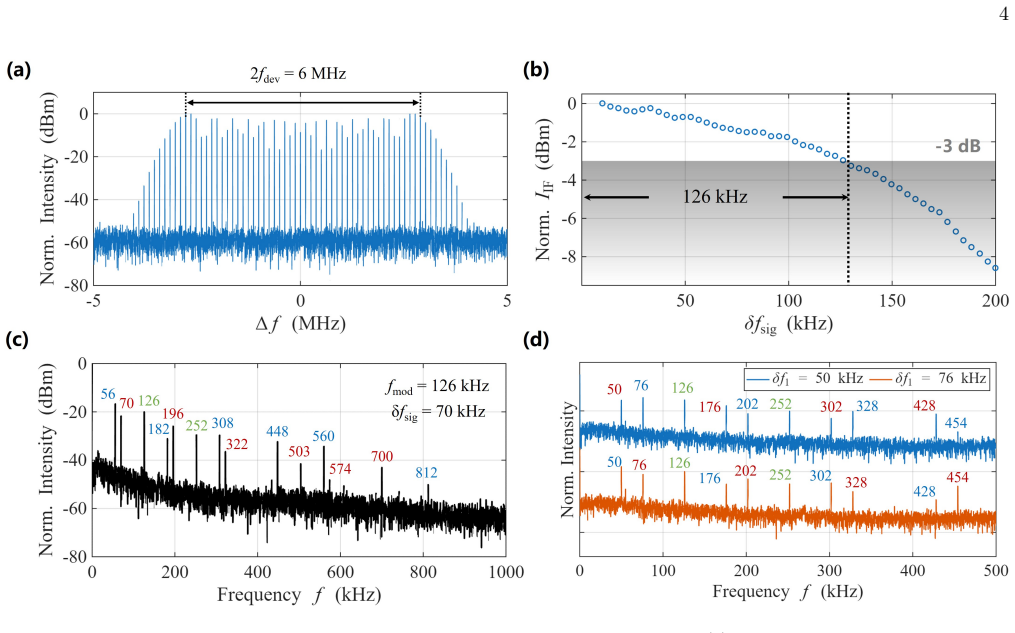
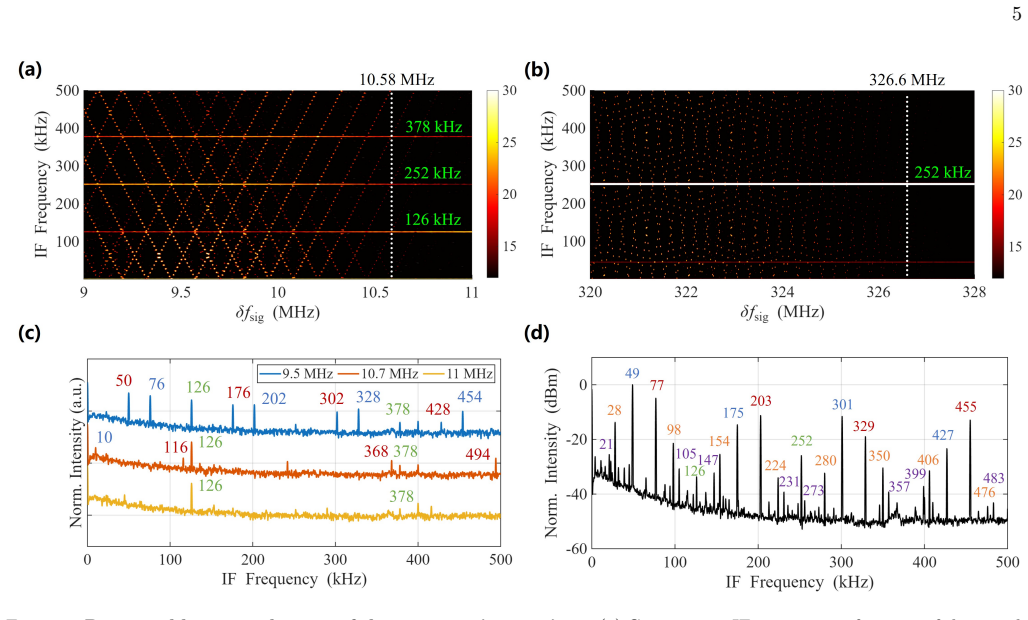
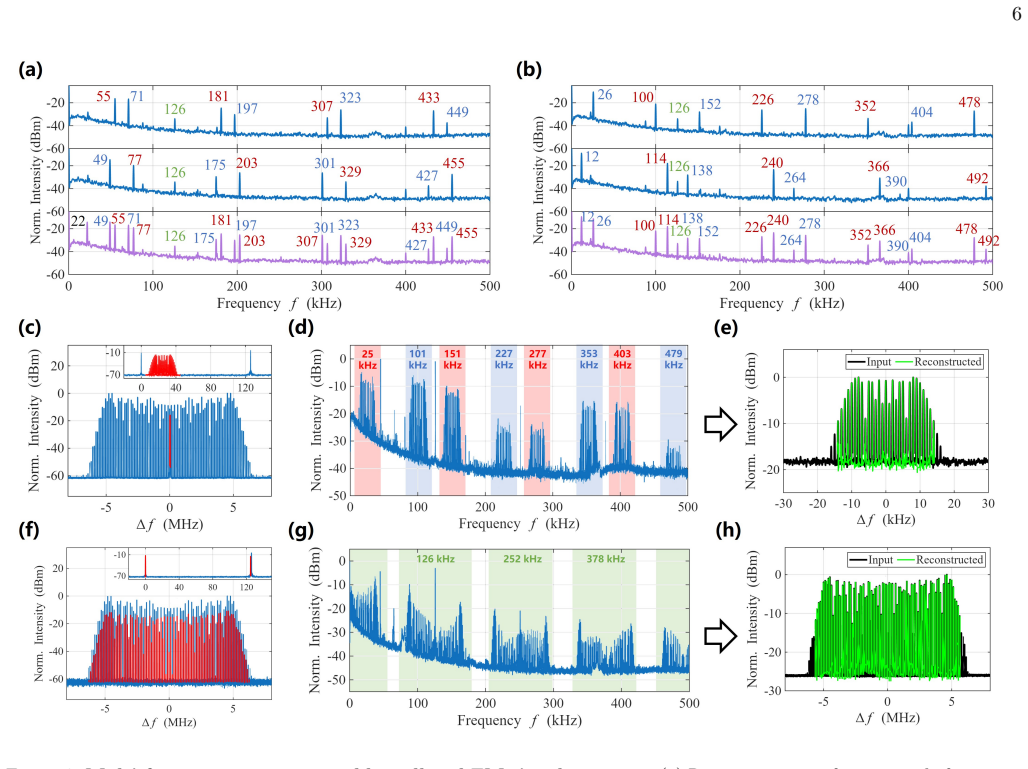
The frequency-modulated local oscillator creates multiple parallel sensing channels that collectively form a physical compressive sensing matrix, generating multiple narrowband intermediate-frequency replicas of the input signal. Spectral information spanning over 640 MHz is compressed into the 126 kHz atomic bandwidth, with a compression ratio exceeding 1000. The replicas provide redundancy for about 10 dB SNR gain via maximal-ratio combining.
What carries the argument
The frequency-modulated local oscillator (FMLO), which generates multiple narrowband intermediate-frequency replicas to form a physical compressive sensing matrix.
If this is right
- Broadband microwave spectra can be sensed using the narrow intrinsic response of Rydberg atoms.
- Signal-to-noise ratio improves by approximately 10 dB for multi-channel communication through maximal-ratio combining of the replicas.
- The approach requires no auxiliary electromagnetic fields or broadband electronics.
- Chip-scale quantum receivers become feasible for latency-critical sensing and next-generation wireless communications.
Where Pith is reading between the lines
- If the replicas maintain independence, the method could extend to other narrowband quantum sensors beyond Rydberg atoms.
- Integration with existing waveguide-coupled setups might enable scalable arrays for higher compression ratios.
- Testing in real wireless environments would reveal whether the compression holds under varying signal conditions.
Load-bearing premise
The frequency-modulated local oscillator produces multiple replicas without significant crosstalk or loss of spectral information.
What would settle it
An experiment showing that the recovered spectrum from the compressed replicas deviates substantially from the original input spectrum or exhibits high crosstalk between channels would falsify the claim.
Figures
read the original abstract
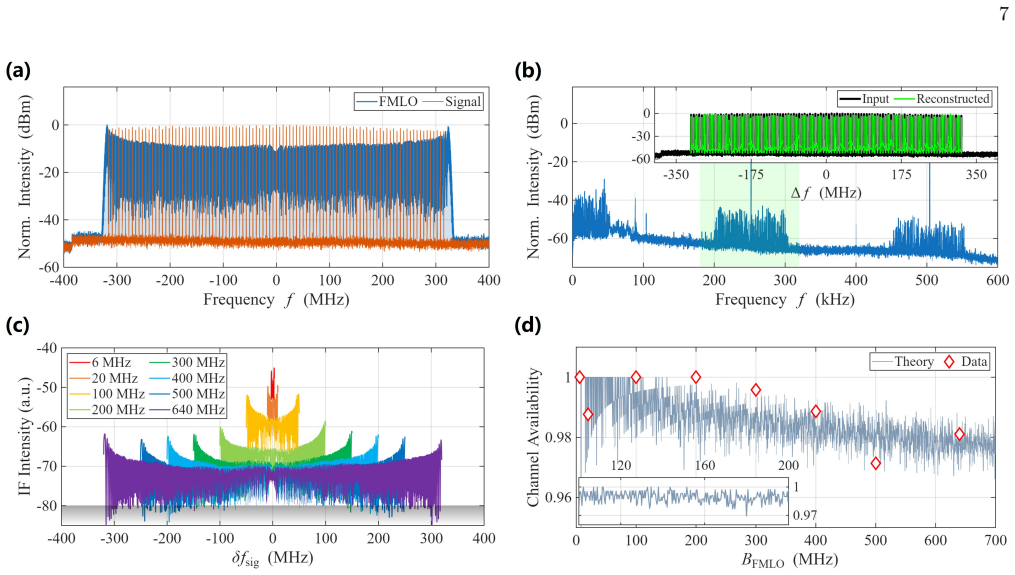
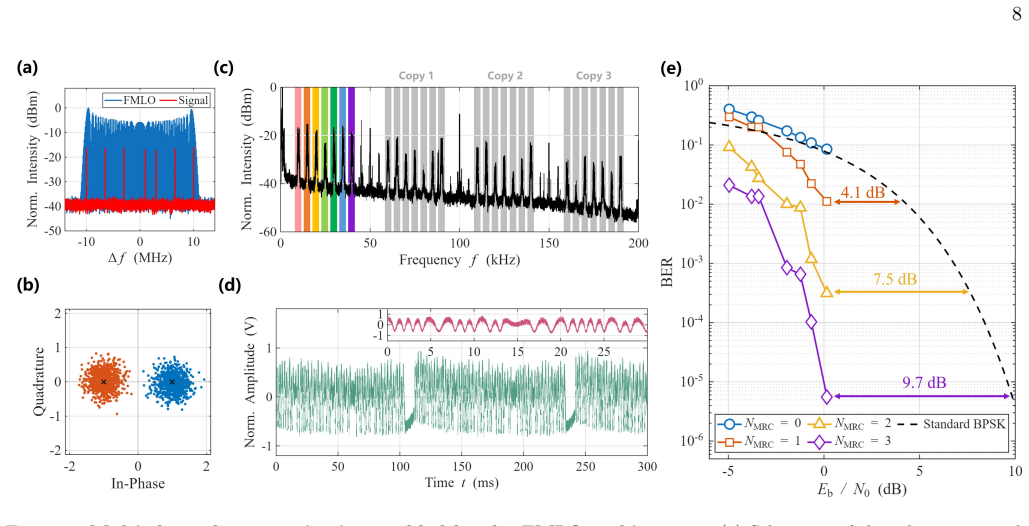
Rydberg-atomic receivers exhibit exceptional sensitivity yet are fundamentally constrained by the narrow instantaneous bandwidth, limiting their practical deployment in broadband scenarios. Prior approaches typically expand the bandwidth by physically broadening the atomic response, which usually requires auxiliary electromagnetic fields or stringent parameter tuning, thereby increasing overall system complexity. Here, we propose a compressive spectral multiplexing framework implemented in a waveguide-coupled Rydberg atomic receiver using a frequency-modulated local oscillator (FMLO). The FMLO creates multiple parallel sensing channels that collectively constitute a physical compressive sensing matrix, generating multiple narrowband intermediate-frequency replicas of the input signal. Thus, a broadband microwave spectrum is projected onto a set of narrowband atomic responses. It is demonstrated that spectral information spanning a bandwidth of over 640 MHz can be effectively compressed into the intrinsic atomic bandwidth of 126 kHz, achieving a spectrum compression ratio exceeding 1000. Furthermore, these output replicas offer intrinsic measurement redundancy and facilitate signal-to-noise ratio enhancement. An approximate 10 dB gain is achieved in the required bit-energy-to-noise-power-density ratio for multi-channel communication via maximal-ratio combining. This approach requires no auxiliary fields or broadband electronics, providing a simple and scalable pathway for chip-scale quantum receivers, latency-critical sensing, and next-generation wireless communications.
Editorial analysis
A structured set of objections, weighed in public.
Referee Report
Summary. The manuscript proposes and experimentally demonstrates a compressive spectral multiplexing framework in a waveguide-coupled Rydberg atomic receiver driven by a frequency-modulated local oscillator (FMLO). The FMLO generates multiple narrowband intermediate-frequency replicas that physically implement a compressive sensing matrix, projecting spectral information over 640 MHz into the 126 kHz intrinsic atomic response (compression ratio >1000) without auxiliary fields. The replicas provide measurement redundancy that yields an approximate 10 dB improvement in required bit-energy-to-noise-power-density ratio via maximal-ratio combining.
Significance. If the experimental claims hold, the work provides a concrete, hardware-level solution to the narrow instantaneous bandwidth that has limited Rydberg receivers in broadband applications. The absence of auxiliary fields and the use of existing FMLO drive make the approach scalable for chip-scale devices; the reported compression ratio and SNR gain are directly relevant to latency-critical sensing and next-generation wireless systems.
major comments (2)
- [§4, Fig. 5] §4 (Experimental Results), Fig. 5 and associated text: the reported compression ratio >1000 and the claim of 'no significant crosstalk or information loss' rest on the observed fidelity of the reconstructed spectrum. The manuscript should quantify the residual crosstalk between the generated IF replicas (e.g., via measured isolation in dB or reconstruction error versus number of channels) to confirm that the physical compressive matrix remains well-conditioned across the full 640 MHz span.
- [§3.2, Eq. (3)] §3.2 (FMLO Implementation) and Eq. (3): the derivation of the effective sensing matrix assumes that the FMLO modulation produces strictly parallel, non-overlapping channels within the atomic response. The paper should explicitly state the modulation index and sweep rate used and verify that the resulting channel spacing remains larger than the 126 kHz atomic linewidth for all tested input frequencies.
minor comments (2)
- The abstract states 'an approximate 10 dB gain'; the main text should report the exact measured improvement together with the number of channels combined and the statistical uncertainty.
- Figure captions for the spectrum plots should include the exact input bandwidth, number of FMLO channels, and integration time to allow direct comparison with the claimed 640 MHz to 126 kHz compression.
Simulated Author's Rebuttal
We thank the referee for the positive evaluation and recommendation of minor revision. We address each major comment below and will revise the manuscript accordingly to strengthen the presentation of the experimental validation.
read point-by-point responses
-
Referee: [§4, Fig. 5] §4 (Experimental Results), Fig. 5 and associated text: the reported compression ratio >1000 and the claim of 'no significant crosstalk or information loss' rest on the observed fidelity of the reconstructed spectrum. The manuscript should quantify the residual crosstalk between the generated IF replicas (e.g., via measured isolation in dB or reconstruction error versus number of channels) to confirm that the physical compressive matrix remains well-conditioned across the full 640 MHz span.
Authors: We agree that explicit quantification of residual crosstalk strengthens the claim that the compressive matrix is well-conditioned. In the revised manuscript we will augment §4 and Fig. 5 (or add a supplementary figure) with measured isolation values between replicas (in dB) and reconstruction error versus channel count, obtained from the same experimental dataset. These additions will directly confirm negligible crosstalk over the full 640 MHz span while preserving the reported compression ratio and SNR gain. revision: yes
-
Referee: [§3.2, Eq. (3)] §3.2 (FMLO Implementation) and Eq. (3): the derivation of the effective sensing matrix assumes that the FMLO modulation produces strictly parallel, non-overlapping channels within the atomic response. The paper should explicitly state the modulation index and sweep rate used and verify that the resulting channel spacing remains larger than the 126 kHz atomic linewidth for all tested input frequencies.
Authors: We will revise §3.2 to state the exact modulation index and sweep rate employed in the experiments. We will also add a short verification paragraph confirming that, for every tested input frequency, the resulting channel spacing exceeds the 126 kHz atomic linewidth, consistent with the parallel-channel assumption underlying Eq. (3). These clarifications require only textual additions and do not alter the experimental results. revision: yes
Circularity Check
No significant circularity detected
full rationale
The paper describes an experimental implementation of compressive spectrum sensing via FMLO in a Rydberg receiver, with the >1000 compression ratio presented as a measured physical outcome rather than a derived prediction. No equations, fitted parameters renamed as predictions, or self-citation chains appear in the abstract or framework description; the parallel-channel matrix is introduced as a physical construction without reducing to prior self-referential definitions or ansatzes. The demonstration relies on external experimental validation (SNR gain via combining), making the central claim self-contained against benchmarks outside the paper's own inputs.
Axiom & Free-Parameter Ledger
axioms (1)
- domain assumption The FMLO generates multiple narrowband IF replicas that together constitute a physical compressive sensing matrix projecting broadband input onto the narrow atomic response.
Reference graph
Works this paper leans on
-
[1]
Torrieri,Principles of Spread-Spectrum Communica- tion Systems(Springer International Publishing, Cham, 2022)
D. Torrieri,Principles of Spread-Spectrum Communica- tion Systems(Springer International Publishing, Cham, 2022)
2022
-
[2]
K. E. Kolodziej, In-band full-duplex propagation-domain techniques and applications, in2021 International Sym- posium on Antennas and Propagation (ISAP)(IEEE,
-
[3]
M. Cui, Q. Zeng, and K. Huang, Rydberg Atomic Re- ceiver: Next Frontier of Wireless Communications, IEEE Communications Magazine64, 146 (2026)
2026
-
[4]
Zhang, B
F. Zhang, B. Jin, Z. Lan, Z. Chang, D. Zhang, Y. Jiao, M. Shi, and J. Xiong, Quantum wireless sensing: Prin- ciple, design and implementation, inProceedings of the 29th Annual International Conference on Mobile Com- puting and Networking, ACM MobiCom ’23 (Association for Computing Machinery, New York, NY, USA, 2023)
2023
-
[5]
G. Allinson, M. Bason, A. Bonnin, S. Bor´ owka, P. Martin-Iglesias, M. M. Neira, M. Mazelanik, R. Murchie, M. Parniak, S. Pataraia,et al., Ryd- berg receivers for space applications, arXiv preprint arXiv:2601.20631 (2026)
-
[6]
T. Gong, A. Chandra, C. Yuen, Y. L. Guan, R. Dumke, C. M. S. See, M. Debbah, and L. Hanzo, Rydberg atomic quantum receivers for classical wireless communication and sensing, IEEE Wireless Communications (2025)
2025
-
[7]
C. L. Holloway, M. T. Simons, A. B. Artusio-Glimpse, and J. A. Gordon, Overview of Rydberg atom-based sensors/receivers for the measurement of electric fields, power, voltage, and modulated signals, Antenna and Ar- ray Technologies for Future Wireless Ecosystems , 393 (2022)
2022
-
[8]
B. Liu, L. Zhang, Z. Liu, Z. Deng, D. Ding, B. Shi, and G. Guo, Electric field measurement and application based on Rydberg atoms, Electromagnetic Science1, 1 (2023)
2023
-
[9]
Schlossberger, N
N. Schlossberger, N. Prajapati, S. Berweger, A. P. Ro- tunno, A. B. Artusio-Glimpse, M. T. Simons, A. A. Sheikh, E. B. Norrgard, S. P. Eckel, and C. L. Holloway, Rydberg states of alkali atoms in atomic vapour as SI- traceable field probes and communications receivers, Na- ture Reviews Physics6, 606 (2024)
2024
-
[10]
Somaweera, A
D. Somaweera, A. Abdulghani, A. A. Odebowale, A. M. Berhe, M. I. U. Weerasinghe, K. As’ham, I. A. M. Al Ani, M. C. Dumlao, A. E. Miroshnichenko, and H. T. Hat- tori, Rydberg Atom-Based Sensors: Principles, Recent Advances, and Applications, Photonics12, 1228 (2025)
2025
-
[11]
J. Yuan, W. Yang, M. Jing, H. Zhang, Y. Jiao, W. Li, L. Zhang, L. Xiao, and S. Jia, Quantum sensing of mi- crowave electric fields based on Rydberg atoms, Reports on Progress in Physics86, 106001 (2023)
2023
-
[12]
M. Jing, Y. Hu, J. Ma, H. Zhang, L. Zhang, L. Xiao, and S. Jia, Atomic superheterodyne receiver based on microwave-dressed Rydberg spectroscopy, Nature Physics16, 911 (2020)
2020
-
[13]
J. Yuan, T. Jin, L. Xiao, S. Jia, and L. Wang, A Rydberg Atom-Based Receiver With Amplitude Modulation Tech- nique for the Fifth-Generation Millimeter-Wave Wireless Communication, IEEE Antennas and Wireless Propaga- tion Letters22, 2580 (2023)
2023
-
[14]
Y.-J. Wang, J. Zhang, Z.-Y. Zhang, S.-Y. Shao, Q. Li, H.-C. Chen, Y. Ma, T.-Y. Han, Q.-F. Wang, J.-D. Nan, Y.-M. Yin, D.-Y. Zhu, Q.-Q. Fang, C. Yu, X. Liu, G.- C. Guo, B. Liu, L.-H. Zhang, D.-S. Ding, and B.-S. Shi, Quantum enhanced metrology based on flipping trajec- tory of cold Rydberg gases, Nature Communications17, 1160 (2026)
2026
- [15]
-
[16]
D. Xiao, Z. Shi, L. Chen, S. Yan, L. Xu, and H. Zhang, Low-frequency weak electric field measurement based on Rydberg atoms using cavity-enhanced three photon sys- tem, Frontiers in Physics12, 1405149 (2024)
2024
- [17]
-
[18]
V. Venu, S. M. Bohaichuk, F. Christaller, M. Schmidt, H. K¨ ubler, and J. P. Shaffer, Three-photon Rydberg atom electrometry with enhanced sensitivity, inQuan- tum Sensing, Imaging, and Precision Metrology III, Vol. 13392 (SPIE, 2025) pp. 255–260
2025
-
[19]
N. Schlossberger, N. Prajapati, A. B. Artusio- Glimpse, S. Berweger, and C. L. Holloway, Fundamen- tal linewidth limit of electromagnetically induced trans- parency in a thermal Rydberg ladder, arXiv preprint arXiv:2603.04596 (2026)
-
[20]
Prajapati, N
N. Prajapati, N. Bhusal, A. P. Rotunno, S. Berweger, M. T. Simons, A. B. Artusio-Glimpse, Y. Ju Wang, E. Bottomley, H. Fan, and C. L. Holloway, Sensitivity comparison of two-photon vs three-photon Rydberg elec- trometry, Journal of Applied Physics134, 023101 (2023)
2023
-
[21]
N. Schlossberger, C. L. Holloway, E. McKee, M. A. Highman, and N. Prajapati, Electromagnetically induced transparency and population repump readout of ryd- berg states of cs atoms in a J-scheme, arXiv preprint arXiv:2603.08678 (2026)
-
[22]
Tu, K.-Y
H.-T. Tu, K.-Y. Liao, H.-L. Wang, Y.-F. Zhu, S.-Y. Qiu, H. Jiang, W. Huang, W. Bian, H. Yan, and S.-L. Zhu, Ap- proaching the standard quantum limit of a Rydberg-atom microwave electrometer, Science Advances10, eads0683 (2024). 14
2024
-
[23]
Liu, K.-Y
X.-H. Liu, K.-Y. Liao, Z.-X. Zhang, H.-T. Tu, W. Bian, Z.-Q. Li, S.-Y. Zheng, H.-H. Li, W. Huang, H. Yan, and S.-L. Zhu, Continuous-Frequency Microwave Heterodyne Detection in an Atomic Vapor Cell, Physical Review Ap- plied18, 054003 (2022)
2022
-
[24]
Zhang, Y
J. Zhang, Y. Liu, Y. Liu, Z. Xu, F. Jia, J. Wang, F. Meng, Q. Wang, J. Zhang, and Z. Zhong, Advanc- ing Three-Photon-Excited Rydberg RF Sensing: Fluo- rescence Readout for Wide-Dynamic-Range Characteri- zation and Spatial Resolution Beyond Transmission, Sen- sors25, 7185 (2025)
2025
-
[25]
J. Yao, Z. Sun, Y. Lin, D. Sang, S. Zhang, K. Yang, J. Zhang, Q. An, and Y. Fu, Ultra-wideband con- tinuous spectrum Rydberg atomic superheterodyne re- ceiver with high sensitivity, Communications Physics 10.1038/s42005-026-02529-3 (2026)
-
[26]
Jiang, J
Y. Jiang, J. Wu, M. Shi, H. Zheng, F. Guo, Z. Xiao, and Z. Zhang, Quantum weak measurement amplifies disper- sion signal of Rydberg atomic system, Communications Physics8, 144 (2025)
2025
-
[27]
G. Chen, C. Wang, B. Yang, and T. Chen, Instantaneous Frequency Estimation of Radio Frequency Signal Based on Rydberg Atomic Receiver, IEEE Photonics Journal 16, 1 (2024)
2024
-
[28]
Liu, L.-H
Z.-K. Liu, L.-H. Zhang, B. Liu, Z.-Y. Zhang, G.-C. Guo, D.-S. Ding, and B.-S. Shi, Deep learning enhanced Ryd- berg multifrequency microwave recognition, Nature Com- munications13, 1997 (2022)
1997
-
[29]
J. A. Gordon, M. T. Simons, A. H. Haddab, and C. L. Holloway, Weak electric-field detection with sub-1 Hz res- olution at radio frequencies using a Rydberg atom-based mixer, AIP Advances9, 045030 (2019)
2019
-
[30]
Y. Han, C. He, P. Xu, Y. Zhao, T. Wang, and W. Li, Phase-sensitive Rydberg-atom interferometry with Flo- quet electromagnetically induced transparency, Physical Review Applied24, 024063 (2025)
2025
-
[31]
Berweger, A
S. Berweger, A. B. Artusio-Glimpse, A. P. Rotunno, N. Prajapati, J. D. Christesen, K. R. Moore, M. T. Si- mons, and C. L. Holloway, Closed-loop quantum inter- ferometry for phase-resolved Rydberg-atom field sensing, Physical Review Applied20, 054009 (2023)
2023
-
[32]
M. T. Simons, A. H. Haddab, J. A. Gordon, and C. L. Holloway, A Rydberg atom-based mixer: Measuring the phase of a radio frequency wave, Applied Physics Letters 114, 114101 (2019)
2019
-
[33]
Berweger, A
S. Berweger, A. B. Artusio-Glimpse, N. Prajapati, A. P. Rotunno, N. Schlossberger, D. Shylla, K. R. Moore, M. T. Simons, and C. L. Holloway, Independent Ryd- berg atom sensing using a dual-ladder scheme, Applied Physics Letters124, 184001 (2024)
2024
-
[34]
P. K. Elgee, K. C. Cox, J. C. Hill, P. D. Kunz, and D. H. Meyer, Electrically small Rydberg sensor for three- dimensional determination of radio-frequencyk-vectors, Physical Review Applied23, 064022 (2025)
2025
-
[35]
Chang, T
R. Chang, T. Wang, Y. Yang, L. Hao, J. He, and J. Wang, Effect of the Coupling Beam with Different Intensity Pro- file upon Rydberg EIT and Rydberg Two-Color Polariza- tion Spectroscopy with Cesium Ladder-Type Level, Ad- vanced Quantum Technologies , 2400469 (2025)
2025
-
[36]
S. H. You, M. H. Cai, H. A. Zhang, Z. F. Song, and H. Liu, RF spectra induced by different polarized mi- crowave, AIP Advances14, 015245 (2024)
2024
-
[37]
Schlossberger, A
N. Schlossberger, A. P. Rotunno, A. B. Artusio-Glimpse, N. Prajapati, S. Berweger, D. Shylla, M. T. Simons, and C. L. Holloway, Zeeman-resolved Autler-Townes splitting in Rydberg atoms with tunable resonances and a sin- gle transition dipole moment, Physical Review A109, L021702 (2024)
2024
-
[38]
S. B. Oliver, S. Berweger, E. E. Mikhailov, D. Manchaiah, N. Prajapati, C. L. Holloway, and M. T. Simons, Simul- taneous detection, demodulation, and angle-of-arrival de- termination of communication signals using a dual lad- der Rydberg receiver, arXiv preprint arXiv:2603.00297 (2026)
-
[39]
Talashila, W
R. Talashila, W. J. Watterson, B. L. Moser, J. A. Gor- don, A. B. Artusio-Glimpse, N. Prajapati, N. Schloss- berger, M. T. Simons, and C. L. Holloway, Determining angle of arrival of radio-frequency fields using subwave- length, amplitude-only measurements of standing waves in a Rydberg atom sensor, Journal of Applied Physics 138, 114402 (2025)
2025
-
[40]
H. Chen, Q. An, B. Wu, and Y. Fu, Multi-beam forming based on electric field measurement with Rydberg atoms, in2025 International Conference on Microwave and Mil- limeter Wave Technology (ICMMT)(IEEE, 2025) pp. 1– 3
2025
-
[41]
R. Mao, Y. Lin, Y. Fu, Y. Ma, and K. Yang, Digital Beamforming and Receiving Array Research Based on Rydberg Field Probes, IEEE Transactions on Antennas and Propagation72, 2025 (2024)
2025
-
[42]
Y. Tong, Z. Liu, Q. Ren, H. Wang, W. Yang, J. Xie, M. Jing, H. Zhang, L. Xiao, S. Jia, and L. Zhang, Broad- band frequency hopping by Rydberg atoms with high or- bital angular momentum states, Optics Express34, 5447 (2026)
2026
-
[43]
W. Wen, S. Yan, R. Wang, X. Li, J. Tan, X. Pang, W. Zhai, W. Cui, and Y. Gao, Rydberg-atom-based multiband frequency-hopping communication receiver using five-level atomic system, Optics Express32, 42872 (2024)
2024
-
[44]
Q. Peng, T. Gong, Z. Song, Q. Luo, Z. Lin, P. Xiao, and C. Yuen, Enhanced Ground-Satellite Direct Access via Onboard Rydberg Atomic Quantum Receivers, IEEE Wireless Communications (2026)
2026
-
[45]
Qiu, H.-L
S.-Y. Qiu, H.-L. Wang, X.-H. Liu, Z.-Q. Du, Y.-Q. Guo, H.-T. Tu, Y. Xu, T.-F. Miao, H. Yan, and K.-Y. Liao, Shortwave frequency-hopping reception via a Rydberg atom-based electrically small antenna, Applied Physics Letters128, 034003 (2026)
2026
-
[46]
Y. Xie, M. Lei, Z. Xing, J. Zhang, W. Dong, and M. Shi, Atomic microwave sensing based on CNN-transformer, Journal of Applied Physics138(2025)
2025
-
[47]
S. H. Knarr, V. G. Bucklew, J. Langston, K. C. Cox, J. C. Hill, D. H. Meyer, and J. A. Drakes, Spatiotem- poral Multiplexed Rydberg Receiver, IEEE Transactions on Quantum Engineering4, 1 (2023)
2023
-
[48]
D. H. Meyer, J. C. Hill, P. D. Kunz, and K. C. Cox, Simultaneous Multiband Demodulation Using a Ryd- berg Atomic Sensor, Physical Review Applied19, 014025 (2023)
2023
-
[49]
Arumugam, J.-H
D. Arumugam, J.-H. Park, B. Feyissa, J. Bush, and S. P. Mysore Nagaraja, Remote sensing of soil moisture using Rydberg atoms and satellite signals of opportunity, Sci- entific Reports14, 18025 (2024)
2024
-
[50]
W. J. Watterson, N. Prajapati, R. Castillo-Garza, S. Berweger, N. Schlossberger, A. Artusio-Glimpse, C. L. Holloway, and M. T. Simons, An imaging radar using a Rydberg atom receiver, Applied Physics Letters127, 15 161101 (2025)
2025
-
[51]
Zhang, Z.-K
Bang Liu, L.-H. Zhang, Z.-K. Liu, Z.-Y. Zhang, Z.-H. Zhu, W. Gao, G.-C. Guo, D.-S. Ding, and B.-S. Shi, Highly Sensitive Measurement of a Megahertz rf Elec- tric Field with a Rydberg-Atom Sensor, Physical Review Applied18, 014045 (2022)
2022
-
[52]
Lei and M
M. Lei and M. Shi, High sensitivity measurement of ULF, VLF, and LF fields with a Rydberg-atom sensor, Optics Letters49, 5547 (2024)
2024
- [53]
-
[54]
Arumugam, Stark modulated Rydberg dissipative time crystals at room temperature applied to sub-kHz electric field sensing, Scientific Reports15, 35976 (2025)
D. Arumugam, Stark modulated Rydberg dissipative time crystals at room temperature applied to sub-kHz electric field sensing, Scientific Reports15, 35976 (2025)
2025
-
[55]
S. Jin, X. Fan, X. Wang, Y. Song, and Y. Sun, Het- erodyne Detection of Low-Frequency Fields via Rydberg EIT with Phase Demodulation, Chinese Physics Letters 42, 110304 (2025)
2025
-
[56]
A. Chandra, N. Paensin, and R. Dumke, Electrometry of extremely-low frequencies from kHz to sub-Hz with a Rydberg-atom sensor, arXiv preprint arXiv:2603.13827 (2026)
-
[57]
D. Hammerland, R. Talashila, D. Manchaiah, N. Prajap- ati, N. Schlossberger, E. McKee, M. A. Highman, M. T. Simons, S. Berweger, A. B. Artusio-Glimpse,et al., MHz to sub-kHz field detection with an all-dielectric potassium Rydberg-atom sensor, arXiv preprint arXiv:2603.06935 (2026)
-
[58]
S. M. Bohaichuk, D. Booth, K. Nickerson, H. Tai, and J. P. Shaffer, Origins of Rydberg-Atom Electrometer Transient Response and Its Impact on Radio-Frequency Pulse Sensing, Physical Review Applied18, 034030 (2022)
2022
- [59]
-
[60]
Liu, Z.-K
LiHua Zhang, B. Liu, Z.-K. Liu, Z.-Y. Zhang, S.-Y. Shao, Q.-F. Wang, Y. Ma, T.-Y. Han, G.-C. Guo, D.- S. Ding, and B.-S. Shi, Ultra-wide dual-band Rydberg atomic receiver based on space division multiplexing radio-frequency chip modules, Chip3, 100089 (2024)
2024
-
[61]
Tu, K.-Y
H.-T. Tu, K.-Y. Liao, Z.-X. Zhang, X.-H. Liu, S.-Y. Zheng, S.-Z. Yang, X.-D. Zhang, H. Yan, and S.-L. Zhu, High-efficiency coherent microwave-to-optics conversion via off-resonant scattering, Nature Photonics16, 291 (2022)
2022
-
[62]
Prajapati, A
N. Prajapati, A. P. Rotunno, S. Berweger, M. T. Simons, A. B. Artusio-Glimpse, S. D. Voran, and C. L. Holloway, Tv and video game streaming with a quantum receiver: A study on a Rydberg atom-based receiver’s bandwidth and reception clarity, AVS Quantum Science4(2022)
2022
-
[63]
Y. Yan, B. Yang, X. Li, H. Zhao, B. Yu, J. Deng, L. Chen, and H. Cheng, Multi-Dress-State Engineered Rydberg Electrometry: Achieving 100-MHz-level Instantaneous- Bandwidth, arXiv preprint arXiv:2506.10541 (2025)
work page internal anchor Pith review Pith/arXiv arXiv 2025
-
[64]
Bowen Yang, Y. Yan, X. Li, L. Xiao, X. Li, L. Chen, J. Deng, and H. Cheng, Highly sensitive microwave elec- trometry with enhanced instantaneous bandwidth, Phys- ical Review Applied21, L031003 (2024)
2024
- [65]
-
[66]
A. B. Artusio-Glimpse, D. A. Long, S. M. Bresler, N. Prajapati, D. Shylla, A. P. Rotunno, M. T. Simons, S. Berweger, N. Schlossberger, T. W. LeBrun,et al., In- creased instantaneous bandwidth of Rydberg atom elec- trometry with an optical frequency comb probe, arXiv preprint arXiv:2402.17942 (2024)
-
[67]
L.-H. Zhang, Z.-K. Liu, B. Liu, Q.-F. Wang, Y. Ma, T.-Y. Han, Z.-Y. Zhang, H.-C. Chen, S.-Y. Shao, Q. Lim,et al., Floquet engineering Rydberg sub-THz frequency comb spectroscopy, arXiv preprint arXiv:2404.07433 (2024)
-
[68]
LiHua Zhang, Z. Liu, B. Liu, Q. Wang, Y. Ma, T. Han, Z. Zhang, H. Chen, S. Shao, Q. Li, J. Zhang, D. Ding, and B. Shi, Tunable off-resonant Rydberg microwave fre- quency comb spectroscopy based on metawaveguide cou- pled Rydberg atoms, Chinese Optics Letters22, 080201 (2024)
2024
-
[69]
Qimeng, Q
W. Qimeng, Q. An, and Y. Fu, Instantaneous Bandwidth Expansion of a Gradient Magnetic Field-Enhanced Ryd- berg Atomic Receiver, IEEE Sensors Journal25, 24045 (2025)
2025
- [70]
-
[71]
Zhang, Z.-K
L.-H. Zhang, Z.-K. Liu, B. Liu, Z.-Y. Zhang, G.-C. Guo, D.-S. Ding, and B.-S. Shi, Rydberg microwave- frequency-comb spectrometer, Phys. Rev. Applied18, 014033 (2022). Supplementary Material: Compressive Spectrum Sensing via Spectral Multiplexing in Rydberg Atomic Receiver Jun-Rong Chen 1,⋆, Yi-Ming Yin 2,3,⋆, Le-Bin Chen 6,⋆, Kai Wang 4,⋆, Bang Liu 2,3, ...
2022
-
[72]
J. W. Choi, B. Shim, Y. Ding, B. Rao, and D. I. Kim, Compressed Sensing for Wireless Communications: Useful Tips and Tricks, IEEE Communications Surveys & Tutorials19, 1527 (2017)
2017
-
[73]
Baydoun, R
Z. Baydoun, R. Youssef, E. Radoi, S. Azou, and T. Yaacoub, CFAR Compressed Detection in Heavy-Cluttered Indoor Environments Using IR-UWB Radar: New Experimentally Supported Results, IEEE Transactions on Radar Systems2, 991 (2024)
2024
-
[74]
Joseph, V
G. Joseph, V. Gandikota, A. Bhandari, J. Choi, I.-s. Kim, G. Lee, M. Matthaiou, C. R. Murthy, H. Q. Ngo, P. K. Varshney, T. Wimalajeewa, W. Yi, Y. Yuan, and G. Zhang, Low-resolution compressed sensing and beyond for communications and sensing: Trends and opportunities, Signal Processing235, 110020 (2025)
2025
-
[75]
Chen, M.-M
Z. Chen, M.-M. Zhao, M. Li, F. Xu, Q. Wu, and M.-J. Zhao, Joint Location Sensing and Channel Estimation for IRS-Aided mmWave ISAC Systems, IEEE Transactions on Wireless Communications23, 11985 (2024)
2024
-
[76]
S. P. M., R. Ganiga, S. Hiremath, and M. B. Teklu, Integration of Deep Learning and Compressive Sensing Algorithm for Beamspace Channel Estimation in mmWave Massive MIMO Systems, IEEE Access13, 181200 (2025)
2025
-
[77]
W. Xia, W. Kai, W. Qing-Yun, L. Rui-Yu, Z. U. O. Jia-Kuo, Z. Li, and Z. O. U. Cai-Rong, Deterministic random measure- ment matrices construction for compressed sensing, JOURNAL OF SIGNAL PROCESSING30, 436 (2014)
2014
-
[78]
M. Shen, P. Zhang, and H.-J. Zhou, Compressed sensing by shortest-solution guided decimation, IEEE Access6, 5564 (2018)
2018
-
[79]
X. Feng, F. Tian, J. Wang, M. Zhou, D. Li, H. Sun, and R. Song, A Survey on Maximum Ratio Combination: Applications, Evaluation and Future Directions, Electronics13, 3087 (2024)
2024
discussion (0)
Sign in with ORCID, Apple, or X to comment. Anyone can read and Pith papers without signing in.