Electronic Bursting Neuron: design, equations and hardware implementation
Pith reviewed 2026-07-03 03:05 UTC · model grok-4.3
The pith
A phase-locked loop circuit implements a bursting neuron after equations are adjusted for simple hardware.
A machine-rendered reading of the paper's core claim, the machinery that carries it, and where it could break.
Core claim
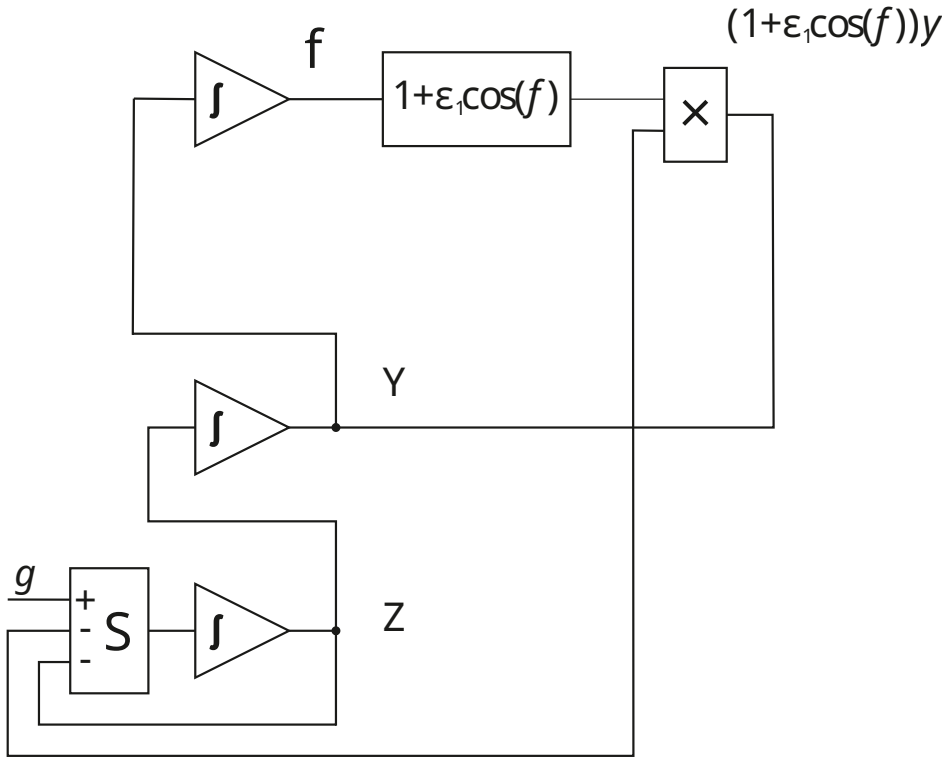
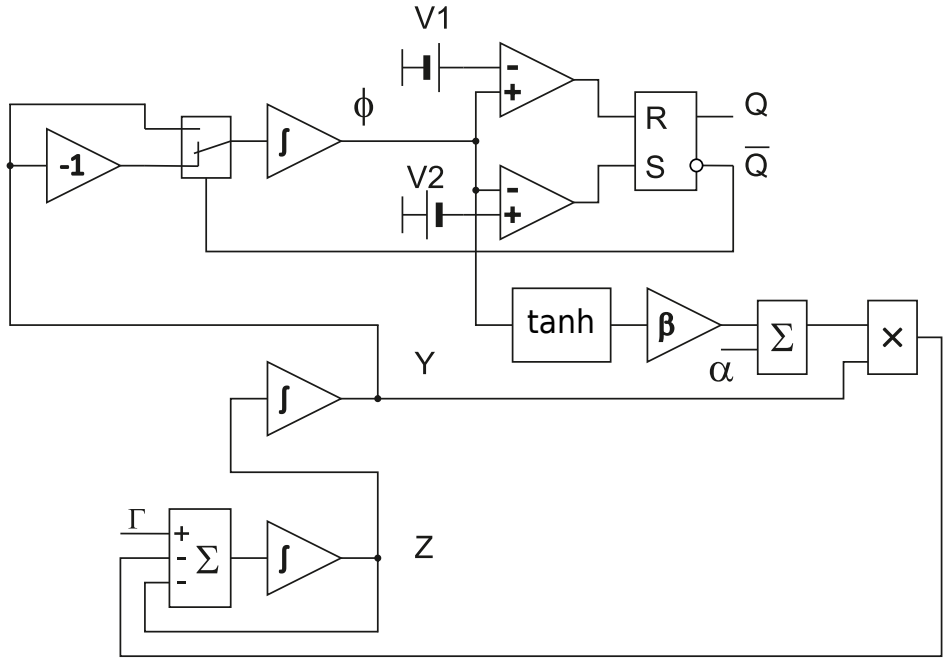
The authors construct an electronic bursting neuron by implementing a set of modified phase-locked loop equations in analog hardware. Starting from phenomenological models that already produce the required bursting patterns, they alter the equations specifically to allow a simpler circuit realization; the built circuit then reproduces the mathematical behavior and supports both single-neuron and small-network descriptions.
What carries the argument
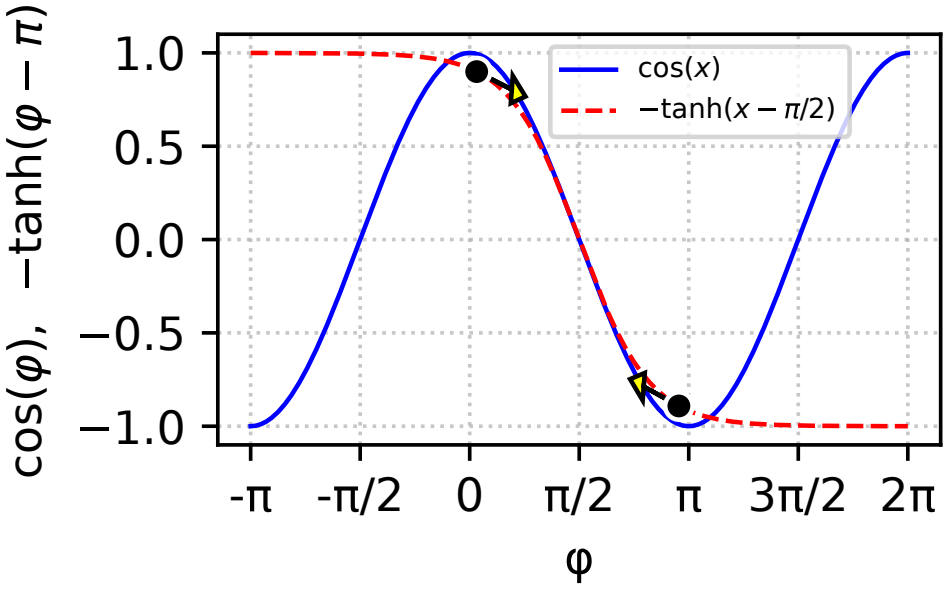
Hybrid adjustment of phase-locked loop phenomenological equations to enable a minimal analog circuit that still generates the full set of demanded bursting regimes.
If this is right
- The circuit can be assembled from standard, low-cost components.
- Mathematical analysis of the equations directly predicts hardware behavior.
- Small networks of these neurons become feasible without prohibitive complexity.
- The same neuron can be tuned across multiple bursting types by parameter changes.
Where Pith is reading between the lines
- If the circuit remains simple when coupled, larger networks could be prototyped on breadboards or PCBs.
- The method of equation-first adjustment may apply to other neuron classes such as regular spiking or chattering cells.
- Integration with existing analog computing elements could allow hybrid digital-analog neural emulators.
Load-bearing premise
Equations can be changed to reduce hardware parts while still producing every required bursting pattern without losing the essential dynamics.
What would settle it
Build the proposed circuit and compare its output spike trains against numerical integration of the stated equations under the same parameter values; mismatch in regime boundaries or waveform shapes would disprove the match.
Figures
read the original abstract
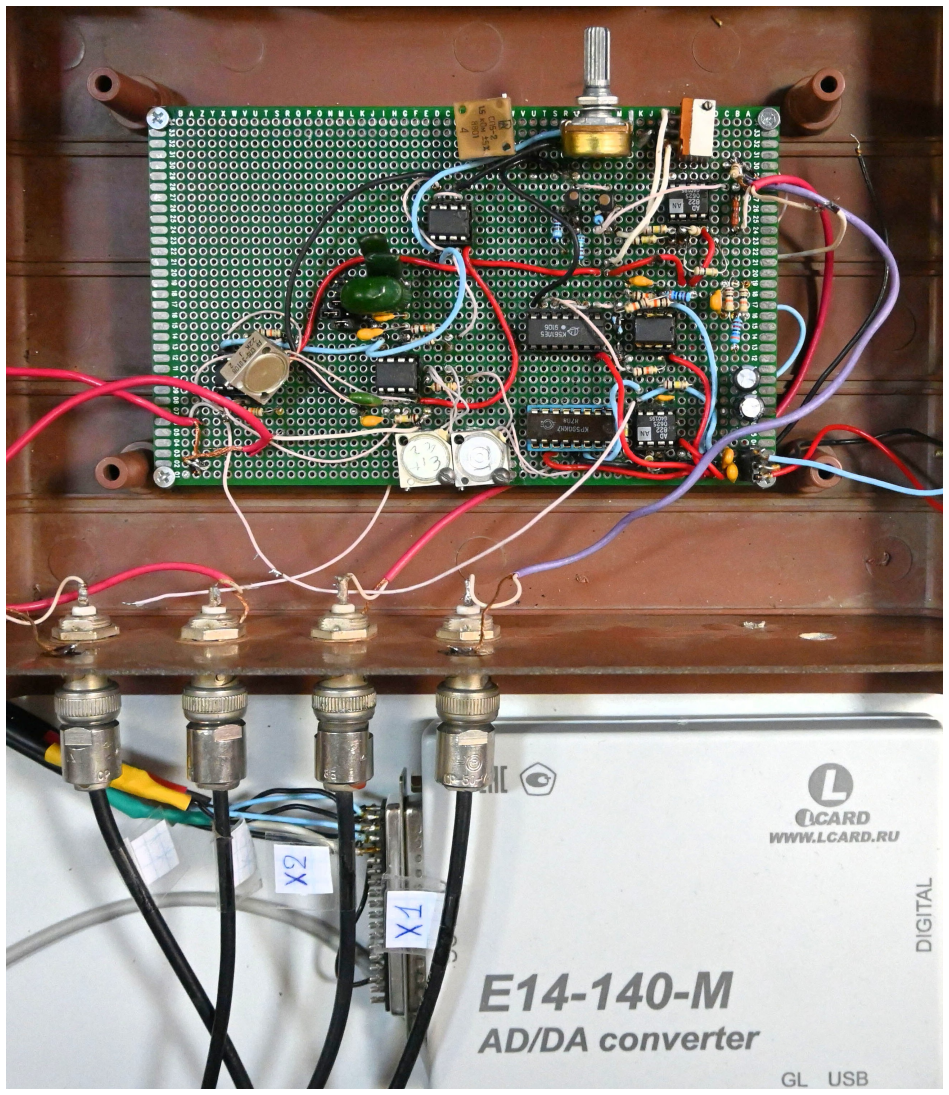
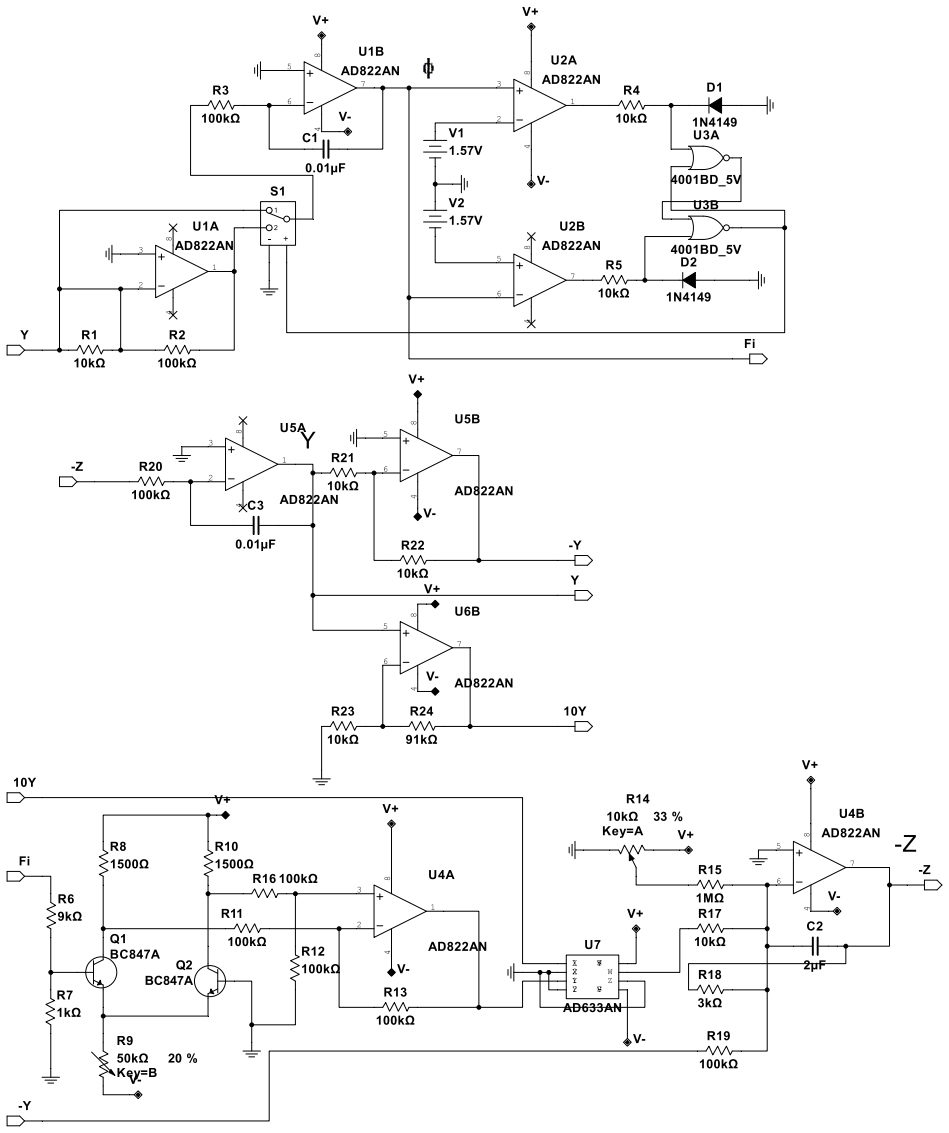
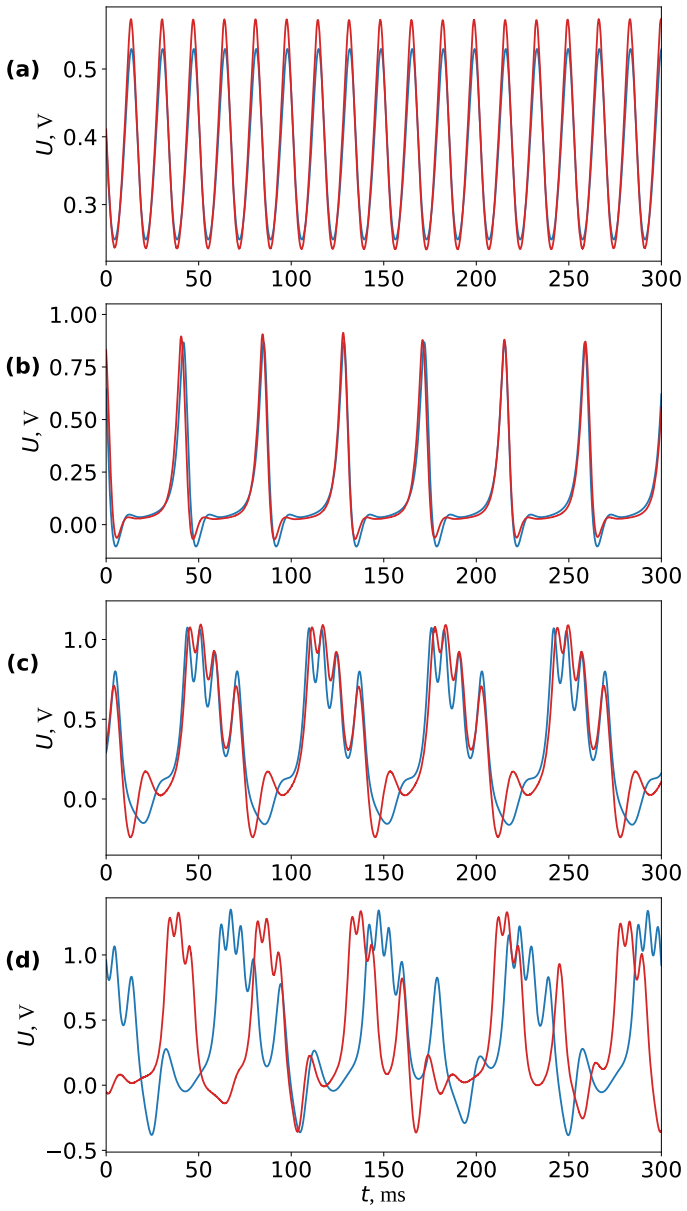
Electronic neurons are a keystone for construction of the spiking neural networks which have numerous applications in neuroprosthetics, artificial memory, intensive calculations etc. A number of concepts of electronic neurons has been already proposedm with some of them implemented in hardware. However, new schemes are of significant interest since the existing ones do not fit all requirements: either they are too complex and expensive in realization, or they are not able to demonstrate all demanded regimes, or their do not have a appropriate mathematical description and therefore may be investigated only experimentally etc. In this study we propose a new design of bursting electronic neuron constructed as a circuit implementation of the equations of a phase-locked loop system. To succeed, we use a novel hybrid approach: we start from the phenomenological equations providing the demanded, then we adjust and modify these equations to simplify the implementation rather than implementing the biophysical equations into thee hardware directly or writing equations for the already constructed circuit. The resulting circuit is simple in implementation and well matches the underlying equations. It can be used for description of not only a single neuron, but small neural circuits too.
Editorial analysis
A structured set of objections, weighed in public.
Referee Report
Summary. The manuscript proposes a hybrid design for an electronic bursting neuron: phenomenological equations are selected to produce desired bursting regimes, then adjusted and modified to enable a simple circuit realization based on a phase-locked loop system. The central claim is that the resulting hardware circuit is straightforward to implement, well matches the (modified) underlying equations, and can be extended to small neural circuits.
Significance. If the modifications preserve the full set of bursting regimes and the hardware faithfully reproduces the equations (with supporting verification), the approach could supply a practical, low-complexity hardware neuron primitive for spiking neural networks, addressing gaps in existing designs that are either overly complex or lack mathematical grounding.
major comments (2)
- [Abstract] Abstract: the claim that 'the resulting circuit is simple in implementation and well matches the underlying equations' is unsupported by any verification data, error analysis, simulation-to-hardware comparison, or demonstration that multiple demanded bursting regimes are achieved in the physical circuit.
- [Abstract] The hybrid method (phenomenological equations chosen then modified for hardware convenience): without explicit comparison of phase portraits, bifurcation diagrams, or attractor sets before versus after the adjustments, it is unclear whether all demanded bursting regimes and their transitions are retained; this is load-bearing for the completeness claim.
minor comments (1)
- [Abstract] Abstract contains multiple typographical errors ('proposedm', 'thee hardware', 'their do not have a appropriate') that should be corrected.
Simulated Author's Rebuttal
We thank the referee for the constructive comments. We address the two major points below and will revise the manuscript to strengthen the abstract and supporting analysis as indicated.
read point-by-point responses
-
Referee: [Abstract] Abstract: the claim that 'the resulting circuit is simple in implementation and well matches the underlying equations' is unsupported by any verification data, error analysis, simulation-to-hardware comparison, or demonstration that multiple demanded bursting regimes are achieved in the physical circuit.
Authors: We agree the abstract claim requires explicit support. The manuscript body contains SPICE simulations, equation-to-circuit comparisons, and hardware prototype results demonstrating agreement across bursting regimes. We will revise the abstract to reference these verifications (e.g., noting simulation-to-hardware match and regime coverage) and ensure error metrics and multi-regime demonstrations are clearly highlighted or added as a summary figure in the revision. revision: yes
-
Referee: [Abstract] The hybrid method (phenomenological equations chosen then modified for hardware convenience): without explicit comparison of phase portraits, bifurcation diagrams, or attractor sets before versus after the adjustments, it is unclear whether all demanded bursting regimes and their transitions are retained; this is load-bearing for the completeness claim.
Authors: The referee correctly notes the absence of direct dynamical comparisons. While the text describes the modifications and states that key regimes are retained, no before/after phase portraits or bifurcation diagrams are provided. We will add a dedicated subsection with these comparisons in the revised manuscript to confirm preservation of bursting regimes and transitions. revision: yes
Circularity Check
Hardware-driven modification of phenomenological equations renders match claim tautological
specific steps
-
self definitional
[Abstract]
"we start from the phenomenological equations providing the demanded, then we adjust and modify these equations to simplify the implementation rather than implementing the biophysical equations into thee hardware directly or writing equations for the already constructed circuit. The resulting circuit is simple in implementation and well matches the underlying equations."
Equations are adjusted specifically to simplify hardware implementation; the circuit is then asserted to 'well match' those (now-modified) equations. The match follows directly from having implemented the adjusted equations, without separate demonstration that the modifications retain the original demanded bursting dynamics.
full rationale
The paper's central method begins with phenomenological equations for bursting, then explicitly adjusts those equations to enable simple circuit realization. The subsequent claim that the implemented circuit 'well matches the underlying equations' therefore holds by construction once the circuit is built from the modified equations. No independent verification is described that the adjustments preserve the full set of demanded regimes and bifurcations from the original phenomenological model. This reduces the load-bearing performance assertion to the authors' modification choices rather than an external derivation or test.
Axiom & Free-Parameter Ledger
Reference graph
Works this paper leans on
-
[1]
A. Hodgkin, A. Huxley, A quantitative description of membrane current and its application to conduction and excitation in nerve, J. Physiol. 117 (1952) 500–544. doi:10.1113/jphysiol.1952.sp004764
-
[2]
1 (1961) 445–466
R.FitzHugh, Impulsesandphysiologicalstatesintheoreticalmodelsofnervemembrane, Biophysical J. 1 (1961) 445–466
1961
-
[3]
Nagumo, S
J. Nagumo, S. Arimoto, S. Yoshizawa, An active pulse transmission line simulating nerve axon, Proc. IRE 50 (1962) 2061–2070
1962
-
[4]
E. M. Izhikevich, Dynamical systems in neuroscience, MIT press, Cambridge, MA, USA, 2007
2007
-
[5]
L. Chua, Memristor, hodgkin-huxley, and edge of chaos, Handbook of Memristor Net- works (2019) 287–313doi:10.1007/978-3-319-76375-0\_10
-
[6]
P. Baryczkowski, S. Szczepaniak, N. Matykiewicz, K. Perz, S. Szcze ˛sny, Study of the complexity of cmos neural network implementations featuring heart rate detection, Elec- tronics 12 (20) (2023) 4291.doi:10.3390/electronics12204291
-
[7]
H. Peng, L. Gan, X. Guo, Memristor-based spiking neural networks: cooperative devel- opment of neural network architecture/algorithms and memristors, Chip 3 (2) (2024) 100093.doi:10.1016/j.chip.2024.100093
-
[8]
G. Tanaka, T. Yamane, J. B. H´ eroux, R. Nakane, N. Kanazawa, S. Takeda, H. Numata, D. Nakano, A. Hirose, Recent advances in physical reservoir computing: A review, Neural Networks 115 (2019) 100–123.doi:10.1016/j.neunet.2019.03.005
-
[9]
D. Markovi´ c, A. Mizrahi, D. Querlioz, J. Grollier, Physics for neuromorphic computing, Nature Reviews Physics 2 (2020) 499–510.doi:10.1038/s42254-020-0208-2
-
[10]
L. Larger, M. C. Soriano, D. Brunner, L. Appeltant, J. M. Guti´ errez, L. Pesquera, C. R. Mirasso, I. Fischer, Photonic information processing beyond Turing: an optoelectronic implementation of reservoir computing, Optics express 20 (3) (2012) 3241–3249.doi: 10.1364/OE.20.003241. 11
-
[11]
G. Indiveri, B. Linares-Barranco, T. J. Hamilton, A. v. Schaik, R. Etienne-Cummings, T. Delbruck, S.-C. Liu, P. Dudek, P. H¨ afliger, S. Renaud, et al., Neuromorphic sili- con neuron circuits, Frontiers in neuroscience 5 (2011) 73.doi:10.3389/fnins.2011. 00073
-
[12]
Mahowald, R
M. Mahowald, R. Douglas, A silicon neuron, Nature 354 (1991) 515–518.doi:10.1038/ 354515a0
1991
-
[13]
C. Rasche, R. Douglas, An improved silicon neuron, Analog Integrated Circuits and Signal Processing 23 (2000) 227–236.doi:10.1023/A:1008357931826
-
[14]
A. van Schaik, Building blocks for electronic spiking neural networks, Neural Networks 14 (6) (2001) 617–628.doi:10.1016/S0893-6080(01)00067-3
-
[15]
S. Binczak, V. B. Kazantsev, V. I. Nekorkin, J. M. Bilbault, Experimental study of bifurcations in modified FitzHugh–Nagumo cell, Electronics Letters 39 (13) (2003) 1. doi:doi:10.1049/el:20030657
-
[16]
F. Li, Q. Liu, H. Guo, Y. Zhao, J. Tang, J. Ma, Simulating the electric activity of FitzHugh-Nagumo neuron by using josephson junction model, Nonlinear Dynamics 69 (4) (2012) 2169–2179.doi:10.1007/s11071-012-0417-z
-
[17]
D. Kulminskiy, V. Ponomarenko, M. Prokhorov, A. Hramov, Synchronization in en- sembles of delay-coupled nonidentical neuronlike oscillators, Nonlinear Dynamics 98 (1) (2019) 735–748.doi:10.1007/s11071-019-05224-x
-
[18]
N. M. Egorov, I. V. Sysoev, V. I. Ponomarenko, M. V. Sysoeva, Complex regimes in electronic neuron-like oscillators with sigmoid coupling, Chaos, Solitons & Fractals 160 (2022) 112171.doi:10.1016/j.chaos.2022.112171
-
[19]
X.Hu, C.Liu, L.Liu, J.Ni, S.Li, AnelectronicimplementationforMorris–Lecarneuron model, Nonlinear Dynamics 84 (2016) 2317–2332.doi:10.1007/s11071-016-2647-y
-
[20]
E. Farquhar, P. Hasler, A bio-physically inspired silicon neuron, IEEE Transactions on Circuits and Systems I: Regular Papers 52 (3) (2005) 477–488.doi:10.1109/TCSI. 2004.842871
-
[21]
Q. Ma, M. R. Haider, V. L. Shrestha, Y. Massoud, Bursting hodgkin–huxley model- based ultra-low-power neuromimetic silicon neuron, Analog Integrated Circuits and Signal Processing 73 (2012) 329–337.doi:10.1007/s10470-012-9888-6
-
[22]
G. H. Rutherford, Z. D. Mobille, J. Brandt-Trainer, R. Follmann, E. Rosa, Analog implementation of a hodgkin–huxley model neuron, American Journal of Physics 88 (11) (2020) 918–923.doi:10.1119/10.0001072
-
[23]
M. A. Mishchenko, V. D. Shalfeev, V. V. Matrosov, Neuron-like dynamics in phase- locked loop, Izvestiya VUZ. Applied Nonlinear Dynamics 20 (4) (2012) 122–130.doi: 10.18500/0869-6632-2012-20-4-122-130
-
[24]
V. V. Matrosov, M. A. Mishchenko, V. D. Shalfeev, Neuron-like dynamics of a phase- locked loop, The European Physical Journal Special Topics 222 (10) (2013) 2399–2405. doi:10.1140/epjst/e2013-02024-9. 12
-
[25]
M. A. Mishchenko, D. I. Bolshakov, V. Matrosov, Instrumental implementation of a neuronlike generator with spiking and bursting dynamics based on a phase-locked loop, Tech. Phys. Lett. 43 (2017) 596–599.doi:10.1134/S1063785017070100
-
[26]
V. D. Shalfeev, Investigation of the dynamics of a system of automatic phase control of frequency with a coupling capacitor in the control loop, Radiophys Quantum Electron 11 (3) (1968) 221–226
1968
-
[27]
Ulmann, Analog and hybrid computer programming, 2nd Edition, Walter de Gruyter GmbH & Co KG, 2023
B. Ulmann, Analog and hybrid computer programming, 2nd Edition, Walter de Gruyter GmbH & Co KG, 2023
2023
-
[28]
M. A. Mishchenko, D. I. Bolshakov, A. S. Vasin, V. V. Matrosov, I. V. Sysoev, Identi- fication of phase-locked loop system from its experimental time series, IEEE Trans- actions on Circuits and Systems II: Express Briefs 69 (3) (2022) 854–858.doi: 10.1109/TCSII.2021.3122892
-
[29]
A. van Ooytien, J. Van Pelt, M. Corner, F. Lopes da Silva, The emergence of long- lasting transients of activity in simple neural networks, Biological cybernetics 67 (3) (1992) 269–277.doi:10.1007/BF00204400
-
[30]
H. Riecke, A. Roxin, S. Madruga, S. A. Solla, Multiple attractors, long chaotic tran- sients, and failure in small-world networks of excitable neurons, Chaos: An Interdisci- plinary Journal of Nonlinear Science 17 (2) (2007).doi:10.1063/1.2743611
-
[31]
V. S. Afraimovich, M. I. Rabinovich, P. Varona, Heteroclinic contours in neural ensem- bles and the winnerless competition principle, International Journal of Bifurcation and Chaos 14 (04) (2004) 1195–1208.doi:10.1142/S0218127404009806
-
[32]
N. M. Egorov, M. V. Sysoeva, M. V. Kornilov, V. I. Ponomarenko, I. V. Sysoev, Hardware implementation of the ring generator with tunable frequency based on elec- tronic neurons, Nonlinear Dynamics 112 (13) (2024) 11471–11481.doi:10.1007/ s11071-024-09671-z
2024
-
[33]
G. V. Savino, C. M. Formigli, Nonlinear electronic circuit with neuron like bursting and spiking dynamics, Biosystems 97 (1) (2009) 9–14.doi:10.1016/j.biosystems.2009. 03.005. 13
discussion (0)
Sign in with ORCID, Apple, or X to comment. Anyone can read and Pith papers without signing in.