l-forbidden M1 strengths near ¹⁰⁰Sn from knockout reactions in Cd and Sn
Pith reviewed 2026-07-03 01:46 UTC · model grok-4.3
The pith
Neutron knockout measurements find that VS-IMSRG calculations underpredict l-forbidden M1 strengths near 100Sn.
A machine-rendered reading of the paper's core claim, the machinery that carries it, and where it could break.
Core claim
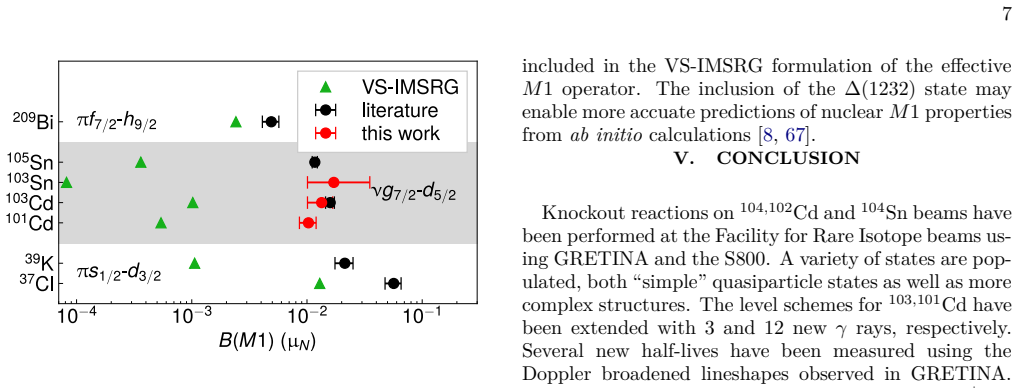
The VS-IMSRG calculations under-predict the l-forbidden M1 strengths in the 100Sn region, as well as in other regions of the nuclear chart near 40Ca and 208Pb.
What carries the argument
Doppler-shifted gamma-ray lineshape analysis from knockout reactions to determine B(M1) strengths for the nu g7/2 7/2+ states.
If this is right
- The l-forbidden M1 strengths near 100Sn are larger than VS-IMSRG predicts.
- The same underprediction pattern appears in the 40Ca and 208Pb regions.
- Refinement of the effective M1 operator or valence-space treatment is required to match the measured values.
Where Pith is reading between the lines
- The discrepancy may indicate missing contributions from core excitations or higher-order effective operators across multiple shell closures.
- Systematic measurements of similar transitions in additional nuclei could map whether the underprediction is universal.
- If confirmed, the result would constrain the development of improved nuclear Hamiltonians for medium-mass and heavy nuclei.
Load-bearing premise
The populated states are correctly assigned as 7/2+ nu g7/2 levels and the extracted half-lives accurately reflect the B(M1) strengths without large unaccounted systematics.
What would settle it
A new measurement or reanalysis that yields B(M1) strengths matching the VS-IMSRG predictions in these nuclei would falsify the reported underprediction.
Figures






read the original abstract
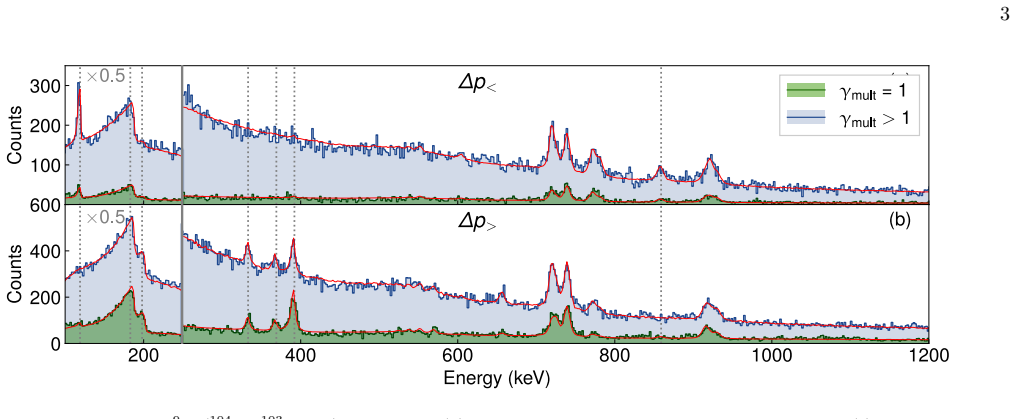
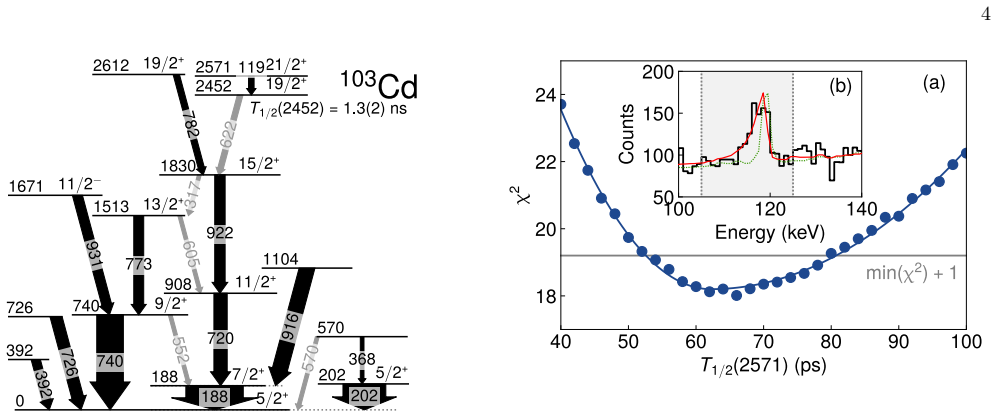
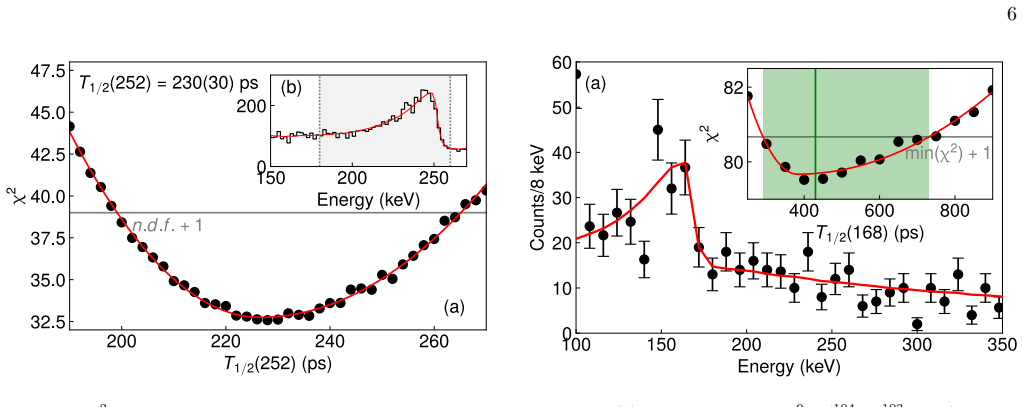
Neutron knockout reactions on beams of $^{104,102}$Cd, and $^{104}$Sn are presented. States in the residual $^{103,101}$Cd and $^{103}$Sn nuclei are populated, including low-lying $7/2^+$ states of $\nu g_{7/2}$ character. These states have half-lives $\approx 400$ ps due to their low energy and hindered $B(M1; 7/2^+ \rightarrow 5/2^+)$ strengths. The excited-state half-lives were measured using their Doppler-shifted lineshapes, and the resulting $B(M1)$ strengths are compared to Valence Space In Medium Similarity Renormalization Group (VS-IMSRG) calculations. The VS-IMSRG calculations under-predict the $l$-forbidden $M1$ strengths in the $^{100}$Sn region, as well as in other regions of the nuclear chart near $^{40}$Ca and $^{208}$Pb.
Editorial analysis
A structured set of objections, weighed in public.
Referee Report
Summary. The manuscript reports neutron knockout reactions using beams of 104Cd, 102Cd, and 104Sn to populate low-lying states in the odd-A residuals 103Cd, 101Cd, and 103Sn. It assigns 7/2+ states of νg7/2 character, extracts their half-lives (~400 ps) and the resulting B(M1; 7/2+ → 5/2+) strengths via Doppler-shifted γ-ray lineshape analysis, and compares the measured l-forbidden M1 strengths to VS-IMSRG calculations. The central claim is that VS-IMSRG systematically under-predicts these strengths both in the 100Sn region and near other shell closures (40Ca, 208Pb).
Significance. If the experimental B(M1) values are shown to be robust, the result would establish a clear, multi-region benchmark indicating that current VS-IMSRG truncations miss important contributions to l-forbidden M1 matrix elements near closed shells. This would directly inform the development of improved effective operators or extended valence spaces in ab initio calculations for heavy nuclei.
major comments (2)
- [Section 3] Doppler lineshape analysis (Section 3): the extraction of the ~400 ps half-lives for the 7/2+ states relies on assumptions about feeding, target stopping powers, and reaction kinematics that are not quantified with sensitivity studies; a 30-50% systematic shift in any of these would remove or reverse the reported discrepancy with VS-IMSRG.
- [Section 2.2 and Table 1] State identification (Section 2.2 and Table 1): the assignment of the observed low-lying states as the νg7/2 7/2+ levels is based on systematics and γ-ray branching; no cross-checks (e.g., angular distributions or transfer data) are presented to exclude alternative spin-parity assignments that would invalidate the B(M1) comparison.
minor comments (2)
- [Abstract] The abstract and introduction use “under-predict” without stating the typical factor (e.g., 2–3) by which theory falls short of experiment; this should be quantified in the text.
- [Figure 4] Figure 4 caption should explicitly state the experimental and theoretical B(M1) values plotted, including uncertainties.
Simulated Author's Rebuttal
We thank the referee for the careful and constructive review of our manuscript. We address each major comment below with point-by-point responses. Where appropriate, we indicate revisions that will be incorporated into a revised version of the manuscript.
read point-by-point responses
-
Referee: [Section 3] Doppler lineshape analysis (Section 3): the extraction of the ~400 ps half-lives for the 7/2+ states relies on assumptions about feeding, target stopping powers, and reaction kinematics that are not quantified with sensitivity studies; a 30-50% systematic shift in any of these would remove or reverse the reported discrepancy with VS-IMSRG.
Authors: We agree that the original manuscript did not include explicit sensitivity studies for the Doppler lineshape analysis. The half-lives were extracted using the standard Doppler-shift attenuation method with stopping powers from established codes and feeding intensities derived from the measured γ-ray intensities. In the revised manuscript we will add a new subsection quantifying the impact of variations in stopping powers (±10% as typical for SRIM uncertainties), feeding assumptions, and kinematic effects from the knockout reaction. These studies indicate that the extracted half-lives shift by at most 15–20%, which is insufficient to remove the reported discrepancy with VS-IMSRG. We therefore maintain the robustness of the central result while acknowledging that the added quantification improves the presentation. revision: yes
-
Referee: [Section 2.2 and Table 1] State identification (Section 2.2 and Table 1): the assignment of the observed low-lying states as the νg7/2 7/2+ levels is based on systematics and γ-ray branching; no cross-checks (e.g., angular distributions or transfer data) are presented to exclude alternative spin-parity assignments that would invalidate the B(M1) comparison.
Authors: The 7/2+ assignments follow from well-established systematics across the Cd and Sn chains near N=50, where the νg7/2 orbital produces the characteristic low-lying 7/2+ states, together with the observed γ-ray branching ratios that match the expected hindered M1 transitions. The selective population in neutron knockout further supports these assignments over alternatives. We cannot add new experimental cross-checks such as angular distributions or transfer reactions, as those data were not collected in the present experiment. In the revision we will expand Section 2.2 with an explicit discussion of possible alternative spin-parity assignments and why they are disfavored by both the reaction mechanism and the decay pattern, thereby clarifying the validity of the B(M1) comparison. revision: partial
Circularity Check
No circularity: direct experimental B(M1) measurement compared to independent theory
full rationale
The paper reports knockout-reaction data, Doppler lineshape analysis to extract half-lives and B(M1; 7/2+ → 5/2+) values, and a straightforward numerical comparison of those measured strengths to VS-IMSRG results. No equation, fit, or self-citation chain reduces the reported under-prediction to a tautology or to the input data themselves. The VS-IMSRG calculations are external to the present work and the experimental extraction does not invoke any fitted parameter that is then relabeled as a prediction.
Axiom & Free-Parameter Ledger
Reference graph
Works this paper leans on
-
[1]
P. L. Sassarini, J. Dobaczewski, J. Bonnard, and R. F. G. Ruiz, J. Phys. G: Nucl. Phys. 49, 11LT01 (2022)
work page 2022
- [2]
- [3]
- [4]
- [5]
-
[6]
V. Pascalutsa, M. Vanderhaeghen, and S. N. Yang, Phys. Rep. 437, 125232 (2007)
work page 2007
-
[7]
J. L. Rodríguez-Sánchez, J. Benlliure, I. Vidaña, et al. , Phys. Rev. C 106, 014618 (2022)
work page 2022
-
[8]
I. S. Towner and F. C. Khanna, Nucl. Phys. A 399, 334364 (1983)
work page 1983
-
[9]
I. S. Towner, Phys. Rep. 155, 263377 (1987)
work page 1987
- [10]
- [11]
-
[12]
S. R. Stroberg, J. D. Holt, A. Schwenk, and J. Simonis, Phys. Rev. Lett. 126, 022501 (2021)
work page 2021
-
[13]
S. R. Stroberg, A. Calci, H. Hergert, et al. , Phys. Rev. Lett. 118, 032502 (2017)
work page 2017
-
[14]
B. A. Brown and B. H. Wildenthal, Phys. Rev. C 28, 2397 (1983)
work page 1983
-
[15]
B. A. Brown and B. H. Wildenthal, Nucl. Phys. A 474, 290306 (1987)
work page 1987
-
[16]
S. R. Stroberg, A. Gade, T. Baugher, et al. , Phys. Rev. C 86, 024321 (2012)
work page 2012
-
[17]
S. Bhattacharya, V. Tripathi, S. L. Tabor, et al. , Phys. Rev. C 108, 024312 (2023)
work page 2023
-
[18]
V. Tripathi, S. Bhattacharya, E. Rubino, et al. , Phys. Rev. C 109, 044320 (2024)
work page 2024
-
[19]
D. R. Semon, M. C. Allen, H. Dejbakhsh, et al. , Phys. Rev. C 53, 96 (1996)
work page 1996
- [20]
-
[21]
D. Seweryniak, M. P. Carpenter, S. Gros, et al. , Phys. Rev. Lett. 99, 022504 (2007)
work page 2007
-
[22]
I. G. Darby, R. K. Grzywacz, J. C. Batchelder, et al. , Phys. Rev. Lett. 105, 162502 (2010)
work page 2010
-
[23]
J. M. Wouters, H. M. Thierens, J. Äystö, et al. , Phys. Rev. C 27, 1745 (1983)
work page 1983
-
[24]
J. Verplancke, E. Coenen, K. Cornelis, et al. , Z. Phys. A 315, 307 (1984)
work page 1984
-
[25]
V. R. Bom, R. W. Hollander, E. Coenen, et al. , Z. Phys. A 331, 21 (1988)
work page 1988
- [26]
- [27]
- [28]
- [29]
-
[30]
A. Chakraborty, Krishichayan, S. Mukhopadhyay, et al. , Phys. Rev. C 76, 044327 (2007)
work page 2007
- [31]
- [32]
- [33]
-
[34]
D. Seweryniak, W. B. Walters, A. Woehr, et al. , Phys. Rev. C 66, 051307 (2002)
work page 2002
-
[35]
C. Fahlander, M. Palacz, D. Rudolph, et al. , Phys. Rev. C 63, 021307 (2001)
work page 2001
- [36]
-
[37]
S. Paschalis, I. Lee, A. Macchiavelli, et al., Nucl. Instrum. Methods Phys. Rev., Sect. A 709, 44 (2013)
work page 2013
-
[38]
A. F. Ayres, A Study of the Structure of Light Tin Iso- topes via Single-Neutron Knockout Reactions , Ph.D. the- sis, University of Tennessee (2014)
work page 2014
-
[39]
B. R. Longfellow, Coulomb excitation of neutron-rich sulfur isotopes , Ph.D. thesis, Michigan State University (2020)
work page 2020
-
[40]
S. M. McDaniel, A study of complementary reactions: single-proton knockout and single-particle pickup , Ph.D. thesis, Michigan State University (2011)
work page 2011
-
[41]
S. R. Stroberg, Single-particle structure of neutron-rich Silicon isotopes and the breakdown of the N = 28 shell closure, Ph.D. thesis , Michigan State University (2014)
work page 2014
- [42]
-
[43]
S. Agostinelli, J. Allison, K. Amako, et al., Nucl. Instrum. Methods Phys. Rev., Sect. A 506, 250 (2003)
work page 2003
-
[44]
O. Tange, Gnu parallel 20251222 (’bondi’) (2025), GNU Parallel is a general parallelizer to run multiple serial command line programs in parallel without changing them
work page 2025
-
[45]
A. Gade, B. A. Brown, D. Weisshaar, et al. , Phys. Rev. Lett. 129, 242501 (2022)
work page 2022
-
[46]
A. Gade, D. Weisshaar, B. A. Brown, et al. , Phys. Rev. C 106, 064303 (2022)
work page 2022
-
[47]
A. Gade, P. Adrich, D. Bazin, et al. , Phys. Lett. B 666, 218221 (2008)
work page 2008
-
[48]
S. R. Stroberg, A. Gade, J. A. Tostevin, et al. , Phys. Rev. C 90, 034301 (2014)
work page 2014
-
[49]
A. Mutschler, O. Sorlin, A. Lemasson, et al. , Phys. Rev. C 93, 034333 (2016)
work page 2016
-
[50]
H. L. Crawford, A. O. Macchiavelli, P. Fallon, et al. , Phys. Rev. C 95, 064317 (2017)
work page 2017
-
[51]
M. Spieker, A. Gade, D. Weisshaar, et al. , Phys. Rev. C 99, 051304 (2019)
work page 2019
-
[52]
See Supplementary Material for population amplitudes and corresponding γ-ray intensities
- [55]
-
[56]
J. Shergur, B. A. Brown, V. Fedoseyev, et al. , Phys. Rev. C 65, 034313 (2002)
work page 2002
-
[57]
A. F. Lisetskiy, B. A. Brown, M. Horoi, and H. Grawe, Phys. Rev. C 70, 044314 (2004)
work page 2004
-
[58]
Shimizu, Nuclear shell-model code for massive parallel computation, “KSHELL” (2013)
N. Shimizu, Nuclear shell-model code for massive parallel computation, “KSHELL” (2013)
work page 2013
-
[59]
G. Pasqualato, A. Gottardo, D. Mengoni, et al. , Phys. Lett. B 845, 138148 (2023)
work page 2023
-
[60]
Blachot, Nuclear Data Sheets 109, 13831526 (2008)
J. Blachot, Nuclear Data Sheets 109, 13831526 (2008)
work page 2008
-
[61]
S. Lalkovski, J. Timar, and Z. Elekes, Nuclear Data Sheets 161-162, 1353 (2019)
work page 2019
-
[62]
B. A. Brown, N. J. Stone, J. R. Stone, et al. , Phys. Rev. C 71, 044317 (2005)
work page 2005
-
[63]
S. R. Stroberg, H. Hergert, S. K. Bogner, and J. D. Holt, Annu. Rev. Nucl. Part. Sci. 69, 307 (2019)
work page 2019
-
[64]
Improved nuclear matter calculations from chiral low-momentum interactions
K. Hebeler, S. K. Bogner, R. J. Furnstahl, et al. , Phys. Rev. C 83, 031301 (2011) , 1012.3381. 9
work page internal anchor Pith review Pith/arXiv arXiv 2011
-
[65]
D. R. Entem and R. Machleidt, Phys. Rev. C 68, 041001 (2003)
work page 2003
-
[66]
S. R. Stroberg, github.com/ragnarstroberg/imsrg (2023)
work page 2023
- [67]
-
[68]
J. Cameron, J. Chen, B. Singh, and N. Nica, Nuclear Data Sheets 113, 365514 (2012)
work page 2012
- [69]
-
[70]
Chen, Nuclear Data Sheets 149, 1251 (2018)
J. Chen, Nuclear Data Sheets 149, 1251 (2018) . 1 I. SUPPLEMENT AL MA TERIAL Tables I and II give the relative population amplitudes and γ-ray intensities following the 9Be(104Cd,103Sn+γ)X and 9Be(102Cd,101Cd+γ)X reactions. Uncertainties for newly-observed transition energies are also given in Table II. For previously observed transi- tions, the energies ...
work page 2018
-
[71]
De Frenne, Nuclear Data Sheets 110, 20812256 (2009)
D. De Frenne, Nuclear Data Sheets 110, 20812256 (2009)
work page 2009
-
[72]
ENSDF version as of July 2006, https://www.nndc.bnl. gov/ensdfarchivals/
work page 2006
discussion (0)
Sign in with ORCID, Apple, or X to comment. Anyone can read and Pith papers without signing in.