REVIEW 1 major objections 26 references
Refinement of Reliability Grid Codes in the Provision of Ancillary Services
T0 review · 1 major / 0 minor · reviewed 2026-07-03 · grok-4.3
Pith's one-line read A bilevel optimization model shows the cost-optimal reliability threshold for stochastic reserve providers lies below the conventional P90 level.
desk verdict The paper endogenizes the reliability threshold in a bilevel model and reports up to 14.5% cost savings versus fixed P90 in the Nordic FCR-D market, but the closed-form chance constraints rest on an unvalidated Weibull assumption. read the letter →
The pith
A machine-rendered reading of the paper's core claim, the machinery that carries it, and where it could break.
The reading
What carries the argument
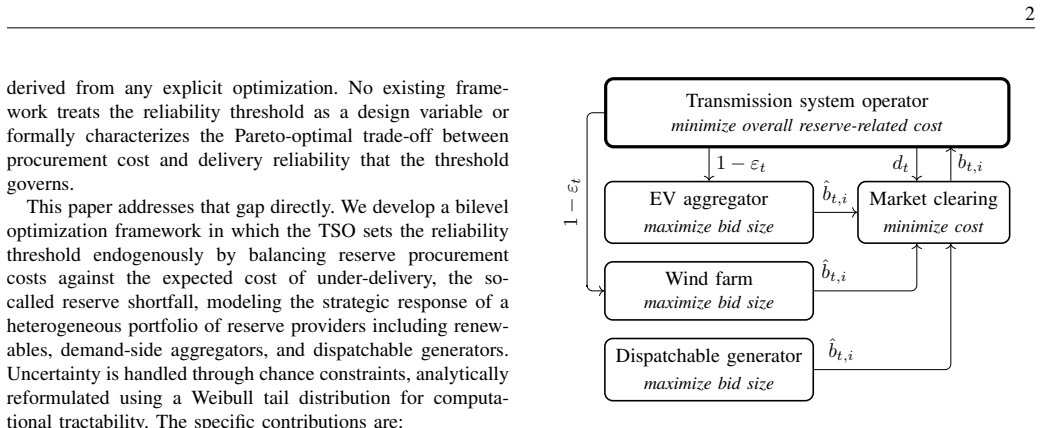
Bilevel optimization framework in which the TSO sets the reliability threshold in the upper level and stochastic providers respond with reliability-constrained bids in the lower level, using analytical reformulation of chance constraints via Weibull tail distribution.
What would settle it
Implement the model's cost-optimal threshold in the actual Nordic FCR-D market clearing and measure whether realized procurement costs fall by approximately 14.5 percent while accepted bids continue to meet the chosen reliability level.
Extended reading notes
Core claim
The central claim is that endogenizing the reliability threshold via bilevel optimization, with chance constraints reformulated analytically from a Weibull tail distribution on delivery uncertainty, yields a cost-optimal threshold below P90 that reduces total procurement costs by as much as 14.5 percent in the studied Nordic FCR-D cases, while dynamic hourly thresholds provide further reductions up to 2.4 percent.
Load-bearing premise
Delivery uncertainty of stochastic providers follows a Weibull tail distribution that permits exact analytical reformulation of the chance constraints.
Editorial extensions
If this is right
- Total reserve procurement costs fall when the TSO selects a threshold below the current P90 standard.
- Stochastic providers submit larger accepted bids at the optimized threshold without violating reliability requirements.
- Allowing the threshold to adjust each hour produces additional cost savings beyond a static threshold.
- The same bilevel structure can be applied to other ancillary service products that admit stochastic participation.
Reading between the lines
- In markets with greater diversity of stochastic resources the value of hourly threshold adjustment would likely increase.
- Regulatory bodies could replace fixed probability thresholds with a periodic optimization process that updates the requirement based on observed bid distributions.
- The framework could be extended to joint procurement across multiple ancillary services to capture cross-product reliability interactions.
Signed reviews
Editorial analysis
A structured set of objections, weighed in public.
Referee Report
Summary. The manuscript develops a bilevel optimization framework in which the TSO endogenously sets a reliability threshold for stochastic reserve providers while lower-level providers optimize bids subject to chance constraints that are analytically reformulated under a Weibull tail assumption on delivery uncertainty. Applied to the Nordic FCR-D market, the cost-optimal threshold lies below the conventional P90 level, producing cost reductions of up to 14.5% relative to the fixed standard, with dynamic hourly thresholds yielding an additional 2.4% reduction.
Significance. If the distributional assumption holds, the work supplies a quantitative method for treating reliability thresholds as design variables rather than regulatory constants, which could improve efficiency in ancillary-service markets with growing stochastic participation. The closed-form chance-constraint reformulation is a methodological contribution that enables tractable optimization; the numerical results on threshold location and savings are the primary empirical claim.
major comments (1)
- [chance-constraint reformulation (abstract and modeling sections)] The headline claims (optimal threshold below P90 and up to 14.5% cost reduction) rest on the Weibull tail assumption that permits exact analytical reformulation of the chance constraints. The abstract states this reformulation but the provided text contains no Kolmogorov-Smirnov test, tail-index estimation, or other goodness-of-fit evidence on actual Nordic FCR-D delivery traces, nor any sensitivity replacing Weibull with an empirical quantile or alternative distribution. Because the feasible set and objective are defined by this choice, the quantitative results cannot be assessed for robustness without such validation.
Simulated Author's Rebuttal
We thank the referee for the constructive comment on the robustness of our distributional assumptions. We address the point directly below and will revise the manuscript accordingly to strengthen the empirical support for the reported results.
read point-by-point responses
-
Referee: The headline claims (optimal threshold below P90 and up to 14.5% cost reduction) rest on the Weibull tail assumption that permits exact analytical reformulation of the chance constraints. The abstract states this reformulation but the provided text contains no Kolmogorov-Smirnov test, tail-index estimation, or other goodness-of-fit evidence on actual Nordic FCR-D delivery traces, nor any sensitivity replacing Weibull with an empirical quantile or alternative distribution. Because the feasible set and objective are defined by this choice, the quantitative results cannot be assessed for robustness without such validation.
Authors: We agree that explicit validation of the Weibull assumption on Nordic FCR-D data is necessary for assessing robustness of the quantitative claims. The Weibull tail was selected because it yields a closed-form reformulation of the chance constraints (detailed in the modeling section), which is the methodological contribution enabling the bilevel optimization. In the revised manuscript we will add: (i) Kolmogorov-Smirnov goodness-of-fit tests and maximum-likelihood tail-index estimates on historical Nordic delivery traces; (ii) sensitivity runs replacing the parametric assumption with empirical quantiles and with alternative distributions (lognormal, gamma). These additions will qualify the 14.5 % cost-reduction figure and the location of the optimal threshold without altering the core bilevel framework or the analytical reformulation itself. revision: yes
Circularity Check
No circularity: bilevel optimization derives threshold endogenously from market data and Weibull reformulation
full rationale
The derivation optimizes the reliability threshold as an upper-level decision variable in a bilevel program whose lower level produces reliability-constrained bids; the chance-constraint reformulation is obtained directly from the explicit Weibull tail assumption rather than from any fitted parameter or self-citation. The reported cost savings and optimal threshold below P90 are therefore computed outputs of the model applied to Nordic FCR-D data, not quantities that reduce to the inputs by construction. No self-citation load-bearing steps, uniqueness theorems, or renaming of known results appear in the provided text.
Assumptions & free parameters
free parameters (1)
- Weibull shape and scale parameters
assumptions (1)
- domain assumption Delivery uncertainty of stochastic providers admits an exact analytical reformulation via Weibull tail probabilities
Cite this review
Pith. "Pith review of Refinement of Reliability Grid Codes in the Provision of Ancillary Services." pith.science (2026). https://pith.science/paper/TGV2I7HQ
@misc{pith2026260702319,
  author       = {Pith},
  title        = {Pith review of: Refinement of Reliability Grid Codes in the Provision of Ancillary Services},
  year         = {2026},
  howpublished = {\url{https://pith.science/paper/TGV2I7HQ}},
  note         = {Machine review of arXiv:2607.02319}
}
read the original abstract
Stochastic resources such as wind farms, electric vehicle aggregators, and demand-side assets are increasingly participating as reserve providers in ancillary service markets. To manage delivery uncertainty, system operators impose minimum reliability thresholds on such providers. Energinet, the Danish transmission system operator (TSO), has pioneered this approach through the P90 requirement, requiring stochastic providers to make accepted reserve capacity bids available with at least 90% probability. Yet this threshold is set by regulatory convention, not optimization: no existing framework treats it as a design variable or characterizes the cost-reliability trade-off it governs. This paper closes that gap. We develop a bilevel optimization framework in which the TSO in the upper level sets the reliability threshold endogenously while providers in the lower levels respond through reliability-constrained bidding, with chance constraints reformulated analytically using a Weibull tail distribution. Applied to the Nordic frequency containment reserve for disturbances (FCR-D) market, the cost-optimal threshold lies below P90 in the studied cases, with cost reductions by up to 14.5% relative to the fixed standard. Dynamic hourly thresholds yield a further reduction of up to 2.4%, suggesting efficiency gains may increase in larger and more diverse reserve markets.
Figures


Figures from the paper (2 more)


Reference graph
Works this paper leans on
-
[1]
A. J. Wood, B. F. Wollenberg, and G. B. Sheblé,Power Generation, Operation, and Control. John Wiley & Sons, 3 ed., 2013
work page 2013
-
[2]
Optimizing the flexibility of a portfolio of generating plants to deal with wind generation,
D. S. Kirschen, J. Ma, V . Silva, and R. Belhomme, “Optimizing the flexibility of a portfolio of generating plants to deal with wind generation,” in2011 IEEE Power and Energy Society General Meeting, pp. 1–7, 2011
work page 2011
-
[3]
Classification and quantifi- cation of reserve requirements for balancing,
J. Frunt, W. Kling, and P. van den Bosch, “Classification and quantifi- cation of reserve requirements for balancing,”Electric Power Systems Research, vol. 80, no. 12, pp. 1528–1534, 2010
work page 2010
-
[4]
Estimation of regulation reserve re- quirement based on control performance standard,
G. Zhang and J. D. McCalley, “Estimation of regulation reserve re- quirement based on control performance standard,”IEEE Transactions on Power Systems, vol. 33, no. 2, pp. 1173–1183, 2018
work page 2018
-
[5]
M. A. Ortega-Vazquez and D. S. Kirschen, “Estimating the spinning reserve requirements in systems with significant wind power generation penetration,”IEEE Transactions on Power Systems, vol. 24, no. 1, pp. 114–124, 2009
work page 2009
-
[6]
Wind gener- ation as a reserve provider,
Y . Dvorkin, M. A. Ortega-Vazuqez, and D. S. Kirschen, “Wind gener- ation as a reserve provider,”IET Generation, Transmission & Distribu- tion, vol. 9, no. 8, pp. 779–787, 2015
work page 2015
-
[7]
I. Pavi ´c, H. Pandži ´c, and T. Capuder, “Electric vehicle aggregator as an automatic reserves provider under uncertain balancing energy procurement,”IEEE Transactions on Power Systems, vol. 38, no. 1, pp. 396–410, 2023
work page 2023
-
[8]
L. A. Duffaut Espinosa and M. Almassalkhi, “A packetized energy management macromodel with quality of service guarantees for demand- side resources,”IEEE Transactions on Power Systems, vol. 35, no. 5, pp. 3660–3670, 2020
work page 2020
Show all 26 references
-
[9]
Partic- ipation of wind power plants in system frequency control: Review of grid code requirements and control methods,
F. Díaz-González, M. Hau, A. Sumper, and O. Gomis-Bellmunt, “Partic- ipation of wind power plants in system frequency control: Review of grid code requirements and control methods,”Renewable and Sustainable Energy Reviews, vol. 34, pp. 551–564, 2014
2014
-
[10]
Prequalification of units and aggregated portfolios
Energinet, “Prequalification of units and aggregated portfolios.” https: //en.energinet.dk/electricity/ancillary-services/prequalification-and-test/,
-
[11]
Accessed: (2026-05-10)
2026
-
[12]
Overview of frequency control in the Nordic power system,
ENTSO-E, “Overview of frequency control in the Nordic power system,” tech. rep., 2024
2024
-
[13]
Aggregator of electric vehicles bidding in Nordic FCR-D markets: A chance- constrained program,
G. A. Lunde, E. V . Damm, P. A. V . Gade, and J. Kazempour, “Aggregator of electric vehicles bidding in Nordic FCR-D markets: A chance- constrained program,”IEEE Transactions on Power Systems, vol. 40, no. 6, pp. 4648–4659, 2025
2025
-
[14]
Active power control of wind turbines for ancillary services: A comparison of pitch and torque control methodologies,
J. Aho, P. Fleming, and L. Y . Pao, “Active power control of wind turbines for ancillary services: A comparison of pitch and torque control methodologies,” in2016 American Control Conference (ACC), pp. 1407–1412, 2016
2016
-
[15]
Historical statistics for ancillary services and grid frequency,
Energinet, “Historical statistics for ancillary services and grid frequency,” tech. rep., 2025. https://energinet.dk/media/d3xeql1u/ historical-statistics-for-ancillary-services-and-grid-frequency-10-04-2026. pdf
2025
-
[16]
Generalized Nash games and quasi-variational inequali- ties,
P. T. Harker, “Generalized Nash games and quasi-variational inequali- ties,”European Journal of Operational Research, vol. 54, no. 1, pp. 81– 94, 1991. 12
1991
-
[17]
Scenario approximations of chance constraints,
A. Nemirovski and A. Shapiro, “Scenario approximations of chance constraints,” inProbabilistic and Randomized Methods for Design under Uncertainty(G. Calafiore and F. Dabbene, eds.), pp. 3–47, London: Springer London, 2006
2006
-
[18]
A sample approximation approach for opti- mization with probabilistic constraints,
J. Luedtke and S. Ahmed, “A sample approximation approach for opti- mization with probabilistic constraints,”SIAM Journal on Optimization, vol. 19, no. 2, pp. 674–699, 2008
2008
-
[19]
Bidding in ancillary service markets: An analytical approach using extreme value theory,
T. R. Herstad, J. Kazempour, L. Mitridati, and B. Zwart, “Bidding in ancillary service markets: An analytical approach using extreme value theory,”Computational Management Science, vol. 23, 2026
2026
-
[20]
Weibull distributions and their applications,
C.-D. Lai, D. Murthy, and M. Xie, “Weibull distributions and their applications,”Springer Handbook of Engineering Statistics, vol. Chapter 3, pp. 63–78, 02 2006
2006
-
[21]
S. A. Gabrielet al.,Complementarity Modeling in Energy Markets. Springer New York, 2013
2013
-
[22]
Github repository
T. R. Herstad, “Github repository.” https://github.com/torine-dtu/ reliability-grid-code-optimization, 2026
2026
-
[23]
Accessed: 2025
“CorRES.” https://corres.windenergy.dtu.dk/using-corres. Accessed: 2025
2025
-
[24]
A review of wind speed probability distributions used in wind energy analysis: Case studies in the Canary Islands,
J. Carta, P. Ramírez, and S. Velázquez, “A review of wind speed probability distributions used in wind energy analysis: Case studies in the Canary Islands,”Renewable and Sustainable Energy Reviews, vol. 13, no. 5, pp. 933–955, 2009
2009
-
[25]
Dodge,Kolmogorov–Smirnov Test
Y . Dodge,Kolmogorov–Smirnov Test. In: The Concise Encyclopedia of Statistics, pp. 283–287. Springer New York, 2008
2008
-
[26]
Convexity of the inverse function,
M. Mrševi, “Convexity of the inverse function,” tech. rep., The Teaching of Mathematics, 2008
2008
Reviewed July 3, 2026 · model on record in the stance chip above.
Discussion (0). Continue with ORCID to comment.