REVIEW 3 major objections 5 minor 74 references
Comparing Monte Carlo Models of Impact Alteration of Planetary Atmospheres
T0 review · 3 major / 5 minor · reviewed 2026-07-12 · grok-4.5
Pith's one-line read Using any single model of how impacts reshape planetary atmospheres is risky because the models disagree by orders of magnitude, yet most still predict net atmospheric growth of 0.01 to 100 bar.
desk verdict Clean Monte-Carlo head-to-head of seven impact-atmosphere models shows 2–3 order final-pressure scatter and frequent net growth, but the growth result is conditioned on extensive Appendix-B patches that zero non-physical losses. read the letter →
The pith
A machine-rendered reading of the paper's core claim, the machinery that carries it, and where it could break.
The reading
What carries the argument
Sequential Monte Carlo evolution of atmospheric pressure under 5 million impactors whose sizes, velocities, and volatile contents are drawn from observed distributions; each impactor updates the atmosphere under either an individual literature model or a size-restricted composite average of those models.
What would settle it
A new suite of three-dimensional hydrocode runs spanning the full range of impactor radii (0.3–5000 km) and initial surface pressures (0.006–92.5 bar) that either collapses the order-of-magnitude spread among existing models or confirms that most regimes still produce net atmospheric growth of the same magnitude.
Extended reading notes
Core claim
When seven individual impact-atmosphere models are applied to the same large Monte Carlo impactor population starting from present-day pressures, final atmospheric pressures for Venus, Earth, and Mars spread over roughly two to three orders of magnitude. Most models and most initial pressures (0.006–92.5 bar) nevertheless yield net growth between +0.01 and +100 bar. A composite that restricts each component to its preferred size regime also produces net growth for all three planets, with Earth’s atmosphere growing most quickly; early Mars (1 bar) and early Earth (0.25 bar) atmospheres likewise grow. Single-model use is therefore risky, and impacts were likely a significant early volatile sou
Load-bearing premise
That the many algorithmic patches required to stop older models from producing non-physical gains or losses still leave those models comparable, and that averaging them only inside their preferred size windows produces a meaningful composite rather than an artifact of the patches and discontinuities.
Editorial extensions
If this is right
- Heavy bombardment more often thickens than thins secondary atmospheres, raising the chance of surface habitability after impact eras.
- Early volatile inventories of the terrestrial planets may have been substantially supplied by impact delivery rather than solely by outgassing.
- Model choice alone can change predicted final pressure by factors of 10–100, so multi-model ensembles are required for reliable evolutionary histories.
- Earth’s atmosphere grows faster than Venus’s or Mars’s under identical bombardment, so planetary parameters matter as much as impactor flux.
- Paleopressure reconstructions that ignore impact delivery will systematically under-estimate the later atmospheric loss needed to reach modern values.
Reading between the lines
- The discontinuities in the composite imply that a single modern hydrocode campaign covering the full size and pressure range could replace the patchwork of older analytic and two-dimensional fits.
- A systematic net-gain trend would shift the cosmic shoreline toward more planets retaining atmospheres after late accretion, raising the expected number of potentially habitable worlds.
- Because loss algorithms are more planet-dependent than gain algorithms, comparative Venus–Earth studies may be more diagnostic of model correctness than absolute pressure evolution on one body alone.
Signed reviews
Editorial analysis
A structured set of objections, weighed in public.
Referee Report
Summary. The manuscript uses Monte Carlo sampling of 5e6 impactors (masses ~10^20 kg) to evolve initial atmospheres (0.006–92.5 bar) on Venus, Earth and Mars under seven published impact-alteration models (Sector/Vickery–Melosh, Pham, Svetsov 2000/2007, Genda & Abe, Shuvalov, Kegerreis) plus two literature composites and one new piecewise composite that averages models only inside their preferred size windows. After documenting extensive algorithmic patches (Appendix B) needed to keep the formulas from diverging or becoming negative/complex, the authors report that single-model runs starting from present-day pressures produce final pressures that differ by 2–3 orders of magnitude, that most models and starting conditions yield net growth of +0.01 to +100 bar, and that both an early-Mars (1 bar) and early-Earth (0.25 bar) atmosphere grow under bombardment. They conclude that using any single model is risky and that impacts were likely a significant early volatile source.
Significance. A systematic, apples-to-apples Monte-Carlo comparison of the existing impact-erosion/gain scalings is valuable; the community has long applied these formulas outside their original domains without quantifying the resulting scatter. Public release of the code (Huffman & Johnston 2025) and the transparent interquartile envelopes strengthen reproducibility. If the net-growth result survives scrutiny of the Appendix-B interventions, the work would tighten the “cosmic shoreline” argument and supply a useful prior for early-atmosphere volatile budgets on the terrestrial planets and rocky exoplanets.
major comments (3)
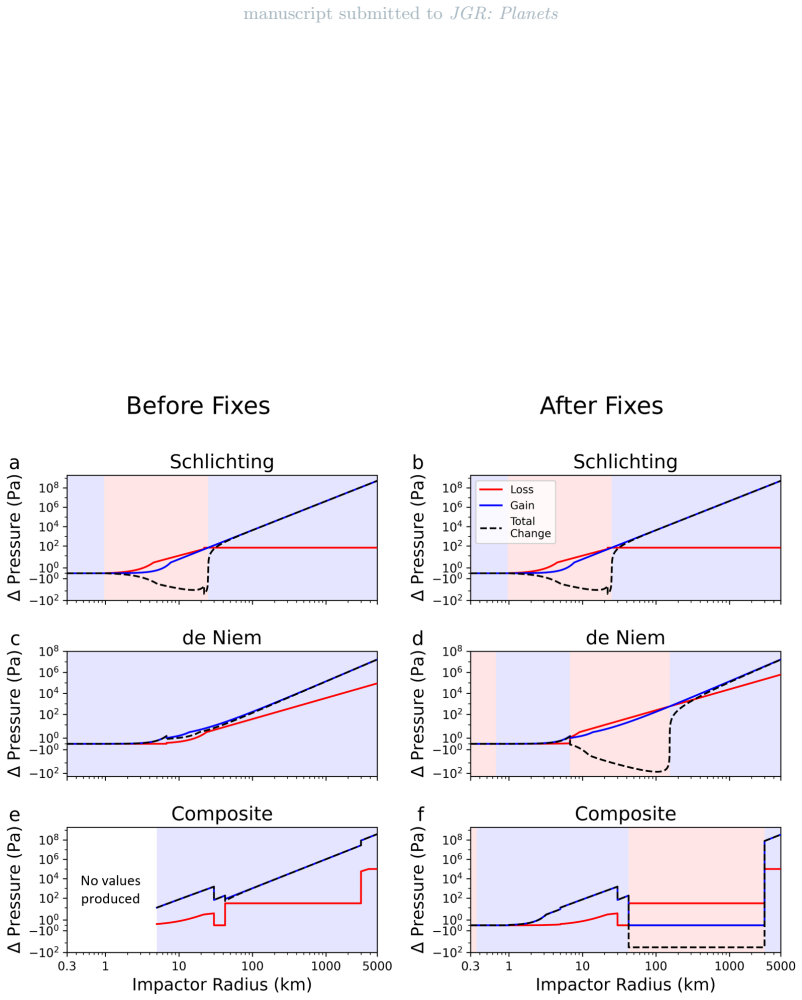
- Appendix B (and the “after” panels of Figs. 4 & 6) catalogues numerous non-physical fixes—zeroing infinite Svetsov-2000 losses when the exponential term diverges for small r_imp/dense atmospheres, forcing Svetsov-2007 gains that become negative or complex to zero, capping gains at 10^30 kg, setting ξ≤0 or χ_a o∞ in Shuvalov, applying the Svetsov obliquity factor outside its derivation domain, etc. Because the same impactor sequence is used for every model, these interventions systematically suppress large losses. The central qualitative claim (most models produce net growth of +0.01–+100 bar; impacts were a significant early volatile source) therefore rests on the patches. A load-bearing sensitivity test is required: re-run the Monte-Carlo suite with the patches disabled (or replaced by hard domain cuts that simply discard the offending impactors) and report how the median ΔP and the gro
- §4.2 and Fig. 6f: the authors’ composite averages gain and loss only inside preferred size windows and discards any model that still requires an Appendix-B patch. This procedure guarantees that the reported composite growth is conditioned on the very regions the authors themselves flag as non-physical. The discontinuities that remain are acknowledged as non-physical, yet the composite is still used to claim that “the atmospheres of Venus, Earth and Mars tend to grow.” Either justify why arithmetic averaging of patched models is physically preferable to the existing de Niem or Schlichting composites, or replace the average with a transparent envelope that shows the full range of the unpatched component models.
- §5 and Table 3: the paleopressure case studies (Mars P0=1 bar, Earth P0=0.25 bar) are presented as thought experiments, yet the text still ranks models by how closely P_initial+ΔP_bombardment matches modern pressure after literature loss estimates. Because those loss estimates themselves carry large systematic uncertainties, and because the bombardment ΔP already incorporates the Appendix-B patches, the ranking of Schlichting and Kegerreis as “most reliable” is not robust. Either remove the ranking or quantify how the ranking shifts when the patches are varied.
minor comments (5)
- Abstract and §2.2: the impactor count is written “5x10^6” and “5,000,000”; standardize scientific notation and state the corresponding total mass range once in the abstract.
- Fig. 3 caption and §2.1: the preferred size ranges are shown graphically but never tabulated with explicit numerical bounds; a short table would make the composite construction reproducible without inspecting the figure.
- Table 1 and Appendix A: several symbols (e.g., ζ, χ_imp, f_M) are defined only in the appendix; a brief “notation” paragraph or inline definitions would help readers who consult only the main text.
- §2.1.2: the choice n=250 for the Pham efficiency factor is described as a logarithmic average of the extremes; a one-sentence sensitivity check (n=10 vs n=2400) would quantify how free this parameter remains.
- Throughout: occasional typographic slips (“Svestov”, “matmgain”, missing spaces around operators) should be cleaned in copy-editing.
Circularity Check
No load-bearing circularity; forward Monte-Carlo comparison of published formulas with acknowledged patches and no parameters fitted to the target outcomes.
full rationale
The paper performs a controlled numerical experiment: it generates the same Monte-Carlo impactor sequences from external size/velocity/probability distributions (Nesvorný et al. 2023, Drolshagen et al. 2020, Olsson-Steel 1987), applies seven literature models (plus two existing composites) to every impactor or only inside preferred size windows, and reports the resulting pressure trajectories. No free parameter is adjusted so that final pressures match modern or paleo values; the paleopressure case studies are explicitly labeled thought experiments that merely check which models land inside independent loss-budget ranges. Appendix B patches (zeroing divergent losses, capping non-physical gains, forcing ζ ≥ 0, applying an obliquity factor outside its original domain) are interventions that affect robustness, not circular reductions of outputs to inputs. The single self-citation (Huffman et al. 2024) supplies only a qualitative statement about volatile reservoirs and is not used to justify any uniqueness claim or scaling. Consequently the derivation chain does not collapse by construction, by fit, or by self-citation load-bearing argument.
Assumptions & free parameters
free parameters (5)
- Pham impact-efficiency factor n =
250
- Impactor radius cut-offs =
0.3–5000 km
- Number of impactors per run =
5e6
- Asteroid/comet densities and volatile fractions =
2700 / 1000 kg m^{-3}
- Svetsov/Genda obliquity enhancement factor =
≈7.04
assumptions (4)
- ad hoc to paper Published hydrocode-derived scaling laws (Svetsov 2000/2007, Shuvalov 2009, Kegerreis 2020) remain valid when extrapolated far outside their original impactor-size and atmospheric-pressure domains after the Appendix-B patches.
- domain assumption Impactor size-frequency distributions follow the Nesvorný et al. (2023) power-law slopes and the Drolshagen/de Niem velocity distributions, truncated at the chosen radius bounds.
- domain assumption Atmospheric scale height and temperature remain constant while surface pressure evolves over 5×10^6 impacts.
- ad hoc to paper When multiple models apply to the same impactor, arithmetic averaging of their gain and loss is a legitimate composite.
invented entities (1)
-
Piecewise composite model (authors’)
Cite this review
Pith. "Pith review of Comparing Monte Carlo Models of Impact Alteration of Planetary Atmospheres." pith.science (2026). https://pith.science/paper/KDWALQJ2
@misc{pith2026260703635,
  author       = {Pith},
  title        = {Pith review of: Comparing Monte Carlo Models of Impact Alteration of Planetary Atmospheres},
  year         = {2026},
  howpublished = {\url{https://pith.science/paper/KDWALQJ2}},
  note         = {Machine review of arXiv:2607.03635}
}
read the original abstract
One process that affects atmospheric surface pressure is impact bombardment. The evolution of a planet's atmosphere under impact bombardment is an open question. We use a Monte Carlo method to evolve a range (0.006 to 92.5 bar) of initial atmospheres at Mars, Earth, and Venus under bombardment of 5x10^6 impactors using seven individual models. Since these seven models are best suited for specific impactor size regimes, we also combine these models into a composite model and compare it to other existing composites. Alterations to the existing models are required to apply to broad initial conditions. If we use each component model for every impactor, starting from present-day atmospheric pressure, we find about two or three orders of magnitude spread in the final atmospheric pressure. Given these differences, we suggest that the use of any one model to determine atmospheric change due to impact bombardment is risky. Most models and starting parameters result in net growth between +0.01 and +100 bar. Our composite model shows that the atmospheres of Venus, Earth, and Mars tend to grow under bombardment, with Earth's atmosphere growing most quickly. For an early Martian (P_0=1 bar) and an early terrestrial (with an initial pressure of P_0=0.25 bar) atmosphere, both tend to grow under bombardment. The results suggested here, where the models are universally applied, suggest that impact bombardment was likely a significant source of volatiles in the early Solar System. Additional work and careful consideration of how impact events affect the evolution of planetary atmospheres is needed.
Figures


Figures from the paper (8 more)




Reference graph
Works this paper leans on
-
[1]
Space Science Reviews , author=
Characterizing atmospheric escape from Mars today and through time, with Maven , volume=. Space Science Reviews , author=. 2015 , month=. doi:10.1007/s11214-015-0165-8 , number=
-
[2]
The Planetary Science Journal , author=
Atmospheric loss during giant impacts: Mechanisms and scaling of near- and far-field loss , volume=. The Planetary Science Journal , author=. 2025 , month=. doi:10.5194/epsc-dps2025-1501 , number=
-
[3]
The Planetary Science Journal , author=
Inferring the CO2 Abundance in Comet 45P/Honda-Mrkos-Pajdušáková from [O I] Observations: Implications for the Source of Icy Grains in Cometary Comae , volume=. The Planetary Science Journal , author=. 2024 , month=. doi:10.3847/psj/ad1935 , number=
-
[4]
Derivation of the collision probability between orbiting objects: the lifetimes of jupiter's outer moons. Icarus , keywords =. doi:10.1016/0019-1035(81)90151-2 , adsurl =
-
[5]
Pattern Recognition and Image Analysis , year = 1951, month = jan, volume =
Collision probabilities with the planets and the distribution of interplanetary matter. Pattern Recognition and Image Analysis , year = 1951, month = jan, volume =
1951
-
[6]
Zahnle, Kevin J. and Catling, David C. , title =. The Astrophysical Journal , abstract =. 2017 , month =. doi:10.3847/1538-4357/aa7846 , url =
-
[7]
doi:https://doi.org/10.5281/zenodo.17794241 , year =
Huffman, Mikayla and Johnston, Julia , title =. doi:https://doi.org/10.5281/zenodo.17794241 , year =
-
[8]
Leblanc, F. and Modolo, R. and Curry, S. and Luhmann, J. and Lillis, R. and Chaufray, J. Y. and Hara, T. and McFadden, J. and Halekas, J. and Eparvier, F. and Larson, D. and Connerney, J. and Jakosky, B. , title =. Geophysical Research Letters , volume =. doi:https://doi.org/10.1002/2015GL066170 , url =. https://agupubs.onlinelibrary.wiley.com/doi/pdf/10....
Show all 74 references
-
[9]
Jakosky and D
B.M. Jakosky and D. Brain and M. Chaffin and S. Curry and J. Deighan and J. Grebowsky and J. Halekas and F. Leblanc and R. Lillis and J.G. Luhmann and L. Andersson and N. Andre and D. Andrews and D. Baird and D. Baker and J. Bell and M. Benna and D. Bhattacharyya and S. Boughe...
2018 doi
-
[10]
Kislyakova, K. G. and Johnstone, C. P. and Scherf, M. and Holmström, M. and Alexeev, I. I. and Lammer, H. and Khodachenko, M. L. and Güdel, M. , title =. Journal of Geophysical Research: Space Physics , volume =. doi:https://doi.org/10.1029/2020JA027837 , url =. https://agupub...
-
[11]
and Jakosky, Bruce M
Brain, David A. and Jakosky, Bruce M. , title =. Journal of Geophysical Research: Planets , volume =. doi:https://doi.org/10.1029/98JE02074 , url =. https://agupubs.onlinelibrary.wiley.com/doi/pdf/10.1029/98JE02074 , year =
-
[12]
Alvarez and Walter Alvarez and Frank Asaro and Helen V
Luis W. Alvarez and Walter Alvarez and Frank Asaro and Helen V. Michel , title =. Science , volume =. 1980 , doi =. https://www.science.org/doi/pdf/10.1126/science.208.4448.1095 , abstract =
1980 doi
-
[13]
and Melosh, H
Pierazzo, Elisabetta and Kring, David A. and Melosh, H. Jay , title =. Journal of Geophysical Research: Planets , volume =. doi:https://doi.org/10.1029/98JE02496 , url =. https://agupubs.onlinelibrary.wiley.com/doi/pdf/10.1029/98JE02496 , abstract =
-
[14]
Nature Geoscience , author=
Low palaeopressure of the martian atmosphere estimated from the size distribution of ancient craters , volume=. Nature Geoscience , author=. 2014 , month=. doi:10.1038/ngeo2137 , number=
2014 doi
-
[15]
Smith and Robert L
Jeffrey C. Smith and Robert L. Morris and Clemens Rumpf and Randolph Longenbaugh and Nina McCurdy and Christopher Henze and Jessie Dotson , keywords =. An automated bolide detection pipeline for GOES GLM , journal =. 2021 , issn =. doi:https://doi.org/10.1016/j.icarus.2021.114...
2021 doi
-
[16]
Smith and Jessie L
Anthony Ozerov and Jeffrey C. Smith and Jessie L. Dotson and Randolph S. Longenbaugh and Robert L. Morris , keywords =. GOES GLM, biased bolides, and debiased distributions , journal =. 2024 , issn =. doi:https://doi.org/10.1016/j.icarus.2023.115843 , url =
2024 doi
-
[17]
2020 , issn =
Velocity distribution of larger meteoroids and small asteroids impacting Earth , journal =. 2020 , issn =. doi:https://doi.org/10.1016/j.pss.2020.104869 , url =
2020 doi
-
[18]
10.1051/0004-6361/202244217
Oxygen line in fireball spectra and its application to satellite observations , DOI= "10.1051/0004-6361/202244217", url= "https://doi.org/10.1051/0004-6361/202244217", journal =
-
[19]
2005 , doi =
Origin of the cataclysmic Late Heavy Bombardment period of the terrestrial planets , journal =. 2005 , doi =
2005
-
[20]
1990 , doi =
Impact delivery and erosion of planetary oceans in the early inner Solar System , journal =. 1990 , doi =
1990
-
[21]
Late Heavy Bombardment
Harold F. Levison and Luke Dones and Clark R. Chapman and S.Alan Stern and Martin J. Duncan and Kevin Zahnle , abstract =. Could the Lunar “Late Heavy Bombardment” Have Been Triggered by the Formation of Uranus and Neptune? , journal =. 2001 , issn =. doi:https://doi.org/10.10...
2001 doi
-
[22]
Engineers Edge - Engineering, Design and Manufacturing Solutions , author=
Thermodynamic properties carbon dioxide , url=. Engineers Edge - Engineering, Design and Manufacturing Solutions , author=
-
[23]
Engineers Edge - Engineering, Design and Manufacturing Solutions , author=
Thermodynamic properties nitrogen , url=. Engineers Edge - Engineering, Design and Manufacturing Solutions , author=
-
[24]
Engineers Edge - Engineering, Design and Manufacturing Solutions , author=
Ideal gas properties carbon dioxide , url=. Engineers Edge - Engineering, Design and Manufacturing Solutions , author=
-
[25]
Engineers Edge - Engineering, Design and Manufacturing Solutions , author=
Ideal gas properties nitrogen , url=. Engineers Edge - Engineering, Design and Manufacturing Solutions , author=
-
[26]
Venus fact sheet , url=
NASA , year=. Venus fact sheet , url=. NASA , publisher=
-
[27]
Earth fact sheet , url=
NASA , year=. Earth fact sheet , url=. NASA , publisher=
-
[28]
Mars fact sheet , url=
NASA , year=. Mars fact sheet , url=. NASA , publisher=
-
[29]
and Genova, Antonio and Mazarico, Erwan and Nicholas, Joseph B
Goossens, Sander and Sabaka, Terence J. and Genova, Antonio and Mazarico, Erwan and Nicholas, Joseph B. and Neumann, Gregory A. , title =. Geophysical Research Letters , volume =. doi:https://doi.org/10.1002/2017GL074172 , url =. https://agupubs.onlinelibrary.wiley.com/doi/pdf...
-
[30]
and Mooney, Walter D
Christensen, Nikolas I. and Mooney, Walter D. , title =. Journal of Geophysical Research: Solid Earth , volume =. doi:https://doi.org/10.1029/95JB00259 , url =. https://agupubs.onlinelibrary.wiley.com/doi/pdf/10.1029/95JB00259 , abstract =
-
[31]
Treatise on Geochemistry , year = 2003, month = dec, volume =
Venus. Treatise on Geochemistry , year = 2003, month = dec, volume =. doi:10.1016/B0-08-043751-6/01150-6 , adsurl =
2003 doi
-
[32]
Bottke and Robert Jedicke and Shantanu Naidu and Steven R
David Nesvorný and Rogerio Deienno and William F. Bottke and Robert Jedicke and Shantanu Naidu and Steven R. Chesley and Paul W. Chodas and Mikael Granvik and David Vokrouhlický and Miroslav Brož and Alessandro Morbidelli and Eric Christensen and Frank C. Shelly and Bryce T. B...
2023 doi
-
[33]
Schlichting and Re’em Sari and Almog Yalinewich , keywords =
Hilke E. Schlichting and Re’em Sari and Almog Yalinewich , keywords =. Atmospheric mass loss during planet formation: The importance of planetesimal impacts , journal =. 2015 , issn =. doi:https://doi.org/10.1016/j.icarus.2014.09.053 , url =
2015 doi
-
[34]
Atmospheric erosion and replenishment induced by impacts upon the Earth and Mars during a heavy bombardment , journal =
D. Atmospheric erosion and replenishment induced by impacts upon the Earth and Mars during a heavy bombardment , journal =. 2012 , issn =. doi:https://doi.org/10.1016/j.icarus.2012.07.032 , url =
2012 doi
-
[35]
Cometary impacts upon the planets , author=
Collisions in the Solar System--IV. Cometary impacts upon the planets , author=. Monthly Notices of the Royal Astronomical Society , volume=. 1987 , publisher=
1987
-
[36]
Schultz and Brendan Hermalyn and Anthony Colaprete and Kimberly Ennico and Mark Shirley and William S
Peter H. Schultz and Brendan Hermalyn and Anthony Colaprete and Kimberly Ennico and Mark Shirley and William S. Marshall , title =. Science , volume =. 2010 , doi =. https://www.science.org/doi/pdf/10.1126/science.1187454 , abstract =
2010 doi
-
[37]
Jakosky , abstract =
Bruce M. Jakosky , abstract =. The CO2 inventory on Mars , journal =. 2019 , issn =. doi:https://doi.org/10.1016/j.pss.2019.06.002 , url =
2019 doi
-
[38]
Effects of impacts on the atmospheric evolution: Comparison between Mars, Earth, and Venus , journal =
Le Binh San Pham and Ozgur Karatekin and Veronique Dehant , keywords =. Effects of impacts on the atmospheric evolution: Comparison between Mars, Earth, and Venus , journal =. 2011 , note =. doi:https://doi.org/10.1016/j.pss.2010.11.010 , url =
2011 doi
-
[39]
Astrobiology , author=
Effects of meteorite impacts on the atmospheric evolution of Mars , volume=. Astrobiology , author=. 2009 , pages=. doi:10.1089/ast.2008.0242 , number=
2009 doi
-
[40]
Monthly Notices of the Royal Astronomical Society , volume =
Sinclair, Catriona A and Wyatt, Mark C and Morbidelli, Alessandro and Nesvorný, David , title = ". Monthly Notices of the Royal Astronomical Society , volume =. 2020 , month =. doi:10.1093/mnras/staa3210 , url =
2020 doi
-
[41]
Nature , author=
Impact erosion of the primordial atmosphere of Mars , volume=. Nature , author=. 1989 , month=. doi:10.1038/338487a0 , number=
1989 doi
-
[42]
Survival of a proto-atmosphere through the stage of giant impacts: the mechanical aspects , journal =
Hidenori Genda and Yutaka Abe , keywords =. Survival of a proto-atmosphere through the stage of giant impacts: the mechanical aspects , journal =. 2003 , issn =. doi:https://doi.org/10.1016/S0019-1035(03)00101-5 , url =
2003 doi
-
[43]
Shock Waves , author=
Multi-dimensional hydrodynamic code SOVA for interfacial flows: Application to the thermal layer effect , volume=. Shock Waves , author=. 1999 , pages=. doi:10.1007/s001930050168 , number=
1999 doi
-
[44]
, year =
Svettsov, V. , year =. On the Efficiency of the Impact Mechanism of Atmospheric Erosion , volume =
-
[45]
Solar System Research , author=
Atmospheric erosion and replenishment induced by impacts of cosmic bodies upon the Earth and Mars , volume=. Solar System Research , author=. 2007 , pages=. doi:10.1134/s0038094607010030 , number=
2007 doi
-
[46]
Shuvalov, V. V. , title =. Meteoritics & Planetary Science , volume =. doi:https://doi.org/10.1111/j.1945-5100.2009.tb01209.x , url =. https://onlinelibrary.wiley.com/doi/pdf/10.1111/j.1945-5100.2009.tb01209.x , abstract =
1945 doi
-
[47]
and Treiman, Allan H
Jakosky, Bruce M. and Treiman, Allan H. , year=. Mars volatile inventory and outgassing history , volume=. doi:10.1016/j.icarus.2023.115627 , journal=
2023 doi
-
[48]
The Great Oxygenation Event
Ligrone, Roberto. The Great Oxygenation Event. Biological Innovations that Built the World: A Four-billion-year Journey through Life and Earth History. 2019. doi:10.1007/978-3-030-16057-9_5
2019 doi
-
[49]
Earth and Planetary Science Letters , keywords =
Shock-induced CO _ 2 loss from CaCO _ 3 ; implications for early planetary atmospheres. Earth and Planetary Science Letters , keywords =. doi:10.1016/0012-821X(86)90150-0 , adsurl =
-
[50]
Icarus , keywords =
The evolution of an impact-generated atmosphere. Icarus , keywords =. doi:10.1016/0019-1035(82)90031-8 , adsurl =
-
[51]
Lunar and Planetary Science Conference , year = 1984, series =
Studies of the Chemical Composition of Gaseous Phase Released from Laser Pulse Evaporated Rocks and Meteorite Materials. Lunar and Planetary Science Conference , year = 1984, series =
1984
-
[52]
Elements , author=
Earth’s Earliest Atmosphere , volume=. Elements , author=. 2006 , month=aug, pages=. doi:10.2113/gselements.2.4.217 , number=
2006 doi
-
[53]
Chemical Geology , author=
The evolution of terrestrial volatiles: a view from helium, neon, argon and nitrogen isotope modelling , volume=. Chemical Geology , author=. 1998 , month=may, pages=. doi:10.1016/S0009-2541(97)00170-8 , number=
1998 doi
-
[54]
Origin of the Earth and Moon , volume=
Rare gas constraints on early Earth history , author=. Origin of the Earth and Moon , volume=. 2000 , publisher=
2000
-
[55]
The Astronomy and Astrophysics Review , author=
Origin and evolution of the atmospheres of early Venus, Earth and Mars , volume=. The Astronomy and Astrophysics Review , author=. 2018 , month=nov, pages=. doi:10.1007/s00159-018-0108-y , number=
2018 doi
-
[56]
Journal of Geophysical Research: Planets , author=
Retention of an atmosphere on early Mars , volume=. Journal of Geophysical Research: Planets , author=. 1999 , month=sep, pages=. doi:10.1029/1999JE001048 , abstractNote=
1999 doi
-
[57]
Tellus B: Chemical and Physical Meteorology , author=
Evolution of natural and anthropogenic fluxes of atmospheric CO2 from 1957 to 2003 , volume=. Tellus B: Chemical and Physical Meteorology , author=. 2011 , month=jan, pages=. doi:10.1111/j.1600-0889.2010.00507.x , number=
1957 doi
-
[58]
Tellus A: Dynamic Meteorology and Oceanography , author=
Atmospheric carbon dioxide variations at Mauna Loa Observatory, Hawaii , volume=. Tellus A: Dynamic Meteorology and Oceanography , author=. 1976 , month=jan, pages=. doi:10.3402/tellusa.v28i6.11322 , number=
1976 doi
-
[59]
and Hunten, Donald M
Taylor, Fredric W. and Hunten, Donald M. , year=. Venus , rights=. doi:10.1016/B978-0-12-415845-0.00014-1 , booktitle=
-
[60]
Planetary and Space Science , author=
Atmospheric and water loss from early Venus , volume=. Planetary and Space Science , author=. 2006 , month=nov, pages=. doi:10.1016/j.pss.2006.04.021 , number=
2006 doi
-
[61]
Science , author=
Mars’ atmospheric history derived from upper-atmosphere measurements of 38 Ar/ 36 Ar , volume=. Science , author=. 2017 , month=mar, pages=. doi:10.1126/science.aai7721 , abstractNote=
2017 doi
-
[62]
Water On Mars , ISBN=
Carr, Michael H , year=. Water On Mars , ISBN=. doi:10.1093/oso/9780195099386.001.0001 , abstractNote=
-
[63]
Nature Geoscience , author=
Earth’s air pressure 2.7 billion years ago constrained to less than half of modern levels , volume=. Nature Geoscience , author=. 2016 , month=jun, pages=. doi:10.1038/ngeo2713 , number=
2016 doi
-
[64]
Monthly Notices of the Royal Astronomical Society , author=
Susceptibility of planetary atmospheres to mass loss and growth by planetesimal impacts: the impact shoreline , rights=. Monthly Notices of the Royal Astronomical Society , author=. 2019 , month=nov, pages=. doi:10.1093/mnras/stz3052 , abstractNote=
2019 doi
-
[65]
and Wilson, Gregory P
Holroyd, Patricia A. and Wilson, Gregory P. and Hutchison, J. Howard , year=. Temporal changes within the latest Cretaceous and early Paleogene turtle faunas of northeastern Montana , ISBN=. doi:10.1130/2014.2503(11) , booktitle=
2014 doi
-
[66]
Solar System Research , author=
Large Meteoroid Fragmentation: Modeling the Interaction of the Chelyabinsk Meteoroid with the Atmosphere , volume=. Solar System Research , author=. 2018 , month=sep, pages=. doi:10.1134/S0038094618050027 , number=
2018 doi
-
[67]
and Delcroix, M
Hueso, R. and Delcroix, M. and Sánchez-Lavega, A. and Pedranghelu, S. and Kernbauer, G. and McKeon, J. and Fleckstein, A. and Wesley, A. and Gómez-Forrellad, J. M. and Rojas, J. F. and et al. , year=. Small impacts on the giant planet Jupiter , volume=. doi:10.1051/0004-6361/2...
-
[68]
The Astrophysical Journal , author=
Atmospheric Erosion by Giant Impacts onto Terrestrial Planets , volume=. The Astrophysical Journal , author=. 2020 , month=jul, pages=. doi:10.3847/1538-4357/ab9810 , abstractNote=
2020 doi
-
[69]
Shuvalov, V. V. , title =. Lunar and Planetary Science Conference 41 , year =
-
[70]
and Kasting, James F
Catling, David C. and Kasting, James F. , year=. Escape of Atmospheres to Space , booktitle=
-
[71]
and Kasting, James F
Catling, David C. and Kasting, James F. , year=. Evolution of the Earth’s Atmosphere , booktitle=
-
[72]
2016 , editor =
David Brain , title =. 2016 , editor =
2016
-
[73]
Zel'dovich and Yu.P
Ya.B. Zel'dovich and Yu.P. Raizer , title =
-
[74]
and Melosh, H
Vickery, Ann M. and Melosh, H. Jay , isbn =. Atmospheric erosion and impactor retention in large impacts, with application to mass extinctions. Global Catastrophes in Earth History; An Interdisciplinary Conference on Impacts, Volcanism, and Mass Mortality. 1990 , month =. doi:...
1990 doi
Reviewed July 12, 2026 · model on record in the stance chip above.
Discussion (0). Continue with ORCID to comment.