REVIEW 2 major objections 5 minor 56 references
Scalar and Electromagnetic Perturbations around a Black Hole with a Topological Defect: Quasinormal Modes and Quasi-bound States in a Plasma Medium
T0 review · 2 major / 5 minor · reviewed 2026-07-14 · grok-4.5
Pith's one-line read Plasma and a topological defect reshape black-hole ringdown and can trap electromagnetic waves only when the plasma is homogeneous and not too dense.
desk verdict Solid incremental gr-qc paper: clean axial EM quasi-bound threshold plus comparative scalar QNM tables for defect + three plasma profiles; scalar coupling is the only real soft spot. read the letter →
The pith
A machine-rendered reading of the paper's core claim, the machinery that carries it, and where it could break.
The reading
What carries the argument
The axial effective potential V_ax = f(r) [ℓ(ℓ+1)/r^{2} + ω_pl^{2}], in which the plasma frequency supplies an effective mass term; its barrier-well structure exists only for constant ω_pl below the critical threshold derived from the locations of its extrema.
What would settle it
Compute the axial electromagnetic spectrum for a homogeneous plasma with M ω_pl just above and just below (1−k)√[l(l+1)/12] for fixed k and l; the quasi-bound frequencies must disappear exactly when the inequality is violated, and the same calculation for SIS or NSIS density must show no bound states at all.
Extended reading notes
Core claim
In a black-hole spacetime with topological defect parameter k, a surrounding plasma shifts both the real and imaginary parts of massive-scalar quasinormal frequencies, with larger k monotonically suppressing the oscillation frequency for homogeneous, SIS and NSIS density profiles. Electromagnetic perturbations decouple into independent axial and polar sectors; in the axial sector the plasma frequency enters as an effective mass, permitting quasi-bound states solely for homogeneous plasma and only when M ω_pl ≤ (1−k)√[l(l+1)/12].
Load-bearing premise
The scalar-field calculation treats the plasma as an extra potential term whose strength is a free coupling constant, so the entire scalar spectrum rests on that phenomenological model rather than a derived plasma-scalar interaction.
Signed reviews
Editorial analysis
A structured set of objections, weighed in public.
Referee Report
Summary. The paper studies a Schwarzschild black hole with a global-monopole topological defect (metric function f=1-k-2M/r) immersed in plasma. It first relates the real part of eikonal QNMs to the shadow radius via the plasma refractive index and shows that the photon-sphere Lyapunov exponent depends only weakly on plasma frequency while decreasing with k. It then computes massive scalar QNMs with third- and sixth-order WKB for homogeneous, SIS and NSIS plasma, finding that larger k suppresses Re(ω) and that NSIS yields slightly higher frequencies. Finally it derives the cold-plasma Maxwell system on this background, shows axial/polar decoupling, and demonstrates that axial quasi-bound states exist only for homogeneous plasma when M ω_pl ≤ (1-k)√[l(l+1)/12].
Significance. If the results hold, the work supplies a concrete, observationally relevant map from the topological-defect parameter k and plasma density profiles onto three classes of observables: shadow radius, scalar QNM spectra, and the existence window for electromagnetic quasi-bound states. The axial critical-frequency inequality is derived algebraically from the Breuer–Ehlers system and is therefore falsifiable; the WKB tables for both scalar and axial sectors give quantitative benchmarks that can be compared with future ringdown or radio-wave data. The systematic comparison of homogeneous, SIS and NSIS profiles is a useful addition to the existing plasma-optics literature.
major comments (2)
- Sec. IV, Eq. (18): the scalar-plasma interaction is introduced by hand as an extra potential +κ N(r) Φ^{2} with free coupling κ. Unlike the electromagnetic sector, which follows from the cold-plasma Maxwell equations, this term is not derived from a plasma microphysics model. Consequently the entire scalar QNM spectrum (Tables I–III, Figs. 2–5) is only as physical as that phenomenological coupling. The authors should either justify the term from a concrete plasma-scalar interaction or clearly label the scalar results as exploratory and relegate them to secondary status relative to the axial EM claim.
- Sec. V.C and Appendix B: the polar-sector effective potential is written down but never solved; the text simply states that WKB fails because of the complicated ω dependence. Given that the abstract and introduction advertise a complete treatment of electromagnetic perturbations, the polar sector should either be integrated numerically (as in the cited works [33,54]) or the claim of a full EM analysis should be narrowed to the axial sector alone.
minor comments (5)
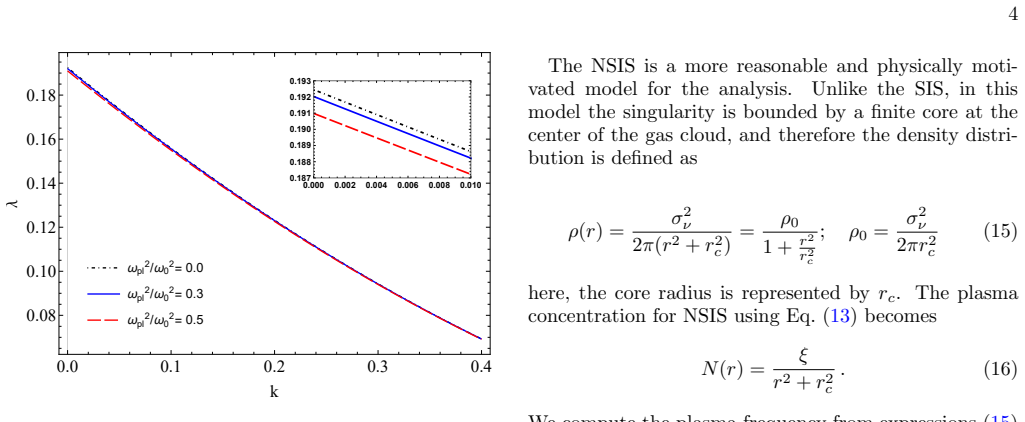
- Fig. 1 inset: the vertical scale is too compressed to judge the claimed weak plasma dependence; a relative-difference plot would help.
- Tables I–III: several (0,0) entries are blank for Schwarzschild while present for k eq0; a short remark on why the fundamental mode appears only for the defect geometry would improve readability.
- Eq. (9) and surrounding text: the eikonal correspondence is stated for homogeneous plasma; a one-sentence caveat that the same simple relation need not hold for SIS/NSIS would avoid over-generalization.
- Notation: χ(r)=κ N(r) is used for the scalar plasma term while ω_pl is used for the EM plasma frequency; a brief glossary or consistent subscripting would reduce confusion.
- Appendix A: the photon-sphere radius formula (A1) is written with an overall minus sign that makes r_ps negative for small η; a parenthetical check that the physical root is positive would be useful.
Circularity Check
No significant circularity: all load-bearing results follow forward from the metric, a phenomenological scalar-plasma coupling, and the Breuer–Ehlers cold-plasma system via standard WKB or algebraic extremum conditions.
full rationale
The paper’s derivation chains are self-contained and non-circular. The eikonal shadow–QNM link (Eqs. 5–9) is obtained by substituting the plasma refractive index into the standard Cardoso–Ferrari–Mashhoon correspondence and the geometric definition θ = R_S/D; no parameter is fitted and then re-predicted. The Lyapunov exponent (Eq. 10 and Appendix A) is an explicit algebraic function of the metric function f(r) and a constant plasma frequency; its weak plasma dependence and monotonic decrease with k are direct evaluations, not tautologies. Scalar QNMs begin from an explicitly introduced phenomenological term +κ N(r) Φ^{2} in the Klein–Gordon action (Eq. 18), produce the effective potential (Eq. 25), and are evaluated by third- and sixth-order WKB; the resulting tables and figures simply report those numbers for chosen parameter values. Electromagnetic axial quasi-bound states follow from the Breuer–Ehlers system after multipolar decomposition (Eqs. 42–45), reduce to a Schrödinger equation whose potential is V_ax = f(ℓ(ℓ+1)/r^{2} + ω_pl^{2}) (Eq. 47), and admit a double-root condition derived algebraically in Appendix C (M ω_pl ≤ (1−k)√[ℓ(ℓ+1)/12]); the WKB frequencies in Table IV are consistent with the potential-well structure of Fig. 6. Polar-sector equations are left unsolved by design. Self-citations point to standard methods (WKB, plasma optics) or prior calculations by overlapping authors that are not used as uniqueness theorems or to force the present spectra. No fitted constants are relabeled as predictions, no ansatz is smuggled via citation, and no known empirical pattern is merely renamed. The only modeling choice that could be questioned is the ad-hoc scalar-plasma coupling, but that is an assumption of the model, not a circular step inside the derivation.
Assumptions & free parameters
free parameters (4)
- topological-defect parameter k
- scalar-plasma coupling κ (or χ=κN)
- plasma density scales (ω_pl, ξ, r_c, κξ)
- scalar field mass m
assumptions (5)
- domain assumption Barriola–Vilenkin metric f(r)=1−k−2M/r correctly describes a black hole with a global-monopole topological defect.
- ad hoc to paper Plasma effects on a test scalar can be captured by adding +κ N(r) Φ² to the Klein–Gordon action while preserving linearity.
- domain assumption Cold, unmagnetized, two-fluid plasma on a static spherical background is adequately described by the Breuer–Ehlers linearized system, with ions frozen and metric back-reaction neglected.
- domain assumption Third- and sixth-order WKB approximations give reliable QNM and quasi-bound frequencies for the multipoles and overtones reported.
- domain assumption Eikonal QNM–shadow correspondence continues to hold after plasma refractive-index corrections for this metric.
Cite this review
Pith. "Pith review of Scalar and Electromagnetic Perturbations around a Black Hole with a Topological Defect: Quasinormal Modes and Quasi-bound States in a Plasma Medium." pith.science (2026). https://pith.science/paper/ITDWGXJM
@misc{pith2026260707487,
  author       = {Pith},
  title        = {Pith review of: Scalar and Electromagnetic Perturbations around a Black Hole with a Topological Defect: Quasinormal Modes and Quasi-bound States in a Plasma Medium},
  year         = {2026},
  howpublished = {\url{https://pith.science/paper/ITDWGXJM}},
  note         = {Machine review of arXiv:2607.07487}
}
abstract
We investigated the influence of a plasma environment on the optical and perturbative properties of a black hole with a topological defect, characterized by the parameter \(k\). We first established a straightforward correspondence between the real part of the quasinormal-mode (QNM) frequencies in the eikonal limit and the black-hole shadow radius. We then demonstrated that the Lyapunov exponent associated with the photon sphere exhibits only a weak dependence on the plasma frequency, while it monotonically decreases as the topological-defect parameter \(k\) increases. Subsequently, we analyzed massive scalar-field perturbations by deriving the associated effective potential and computing the QNM spectrum using the third- and sixth-order WKB approximations for both homogeneous and radially inhomogeneous plasma configurations, including the singular isothermal sphere (SIS) and non-singular isothermal sphere (NSIS) density profiles. Our results show that the presence of plasma induces shifts in both the oscillation frequencies and the damping rates of the modes, and that larger values of \(k\) systematically suppress the real part of the QNM frequencies. Among the plasma models considered, the NSIS profile generally yields slightly higher oscillation frequencies than both the SIS and homogeneous cases. Finally, we derived the dynamical equations governing electromagnetic perturbations in a cold, unmagnetized plasma and demonstrated that the axial and polar sectors decouple. In the axial sector, the plasma frequency enters as an effective mass term, thereby permitting the existence of quasi-bound states only in the case of a homogeneous plasma and only when the plasma frequency lies below a critical threshold that depends on the topological-defect parameter \(k\) and the multipole index \(l\).
Figures


Figures from the paper (5 more)


Reference graph
Works this paper leans on
-
[1]
Effective potential for the polar sector in the homogeneous plasma case Vpl =−A −1 4r12ω10 + 4l(1 +l)(2M+ (−1 +k)r) 6ω4 pl l+l 2 + 4r2ω2 pl −4r 9(−2M+r−kr)ω 8 3l(1 +l) + 5r 2ω2 pl + 4r(2M+ (−1 +k)r) 5ω4 pl l2(1 +l) 2(1 +l+l 2) +l(1 +l)(1 + 3l(1 +l))r 2ω2 pl + 3l(1 +l)r 4ω4 pl +r 6ω6 pl +r 4(2M+ (−1 +k)r)ω 6 2l(1 +l)r 3 + 30l(1 +l)r(2M+ (−1 +k)r) 2 + (2M+ ...
-
[2]
Effective potential for the polar sector in the inhomogeneous plasma case In the general case of an inhomogeneous plasma, the effective potential for the polar sector was discussed in Ref. [54]. Appendix C: Relative location of maxima and minima for the axial effective potential The effective axial potentialV ax ℓm(r) is given by Eq. (47), which admits bo...
-
[3]
B. P. Abbottet al.(LIGO Scientific, Virgo), Phys. Rev. Lett.116, 061102 (2016), arXiv:1602.03837 [gr-qc]
arXiv 2016
-
[4]
B. P. Abbottet al.(LIGO Scientific, Virgo), Phys. Rev. Lett.119, 161101 (2017), arXiv:1710.05832 [gr-qc]
arXiv 2017
-
[5]
Akiyamaet al.(Event Horizon Telescope), Astrophys
K. Akiyamaet al.(Event Horizon Telescope), Astrophys. J. Lett.875, L1 (2019), arXiv:1906.11238 [astro-ph.GA]
arXiv 2019
-
[6]
Akiyamaet al.(Event Horizon Telescope), Astrophys
K. Akiyamaet al.(Event Horizon Telescope), Astrophys. J. Lett.930, L12 (2022), arXiv:2311.08680 [astro-ph.HE]
arXiv 2022
-
[7]
Psaltiset al.(Event Horizon Telescope), Phys
D. Psaltiset al.(Event Horizon Telescope), Phys. Rev. Lett.125, 141104 (2020), arXiv:2010.01055 [gr-qc]
arXiv 2020
-
[8]
S. Vagnozziet al., Class. Quant. Grav.40, 165007 (2023), arXiv:2205.07787 [gr-qc]
arXiv 2023
Show all 56 references
-
[9]
T. W. B. Kibble, J. Phys. A9, 1387 (1976)
1976
-
[10]
Vilenkin, Phys
A. Vilenkin, Phys. Rept.121, 263 (1985)
1985
-
[11]
Barriola and A
M. Barriola and A. Vilenkin, Phys. Rev. Lett.63, 341 (1989)
1989
-
[12]
G. S. Bisnovatyi-Kogan and O. Y. Tsupko, Mon. Not. R. Astron. Soc.404, 1790 (2010)
2010
-
[13]
Perlick, O
V. Perlick, O. Y. Tsupko, and G. S. Bisnovatyi-Kogan, Phys. Rev. D92, 104031 (2015), arXiv:1507.04217 [gr- qc]
2015 arXiv
-
[14]
Perlick and O
V. Perlick and O. Y. Tsupko, Phys. Rev. D95, 104003 (2017), arXiv:1702.08768 [gr-qc]
2017 arXiv
-
[15]
Atamurotov and B
F. Atamurotov and B. Ahmedov, Phys. Rev. D92, 084005 (2015), arXiv:1507.08131 [gr-qc]
2015 arXiv
-
[16]
G. Z. Babar, A. Z. Babar, and F. Atamurotov, Eur. Phys. J. C80, 761 (2020), [Erratum: Eur.Phys.J.C 82, 403 (2022)], arXiv:2008.05845 [gr-qc]
2020 arXiv
-
[17]
Atamurotov, K
F. Atamurotov, K. Jusufi, M. Jamil, A. Abdujabbarov, and M. Azreg-A¨ ınou, Phys. Rev. D104, 064053 (2021), arXiv:2109.08150 [gr-qc]
2021 arXiv
-
[18]
Atamurotov, M
F. Atamurotov, M. Jamil, and K. Jusufi, Chin. Phys. C 47, 035106 (2023), arXiv:2212.12949 [gr-qc]
2023 arXiv
-
[19]
Atamurotov, I
F. Atamurotov, I. Hussain, G. Mustafa, and K. Jusufi, Eur. Phys. J. C82, 831 (2022), arXiv:2209.01652 [gr-qc]
2022 arXiv
-
[20]
R. A. Konoplya and A. Zhidenko, Rev. Mod. Phys.83, 793 (2011), arXiv:1102.4014 [gr-qc]
2011 arXiv
-
[21]
R. A. Konoplya, Phys. Lett. B823, 136734 (2021), arXiv:2109.01640 [gr-qc]
2021 arXiv
-
[22]
R. A. Konoplya and A. Zhidenko, Astrophys. J.933, 166 (2022), arXiv:2202.02205 [gr-qc]
2022 arXiv
-
[23]
Cardoso, A
V. Cardoso, A. S. Miranda, E. Berti, H. Witek, and V. T. Zanchin, Phys. Rev. D79, 064016 (2009), arXiv:0812.1806 [hep-th]
2009 arXiv
-
[24]
Ferrari and B
V. Ferrari and B. Mashhoon, Phys. Rev. D30, 295 (1984)
1984
- [25]
- [26]
-
[27]
I. Z. Stefanov, S. S. Yazadjiev, and G. G. Gyulchev, Phys. Rev. Lett.104, 251103 (2010), arXiv:1003.1609 [gr-qc]
2010 arXiv
-
[28]
Cuadros-Melgar, R
B. Cuadros-Melgar, R. D. B. Fontana, and J. de Oliveira, Phys. Lett. B811, 135966 (2020)
2020
-
[29]
Yang, Phys
H. Yang, Phys. Rev. D103, 084010 (2021)
2021
-
[30]
P. C. Li, T. C. Lee, M. Guo, and B. Chen, Phys. Rev. D104, 084044 (2021), arXiv:2105.14268 [gr-qc]. 16
2021 arXiv
-
[31]
Wu and X
X. Wu and X. Zhang, Universe8, 604 (2022)
2022
-
[32]
M. S. Churilova, Eur. Phys. J. C79, 629 (2019)
2019
-
[33]
R. A. Konoplya and Z. Stuchl´ ık, Phys. Lett. B771, 597 (2017), arXiv:1705.05928 [gr-qc]
2017 arXiv
-
[34]
J. G. Rosa and S. R. Dolan, Phys. Rev. D85, 044043 (2012), arXiv:1110.4494 [gr-qc]
2012 arXiv
-
[35]
Cannizzaro, A
E. Cannizzaro, A. Caputo, L. Sberna, and P. Pani, Phys. Rev. D103, 124018 (2021), arXiv:2012.05114 [gr-qc]
2021 arXiv
-
[36]
Hindmarsh, A.-C
M. Hindmarsh, A.-C. Davis, and R. H. Brandenberger, Phys. Rev. D49, 1944 (1994), arXiv:hep-ph/9307203
1944 arXiv
-
[37]
Vilenkin, Phys
A. Vilenkin, Phys. Rev. D23, 852 (1981)
1981
-
[38]
Vilenkin, Phys
A. Vilenkin, Phys. Rev. D24, 2082 (1981)
-
[39]
Vilenkin, Nucl
A. Vilenkin, Nucl. Phys. B196, 240 (1982)
1982
-
[40]
A. S. Goldhaber, Phys. Rev. Lett.63, 2158 (1989)
1989
-
[41]
S. H. Rhie and D. P. Bennett, Phys. Rev. Lett.67, 1173 (1991)
1991
-
[42]
Perivolaropoulos, Nucl
L. Perivolaropoulos, Nucl. Phys. B375, 665 (1992)
1992
-
[43]
Dadhich, K
N. Dadhich, K. Narayan, and U. A. Yajnik, Pramana 50, 307 (1998), arXiv:gr-qc/9703034
1998 arXiv
-
[44]
Perlick and O
V. Perlick and O. Y. Tsupko, Phys. Rept.947, 1 (2022), arXiv:2105.07101 [gr-qc]
2022 arXiv
-
[45]
Wei and Y.-X
S.-W. Wei and Y.-X. Liu, Chin. Phys. C44, 115103 (2020), arXiv:1909.11911 [gr-qc]
2020 arXiv
-
[46]
Umarov, O
D. Umarov, O. Yunusov, F. Atamurotov, A. Abdujab- barov, and S. G. Ghosh, Chin. Phys. C49, 055102 (2025)
2025
-
[47]
Rogers, Mon
A. Rogers, Mon. Not. Roy. Astron. Soc.451, 17 (2015), arXiv:1505.06790 [gr-qc]
2015 arXiv
-
[48]
G. B. Gelmini, V. Takhistov, and E. Vitagliano, Phys. Lett. B809, 135779 (2020), arXiv:2006.13909 [hep-ph]
2020 arXiv
-
[49]
D. J. Gogoi and U. D. Goswami, JCAP06, 029 (2022), arXiv:2203.07594 [gr-qc]
2022 arXiv
-
[50]
R. A. Konoplya, Phys. Rev. D68, 024018 (2003), arXiv:gr-qc/0303052
2003 arXiv
-
[51]
B. F. Schutz and C. M. Will, APJL291, L33 (1985)
1985
-
[52]
Iyer and C
S. Iyer and C. M. Will, Phys. Rev. D35, 3621 (1987)
1987
-
[53]
M. F. S. Alves, B. P. Pˆ onquio, and L. G. Medeiros, Phys. Rev. D112, 124007 (2025), arXiv:2509.07235 [gr-qc]
2025
-
[54]
R. A. Breuer and J. Ehlers, Astronomy and Astrophysics 96, 293 (1981)
1981
-
[55]
G. F. R. Ellis, Proc. Int. Sch. Phys. Fermi47, 104 (1971)
1971
-
[56]
Chowdhury, S
A. Chowdhury, S. Biswas, and S. Chakraborty, Phys. Rev. D110, 064072 (2024), arXiv:2405.04006 [gr-qc]
2024 arXiv
Reviewed July 14, 2026 · model on record in the stance chip above.
Discussion (0). Continue with ORCID to comment.