REVIEW 2 major objections 5 minor 71 references
A third giant, supersoft X-ray outburst of IC 3599 rules out strictly periodic triggers and favors a radiation-pressure disk instability whose onset is set by local disk conditions.
Reviewed by Pith at T0; open to challenge. T0 means a machine referee read the full paper against a public rubric. the ladder, T0–T4 →
T0 review · grok-4.5
2026-07-13 00:49 UTC pith:ZQ3UD6OV
load-bearing objection Solid third-outburst report with real-time multiwavelength data that cleanly kills constant-period models; the radiation-pressure story works only with an explicit free adjustment of onset times, and the QPO is correctly labeled candidate. the 2 major comments →
In the Eye of the Storm: The Third Giant X-ray Outburst of the Extreme Changing-look AGN IC 3599
The pith
A machine-rendered reading of the paper's core claim, the machinery that carries it, and where it could break.
Core claim
The third giant supersoft X-ray outburst of IC 3599, caught in real time, has unequal recurrence intervals and therefore eliminates strictly periodic outburst engines while remaining fully consistent with an accretion-disk radiation-pressure instability whose onset time is modulated by local disk conditions; the same high state also produces a dramatic coronal-line response and an hours-scale oscillatory X-ray light curve.
What carries the argument
Accretion-disk radiation-pressure instability (Lightman–Eardley type), evaluated with the analytic recurrence relation of the authors’ earlier work and now allowed a variable onset set by local disk state; the unequal observed intervals (19.5 yr, 15.7 yr) are the decisive observational filter that discards fixed-period alternatives.
Load-bearing premise
The radiation-pressure model only continues to fit after one freely allows local disk conditions to change the start time of each new instability cycle so the observed intervals need not be strictly equal.
What would settle it
A fourth outburst whose recurrence time returns exactly to 19.5 yr (or any other fixed period), or a longer XMM-Newton light curve that fails to confirm the candidate 4.8–7.4 hr quasi-period, would undermine the variable-onset instability picture.
If this is right
- Strictly periodic engines (fixed-orbit tidal stripping or binary impacts) are ruled out for IC 3599 and become less plausible for other recurrent changing-look AGN with unequal intervals.
- IC 3599 supplies a clean laboratory for near-Eddington accretion-disk physics and for coronal-line reverberation mapping on the light-travel time of the inner gas.
- The candidate hours-scale oscillation, if confirmed, would place a dynamical clock at tens of gravitational radii around a few-million-solar-mass black hole.
- Continued Swift monitoring can test whether future outbursts continue to show variable recurrence set by local disk state.
Where Pith is reading between the lines
- If local disk conditions truly control onset, other long-lived AGN with soft high states may show similar non-periodic giant flares once dense monitoring is applied.
- The dramatic brightening of high-ionization iron lines offers a ready-made multi-line reverberation experiment that can map density and ionization structure without waiting for a new outburst.
- A confirmed QPO-like signal would link the same disk region that produces the radiation-pressure instability to the short-term oscillatory variability.
Editorial analysis
A structured set of objections, weighed in public.
Referee Report
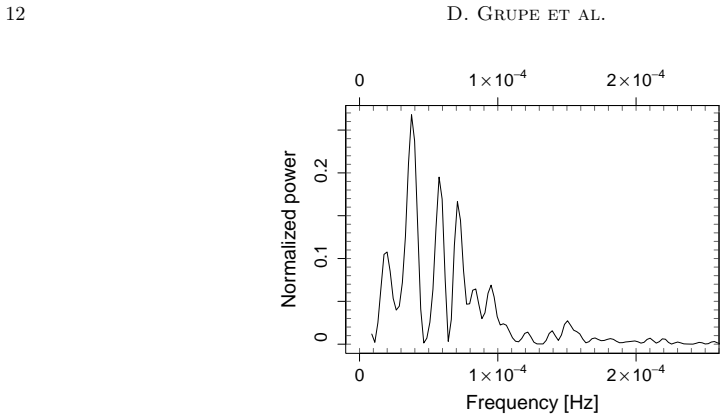
Summary. The manuscript reports the discovery of a third giant (factor >100), supersoft X-ray outburst of the changing-look AGN IC 3599, caught in progress by dedicated Swift monitoring and followed up promptly with Swift, XMM-Newton, and optical spectroscopy. The Swift spectra are extremely soft (almost no photons above ~2.5 keV) and well described by a black-body with kT_BB ~0.1 keV; the peak luminosity implies L/L_Edd ~1 for the adopted host-scaling black-hole mass. The XMM-Newton light curve shows high-amplitude oscillatory variability with a candidate period of ~7.4 hr (Lomb-Scargle). Optical spectra reveal a dramatic brightening of high-ionization coronal lines ([Fe X]–[Fe XIV]) that were absent or weak in low-state spectra, together with a large change in the Heta/[O III] ratio. The unequal recurrence intervals (19.5 yr then 15.7 yr) eliminate strictly periodic models (certain repeat tidal-stripping or binary-impact scenarios) while remaining consistent with a radiation-pressure disk instability once local disk conditions are allowed to modulate the onset of each cycle.
Significance. If the interpretation holds, IC 3599 becomes a uniquely well-sampled laboratory for accretion physics near the Eddington limit: three giant supersoft outbursts spanning 3.5 decades, a strong multi-line coronal-line response that enables future reverberation mapping, and a candidate short-term QPO-like signal. The observational elimination of constant-period models is robust and model-independent. The radiation-pressure framework (with the explicit non-strict-periodicity premise) yields a truncation radius (~20 R_g for M_BH = 2e6 M_sun) that matches the observed near-Eddington peak, providing a concrete, falsifiable link between multi-decade light curves and inner-disk structure. The data set is of high quality and will be of lasting value regardless of the final theoretical preference.
major comments (2)
- Sec. 5.3 and abstract: the radiation-pressure model is retained only after introducing the additional premise that local disk conditions can shift the onset time of each cycle, so that the observed intervals (19.5 yr then 15.7 yr) need not be strictly periodic. This premise is stated explicitly and is not hidden, but it is load-bearing: without it the same analytic relation used previously (Eq. 1 of Grupe et al. 2015) would be disfavored by the unequal Delta-t. The manuscript should quantify how large a change in local parameters (alpha, surface density, magnetic field, outer-disk radius) is required to produce a ~20% shift in recurrence time, and should cite the more recent radiation-pressure calculations (e.g., Sniegowska et al. 2023) that already show flare morphology and timing are sensitive to these quantities. A short paragraph of this form would convert an ad-hoc adjustment into a
- Sec. 3 and Appendix D: the candidate QPO at 7.4 hr (and secondary peak at 4.8 hr) rests on only four cycles of a 120 ks light curve. The Lomb-Scargle powers (0.27 and 0.20) and formal significances are reported, but the manuscript correctly notes that longer coverage is required. Because the QPO-like pattern is highlighted in the abstract and used to place IC 3599 among rare AGN with short-term periodicities, the text should more clearly separate the robust high-amplitude variability (factor 2.5 in 1.75 hr) from the still-unconfirmed periodicity, and should avoid language that could be read as a firm detection.
minor comments (5)
- Fig. 1 caption and Sec. 2.3: the 1990 ROSAT outburst is mentioned but not plotted; a simple vertical marker or inset would help the reader visualize the full three-outburst baseline.
- Sec. 2.3 and Appendix B: the black-body fit to the peak WT spectrum is preferred over a power law, but a brief comparison with a diskbb or Comptonized model (even if the fit does not improve) would strengthen the claim that the spectrum is thermal.
- Table 1: the [Fe XIV] 5303 FWHM and flux are flagged as upper limits because of possible blending; a short note on which other Fe transitions could contribute would be useful for future photoionization modeling.
- Sec. 5.1: the bolometric correction is taken from Grupe et al. (2010); stating the numerical factor used (or the (0.2–2 keV) to bolometric conversion) would aid reproducibility.
- Throughout: a few minor typos and inconsistent hyphenation (e.g., “quasiperiodic” vs “quasi-periodic”, “windowed timing” vs “Windowed Timing”) should be standardized.
Circularity Check
No significant circularity: unequal recurrence times are independent data that eliminate constant-period models; radiation-pressure agreement reuses prior parameters under an explicit extra assumption.
specific steps
-
self citation load bearing
[Sec. 5.3 (and abstract)]
"That model (see Eq. (1) of Grupe et al. 2015) still explains the new outburst well, if we assume local changes in the long-lived accretion disk that impact the onset and timing of the next cycle such that recurrent outbursts are not strictly periodic. At Δt2 = 15.7 yr and all other parameters as before (M_Edd = 1, R0 = 3 Rg, α = 0.1; Grupe et al. 2015), we obtain a truncation radius of R_trunc = (6.2–38) Rg"
The preferred model's quantitative viability (truncation radius and continued agreement) is obtained by importing the exact equation and fixed parameters from the authors' own prior paper and adding an extra free premise about variable onset; this is a mild self-citation dependency, but it is not load-bearing for the independent observational elimination of constant-Δt scenarios and is stated explicitly rather than hidden.
full rationale
The paper's load-bearing observational claims rest on new Swift monitoring (third outburst detection and light curve), XMM-Newton short-term variability, and optical spectroscopy showing brightened coronal lines. These directly yield unequal intervals (Δt1 = 19.5 yr, Δt2 = 15.7 yr) that rule out strictly periodic scenarios by construction of the data, not by model definition. The radiation-pressure instability interpretation re-applies the analytic formula and fixed parameters (α = 0.1, R0 = 3 Rg, M_Edd = 1) from the authors' earlier work (Grupe et al. 2015 Eq. 1) and adds the explicit premise that local disk conditions can shift onset times; this is an interpretive application of an existing model (itself rooted in Lightman & Eardley 1974 / Belloni et al. 1997), not a prediction forced by a fit to the new data or a self-definitional loop. Peak luminosity and L/L_Edd ~ 1 follow from a black-body spectral fit plus a previously published host-scaling mass; the candidate QPO is correctly flagged as needing longer coverage. No step reduces a claimed first-principles result or prediction to its own inputs by construction. Minor self-citation of prior parameters is normal and non-load-bearing for the elimination claim.
Axiom & Free-Parameter Ledger
free parameters (4)
- SMBH mass =
2.2e6 Msun
- viscosity parameter alpha =
0.1
- inner-disk radius R0 =
3 Rg
- black-body temperature kT_BB =
0.12 keV
axioms (4)
- domain assumption Lambda-CDM cosmology with Omega_M=0.3, Omega_Lambda=0.7, H0=70 km/s/Mpc yields D=91 Mpc at z=0.02078
- domain assumption Radiation-pressure instability recurrence time formula of Lightman & Eardley / Belloni et al. (as written in Eq. 1 of Grupe et al. 2015) applies to this AGN
- ad hoc to paper Local conditions in the long-lived accretion disk can shift the onset time of each instability cycle, allowing non-strict periodicity
- domain assumption Galactic N_H = 1.35e20 cm^-2 and E(B-V)=0.015 mag with R_V=3.1
read the original abstract
We report the discovery and multiwavelength follow-up observations of a giant (factor >100) X-ray outburst of the exceptional changing-look active galactic nucleus (AGN) IC 3599. This is the third such outburst after two previous ones serendipitously discovered in 1990 and 2010. Based on our dedicated long-term monitoring of IC 3599 with {\it Swift}, the third outburst was detected while it was happening, and we triggered multiple follow-up observations within days to weeks for the first time. The Swift outburst spectra are supersoft and almost no photons are detected beyond 2.5 keV. The XMM-Newton short-term light curve shows a remarkable apparent oscillatory pattern that is reminiscent of quasiperiodic oscillations (QPOs). The optical high-state spectra reveal a multitude of bright coronal emission lines that have dramatically brightened and were absent or much fainter in low-state spectra. The new results eliminate outburst scenarios that require a constant time interval of repetitions (like certain variants of repeat tidal stripping, or of an orbiting supermassive black hole impacting the inner accretion disk), but remain in excellent agreement with an accretion disk radiation-pressure instability when assuming that local conditions in the disk of this long-lived AGN affect the onset time of each new instability. The combination of recurrent, giant, supersoft outbursts on decadal timescales, the exceptional emission-line response, and the rapid, candidate quasiperiodic, short-term variability on an hours timescale makes IC 3599 unique among AGN, and establishes it as a key system for studying accretion physics under extreme conditions and at the Eddington limit.
Figures



Reference graph
Works this paper leans on
-
[1]
Alloin , D., Pelat , D., Phillips , M. M., Fosbury , R. A. E., & Freeman , K. 1986, ApJ, 308, 23, 10.1086/164475
doi:10.1086/164475 1986
-
[2]
1968, Astrophysical Letters, 1, 111
Andrillat , Y., & Souffrin , S. 1968, Astrophysical Letters, 1, 111
1968
-
[3]
Arnaud , K. A. 1996, in Astronomical Society of the Pacific Conference Series, Vol. 101, Astronomical Data Analysis Software and Systems V, ed. G. H. Jacoby & J. Barnes , 17
1996
-
[4]
R., van der Klis , M., & van Paradijs , J
Belloni , T., M \'e ndez , M., King , A. R., van der Klis , M., & van Paradijs , J. 1997, , 479, L145, 10.1086/310595
doi:10.1086/310595 1997
-
[5]
Brandt , W. N., Pounds , K. A., & Fink , H. 1995, MNRAS, 273, L47, 10.1093/mnras/273.1.L47
-
[6]
Burrows , D. N., Hill , J. E., Nousek , J. A., et al. 2005, Space Science Reviews, 120, 165, 10.1007/s11214-005-5097-2
-
[7]
2025, , 539, 231, 10.1093/mnras/staf496
Callow , J., Graur , O., Clark , P., et al. 2025, , 539, 231, 10.1093/mnras/staf496
-
[8]
2015, , 581, A17, 10.1051/0004-6361/201525965
Campana , S., Mainetti , D., Colpi , M., et al. 2015, , 581, A17, 10.1051/0004-6361/201525965
-
[9]
Cardelli , J. A., Clayton , G. C., & Mathis , J. S. 1989, ApJ, 345, 245, 10.1086/167900
doi:10.1086/167900 1989
-
[10]
Crawley, M. J. 2012, The R Book, 2nd edn. (Chichester, UK: John Wiley & Sons)
2012
-
[11]
Dexter , J., & Begelman , M. C. 2019, MNRAS, 483, L17, 10.1093/mnrasl/sly213
-
[12]
2025, arXiv e-prints, arXiv:2510.18445, 10.48550/arXiv.2510.18445
Dong , Q., Zhang , Z.-X., Gu , W.-M., et al. 2025, arXiv e-prints, arXiv:2510.18445, 10.48550/arXiv.2510.18445
-
[13]
Evans , P. A., Beardmore , A. P., Page , K. L., et al. 2007, , 469, 379, 10.1051/0004-6361:20077530
-
[14]
2016, PASP, 128, 115005, 10.1088/1538-3873/128/969/115005
Fan, Z., Wang, H., Jiang, X., et al. 2016, PASP, 128, 115005, 10.1088/1538-3873/128/969/115005
-
[15]
Filippenko , A. V. 1982, , 94, 715, 10.1086/131052
doi:10.1086/131052 1982
-
[16]
2008, , 455, 369, 10.1038/nature07277
Gierli \'n ski , M., Middleton , M., Ward , M., & Done , C. 2008, , 455, 369, 10.1038/nature07277
-
[17]
Giustini , M., Miniutti , G., & Saxton , R. D. 2020, , 636, L2, 10.1051/0004-6361/202037610
-
[18]
X-RAY OUTBURST OF THE PECULIAR SEYFERT GALAXY IC 3599
Grupe , D., Beuermann , K., Mannheim , K., et al. 1995, , 299, L5, 10.48550/arXiv.astro-ph/9505085
work page internal anchor Pith review Pith/arXiv arXiv doi:10.48550/arxiv.astro-ph/9505085 1995
-
[19]
Grupe , D., Beuermann , K., Thomas , H.-C., Mannheim , K., & Fink , H. H. 1998, , 330, 25, 10.48550/arXiv.astro-ph/9710298
-
[20]
Grupe , D., Komossa , S., Leighly , K. M., & Page , K. L. 2010, ApJS, 187, 64, 10.1088/0067-0049/187/1/64
-
[21]
2015, , 803, L28, 10.1088/2041-8205/803/2/L28
Grupe , D., Komossa , S., & Saxton , R. 2015, , 803, L28, 10.1088/2041-8205/803/2/L28
-
[22]
2024, , 969, 98, 10.3847/1538-4357/ad4530
Grupe , D., Komossa , S., & Wolsing , S. 2024, , 969, 98, 10.3847/1538-4357/ad4530
-
[23]
2025, The Astronomer's Telegram, 17479, 1
Grupe , D., Komossa , S., Wolsing , S., & Schartel , N. 2025, The Astronomer's Telegram, 17479, 1
2025
-
[24]
2001, , 367, 470, 10.1051/0004-6361:20000429
Grupe , D., Thomas , H.-C., & Beuermann , K. 2001, , 367, 470, 10.1051/0004-6361:20000429
-
[25]
2016, Astronomy & Astrophysics, 594, 10.1051/0004-6361/201628642
HI4PI Collaboration , Ben Bekhti , N., Fl \"o er , L., et al. 2016, Astronomy & Astrophysics, 594, 10.1051/0004-6361/201628642
-
[26]
Hill , J. E., Angelini , L., Morris , D. C., et al. 2005, in Society of Photo-Optical Instrumentation Engineers (SPIE) Conference Series, Vol. 5898, UV, X-Ray, and Gamma-Ray Space Instrumentation for Astronomy XIV, ed. O. H. W. Siegmund , 325--340, 10.1117/12.618026
-
[27]
Kollatschny, W., & Fricke, K. J. 1985, , 146, L11
1985
-
[28]
1999, Astronomy & Astrophysics, 343, 775
Komossa , S., & Bade , N. 1999, Astronomy & Astrophysics, 343, 775. astro-ph/9901141
Pith/arXiv arXiv 1999
-
[29]
2024, Serbian Astronomical Journal, 209, 1, 10.2298/SAJ2409001K
Komossa , S., & Grupe , D. 2024, Serbian Astronomical Journal, 209, 1, 10.2298/SAJ2409001K
-
[30]
2014, in Proceedings of Swift: 10 Years of Discovery (SWIFT 10), 143, 10.22323/1.233.0143
Komossa , S., Grupe , D., Saxton , R., & Gallo , L. 2014, in Proceedings of Swift: 10 Years of Discovery (SWIFT 10), 143, 10.22323/1.233.0143
-
[31]
2008, ApJL, 678, L13, 10.1086/588281
Komossa , S., Zhou , H., Wang , T., et al. 2008, ApJL, 678, L13, 10.1086/588281
doi:10.1086/588281 2008
-
[32]
2025, The Astronomer's Telegram, 17507, 1
Komossa , S., Grupe , D., Zheng , W., et al. 2025, The Astronomer's Telegram, 17507, 1
2025
-
[33]
2026, Advances in Space Research, 77, 4041, 10.1016/j.asr.2025.04.058
Komossa , S., Grupe , D., Marziani , P., et al. 2026, Advances in Space Research, 77, 4041, 10.1016/j.asr.2025.04.058
-
[34]
2022, ApJ, 931, 5, 10.3847/1538-4357/ac63aa
Laha , S., Meyer , E., Roychowdhury , A., et al. 2022, ApJ, 931, 5, 10.3847/1538-4357/ac63aa
-
[35]
2018, Nature Astronomy, 2, 102, 10.1038/s41550-017-0372-1
Lawrence , A. 2018, Nature Astronomy, 2, 102, 10.1038/s41550-017-0372-1
-
[36]
2025, , 988, 207, 10.3847/1538-4357/adec76
Li , S.-L., & Cao , X. 2025, , 988, 207, 10.3847/1538-4357/adec76
-
[37]
Lightman , A. P., & Eardley , D. M. 1974, ApJL, 187, L1, 10.1086/181377
doi:10.1086/181377 1974
-
[38]
Liu , F. K., Li , S., & Chen , X. 2009, , 706, L133, 10.1088/0004-637X/706/1/L133
-
[39]
Lomb, N. R. 1976, Astrophysics and Space Science, 39, 447
1976
-
[40]
Mason , K. O., Hassall , B. J. M., Bromage , G. E., et al. 1995, , 274, 1194, 10.1093/mnras/274.4.1194
-
[41]
2025, , 638, 370, 10.1038/s41586-024-08385-x
Masterson , M., Kara , E., Panagiotou , C., et al. 2025, , 638, 370, 10.1038/s41586-024-08385-x
-
[42]
2011, , 417, 250, 10.1111/j.1365-2966.2011.19185.x
Middleton , M., Uttley , P., & Done , C. 2011, , 417, 250, 10.1111/j.1365-2966.2011.19185.x
-
[43]
S., & Stone, R
Miller, J. S., & Stone, R. P. S. 1994, Lick Obs. Tech. Rep. 66 (Santa Cruz: Lick Obs.)
1994
-
[44]
2023, , 674, L1, 10.1051/0004-6361/202346653
Miniutti , G., Giustini , M., Arcodia , R., et al. 2023, , 674, L1, 10.1051/0004-6361/202346653
-
[45]
2018, MNRAS, 480, 3898, 10.1093/mnras/sty2032
Noda , H., & Done , C. 2018, MNRAS, 480, 3898, 10.1093/mnras/sty2032
-
[46]
W., Kollatschny , W., Probst , M
Ochmann , M. W., Kollatschny , W., Probst , M. A., et al. 2024, , 686, A17, 10.1051/0004-6361/202348559
-
[47]
L., Winkler , H., Tsygankov , S
Oknyansky , V. L., Winkler , H., Tsygankov , S. S., et al. 2020, , 498, 718, 10.1093/mnras/staa1552
-
[48]
Park , T., Kashyap , V. L., Siemiginowska , A., et al. 2006, , 652, 610, 10.1086/507406
doi:10.1086/507406 2006
-
[49]
L., Schartel , N., Grupe , D., et al
Parker , M. L., Schartel , N., Grupe , D., et al. 2019, MNRAS, 483, L88, 10.1093/mnrasl/sly224
-
[50]
Potanin , S. A., Belinski , A. A., Dodin , A. V., et al. 2020, Astronomy Letters, 46, 836, 10.1134/S1063773720120038
-
[51]
2021, , 650, A33, 10.1051/0004-6361/202140597
Potts , B., & Villforth , C. 2021, , 650, A33, 10.1051/0004-6361/202140597
-
[52]
2026, R: A Language and Environment for Statistical Computing (Vienna, Austria: R Foundation for Statistical Computing)
R Core Team . 2026, R: A Language and Environment for Statistical Computing (Vienna, Austria: R Foundation for Statistical Computing). https://www.R-project.org/
2026
-
[53]
2023, Nature Astronomy, 7, 1282, 10.1038/s41550-023-02108-4
Ricci , C., & Trakhtenbrot , B. 2023, Nature Astronomy, 7, 1282, 10.1038/s41550-023-02108-4
-
[54]
Rines , K. J., Geller , M. J., Diaferio , A., & Hwang , H. S. 2016, , 819, 63, 10.3847/0004-637X/819/1/63
-
[55]
Roming , P. W. A., Kennedy , T. E., Mason , K. O., et al. 2005, Space Science Reviews, 120, 95, 10.1007/s11214-005-5095-4
-
[56]
Saxton , R. D., Motta , S. E., Komossa , S., & Read , A. M. 2015, , 454, 2798, 10.1093/mnras/stv2160
-
[57]
Scargle, J. D. 1982, ApJ, 263, 835, 10.1086/160554
doi:10.1086/160554 1982
-
[58]
2025, , 994, 203, 10.3847/1538-4357/ae1299
Shen , Y.-H., Lu , K.-X., Guo , W.-J., et al. 2025, , 994, 203, 10.3847/1538-4357/ae1299
-
[59]
Silverman , J. M., Foley , R. J., Filippenko , A. V., et al. 2012, , 425, 1789, 10.1111/j.1365-2966.2012.21270.x
-
[60]
Smith , T. B., Fries , L. B., Trump , J. R., et al. 2025, , 995, 185, 10.3847/1538-4357/ae1f18
-
[61]
2020, Astronomy & Astrophysics, 641, A167, 10.1051/0004-6361/202038575
Sniegowska , M., Czerny , B., Bon , E., & Bon , N. 2020, Astronomy & Astrophysics, 641, A167, 10.1051/0004-6361/202038575
-
[62]
2023, , 672, A19, 10.1051/0004-6361/202243828
\'S niegowska , M., Grz e dzielski , M., Czerny , B., & Janiuk , A. 2023, , 672, A19, 10.1051/0004-6361/202243828
-
[63]
Stern , D., McKernan , B., Graham , M. J., et al. 2018, ApJ, 864, 27, 10.3847/1538-4357/aac726
-
[64]
1986, in Society of Photo-Optical Instrumentation Engineers (SPIE) Conference Series, Vol
Tody , D. 1986, in Society of Photo-Optical Instrumentation Engineers (SPIE) Conference Series, Vol. 627, Instrumentation in astronomy VI, ed. D. L. Crawford , 733, 10.1117/12.968154
-
[65]
Tohline , J. E., & Osterbrock , D. E. 1976, , 210, L117, 10.1086/182317
doi:10.1086/182317 1976
-
[66]
2005, , 362, 235, 10.1111/j.1365-2966.2005.09296.x
Vaughan , S., & Uttley , P. 2005, , 362, 235, 10.1111/j.1365-2966.2005.09296.x
-
[67]
1999, , 349, 389, 10.48550/arXiv.astro-ph/9909315
Voges , W., Aschenbach , B., Boller , T., et al. 1999, , 349, 389, 10.48550/arXiv.astro-ph/9909315
-
[68]
Wang , J., Xu , D. W., Cao , X., et al. 2024, , 970, 85, 10.3847/1538-4357/ad4d89
-
[69]
2012, ApJ, 749, 115, 10.1088/0004-637X/749/2/115
Wang , T.-G., Zhou , H.-Y., Komossa , S., et al. 2012, ApJ, 749, 115, 10.1088/0004-637X/749/2/115
-
[70]
Webbe , R., & Young , A. J. 2023, , 518, 3428, 10.1093/mnras/stac3318
-
[71]
Wright , E. L. 2006, PASP, 118, 1711, 10.1086/510102
doi:10.1086/510102 2006
discussion (0)
Sign in with ORCID, Apple, or X to comment. Anyone can read and Pith papers without signing in.