REVIEW 3 major objections 7 minor 17 references
Rotating a linear array like a CT scanner reconstructs full-space 3D wireless power spectra with far fewer samples than a cubic virtual array.
Reviewed by Pith at T0; open to challenge. T0 means a machine referee read the full paper against a public rubric. the ladder, T0–T4 →
2026-07-14 13:01 UTC pith:ZVMF45DR
load-bearing objection Solid systems paper: rotating-ULA CT with proved isotropic orientations cuts 3D SPS samples from U^{3} to O(U); main soft spot is sim-only validation under the same uniform-sphere prior used for design. the 3 major comments →
Rotating ULA-Enabled Computed Tomography for Efficient 3D Spatial Power Spectrum Synthesis: Architecture and Principled Orientation Design
The pith
A machine-rendered reading of the paper's core claim, the machinery that carries it, and where it could break.
Core claim
A rotating uniform linear array that collects partial coherent sums at a small number of isotropic orientations can synthesize a full-space three-dimensional spatial power spectrum online with a single RF chain, matching the dense cubic virtual-array reference while using only a fraction of the spatial samples.
What carries the argument
RULA-CT synthesis: partial 1-D coherent sums formed by analog combining along each rotated ULA axis, fused either by pointwise minimum of the partial spectrum images or by joint coherent accumulation of the sums; orientations chosen so their outer-product sum equals (R/3)I (isotropic tight frame) and then refined to minimize worst-case projective correlation.
Load-bearing premise
The orientation design assumes multipath directions are randomly and uniformly scattered on the sphere; if real environments are strongly clustered or anisotropic, those orientations need not remain near-optimal.
What would settle it
In a measured indoor or outdoor channel whose multipath directions are markedly non-uniform, compare the spherical ROI-SSIM of the RULA-min spectrum obtained with the paper’s isotropic seven-orientation set against the same metric obtained with orientations re-optimized for the measured angular distribution; a clear drop for the isotropic set would falsify the claim of environment-agnostic optimality.
If this is right
- Full-space 3D spatial power spectrum acquisition becomes practical with O(U) samples and one RF chain instead of U^{3} samples or a physical cubic array.
- Movable-antenna and six-dimensional movable-antenna systems can reconfigure using spectra acquired with far lower movement overhead.
- Intelligent reflecting surface phase tuning and millimeter-wave beam alignment can draw on online full-space spectra rather than half-space planar-array scans.
- Pipelined analog beamforming along successive orientations reduces hardware cost relative to fully digital multi-antenna sampling.
- Pointwise-minimum fusion is preferred in high-SNR resolution-limited regimes; joint coherent fusion is preferred in low-SNR regimes.
Where Pith is reading between the lines
- If mechanical rotation latency dominates, the same sampling geometry could be realized by a sparse set of fixed linear arrays whose orientations already form an isotropic tight frame, trading motion for a modest increase in hardware.
- The isotropic-matrix condition is mathematically the same requirement that appears in equiangular tight frames and spherical designs; existing combinatorial constructions may supply closed-form orientation sets for larger R without numerical optimization.
- Because the design is environment-agnostic, a natural next experiment is online adaptation that reweights orientations once a coarse spectrum estimate reveals strong angular clustering.
Editorial analysis
A structured set of objections, weighed in public.
Referee Report
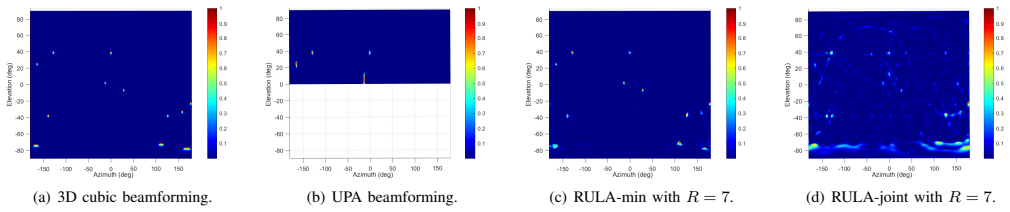
Summary. The paper proposes a rotating uniform linear array (RULA) architecture for online full-space 3D spatial power spectrum (SPS) synthesis with a single RF chain. A ULA is rotated about its center; at each orientation it performs analog receive combining to form partial coherent sums. Full-space SPS is recovered either by pointwise minimum fusion of orientation-wise partial spectra or by joint coherent accumulation of the partial sums (with center-sample correction). Against fixed UPA combining (half-space, non-uniform resolution) and dense U³ cubic virtual-array sampling (full-space but costly), the scheme aims for full-space coverage with RU samples and more uniform resolution. Orientation sets are designed without environment side information by (i) maximizing expected worst-case projected MPC-pair separation, for which the relaxed optimum is the isotropic Gram matrix G★=(R/3)I₃ (Propositions 1–3; attainable by unit-norm tight frames for R≥3), then (ii) minimizing worst-case projective correlation under that constraint via multi-start smooth minimax (Algorithm 1). Numerical ROI-SSIM comparisons under K=12 random paths claim spectra close to the cubic reference with R=7.
Significance. If the claims hold under realistic channels, the work offers a practical middle ground between half-space UPA beamforming and dense volumetric MA sampling for 3D SPS acquisition—relevant to MA/6DMA configuration, RIS tuning, and mmWave sensing. Strengths that should be credited: (1) clean CT-style dual fusion rules under a single-RF architecture, with an explicit implementation comparison (Table I); (2) a mathematically standard and well-proved isotropic relaxation (Haar averaging / concavity for Prop. 1, constructive tight-frame realization for Prop. 2, Poisson rare-event scaling for Prop. 3); (3) an honest SNR-regime split between min fusion and joint fusion in Figs. 10–12. The secondary minimax correlation criterion and multi-start solver are conventional but useful for removing redundant axes that the Gram constraint alone does not forbid.
major comments (3)
- [Section IV–V, Eqs. (25)–(32)] Section IV (Eqs. 25–32, 36) and Section V: the primary orientation criterion and all reported SPS quality results use the same i.i.d. Unif(S²) MPC model. The abstract and strongest efficiency claim (full-space spectra close to the U³ cubic reference with only RU samples) are therefore supported only under the design prior. There is no mismatched-prior experiment (e.g., clustered street-canyon or indoor angular clusters with small spreads). Under strong anisotropy the isotropic tight frame need not maximize actual projected separability, so sample-efficiency can degrade even though the fusion rules remain well-defined. Please add at least one clustered/anisotropic stress test, or clearly scope the numerical claims to the isotropic generative model and discuss degradation risk.
- [Section V, Figs. 8–12] Section V / orientation design validation: Figs. 8–12 compare RULA-min/joint only to cubic and UPA baselines. They do not ablate the proposed two-criterion design against natural alternatives that also use R orientations (random unit axes; repeated coordinate axes; unconstrained min-correlation without the isotropic constraint already shown only geometrically in Fig. 8). Without that ablation it is hard to attribute the reported ROI-SSIM gains to the principled design rather than to “any R≈7 well-spread axes.” A small ablation would make the secondary criterion and Algorithm 1 load-bearing rather than decorative.
- [Section III, Eqs. (21)–(23); Fig. 11] Section III-2, Eqs. (21)–(23): joint coherent fusion requires inter-orientation phase consistency (common phase offsets ψ_m must be estimated/calibrated). The paper states this requirement but provides no estimation method, residual-error model, or sensitivity study. Since RULA-joint is the recommended mode in the low-SNR regime (Fig. 11), phase-error robustness is load-bearing for half of the dual-rule contribution. Please either specify a practical calibration procedure and show residual-phase sensitivity, or qualify joint fusion as conditional on ideal phase alignment.
minor comments (7)
- [Section II-A] d=0.47λ is motivated as a compromise against end-fire 2π ambiguity (Section II-A) but is never swept; a short sensitivity note would help reproducibility.
- [Section V-C, Eq. (44)] ROI-SSIM uses free threshold τ=0.4 and Gaussian windows (Section V-C). Report sensitivity to τ or fix it by a data-independent rule.
- [Algorithm 1 / Section V-B] Algorithm 1: β, ρ, N_start, and ϵ_iso are free; state the values used for Fig. 8 so the orientation sets are reproducible.
- [Fig. 5] Fig. 5 caption and middle row: “slice-like” partial spectra are projections lifted to the sphere; a one-sentence reminder that ridges are iso-μ contours would help non-CT readers.
- [Section III] Notation: both P(ϕ,θ) and P_joint appear; keep a consistent superscript/subscript scheme for min vs joint throughout Section III.
- [Table I] Table I is useful; adding a rough acquisition-time column (mechanical reorientation vs electronic sweep) would align the table with the latency discussion in the text.
- [Section II / References] Typos / polish: “sifting property… given by R_Ω …” line break is awkward; “gigantic” is informal for journal prose; arXiv id in the prompt header is fine but ensure camera-ready citation of the VTC workshop version [1] is consistent.
Circularity Check
No circularity: isotropic orientation design and CT fusion rules are derived independently of the spectrum-image metrics used for validation.
full rationale
The load-bearing derivation chain is self-contained and does not reduce predictions to their inputs by construction. Full-space SPS is defined via the continuous Fourier transform (Eqs. 1–4) and discrete K-path model (Eqs. 5–6). Conventional cubic and UPA baselines are stated independently (Eqs. 7–10). RULA sampling, partial coherent sums, pointwise minimum fusion, and joint coherent fusion (Eqs. 11–23) are architectural constructions, not fits to spectrum images. Orientation design maximizes expected worst-case projected separation of i.i.d. Unif(S²) MPC pairs (Eqs. 24–25); the relaxed optimum G★=(R/3)I₃ follows from rotational invariance and Jensen on a concave objective (Prop. 1, App. A), is realized by finite unit-norm tight frames for R≥3 (Prop. 2, App. B), and yields an explicit large-K scaling (Prop. 3, App. C). The secondary criterion minimizes worst-case |qᵢᵀqⱼ|² under that isotropic constraint (P1, Eq. 38); Algorithm 1 is a standard multi-start smooth minimax, not a fit to ROI-SSIM. Numerical spectra and ROI-SSIM (Figs. 10–12) are post-hoc evaluations under the same prior used for design—normal validation, not a fitted parameter renamed as prediction. Self-citation [1] is only the authors’ VTC preliminary of this work and is not load-bearing for uniqueness or optimality. The skeptic’s concern about mismatched clustered MPCs is an external-assumption risk, not internal circularity.
Axiom & Free-Parameter Ledger
free parameters (4)
- inter-element spacing d
- smoothing β and penalty ρ in L(Q)
- ROI threshold τ
- number of orientations R (main results)
axioms (5)
- domain assumption Narrowband far-field discrete K-path channel: r(p)=Σ α_k exp(j 2π/λ ν_k^T p) plus i.i.d. AWGN
- ad hoc to paper MPC directions for design are i.i.d. uniform on S² (environment-agnostic prior)
- domain assumption At true MPC directions, partial powers are approximately U|α_k|² for every orientation when paths are well separated
- standard math Unit-norm tight frames / isotropic outer-product sums in R³ exist for every R≥3
- domain assumption Joint coherent fusion assumes inter-orientation common phase can be estimated and calibrated
invented entities (2)
-
RULA-CT sampling and dual fusion rules (pointwise min and joint coherent sum)
no independent evidence
-
Two-criterion orientation design (max expected worst-case projected separation, then min worst-case |q_i^T q_j|² under G=R/3 I)
no independent evidence
Cite this review
Pith. "Pith review of Rotating ULA-Enabled Computed Tomography for Efficient 3D Spatial Power Spectrum Synthesis: Architecture and Principled Orientation Design." pith.science (2026). https://pith.science/paper/ZVMF45DR
@misc{pith2026260710270,
  author       = {Pith},
  title        = {Pith review of: Rotating ULA-Enabled Computed Tomography for Efficient 3D Spatial Power Spectrum Synthesis: Architecture and Principled Orientation Design},
  year         = {2026},
  howpublished = {\url{https://pith.science/paper/ZVMF45DR}},
  note         = {Machine review of arXiv:2607.10270}
}
read the original abstract
This paper proposes an efficient three-dimensional (3D) spatial power spectrum synthesis method by rotating a uniform linear array (ULA) about its center in 3D space. Inspired by classical computed tomography (CT), the ULA performs analog receive combining at each rotation angle to produce a partial coherent sum. By collecting such sums over multiple rotations, the full 3D spectrum can be synthesized online via a single radio-frequency (RF) chain, without explicitly acquiring per-antenna signals. Depending on whether the overall coherent sum is accessible, the synthesis is obtained through either a minimum operation over partial spectrum images or joint synthesis after accumulating all coherent sums. Compared with fixed uniform planar array (UPA)-based combining and dense single movable-antenna (MA) sampling for 3D cubic virtual arrays, the proposed scheme achieves full-space 3D coverage with substantially reduced sampling and movement overhead while maintaining uniformly high angular resolution. Its sampling geometry and sequential orientation design also support pipelined analog beamforming, reducing practical hardware cost. To design rotation orientations in a principled manner without prior environmental information, we aim to maximize the expected worst-case projected separation between multi-path component (MPC) pairs. A secondary criterion then minimizes the worst-case projective correlation among orientation axes to reduce orientation redundancy. Accordingly, we optimize orientation sets for different numbers of orientations under isotropic-matrix and unit-norm constraints, using a multistart smooth minimax algorithm. Numerical results show that the optimized orientations uniformly span 3D space and reconstruct full-space 3D spectra close to the dense 3D cubic reference using only a fraction of spatial samples.
Figures



Reference graph
Works this paper leans on
-
[1]
Rotating ULA-enabled computed tomography for efficient 3D spatial power spectrum synthesis via analog receive combining,
H. Hua, W. Mei, J. Xu, and R. Zhang, “Rotating ULA-enabled computed tomography for efficient 3D spatial power spectrum synthesis via analog receive combining,” inIEEE VTC Workshop, Jun. 2026
2026
-
[2]
R. W. Heath Jr and A. Lozano,Foundations of MIMO communication. Cambridge University Press, 2018
2018
-
[3]
A tutorial on near-field XL-MIMO communications towards 6G,
H. Luet al., “A tutorial on near-field XL-MIMO communications towards 6G,”IEEE Commun. Surveys Tuts., vol. 26, no. 4, pp. 2213– 2257, Apr. 2024
2024
-
[4]
Near-field integrated sensing and communication with extremely large-scale antenna array,
H. Hua, J. Xu, and R. Zhang, “Near-field integrated sensing and communication with extremely large-scale antenna array,”IEEE Trans. Wireless Commun., vol. 24, no. 12, pp. 9962–9977, Dec. 2025
2025
-
[5]
Intelligent surfaces empowered wireless network: Recent advances and the road to 6G,
Q. Wu, B. Zheng, C. You, L. Zhu, K. Shen, X. Shao, W. Mei, B. Di, H. Zhang, E. Basar, L. Song, M. Di Renzo, Z.-Q. Luo, and R. Zhang, “Intelligent surfaces empowered wireless network: Recent advances and the road to 6G,”Proc. IEEE, vol. 112, no. 7, pp. 724–763, Jul. 2024
2024
-
[6]
A tutorial on movable antennas for wireless networks,
L. Zhu, W. Ma, W. Mei, Y . Zeng, Q. Wu, B. Ning, Z. Xiao, X. Shao, J. Zhang, and R. Zhang, “A tutorial on movable antennas for wireless networks,”IEEE Commun. Surveys Tuts., vol. 28, pp. 3002–3054, Feb. 2025
2025
-
[7]
6D movable antenna based on user distribution: Modeling and optimization,
X. Shao, Q. Jiang, and R. Zhang, “6D movable antenna based on user distribution: Modeling and optimization,”IEEE Trans. Wireless Commun., vol. 24, no. 1, pp. 355–370, Jan. 2025
2025
-
[8]
Hierarchically tunable 6DMA for wireless communication and sensing: Modeling and performance optimization,
H. Hua, Y . Zhou, W. Mei, J. Xu, and R. Zhang, “Hierarchically tunable 6DMA for wireless communication and sensing: Modeling and performance optimization,”IEEE Trans. Wireless Commun., vol. 25, pp. 4721–4736, Oct. 2025
2025
-
[9]
NeRF2: Neural radio-frequency radiance fields,
X. Zhao, Z. An, Q. Pan, and L. Yang, “NeRF2: Neural radio-frequency radiance fields,” inProc. 29th Annu. Int. Conf. Mobile Comput. Netw. (Mobicom), Oct. 2023, pp. 1–15
2023
-
[10]
60 GHz channel directional characterization using extreme size virtual antenna array,
J. Medbo, H. Asplund, and J.-E. Berg, “60 GHz channel directional characterization using extreme size virtual antenna array,” inProc. IEEE PIMRC. IEEE, Sept. 2015, pp. 176–180
2015
-
[11]
Frequency dependency of measured highly resolved directional propagation channel characteristics,
J. Medbo, N. Seifi, and H. Asplund, “Frequency dependency of measured highly resolved directional propagation channel characteristics,” inProc. 22nd Eur. Wireless Conf. (European Wireless), May 2016, pp. 9–14
2016
-
[12]
6D channel knowledge map construction via bidirectional wireless gaussian splatting,
J. Zhou, C. Hu, G. Wu, Z. Ren, H. Hu, J. Zhang, R. Zhang, and J. Xu, “6D channel knowledge map construction via bidirectional wireless gaussian splatting,”arXiv preprint arXiv:2510.26166, 2025
arXiv 2025
-
[13]
A tutorial on environment-aware communications via channel knowledge map for 6G,
Y . Zeng, J. Chen, J. Xu, D. Wu, X. Xu, S. Jin, X. Gao, D. Gesbert, S. Cui, and R. Zhang, “A tutorial on environment-aware communications via channel knowledge map for 6G,”IEEE Commun. Surveys Tuts., vol. 26, no. 3, pp. 1478–1519, Feb. 2024
2024
-
[14]
An overview of signal processing techniques for millimeter wave MIMO systems,
R. W. Heath, N. Gonzalez-Prelcic, S. Rangan, W. Roh, and A. M. Sayeed, “An overview of signal processing techniques for millimeter wave MIMO systems,”IEEE J. Sel. Topics Signal Process., vol. 10, no. 3, pp. 436–453, Feb. 2016
2016
-
[15]
Con- vergence properties of the Nelder–Mead simplex method in low dimen- sions,
J. C. Lagarias, J. A. Reeds, M. H. Wright, and P. E. Wright, “Con- vergence properties of the Nelder–Mead simplex method in low dimen- sions,”SIAM J. Optim., vol. 9, no. 1, pp. 112–147, 1998
1998
-
[16]
How to generate random matrices from the classical compact groups,
F. Mezzadri, “How to generate random matrices from the classical compact groups,”Notices Amer. Math. Soc., vol. 54, no. 5, pp. 592– 604, 2007
2007
-
[17]
Two moments suffice for Poisson approximations: the Chen–Stein method,
R. Arratia, L. Goldstein, and L. Gordon, “Two moments suffice for Poisson approximations: the Chen–Stein method,”Ann. Probab., vol. 17, no. 1, pp. 9–25, 1989
1989
This paper was first reviewed by grok-4.5 on July 14, 2026.
discussion (0)
Sign in with ORCID, Apple, or X to comment. Anyone can read and Pith papers without signing in.