REVIEW 3 major objections 5 minor 58 references
Towards stealthy hyperuniform networks with optimal isotropic complete photonic band gaps using a novel inverse design procedure
T0 review · 3 major / 5 minor · reviewed 2026-08-02 · deepseek-v4-flash
Pith's one-line read A two-stage inverse design makes disordered, isotropic networks with complete photonic band gaps nearly as wide as those of crystals.
desk verdict New inverse design directly targets stealthy hyperuniformity of the network itself and reports a 14.7% ensemble isotropic complete PBG; the headline thermodynamic-limit claim rests on an unproven self-averaging assumption. read the letter →
The pith
A machine-rendered reading of the paper's core claim, the machinery that carries it, and where it could break.
The reading
What carries the argument
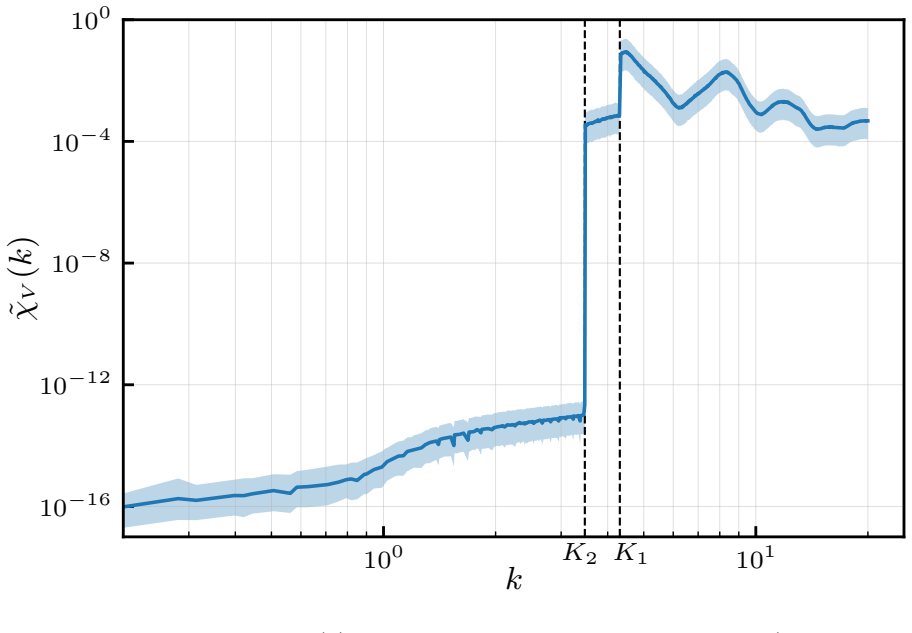
The load-bearing object is the two-stage inverse design loop. Stage 1 solves an inverse problem for the triangle centroids of the point pattern's triangulation, using gradient descent on a structure-factor loss; because the triangulation is recomputed at every step, the network topology can reorganize, avoiding the bond-distortion problem that defeats naive vertex shifting. Stage 2 keeps topology fixed and directly minimizes the spectral density of the final two-phase medium, which is the statistic that defines stealthy hyperuniformity for a heterogeneous material. The coupling of global topology change with direct spectral-density refinement is what produces regular pentagon/hexagon/heptago
What would settle it
Set up a single connected stealthy hyperuniform trivalent network with 50,000–100,000 vertices and compute its photonic density of states (or measure transmission through a fabricated sample of comparable size); if the complete band gap narrows below, say, 10% or closes outright, the ensemble-based persistence claim is refuted.
Extended reading notes
Core claim
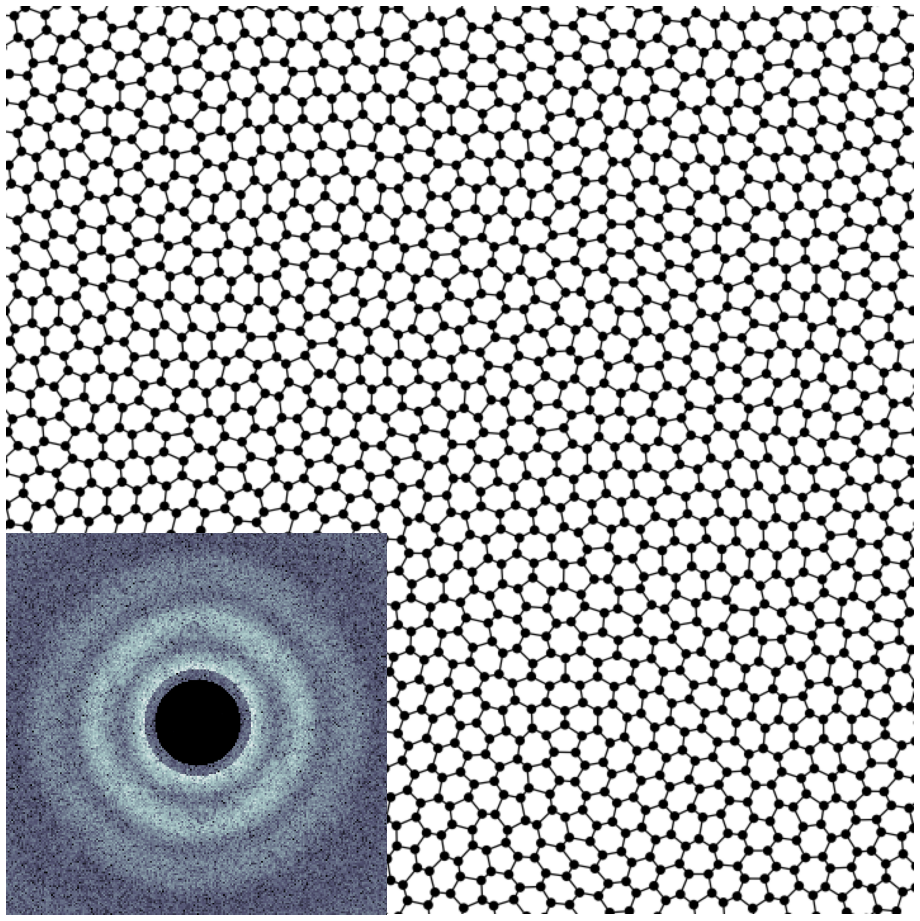
At its core, the paper argues that the decisive step is to require stealthy hyperuniformity of the two-phase dielectric structure itself, not just of the point pattern used to scaffold it. The two-stage optimization first moves the progenitor points so that the centroids of the triangulation — the future network vertices — are as stealthy hyperuniform as possible while the topology is free to change; then it shifts the network vertices so the spectral density of the decorated structure (dielectric disks at vertices and thin walls along bonds) is minimized out to a cutoff wavenumber. The result, for 500 realizations of 2000 vertices, is an ensemble density of states with a complete gap-to-mid
Load-bearing premise
The argument that the gaps persist at 100,000 vertices rests on assuming the photonic density of states is self-averaging, so that stacking 500 independent 2000-vertex simulations is equivalent to one 100,000-vertex system; if that equivalence fails, or if the single-Gamma-point supercell computation misses modes, the gap could close in a truly large connected sample.
Editorial extensions
If this is right
- If the claim holds, isotropic amorphous photonic materials can achieve complete band gaps nearly as wide as the best anisotropic crystals, without the directional constraints of periodicity.
- The ensemble result implies that fabrication of only modest 2000-vertex samples can already deliver near-thermodynamic-limit performance, easing experimental realization.
- Because the structures are trivalent networks of disks and walls, they are compatible with additive manufacturing, enabling free-form waveguides, arbitrary-orientation cavities, and isotropic thermal emitters.
- The near-complete TE-TM overlap means polarization-independent operation over a wide frequency range, simplifying device design.
- Further tuning of disk radius and wall thickness, and deeper suppression of the intermediate-wavenumber scattering ring, could push the gap closer to or beyond that of honeycomb crystals.
Reading between the lines
- If the self-averaging assumption is correct, the effective 100,000-vertex result is a strong hint that the gap stays open in the thermodynamic limit; but the assumption itself is only tested indirectly here, and a true single large-system simulation would settle it.
- The observed disorder-to-order transition at χ≈0.39 for centroid-constrained patterns suggests a ceiling on how stealthy a trivalent network can be before it crystallizes; pushing beyond it would require relaxing local topology constraints.
- The same two-stage logic could be exported to three dimensions, or to phononic and acoustic systems, where isotropic complete gaps remain an open target.
- Since the band-gap width appears tied to the spectral-density suppression between the two cutoffs, deliberately engineering a flatter, deeper suppression ring might be a direct route to even steeper band edges.
Editorial analysis
A structured set of objections, weighed in public.
Referee Report
Summary. The paper introduces a two-stage inverse design procedure for generating disordered, stealthy hyperuniform trivalent photonic networks in two dimensions. The first stage optimizes the Delaunay-centroid point pattern to be close to stealthy hyperuniform, and the second stage refines the vertex positions of the decorated network (discs at vertices, rectangular walls along bonds) to directly enforce stealthy hyperuniformity of the two-phase medium via its spectral density. The authors compute photonic densities of states with MPB for 500 independent 2000-vertex realizations and report an ensemble-averaged complete photonic band gap with gap-to-midgap ratio 14.7%, compared with 4.0% for networks made with the prior Florescu et al. method and 16.7% for a honeycomb photonic crystal with the same dielectric parameters. They also report a single-best realization gap of 19.0%, near-perfect TE–TM overlap, strongly suppressed defect-state density, and claim that the ensemble approach effectively probes a network with 100,000 vertices, making these structures the most promising candidates for an isotropic amorphous complete PBG in the thermodynamic limit.
Significance. If the central claims hold, this would be a notable advance: a direct, topology-changing inverse design route to truly stealthy hyperuniform two-phase networks with wide, isotropic complete photonic band gaps, supported by unusually large ensemble statistics (500 realizations). The paper is honest about its limitations, including the heuristic parameter choice and the self-averaging assumption. However, the headline comparison against the prior method is not controlled, and the thermodynamic-limit conclusion rests on an unvalidated extrapolation. These issues are load-bearing for the paper's main claims, so the manuscript needs substantial revision and additional numerical evidence before the claims can be accepted.
major comments (3)
- [§4 and Fig. 2] The comparison between the new method and the Florescu et al. baseline is not parameter-matched. The new networks use r=0.24, w=0.08, chosen by 'rough optimization' on a few small networks, while the baseline uses r=0.24, w=0.10 from 'established values' and is not re-optimized for the present ensemble. Since the honeycomb crystal's gap changes from 16.7% to 24.2% when r and w are optimized (reported in the same section), parameter choice alone can shift gap-to-midgap ratios by several percent. The 14.7% vs 4.0% difference therefore cannot be attributed solely to the new inverse-design method. The authors should either optimize the baseline (e.g., a wall-width scan for the prior method) or present matched-parameter comparisons, and qualify the 'nearly an order of magnitude wider' claim accordingly.
- [Secs. 1 and 5] The thermodynamic-limit claim rests on an unproven self-averaging assumption. The ensemble of 500 independent 2000-vertex realizations is not equivalent to a single 100,000-vertex network: in one large system, rare regions can produce Lifshitz tails that are exponentially unlikely in any finite realization but unavoidable in the thermodynamic limit. The paper explicitly states 'Assuming a self-averaging property...' in Sec. 1 and concedes in Sec. 5 that a numerical study can probe only finite size, but it provides no finite-size scaling of the photonic DoS or gap. The N=4000,8000 calculations in Fig. 3 concern only the order parameter I6, not photonic properties. To support 'no indication of closing' and 'effective system size of 100,000 vertices,' the authors need at least one single-system calculation at larger N (e.g., 8000 or 16000 vertices) or a systematic gap-vs-N study, and should
- [Methods: Photonic density of states] Evaluating eigenmodes only at the Γ-point is not justified by isotropy. In a periodic supercell approximation, the full density of states requires an integration over the mini-Brillouin zone; a single k-point can miss states at other k that fall inside the apparent gap, especially near band tails. The manuscript states only that 'due to the isotropy of the networks, this single k-point is sufficient' without a convergence test or reference validating this practice for this class of systems. The authors should compare Γ-only DoS with a few sampled k-points in the mini-BZ for a subset of realizations, or with full BZ integration for smaller N, and report the effect on the gap ratios.
minor comments (5)
- [Fig. 2 caption] Specify whether the plotted DoS is the mean or median over the 500 realizations. Fig. 4 uses the median; Fig. 2 says 'averaged', which is ambiguous.
- [§4] To support the claim of 'unprecedented near-complete overlap' between TE and TM gaps, report the TE and TM gap widths separately and state the overlap fraction.
- [Methods] Describe how the complete PBG edges are extracted from the binned histogram (e.g., first/last empty bin, interpolation between bins) and comment on the sensitivity of the reported ratios to the bin width Δω≈0.00092.
- [Abstract and §4] The phrase 'previously widest known isotropic complete PBGs' should be tied to a specific prior value (12.6% is later mentioned) and should note explicitly that the benchmark comparison uses different wall widths for the two methods.
- [General] The main text repeatedly refers to the SI for details of the two-stage optimization; for a standalone reader, a flowchart or pseudocode of the algorithm would improve reproducibility.
Circularity Check
No circularity: the band gap is measured after an optimization for stealthy hyperuniformity, not defined by it, and the central PBG result is benchmarked against an independent honeycomb-crystal computation.
full rationale
The paper's inverse design minimizes structural losses (sum of S(k)/k for centroids and chi_V(k)^2/k for the heterostructure), not the photonic gap; the PBG is then computed with MPB from the resulting dielectric configurations. There is no equation-level identity between the optimized structural spectral density and the reported gap-to-midgap ratio. The 14.7% ensemble gap is a direct DoS measurement over 500 independent realizations, and the comparison with the honeycomb crystal (16.7%) is an external benchmark, so the central quantitative claim does not reduce to its inputs. The ensemble/thermodynamic-limit extension does rely on a self-averaging assumption cited to the authors' prior work [17] and is explicitly qualified ('Assuming a self-averaging property ...'; 'Of course, a numerical study can probe this only up to some finite size'); while this is a load-bearing extrapolation and a correctness risk, it is an acknowledged assumption rather than a constructed equivalence or a fitted quantity renamed as a prediction. Self-citations to [7] and [17] provide methodology and baseline comparisons, but they do not make the measured band gap true by definition. Accordingly, no specific circular step can be exhibited, and the circularity score is 0.
Assumptions & free parameters
free parameters (4)
- χ1(K1) =
0.37
- χ2(K2) =
0.24
- r (disk radius) =
0.24
- w (wall width) =
0.08
assumptions (5)
- domain assumption The photonic density of states is self-averaging over independent realizations
- domain assumption Evaluating supercell eigenmodes only at the Γ-point is sufficient to determine the density of states
- domain assumption The observed transition at χc≈0.39 in finite-size I6 data is the thermodynamic transition, so χ1=0.37 is safely in the disordered regime
- ad hoc to paper The heuristic that square and octagon cells promote localized defect states
- domain assumption MPB plane-wave expansion at resolution 16 with pixelation smoothing is numerically converged
Cite this review
Pith. "Pith review of Towards stealthy hyperuniform networks with optimal isotropic complete photonic band gaps using a novel inverse design procedure." pith.science (2026). https://pith.science/paper/J5XE5WKK
@misc{pith2026260713199,
  author       = {Pith},
  title        = {Pith review of: Towards stealthy hyperuniform networks with optimal isotropic complete photonic band gaps using a novel inverse design procedure},
  year         = {2026},
  howpublished = {\url{https://pith.science/paper/J5XE5WKK}},
  note         = {Machine review of arXiv:2607.13199}
}
read the original abstract
We present a two-stage inverse design procedure for producing disordered stealthy hyperuniform trivalent photonic networks in two dimensions with isotropic complete photonic band gaps (PBGs) blocking light regardless of direction or polarization (TE or TM) over a wide frequency range. Most ordinary disordered systems fail to maintain complete PBGs as system size increases. The only known exceptions that remain open in the largest simulations have been generated by mapping stealthy hyperuniform point patterns into trivalent networks. However, the resulting networks are not truly stealthy hyperuniform two-phase media. Although their PBGs remain open, they are relatively narrow due to limited overlap between the TE and TM band gaps and broad band tails caused by localized defect states. By contrast, our two-stage inverse design aims to make the final network itself stealthy hyperuniform, achieving unprecedented near-optimal overlap between the TE and TM band gaps and a small defect state density at the band edges. We obtain not only single realizations with large PBGs, but a striking homogeneity across a large ensemble, effectively probing a network with 100,000 vertices. This ensemble-based band gap is comparable in width to the complete PBG of an anisotropic honeycomb photonic crystal with the same network parameters and nearly an order of magnitude wider than the previously widest known isotropic complete PBGs. Our designs can be fabricated using additive manufacturing, offering new pathways to manipulate electromagnetic waves for photonic technologies.
Figures


Figures from the paper (1 more)
Reference graph
Works this paper leans on
-
[1]
Strong localization of photons in certain disordered dielectric superlattices,
S. John, “Strong localization of photons in certain disordered dielectric superlattices,” Physical Review Letters, vol. 58, pp. 2486–2489, 1987
1987
-
[2]
Inhibited Spontaneous Emission in Solid-State Physics and Elec- tronics,
E. Yablonovitch, “Inhibited Spontaneous Emission in Solid-State Physics and Elec- tronics,”Physical Review Letters, vol. 58, pp. 2059–2062, 1987
-
[3]
J. D. Joannopoulos, ed.,Photonic Crystals: Molding the Flow of Light. Princeton: Princeton University Press, 2nd ed ed., 2008
2008
-
[4]
Existence of a photonic gap in periodic dielectric structures,
K. M. Ho, C. T. Chan, and C. M. Soukoulis, “Existence of a photonic gap in periodic dielectric structures,”Phys. Rev. Lett., vol. 65, pp. 3152–3155, 1990
1990
-
[5]
Diamond-structured photonic crystals,
M. Maldovan and E. L. Thomas, “Diamond-structured photonic crystals,”Nat. Mater., vol. 3, pp. 593–600, 2004
2004
-
[6]
Connected hexagonal photonic crystals with largest full band gap,
H. K. Fu, Y. F. Chen, R. L. Chern, and C. C. Chang, “Connected hexagonal photonic crystals with largest full band gap,”Optics Express, vol. 13, p. 7854, 2005
2005
-
[7]
Designer disordered materials with large, complete photonic band gaps,
M. Florescu, S. Torquato, and P. J. Steinhardt, “Designer disordered materials with large, complete photonic band gaps,”Proceedings of the National Academy of Sci- ences, vol. 106, pp. 20658–20663, 2009
2009
-
[8]
Disordered photonics,
D. S. Wiersma, “Disordered photonics,”Nat. Photonics, vol. 7, pp. 188–196, 2013
2013
Show all 58 references
-
[9]
Isotropic band gaps and freeform waveguides observed in hyperuniform disordered photonic solids,
W. Man, M. Florescu, E. P. Williamson, Y. He, S. R. Hashemizad, B. Y. C. Leung, D. R. Liner, S. Torquato, P. M. Chaikin, and P. J. Steinhardt, “Isotropic band gaps and freeform waveguides observed in hyperuniform disordered photonic solids,”Proc. Natl. Acad. Sci. USA, vol. 110...
2013
-
[10]
Engineered hyperuniformity for directional light extraction,
S. Gorsky, W. A. Britton, Y. Chen, J. Montaner, A. Lenef, M. Raukas, and L. Dal Ne- gro, “Engineered hyperuniformity for directional light extraction,”APL Photonics, vol. 4, p. 110801, 2019
2019
-
[11]
Tailored Light Scattering through Hyperuniform Disorder in Self- Organized Arrays of High-Index Nanodisks,
P. M. Piechulla, B. Fuhrmann, E. Slivina, C. Rockstuhl, R. B. Wehrspohn, and A. N. Sprafke, “Tailored Light Scattering through Hyperuniform Disorder in Self- Organized Arrays of High-Index Nanodisks,”Adv. Opt. Mater., vol. 9, p. 2100186, 2021
2021
-
[12]
Over 65% Sunlight Absorption in a 1µm Si Slab with Hype- runiform Texture,
N. Tavakoli, R. Spalding, A. Lambertz, P. Koppejan, G. Gkantzounis, C. Wan, R. R¨ ohrich, E. Kontoleta, A. F. Koenderink, R. Sapienza, M. Florescu, and E. Alarcon-Llado, “Over 65% Sunlight Absorption in a 1µm Si Slab with Hype- runiform Texture,”ACS Photonics, vol. 9, pp. 1206...
2022
-
[13]
Hyperuniform Disordered Solids with Morphology Engineer- ing,
D. Wan, T. Li, S. Chen, W. Chen, H. Hu, S. Y. Set, S. Yamashita, L. Shen, Y. Zou, T. Liu, and Z. Cheng, “Hyperuniform Disordered Solids with Morphology Engineer- ing,”Laser Photonics Rev., vol. 17, p. 2300398, 2023
2023
-
[14]
Hole-based stealthy hyperuniform semiconductor computational metamaterials for the mid- infrared,
M. Gallego, S. Kacmoli, Y. Zhang, M. A. Klatt, and C. F. Gmachl, “Hole-based stealthy hyperuniform semiconductor computational metamaterials for the mid- infrared,”Opt. Express, vol. 33, p. 31701, 2025
2025
-
[15]
Hyperuniform states of matter,
S. Torquato, “Hyperuniform states of matter,”Physics Reports, vol. 745, pp. 1–95, 2018
2018
-
[16]
Engineered disorder in photonics,
S. Yu, C.-W. Qiu, Y. Chong, S. Torquato, and N. Park, “Engineered disorder in photonics,”Nature Reviews Materials, vol. 6, pp. 226–243, 2021
2021
-
[17]
Wave propagation and band tails of two-dimensional disordered systems in the thermodynamic limit,
M. A. Klatt, P. J. Steinhardt, and S. Torquato, “Wave propagation and band tails of two-dimensional disordered systems in the thermodynamic limit,”Proceedings of the National Academy of Sciences, vol. 119, p. e2213633119, 2022
2022
-
[18]
Effect of hyperuniform disorder on band gaps,
J. F. Karcher, S. Gopalakrishnan, and M. C. Rechtsman, “Effect of hyperuniform disorder on band gaps,”Phys. Rev. B, vol. 110, p. 174205, 2024
2024
-
[19]
Constraints on collective density variables: Two dimensions,
O. U. Uche, F. H. Stillinger, and S. Torquato, “Constraints on collective density variables: Two dimensions,”Physical Review E, vol. 70, p. 046122, 2004
2004
-
[20]
Classical disordered ground states: Super-ideal gases and stealth and equi-luminous materials,
R. D. Batten, F. H. Stillinger, and S. Torquato, “Classical disordered ground states: Super-ideal gases and stealth and equi-luminous materials,”Journal of Applied Physics, vol. 104, p. 033504, 2008
2008
-
[21]
Ensemble Theory for Stealthy Hyper- uniform Disordered Ground States,
S. Torquato, G. Zhang, and F. H. Stillinger, “Ensemble Theory for Stealthy Hyper- uniform Disordered Ground States,”Physical Review X, vol. 5, p. 021020, 2015
2015
-
[22]
Torquato,Random Heterogeneous Materials, vol
S. Torquato,Random Heterogeneous Materials, vol. 16 ofInterdisciplinary Applied Mathematics. New York: Springer, second ed., 2002
2002
-
[23]
Hyperuniformity and its generalizations,
S. Torquato, “Hyperuniformity and its generalizations,”Phys. Rev. E, vol. 94, p. 022122, 2016
2016
-
[24]
Ground states of stealthy hyperuniform potentials. II. Stacked-slider phases,
G. Zhang, F. H. Stillinger, and S. Torquato, “Ground states of stealthy hyperuniform potentials. II. Stacked-slider phases,”Physical Review E, vol. 92, p. 022120, 2015
2015
-
[25]
Ground states of stealthy hyperuni- form potentials: I. Entropically favored configurations,
G. Zhang, F. H. Stillinger, and S. Torquato, “Ground states of stealthy hyperuni- form potentials: I. Entropically favored configurations,”Physical Review E, vol. 92, p. 022119, 2015
2015
-
[26]
Band gap formation and Anderson localization in disordered photonic materials with structural correlations,
L. S. Froufe-P´ erez, M. Engel, J. J. S´ aenz, and F. Scheffold, “Band gap formation and Anderson localization in disordered photonic materials with structural correlations,” Proceedings of the National Academy of Sciences, vol. 114, pp. 9570–9574, 2017
2017
-
[27]
Bandgap fluctu- ations and robustness in two-dimensional hyperuniform dielectric materials,
L. S. Froufe-P´ erez, G. J. Aubry, F. Scheffold, and S. Magkiriadou, “Bandgap fluctu- ations and robustness in two-dimensional hyperuniform dielectric materials,”Optics Express, vol. 31, pp. 18509–18515, 2023. 15
2023
-
[28]
Light in correlated disordered media,
K. Vynck, R. Pierrat, R. Carminati, L. S. Froufe-P´ erez, F. Scheffold, R. Sapienza, S. Vignolini, and J. J. S´ aenz, “Light in correlated disordered media,”Reviews of Modern Physics, vol. 95, p. 045003, 2023
2023
-
[29]
Stealthy and hyperuniform isotropic photonic band gap structure in 3D,
L. Siedentop, G. Lui, G. Maret, P. M. Chaikin, P. J. Steinhardt, S. Torquato, P. Keim, and M. Florescu, “Stealthy and hyperuniform isotropic photonic band gap structure in 3D,”PNAS Nexus, vol. 3, p. pgae383, 2024
2024
-
[30]
Stealthy hyperuniform disorder: A new route to control- ling electric states and magnetic phase transition in correlated systems,
A. Koga and T. Sugimoto, “Stealthy hyperuniform disorder: A new route to control- ling electric states and magnetic phase transition in correlated systems,” 2026
2026
-
[31]
Multifunctional hyperuniform cellular networks: Opti- mality, anisotropy and disorder,
S. Torquato and D. Chen, “Multifunctional hyperuniform cellular networks: Opti- mality, anisotropy and disorder,”Multifunctional Materials, vol. 1, p. 015001, 2018
2018
-
[32]
Effective electromagnetic wave properties of disordered stealthy hyperuniform layered media beyond the quasistatic regime,
J. Kim and S. Torquato, “Effective electromagnetic wave properties of disordered stealthy hyperuniform layered media beyond the quasistatic regime,”Optica, vol. 10, pp. 965–972, 2023
2023
-
[33]
High-density hyperuniform materials can be transparent,
O. Leseur, R. Pierrat, and R. Carminati, “High-density hyperuniform materials can be transparent,”Optica, vol. 3, pp. 763–767, 2016
2016
-
[34]
Hyperuniform disordered phononic structures,
G. Gkantzounis, T. Amoah, and M. Florescu, “Hyperuniform disordered phononic structures,”Physical Review B, vol. 95, p. 094120, 2017
2017
-
[35]
Experimental Tuning of Transport Regimes in Hyperuniform Disordered Pho- tonic Materials,
G. J. Aubry, L. S. Froufe-P´ erez, U. Kuhl, O. Legrand, F. Scheffold, and F. Mortes- sagne, “Experimental Tuning of Transport Regimes in Hyperuniform Disordered Pho- tonic Materials,”Physical Review Letters, vol. 125, p. 127402, 2020
2020
-
[36]
Diffusion spreadability as a probe of the microstructure of complex media across length scales,
S. Torquato, “Diffusion spreadability as a probe of the microstructure of complex media across length scales,”Physical Review E, vol. 104, p. 054102, 2021
2021
-
[37]
Unidirectional scattering with spatial homo- geneity using correlated photonic time disorder,
J. Kim, D. Lee, S. Yu, and N. Park, “Unidirectional scattering with spatial homo- geneity using correlated photonic time disorder,”Nat. Phys., pp. 1–7, 2023
2023
-
[38]
Hypersonic acoustic wave control via stealthy hyperuniform phononic nanostructures,
M. Diego, J. Hardouin, G. Mazevet-Schargrod, M. Pirro, B. Kim, R. Anufriev, and M. Nomura, “Hypersonic acoustic wave control via stealthy hyperuniform phononic nanostructures,”Science Advances, vol. 11, p. eadw7205, 2025
2025
-
[39]
Deep-subwavelength engi- neering of stealthy hyperuniformity,
J. Park, S. Park, K. Kim, J. Kwak, S. Yu, and N. Park, “Deep-subwavelength engi- neering of stealthy hyperuniformity,”Nanophotonics, vol. 14, pp. 1113–1122, 2025
2025
-
[40]
Electromagnetic Wave Localization in One-Dimensional Hyperuniform Disordered Structures,
A. Meek and M. Florescu, “Electromagnetic Wave Localization in One-Dimensional Hyperuniform Disordered Structures,”Advanced Optical Materials, vol. n/a, p. e03843, 2026
2026
-
[41]
Stealthy-Hyperuniform Wave Dynamics in Two-Dimensional Photonic Crystals,
M. Barsukova, Z. Zhang, B. Gould, K. Sadri, C. Rosiek, S. Stobbe, J. Karcher, and M. C. Rechtsman, “Stealthy-Hyperuniform Wave Dynamics in Two-Dimensional Photonic Crystals,”Physical Review X, vol. 16, p. 021028, 2026
2026
-
[42]
Transparency versus Anderson lo- calization in one-dimensional disordered stealthy hyperuniform layered media,
M. A. Klatt, P. J. Steinhardt, and S. Torquato, “Transparency versus Anderson lo- calization in one-dimensional disordered stealthy hyperuniform layered media,” 2025. 16
2025
-
[43]
Effective Delocalization in the One-Dimensional Anderson Model with Stealthy Disorder,
C. Vanoni, J. Karcher, M. C. Rechtsman, B. L. Altshuler, P. J. Steinhardt, and S. Torquato, “Effective Delocalization in the One-Dimensional Anderson Model with Stealthy Disorder,”Physical Review Letters, vol. 136, p. 150404, 2026
2026
-
[44]
Can exotic disordered “stealthy
G. Zhang, F. H. Stillinger, and S. Torquato, “Can exotic disordered “stealthy” par- ticle configurations tolerate arbitrarily large holes?,”Soft Matter, vol. 13, pp. 6197– 6207, 2017
2017
-
[45]
Generalized Stealthy Hyperuniform Processes: Max- imal Rigidity and the Bounded Holes Conjecture,
S. Ghosh and J. L. Lebowitz, “Generalized Stealthy Hyperuniform Processes: Max- imal Rigidity and the Bounded Holes Conjecture,”Commun. Math. Phys., vol. 363, pp. 97–110, 2018
2018
-
[46]
Bond-orientational order in liquids and glasses,
P. J. Steinhardt, D. R. Nelson, and M. Ronchetti, “Bond-orientational order in liquids and glasses,”Physical Review B, vol. 28, p. 784, 1983
1983
-
[47]
Photonic band-gap formation, light diffusion, and localization in photonic amorphous diamond structures,
S. Imagawa, K. Edagawa, K. Morita, T. Niino, Y. Kagawa, and M. Notomi, “Photonic band-gap formation, light diffusion, and localization in photonic amorphous diamond structures,”Physical Review B, vol. 82, p. 115116, 2010
2010
-
[48]
Dal Negro,Waves in Complex Media: Fundamentals and Device Applications
L. Dal Negro,Waves in Complex Media: Fundamentals and Device Applications. New York: Cambridge university Press, 2021
2021
-
[49]
Three-dimensional silicon inverse photonic quasicrystals for infrared wavelengths,
A. Ledermann, L. Cademartiri, M. Hermatschweiler, C. Toninelli, G. A. Ozin, D. S. Wiersma, M. Wegener, and G. von Freymann, “Three-dimensional silicon inverse photonic quasicrystals for infrared wavelengths,”Nature Materials, vol. 5, pp. 942– 945, 2006
2006
-
[50]
A Review of Additive Manufacturing,
K. V. Wong and A. Hernandez, “A Review of Additive Manufacturing,”Int. Sch. Res. Not., vol. 2012, p. 208760, 2012
2012
-
[51]
Block copolymer self-assembly for nanophotonics,
M. Stefik, S. Guldin, S. Vignolini, U. Wiesner, and U. Steiner, “Block copolymer self-assembly for nanophotonics,”Chem. Soc. Rev., vol. 44, pp. 5076–5091, 2015
2015
-
[52]
Continuous liquid interface production of 3D objects,
J. R. Tumbleston, D. Shirvanyants, N. Ermoshkin, R. Janusziewicz, A. R. Johnson, D. Kelly, K. Chen, R. Pinschmidt, J. P. Rolland, A. Ermoshkin, E. T. Samulski, and J. M. DeSimone, “Continuous liquid interface production of 3D objects,”Science, vol. 347, pp. 1349–1352, 2015
2015
-
[53]
A review on powder-based additive manufac- turing for tissue engineering: Selective laser sintering and inkjet 3D printing,
S. F. S. Shirazi, S. Gharehkhani, M. Mehrali, H. Yarmand, H. S. C. Metselaar, N. Adib Kadri, and N. A. A. Osman, “A review on powder-based additive manufac- turing for tissue engineering: Selective laser sintering and inkjet 3D printing,”Sci. Technol. Adv. Mater., vol. 16, p. ...
2015
-
[54]
An overview of additive manufacturing (3D printing) for microfabrication,
B. Bhushan and M. Caspers, “An overview of additive manufacturing (3D printing) for microfabrication,”Microsyst Technol, vol. 23, pp. 1117–1124, 2017
2017
-
[55]
Experimental realization of Weaire– Phelan foams as photonic crystals,
A. A. Uribe, P. Yazhgur, and F. Scheffold, “Experimental realization of Weaire– Phelan foams as photonic crystals,”APL Photonics, vol. 8, p. 111301, 2023. 17
2023
-
[56]
Printing of 3D photonic crystals in titania with complete bandgap across the visible spectrum,
W. Zhang, J. Min, H. Wang, H. Wang, X. L. Li, S. T. Ha, B. Zhang, C.-F. Pan, H. Li, H. Liu, H. Yin, X. Yang, S. Liu, X. Xu, C. He, H. Y. Yang, and J. K. W. Yang, “Printing of 3D photonic crystals in titania with complete bandgap across the visible spectrum,”Nat. Nanotechnol., ...
2024
-
[57]
Nanoscale 3D printing of glass photonic crystals with near-unity reflectance in the visible spectrum,
W. Zhang, H. Wang, H. Wang, S. T. Ha, L. Chen, X. L. Li, C.-F. Pan, B. Wu, M. A. Rahman, Y. Ke, Q. Ruan, X. Yang, T. Christensen, and J. K. W. Yang, “Nanoscale 3D printing of glass photonic crystals with near-unity reflectance in the visible spectrum,”Sci. Adv., vol. 11, p. ea...
2025
-
[58]
Block-iterative frequency-domain methods for Maxwell’s equations in a planewave basis,
S. Johnson and J. Joannopoulos, “Block-iterative frequency-domain methods for Maxwell’s equations in a planewave basis,”Optics Express, vol. 8, p. 173, 2001. 18
2001
Reviewed August 2, 2026 · model on record in the stance chip above.
Discussion (0). Continue with ORCID to comment.