REVIEW 3 major objections 4 minor 296 references
First planetesimals from DESI DR1: 12 highly metal-rich white dwarfs
T0 review · 3 major / 4 minor · reviewed 2026-08-02 · deepseek-v4-flash
Pith's one-line read DESI spectra of 12 polluted white dwarfs measure the composition of their accreted planetesimals, including two that may be water-rich.
desk verdict Solid DESI-era measurement paper: the abundance work is careful and cross-validated, but the abstract sells the weaker water-rich candidate harder than the data support. read the letter →
The pith
A machine-rendered reading of the paper's core claim, the machinery that carries it, and where it could break.
The reading
What carries the argument
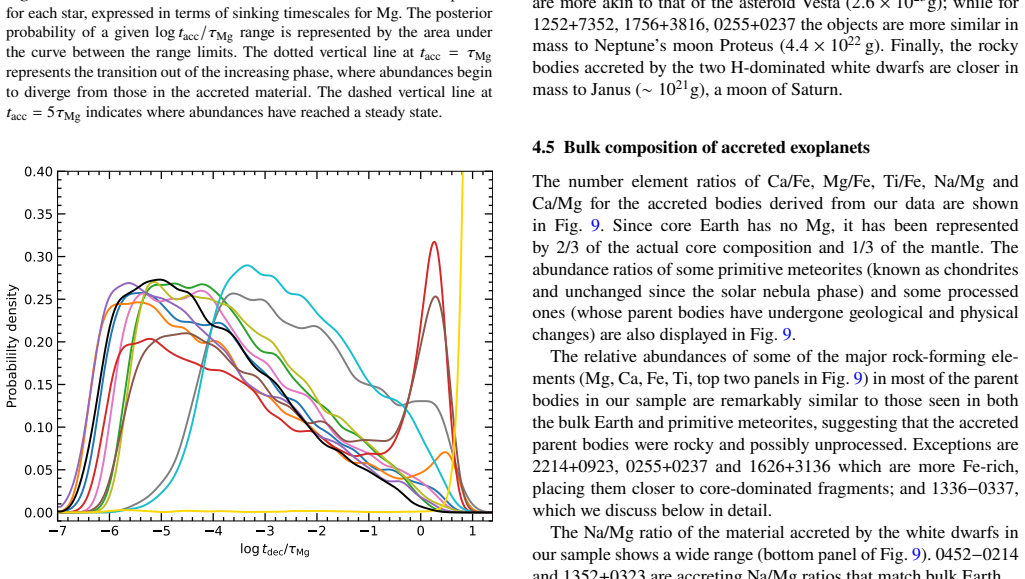
The load-bearing mechanism is the conversion from measured photospheric abundances to parent-body compositions. Each element sinks out of the white dwarf's convection zone on a different diffusion timescale; assuming steady-state accretion, the photospheric abundance of element Z is proportional to its accretion rate times its sinking time. The paper combines these sinking-time corrections with an oxygen-budget accounting (oxygen apportioned among MgO, SiO2, CaO, FeO and similar oxides, with any leftover oxygen attributed to H2O) and a Bayesian model that marginalizes over accretion phase (increasing, steady, or decreasing) and water fraction. The central identity is the oxygen budget ratio
What would settle it
A high-resolution ultraviolet spectrum of 1352+0323, whose oxygen lines are weak and imperfectly fitted, would confirm or refute its oxygen abundance and settle whether the water-rich classification is real. More generally, if refined diffusion models change the relative sinking times of oxygen, magnesium, and iron by more than about a factor of two, the oxygen-budget excess in 0452−0214 could disappear. A search for a transit or a circumstellar disc around these two stars would also test whether accretion is actually ongoing.
Extended reading notes
Core claim
On the paper's own terms, the central discovery is twofold. First, the survey spectra, when combined with iterative atmosphere modelling, give photospheric metal abundances that agree with independent higher-resolution follow-up to within about 1–2 per cent, with no systematic offset. Second, the 12 accreted bodies are compositionally diverse: mostly chondritic, with one core-like (iron-rich, oxygen-poor) body, one silicate-mantle-like body, and two (0452−0214 and 1352+0323) with oxygen budgets suggesting water fractions around 60–80 per cent, i.e. something akin to water-rich planetesimals.
Load-bearing premise
The parent-body compositions, water fractions, and accretion rates all rest on element-specific diffusion (sinking) timescales for each white dwarf; if those timescales are materially wrong, the inferred accretion phase, mass budget, and dry-versus-water-rich classifications all shift.
Editorial extensions
If this is right
- If the survey abundances are reliable at the claimed level, thousands of metal-polluted white dwarfs can be screened for detailed composition study without pre-selection bias.
- The two water-rich candidates, if confirmed, imply that water-bearing planetesimals can survive to the white-dwarf stage and be accreted, with consequences for where water resides in evolved planetary systems.
- Core-rich and mantle-rich accreted bodies (0850+3208 and 1336−0337) indicate that differentiated bodies are common enough to appear in a sample of twelve.
- The diversity seen here supports the view that white-dwarf pollution traces the full range of planetesimal interiors, not just primitive chondrites.
- Detecting three to ten metals per system, including the rock-forming species, sets a benchmark for what medium-resolution spectroscopy can extract from polluted white dwarfs.
Reading between the lines
- If the water-rich interpretation for 0452−0214 and 1352+0323 holds, it would lend support to the idea that volatile-rich delivery can raise debris-disc mass flow and thereby explain the high accretion rates measured for helium-atmosphere white dwarfs; the paper raises this possibility but does not endorse it.
- The tension in 1333+3254 — oxygen budget suggesting roughly 25 per cent water while the Bayesian analysis prefers dry and the hydrogen budget is too low — points toward alternative oxygen carriers such as CO2 or Fe2O3; this could be tested with ultraviolet spectroscopy searching for photospheric carbon.
- A testable extension: the two water-rich candidates should show a circumstellar debris disc with a detectable infrared excess if they are currently accreting volatile-rich material, or atmospheric carbon and nitrogen if the water arrived as CO2 or NH3 ices; the paper finds no infrared excess but notes faint discs can escape detection.
- The cross-instrument agreement of about 1–2 per cent suggests that a systematic abundance error of roughly 0.2 dex, as the paper adopts, is a practical floor for future large-sample surveys; that is enough to separate dry from water-rich bodies at the claimed level.
Editorial analysis
A structured set of objections, weighed in public.
Referee Report
Summary. The paper presents a pilot abundance analysis of 12 highly metal-enriched white dwarfs selected from DESI DR1, with X-shooter follow-up for seven of them. The authors measure stellar parameters and photospheric metal abundances through an iterative photometric+spectroscopic modelling workflow, identify between three and ten metals per system, and convert the abundances into parent-body compositions using diffusion timescales and Bayesian accretion modelling. They report that most accreted bodies resemble primitive chondrites or bulk Earth, that 0850+3208 may be core-rich, that 1336−0337 resembles bulk silicate Earth, and that 0452−0214 and 1352+0323 show large oxygen mass fractions interpreted as water-rich planetesimals. A key quantitative result is the excellent agreement between DESI and X-shooter abundances, with a weighted mean difference of 0.007±0.007 dex.
Significance. If the abundance results are robust, this is a valuable demonstration that DESI medium-resolution spectroscopy can deliver reliable photospheric abundances for highly polluted white dwarfs, expanding the sample of systems with detailed compositional constraints. The cross-instrument comparison is a genuine strength, as is the explicit six-stage fitting workflow and the use of publicly available data with a Zenodo release. The compositional classification of the sample, including two water-rich candidates, is scientifically interesting but depends on external diffusion models and on the reliability of the oxygen detections. The paper also transparently flags its main limitations, including the diffusion-timescale uncertainty and the poor oxygen-line modelling for 1352+0323. These caveats are not fatal, but they need to be reflected in the abstract and conclusions.
major comments (3)
- [Abstract; §4.5; §4.6.1] The abstract and Conclusions count 0452−0214 and 1352+0323 as two water-rich planetesimals. However, §4.5 states that the O lines in 1352+0323 are 'weak and not satisfactorily modelled' and that its O abundance 'requires a deeper spectrum for confirmation and should for now be treated with some care'; §4.6.1 similarly cautions that the water-rich result for 1352+0323 'only holds for a reliably-measured O abundance, which may not be the case for this star.' The Bayesian water fraction for 1352+0323 (Fig. 14, p=0.999) is therefore built on an O measurement the authors themselves flag as unreliable. The abstract should either list only 0452−0214 as a secure water-rich candidate, or explicitly separate 1352+0323 as tentative. As written, the headline claim overstates the evidence.
- [§4.7; Table 5; Eq. (1)] All parent-body inferences—accretion state, steady-state accretion rates, water fractions, oxygen budgets, and accreted masses in Tables 5–6 and Figs 9–14—depend on element-specific diffusion timescales from Koester (2009) Eq. 5. The authors acknowledge in §4.7 that diffusion models are not yet at consensus and that 'future refinements of the diffusion time scales could impact our conclusions.' This is a load-bearing assumption for the compositional classifications, not merely a peripheral caveat. I request a quantitative sensitivity test, e.g. recomputing the oxygen budgets and water-fraction posteriors with diffusion timescales varied coherently by ±0.2–0.5 dex, or with an alternative diffusion prescription. If that is not feasible, the abstract and conclusions should be tempered to state that the dry/wet and core-rich classifications are conditional on current diffusion models.
- [§4.6.1; §4.6.2] There is an unresolved internal tension for 1333+3254: the oxygen-budget analysis (§4.6.1) indicates an O excess corresponding to roughly 25 per cent water, while the Bayesian analysis (§4.6.1) disfavours a wet model at about the 1-σ level, and §4.6.2 shows that the all-H-as-H2O assumption yields an unphysical total mass smaller than the measured CVZ mass. The authors propose speculative resolutions (Fe2O3, CO2, or a decreasing accretion phase). This does not affect the headline water-rich pair, but it is a cautionary example that the oxygen-budget method and the Bayesian method can diverge for an object with weak/ambiguous O and H constraints. The paper should explicitly state that the dry/wet classification for 1333+3254 is uncertain rather than presenting the O budget as a water detection without immediate qualification.
minor comments (4)
- [Abstract vs Conclusions] The abstract says the two stars accrete 'something akin to a water-rich planetesimal,' while the Conclusions say the large O mass fractions 'may tentatively indicate' water-bearing parent bodies. These two formulations should be harmonised, especially given the 1352+0323 caveat.
- [§3.1; Table 4] For stars with untraceable Si, Si is included in the models at CI-chondrite ratios relative to Mg but is not listed in Table 4. The text explains this, but the caption of Table 4 should state explicitly that the Si column does not include these fixed model inputs, to avoid readers interpreting the table as an upper limit or a detection.
- [Data Availability] The statement 'No new data were generated for this study' is confusing, since the paper presents new DESI coadds and new X-shooter observations. Rephrase to indicate that no new data products beyond the published spectra and the Zenodo figure data are released, or clarify that the raw data are public from the archives.
- [Throughout] Minor typographical and formatting issues: the journal header reads 'MNRAS000, 1–34 (20262026)'; several figure captions use 'overplot' instead of 'overplotted'; and Table 5 would benefit from a clearer separator between the four star blocks to avoid misreading the columns.
Circularity Check
No significant circularity; the abundance-to-composition chain rests on external benchmark models and direct spectral fits.
full rationale
The paper's central measurements are photospheric metal abundances obtained by fitting model atmospheres (Koester 2010 code) to DESI and X-shooter spectra in an iterative, custom-grid procedure. The agreement between the two independent datasets (weighted mean difference 0.007±0.007 dex, §4.2) is a genuine external cross-check. The conversion from photospheric abundances to parent-body compositions uses element-specific sinking timescales from Koester (2009) Eq. 5 and the Bayesian accretion-state/composition model of Swan et al. (2023); both are external published methods that do not contain the present target result and are not fitted to these stars. The water-rich inference for 0452−0214 is supported by well-reproduced O lines and by Bayesian model comparison, while the paper itself explicitly flags 1352+0323: 'the O lines in 1352+0323 are weak and not satisfactorily modelled' and its O abundance 'requires a deeper spectrum for confirmation and should for now be treated with some care' (§4.5). That is a data-quality caveat, not a circular step; it weakens the headline but does not make the derivation self-referential. The self-citations (Koester 2009; Swan et al. 2023; Williams et al. 2024; Manser et al. 2024a) are to external methods or systematic-uncertainty estimates, not to a result that presupposes the present conclusions. No equation or fitted parameter reduces to the output by construction, and no claimed 'prediction' is a renamed input.
Assumptions & free parameters
free parameters (3)
- H abundance for 2214+0923 =
log(H/He) = -5.0 (fixed by hand)
- Si abundance for Si-undetected stars =
CI-chondrite ratio relative to Mg
- Oxygen-budget scaling of undetected elements =
Scaled to bulk-Earth Mg mass fraction
assumptions (7)
- domain assumption 1D mixing-length (ML2, alpha=0.8) convection treatment of white dwarf atmospheres
- domain assumption Generic grid metals fixed to CI-chondrite relative abundances (Si-normalized)
- domain assumption Accreted exoplanetary material is broadly similar to Solar System objects
- domain assumption Box-model accretion: constant rate, abrupt switch-off, increasing/steady/decreasing states
- ad hoc to paper All photospheric H in the four water-candidate WDs was delivered as H2O in the currently accreted body
- domain assumption Diffusion/sinking timescales of Koester (2009) Eq. 5 are correct
- ad hoc to paper Oxygen in the parent body is fully bound as MgO, SiO2, CaO, FeO, Al2O3, NiO, TiO2
Cite this review
Pith. "Pith review of First planetesimals from DESI DR1: 12 highly metal-rich white dwarfs." pith.science (2026). https://pith.science/paper/L7VQG2BQ
@misc{pith2026260714251,
  author       = {Pith},
  title        = {Pith review of: First planetesimals from DESI DR1: 12 highly metal-rich white dwarfs},
  year         = {2026},
  howpublished = {\url{https://pith.science/paper/L7VQG2BQ}},
  note         = {Machine review of arXiv:2607.14251}
}
read the original abstract
Metal-enriched white dwarfs provide a unique insight into the composition of exoplanet interiors. These stars accrete the debris of disrupted planetary bodies, and hence, measuring the stellar parameters and photospheric abundances yields the bulk compositions of the parent bodies. At present, over 1750 debris-accreting white dwarfs are known, but just a few dozen are sufficiently enriched to allow a detailed abundance study. Here we report the analysis of 12 highly metal-enriched white dwarfs observed within the Data Release~1 of the Dark Energy Spectroscopic Instrument (DESI). We characterised their stellar parameters and photospheric metal abundances and we identified between three and ten different elements in their optical spectra, including most of the rock-forming species: O, Mg, Si, Ca and Fe. We conclude that the accreted bodies broadly resemble compositions found within the inner Solar System such as primitive meteorites, processed material or planetary cores. Six of the systems allowed a more thorough analysis: four of the parent bodies are composed of dry rock-forming elements; and two of them of something akin to a water-rich planetesimal. Thus, this study establishes DESI as a potent survey for identifying metal-rich targets, yielding reliable compositions of accreted exoplanetary material.
Figures


Figures from the paper (11 more)




Reference graph
Works this paper leans on
-
[1]
Characterizing planetary material accreted by cool helium-atmosphere white dwarfs using an exponentially decaying disc model. , keywords =. doi:10.1093/mnras/staf398 , archivePrefix =. 2503.05345 , primaryClass =
-
[2]
The Chemical Composition of an Extrasolar Minor Planet. , keywords =. doi:10.1086/522223 , archivePrefix =. 0708.0198 , primaryClass =
-
[3]
The spectral evolution of white dwarfs: where do we stand?. , keywords =. doi:10.1007/s10509-024-04307-5 , archivePrefix =. 2405.01268 , primaryClass =
-
[4]
Measurements of three exo-planetesimal compositions: a planetary core, a chondritic body, and an icy Kuiper belt analogue. , keywords =. doi:10.1093/mnras/staf1034 , archivePrefix =. 2506.19931 , primaryClass =
-
[5]
Horizontal spreading of planetary debris accreted by white dwarfs. , keywords =. doi:10.1093/mnras/stab553 , archivePrefix =. 2102.09564 , primaryClass =
-
[6]
Homogeneous mass and age determinations and asteroseismic prospects
New evolutionary sequences for extremely low-mass white dwarfs. Homogeneous mass and age determinations and asteroseismic prospects. , keywords =. doi:10.1051/0004-6361/201321868 , archivePrefix =. 1307.1882 , primaryClass =
-
[7]
White dwarfs with planetary remnants in the era of Gaia - I. Six emission line systems. , keywords =. doi:10.1093/mnras/stab992 , archivePrefix =. 2010.13807 , primaryClass =
arXiv 2010
-
[8]
Using 3.4 m Variability toward White Dwarfs as a Signpost of Remnant Planetary Systems. , keywords =. doi:10.3847/1538-4357/ad5be7 , archivePrefix =. 2406.18646 , primaryClass =
Show all 296 references
-
[9]
, keywords =
The DESI Early Data Release white dwarf catalogue. , keywords =. doi:10.1093/mnras/stae2205 , archivePrefix =. 2402.18641 , primaryClass =
-
[10]
, keywords =
Systematic uncertainties in the characterization of helium-dominated metal-polluted white dwarf atmospheres. , keywords =. doi:10.1093/mnras/stad282 , archivePrefix =. 2301.09670 , primaryClass =
-
[11]
Monthly Notices of the Royal Astronomical Society , volume=
Accelerating astronomical and cosmological inference with preconditioned Monte Carlo , author=. Monthly Notices of the Royal Astronomical Society , volume=. 2022 , publisher=
2022
-
[12]
, keywords =
Seven white dwarfs with circumstellar gas discs II: tracing the composition of exoplanetary building blocks. , keywords =. doi:10.1093/mnras/stae1520 , archivePrefix =. 2406.11470 , primaryClass =
-
[13]
Chondritic compositions and a massive accretion event
Planetesimals at DZ stars - I. Chondritic compositions and a massive accretion event. , keywords =. doi:10.1093/mnras/stad2867 , archivePrefix =. 2309.06467 , primaryClass =
-
[14]
DESI Collaboration and Adame, A. G. and Aguilar, J. and Ahlen, S. and Alam, S. and Aldering, G. and Alexander, D. M. and Alfarsy, R. and Allende Prieto, C. and Alvarez, M. and Alves, O. and Anand, A. and Andrade-Oliveira, F. and Armengaud, E. and Asorey, J. and Avila, S. and A...
2024
-
[15]
, keywords =
The Target-selection Pipeline for the Dark Energy Spectroscopic Instrument. , keywords =. doi:10.3847/1538-3881/aca5f9 , archivePrefix =. 2208.08518 , primaryClass =
-
[16]
arXiv preprint arXiv:2207.05660 , year=
pocoMC: A Python package for accelerated Bayesian inference in astronomy and cosmology , author=. arXiv preprint arXiv:2207.05660 , year=
-
[17]
, keywords =
Overview of the DESI Milky Way Survey. , keywords =. doi:10.3847/1538-4357/acb3c0 , archivePrefix =. 2208.08514 , primaryClass =
-
[18]
2016 , eprint=
The DESI Experiment Part I: Science,Targeting, and Survey Design , author=. 2016 , eprint=
2016
-
[19]
2016 , eprint=
The DESI Experiment Part II: Instrument Design , author=. 2016 , eprint=
2016
-
[20]
, keywords =
PEWDD: A database of white dwarfs enriched by exo-planetary material. , keywords =. doi:10.1051/0004-6361/202450509 , archivePrefix =. 2409.16046 , primaryClass =
-
[21]
Planetary Science Journal , keywords =
A Chondritic Solar Neighborhood. Planetary Science Journal , keywords =. doi:10.3847/PSJ/acdef3 , archivePrefix =. 2306.03743 , primaryClass =
-
[22]
, keywords =
A white dwarf accreting planetary material determined from X-ray observations. , keywords =. doi:10.1038/s41586-021-04300-w , archivePrefix =. 2202.12903 , primaryClass =
-
[23]
, keywords =
The frequency of gaseous debris discs around white dwarfs. , keywords =. doi:10.1093/mnras/staa359 , archivePrefix =. 2002.01936 , primaryClass =
2002 arXiv
-
[24]
, keywords =
I Spy Transits and Pulsations: Empirical Variability in White Dwarfs Using Gaia and the Zwicky Transient Facility. , keywords =. doi:10.3847/1538-4357/abee68 , archivePrefix =. 2012.00035 , primaryClass =
2012 arXiv
-
[25]
, keywords =
The frequency of metal enrichment of cool helium-atmosphere white dwarfs using the DESI early data release. , keywords =. doi:10.1093/mnrasl/slae026 , archivePrefix =. 2402.18644 , primaryClass =
-
[26]
, title =
Zeng, Li and Seager, S. , title =. Publications of the Astronomical Society of the Pacific , abstract =. 2008 , month =. doi:10.1086/591807 , url =
2008 doi
-
[27]
, keywords =
Detection of Planetary Transits Across a Sun-like Star. , keywords =. doi:10.1086/312457 , archivePrefix =. astro-ph/9911436 , primaryClass =
-
[28]
, keywords =
Radius and Structure Models of the First Super-Earth Planet. , keywords =. doi:10.1086/509800 , archivePrefix =. astro-ph/0610122 , primaryClass =
-
[29]
, keywords =
Mass-Radius Relationships for Solid Exoplanets. , keywords =. doi:10.1086/521346 , archivePrefix =. 0707.2895 , primaryClass =
-
[30]
, keywords =
Planetary Radii across Five Orders of Magnitude in Mass and Stellar Insolation: Application to Transits. , keywords =. doi:10.1086/512120 , archivePrefix =. astro-ph/0612671 , primaryClass =
-
[31]
The line spectra
The atmospheres of white dwarfs - III. The line spectra. , year = 1971, month = jan, volume =. doi:10.1093/mnras/152.1.47 , adsurl =
1971 doi
-
[32]
Element abundances in cool white dwarfs. II. Ultraviolet observations of DZ white dwarfs. , keywords =. doi:10.1051/0004-6361:20020194 , archivePrefix =. astro-ph/0204408 , primaryClass =
-
[33]
, keywords =
Know Your Neighborhood: A Detailed Model Atmosphere Analysis of Nearby White Dwarfs. , keywords =. doi:10.1088/0067-0049/199/2/29 , archivePrefix =. 1202.5581 , primaryClass =
-
[34]
, keywords =
Discovery of a Cool, Massive, and Metal-rich DAZ White Dwarf. , keywords =. doi:10.1086/427080 , archivePrefix =. astro-ph/0410706 , primaryClass =
-
[35]
, keywords =
Spectroscopic Identification of Cool White Dwarfs in the Solar Neighborhood. , keywords =. doi:10.1086/501451 , archivePrefix =. astro-ph/0601477 , primaryClass =
-
[36]
, keywords =
Distant White Dwarfs in the US Naval Observatory Flagstaff Station Parallax Sample. , keywords =. doi:10.3847/1538-4365/aae7ca , archivePrefix =. 1809.10803 , primaryClass =
-
[37]
7. Bericht. Zeitschrift Angewandte Mathematik und Mechanik , year = 1925, month = jan, volume =. doi:10.1002/zamm.19250050212 , adsurl =
1925 doi
-
[38]
, keywords =
The 16th Data Release of the Sloan Digital Sky Surveys: First Release from the APOGEE-2 Southern Survey and Full Release of eBOSS Spectra. , keywords =. doi:10.3847/1538-4365/ab929e , archivePrefix =. 1912.02905 , primaryClass =
1912
-
[39]
, keywords =
The Multi-object, Fiber-fed Spectrographs for the Sloan Digital Sky Survey and the Baryon Oscillation Spectroscopic Survey. , keywords =. doi:10.1088/0004-6256/146/2/32 , archivePrefix =. 1208.2233 , primaryClass =
-
[40]
, keywords =
X-shooter, the new wide band intermediate resolution spectrograph at the ESO Very Large Telescope. , keywords =. doi:10.1051/0004-6361/201117752 , archivePrefix =. 1110.1944 , primaryClass =
1944 arXiv
-
[41]
The ESO Reflex environment
Automated data reduction workflows for astronomy. The ESO Reflex environment. , keywords =. doi:10.1051/0004-6361/201322494 , archivePrefix =. 1311.5411 , primaryClass =
-
[42]
Molecfit: A general tool for telluric absorption correction. II. Quantitative evaluation on ESO-VLT/X-Shooterspectra. , keywords =. doi:10.1051/0004-6361/201423909 , archivePrefix =. 1501.07265 , primaryClass =
-
[43]
, keywords =
On the Measurement of Fundamental Parameters of White Dwarfs in the Gaia Era. , keywords =. doi:10.3847/1538-4357/ab153a , archivePrefix =. 1904.02022 , primaryClass =
1904 arXiv
-
[44]
, keywords =
Constraints on Remnant Planetary Systems as a Function of Main-sequence Mass with HST/COS. , keywords =. doi:10.3847/1538-4357/ad86bb , archivePrefix =. 2410.06335 , primaryClass =
-
[45]
, keywords =
X-Ray and Infrared Observations of Two Externally Polluted White Dwarfs. , keywords =. doi:10.1088/0004-637X/699/2/1473 , archivePrefix =. 0905.0117 , primaryClass =
-
[46]
, keywords =
A road-map to white dwarf pollution: tidal disruption, eccentric grind-down, and dust accretion. , keywords =. doi:10.1093/mnras/stab3009 , archivePrefix =. 2110.07601 , primaryClass =
-
[47]
, keywords =
Metal Accretion onto White Dwarfs Caused by Poynting-Robertson Drag on their Debris Disks. , keywords =. doi:10.1088/2041-8205/732/1/L3 , archivePrefix =. 1102.3153 , primaryClass =
-
[48]
, keywords =
Accretion of a Terrestrial-like Minor Planet by a White Dwarf. , keywords =. doi:10.1088/0004-637X/732/2/90 , archivePrefix =. 1102.0311 , primaryClass =
-
[49]
, keywords =
Unusual Abundances from Planetary System Material Polluting the White Dwarf G238-44. , keywords =. doi:10.3847/1538-4357/aca089 , archivePrefix =. 2211.02673 , primaryClass =
-
[50]
, keywords =
Convective overshoot and macroscopic diffusion in pure-hydrogen-atmosphere white dwarfs. , keywords =. doi:10.1093/mnras/stz1759 , archivePrefix =. 1906.11252 , primaryClass =
1906 arXiv
-
[51]
, keywords =
A generalized Bayesian inference method for constraining the interiors of super Earths and sub-Neptunes. , keywords =. doi:10.1051/0004-6361/201628708 , archivePrefix =. 1609.03908 , primaryClass =
-
[52]
, keywords =
Modelling the distributions of white dwarf atmospheric pollution: a low Mg abundance for accreted planetesimals?. , keywords =. doi:10.1093/mnras/stz3191 , archivePrefix =. 1911.05131 , primaryClass =
1911 arXiv
-
[53]
, keywords =
Revisiting the Chemical Composition of WD 1145+017: Impact of Circumstellar Disk Contamination on Photospheric Abundances. , keywords =. doi:10.3847/1538-4357/ad90b7 , archivePrefix =. 2410.10948 , primaryClass =
-
[54]
, keywords =
The Wide-field Infrared Survey Explorer (WISE): Mission Description and Initial On-orbit Performance. , keywords =. doi:10.1088/0004-6256/140/6/1868 , archivePrefix =. 1008.0031 , primaryClass =
-
[56]
, keywords =
Infrared Signatures of Disrupted Minor Planets at White Dwarfs. , keywords =. doi:10.1088/0004-637X/694/2/805 , archivePrefix =. 0901.0973 , primaryClass =
-
[57]
, keywords =
Discovery of an icy and nitrogen-rich extrasolar planetesimal. , keywords =. doi:10.1093/mnras/staf1424 , archivePrefix =. 2509.13422 , primaryClass =
-
[58]
, keywords =
Long-term variability in debris transiting white dwarfs. , keywords =. doi:10.1093/mnras/stae750 , archivePrefix =. 2404.04422 , primaryClass =
-
[59]
DESI DR2 results. II. Measurements of baryon acoustic oscillations and cosmological constraints. , keywords =. doi:10.1103/tr6y-kpc6 , archivePrefix =. 2503.14738 , primaryClass =
-
[60]
Ground-based and Airborne Instrumentation for Astronomy IV , year = 2012, editor =
WEAVE: the next generation wide-field spectroscopy facility for the William Herschel Telescope. Ground-based and Airborne Instrumentation for Astronomy IV , year = 2012, editor =. doi:10.1117/12.925950 , adsurl =
2012 doi
-
[61]
, keywords =
Survey Operations for the Dark Energy Spectroscopic Instrument. , keywords =. doi:10.3847/1538-3881/ad0832 , archivePrefix =. 2306.06309 , primaryClass =
-
[62]
, keywords =
The Spectroscopic Data Processing Pipeline for the Dark Energy Spectroscopic Instrument. , keywords =. doi:10.3847/1538-3881/acb212 , archivePrefix =. 2209.14482 , primaryClass =
-
[63]
, keywords =
Where Are the Extrasolar Mercuries?. , keywords =. doi:10.3847/1538-4357/abad9a , archivePrefix =. 2008.05992 , primaryClass =
2008 arXiv
-
[64]
, keywords =
DESI 2024 VII: cosmological constraints from the full-shape modeling of clustering measurements. , keywords =. doi:10.1088/1475-7516/2025/07/028 , archivePrefix =. 2411.12022 , primaryClass =
2024 arXiv
-
[65]
, keywords =
Overview of the Fiber System for the Dark Energy Spectroscopic Instrument. , keywords =. doi:10.3847/1538-3881/ad76a4 , adsurl =
-
[66]
, keywords =
The Optical Corrector for the Dark Energy Spectroscopic Instrument. , keywords =. doi:10.3847/1538-3881/ad45fe , archivePrefix =. 2306.06310 , primaryClass =
-
[67]
, keywords =
Overview of the Instrumentation for the Dark Energy Spectroscopic Instrument. , keywords =. doi:10.3847/1538-3881/ac882b , archivePrefix =. 2205.10939 , primaryClass =
- [68]
-
[69]
Summary of the content and survey properties
Gaia Data Release 3. Summary of the content and survey properties. , keywords =. doi:10.1051/0004-6361/202243940 , archivePrefix =. 2208.00211 , primaryClass =
-
[70]
, keywords =
Modelling the evolution of silicate/volatile accretion discs around white dwarfs. , keywords =. doi:10.1093/mnras/stac3522 , archivePrefix =. 2211.16797 , primaryClass =
-
[71]
The Messenger , keywords =
4MOST: Project overview and information for the First Call for Proposals. The Messenger , keywords =. doi:10.18727/0722-6691/5117 , archivePrefix =. 1903.02464 , primaryClass =
1903 arXiv
-
[72]
, keywords =
White dwarf and subdwarf stars in the Sloan Digital Sky Survey Data Release 16. , keywords =. doi:10.1093/mnras/stab2411 , archivePrefix =. 2108.10915 , primaryClass =
-
[73]
, keywords =
On the Spectral Evolution of Cool, Helium-Atmosphere White Dwarfs: Detailed Spectroscopic and Photometric Analysis of DZ Stars. , keywords =. doi:10.1086/518468 , archivePrefix =. astro-ph/0703758 , primaryClass =
-
[74]
, keywords =
Discovery of Beryllium in White Dwarfs Polluted by Planetesimal Accretion. , keywords =. doi:10.3847/1538-4357/abe40b , archivePrefix =. 2102.01834 , primaryClass =
-
[75]
, keywords =
Physical Properties of the Current Census of Northern White Dwarfs within 40 pc of the Sun. , keywords =. doi:10.1088/0067-0049/219/2/19 , archivePrefix =. 1505.02297 , primaryClass =
-
[76]
, keywords =
Toward a Spectroscopic Census of White Dwarfs within 40 pc of the Sun. , keywords =. doi:10.1088/0004-6256/145/5/136 , archivePrefix =. 1303.2094 , primaryClass =
-
[77]
The Solar Neighborhood. XIX. Discovery and Characterization of 33 New Nearby White Dwarf Systems. , keywords =. doi:10.1086/518739 , archivePrefix =. 0704.0894 , primaryClass =
-
[78]
, keywords =
Photometric and Spectroscopic Analysis of Cool White Dwarfs with Trigonometric Parallax Measurements. , keywords =. doi:10.1086/320356 , archivePrefix =. astro-ph/0011286 , primaryClass =
-
[79]
, keywords =
Analysis of Helium-rich White Dwarfs Polluted by Heavy Elements in the Gaia Era. , keywords =. doi:10.3847/1538-4357/ab46b9 , archivePrefix =. 1907.05932 , primaryClass =
1907 arXiv
-
[80]
, keywords =
The Gaia mission. , keywords =. doi:10.1051/0004-6361/201629272 , archivePrefix =. 1609.04153 , primaryClass =
-
[81]
, keywords =
New Pulsating DB White Dwarf Stars from the Sloan Digital Sky Survey. , keywords =. doi:10.1088/0004-637X/690/1/560 , archivePrefix =. 0809.0921 , primaryClass =
-
[82]
, keywords =
Analysis of IUE spectra of helium-rich white dwarf stars. , keywords =. doi:10.1051/0004-6361:20054221 , archivePrefix =. astro-ph/0602169 , primaryClass =
-
[83]
, keywords =
Cool helium-rich white dwarfs from the Hamburg/ESO survey. , keywords =
-
[84]
, keywords =
From hydrogen to helium: the spectral evolution of white dwarfs as evidence for convective mixing. , keywords =. doi:10.1093/mnras/stz3638 , archivePrefix =. 1911.00014 , primaryClass =
1911 arXiv
-
[85]
, keywords =
Spectroscopic analysis of DA white dwarfs with 3D model atmospheres. , keywords =. doi:10.1051/0004-6361/201322318 , archivePrefix =. 1309.0886 , primaryClass =
-
[86]
, keywords =
3D spectroscopic analysis of helium-line white dwarfs. , keywords =. doi:10.1093/mnras/staa3684 , archivePrefix =. 2011.12693 , primaryClass =
2011 arXiv
-
[87]
MNRAS, submitted arXiv:2106.07669 , keywords =
A catalogue of white dwarfs in Gaia EDR3. MNRAS, submitted arXiv:2106.07669 , keywords =
-
[88]
, keywords =
White Dwarf Cosmochronology in the Solar Neighborhood. , keywords =. doi:10.1088/0004-637X/791/2/92 , archivePrefix =. 1406.5173 , primaryClass =
-
[89]
, keywords =
Gaia white dwarfs within 40 pc II: the volume-limited Northern hemisphere sample. , keywords =. doi:10.1093/mnras/staa2030 , archivePrefix =. 2006.00874 , primaryClass =
2006 arXiv
-
[91]
Molecfit: A general tool for telluric absorption correction. I. Method and application to ESO instruments. , keywords =. doi:10.1051/0004-6361/201423932 , archivePrefix =. 1501.07239 , primaryClass =
-
[92]
, year = 1958, month = jan, volume =
1958
-
[93]
, keywords =
The Elemental Abundances in Bare Planetary Nebula Central Stars and the Shell Burning in AGB Stars. , keywords =. doi:10.1086/500443 , archivePrefix =. astro-ph/0512320 , primaryClass =
-
[94]
, keywords =
On the formation of hydrogen-deficient post-AGB stars. , keywords =
-
[95]
, keywords =
The formation and evolution of hydrogen-deficient post-AGB white dwarfs: The emerging chemical profile and the expectations for the PG 1159-DB-DQ evolutionary connection. , keywords =. doi:10.1051/0004-6361:20041965 , archivePrefix =. astro-ph/0502005 , primaryClass =
-
[96]
, keywords =
A photometric selection of white dwarf candidates in Sloan Digital Sky Survey Data Release 10. , keywords =. doi:10.1093/mnras/stv120 , adsurl =
-
[97]
doi:10.3847/0004-637X/832/2/160 , adsurl =
Post-main Sequence Evolution of Icy Minor Planets: Implications for Water Retention and White Dwarf Pollution , journal =. doi:10.3847/0004-637X/832/2/160 , adsurl =. 1608.00593 , year = 2016, month = dec, volume = 832, eid =
2016 arXiv
-
[98]
Post-main-sequence Evolution of Icy Minor Planets. II. Water Retention and White Dwarf Pollution around Massive Progenitor Stars , journal =. doi:10.3847/1538-4357/aa7055 , adsurl =. 1704.01165 , year = 2017, month = jun, volume = 842, eid =
2017 arXiv
-
[99]
Post-main-sequence Evolution of Icy Minor Planets. III. Water Retention in Dwarf Planets and Exomoons and Implications for White Dwarf Pollution , journal =. doi:10.3847/1538-4357/aa8df5 , adsurl =. 1708.07489 , year = 2017, month = nov, volume = 849, eid =
2017 arXiv
-
[100]
, year = 2007, month = sep, volume =
Asteroid masses and improvement with Gaia. , year = 2007, month = sep, volume =. doi:10.1051/0004-6361:20077479 , adsurl =
2007 doi
-
[101]
doi:10.1088/0004-637X/730/2/128 , adsurl =
An Improved Spectroscopic Analysis of DA White Dwarfs from the Sloan Digital Sky Survey Data Release 4 , journal =. doi:10.1088/0004-637X/730/2/128 , adsurl =
-
[102]
doi:10.1086/509723 , adsurl =
, year = 2006, month = nov, volume = 651, pages =. doi:10.1086/509723 , adsurl =
2006 doi
-
[103]
, year = 2001, month = apr, volume = 113, pages =
2001
-
[104]
doi:10.1086/498708 , adsurl =
, year = 2006, month = feb, volume = 131, pages =. doi:10.1086/498708 , adsurl =
2006 doi
-
[105]
VizieR Online Data Catalog , keywords =
VizieR Online Data Catalog: AllWISE Data Release (Cutri+ 2013). VizieR Online Data Catalog , keywords =
2013
-
[106]
doi:10.1086/505938 , adsurl =
, year = 2006, month = sep, volume = 132, pages =. doi:10.1086/505938 , adsurl =
2006 doi
-
[107]
14th European Workshop on White Dwarfs , year = 2005, editor =
New High-Proper Motion White Dwarfs in the NLTT Catalog and Sloan Digital Sky Survey. 14th European Workshop on White Dwarfs , year = 2005, editor =
2005
-
[108]
doi:10.1093/mnras/stx1036 , adsurl =
Polluting white dwarfs with perturbed exo-comets , journal =. doi:10.1093/mnras/stx1036 , adsurl =. 1702.07682 , year = 2017, month = aug, volume = 469, pages =
2017 arXiv
-
[109]
doi:10.3847/2041-8213/aa7cf3 , adsurl =
Throwing Icebergs at White Dwarfs , journal =. doi:10.3847/2041-8213/aa7cf3 , adsurl =. 1704.08701 , year = 2017, month = aug, volume = 844, eid =
-
[110]
doi:10.1051/0004-6361:20041183 , adsurl =
, year = 2004, month = sep, volume = 424, pages =. doi:10.1051/0004-6361:20041183 , adsurl =
2004 doi
-
[111]
2020", month =
Are exoplanetesimals differentiated?. , year = "2020", month = "Feb", volume =. doi:10.1093/mnras/stz3603 , eprint =
2020 doi
-
[112]
doi:10.1088/0004-637X/783/2/79 , adsurl =
Elemental Compositions of Two Extrasolar Rocky Planetesimals , journal =. doi:10.1088/0004-637X/783/2/79 , adsurl =
-
[113]
doi:10.1088/0004-637X/766/2/132 , adsurl =
Two Beyond-primitive Extrasolar Planetesimals , journal =. doi:10.1088/0004-637X/766/2/132 , adsurl =
-
[114]
, year = 2019, month = nov, volume =
Interpretation and diversity of exoplanetary material orbiting white dwarfs. , year = 2019, month = nov, volume =. doi:10.1093/mnras/stz2337 , eprint =
2019 doi
-
[115]
doi:10.1146/annurev-earth-060313-054740 , adsurl =
Extrasolar Cosmochemistry , journal =. doi:10.1146/annurev-earth-060313-054740 , adsurl =
-
[116]
doi:10.3847/2041-8213/836/1/L7 , adsurl =
, year = 2017, month = feb, volume = 836, pages =. doi:10.3847/2041-8213/836/1/L7 , adsurl =
2017 doi
-
[117]
doi:10.1088/0004-6256/140/5/1129 , adsurl =
The Survival of Water Within Extrasolar Minor Planets , journal =. doi:10.1088/0004-6256/140/5/1129 , adsurl =
-
[118]
Science , year = 2019, month = oct, volume = 366, pages =
Oxygen fugacities of extrasolar rocks: Evidence for an Earth-like geochemistry of exoplanets. Science , year = 2019, month = oct, volume = 366, pages =. doi:10.1126/science.aax3901 , adsurl =
2019 doi
-
[119]
Bulk element compositions of meteorites: A guide for interpreting remote-sensing geochemical measurements of planets and asteroids , journal =
-
[120]
doi:10.1038/nature03938 , adsurl =
Differentiation of the asteroid Ceres as revealed by its shape , journal =. doi:10.1038/nature03938 , adsurl =
-
[121]
doi:10.1086/157657 , adsurl =
The Surface Chemistry of Stars - Part Two - Fractionated Accretion of Interstellar Matter , journal =. doi:10.1086/157657 , adsurl =
-
[122]
, year = 2020, month = feb, volume =
A Convective Dredge-up Model as the Origin of Hydrogen in DBA White Dwarfs. , year = 2020, month = feb, volume =. doi:10.3847/1538-4357/ab6602 , eprint =
2020 doi
-
[123]
, keywords =
Stochastic accretion of planetesimals on to white dwarfs: constraints on the mass distribution of accreted material from atmospheric pollution. , keywords =. doi:10.1093/mnras/stu183 , archivePrefix =. 1401.6173 , primaryClass =
-
[124]
Determination of atmospheric parameters for DB white dwarfs , journal =
-
[125]
A spectroscopic determination of the mass distribution of DA white dwarfs , journal =
-
[126]
doi:10.1093/mnras/sty2383 , adsurl =
Pure-helium 3D model atmospheres of white dwarfs , journal =. doi:10.1093/mnras/sty2383 , adsurl =. 1809.00590 , year = 2018, month = dec, volume = 481, pages =
2018 arXiv
-
[127]
doi:10.1093/mnras/stz2656 , adsurl =
Calibration of the mixing-length theory for structures of helium-dominated atmosphere white dwarfs , journal =. doi:10.1093/mnras/stz2656 , adsurl =
-
[128]
doi:10.1051/0004-6361:20053058 , adsurl =
, year = 2005, month = aug, volume = 439, pages =. doi:10.1051/0004-6361:20053058 , adsurl =
2005 doi
-
[129]
doi:10.1086/375492 , adsurl =
Solar System Abundances and Condensation Temperatures of the Elements , journal =. doi:10.1086/375492 , adsurl =
-
[130]
Earthquake Thermodynamics and Phase Transformation in the Earth's Interior , year = 2000, publisher =
2000
-
[131]
doi:10.3847/1538-4357/aafac6 , adsurl =
A Comprehensive Spectroscopic and Photometric Analysis of DA and DB White Dwarfs from SDSS and Gaia , journal =. doi:10.3847/1538-4357/aafac6 , adsurl =
-
[132]
doi:10.1093/mnras/sty3067 , adsurl =
Fundamental parameter accuracy of DA and DB white dwarfs in Gaia Data Release 2 , journal =. doi:10.1093/mnras/sty3067 , adsurl =
-
[133]
doi:10.1051/0004-6361:20077285 , adsurl =
, year = 2007, month = aug, volume = 470, pages =. doi:10.1051/0004-6361:20077285 , adsurl =
2007 doi
-
[134]
, year = 2010, volume = 81, pages =
2010
-
[135]
, keywords =
Likely detection of water-rich asteroid debris in a metal-polluted white dwarf. , keywords =. 2015. doi:10.1093/mnras/stv701 , archivePrefix =. 1503.07864 , primaryClass =
2015 arXiv
-
[136]
The dynamics of coorbital satellite systems , journal =
-
[137]
doi:10.1093/mnras/sty446 , adsurl =
Unstable low-mass planetary systems as drivers of white dwarf pollution , journal =. doi:10.1093/mnras/sty446 , adsurl =. 1711.02940 , year = 2018, month = may, volume = 476, pages =
2018 arXiv
-
[138]
The initial-final mass relationship of white dwarfs revisited: effect on the luminosity function and mass distribution , journal =
-
[139]
Probing the Lower Mass Limit for Supernova Progenitors and the High-Mass End of the Initial-Final Mass Relation from White Dwarfs in the Open Cluster M35 (NGC 2168) , journal =
-
[140]
doi:10.1086/527028 , adsurl =
The Initial-Final Mass Relation: Direct Constraints at the Low-Mass End , journal =. doi:10.1086/527028 , adsurl =
-
[141]
doi:10.1111/j.1365-2966.2009.14593.x , adsurl =
High-resolution optical spectroscopy of Praesepe white dwarfs , journal =. doi:10.1111/j.1365-2966.2009.14593.x , adsurl =
2009
-
[142]
, keywords =
Velocity-Dependent Catastrophic Disruption Criteria for Planetesimals. , keywords =. doi:10.1088/0004-637X/691/2/L133 , adsurl =
-
[143]
, keywords =
A parsec-scale Galactic 3D dust map out to 1.25 kpc from the Sun. , keywords =. doi:10.1051/0004-6361/202347628 , archivePrefix =. 2308.01295 , primaryClass =
-
[144]
, keywords =
Polluted White Dwarfs: Mixing Regions and Diffusion Timescales. , keywords =. doi:10.3847/1538-4357/ab0028 , archivePrefix =. 1812.09602 , primaryClass =
-
[145]
arXiv e-prints , keywords =
A Theoretical Investigation of He I Line Profiles for the Spectroscopic Analysis of DB White Dwarfs. arXiv e-prints , keywords =
-
[146]
, keywords =
Exogeological inferences from white dwarf pollutants: the impact of stellar physics. , keywords =. doi:10.1093/mnras/staf1832 , archivePrefix =. 2510.17985 , primaryClass =
-
[147]
, keywords =
3D Simulations Demonstrate Propagating Thermohaline Convection for Polluted White Dwarfs. , keywords =. doi:10.3847/2041-8213/addbd5 , archivePrefix =. 2503.20885 , primaryClass =
-
[148]
, keywords =
Three-dimensional extinction maps: Inverting inter-calibrated extinction catalogues. , keywords =. doi:10.1051/0004-6361/202243319 , archivePrefix =. 2205.09087 , primaryClass =
-
[149]
, keywords =
Updated Gaia-2MASS 3D maps of Galactic interstellar dust. , keywords =. doi:10.1051/0004-6361/202142846 , archivePrefix =. 2203.01627 , primaryClass =
-
[150]
, keywords =
A Gaia Early DR3 Mock Stellar Catalog: Galactic Prior and Selection Function. , keywords =. doi:10.1088/1538-3873/ab8cb0 , archivePrefix =. 2004.09991 , primaryClass =
2004 arXiv
-
[151]
Estimating Distance from Parallaxes. IV. Distances to 1.33 Billion Stars in Gaia Data Release 2. , year = 2018, month = aug, volume = 156, eid =
2018
-
[152]
doi:10.1051/0004-6361/201730831 , adsurl =
Three-dimensional mapping of the local interstellar medium with composite data , journal =. doi:10.1051/0004-6361/201730831 , adsurl =. 1706.07711 , year = 2017, month = oct, volume = 606, eid =
2017 arXiv
-
[153]
doi:10.1088/0004-637X/810/1/25 , adsurl =
A Three-dimensional Map of Milky Way Dust , journal =. doi:10.1088/0004-637X/810/1/25 , adsurl =. 1507.01005 , year = 2015, month = sep, volume = 810, eid =
2015 arXiv
-
[154]
doi:10.1088/0004-637X/737/2/103 , adsurl =
Measuring Reddening with Sloan Digital Sky Survey Stellar Spectra and Recalibrating SFD , journal =. doi:10.1088/0004-637X/737/2/103 , adsurl =
-
[155]
Summary of the contents and survey properties
Gaia Data Release 2. Summary of the contents and survey properties. , keywords =. doi:10.1051/0004-6361/201833051 , archivePrefix =. 1804.09365 , primaryClass =
-
[156]
Science , year = 1995, month = mar, volume = 267, pages =
The Hubble Space Telescope (HST) Observing Campaign on Comet Shoemaker- Levy 9. Science , year = 1995, month = mar, volume = 267, pages =. doi:10.1126/science.7871424 , adsurl =
1995 doi
-
[157]
Science , year = 1994, month = feb, volume = 263, pages =
Hubble Space Telescope Observations of Comet P/Shoemaker-Levy 9 (1993e). Science , year = 1994, month = feb, volume = 263, pages =. doi:10.1126/science.263.5148.787 , adsurl =
1994 doi
-
[159]
, archivePrefix = "arXiv", eprint =
White dwarfs in the UKIRT Infrared Deep Sky Survey Large Area Survey: the substellar companion fraction. , archivePrefix = "arXiv", eprint =. doi:10.1111/j.1365-2966.2011.19225.x , adsurl =
2011
-
[160]
, keywords =
Diffusion coefficients for stellar plasmas. , keywords =. doi:10.1086/191111 , adsurl =
-
[161]
New diffusion timescales and applications to GD 362 and G 29-38
Accretion and diffusion in white dwarfs. New diffusion timescales and applications to GD 362 and G 29-38. , archivePrefix = "arXiv", eprint =. doi:10.1051/0004-6361/200811468 , adsurl =
-
[162]
, archivePrefix = "arXiv", eprint =
Evidence for Eccentric, Precessing Gaseous Debris in the Circumstellar Absorption toward WD 1145 + 017. , archivePrefix = "arXiv", eprint =. doi:10.3847/2041-8213/aaa3d9 , adsurl =
-
[163]
, archivePrefix = "arXiv", eprint =
WD 1145+017 photometric observations during eight months of high activity. , archivePrefix = "arXiv", eprint =. doi:10.1093/mnras/stw2921 , adsurl =
-
[164]
, archivePrefix = "arXiv", eprint =
Drifting asteroid fragments around WD 1145+017. , archivePrefix = "arXiv", eprint =. doi:10.1093/mnras/stw612 , adsurl =
-
[165]
Tidal disruption of an extremely eccentric asteroid , journal =
Formation of planetary debris discs around white dwarfs - I. Tidal disruption of an extremely eccentric asteroid , journal =. doi:10.1093/mnras/stu1871 , adsurl =
-
[166]
, archivePrefix = "arXiv", eprint =
Explaining the variability of WD 1145+017 with simulations of asteroid tidal disruption. , archivePrefix = "arXiv", eprint =. doi:10.1093/mnras/stw2748 , adsurl =
-
[167]
, archivePrefix = "arXiv", eprint =
Simultaneous infrared and optical observations of the transiting debris cloud around WD 1145+017. , archivePrefix = "arXiv", eprint =. doi:10.1093/mnras/stw2286 , adsurl =
-
[168]
, archivePrefix = "arXiv", eprint =
Multiwavelength Transit Observations of the Candidate Disintegrating Planetesimals Orbiting WD 1145+017. , archivePrefix = "arXiv", eprint =. doi:10.3847/1538-4357/836/1/82 , adsurl =
-
[169]
, archivePrefix = "arXiv", eprint =
Mass and eccentricity constraints on the planetary debris orbiting the white dwarf WD 1145+017. , archivePrefix = "arXiv", eprint =. doi:10.1093/mnras/stw2293 , adsurl =
-
[170]
doi:10.1111/j.1365-2966.2010.16426.x , adsurl =
Rocky planetesimals as the origin of metals in DZ stars , journal =. doi:10.1111/j.1365-2966.2010.16426.x , adsurl =
2010
-
[171]
Science , keywords =
Evidence for Water in the Rocky Debris of a Disrupted Extrasolar Minor Planet. Science , keywords =. 2013. doi:10.1126/science.1239447 , archivePrefix =. 1310.3269 , primaryClass =
2013 arXiv
-
[172]
Magnetism, X-rays and accretion rates in WD 1145+017 and other polluted white dwarf systems , journal = mn, eprint =
-
[173]
, archivePrefix = "arXiv", eprint =
A dearth of small particles in the transiting material around the white dwarf WD 1145+017. , archivePrefix = "arXiv", eprint =. doi:10.1093/mnras/stx3023 , adsurl =
-
[174]
, archivePrefix = "arXiv", eprint =
Spectroscopic Evolution of Disintegrating Planetesimals: Minute to Month Variability in the Circumstellar Gas Associated with WD 1145+017. , archivePrefix = "arXiv", eprint =. doi:10.3847/1538-4357/aa68a0 , adsurl =
-
[175]
Collins and John F
Karen A. Collins and John F. Kielkopf and Keivan G. Stassun and Frederic V. Hessman , title=. The Astronomical Journal , volume=. 2017 , abstract=
2017
-
[176]
S\'anchez and M
B. S\'anchez and M. Aguiar-Gonz\'alez and R. Barreto and Santiago Becerril and Joss Bland-Hawthorn and Angel Bongiovanni and Jordi Cepa and Santiago Correa and Oscar Chapa and Alessandro Ederoclite and Carlos Espejo and Alejandro Farah and Ana Belén Fragoso and Patricia FernÃ...
2012
-
[177]
Steele and S
Iain A. Steele and S. D. Bates and N. Gibson and F. Keenan and J. Meaburn and C. J. Mottram and D. Pollacco and I. Todd , title =. Proc. SPIE , volume =. 2008 , doi =
2008
-
[178]
Dalba and Andrew Vanderburg and Jason Eastman and Saul Rappaport and John DeVore and Allyson Bieryla and Philip S
Bryce Croll and Paul A. Dalba and Andrew Vanderburg and Jason Eastman and Saul Rappaport and John DeVore and Allyson Bieryla and Philip S. Muirhead and Eunkyu Han and David W. Latham and Thomas G. Beatty and Robert A. Wittenmyer and Jason T. Wright and John Asher Johnson and N...
2017
-
[179]
, keywords =
An optimal extraction algorithm for CCD spectroscopy. , keywords =. doi:10.1086/131801 , adsurl =
-
[180]
, archivePrefix = "arXiv", eprint =
Gray transits of WD 1145+017 over the visible band. , archivePrefix = "arXiv", eprint =. doi:10.1051/0004-6361/201628511 , adsurl =
-
[181]
and Xu (许偲艺), S
Hallakoun, N. and Xu (许偲艺), S. and Maoz, D. and Marsh, T. R. and Ivanov, V. D. and Dhillon, V. S. and Bours, M. C. P. and Parsons, S. G. and Kerry, P. and Sharma, S. and Su, K. and Rengaswamy, S. and Pravec, P. and Kušnirák, P. and Kučáková, H. and Armstrong, J. D. and Arnold,...
2017
-
[182]
, archivePrefix = "arXiv", eprint =
Updated parameters for the transiting exoplanet WASP-3b using RISE, a new fast camera for the Liverpool Telescope. , archivePrefix = "arXiv", eprint =. doi:10.1051/0004-6361:200811015 , adsurl =
- [183]
-
[184]
, archivePrefix = "arXiv", eprint =
The frequency of planetary debris around young white dwarfs. , archivePrefix = "arXiv", eprint =. doi:10.1051/0004-6361/201423691 , adsurl =
-
[185]
, archivePrefix = "arXiv", eprint =
A disintegrating minor planet transiting a white dwarf. , archivePrefix = "arXiv", eprint =. doi:10.1038/nature15527 , adsurl =
-
[186]
, archivePrefix = "arXiv", eprint =
High-speed Photometry of the Disintegrating Planetesimals at WD1145+017: Evidence for Rapid Dynamical Evolution. , archivePrefix = "arXiv", eprint =. doi:10.3847/2041-8205/818/1/L7 , adsurl =
-
[187]
, archivePrefix = "arXiv", eprint =
Evidence for Gas from a Disintegrating Extrasolar Asteroid. , archivePrefix = "arXiv", eprint =. doi:10.3847/2041-8205/816/2/L22 , adsurl =
-
[188]
, archivePrefix = "arXiv", eprint =
ULTRACAM: an ultrafast, triple-beam CCD camera for high-speed astrophysics. , archivePrefix = "arXiv", eprint =. doi:10.1111/j.1365-2966.2007.11881.x , adsurl =
2007
-
[189]
, keywords =
The infrared excess of G29-38 - A brown dwarf or dust?. , keywords =. doi:10.1086/168907 , adsurl =
-
[190]
, eprint =
A Tidally Disrupted Asteroid around the White Dwarf G29-38. , eprint =. doi:10.1086/374036 , adsurl =
-
[191]
, keywords =
The Presence of Helium in Hot DA White Dwarfs: The Role of Radiative Levitation and the Case for Stratifies Atmospheres. , keywords =. doi:10.1086/166606 , adsurl =
-
[192]
, keywords =
Atmospheric parameters and carbon abundance of white dwarfs of spectral types C2 and DC. , keywords =
-
[193]
, keywords =
Carbon in the cool DC and C2 white dwarfs - Dredge-up in compositionally stratified envelopes. , keywords =. doi:10.1086/184203 , adsurl =
-
[194]
, keywords =
Carbon pollution in helium-rich white dwarf atmospheres Time-dependent calculations of the dredge-up process. , keywords =. doi:10.1086/164410 , adsurl =
-
[195]
, eprint =
Debris Disks around White Dwarfs: The DAZ Connection. , eprint =. doi:10.1086/504682 , adsurl =
-
[196]
Science , eprint =
A Gaseous Metal Disk Around a White Dwarf. Science , eprint =. doi:10.1126/science.1135033 , adsurl =
-
[197]
, archivePrefix = "arXiv", eprint =
Variable emission from a gaseous disc around a metal-polluted white dwarf. , archivePrefix = "arXiv", eprint =. doi:10.1093/mnras/stu1876 , adsurl =
-
[198]
, archivePrefix = "arXiv", eprint =
Possible Disintegrating Short-period Super-Mercury Orbiting KIC 12557548. , archivePrefix = "arXiv", eprint =. doi:10.1088/0004-637X/752/1/1 , adsurl =
-
[199]
, archivePrefix = "arXiv", eprint =
KOI-2700b A Planet Candidate with Dusty Effluents on a 22 hr Orbit. , archivePrefix = "arXiv", eprint =. doi:10.1088/0004-637X/784/1/40 , adsurl =
-
[200]
, archivePrefix = "arXiv", eprint =
The K2-ESPRINT Project I: Discovery of the Disintegrating Rocky Planet K2-22b with a Cometary Head and Leading Tail. , archivePrefix = "arXiv", eprint =. doi:10.1088/0004-637X/812/2/112 , adsurl =
-
[201]
, archivePrefix = "arXiv", eprint =
WD 1145+017: optical activity during 2016-2017 and limits on the X-ray flux. , archivePrefix = "arXiv", eprint =. doi:10.1093/mnras/stx2663 , adsurl =
2016 doi
-
[202]
, archivePrefix = "arXiv", eprint =
The Starspots of HAT-P-11: Evidence for a Solar-like Dynamo. , archivePrefix = "arXiv", eprint =. doi:10.3847/1538-4357/aa8555 , adsurl =
-
[203]
, archivePrefix = "arXiv", eprint =
Ancient Planetary Systems are Orbiting a Large Fraction of White Dwarf Stars. , archivePrefix = "arXiv", eprint =. doi:10.1088/0004-637X/722/1/725 , adsurl =
-
[204]
doi:10.1093/mnras/stu348 , Adsurl =
-
[205]
, archivePrefix = "arXiv", eprint =
Dynamical mass and multiplicity constraints on co-orbital bodies around stars. , archivePrefix = "arXiv", eprint =. doi:10.1093/mnras/stw1324 , adsurl =
-
[206]
A METHOD FOR THE SOLUTION OF CERTAIN NON-LINEAR PROBLEMS IN LEAST SQUARES , volume =
Levenberg, Kenneth , journal =. A METHOD FOR THE SOLUTION OF CERTAIN NON-LINEAR PROBLEMS IN LEAST SQUARES , volume =
-
[207]
Journal of the Society for Industrial and Applied Mathematics , volume=
An algorithm for least-squares estimation of nonlinear parameters , author=. Journal of the Society for Industrial and Applied Mathematics , volume=. 1963 , publisher=
1963
-
[208]
ArXiv e-prints , archivePrefix = "arXiv", eprint =
The Gaia 20 pc white dwarf sample. ArXiv e-prints , archivePrefix = "arXiv", eprint =
-
[209]
, archivePrefix = "arXiv", eprint =
A Comprehensive Spectroscopic Analysis of DB White Dwarfs. , archivePrefix = "arXiv", eprint =. doi:10.1088/0004-637X/737/1/28 , adsurl =
-
[210]
, archivePrefix = "arXiv", eprint =
The Pan-STARRS1 Photometric System. , archivePrefix = "arXiv", eprint =. doi:10.1088/0004-637X/750/2/99 , adsurl =
-
[211]
ArXiv e-prints , archivePrefix = "arXiv", eprint =
Gaia Data Release 2: Photometric content and validation. ArXiv e-prints , archivePrefix = "arXiv", eprint =
-
[212]
, keywords =
The Sloan Digital Sky Survey Photometric System. , keywords =. doi:10.1086/117915 , adsurl =
-
[213]
, volume=
Rocky extrasolar planetary compositions derived from externally polluted white dwarfs , author=. , volume=. 2011 , doi =
2011
-
[214]
, archivePrefix = "arXiv", eprint =
Galactic reddening in 3D from stellar photometry - an improved map. , archivePrefix = "arXiv", eprint =. doi:10.1093/mnras/sty1008 , adsurl =
-
[215]
, archivePrefix = "arXiv", eprint =
emcee: The MCMC Hammer. , archivePrefix = "arXiv", eprint =. doi:10.1086/670067 , adsurl =
-
[216]
, keywords =
Radiative Levitation in Hot White Dwarfs: Equilibrium Theory. , keywords =. doi:10.1086/192184 , adsurl =
-
[217]
, keywords =
Excess infrared radiation from a white dwarf an orbiting brown dwarf?. , keywords =. doi:10.1038/330138a0 , adsurl =
-
[218]
, keywords =
The Discovery of the Most Metal-rich White Dwarf: Composition of a Tidally Disrupted Extrasolar Dwarf Planet. , keywords =. doi:10.1088/0004-637X/719/1/803 , archivePrefix =. 1006.3710 , primaryClass =
-
[219]
, archivePrefix = "arXiv", eprint =
Chemical Abundances in the Externally Polluted White Dwarf GD 40: Evidence of a Rocky Extrasolar Minor Planet. , archivePrefix = "arXiv", eprint =. doi:10.1088/0004-637X/709/2/950 , adsurl =
-
[221]
, eprint =
Imaging planets around nearby white dwarfs. , eprint =. doi:10.1046/j.1365-8711.2002.05417.x , adsurl =
2002
-
[222]
, eprint =
Are There Unstable Planetary Systems around White Dwarfs?. , eprint =. doi:10.1086/340291 , adsurl =
-
[223]
Identification and spectral analysis
Cool DZ white dwarfs - I. Identification and spectral analysis. , archivePrefix = "arXiv", eprint =. doi:10.1093/mnras/stx250 , adsurl =
-
[224]
, archivePrefix = "arXiv", eprint =
Cool DZ white dwarfs II: compositions and evolution of old remnant planetary systems. , archivePrefix = "arXiv", eprint =. doi:10.1093/mnras/sty592 , adsurl =
-
[225]
, eprint =
The accretion-diffusion scenario for metals in cool white dwarfs. , eprint =. doi:10.1051/0004-6361:20064843 , adsurl =
-
[226]
, keywords =
On the Spectral Evolution of Helium-atmosphere White Dwarfs Showing Traces of Hydrogen. , keywords =. 2018. doi:10.3847/1538-4357/aab713 , archivePrefix =. 1803.05965 , primaryClass =
2018 arXiv
-
[227]
, keywords =
Hydrogen delivery onto white dwarfs from remnant exo-Oort cloud comets. , keywords =. 2014. doi:10.1093/mnras/stu2026 , archivePrefix =. 1409.7691 , primaryClass =
2014 arXiv
-
[228]
, keywords =
How Much Hydrogen Is There in a White Dwarf?. , keywords =. 1991. doi:10.1086/169937 , adsurl =
1991 doi
-
[229]
, keywords =
Trace hydrogen in helium atmosphere white dwarfs as a possible signature of water accretion. , keywords =. 2017. doi:10.1093/mnras/stx468 , archivePrefix =. 1702.06542 , primaryClass =
2017 arXiv
-
[230]
doi:10.1093/mnras/stx425 , adsurl =
Infrared observations of white dwarfs and the implications for the accretion of dusty planetary material , journal =. doi:10.1093/mnras/stx425 , adsurl =. 1702.05123 , year = 2017, month = jun, volume = 468, pages =
2017 arXiv
-
[231]
, keywords =
The unbiased frequency of planetary signatures around single and binary white dwarfs using Spitzer and Hubble. , keywords =. doi:10.1093/mnras/stz1050 , archivePrefix =. 1904.05891 , primaryClass =
1904 arXiv
-
[232]
, keywords =
A Gaia Data Release 2 catalogue of white dwarfs and a comparison with SDSS. , keywords =. doi:10.1093/mnras/sty3016 , archivePrefix =. 1807.03315 , primaryClass =
-
[233]
, keywords =
DB white dwarfs in the Sloan Digital Sky Survey data release 10 and 12. , keywords =. 2015 , month =. doi:10.1051/0004-6361/201527169 , archivePrefix =. 1509.08244 , primaryClass =
2015 arXiv
-
[234]
, year = 1994, editor =
HIRES: the high-resolution echelle spectrometer on the Keck 10-m Telescope. , year = 1994, editor =. doi:10.1117/12.176725 , adsurl =
1994 doi
-
[235]
, keywords =
Cosmic-Ray Rejection by Laplacian Edge Detection. , keywords =. doi:10.1086/323894 , archivePrefix =. astro-ph/0108003 , primaryClass =
-
[236]
, keywords =
Constraints on the Lifetimes of Disks Resulting from Tidally Destroyed Rocky Planetary Bodies. , keywords =. 2012. doi:10.1088/0004-637X/749/2/154 , archivePrefix =. 1202.3784 , primaryClass =
2012 arXiv
-
[237]
, keywords =
Signs of a faint disc population at polluted white dwarfs. , keywords =. 2014. doi:10.1093/mnras/stu1565 , archivePrefix =. 1408.0229 , primaryClass =
2014 arXiv
-
[238]
IAU Colloq
Recent advances in the theory of white dwarf spectral evolution. IAU Colloq. 95: Second Conference on Faint Blue Stars , year = "1987", editor =
1987
-
[239]
, keywords =
Temperatures for Hot and Pulsating DB White Dwarfs Obtained with the IUE Observatory. , keywords =. 1986. doi:10.1086/164595 , adsurl =
1986 doi
-
[240]
, keywords =
Correcting for the Effects of Interstellar Extinction. , keywords =. doi:10.1086/316293 , archivePrefix =. astro-ph/9809387 , primaryClass =
-
[241]
, year = 1948, month = jan, volume =
Spectrum of White Dwarfs. , year = 1948, month = jan, volume =. doi:10.1038/161061b0 , adsurl =
1948 doi
-
[242]
, keywords =
Optical and Ultraviolet Analyses of ZZ Ceti Stars and Study of the Atmospheric Convective Efficiency in DA White Dwarfs. , keywords =. doi:10.1086/176053 , adsurl =
-
[243]
, keywords =
The Extraction of Highly Distorted Spectra. , keywords =. doi:10.1086/132570 , adsurl =
-
[244]
Application to DQ white dwarfs
New white dwarf envelope models and diffusion. Application to DQ white dwarfs. , keywords =. doi:10.1051/0004-6361/202037530 , archivePrefix =. 2002.10170 , primaryClass =
2002 arXiv
-
[245]
19th European Workshop on White Dwarfs , year = 2015, editor =
Hot DQ White Dwarf Stars as Failed Type Ia Supernovae. 19th European Workshop on White Dwarfs , year = 2015, editor =
2015
-
[246]
, keywords =
A Catalog of Spectroscopically Identified White Dwarf Stars in the First Data Release of the Sloan Digital Sky Survey. , keywords =. doi:10.1086/383464 , archivePrefix =. astro-ph/0402209 , primaryClass =
-
[247]
, keywords =
SDSS DR7 White Dwarf Catalog. , keywords =. doi:10.1088/0067-0049/204/1/5 , archivePrefix =. 1212.1222 , primaryClass =
-
[248]
, keywords =
New white dwarf stars in the Sloan Digital Sky Survey Data Release 10. , keywords =. doi:10.1093/mnras/stu2388 , archivePrefix =. 1411.4149 , primaryClass =
-
[249]
, keywords =
New white dwarf and subdwarf stars in the Sloan Digital Sky Survey Data Release 12. , keywords =. doi:10.1093/mnras/stv2526 , archivePrefix =. 1510.08409 , primaryClass =
-
[250]
, keywords =
White dwarf and subdwarf stars in the Sloan Digital Sky Survey Data Release 14. , keywords =. doi:10.1093/mnras/stz960 , archivePrefix =. 1904.01626 , primaryClass =
1904 arXiv
-
[251]
, keywords =
The Luminosity Function of DA White Dwarfs. , keywords =. doi:10.1086/164488 , adsurl =
-
[252]
, keywords =
Spectrophotometric and model-atmosphere analyses of the hot DO and DAO white dwarfs from the Palomar-Green survey. , keywords =. doi:10.1086/191046 , adsurl =
-
[253]
A. B. On the Spectral Evolution of Hot White Dwarf Stars. I. A Detailed Model Atmosphere Analysis of Hot White Dwarfs from. doi:10.3847/1538-4357/abafbe , url =
-
[254]
, keywords =
The Sloan Digital Sky Survey: Technical Summary. , keywords =. doi:10.1086/301513 , archivePrefix =. astro-ph/0006396 , primaryClass =
-
[255]
, keywords =
A Catalog of Spectroscopically Confirmed White Dwarfs from the Sloan Digital Sky Survey Data Release 4. , keywords =. doi:10.1086/507110 , archivePrefix =. astro-ph/0606700 , primaryClass =
-
[256]
, keywords =
Hot DB White Dwarfs from the Sloan Digital Sky Survey. , keywords =. doi:10.1086/504424 , archivePrefix =. astro-ph/0606702 , primaryClass =
-
[257]
The Astrophysical Journal , abstract =
Kaisey Mandel and Eric Agol , title =. The Astrophysical Journal , abstract =. doi:10.1086/345520 , url =
-
[258]
, keywords =
A giant planet candidate transiting a white dwarf. , keywords =. doi:10.1038/s41586-020-2713-y , archivePrefix =. 2009.07282 , primaryClass =
2009 arXiv
-
[259]
, keywords =
A White Dwarf with Transiting Circumstellar Material Far outside the Roche Limit. , keywords =. doi:10.3847/1538-4357/ab9649 , archivePrefix =. 1908.09839 , primaryClass =
1908 arXiv
-
[260]
2010 , publisher=
Communications in Applied Mathematics and Computational Science , author=. 2010 , publisher=
2010
-
[261]
2003 , publisher=
Information theory, inference and learning algorithms , author=. 2003 , publisher=
2003
-
[262]
Monthly Notices of the Royal Astronomical Society , volume =
Hoskin, Matthew J and Toloza, Odette and Gänsicke, Boris T and Raddi, Roberto and Koester, Detlev and Pala, Anna F and Manser, Christopher J and Farihi, Jay and Belmonte, Maria Teresa and Hollands, Mark and Gentile Fusillo, Nicola and Swan, Andrew , title = ". Monthly Notices ...
2020 doi
-
[263]
, keywords =
GD 424 - a helium-atmosphere white dwarf with a large amount of trace hydrogen in the process of digesting a rocky planetesimal. , keywords =. doi:10.1093/mnras/staa3987 , archivePrefix =. 2012.12957 , primaryClass =
2012 arXiv
-
[264]
Spectroscopic investigation of old planetaries. III. Spectral types, magnitudes, and distances. , keywords =
-
[265]
, keywords =
The Palomar-Green Catalog of Ultraviolet-Excess Stellar Objects. , keywords =. doi:10.1086/191115 , adsurl =
-
[266]
, keywords =
Fast spectrophotometry of WD 1145+017. , keywords =. doi:10.1093/mnras/sty2315 , archivePrefix =. 1808.07320 , primaryClass =
-
[267]
, keywords =
The Frequency of Hydrogen White Dwarfs as Observed at High Signal to Noise. , keywords =. doi:10.1086/164168 , adsurl =
-
[268]
, keywords =
The Ratio of Helium- to Hydrogen-Atmosphere White Dwarfs: Direct Evidence for Convective Mixing. , keywords =. doi:10.1086/524134 , archivePrefix =. 0710.1073 , primaryClass =
-
[269]
, keywords =
SDSSJ084539.17+225728.0: the first DBZ white dwarf with a metal-rich gaseous debris disc. , keywords =. doi:10.1111/j.1745-3933.2008.00565.x , archivePrefix =. 0809.2600 , primaryClass =
2008
-
[270]
, keywords =
SDSSJ104341.53+085558.2: a second white dwarf with a gaseous debris disc. , keywords =. doi:10.1111/j.1745-3933.2007.00343.x , archivePrefix =. 0705.0447 , primaryClass =
2007
-
[271]
, keywords =
A trio of metal-rich dust and gas discs found orbiting candidate white dwarfs with K-band excess. , keywords =. doi:10.1111/j.1365-2966.2012.20421.x , archivePrefix =. 1112.5163 , primaryClass =
2012
-
[272]
, keywords =
Accretion of a giant planet onto a white dwarf star. , keywords =. doi:10.1038/s41586-019-1789-8 , archivePrefix =. 1912.01611 , primaryClass =
1912 arXiv
-
[273]
, keywords =
Water Fractions in Extrasolar Planetesimals. , keywords =. doi:10.1088/0004-6256/143/1/6 , archivePrefix =. 1110.1774 , primaryClass =
-
[274]
, year = 1987, month = jan, volume =
Analysis of Lyman alpha profiles in hot DA white dwarfs. , year = 1987, month = jan, volume =
1987
-
[275]
, keywords =
On the Surface Composition of Cool, Hydrogen-Line White Dwarfs: Discovery of Helium in the Atmospheres of Cool DA Stars and Evidence for Convective Mixing. , keywords =. doi:10.1086/185670 , adsurl =
-
[276]
, keywords =
Gemini spectra of 12000 K white dwarf stars. , keywords =. doi:10.1111/j.1365-2966.2006.10992.x , archivePrefix =. astro-ph/0610334 , primaryClass =
2006
-
[277]
, keywords =
Implications of the absolute magnitude distribution functions of DA and non-DA white dwarfs. , keywords =. doi:10.1086/162240 , adsurl =
-
[278]
Principles of stellar structure
-
[279]
, year = 1931, month = jul, volume =
The Maximum Mass of Ideal White Dwarfs. , year = 1931, month = jul, volume =. doi:10.1086/143324 , adsurl =
1931 doi
-
[280]
arXiv e-prints , keywords =
Gaia Early Data Release 3: Photometric content and validation. arXiv e-prints , keywords =
-
[281]
, keywords =
A Photometric and Spectroscopic Investigation of the DB White Dwarf Population Using SDSS and Gaia Data. , keywords =. doi:10.3847/1538-4357/ab379e , archivePrefix =. 1908.01728 , primaryClass =
1908 arXiv
-
[282]
, keywords =
Calcium in the helium white dwarf GD 40. , keywords =. doi:10.1086/112077 , adsurl =
-
[283]
Hydrogen Deficient Stars , year = 1996, editor =
The DB and DBA white dwarfs: epitomes of hydrogen-deficient stars. Hydrogen Deficient Stars , year = 1996, editor =
1996
-
[284]
, keywords =
Atmospheric parameters of the variable DB white dwarf GD 358. , keywords =
-
[285]
, keywords =
The DB white dwarfs.I The He I 4388+4471+4516 blend. , keywords =. doi:10.1093/mnras/203.3.887 , adsurl =
-
[286]
The Messenger , keywords =
SPY - the ESO Supernovae type Ia Progenitor survey. The Messenger , keywords =
-
[287]
, keywords =
Spectroscopic Studies of DB White Dwarfs: The Instability Strip of the Pulsating DB (V777 Herculis) Stars. , keywords =. doi:10.1086/307148 , adsurl =
-
[288]
, keywords =
Spectroscopic Analysis of DA White Dwarfs: Stark Broadening of Hydrogen Lines Including Nonideal Effects. , keywords =. doi:10.1088/0004-637X/696/2/1755 , archivePrefix =. 0902.4182 , primaryClass =
-
[289]
, keywords =
The Temperature Scale and Mass Distribution of Hot DA White Dwarfs. , keywords =. doi:10.1086/304668 , adsurl =
-
[290]
20th European White Dwarf Workshop , year = 2017, editor =
A Study of the Lyman- Line Profile in DBA White Dwarfs. 20th European White Dwarf Workshop , year = 2017, editor =
2017
-
[291]
, keywords =
The Chemical Evolution of Cool White Dwarfs and the Age of the Local Galactic Disk. , keywords =. doi:10.1086/312955 , adsurl =
-
[292]
, keywords =
The White Dwarf Luminosity Function from Sloan Digital Sky Survey Imaging Data. , keywords =. doi:10.1086/497966 , archivePrefix =. astro-ph/0510820 , primaryClass =
-
[293]
Non-LTE Line-blanketed Model Atmospheres of Hot Stars. I. Hybrid Complete Linearization/Accelerated Lambda Iteration Method. , keywords =. doi:10.1086/175226 , adsurl =
-
[294]
arXiv e-prints , keywords =
A brief introductory guide to TLUSTY and SYNSPEC. arXiv e-prints , keywords =
-
[295]
arXiv e-prints , keywords =
TLUSTY User's Guide II: Reference Manual. arXiv e-prints , keywords =
-
[296]
arXiv e-prints , keywords =
TLUSTY User's Guide III: Operational Manual. arXiv e-prints , keywords =
-
[297]
, keywords =
Hydrogen-driving and the blue edge of compositionally stratified ZZ Ceti star models. , keywords =. doi:10.1086/183721 , adsurl =
-
[298]
, year = 1972, month = nov, volume =
Masses and Radii of White Dwarfs. , year = 1972, month = nov, volume =. doi:10.1086/151752 , adsurl =
1972 doi
-
[299]
, year = 1968, month = jul, volume =
A New Short-Period Blue Variable. , year = 1968, month = jul, volume =. doi:10.1086/149645 , adsurl =
1968 doi
-
[300]
The Pulsating Helium-atmosphere White Dwarfs. I. New DBVs from the Sloan Digital Sky Survey. , keywords =. doi:10.3847/1538-4357/ac4caf , archivePrefix =. 2201.09893 , primaryClass =
Reviewed August 2, 2026 · model on record in the stance chip above.
Discussion (0). Sign in to comment.