REVIEW 2 major objections 5 minor 125 references
Identification Codes and Post-Shannon Communication: Theory, Architectures, and Emerging Applications
T0 review · 2 major / 5 minor · reviewed 2026-08-02 · deepseek-v4-flash
Pith's one-line read By replacing message reconstruction with a binary yes/no relevance test, identification (ID) coding grows the number of identifiable messages double-exponentially with blocklength, and this survey argues that turns ID into a practical build
desk verdict Solid survey of ID coding; theory is sound, but the storage application section overclaims by treating asymptotic capacity as a fixed-bit membership scheme. read the letter →
The pith
A machine-rendered reading of the paper's core claim, the machinery that carries it, and where it could break.
The reading
What carries the argument
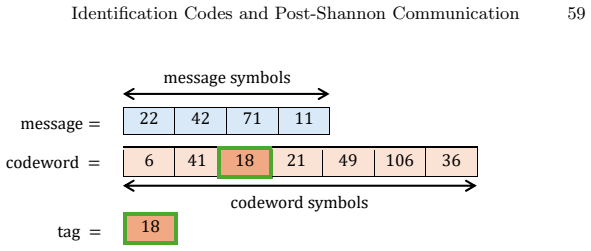
The key machinery is the randomized ID code built from an epsilon-almost universal hash family. To send identity i, the encoder picks a random seed S uniformly and transmits the pair (S, h(i, S)) using an ordinary transmission code; the receiver, testing a query i', recomputes h(i', S) and accepts if the hashes match. The hash-family property bounds the collision probability, which is exactly the type-II error, while the seed acts as common randomness between sender and receiver. Because the seed can be pre-shared or generated through feedback, most of the channel resource can be spent on the short hash, and the identity space expands as two nested exponentials. This construction replaces Sh
What would settle it
Measure the number of reliably identifiable messages at fixed short blocklengths (n = 50, 100, 200, 500) over a binary symmetric channel with crossover p = 0.01 using the Reed–Muller-based randomized construction of Section 5.3; if the log-log growth of N does not visibly outpace the classical transmission codebook size 2^n in that range, the claimed practical scalability advantage fails a direct test.
Extended reading notes
Core claim
The paper's central claim is that identification coding—where the receiver tests whether a given identity was sent instead of decoding a payload—achieves a double-exponential number of identifiable messages with blocklength, N ≈ 2^(2^nR), in contrast to the exponential growth of classical transmission codes. This scaling arises because ID decoding sets may overlap and because randomized encoding plus shared randomness lets the channel be used to convey a short hash rather than full data. The survey shows that the same principle extends across discrete memoryless, Gaussian, Poisson, MIMO, broadcast, and wiretap channels, and that it enables a practical design philosophy: communication resourc
Load-bearing premise
The load-bearing premise is that the double-exponential ID scaling, proven asymptotically for idealized channels, survives at the short blocklengths, finite randomness, noisy random-access channels, and receiver-side hypothesis-testing costs of real deployments—and the survey itself lists finite-blocklength ID and scalable decoding as open problems.
Editorial extensions
If this is right
- ID signals can act as a scalable pre-filter in hybrid architectures: a short ID stage decides who or what is relevant, and classical payload transmission is activated only when needed.
- The same physical storage can support membership queries over vastly larger logical spaces than reconstruction-based storage; the worked example shrinks a 90 PB/day presence-verification log to roughly 500 TB/day.
- When a wiretap channel has positive secrecy capacity, secure identification reaches the full ID capacity of the legitimate channel—security is achieved by design, with no asymptotic rate loss, unlike secure transmission.
- Deterministic ID codes, though lacking the double-exponential scaling, can still identify reliably in regimes where classical transmission error probability approaches one, and explicit Reed–Muller implementations run on embedded hardware at low latency and energy.
- Query repetition with majority voting drives per-query error down exponentially, so ID-based systems can tolerate noisy short-packet operation in practice.
- The control-plane use case in mobile networks suggests a migration path where ID first rides as an application-layer overlay and eventually becomes a native 6G primitive, reducing random-access load and device energy.
Reading between the lines
- The practical gains claimed for monitoring, storage, and control depend on the double-exponential asymptotic regime materializing at the short blocklengths of real systems; if finite-blocklength ID requires very large n before the second exponent appears, these architectures would degrade toward ordinary transmission with added randomness.
- The secure-ID dichotomy is a razor: if an adversary's channel becomes even slightly better than the legitimate receiver's, or the secrecy capacity hits zero, secure ID collapses completely—so deployments must actively measure and maintain a channel advantage, not assume it.
- A direct test of the program is to measure how quickly log log N grows with blocklength on a binary symmetric channel using the reported Reed–Muller constructions; if the growth does not clearly accelerate across, say, n = 50 to 500, the large-scale IoT and smart-dust scenarios would need either much longer packets or pre-distributed common randomness.
- The membership-query view of ID storage exposes a privacy tension that the survey itself flags: each yes/no answer is a bit, and repeated adaptive queries could reconstruct profiles, so any real deployment needs query rate-limits or differential-privacy-style protections before the 'privacy by design' claim holds.
Editorial analysis
A structured set of objections, weighed in public.
Referee Report
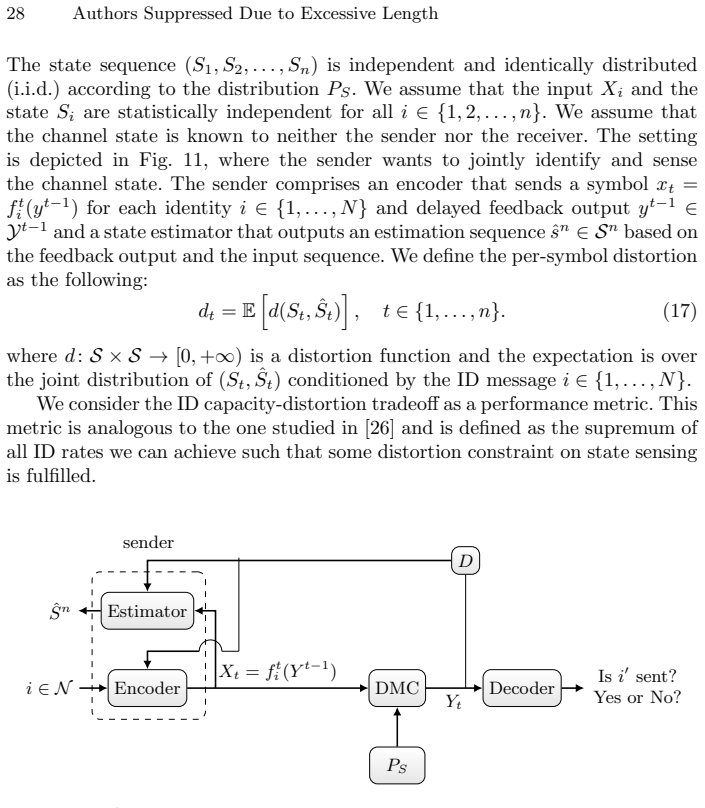
Summary. The paper is a survey of identification (ID) coding and its proposed role in post-Shannon communication. It reviews the theoretical foundations of randomized and deterministic ID: the Ahlswede–Dueck double-exponential scaling for DMCs, capacity results for Gaussian, Poisson, MIMO, compound, broadcast, and multiple-access channels, K-identification and opportunistic communication, common randomness, and the Ahlswede–Zhang secure-ID dichotomy for wiretap channels. It then presents application scenarios, including monitoring/alarming, special-purpose data storage, joint identification and sensing (JIDAS), semantic communication, mobile-network control, and networked consensus testing. Finally, it surveys code constructions and implementations (Reed–Solomon, Reed–Muller, hash-based, embedded experiments) and lists open problems in finite-blocklength ID, complexity, and hybrid architectures.
Significance. The theoretical survey portions are valuable and broadly consistent with the standard literature: the core ID capacity results and the Ahlswede–Zhang dichotomy are presented accurately, and the paper usefully gathers a wide set of references, including recent system implementations. The explicit code constructions, software-defined-radio experiments, and embedded energy/latency measurements are strengths that give readers a concrete picture of current practice. However, the paper's central claim—that ID enables scalable large-scale distributed systems—rests on extrapolating asymptotic double-exponential capacity to concrete application numbers, most sharply in §3.2's storage claims. Since the paper itself identifies finite-blocklength ID and scalable decoding as open (§6.1–§6.2), the application-level assertions need to be scoped and, where quantitative, derived from finite-blocklength analyses rather than from asymptotic capacity statements.
major comments (2)
- [§3.2 (Table 5, paragraph beginning 'To put this into accessible perspective')] The claimed 4–5 bits/entry for the mobile-cell presence store does not follow from Theorem 2. Theorem 2 is a communication statement over n channel uses: it requires a transmission code of rate R plus an ε-almost universal hash family and shared randomness (a seed). It does not imply that a fixed ℓ-bit tag supports membership queries over a 2^{2^{nR}}-sized universe with controlled false positives. For a membership scheme with ℓ-bit tags and N stored records, a non-stored record collides with some stored tag with probability roughly min(1, N/2^ℓ). With N ≈ 9×10^14 and ℓ=5, this is essentially 1, so the per-query error of 10^-3 used in the 'Query repetition and robustness' paragraph is not achieved. The section's own disclaimer that 'all of the capacity statements above are asymptotic,' combined with §6.1, shows this is an extrapolation. I recommend either removing the concrete storage nu
- [Abstract, §1, §7] The abstract and conclusion assert that double-exponential scaling 'enables fundamentally new communication architectures for large-scale distributed systems.' In the surveyed theory, this is a statement about randomized ID over n channel uses in the limit n→∞. The practical architectures in §3 and §5 assume that this scaling survives short blocklengths, finite randomness, and receiver-side testing over enormous identity spaces; §6.1 and §6.2 list exactly these as open problems. Thus the central 'enabling' claim is a research vision rather than a demonstrated system property. I ask the authors to temper the wording and to distinguish explicitly between asymptotic ID capacity and finite-blocklength feasibility. If the claim is retained, it should be supported by finite-blocklength evidence from the cited implementations or by a clear statement that it is a conjecture.
minor comments (5)
- [§4.3] There is a duplicated phrase: 'one of the fundamental results in secure ID theory.fundamental results in secure ID theory.' Please fix.
- [§2.2, Table 4 and Remark 4] For the deterministic AWGN capacity under the ζ2 scaling, Remark 4 cites [92] while Table 4 cites [28]; please harmonize the references and make clear which result is being stated.
- [§2.3, Eq. (14) and Theorem 3] Equation (14) defines R_a(P_{Y|X}), and Theorem 3 states C = R_2(P_{Y|X}). Please state explicitly that the index 2 corresponds to a=2 in the definition, to avoid confusion with the subscript in R_2.
- [§3.2, paragraph beginning 'If a classical storage system...'] The sentence comparing 'a few thousand distinct identities' with 'the count of atoms in the observable universe' is an asymptotic illustration. Please label it as such, since in a finite-blocklength system the number of identifiable messages depends on the code parameters, not only on the asymptotic scaling.
- [§5.4] There is a typo: 'To evaluate the practical feasibility of these constructions, embedded-system, the authors in [7] deployed...' should read '... these constructions, the authors in [7] deployed...'.
Circularity Check
No significant circularity: the central double-exponential scaling result is attributed to the external Ahlswede–Dueck theory; the survey's application extrapolations are explicitly flagged as asymptotic and are not fitted inputs renamed as predictions.
full rationale
This paper is a survey rather than a new derivation, and its load-bearing theoretical claim is not circular. Section 2.1 quotes Theorem 2, "The randomized ID capacity of the DMC W_D is given by C_ID(W_D, ζ_3) = sup_{P_X} I(X;Y)", attributing it to [6,46] — external foundational work, not to the survey's own assumptions. Later sections report prior results by citation, including the authors' own papers (e.g., JIDAS Theorems 5–6 from [65]/[61], effective-secrecy bounds from [90], K-ID Theorem 3 from [86]); these are literature summaries, not premises that assume the survey's conclusion. The storage example in Section 3.2 computes "ID-based storage per entry 4–5 bits" and "ID-based daily storage 500 TB" as an illustrative calculation, not as a prediction extracted from a fitted parameter. Moreover, the paper itself states, "All of the capacity statements above are asymptotic", and Sections 6.1–6.2 list finite-blocklength ID and scalable decoding as open problems. Thus the gap between asymptotic ID capacity and the finite-blocklength storage claims is a correctness/risk concern, not a definitional or self-citational circularity. No step in the paper reduces by construction to its own inputs.
Assumptions & free parameters
free parameters (3)
- ID storage bits per entry =
4–5 bits
- per-query error for repetition example =
10^-3
- classical record size =
100 bytes
assumptions (5)
- standard math Shannon transmission capacity and Wyner/Csiszár–Körner secrecy capacity formulas
- domain assumption DMC/state-dependent channel models with i.i.d. state independent of input
- standard math Ahlswede–Dueck randomized ID construction over DMCs with hash functions
- domain assumption PUF/QPUF hardware produces reproducible, unclonable secret randomness
- domain assumption Common randomness can be generated from feedback/noise
Cite this review
Pith. "Pith review of Identification Codes and Post-Shannon Communication: Theory, Architectures, and Emerging Applications." pith.science (2026). https://pith.science/paper/POG56SRG
@misc{pith2026260714666,
  author       = {Pith},
  title        = {Pith review of: Identification Codes and Post-Shannon Communication: Theory, Architectures, and Emerging Applications},
  year         = {2026},
  howpublished = {\url{https://pith.science/paper/POG56SRG}},
  note         = {Machine review of arXiv:2607.14666}
}
read the original abstract
Identification (ID) coding, introduced by Ahlswede and Dueck, extends Shannon's classical communication paradigm by replacing message reconstruction with hypothesis testing. Instead of decoding the transmitted message, the receiver only decides whether a particular message was sent. A fundamental result of ID theory is the double-exponential growth in the number of identifiable messages with respect to (w.r.t.) the blocklength. This scaling behavior enables fundamentally new communication architectures for large-scale distributed systems and forms a key building block of post-Shannon communication. While ID cannot replace classical communication in general, it is particularly well-suited for scenarios in which full message reconstruction is unnecessary, such as monitoring, alarming, and control systems. In this survey, we review the theoretical foundations of ID coding and discuss emerging communication architectures and application domains based on this paradigm. Particular emphasis is placed on practical use cases, including monitoring systems, special-purpose data storage, joint identification and sensing (JIDAS), semantic communications, mobile-network control systems and networked consensus testing systems. We further highlight recent system concepts, industrial perspectives, and implementation examples that illustrate how ID-based principles can be realized in practical communication systems.
Figures


Figures from the paper (22 more)






Reference graph
Works this paper leans on
-
[1]
Ahlswede, R., Cai, N.: Watermarking Identification Codes with Related Topics on Common Randomness, pp. 107–153. Springer Berlin Heidelberg, Berlin, Hei- delberg (2006)
2006
-
[2]
IEEE Transactions on Information Theory35(1), 30–36 (Jan 1989)
Ahlswede, R., Dueck, G.: Identification in the Presence of Feedback-A Discovery of New Capacity Formulas. IEEE Transactions on Information Theory35(1), 30–36 (Jan 1989)
1989
-
[3]
In: Proceedings of 1994 IEEE International Symposium on Information Theory
Ahlswede, R., Zhang, Z.: Identification via wiretap channels. In: Proceedings of 1994 IEEE International Symposium on Information Theory. pp. 352– (June 1994)
1994
-
[4]
Discrete Applied Mathematics156(9), 1348–1388 (2008)
Ahlswede, R.: General theory of information transfer: Updated. Discrete Applied Mathematics156(9), 1348–1388 (2008)
2008
-
[5]
IEEE Transactions on Information Theory45, 2636–2642 (1999)
Ahlswede, R., Cai, N.: Identification Without Randomization. IEEE Transactions on Information Theory45, 2636–2642 (1999)
1999
-
[6]
IEEE Transactions on In- formation Theory35(1), 15–29 (1989)
Ahlswede, R., Dueck, G.: Identification via channels. IEEE Transactions on In- formation Theory35(1), 15–29 (1989)
1989
-
[7]
In: European Wireless 2026 (EW 2026)
Ali, S.U., Mahajan, S., Cabrera, J.A., Hofmann, P., Fitzek, F.H.P.: Quantitative analysis of energy consumption for identification codes on embedded devices. In: European Wireless 2026 (EW 2026). p. 6. Rimini, Italy (Jun 2026)
2026
-
[8]
In: Fitzek, F., Boche, H., Kellerer, W., Seeling, P
Amiri, Z., Bassoli, R., Boche, H., Charania, S., Czarske, J., Das, S., Deppe, C., Calsi, D., Maheshwari, S., Nande, S., Nilesh, K., N¨ otzel, J., Zhang, Q.: Quan- tum technology applications for 6G networks. In: Fitzek, F., Boche, H., Kellerer, W., Seeling, P. (eds.) 6G-life: Unveiling the Future of Technological Sovereignty, Sustainability and Trustworth...
2026
Show all 125 references
-
[9]
In: Fitzek, F., Boche, H., Kellerer, W., Seeling, P
Amiri, Z., Bassoli, R., Boche, H., Charania, S., Czarske, J., Das, S., Deppe, C., Dev, S., Fitzek, F., Habibie, M., Hawellek, J., He, M., Jamshidi, K., Calsi, D., Nande, S., Nilesh, K., N¨ otzel, J., Plettemeier, D., Shetewy, A., Upadhyay, C., Zhang, Q.: Quantum technology con...
2026
-
[10]
cryptography2(2), 8 (2018)
Baur, S., Boche, H.: Robust secure authentication and data storage with perfect secrecy. cryptography2(2), 8 (2018)
2018
-
[11]
United States Patent and Trade- mark Office (2021), u.S
Baur, S., Boche, H., Deppe, C.: Method and unit of operating a storage means, storage means and system for data processing. United States Patent and Trade- mark Office (2021), u.S. Patent Application US20210117126A1, Patent Applica- tion No. US17/252,971
2021
-
[12]
IEEE Transactions on Information Forensics and Security 14(8), 2013–2027 (2019) Identification Codes and Post-Shannon Communication 69
Baur, S., Deppe, C., Boche, H.: Secure storage for identification; random resources and privacy leakage. IEEE Transactions on Information Forensics and Security 14(8), 2013–2027 (2019) Identification Codes and Post-Shannon Communication 69
2013
-
[13]
In: 2015 IEEE Global Communications Conference (GLOBECOM)
Bica, M., Huang, K.W., Mitra, U., Koivunen, V.: Opportunistic radar waveform design in joint radar and cellular communication systems. In: 2015 IEEE Global Communications Conference (GLOBECOM). pp. 1–7 (2015)
2015
-
[14]
In: Fitzek, F., Boche, H., Kellerer, W., Seeling, P
Bienau, A., Boche, H., Deppe, C., Fitzek, F., Hofmann, P., Kellerer, W., Labidi, W., Richter, A., Simmel, F., Wietfeld, A., Zheng, R., Zhou, P.: Molecular Com- munication for 6G Networks. In: Fitzek, F., Boche, H., Kellerer, W., Seeling, P. (eds.) 6G-life: Unveiling the Future...
2026
-
[15]
Bierbrauer, J., Johansson, T., Kabatianskii, G., Smeets, B.: On Families of Hash Functions via Geometric Codes and Concatenation, pp. 331–342. Springer Berlin Heidelberg (1993)
1993
-
[16]
Bjelakovi´ c, I., Boche, H., Sommerfeld, J.: Secrecy results for compound wiretap channels. Probl. Inf. Transm.49(1), 73–98 (Jan 2013)
2013
-
[17]
In: 2014 IEEE Radar Conference
Bliss, D.W.: Cooperative radar and communications signaling: The estimation and information theory odd couple. In: 2014 IEEE Radar Conference. pp. 0050– 0055 (2014)
2014
-
[18]
IEEE Transactions on Information Forensics and Security13(7), 1641–1655 (July 2018)
Boche, H., Deppe, C.: Secure identification for wiretap channels; robustness, super-additivity and continuity. IEEE Transactions on Information Forensics and Security13(7), 1641–1655 (July 2018)
2018
-
[19]
European Patent Office (2024), european Patent EP3937117B1
Boche, H., Deppe, C.: Method and system for transmitting and/or receiving messages via identification. European Patent Office (2024), european Patent EP3937117B1
2024
-
[20]
European Patent Office (2024), european Patent Application 4687357
Boche, H., Deppe, C., Geitz, M., Rosenberger, J.: Disaster communication system based on post-shannon communication. European Patent Office (2024), european Patent Application 4687357
2024
-
[21]
German Patent Office (2025), patent Application DE102025143864.1
Boche, H., Geitz, M.: Identifikationskommunikationsnetzwerk, computerimple- mentiertes verfahren zur uebermittlung einer handlungsanweisung, sendeeinheit, empfangseinheit, system und computerprogramm. German Patent Office (2025), patent Application DE102025143864.1
2025
-
[22]
In: 2019 IEEE International Symposium on Information Theory (ISIT)
Boche, H., Schaefer, R.F., Vincent Poor, H.: Identification capacity of correlation- assisted discrete memoryless channels: Analytical properties and representations. In: 2019 IEEE International Symposium on Information Theory (ISIT). pp. 470– 474 (2019)
2019
-
[23]
IEEE Trans- actions on Information Theory63(6), 3480–3501 (2017)
Bracher, A., Lapidoth, A.: Identification via the broadcast channel. IEEE Trans- actions on Information Theory63(6), 3480–3501 (2017)
2017
-
[24]
In: Proceedings of the 1999 IEEE Information Theory and Communications Workshop (Cat
Burnashev, M.V.: On method of ”types”, approximation of output measures and id-capacity for channels with continuous alphabets. In: Proceedings of the 1999 IEEE Information Theory and Communications Workshop (Cat. No. 99EX253). pp. 80–81 (June 1999)
1999
-
[25]
Carnap, R., Bar-Hillel, Y.: An outline of a theory of semantic information. Tech. rep., Research Laboratory of Electronics, Massachusetts Institute of Technology (Oct 1952)
1952
-
[26]
IEEE Trans- actions on Information Theory59(6), 3709–3719 (2013)
Choudhuri, C., Kim, Y.H., Mitra, U.: Causal state communication. IEEE Trans- actions on Information Theory59(6), 3709–3719 (2013)
2013
-
[27]
arXiv e-prints arXiv:2605.05168 (May 2026).https://doi.org/10.48550/arXiv.2605.05168
Colomer, P., Deppe, C., Boche, H., Winter, A.: Deterministic identification for Bernoulli channels and related channels with continuous input. arXiv e-prints arXiv:2605.05168 (May 2026).https://doi.org/10.48550/arXiv.2605.05168
-
[28]
Colomer, P., Deppe, C., Boche, H., Winter, A.: Rate-reliability tradeoff for deter- ministic identification over gaussian channels (2026),https://arxiv.org/abs/ 2602.12182 70 Authors Suppressed Due to Excessive Length
2026
-
[29]
IEEE trans- actions on information theory24(3), 339–348 (1978)
Csisz´ ar, I., Korner, J.: Broadcast channels with confidential messages. IEEE trans- actions on information theory24(3), 339–348 (1978)
1978
-
[30]
Entropy (22) (2020)
Derebeyo˘ glu, S., Deppe, C., Ferrara, R.: Performance analysis of identification codes. Entropy (22) (2020)
2020
-
[31]
Deutsche Telekom: (Jul 2024),https://www.facebook.com/deutschetelekom /posts/5-jahre-5g-am-3-juli-2019-ffneten-wir-das-5g-netz-erstmals-f r-unsere-kundinnen/1013485793766423/, retrieved on: 27 Mai 2026
2024
-
[32]
In: Deppe, C., Winter, A., Yeung, R.W., Boche, H., Alth¨ ofer, I., Stoye, J., Tamm, U., Ezzine, R
Ezzine, R., Labidi, W., Deppe, C., Boche, H.: Optimal signal processing for com- mon randomness generation over mimo gaussian channels with applications in identification. In: Deppe, C., Winter, A., Yeung, R.W., Boche, H., Alth¨ ofer, I., Stoye, J., Tamm, U., Ezzine, R. (eds.)...
2025
-
[33]
In: GLOBECOM 2020-2020 IEEE Global Communications Conference
Ezzine, R., Labidi, W., Boche, H., Deppe, C.: Common randomness genera- tion and identification over gaussian channels. In: GLOBECOM 2020-2020 IEEE Global Communications Conference. pp. 1–6. IEEE (2020)
2020
-
[34]
In: European Wireless 2022; 27th European Wireless Conference
Ferrara, R., Torres-Figueroa, L., Boche, H., Deppe, C., Labidi, W., M¨ onich, J.U., Andrei, V.C.: Implementation and experimental evaluation of reed-solomon iden- tification. In: European Wireless 2022; 27th European Wireless Conference. pp. 1– 6 (2022)
2022
-
[35]
Communications of the ACM 65(4), 48–49 (Apr 2022)
Fettweis, G., Boche, H.: On 6G and trustworthiness. Communications of the ACM 65(4), 48–49 (Apr 2022)
2022
-
[36]
IEEE BITS the Information Theory Magazine1(1), 71–82 (2021)
Fettweis, G., Boche, H.: 6G: The personal tactile internet—and open questions for information theory. IEEE BITS the Information Theory Magazine1(1), 71–82 (2021)
2021
-
[37]
Minds and Ma- chines14(2), 197–221 (2004)
Floridi, L.: Outline of a theory of strongly semantic information. Minds and Ma- chines14(2), 197–221 (2004)
2004
-
[38]
In: ICC 2022 - IEEE International Conference on Communications
Frank, A., Voichtleitner, J., Wiese, M., Boche, H.: Implementation of a modu- lar coding scheme for secure communication. In: ICC 2022 - IEEE International Conference on Communications. pp. 2900–2905 (2022)
2022
-
[39]
European Patent Office (2024), euro- pean Patent Application EP24219710.1
Geitz, M.: Post shannon’sche kommunikation zur kanaloptimierung von iot sen- soren in zuk¨ unftigen mobilfunknetzwerken. European Patent Office (2024), euro- pean Patent Application EP24219710.1
2024
-
[40]
In: Proceedings of the European Wireless 2026
Gholamian, V., Zhao, Y., Deppe, C., Boche, H., Schaefer, R.F.: Secure random- ized identification with feedback and sensing over state-dependent wiretap chan- nels. In: Proceedings of the European Wireless 2026. Rimini, Italy (2026), post- Shannon and Semantic Communications Track
2026
-
[41]
In: Proc
Gholipour, J., et al.: Semantic communication: From philosophical concep- tions towards a mathematical framework. In: Proc. IEEE Wireless Communi- cations and Networking Conference (WCNC). Kuala Lumpur, Malaysia (2026), arXiv:2505.01342
2026 arXiv
-
[42]
Intel, CA, USA, Tech
Gopal, V., Ozturk, E., Guilford, J., Wolrich, G., Feghali, W., Dixon, M., Karakoyunlu, D.: Fast crc computation for generic polynomials using pclmulqdq instruction. Intel, CA, USA, Tech. Rep (2009)
2009
-
[43]
Grand View Research: High frequency trading market size, share & trends anal- ysis report, 2030.https://www.grandviewresearch.com/industry-analysis/ high-frequency-trading-market-report(2024), reports a global high- frequency-trading market size of USD 10.36 billion in 2024 an...
-
[44]
IEEE Journal on Selected Areas in Communications41(1), 5–41 (Jan 2023)
G¨ und¨ uz, D., de Kerret, P., Erkip, E., Gesbert, D., G¨ und¨ uz, D., Yanikomeroglu, H., et al.: Beyond transmitting bits: Context, semantics, and task-oriented com- munications. IEEE Journal on Selected Areas in Communications41(1), 5–41 (Jan 2023)
2023
-
[45]
IEEE Transactions on Information Theory38(1), 14–25 (Jan 1992)
Han, T.S., Verdu, S.: New Results in the Theory of Identification via Channels. IEEE Transactions on Information Theory38(1), 14–25 (Jan 1992)
1992
-
[46]
Springer (2003)
Han, T.S.: Information-Spectrum Methods in Information Theory. Springer (2003)
2003
-
[47]
Haselmayr, W., Springer, A., Fischer, G., Alexiou, C., Boche, H., Hoeher, P., Dressler, F., Schober, R.: Integration of molecular communications into future generation wireless networks (2019)
2019
-
[48]
IEEE Transactions on Information Theory58(7), 4914–4929 (2012)
Hayden, P., Winter, A.: Weak decoupling duality and quantum identification. IEEE Transactions on Information Theory58(7), 4914–4929 (2012)
2012
-
[49]
In: 2015 IEEE Radar Con- ference (RadarCon)
Huang, K.W., Bic˘ a, M., Mitra, U., Koivunen, V.: Radar waveform design in spec- trum sharing environment: Coexistence and cognition. In: 2015 IEEE Radar Con- ference (RadarCon). pp. 1698–1703 (2015)
2015
-
[50]
In: 26th Annual Symposium on Foundations of Computer Science (sfcs 1985)
Ja, J.J.: Identification is easier than decoding. In: 26th Annual Symposium on Foundations of Computer Science (sfcs 1985). pp. 43–50 (1985)
1985
-
[51]
Advanced Quantum Technologies9(1) (Jan 2026), arXiv preprint arXiv:2508.09296, 2025
Juli` a Farr´ e, P., Galetsky, V., Belhassen, M., Pieplow, G., Nilesh, K., Boche, H., Schr¨ oder, T., N¨ otzel, J., Deppe, C.: Secure authentication via quantum physical unclonable functions: A review. Advanced Quantum Technologies9(1) (Jan 2026), arXiv preprint arXiv:2508.09296, 2025
2026
-
[52]
Kleinew¨ achter, C.: On Identification, pp. 62–83. Springer Berlin Heidelberg, Berlin, Heidelberg (2006)
2006
-
[53]
In: 2018 IEEE International Symposium on Information Theory (ISIT)
Kobayashi, M., Caire, G., Kramer, G.: Joint state sensing and communication: Optimal tradeoff for a memoryless case. In: 2018 IEEE International Symposium on Information Theory (ISIT). pp. 111–115 (2018)
2018
-
[54]
In: 2025 IEEE International Conference on Communications (ICC): IoT and Sensor Networks Symposium (IEEE ICC’25 - IoTSN Symposium)
Kutsevol, P., von Lengerke, C., Cabrera, J.A., Fitzek, F.H.P., Kellerer, W.: Dis- tributed platoon control via Semantic-Aware identification codes. In: 2025 IEEE International Conference on Communications (ICC): IoT and Sensor Networks Symposium (IEEE ICC’25 - IoTSN Symposium)...
2025
-
[55]
In: ICC 2025 - IEEE International Conference on Communications
Kutsevol, P., Von Lengerke, C., Cabrera, J.A., Fitzek, F.H.P., Kellerer, W.: Dis- tributed platoon control via semantic-aware identification codes. In: ICC 2025 - IEEE International Conference on Communications. pp. 2070–2076 (2025)
2025
-
[56]
In: European Wireless 2024 (September 2024)
Labidi, W., Deppe, C., Boche, H.: Information-theoretical analysis of event- triggered molecular communication. In: European Wireless 2024 (September 2024)
2024
-
[57]
Labidi, W.: Post-Shannon Theory for Infinite Alphabets: Identification and Com- mon Randomness Generation. Ph.D. thesis, School of Computation, Information and Technology (2025), submitted
2025
-
[58]
In: 2021 IEEE International Symposium on Information Theory (ISIT)
Labidi, W., Boche, H., Deppe, C., Wiese, M.: Identification over the gaussian channel in the presence of feedback. In: 2021 IEEE International Symposium on Information Theory (ISIT). pp. 278–283 (2021)
2021
-
[59]
In: ICASSP 2020 - 2020 IEEE International Conference on Acoustics, Speech and Signal Processing (ICASSP)
Labidi, W., Deppe, C., Boche, H.: Secure Identification for Gaussian Channels. In: ICASSP 2020 - 2020 IEEE International Conference on Acoustics, Speech and Signal Processing (ICASSP). pp. 2872–2876 (2020)
2020
-
[60]
In: WSA 2021; 25th International ITG Workshop on Smart Antennas
Labidi, W., Deppe, C., Boche, H.: Identification for multi-antenna gaussian chan- nels. In: WSA 2021; 25th International ITG Workshop on Smart Antennas. pp. 1–
2021
-
[61]
VDE (2021) 72 Authors Suppressed Due to Excessive Length
2021
-
[62]
In: 2023 IEEE International Symposium on Information Theory (ISIT)
Labidi, W., Deppe, C., Boche, H.: Joint identification and sensing for discrete memoryless channels. In: 2023 IEEE International Symposium on Information Theory (ISIT). pp. 442–447 (2023)
2023
-
[63]
In: Information Theory and Related Fields: Festschrift in Memory of Ning Cai, pp
Labidi, W., Deppe, C., Boche, H.: Secure identification for multi-antenna gaussian channels. In: Information Theory and Related Fields: Festschrift in Memory of Ning Cai, pp. 397–423. Springer (2025)
2025
-
[64]
European Patent Office (2025), european Patent Application EP25201197.8
Labidi, W., Deppe, C., Boche, H., Geitz, M.: System und verfahren zur nicht- invasiven tumortherapie mit hilfe von joint detection and identification. European Patent Office (2025), european Patent Application EP25201197.8
2025
-
[65]
European Patent Office (2025), european Patent Application EP25201196.0
Labidi, W., Deppe, C., Boche, H., Geitz, M.: System und verfahren zur steuerung und kontrolle autonomer mikro-flugmaschinen mit hilfe von post shannon‘scher identifikation (environment sensing and identification). European Patent Office (2025), european Patent Application EP25201196.0
2025
-
[66]
Entropy27(1), 12 (2025)
Labidi, W., Zhao, Y., Deppe, C., Boche, H.: Joint identification and sensing for discrete memoryless channels. Entropy27(1), 12 (2025)
2025
-
[67]
In: 2023 IEEE In- ternational Conference on Metaverse Computing, Networking and Applications (MetaCom)
von Lengerke, C., Cabrera, J.A., Fitzek, F.H.P.: Identification codes for increased reliability in digital twin applications over noisy channels. In: 2023 IEEE In- ternational Conference on Metaverse Computing, Networking and Applications (MetaCom). pp. 550–557 (2023)
2023
-
[68]
IEEE Communications Surveys & Tutorials (2025)
von Lengerke, C., Cabrera, J.A., Reisslein, M., Fitzek, F.H.P.: Codes for identifica- tion via channels: Tutorial for communications generalists. IEEE Communications Surveys & Tutorials (2025)
2025
-
[69]
Lengerke, C., Hefele, A., Cabrera, J.A., Fitzek, F.H.P.: Stopping the data flood: Post-shannon traffic reduction in digital-twins applications
v. Lengerke, C., Hefele, A., Cabrera, J.A., Fitzek, F.H.P.: Stopping the data flood: Post-shannon traffic reduction in digital-twins applications. In: IEEE/IFIP Networking Operations Management Symposium (NOMS) (Apr 2022), best Paper
2022
-
[70]
IEEE Access11, 14961–14982 (2023)
Lengerke, C.V., Hefele, A., Cabrera, J.A., Kosut, O., Reisslein, M., Fitzek, F.H.P.: Identification Codes: A Topical Review With Design Guidelines for Practical Sys- tems. IEEE Access11, 14961–14982 (2023)
2023
-
[71]
Journal of Industrial Information Integration6, 1 – 10 (2017)
Lu, Y.: Industry 4.0: A survey on technologies, applications and open research issues. Journal of Industrial Information Integration6, 1 – 10 (2017)
2017
-
[72]
In: Proc
Mariani, F.F.L., Zhu, M., Magarini, M.: Semantic communications via fea- tures identification. In: Proc. IEEE International Conference on Communications (ICC). pp. 4135–4141. Montreal, Canada (2025)
2025
-
[73]
McKay Brothers International: Mckay brothers launches route between slough and frankfurt in 4.64 ms: Lowest known latency.https://mckay-brothers.com /media(Mar 2015), reports 4.64 ms round-trip latency between Slough-LD4 and Frankfurt-FR2
2015
-
[74]
McKay Brothers International: Mckay brothers microwave sets new latency record between uk and frankfurt.https://mckay-brothers.com/media(Jan 2015), re- ports 4.192 ms latency on the wireless route between Frankfurt and Basildon
2015
-
[75]
Signal Processing81(6), 1121 – 1139 (2001), special section on Information theoretic aspects of digital watermarking
Moulin, P.: The role of information theory in watermarking and its application to image watermarking. Signal Processing81(6), 1121 – 1139 (2001), special section on Information theoretic aspects of digital watermarking
2001
-
[76]
In: ICC 2026 (IEEE In- ternational Conference on Communications) (2026)
Nilesh, K., Deppe, C., Geitz, M., Boche, H.: Quantum PUF and quantum biometric-based identification supporting authentication. In: ICC 2026 (IEEE In- ternational Conference on Communications) (2026)
2026
-
[77]
In: 2024 IEEE International Symposium on Information Theory (ISIT)
Nilesh, K., Deppe, C., Boche, H.: Information theoretic analysis of a quantum puf. In: 2024 IEEE International Symposium on Information Theory (ISIT). pp. 3320–3325. IEEE (2024) Identification Codes and Post-Shannon Communication 73
2024
-
[78]
In: 2024 IEEE 10th World Forum on Internet of Things (WF-IoT)
Nilesh, K., Deppe, C., Boche, H.: Quantum puf and its applications with informa- tion theoretic analysis. In: 2024 IEEE 10th World Forum on Internet of Things (WF-IoT). pp. 1–6. IEEE (2024)
2024
-
[79]
In: ICC 2025-IEEE International Conference on Communications
Nilesh, K., Deppe, C., Boche, H.: Authentication based on quantum PUF. In: ICC 2025-IEEE International Conference on Communications. pp. 6796–6801. IEEE (2025)
2025
-
[80]
In: 2025 IEEE International Symposium on Information Theory (ISIT)
Nilesh, K., Deppe, C., Boche, H.: Quantum PUF based secret key generation and secure storage with side information. In: 2025 IEEE International Symposium on Information Theory (ISIT). pp. 1–5. IEEE (2025)
2025
-
[81]
In: 2025 IEEE Information Theory Workshop (ITW)
Nilesh, K., Deppe, C., Boche, H.: Secret key generation and storage based on QPUF. In: 2025 IEEE Information Theory Workshop (ITW). pp. 1–6. IEEE (2025)
2025
-
[82]
In: ICC 2025-IEEE International Conference on Communications
Nilesh, K., Deppe, C., Boche, H.: Secure storage and identification using quantum PUF. In: ICC 2025-IEEE International Conference on Communications. pp. 6802–
2025
-
[83]
In: GLOBECOM 2025-2025 IEEE Global Communications Conference
Nilesh, K., Deppe, C., Geitz, M., Boche, H.: Secure storage for identification using fully quantum PUF. In: GLOBECOM 2025-2025 IEEE Global Communications Conference. pp. 1974–1979. IEEE (2025)
2025
-
[84]
In: 2025 IEEE Future Networks World Forum (FNWF)
Nilesh, K., Geitz, M., D¨ oring, R., Deppe, C., Boche, H.: Implementation of quantum PUF in future network. In: 2025 IEEE Future Networks World Forum (FNWF). pp. 1–6. IEEE (2025)
2025
-
[85]
In: ICC 2024 – IEEE International Conference on Communications
Perotti, A.G., Berggren, F., Popovi´ c, B.M.: Identification codes for wake-up sig- nals. In: ICC 2024 – IEEE International Conference on Communications. pp. 3839–3844 (2024)
2024
-
[86]
In: Proceedings of the USENIX Conference on File and Storage Technologies (F AST)
Quinlan, S., Dorward, S.: Venti: A new approach to archival data storage. In: Proceedings of the USENIX Conference on File and Storage Technologies (F AST). USENIX Association, Monterey, California, USA (2002)
2002
-
[87]
In: Submitted to 2026 (Jun 2026)
Rosenberger, J., Boche, H.: Explicit Codes For K-Identification And -Decoding. In: Submitted to 2026 (Jun 2026)
2026
-
[88]
In: ISIT 2025 (IEEE International Sympo- sium on Information Theory) (2025)
Rosenberger, J., Boche, H., Cabrera, J.A., Deppe, C., Fitzek, F.H.P.: Stochastic consensus-testing in relay networks. In: ISIT 2025 (IEEE International Sympo- sium on Information Theory) (2025)
2025
-
[89]
In: IEEE Global Communica- tions Conference (GLOBECOM)
Rosenberger, J., Boche, H., Cabrera, J.A., Fitzek, F.H.P.: Consensus testing via relay networks by physical-layer network coding. In: IEEE Global Communica- tions Conference (GLOBECOM). Cape Town, South Africa (12 2024)
2024
-
[90]
In: IEEE International Symposium on Information Theory (ISIT) (Jun 2025)
Rosenberger, J., Boche, H., Deppe, C., Pereg, U.: The Quantum Identification Capacity With Entanglement Assistance. In: IEEE International Symposium on Information Theory (ISIT) (Jun 2025)
2025
-
[91]
In: 2023 IEEE International Symposium on Information Theory (ISIT)
Rosenberger, J., Ibrahim, A., Bash, B.A., Deppe, C., Ferrara, R., Pereg, U.: Ca- pacity bounds for identification with effective secrecy. In: 2023 IEEE International Symposium on Information Theory (ISIT). pp. 1202–1207. IEEE (2023)
2023
-
[92]
In: 2023 IEEE International Symposium on Information Theory (ISIT)
Rosenberger, J., Ibrahim, A., Deppe, C., Ferrara, R.: Deterministic identifica- tion over multiple-access channels. In: 2023 IEEE International Symposium on Information Theory (ISIT). pp. 1699–1704 (2023)
2023
-
[93]
In: 2020 IEEE Information Theory Workshop (ITW)
Salariseddigh, M.J., Pereg, U., Boche, H., Deppe, C.: Deterministic Identifica- tion over Fading Channels. In: 2020 IEEE Information Theory Workshop (ITW). pp. 1–5. IEEE (2021)
2020
-
[94]
IEEE Transactions on Information Theory 68(1), 1–24 (2022) 74 Authors Suppressed Due to Excessive Length
Salariseddigh, M.J., Pereg, U., Boche, H., Deppe, C.: Deterministic identification over channels with power constraints. IEEE Transactions on Information Theory 68(1), 1–24 (2022) 74 Authors Suppressed Due to Excessive Length
2022
-
[95]
Cambridge University Press (2017)
Schaefer, R.F., Boche, H., Khisti, A., Poor, H.V.: Information theoretic security and privacy of information systems. Cambridge University Press (2017)
2017
-
[96]
Tutorial at the 2022 IEEE Global Com- munications Conference (GLOBECOM) (Dec 2022), presented at IEEE GLOBE- COM 2022, Rio de Janeiro, Brazil by Christian Deppe, Dec
Schaefer, R.F., Deppe, C., Fitzek, F.H.P., Boche, H.: Post-shannon communica- tions – breaking the shannon limit for 6g. Tutorial at the 2022 IEEE Global Com- munications Conference (GLOBECOM) (Dec 2022), presented at IEEE GLOBE- COM 2022, Rio de Janeiro, Brazil by Christian D...
2022
-
[97]
Uni- versity of Illinois Press, Urbana, IL, USA (1949)
Shannon, C.E., Weaver, W.: The Mathematical Theory of Communication. Uni- versity of Illinois Press, Urbana, IL, USA (1949)
1949
-
[98]
The Bell system tech- nical journal27(3), 379–423 (1948)
Shannon, C.E.: A mathematical theory of communication. The Bell system tech- nical journal27(3), 379–423 (1948)
1948
-
[99]
Proceedings of the IEEE 76(5), 603–620 (May 1988)
Simmons, G.: A survey of information authentication. Proceedings of the IEEE 76(5), 603–620 (May 1988)
1988
-
[100]
Mai 2026
SMARTWEB: Telekom netz im test - smartweb netztest.https://www.sm artweb.de/telekom-netz-im-test(2026), besucht am 27. Mai 2026
2026
-
[101]
arXiv e-prints arXiv:2107.07649 (Jul 2021)
Spandri, M., Ferrara, R., Deppe, C.: Reed-Muller Identification. arXiv e-prints arXiv:2107.07649 (Jul 2021)
2021 arXiv
-
[102]
In: 2022 Inter- national Zurich Seminar on Information and Communication
Spandri, M., Ferrara, R., Deppe, C.: Reed–Muller Identification. In: 2022 Inter- national Zurich Seminar on Information and Communication. ETH Zurich (2022)
2022
-
[103]
IEEE Transactions on Information Theory47(4), 1410–1422 (2001)
Steinberg, Y., Merhav, N.: Identification in the Presence of Side Information with Application to Watermarking. IEEE Transactions on Information Theory47(4), 1410–1422 (2001)
2001
-
[104]
Proceedings of the IEEE 99(7), 1236–1259 (2011)
Sturm, C., Wiesbeck, W.: Waveform design and signal processing aspects for fusion of wireless communications and radar sensing. Proceedings of the IEEE 99(7), 1236–1259 (2011)
2011
-
[105]
In: Proceedings of the IEEE Global Communications Conference, 2025 (GLOBECOM ’25)
Torres-Figueroa, L., Ferrara, R., Boche, H., Voichtleitner, J., Deppe, C., Wiese, M., M¨ onich, U.J.: Experimental Analysis of Semantic-Secure Randomized Identi- fication in A WGN Channels. In: Proceedings of the IEEE Global Communications Conference, 2025 (GLOBECOM ’25). pp. ...
2025
-
[106]
IEEE Internet of Things Magazine6(4), 42–47 (12 2023)
Torres-Figueroa, L., Ferrara, R., Deppe, C., Boche, H.: Message Identification for Task-Oriented Communications: Exploiting an Exponential Increase in the Number of Connected Devices. IEEE Internet of Things Magazine6(4), 42–47 (12 2023)
2023
-
[107]
In: Proceedings of the IEEE Global Communications Conference, 2022 (GLOBECOM ’22)
Torres-Figueroa, L., H¨ ormann, M., Wiese, M., M¨ onich, U.J., Boche, H., Holschke, O., Geitz, M.: Implementation of Physical Layer Security into 5G NR Systems and E2E Latency Assessment. In: Proceedings of the IEEE Global Communications Conference, 2022 (GLOBECOM ’22). pp. 40...
2022
-
[108]
In: 2021 IEEE Global Communications Conference (GLOBECOM’21)
Torres-Figueroa, L., M¨ onich, U.J., Voichtleitner, J., Frank, A., Andrei, V.C., Wiese, M., Boche, H.: Experimental Evaluation of a Modular Coding Scheme for Physical Layer Security. In: 2021 IEEE Global Communications Conference (GLOBECOM’21). pp. 1–6 (2021)
2021
-
[109]
In: Proceedings of the IEEE Global Commu- nications Conference, 2023 (GLOBECOM ’23)
Torres-Figueroa, L., Voichtleitner, J., M¨ onich, U.J., Wiese, M., Boche, H.: Seman- tic Secrecy Assessment of Physical Layer Security in 5G NR Uplink Transmissions Under Fading Channel Conditions. In: Proceedings of the IEEE Global Commu- nications Conference, 2023 (GLOBECOM ...
2023
-
[110]
In: 2024 IEEE Globecom Workshops - Security 6G
Torres-Figueroa, L., Voichtleitner, J., M¨ onich, U.J., Eichler, T., Wiese, M., Boche, H.: Exploiting Beamforming for Enforcing Semantic Secrecy in 5G NR mmWave Communications. In: 2024 IEEE Globecom Workshops - Security 6G. pp. 1–7 (2024)
2024
-
[111]
In: Proceedings of the IEEE International Conference on Communications (ICC) 2026, (ICC ’26) (2026)
Torres-Figueroa, L., Vorobyev, I., Deppe, C., M¨ onich, U.J., Boche, H.: Experimen- tal performance of deterministic identification for goal-oriented communications Identification Codes and Post-Shannon Communication 75 in A WGN channels. In: Proceedings of the IEEE Internatio...
2026
-
[112]
IEEE Transactions on Information Theory39(1), 30– 36 (1993)
Verd´ u, S., Wei, V.K.: Explicit construction of optimal constant-weight codes for identification via channels. IEEE Transactions on Information Theory39(1), 30– 36 (1993)
1993
-
[113]
In: 2024 IEEE 25th International Workshop on Signal Processing Advances in Wireless Communications (SPA WC)
Voichtleitner, J., Wiese, M., Boche, H.: Comparison of universal hash functions for physical layer security in wiretap channels. In: 2024 IEEE 25th International Workshop on Signal Processing Advances in Wireless Communications (SPA WC). pp. 191–195 (2024)
2024
-
[114]
In: Proceedings of the IEEE Global Communications Conference, 2025 (GLOBECOM ’25) (2025)
Voichtleitner, J., Wiese, M., Boche, H.: Seed analysis of universal hash functions for physical layer security in the wiretap channel. In: Proceedings of the IEEE Global Communications Conference, 2025 (GLOBECOM ’25) (2025)
2025
-
[115]
In: Proceedings of the IEEE Wireless Communication and Networking Conference, 2026 (WCNC ’26) (2026), accepted
Voichtleitner, J., Wiese, M., Boche, H.: Comparison of methods to experimentally validate information-theoretic physical layer security. In: Proceedings of the IEEE Wireless Communication and Networking Conference, 2026 (WCNC ’26) (2026), accepted
2026
-
[116]
IEEE Transactions on Informa- tion Forensics and Security21, 1697–1711
Voichtleitner, J., Wiese, M., Frank, A., Boche, H.: Experimental Validation of Information-Theoretic Physical Layer Security. IEEE Transactions on Informa- tion Forensics and Security21, 1697–1711
-
[117]
In: Proc
Vorobyev, I., Deppe, C., Torres-Figueroa, L., Boche, H.: Deterministic identifica- tion: From theoretical analysis to practical identification codes. In: Proc. IEEE International Symposium on Information Theory (ISIT). pp. 303–308 (2024)
2024
-
[118]
In: Fitzek, F., Boche, H., Kellerer, W., Seeling, P
Wiese, M., Pehl, M., Pohle, D., Torres-Figueroa, L., Voichtleitner, J., M¨ onich, U., Seifert, D., Boche, H., Czarske, J., Schaefer, R., Sigl, G.: Physical layer security for 6g. In: Fitzek, F., Boche, H., Kellerer, W., Seeling, P. (eds.) 6G-life: Unveiling the Future of Techn...
2026
-
[119]
IEEE Transactions on Information Theory 69(11), 6811–6821 (2022)
Wiese, M., Labidi, W., Deppe, C., Boche, H.: Identification over additive noise channels in the presence of feedback. IEEE Transactions on Information Theory 69(11), 6811–6821 (2022)
2022
-
[120]
In: Information Theory, Combi- natorics, and Search Theory, pp
Winter, A.: Identification via quantum channels. In: Information Theory, Combi- natorics, and Search Theory, pp. 217–233. Springer, Berlin, Heidelberg (2013)
2013
-
[121]
Bell system technical journal54(8), 1355– 1387 (1975)
Wyner, A.D.: The wire-tap channel. Bell system technical journal54(8), 1355– 1387 (1975)
1975
-
[122]
In: Proceedings of the eleventh annual ACM symposium on Theory of computing
Yao, A.C.C.: Some complexity questions related to distributive computing (pre- liminary report). In: Proceedings of the eleventh annual ACM symposium on Theory of computing. pp. 209–213 (1979)
1979
-
[123]
In: International Conference on Quantum Communications, Networking, and Computing)
Yin, M., Geitz, M., Albanese, I., Gnaust, T., Holschke, O., Njoku, B., Bassoli, R., Cabrera, J.A., Hofmann, P., Fitzek, F.H.P.: A global quantum secure communi- cation service for iot. In: International Conference on Quantum Communications, Networking, and Computing). p. 6. Ko...
2026
-
[124]
In: GLOBECOM 2024 - 2024 IEEE Global Communications Conference
Zhao, Y., Labidi, W., Boche, H., Jorswieck, E., Deppe, C.: An achievable rate- distortion region of joint identification and sensing for multiple access channels. In: GLOBECOM 2024 - 2024 IEEE Global Communications Conference. pp. 1863– 1868 (2024)
2024
-
[125]
In: 2024 IEEE Information Theory Workshop (ITW)
Zhao, Y., Labidi, W., Boche, H., Jorswieck, E., Deppe, C.: Identification via gaussian multiple access channels in the presence of feedback. In: 2024 IEEE Information Theory Workshop (ITW). pp. 783–788 (2024)
2024
Reviewed August 2, 2026 · model on record in the stance chip above.
Discussion (0). Sign in to comment.