REVIEW 3 major objections 3 minor 48 references
For micro-tearing modes, the current layer width, not profile variation alone, determines when local and global gyrokinetic simulations diverge, with current-layer overlap at high mode numbers producing the largest discrepancies.
Reviewed by Pith at T0; open to challenge. T0 means a machine referee read the full paper against a public rubric. the ladder, T0–T4 →
Micro-tearing modes match local gyrokinetic simulations when their current layer is narrow, but current-layer overlap in pedestal/high-n regimes makes global effects important.
T0 review reviewed 2026-08-01 challenge →
load-bearing objection The paper makes a plausible, well-structured case that Δc governs local–global MTM agreement, but its load-bearing current-layer scaling is asserted, not derived or validated, so treat the criterion as promising rather than proven. the 3 major comments →
Linear Gyrokinetic Simulations of Micro-tearing Mode: Local versus Global
The pith
A machine-rendered reading of the paper's core claim, the machinery that carries it, and where it could break.
The reading
Core claim
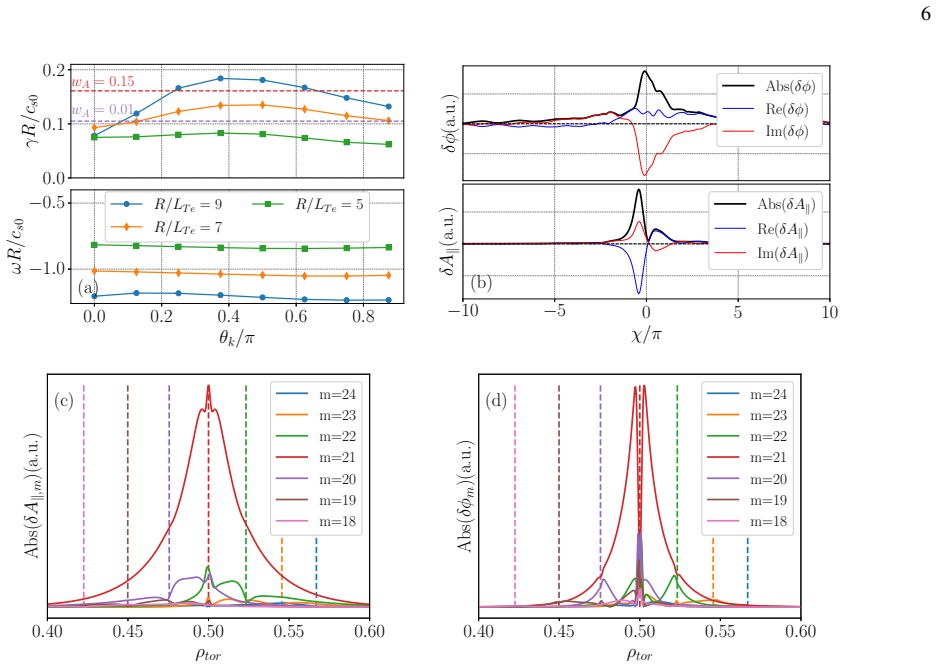
Micro-tearing modes in gyrokinetic simulations are controlled by the width Δc of their tearing current layer. When Δc is narrow, the mode is slab-like and localized at its mode rational surface, so local flux-tube and global simulations agree. In the pedestal, steep gradients broaden Δc to the profile scale, producing quantitative deviations for low-n modes; for high-n, Δc can exceed the separation Δm between rational surfaces, current layers overlap, toroidal coupling strengthens, and discrepancies become substantial. A separate finding: global simulations reveal a 'parity-mixing' micro-tearing mode — even and odd parity superposed, corresponding to finite ballooning angle θk — strongly des
What carries the argument
The central object is the tearing current layer width Δc, estimated as Δc/ρs0 ≈ (q/ŝ)(ω/(cs0/R))/(kyρs0)·√(me/mH), which for MTMs (ω≈ω*pe) becomes Δc/ρs0 ≈ (q/ŝ)√(me/mH)·(R/Lne + R/LTe). This width is compared with the pressure-gradient scale length and with the mode rational surface spacing Δm = 1/(ŝky) to predict when local and global results diverge. The second machinery is parity decomposition: even symmetry of δA∥ about the rational surface defines tearing/MTM parity, odd symmetry defines ballooning parity, and a numerical parity filter isolates each. The bounce-averaged trapped-electron response completes the picture: it cancels for odd-parity structures at θk=0 but becomes finite at n
Load-bearing premise
The paper's organizing criterion rests on the current-layer width estimate Δc/ρs0 = (q/ŝ)(ω/(cs0/R))/(kyρs0)√(me/mH), introduced without derivation; if this width scaling is wrong for steep-pedestal or high-n parameters, the claimed control by current-layer width loses its quantitative basis.
What would settle it
Measure Δc directly from the radial profile of the perturbed parallel current in a global simulation across a scan of pedestal cases with varying ŝ and R/LTe, and compare with Eq. (4). If local and global growth rates agree in a case where the formula says Δc exceeds Δm, the criterion fails. A cheap spot-check is a weak-shear pedestal case, where Eq. (4) predicts a wide layer but the simulation may not show local-global divergence.
If this is right
- In core plasmas with normal or weak shear, slab-like micro-tearing modes are localized to their rational surfaces, so local flux-tube simulations capture the linear instability accurately.
- In pedestal plasmas, the current layer widens to the profile scale; for low-n modes, the main cause of local-global deviation is radial variation of density and temperature gradients, not metric or boundary effects.
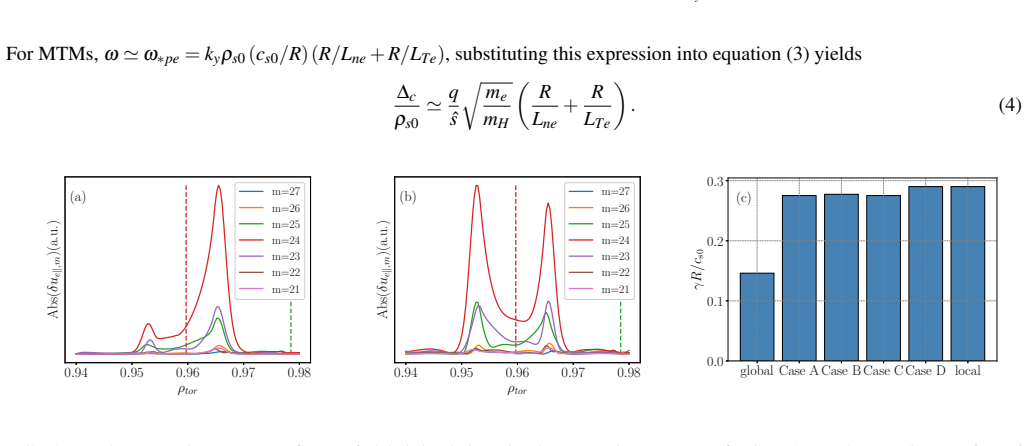
- For high-n pedestal modes, Δc can exceed the rational-surface spacing, so current layers overlap and toroidal coupling strengthens; each local assumption materially changes the growth rate, and apparent convergence with n is likely incidental.
- A finite-ballooning-angle micro-tearing mode with mixed parity is strongly destabilized by trapped electrons; zero-θk local simulations that omit this effect underestimate growth rates.
- A parity-based mode filter can robustly isolate tearing-parity from ballooning-parity modes when both are unstable, independent of initial condition.
- Local simulations that scan over ballooning angle are needed to capture the parity-mixing branch that global simulations naturally reveal.
Where Pith is reading between the lines
- The Δc formula could be used as a cheap pre-screening metric before running costly global simulations: evaluate Δc/ρs0 and compare with the local equilibrium scale and with Δm to decide whether flux-tube results are trustworthy.
- If current-layer overlap is the operative mechanism, nonlinear saturation and turbulent electron transport in the pedestal may also depend on whether current layers from adjacent rational surfaces couple, not just on the linear growth rate.
- Because the parity-mixing branch is driven by trapped electrons, it may blur the usual MTM/TEM distinction in experimental mode identification; diagnostics separating density and magnetic fluctuations could distinguish them.
- The width scaling's dependence on q/ŝ and √(me/mH) suggests the local-global criterion may transfer to other machines or tearing-parity electromagnetic instabilities, but this extension is not tested in the paper.
Editorial analysis
A structured set of objections, weighed in public.
Referee Report
Summary. The manuscript presents a systematic comparison of local (flux-tube) and global linear gyrokinetic GENE simulations of micro-tearing modes (MTMs) across core and pedestal plasmas. The central thesis is that the current-layer width Δc controls the importance of global effects: in the core, slab-like MTMs with narrow Δc yield local/global agreement; in the pedestal, steep gradients broaden Δc and drive quantitative deviations when Δc approaches the profile scale length; and for high toroidal mode numbers, current layers from adjacent mode rational surfaces overlap, enhancing toroidal coupling and producing substantial local/global discrepancies. In addition, the paper reports a distinct 'parity-mixing' MTM in global core simulations at high R/LTe, associated with finite ballooning angle θk and destabilized by trapped electrons. The authors validate a parity-filtering module in Appendix A and use a case-by-case decomposition of local assumptions in Figs. 10 and 13.
Significance. If the claims hold, the paper offers a useful organizing principle for when global gyrokinetic simulations are necessary for MTMs, distinguishing them from electrostatic drift-wave instabilities where radial envelope effects are generally more central. The parity-mixing/trapped-electron destabilization mechanism and the systematic isolation of local approximations via Cases A–D are valuable contributions. Strengths of the manuscript include the broad parameter coverage, the explicit validation of the numerical parity filter, and the careful case decomposition that separates profile-gradient, metric, and boundary-condition effects. However, the central quantitative criterion rests on a current-layer-width estimate that is stated without derivation or validation, which is a load-bearing issue for the paper's main claims.
major comments (3)
- [Section IV, Eq. (3)] The estimate Δc/ρs0 = (q/ŝ)(ω/(cs0/R))/(kyρs0)√(me/mH) is introduced as 'can be estimated by' with no derivation, citation, or order-unity coefficient. This is not a trivial rearrangement; it is a tearing-layer scaling that depends on the specific dissipation and collision model. The formula is then used to derive Eq. (4) and the overlap condition Eq. (5), so all three legs of the paper's organizing principle (core narrow, pedestal broad, high-n overlap) rely on this unvalidated expression. The manuscript does not compare Eq. (3) with the simulated current-layer widths shown qualitatively in Figs. 10–12. Please supply a derivation or reference, and preferably a direct numerical check of predicted versus measured Δc for the pedestal cases.
- [Section IV, Figs. 12–13] The claim that overlapping current layers cause the high-n local/global discrepancies is inferred from mode structure rather than directly tested. The case decomposition in Fig. 13 shows that each local assumption individually changes the growth rate with no clear trend as n varies, and the text concedes that the apparent convergence or divergence 'may be incidental'. This does not isolate the overlap mechanism from other profile, metric, or boundary effects. A more direct test—for example, varying Δm by changing ŝ or Lx while holding other profiles fixed, or artificially suppressing the coupling—would be needed to attribute the high-n discrepancies specifically to current-layer overlap. As written, this part of the central claim is underdetermined.
- [Section IV, Eq. (4)] The approximation ω ≃ ω*pe = kyρs0(cs0/R)(R/Lne + R/LTe) is used to convert Eq. (3) into Eq. (4) and then into the overlap threshold Eq. (5). The manuscript does not verify that the actual frequencies of the simulated pedestal modes (Fig. 9) match ω*pe. If the real frequency has a significant tearing-layer or collisional contribution, the numerical values of Δc and the threshold kyρs0 > O(0.1) would change. Please show a comparison of the simulated frequencies with ω*pe, or justify the approximation for the pedestal parameters.
minor comments (3)
- [Section IV, Eq. (5)] The displayed equation appears to have a formatting/typographical issue: from Eq. (4) and Δm = 1/(ŝky), the threshold should be kyρs0 > (1/q)√(mH/me) / (R/Lne + R/LTe). As printed, the factor (R/Lne + R/LTe) appears in the numerator, which is dimensionally inconsistent and would give the wrong threshold.
- [Section IV, Fig. 9 discussion] The text states that 'no finite θk destabilization is observed in the local simulations (data not shown here)'. Since this is a negative result that contrasts with the core findings, a supporting figure or quantitative statement (e.g., the range of θk scanned and the resulting growth-rate variation) should be included or the statement should be qualified.
- [Section II, boundary conditions] The description of the Krook operator at the boundaries would benefit from a brief statement of the damping strength or profile, as the results (especially for modes whose structures reach the boundaries, as in Fig. 12) may depend on this numerical choice.
Circularity Check
No circularity found: the Δc criterion and parity-mixing mechanism rest on independent scaling arguments, explicit equations, and direct simulations, not on their own conclusions.
full rationale
The paper's central claim is that the current-layer width Δc controls local-versus-global MTM behavior. This is not circular: Δc is estimated from Eq. (3), an independent tearing-layer scaling, and combined with the standard MTM frequency estimate ω ≈ ω*pe to produce Eq. (4); the overlap condition Eq. (5) follows arithmetically. No parameter in Eqs. (3)-(5) is fitted to the local/global discrepancies that Δc is used to explain—the functional dependencies come from the stated scaling and from equilibrium quantities (q, s-hat, gradients, mass ratio). The core, pedestal, and high-n classifications are supported by direct GENE simulations (Figs. 2-4, 9-13), not by the formula alone, and the paper explicitly checks progressive local assumptions in Cases A-D. The parity-mixing mechanism is derived from the written bounce-averaged drift-kinetic equation, Eqs. (1)-(2), and is corroborated by the parity-filter validation in Appendix A, local θk scans, and trapped-electron phase-space diagnostics; it is not merely imported from a citation. Some self-citations appear (e.g., refs. 15, 19, 41, 43), but they are not load-bearing: the relevant equations and simulation results are presented in this manuscript, and the cited theory is independently grounded. The weakest element is Eq. (3), which is asserted without derivation or citation and is not quantitatively validated against measured current-layer widths; this is an evidentiary or robustness concern, not a circular reduction. Therefore the derivation chain is self-contained with respect to circularity. Score 0.
Axiom & Free-Parameter Ledger
free parameters (1)
- w_A (profile gradient width parameter) =
scanned: 0.01, 0.05, 0.15
axioms (5)
- domain assumption The GENE code correctly solves the gyrokinetic Vlasov-Maxwell equations for MTMs in local and global configurations.
- domain assumption The local flux-tube approximation is valid when the radial width Lx is an integer multiple of Δm, profiles are held constant, and periodic boundary conditions are used.
- domain assumption Δc can be estimated by Eq. (3), the tearing-layer current-width scaling.
- domain assumption For MTMs, ω ≈ ω*pe = kyρs0 (cs0/R)(R/Lne + R/LTe).
- domain assumption Trapped electrons satisfy ω_b >> ω so the bounce-averaged equation Eq. (1) applies.
Cite this review
Pith. "Pith review of Linear Gyrokinetic Simulations of Micro-tearing Mode: Local versus Global." pith.science (2026). https://pith.science/paper/5ZCI6XRD
@misc{pith2026260715678,
  author       = {Pith},
  title        = {Pith review of: Linear Gyrokinetic Simulations of Micro-tearing Mode: Local versus Global},
  year         = {2026},
  howpublished = {\url{https://pith.science/paper/5ZCI6XRD}},
  note         = {Machine review of arXiv:2607.15678}
}
read the original abstract
A systematic comparison of local and global linear gyrokinetic simulations of micro-tearing modes (MTMs) is performed using the GENE code. The analysis spans diverse plasma parameters, including the core regions with normal and weak magnetic shear, as well as the pedestal region with the strong plasma non-uniformity. The global simulations reveal a distinct MTM type characterized by a `parity mixing' mode structure, which can be significantly destabilized by trapped electrons. Moreover, in contrast to electrostatic drift wave instabilities, the current layer width ($ \Delta _c $) is identified as the crucial factor determining the importance of global effects. The MTM in the core region exhibits the slab-like feature with narrow $ \Delta _c $, leading to high consistency between local and global results. However, in the pedestal region, the steep pressure gradient broadens $\Delta_c$, driving quantitative deviations when $\Delta_c$ becomes comparable to the plasma pressure gradient scale length. For high-$n$ MTMs, $ \Delta _c $ can exceed the distance between adjacent mode rational surfaces. The resulted overlapping of current layers enhances the toroidal mode coupling effect, accounting for the substantial discrepancies observed between local and global simulations.
Figures






Reference graph
Works this paper leans on
-
[1]
Rechester, A. B. and Rosenbluth, M. N. , title =. Physical Review Letters , year =
-
[2]
Applegate, D. J. and Roach, C. M. and Connor, J. W. and Cowley, S. C. and Dorland, W. and Hastie, R. J. and Joiner, N. , title =. Plasma Physics and Controlled Fusion , year =
-
[3]
Wong, K. L. and Kaye, S. and Mikkelsen, D. R. and Krommes, J. A. and Hill, K. and Bell, R. and LeBlanc, B. , title =. Physical Review Letters , year =
-
[4]
and Candy, J
Guttenfelder, W. and Candy, J. and Kaye, S. M. and Nevins, W. M. and Wang, E. and Bell, R. E. and Hammett, G. W. and LeBlanc, B. P. and Mikkelsen, D. R. and Yuh, H. , title =. Physical Review Letters , year =
-
[5]
and Jenko, F
Doerk, H. and Jenko, F. and Pueschel, M. J. and Hatch, D. R. , title =. Physical Review Letters , year =
-
[6]
and Chen, Yang and Wan, Weigang and Parker, Scott E
Chowdhury, J. and Chen, Yang and Wan, Weigang and Parker, Scott E. and Guttenfelder, W. and Canik, J. M. , title =. Physics of Plasmas , year =
-
[7]
and Watanabe, T.-H
Maeyama, S. and Watanabe, T.-H. and Ishizawa, A. , title =. Physical Review Letters , year =
-
[8]
and Holland, C
Jian, X. and Holland, C. and Candy, J. and Belli, E. and Chan, V. and Garofalo, A. M. and Ding, S. , title =. Physical Review Letters , year =
-
[9]
Pueschel, M. J. and Hatch, D. R. and Kotschenreuther, M. and Ishizawa, A. and Merlo, G. , title =. Nuclear Fusion , year =
-
[10]
and Dickinson, D
Giacomin, M. and Dickinson, D. and Kennedy, D. and Patel, B. S. and Roach, C. M. , title =. Plasma Physics and Controlled Fusion , year =
-
[11]
and Jenko, F
Doerk, H. and Jenko, F. and G. Gyrokinetic prediction of microtearing turbulence in standard tokamaks , journal =. 2012 , volume =
2012
-
[12]
and Waltz, R
Candy, J. and Waltz, R. E. and Dorland, W. , title =. Physics of Plasmas , year =
-
[13]
McMillan, B. F. and Lapillonne, X. and Brunner, S. and Villard, L. and Jolliet, S. and Bottino, A. and G. System. Physical Review Letters , year =
-
[14]
and Bottino, A
Villard, L. and Bottino, A. and Brunner, S. and Casati, A. and Chowdhury, J. and Dannert, T. and Ganesh, R. and Garbet, X. and G?rler, T. and Grandgirard, V. and Hatzky, R. and Idomura, Y. and Jenko, F. and Jolliet, S. and Aghdam, S. Khosh and Lapillonne, X. and Latu, G. and McMillan, B. F. and Merz, F. and Sarazin, Y. and Tran, T. M. and Vernay, T. , tit...
-
[15]
Physics of Plasmas , year =
Chen, Haotian and Chen, Liu , title =. Physics of Plasmas , year =
-
[16]
Hatch, D. R. and Kotschenreuther, M. and Mahajan, S. M. and Pueschel, M. J. and Michoski, C. and Merlo, G. and Hassan, E. and Field, A. R. and Frassinetti, L. and Giroud, C. and Hillesheim, J. C. and Maggi, C. F. and Thun, C. Perez von and Roach, C. M. and Saarelma, S. and Jarema, D. and Jenko, F. and Contributors, J. E. T. , title =. Nuclear Fusion , year =
-
[17]
Larakers, J. L. and Curie, M. and Hatch, D. R. and Hazeltine, R. D. and Mahajan, S. M. , title =. Physical Review Letters , year =
-
[18]
Hassan, Ehab and Hatch, D. R. and Halfmoon, M. R. and Curie, M. and Kotchenreuther, M. T. and Mahajan, S. M. and Merlo, G. and Groebner, R. J. and Nelson, A. O. and Diallo, A. , title =. Nuclear Fusion , year =
-
[19]
Frieman, E. A. and Chen, Liu , title =. Phys. Fluids , year =
-
[20]
Brizard, A. J. and Hahm, T. S. , title =. Rev. Mod. Phys. , year =
-
[21]
Communications Physics , year =
Chen, Haotian and Chen, Liu and Zonca, Fulvio and Li, Jiquan and Xu, Min , title =. Communications Physics , year =
-
[22]
and Hahm, T
Lin, Z. and Hahm, T. S. and Lee, W. W. and Tang, W. M. and White, R. B. , title =. Science , year =
-
[23]
, title =
Chen, Yang and Parker, Scott E. , title =. Journal of Computational Physics , year =
-
[24]
and Kishimoto, Y
Wang, W. and Kishimoto, Y. and Imadera, K. and Li, J. Q. and Wang, Z. X. , title =. Nucl. Fusion , year =
-
[25]
Beer, Michael Alan , title =
-
[26]
and Tang, W.M
Kotschenreuther, Mike and Rewoldt, G. and Tang, W.M. , title =. Computer Physics Communications , year =
-
[27]
Computer Physics Communications , year =
Jenko, Frank , title =. Computer Physics Communications , year =
-
[28]
and Waltz, R
Candy, J. and Waltz, R. E. , title =. J. Comput. Phys. , year =
-
[29]
The global version of the gyrokinetic turbulence code
G. The global version of the gyrokinetic turbulence code. Journal of Computational Physics , year =
-
[30]
Hatch, D. R. and Kotschenreuther, M. and Mahajan, S. and Valanju, P. and Jenko, F. and Told, D. and G. Microtearing turbulence limiting the. Nuclear Fusion , year =
-
[31]
Intercode comparison of gyrokinetic global electromagnetic modes , journal =
G. Intercode comparison of gyrokinetic global electromagnetic modes , journal =. 2016 , volume =
2016
-
[32]
Ajay, C. J. and McMillan, B. F. and Pueschel, M. J. , title =. Nuclear Fusion , year =
-
[33]
and Roach, C
Dickinson, D. and Roach, C. M. and Saarelma, S. and Scannell, R. and Kirk, A. and Wilson, H. R. , title =. Plasma Physics and Controlled Fusion , year =
-
[34]
Connor, John William and Hastie, R. J. and Taylor, John Bryan , title =. Proceedings of the Royal Society of London. A. Mathematical and Physical Sciences , year =
-
[35]
Dewar, R. L. , title =. Plasma Physics and Controlled Fusion , year =
-
[36]
Journal of Geophysical Research: Space Physics , year =
Chen, Liu and Hasegawa, Akira , title =. Journal of Geophysical Research: Space Physics , year =
-
[37]
Chen, Haotian , title =
-
[38]
Geophysical Research Letters , year =
Yao, Yao and Chen, Haotian and Li, Zilong and Li, Jiquan , title =. Geophysical Research Letters , year =
-
[39]
Nuclear Fusion , year =
Chen, Haotian and Chen, Wei , title =. Nuclear Fusion , year =
-
[40]
Plasma Physics and Controlled Fusion , year =
Chen, Hao-Tian and Chen, Liu , title =. Plasma Physics and Controlled Fusion , year =
-
[41]
Halfmoon, M. R. and Hatch, D. R. and Kotschenreuther, M. T. and Mahajan, S. M. and Nelson, A. O. and Kolemen, E. and Curie, M. and Diallo, A. and Groebner, R. J. and Hassan, E. and Belli, E. A. and Candy, J. , title =. Physics of Plasmas , year =
-
[42]
Curie, M. T. and Hatch, D. R. and Halfmoon, M. and Chen, J. and Brower, D. L. and Hassan, E. and Kotschenreuther, M. and Mahajan, S. M. and Groebner, R. J. and team, DIII-D. , title =. Nuclear Fusion , year =
-
[43]
and Jian, X
Chen, J. and Jian, X. and Brower, D. L. and Haskey, S. R. and Yan, Z. and Groebner, R. and Wang, H. Q. and Rhodes, T. L. and Laggner, F. and Ding, W. and Barada, K. and Banerjee, S. , title =. Nuclear Fusion , year =
-
[44]
and Chen, J
Jian, X. and Chen, J. and Holland, C. and Chan, V. S. and Zhang, X. R. and Yu, G. and Yan, Z. , title =. Plasma Physics and Controlled Fusion , year =
-
[45]
and Smith, S.P
Meneghini, O. and Smith, S.P. and Lao, L.L. and Izacard, O. and Ren, Q. and Park, J.M. and Candy, J. and Wang, Z. and Luna, C.J. and Izzo, V.A. and Grierson, B.A. and Snyder, P.B. and Holland, C. and Penna, J. and Lu, G. and Raum, P. and McCubbin, A. and Orlov, D.M. and Belli, E.A. and Ferraro, N.M. and Prater, R. and Osborne, T.H. and Turnbull, A.D. and ...
-
[46]
Curie, M. T. and Larakers, J. L. and Hatch, D. R. and Nelson, A. O. and Diallo, A. and Hassan, E. and Guttenfelder, W. and Halfmoon, M. and Kotschenreuther, M. and Hazeltine, R. D. and Mahajan, S. M. and Groebner, R. J. and Chen, J. and Perez von Thun, C. and Frassinetti, L. and Saarelma, S. and Giroud, C. and Tennery, M. M. , title =. Physics of Plasmas , year =
-
[47]
and Guttenfelder, W
Dominski, J. and Guttenfelder, W. and Hatch, D. and Goerler, T. and Jenko, F. and Munaretto, S. and Kaye, S. , title =. Physics of Plasmas , year =
-
[48]
Connor, J. W. and Cowley, S. C. and Hastie, R. J. , journal =. Micro-tearing stability in. 1990 , issn =
1990
This paper was first reviewed by deepseek-v4-flash on August 1, 2026.
discussion (0)
Sign in with ORCID, Apple, or X to comment. Anyone can read and Pith papers without signing in.